The Dry Dirt Beneath Their Feet: A Novel of Ownership, Margin, and the Iron Law of the Soil
CHAPTER 1: THE LANDING AND THE DUST
The jet lag was a physical weight behind my eyes, a dry sand that Dubai had left in my tear ducts and the delta flight hadn’t washed away. The morning air on Lake View Drive smelled of damp cedar and stagnant creek water, the heavy, unhurried breath of the South in early spring. I had the windows of the rental truck down, letting the cool draft wake me. I was thinking of thirty-six hours of uninterrupted sleep. I was thinking of the stone-paved terrace I’d spent three summers grading by hand.
Then I rounded the final bend where the old-growth oaks usually screened the water.
My foot didn’t hit the brake; it simply stopped pressing the gas. The truck drifted, its tires crunching onto the gravel shoulder with a slow, grinding crawl.
Where the gray stone chimney of the guest wing should have caught the first orange slant of the eastern sun, there was only empty space. A wide, raw gap of yellow sky.
I killed the engine. The silence that followed was instant, thick, and broken only by the rhythmic, plastic slap of orange construction fencing caught in the lake breeze. I climbed out, the gravel shifting under my boots with the dry, metallic rattle of rusted iron.
The main house was still there, but its eastern flank had been torn open like soft bread. Splintered oak joists hung down like broken ribs, their white inner grain exposed to the damp morning mist. Copper plumbing lines had been pinched shut and twisted, gleaming like dull red veins in the rubble. At the center of the clearing, where my hand-carved entry door had stood, a yellow sheet of paper was stapled to a surviving piece of lintel. It fluttered against the wood.
I walked through the gap in the plastic fence. My boot heel came down on a shard of blue-glazed Portuguese tile, crushing it into a fine, pale powder against the concrete slab.
I didn’t yell. I didn’t reach for my phone. I simply walked up to the yellow paper, my fingers tracing the cold, rough edge of the wood before I read the ink.
Delinquent dues. Eight months. Authorized demolition. Karen Hollis, President.
The ink was slightly smeared from the night’s dew. Below her signature, the stamp of the Lake View Heights Homeowners Association was pressed into the paper, its circular border slightly crooked.
I reached down and picked up a rusted surveyor’s brass tag from the dirt near my heel—an old marker, stamped 1962-S-09. It was cool, heavy, and completely out of place in the fresh tread-marks of a commercial excavator.
I turned back to the lake. The water was gray, flat as sheet metal, reflecting nothing but the ruined frame of the house and the empty sky. My dues had been on an automatic corporate draw since the day I signed the master deed. Karen hadn’t looked at the ledger. She hadn’t looked at the county registry. She had only looked at an empty driveway and decided she had the right to clear the view.
I took the blue tile shard from my pocket, turning its sharp edge against my thumb until the pressure registered.
“Richard,” I said when the line connected on the third ring. My voice didn’t have any heat in it. It was as flat as the lake. “Get your coat. You need to see what they did to the dirt.”
CHAPTER 2: THE VALUATION OF RUIN
The line went quiet after my voice cut through the static, the dead air between Nashville and Richard Cole’s downtown office carrying only the faint hum of a high-altitude connection. On my end, the silence of the lake was absolute, save for the persistent, dry flutter of that yellow paper notice against the splintered pine. I didn’t drop my hand. I kept the phone pressed hard against my ear, my eyes fixed on the heavy, yellow crawler tracks that had chewed the damp turf into a soup of red clay and crushed gravel.
“Richard,” I repeated, my voice dropping into a register that was more bone than breath. “Did you copy?”
“I copy,” Richard’s voice finally came through, stripped of its usual professional warmth. It was dry, thin, and flat—the sound of an actuary looking at a collapsed bridge. “Don’t touch the notice. Don’t touch the yellow tape. Don’t speak to anyone who looks like they have a clipboard. I’m leaving the office now. It’s a forty-minute drive if I take the old toll road. Stay on the dirt.”
The call ended with a sharp, mechanical click. I slid the phone back into my pocket, my thumb immediately finding the jagged edge of the blue-glazed Portuguese tile I had tucked into my palm. It was cold, the glaze slick against my skin, but the fractured backside was rough as sandpaper.
I didn’t pace. Pacing was a waste of calorie and momentum. Instead, I stood at the edge of what had been my dining room, looking at the exposed copper piping that stuck out of the foundation like severed arteries. The local contractors had been efficient; they’d used a heavy bucket, likely a thirty-ton excavator, to shear the guest wing cleanly from the main structure. They’d worked fast, probably under the cover of the previous day’s heavy rain when the sound of diesel engines would have been muffled by the downpour.
The smell of wet sheetrock and old insulation rose from the pile, a sour, chalky odor that mixed with the sharp scent of hydraulic fluid leaked from a faulty hose. It was the smell of small-town authority trying to make a point.
Forty-two minutes later, the low rumble of Richard’s sedan vibrated through the gravel. He didn’t park on the paved driveway; he pulled straight onto the grass, the tires of his heavy German car sinking three inches into the mud before he cut the ignition.
He climbed out slowly, his wool coat dark against the gray light of the lake. He was sixty-two, with a face that had been carved by forty years of chancery court filings and land disputes, but as his eyes took in the raw, open wound of the house, his jaw tightened. His gaze went from the splintered structural beams up to the gray sky, then down to the yellow notice still stapled to the doorframe.
“They used a municipal code stamp,” Richard said, walking toward me without greeting. He didn’t offer a hand. He just stopped two feet away, his breath misting in the cold air. “But this isn’t a municipal action. This is Karen.”
“She signed it,” I said, pointing a finger toward the paper. “HOA President. Authorized demolition under Chapter 4, section nine of their updated handbook. They called it an emergency nuisance clearance.”
Richard reached into his coat, pulled out a pair of thin leather driving gloves, and snapped them on with a dull thwack. He walked up to the notice, bent his head, but didn’t touch it. He studied the ink, his eyes tracing the signature.
“The handbook isn’t registered with the county,” Richard muttered, his voice barely louder than the lapping of the lake against the dock below. “They passed those amendments in a closed session last November while you were in Dubai. I warned their previous counsel, Garrett, that they were operating outside their corporate charter, but Karen replaced him with a strip-mall foreclosure lawyer three months ago.”
He turned back to face me, his back to the ruins. Behind him, the lake seemed to have turned a deeper shade of iron, the water flat and unmoving under the low cloud cover.
“They don’t have the coverage for this,” Richard said. It wasn’t an emotional statement; it was an assessment of mathematical limits. “The HOA has a standard liability rider of three hundred and eighty thousand dollars. This damage… the Portuguese tile alone, the custom ash cabinetry, the structural compromise to the main foundation… we’re looking at six million to restore the footprint. If they don’t have corporate indemnity, they are personally exposed.”
“They don’t have it,” I said. My hand was still in my pocket, my thumb pressing against the sharp point of the blue tile shard. “Look at the ground beneath your boots, Richard. Whose name is on the master title?”
Richard looked down. He shifted his weight, his leather sole grinding a piece of red brick into the clay. A faint, dry smile touched the corner of his mouth, though his eyes remained completely cold.
“Blackwood Capital Holdings,” he said softly. “The Blackwood Master Deed. 1962.”
“Exactly,” I said, stepping closer to the edge of the concrete slab. “Karen thinks she’s enforcing a neighborhood aesthetic. She doesn’t realize that under Covenant Section 14, any material breach of the ground lease by a tenant—or an organization operating under their direction—gives the landowner the immediate right to terminate the underlying dirt rights. She didn’t just tear down my guest wing.”
I looked out across the gray water toward the cluster of luxury homes lining the opposite ridge, their cedar siding and glass walls reflecting the dull morning light.
“She just gave me the legal right to foreclose on her lawn,” I said.
Richard took a slow, deep breath, the damp air rattling in his throat. He looked at the wreckage, then back to me, the calculation complete in his head. “Let’s go find their new attorney. We’ll start with the deed.”
CHAPTER 3: THE BOARDROOM TABLE
The passenger door of Richard’s sedan closed with a heavy, metallic thud that cut off the damp sigh of the lake wind. Beneath the floorboards, the transmission engaged with a dull clunk, and the rear tires spun once in the red clay, throwing wet earth against the rusted inner fender wells before the rubber found the hard gravel of the road. Richard didn’t speak. He gripped the steering wheel, his gloved fingers leaving faint, dark impressions on the worn leather wrap.
In the back seat, resting between a stack of manila folders and a spare tire iron, lay the ledger we had pulled from the county archives—the original logbook of The 1962 Syndicate. It smelled of vinegar and rotting glue, a physical anchor to the men who had mapped these coordinates before the lake was even flooded.
The heater core in the dashboard hummed, spitting out a dry, hot draft that smelled of scorched dust and old coolant. As the heat hit my face, a sudden memory cut through the fog of my jet lag: the summer of 2019, sitting in a windowless room in the basement of the probate court, grease from a cheap ham sandwich staining my fingers as I first turned the pages of the Blackwood Master Deed. I remembered the dry, paper-thin whisper of those sheets. The original syndicate hadn’t built this community for the families; they had built it as a slow-motion trap, keeping the dirt so they could squeeze the structures when the market turned. Karen Hollis thought she was a pioneer of civic order, but she was just the latest tenant walking into the teeth of an old machine.
We turned off Lake View Drive and onto the state highway, the tires singing a high, wet note against the asphalt.
“I called Garrett’s office while you were inspecting the foundation,” Richard said, his eyes fixed on the gray line of the road ahead. He didn’t turn his head. “He’s at the community annex. Karen called an emergency meeting of the executive committee to ratify the nuisance declaration post-facto. They think they’re sealing the file.”
“They’re sealing their own casket,” I said. My hand was still inside my pocket, my fingers tracing the jagged corner of the Portuguese tile. The friction of the stone was reassuring, a small piece of the house that had survived the steel teeth of the excavator. “Does Garrett know we’re coming?”
“Garrett knows I don’t bluff,” Richard replied. “He’ll have the doors unlocked.”
Three miles north, the community annex sat on a rise overlooking the marina, its cedar-shingled facade bleached to a dull silver by decades of lake humidity. Rain was beginning to fall again, a fine, cold mist that turned the gravel parking lot into a slick slate surface. Richard parked near the back entrance, right next to Karen’s white luxury SUV. The chrome on her tailpipes was immaculate, untouched by the rust that ate at every other vehicle that spent its life near the water.
We walked up the concrete steps, our boots leaving dark, wet prints on the gray paint. The door handle was cold, the return spring inside the brass mechanism grinding with a dry, iron scrape as I pushed it open.
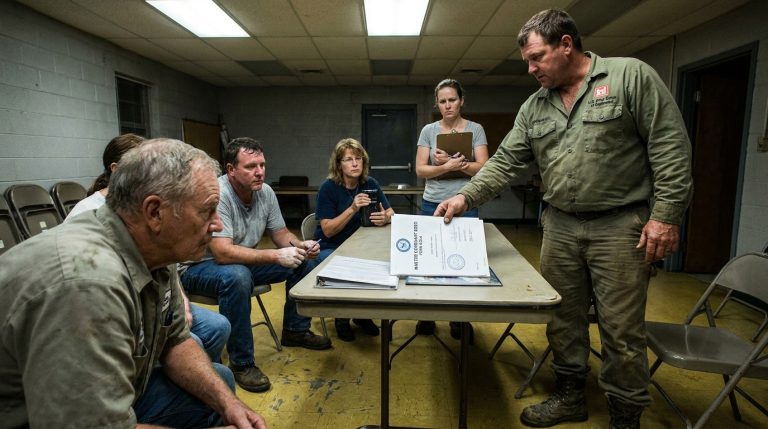
The conference room inside smelled of lemon wax and stale drip coffee. Eight people sat around a long, veneered table that had been polished until it reflected the fluorescent tubes overhead. At the far end sat Karen Hollis, her posture straight as an iron spike, her fingers resting on a pristine blue folder. Beside her was Philip Garrett, his tie slightly askew, his reading glasses slid halfway down his nose as he turned pages in a copy of the neighborhood charter.
The silence that fell when we entered was not sudden; it was a slow, heavy settling, like dust falling in an abandoned barn.
“This is a closed executive session,” Karen said. Her voice was thin, sharp, and perfectly metered, the sound of a person who spent her life managing small margins of social capital. “We are reviewing municipal code compliance. You have no standing to speak here.”
Richard didn’t answer her. He walked to the center of the table, unbuttoned his wool coat, and pulled the yellowed copy of the Blackwood Master Deed from his briefcase. He dropped it onto the wood. The heavy paper hit the veneer with a solid, flat slap that made Karen’s blue folder slide an inch to the left.
“Under Covenant Section 14, Paragraph 3,” Richard said, his voice dropping into the quiet, rhythmic tone of a man reading a death warrant, “the master deed holder has the immediate right to inspect any corporate action taken by the leaseholder association that results in the alteration of the underlying land. You didn’t just clear a nuisance, Karen. You altered the dirt.”
Garrett looked up from his papers. His eyes drifted from Richard’s face down to the ledger on the table, and for the first time, the polished confidence in his expression began to fray at the edges. His fingers twitched against his pen.
“We have the authority to clear abandoned properties,” Karen said, her voice rising half an octave, though her hands remained flat on her folder. “The dues were delinquent. The structure was unsecured.”
“My client’s dues were paid from a Blackwood Capital corporate account,” I said, leaning forward to place both hands on the cool wood of the table. I felt the dry grain of the veneer under my palms, the physical artificiality of the room. “You didn’t check the ledger because you didn’t want to see it. You wanted the sky where my chimney was. But you forgot to look at what was holding the chimney up.”
I turned my head toward Garrett. “Show her the deed, Philip. Read her the clause about the dirt.”
CHAPTER 4: THE LAW OF THE DIRT
Philip Garrett did not look up immediately. His hand, weathered by years of signing off on easements and minor zoning variances, remained suspended over the yellowed page. The tip of his fountain pen hovered bare millimeters above the text, a single drop of dark ink forming on the nib but refusing to fall.
Across the veneer table, Karen Hollis didn’t move. Her breathing was shallow, a tiny, rapid flutter at the base of her throat that was the only indicator she hadn’t turned to stone.
“Read it, Philip,” Karen said, her voice dropping its sharp edge, replaced by a thin, reedy strain. “Tell them they’re misinterpreting the bylaws.”
Garrett’s finger finally touched the paper, tracing the faded typewriter print of Covenant Section 14. His mouth opened, closed, and then he let out a long, slow exhalation that smelled of cold coffee. “The bylaws don’t apply here, Karen. They never did. The homeowners association is a tenant of the ground. When you authorized the backhoe to cross the property line to demolish the guest wing, you did so as an agent of the leaseholder. Under the 1962 terms… any willful damage to the ground lesser’s estate is a non-curable default.”
He looked up, his eyes wide behind his thick lenses, staring not at me, but at the empty space between us. “The lease is terminated. Or rather, it can be, at the landowner’s discretion. Which means every structure sitting on this dirt is technically in trespass.”
“That’s absurd,” Karen hissed, her knuckles turning white as she gripped the edges of her blue folder. “We have a three-million-dollar umbrella policy. The board is protected from personal liability under the association’s indemnity clause. We followed standard nuisance abatement protocols.”
Richard Cole leaned forward, his wool sleeve dragging across the polished wood of the table. He didn’t look at Karen. He kept his eyes locked on Garrett. “Philip, did you review the exclusions in the Mutual Assurance policy you renewed in January?”
Garrett’s hand trembled slightly. He slowly closed the ledger, the old spine groaning under the pressure. “The willful destruction of third-party real property… on unleased parcels…” He didn’t finish the sentence. He didn’t have to.
The decoy secret—the shield they thought would save them—had just shattered. The corporate indemnity policy had a hard exclusion. The board members were standing on the ice alone, stripped of their corporate armor, personally liable for every splinter of oak and portuguese tile currently rotting in my yard.
“We need to go to court,” Garrett said softly, his voice hollow. “We need a judge to stay the termination.”
We didn’t wait for them to adjourn. Richard picked up his briefcase, his leather gloves snapping against the brass clasps with a clean, sharp sound. I turned my back on the room, my boots squeaking against the polished linoleum of the annex floor as we walked out into the cold rain.
The transition from that stale room to the Davidson County courthouse was a physical grind of paperwork and miles. We didn’t jump time; we lived every minute of the forty-seven-day legal siege that followed. It was a sequence of cold mornings spent in Richard’s office, the radiator clanking behind his desk as we drafted the summons, followed by the physical delivery of the papers to the county clerk’s window on 2nd Avenue. I watched the clerk’s heavy metal stamp come down on the blue backing of the lawsuit—April 3rd—the ink wet and purple in the dim fluorescent light.
Now, on the morning of the hearing, we sat in the third row of Judge Warren Holloway’s courtroom. The room was high-ceilinged, smelling of beeswax, old wool coats, and the dry, metallic heat of cast-iron radiators.
Judge Holloway sat behind his elevated mahogany bench, his eyes fixed on the thick binder of the Blackwood Master Deed. He was a man who didn’t use a gavel; he used his silence. He turned a page, the dry rustle of the paper echoing off the tall windows that looked out over the gray Cumberland River.
Karen Hollis sat at the defense table, her hair pulled back so tightly her skin looked stretched over her cheekbones. Her new attorney, a bankruptcy specialist from Nashville, was adjusting a stack of legal pads, his fingers tapping a nervous, erratic rhythm against the yellow paper.
“Mr. Garrett,” Judge Holloway said, his voice deep and unhurried, cutting through the low hum of the courtroom’s ceiling fan. “I’ve read your brief on community standards and the implied consent of abandoned properties. But I am looking at a deed from 1962 that has been recorded in this county for over sixty years. Tell me how an HOA bylaw, passed by a local board in a closed room, overrides a foundational land covenant.”
Garrett stood up slowly. His suit looked too large for him now, his shoulders slumping under the weight of the lights. “Your Honor, the board acted in good faith to preserve the aesthetic value of the surrounding properties. The main house appeared—”
“Good faith,” Holloway interrupted, his voice dropping into a quiet, dangerous register, “does not give you the right to bring a thirty-ton excavator onto land you do not own to destroy a three-point-eight-million-dollar structure. The contract is clear. The soil belongs to Blackwood Capital. The breach is material.”
He closed the binder with a solid, echoing thud that sounded like a dry branch snapping in the woods.
“I am granting the plaintiff’s motion for immediate summary judgment on the issue of liability,” Holloway said, his eyes coming down to rest directly on Karen. “We will convene tomorrow morning to determine the exact scope of the damages. But let me be entirely clear: the dirt under your houses is no longer your shield.”
CHAPTER 5: THE TERMINATION NOTICE
The oak-and-brass doors of Judge Holloway’s courtroom hissed shut behind us with a heavy, pressurized sigh. The vibration traveled up through the soles of my boots, a quiet confirmation that the gavel had fallen and the dirt had held. On the wet steps of the courthouse, the gray Nashville afternoon was dissolving into a cold, driving downpour that turned the limestone columns slick and dark.
Richard didn’t slow down. He pulled his collar up against the wind, his leather briefcase held close to his ribs like a shield. “The summary judgment is only the anchor,” he said, his voice flat as we reached the bottom of the steps where the rain was starting to pool. “Now we drop the net. We don’t wait for her to appeal the damages ruling. We serve the formal thirty-day termination of the ground lease to her mortgage holder before the county clerk’s office closes its drawers.”
We didn’t skip a second. We climbed back into the sedan, the smell of wet wool and engine heat filling the cabin as Richard navigated the slick streets toward the banking district. Every block was a slow, deliberate grind through the afternoon traffic, the windshield wipers scraping a rhythmic, dry screech against the glass.
By 4:15 p.m., we were standing in the basement archives of the First Federal of Tennessee branch, where the damp smell of old cardboard storage boxes filled the narrow corridors. The air-conditioning unit hummed a high, vibrating note that suddenly died as a jagged spike of lightning hit the transformer block three streets over. For five seconds, the room went entirely black, save for the emergency exit signs glowing like small, red wounds in the dark.
With a low, mechanical cough, the building’s auxiliary diesel generator kicked in. The lights flickered back to life, dim and amber-tinged, casting long, distorted shadows across the rows of rusted steel filing cabinets.
The branch manager, a tired-looking man named Robert Vance whose cuffs were frayed at the edges, looked up from his desk. He wasn’t using his desktop monitor; the power surge had locked his terminal, and he had been forced to drag out a thick, leather-bound manual registry to look up the portfolio details for the Lake View Heights properties.
“We received the court’s summary judgment about twenty minutes ago via the courier,” Vance said, his fingers tracing a line of handwritten ledger entries. He didn’t look at me; his eyes were fixed on the columns of numbers. “Without a valid ground lease, her structure at 142 Lake View Drive has no underlying land rights. Our underwriting guidelines are very specific. A residential structure sitting on land it has no right to occupy is a non-performing asset. It’s appraised at scrap salvage value.”
He took a slow, deliberate breath, his pen hovering over a formal red stamp. “We’re calling the loan. All four hundred and twelve thousand dollars of it. Due in thirty days.”
“She’ll try to file for retaliation in the bankruptcy court to stay the foreclosure,” Richard said evenly, his hand resting on the cold steel of Vance’s desk.
“She can try,” Vance replied, his voice carrying the dry, unbothered tone of a man who worked for the system, not the people in it. “But the bankruptcy trustee has to respect the property boundaries. If Judge Holloway has already ruled that the lease is terminated due to material breach of Covenant Section 14, the bankruptcy court cannot manufacture land rights that no longer exist. She’s sitting on your dirt, Mr. Blackwood.”
He brought the heavy stamp down onto the file with a solid, echoing thwack that rattled the dry paper clips in their metal dish.
I reached into my pocket, my fingers brushing against the cold, jagged edge of the blue-glazed tile shard. The sharp corner bit into my skin, a physical reminder of the boundary that had been crossed and the slow, inevitable weight of the law grinding Karen’s world into dust. She had spent years believing that a title was just a piece of paper you could ignore if the grass was cut. She was about to find out that when you lose the dirt, the walls have nothing left to hold them up.
We left the bank as the rain began to turn the streets into running gray creeks, our boots heavy and wet as we walked back to the car to prepare the next phase of the foreclosure.
CHAPTER 6: THE SALVAGE SALE
The heavy door of the sedan slammed shut against the downpour, sealing us inside a cabin thick with the smell of wet overcoats and the sharp, hot musk of the heater vents fighting the chill. Richard didn’t let the engine idle. He threw the car into drive, the transmission clunking as we pulled away from the curb of First Federal of Tennessee. The water on the street had risen to the hubcaps, spraying in wide, gray sheets against the concrete retaining walls as we traveled the seven miles back toward the lake.
“The bank’s demand letter went out by certified courier five minutes ago,” Richard said, his gloved hand resting steady on the wheel as the windshield wipers whipped back and forth. “By tomorrow morning, the other five board members will receive their personal joinder notices. When they realize Karen’s signature on that demolition order didn’t protect them from the indemnity exclusion, they’ll start looking for exit ramps.”
“They won’t find any,” I muttered.
I turned my head to look out the side window. The rain-streaked glass blurred the passing pine trees into a dark, continuous smudge. My hand was deep in my pocket, my fingers working the smooth, cold face of the Portuguese tile shard. We were entering the narrow neck of the peninsula now. The road was slick, littered with torn pine branches and pooling yellow mud from the construction runoff.
As we cleared the tree line of Lake View Drive, the yellow flashing lights of a flatbed truck cut through the gray mist.
It wasn’t a county vehicle. It was a privately owned commercial carrier, its side panels stenciled with the faded white lettering of a local salvage operator. It was parked crookedly across the asphalt outside Karen’s driveway, the diesel engine idling with a heavy, rhythmic rattle that vibrated through the floorboards of our car.
Richard slowed the sedan to a crawl, the tires crunching over a scatter of wet gravel.
Through the rain, I watched two men in yellow oilskins drag a heavy, mud-splattered canvas tarp across Karen’s front lawn. The lawn was no longer pristine. The heavy truck tires had gouged deep, red trenches through the Bermuda grass, exposing the raw, rocky clay beneath.
Karen Hollis stood on her porch. She wasn’t wearing her polished committee blazer. She wore a thin, dark raincoat, her hands shoved deep into her pockets as she watched a third worker load a pair of heavy brass porch lanterns into the back of the flatbed. Her posture was stooped, her shoulders drawn inward as if she were trying to occupy as little of the damp air as possible.
She didn’t look at our car as we stopped at the edge of the asphalt. Her eyes were fixed on the front door of her house—a structural shell that was now appraised at eighty-seven thousand dollars salvage value, stripped of the land rights that gave it worth.
“She’s selling the architectural hardware,” Richard observed quietly, cutting the ignition. The engine’s death left only the heavy, wet rattle of the contractor’s diesel. “The solid oak interior doors, the copper flashing, the slate hearth. The demolition contractor bought the physical carcass for the raw materials. He’ll have the roof off by Friday.”
I opened my door, stepping down into three inches of cold, muddy water. The rain pelted my face, smelling of iron and dead pine needles. I walked toward the edge of her driveway, my boots sinking into the red clay.
“Karen,” I said. My voice wasn’t loud, but it cut through the diesel idle.
She flinched, her head turning slowly. Her face looked dry, the skin around her eyes dark and hollow in the gray light. For a second, her jaw tightened, her fingers clenching inside her pockets.
“You didn’t have to do this,” she said, her voice shaking slightly under the cold draft from the lake. “The board made a collective decision. We had a report.”
“You had a piece of paper you wrote yourself,” I said, stopping at the edge of her grass. “You thought the authority stopped at the dirt line. It didn’t.”
Before she could answer, a second car—a rusted blue pickup—pulled up behind the flatbed. Robert Marsh, the board member who had voted against the demolition from the beginning, climbed out. He didn’t have an umbrella. He walked past Karen’s porch without looking at her, his eyes fixed entirely on me. His face was weathered, his hands rough from forty years of maintaining his own dock.
“The other four are signing the settlement agreements,” Marsh said, his voice carrying the dry, hard gravel of the shoreline. “We just got the notices from First Federal. They aren’t going to fight the personal liability. They’re paying the eighty-five thousand each.”
He looked at the flatbed truck, then down at the raw red trenches in Karen’s lawn.
“If we’d understood the 1962 terms better five years ago,” Marsh muttered, his fingers twitching against his belt, “none of this would have started.”
“The contract was always there, Robert,” I said, my hand closing tight around the tile shard in my pocket. “You just had to read the ground.”
CHAPTER 7: THE 47DAY PEACE
Robert Marsh’s boots remained sunk deep in the churned red clay of Karen’s ruined yard, his weathered face wet with the cold, persistent drizzle. I turned from him, my own boots dragging through the heavy mud as I walked back toward the gravel line of the road. The flatbed truck’s engine sputtered, a thick puff of black diesel smoke rising into the damp cedar trees as the salvage operator began his slow descent from the ridge. Behind us, Karen Hollis retreated inside her stripped-down home, the door clicking shut with a hollow, dead sound that signaled the end of her local reign.
“The wind is shifting,” Richard Cole said as I reached the passenger side of the sedan. He didn’t look at the house; he was already adjusting a fresh set of legal briefs on his lap. “The storm is rolling off the ridge. The transition is over. Now we build.”
We didn’t skip a beat. We didn’t teleport. We drove the length of the peninsula, watching the rain slacken and the gray sky lift, revealing the cold, green-blue water of the reservoir.
Over the forty-seven days that followed, that drive became my daily labor. Every morning began with the physical reality of the site: the smell of wet earth, the squeak of dry hinges as I opened the doors of the temporary community center, and the quiet, tense arrivals of the remaining homeowners. They came in small groups, their coats smelling of damp wool, their hands holding copies of the proposed lease modifications we drafted in real-time.
We gathered around a heavy, solid oak table in the annex, the very room where Karen had tried to seal her closed-door vote. The lemon wax was gone, replaced by the dry, chalky smell of blueprint paper and the clean scent of freshly cut yellow pine from my rising east wing.
“This isn’t about clearing the view anymore,” Robert Marsh said during the eleventh day of negotiations, his rough finger tracing the bold ink of the new lease contract. He sat across from me, his shoulders relaxed but his gaze unyielding. “It’s about knowing where the borders are. We need to make sure no future board can write their own rules in the dark.”
“The rules are in the dirt, Robert,” I replied, my voice steady, my palm resting flat on the cool wood. Underneath my fingers lay the draft of the new agreement. “A ninety-nine-year renewable term. Explicit limits on HOA authority. Annual meetings where the landowner is present to sign off on any structural alterations. We eliminate the ambiguity.”
I watched him read. The draft wasn’t a corporate shield; it was a contract of mutual survival.
Through the tall glass windows of the annex, the lake was starting to clear, the sun finally breaking through the autumn haze to strike the water like a sheet of clean tin. Across the cove, the crane at my house was already in motion, its long iron arm swinging a heavy bundle of timber into the blue sky. The structural framework of my new thirty-two-hundred-square-foot wing was taking shape, its skeletal outline clean and balanced against the natural drop of the land.
Near the end of the thirty-fifth day, Robert Marsh looked up from the final page of the covenant. The lines around his eyes were deep, but the tension had left his jaw. He picked up a heavy brass fountain pen, dipped the nib, and pressed his signature to the parchment right beside the red seal of Blackwood Capital Holdings.
“It’s a fair lease,” Marsh said, his voice dropping into a quiet murmur that was swallowed by the hum of the heater. “We should have done this five years ago.”
I reached into my pocket, my thumb running over the smooth glaze of the Portuguese tile shard. It was warm now, heated by the friction of my skin. I didn’t say anything. I simply nodded, watching the ink dry on the page under the bright light of the morning sun.