The Legacy on the Water: A Hard-Earned Lesson in Boundaries and Family Shadows
CHAPTER 1: THE KITCHEN COUNTER AMBUSH
Three weeks of cleaning, scrubbing tiles, and stocking pantry shelves meant nothing the moment Lydia set her porcelain mug onto the granite counter without making a sound.
The oak kitchen in my father’s house smelled the same as it had ten years ago—lemon polish mixed with old coffee grounds. I sat in the high-backed stool, holding my aunt’s heavy brass key ring. The worn brass felt cool against my palm as I thumbed the smooth notch on the master key.
“I finished the menu list,” I said, sliding the notepad across the island. “We can do the salmon on Friday night. Dad said he missed the way Aunt Margaret used to grill it.”
My father didn’t look up from his phone. His thumb moved rhythmically across the glass, his shoulders hunched inside a faded cardigan that hung slightly loose on his frame.
Lydia didn’t touch the notepad. She smoothed the front of her pressed linen shirt, her knuckles pale against the fabric.
“Clara,” Lydia said. Her voice lacked its usual high, theatrical pitch. It was flat, measured, and stripped of polish. “You need to listen to me carefully. You won’t be coming to the lake house this week.”
The brass key ring stopped moving in my hand. The quiet in the room hit like a sudden drop in air pressure.
“The groceries are already in the trunk of my car,” I said, keeping my voice level. “I spent four hours at the wholesaler yesterday.”
“We’ve discussed it,” Lydia continued, ignoring the notepad entirely. “This trip is for family. The girls, their fiancés, your father, and me. Adding another person creates an awkward dynamic when we’re trying to integrate Aaron and Joel into the core unit.”
I turned my head toward my father. “Dad?”
He shifted in his chair. His gaze remained locked on the phone screen, his fingers twitching slightly against the plastic casing before he dropped both hands into his lap. He cleared his throat, the sound dry and thin.
“It’s just… it’s a tight squeeze, Clara,” he muttered to his hands. “Lydia thinks it’s best if we have space to get to know the boys.”
“It’s a four-bedroom house,” I said. “I inherited it two years ago. I cleaned every mattress in that building last weekend.”
“And we appreciate the preparation,” Lydia said, her tone snapping back to a sharp, dismissive efficiency. She reached out and tapped the brass keys resting near my knuckles. “Leave the spare set on the counter. We’re leaving early Thursday morning to beat the highway traffic.”
The edge of the brass ring bit into the palm of my hand as I squeezed my fist shut around it. I stood up from the stool, the wooden legs scraping harsh against the linoleum floor. Neither of them flinched.
“Enjoy the drive,” I said.
I turned and walked out the front door, the heavy brass ring locked tight in my grip.
CHAPTER 2: THE SILENT RECLAMATION
Standing beside my idling sedan in the gravel driveway, my thumb traced the cold, sharp teeth of Aunt Margaret’s brass key.
The six-hour drive up to the lake had cleared the fog from my head, leaving only a hard, quiet heat behind my ribs. I turned off the ignition and stepped out onto the gravel. The smell of damp pine needles and open water hit me instantly, unchanged from the summers when Mom was still alive.
I walked up the porch steps, the cedar boards creaking under my boots. The key turned smoothly in the lock—the same original lock Aunt Margaret had installed thirty years ago. I opened the door, stepped inside, and dropped my heavy canvas tote bag onto the entryway bench.
My first stop wasn’t the kitchen or the master bedroom. I walked straight to the small den near the back hallway, opened the top drawer of the mahogany desk, and pulled out the thick leather binder containing the original deed and Aunt Margaret’s probated will.
I took the legal papers, along with my utility bills from the last two years, and laid them neatly in the center of the kitchen island.
Then I called Layla.
“The house is empty,” I said the second she picked up. “How fast can you and the guys get up here?”
“We’re already packing the cooler,” Layla said, her voice crackling over the speaker. “Reed’s grabbing two cases of beer and Jenna’s bringing the grill gear. Are you sure you’re okay with us turning this into a full house?”
“I don’t want a single empty bed in this building by Thursday morning,” I said, looking out through the sliding glass doors toward the dock. “Bring extra lawn chairs for the porch, too.”
I spent the next forty-eight hours setting the stage without touching a single screw on the doorframes. I didn’t need new deadbolts. The law was written on paper, and the property was registered in my name alone.
By Wednesday evening, the quiet cabin was full of life. Layla, Reed, Jenna, Tommy, Sharon, and Mike had spread their gear across every guest room. The driveway was packed with four vehicles, parked in a tight, deliberate line that blocked off the main turning apron.
We spent Wednesday night sitting on the back deck, grilling steaks and listening to the water lap against the wooden pilings. It felt human. It felt like the home Aunt Margaret had wanted me to keep.
Thursday morning arrived with a thin layer of mist hanging over the lake. I woke up at six, brewed a large pot of dark roast coffee, and poured myself a mug.
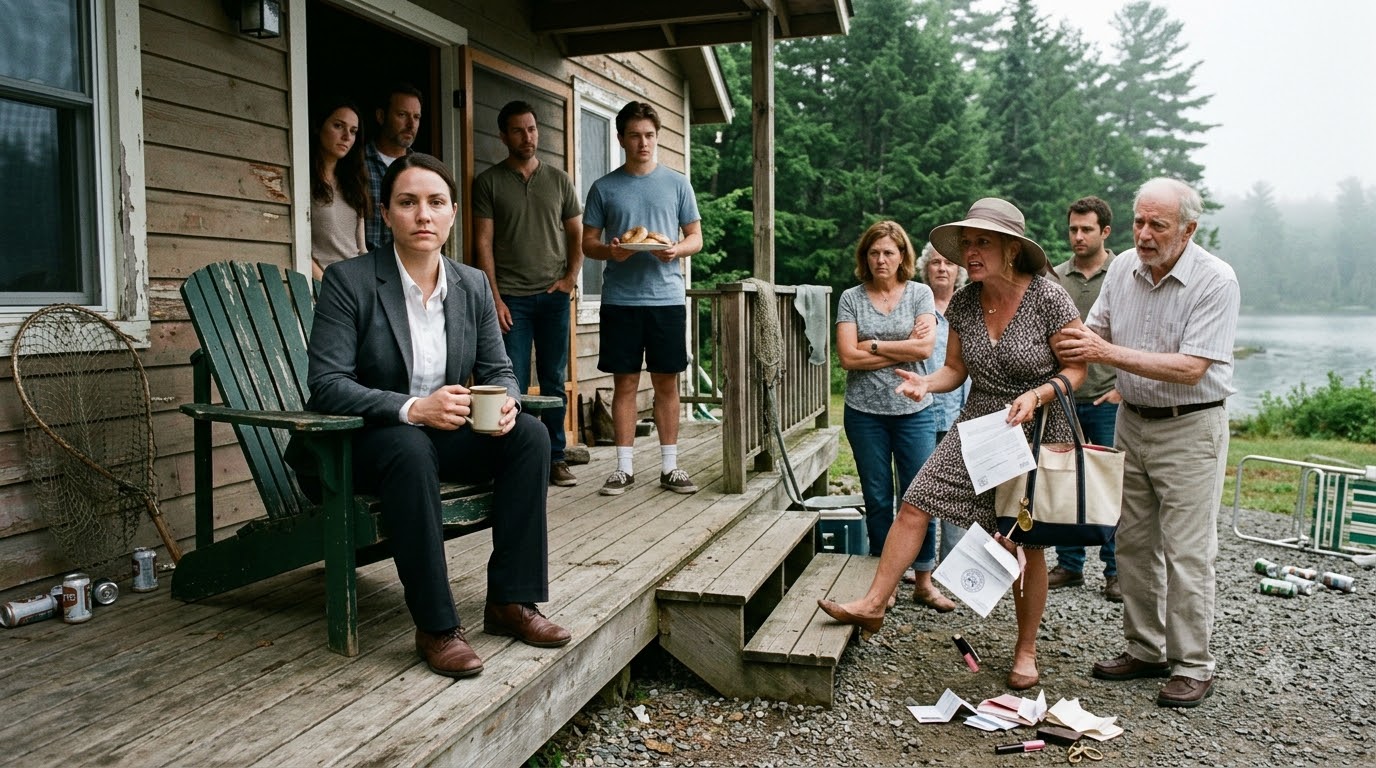
Instead of waiting inside, I dragged a heavy Adirondack chair to the top of the front porch steps. I sat down, wrapped both hands around the warm ceramic mug, and let the morning air settle over my skin.
At precisely eleven fifteen, the sound of tires crunching on gravel echoed through the treeline.
Three cars pulled into the driveway in single file: Dad’s gray sedan, Marcy’s red Honda, and a late-model blue SUV I didn’t recognize. They slowed down, their drivers clearly startled by the four unfamiliar vehicles already clogging the parking space.
The engines cut out one by one. The doors opened, and the noise of six people talking and laughing suddenly died in the humid air.
Lydia stepped out of the passenger side of Dad’s car, wearing a wide-brimmed sun hat and holding a tote bag. She took two steps toward the house, looked up, and froze when her eyes locked onto me sitting at the top of the steps.
Dad got out next, holding a large foam cooler by its plastic handles. He stopped dead in his tracks, his eyes darting from my face to the fleet of cars parked in front of the garage.
Lydia adjusted her sun hat, her lips pressing into a thin, white line as she marched straight toward the porch, key already drawn from her purse like a weapon.
“Clara,” she called out, her voice echoing off the trees. “What is the meaning of all these cars?”
I didn’t stand up. I took a slow sip of coffee and let the silence stretch until she reached the bottom step.
“Good morning, Lydia,” I said.
CHAPTER 3: THE DRIVEWAY STANDOFF
I took a slow sip of coffee and let the silence stretch until Lydia reached the bottom step, her key held out like a small brass dagger.
“Good morning, Lydia,” I said, setting the ceramic mug down onto the armrest.
“Whose cars are these?” Lydia demanded, her voice rising an octave as she gestured wildly toward the packed driveway. “We drove six hours, Clara. Move these vehicles immediately so we can unload the trunk.”
Marcy and Elaine pushed past their fiancés, marching up the gravel behind Lydia. Marcy glared at me, her arms crossed tight over her sweater.
“Is this a joke?” Marcy sneered. “Who are all these people inside? I can see them through the window!”
“Those are my guests,” I said, keeping my posture relaxed against the wood of the Adirondack chair. “They’ve been here since yesterday.”
Dad stepped up beside Lydia, setting the heavy foam cooler down onto the dirt with a dull thud. His skin looked sallow under the glare of the late morning sun, a nervous tremor stirring the corner of his left eye.
“Clara, honey,” Dad began, lifting a hand in a placating gesture. “We talked about this three days ago. We have seven people here. We need the house.”
“You talked three days ago,” I corrected him, looking straight into his eyes. “You told me I wasn’t real family. You told me my presence would ruin your vacation. So I made other plans.”
Lydia’s face flushed a deep crimson under the brim of her sun hat. She stomped up the first three porch steps, bringing her face level with mine.
“Don’t you start with this melodramatic victim routine!” Lydia snapped, jamming her key toward the front door lock. “We have the key! Move aside right now, or I’m calling the county sheriff for illegal occupation!”
She shoved the key into the brass keyway and twisted.
The lock didn’t move. She jerked it back, jammed it in harder, and rattled the knob violently. The latch stayed firmly clicked in place.
“What did you do?” Lydia shrieked, rattling the handle until the wood frame groaned. “You changed the deadbolts! You locked us out!”
“I didn’t touch the deadbolts,” I said calmly. “That’s Aunt Margaret’s original lock. Look at your key, Lydia.”
Lydia yanked the key out and stared at it.
I picked up Aunt Margaret’s heavy brass ring from the small side table, letting the spare keys clink together in the quiet morning air.
“You’re holding the key to your own front house in the city,” I said, pointing with my chin toward her hand. “When you disinvited me on Monday, you left your spare set on my counter. I didn’t change a single lock on this house. You just assumed you had unfettered access to a place you don’t own.”
Behind Lydia, the front door swung open. Layla stepped out onto the porch wearing a faded sweatshirt, holding a fresh plate of toasted bagels, with Reed and Tommy hovering right behind her in the doorway.
“Everything alright out here, Clara?” Layla asked, her voice carrying clearly across the driveway. “We’re about to take the boat out on the water.”
“Everything’s fine, Layla,” I said without looking back. “Just explaining property boundaries.”
“This is abuse!” Marcy yelled from the bottom of the steps, her voice echoing out over the lake. “Mom, call the police! She can’t keep us out of our family house!”
“Call them,” I said, leaning forward and resting my elbows on my knees. “The deed is registered in my name. The property tax bill comes to my apartment. When the deputy gets here, I’ll hand him the title and have all six of you cited for criminal trespass before noon.”
Dad swallowed hard, his eyes dropping to the porch floorboards. He reached out and grabbed Lydia’s arm, trying to pull her back.
“Lydia, stop,” Dad muttered, his voice trembling. “She’s right. The house is hers.”
“Shut up, Arthur!” Lydia hissed, twisting her arm out of his grip. She turned back to me, her knuckles white around her purse strap. “We paid eighteen hundred dollars for caterers and deposit fees for the wedding rehearsal party we planned on this deck next week! Joel’s parents are driving up from Ohio tomorrow!”
I paused, absorbing the sentence. I looked past Lydia to Joel—Elaine’s fiancé—who suddenly looked deeply uncomfortable, staring down at his boots.
“A wedding rehearsal party?” I asked softly. “You didn’t want a family vacation. You promised my house to your in-laws to save money on a venue.”
“It doesn’t matter what we planned!” Lydia yelled, her composure completely shattering. “You owe this family respect! Your father sacrificed ten years of his life raising you, and you’re turning his family out into the street!”
“My father hasn’t looked me in the eye since Mom died,” I said, standing up from the chair. The porch went dead silent. “And you don’t get to leverage my dead aunt’s house for your daughters’ wedding clout.”
Lydia took a step back, her heel catching on the edge of the second step. She stumbled, grabbing the wooden railing to catch herself, her purse dropping to the gravel below.
The purse spilled open. Makeup, lipstick, and a thick stack of folded papers scattered across the dirt right at my father’s feet.
Among the clutter, a crisp white envelope caught the sunlight. Printed in dark red ink across the front was a official seal: County Clerk’s Office – Final Notice of Tax Encumbrance & Deed Assignment.
Dad stared down at the paper, his face turning entirely pale.
CHAPTER 4: UNCOVERING THE DEEPER BETRAYAL
Clara stood at the top of the porch steps, looking down at the red-stamped county envelope sitting face-up in the dry gravel.
Lydia lunged forward, her knees hitting the dirt as she scrambled to snatch the papers back into her open purse.
Dad didn’t move. His shoe was resting two inches from the paper, his jaw working silently as he stared at the red official seal.
“Get your hands off that!” Lydia snapped, her voice cracking as she shoved the folded documents deep into her tote bag. “It’s personal mail! Arthur, get the bags back in the car!”
I walked down the three porch steps, my boots clicking heavy against the wood. I stopped right in front of my father.
“What was that notice, Dad?” I asked.
“Nothing,” Dad lied, his voice thin and dry. “Just… county reassessment paperwork. From the probate transition.”
“The county clerk doesn’t send red-stamped encumbrance notices for simple probate transitions,” I said. “And they don’t send them to Lydia’s address.”
Layla stepped down off the porch behind me, her eyes darting between my father and the open tote bag on the ground. She didn’t say a word, but her presence at my shoulder kept the pressure firmly on the gravel driveway.
“It’s private family business!” Marcy yelled, stepping up beside her mother. “You don’t even live with us! You have no right to question my mom!”
I ignored Marcy completely, keeping my eyes locked on my father’s pale face.
“Did you take out a loan, Dad?” I asked quietly. “Aunt Margaret left the house to me in a clear, probated will two years ago. The deed is registered in my name at the county courthouse. What did you sign?”
Dad’s shoulder twitched. He wiped his mouth with the back of his hand, his eyes shifting nervously toward the blue SUV where Elaine and Joel were watching the scene unfold.
“Lydia needed… she had a line of credit for her boutique,” Dad stammered, his words coming out in a rushed, quiet spill. “The bank needed a secondary guarantor signature. A property asset to back the loan extension.”
“You pledged equity on Aunt Margaret’s estate?” I felt the cold air hit my lungs like sharp glass. “You don’t own this house, Dad. You haven’t owned a single square foot of this lot since the probate wrapped up.”
“He was trying to help his family!” Lydia shouted, pulling herself up from the dirt and brushing off her knees. “We raised you! Your father gave you a home for twenty years! A paper pledge on a property sitting empty eight months a year isn’t going to hurt you!”
“It’s fraud,” I said plainly.
The word hung over the driveway like an anvil. Joel, standing near the blue SUV, took a deliberate step back toward his vehicle, his hand coming up to tug at his collar.
“Don’t you use that word with me!” Lydia spat, her finger shaking as she pointed it straight at my chest. “You arrogant, ungrateful little brute! Your father worked himself to the bone after your mother died, and you sit up on that porch like a queen holding a grudge over a vacation!”
“I’m not holding a grudge over a vacation,” I said, my voice dropping into a steady, flat tone that cut straight through her shouting. “You forged a secondary lien application using my father’s signature on a property that belongs to me. That notice in the dirt wasn’t a reassessment. It was a notice of default.”
Dad’s head snapped toward Lydia. “Default? You told me the boutique payments were automated!”
Lydia’s mouth pressed into a tight, silent line. For the first time all morning, her eyes flicked away from mine, darting toward the treeline.
“You didn’t pay it,” Dad whispered, his hands dropping to his sides. “Lydia, you said the wedding deposits were covered by the spring inventory sales.”
“We’ll cover it after the wedding!” Lydia snapped, turning her anger on him now. “If Clara just let us use the house for the in-laws this week, Mr. Vance was going to write the catering contract directly to the business account! It was all coordinated!”
I looked at my father as he stood there in the dust, watching the entire structure of his second marriage unravel in front of his daughters, his in-laws, and my friends.
“Get off my property,” I said to Lydia. “All of you. Right now.”
“We’re not going anywhere!” Marcy shouted, stepping closer. “You can’t just throw us out after six hours of driving!”
I pulled my cell phone from my back pocket, unlocked the screen, and tapped the screen three times.
“I have Aunt Margaret’s original deed resting on the kitchen island alongside my utility receipts,” I said, holding the screen up so Dad could see the numbers dialed into the keypad. “I’m giving you three minutes to put your cooler back in the trunk and turn your cars around. If those tires are still on my gravel when the timer hits zero, I hit call, and the county deputy processes the fraud report right here in front of Joel’s parents.”
CHAPTER 5: THE FINANCIAL CHECKMATE
I held my phone steady, the screen glowing with three dialed digits as Dad stared at the display in complete silence.
Lydia’s hand twitched over her purse strap. Her face had gone pale, the arrogance draining out of her features as she looked from my phone to the red SUV parked twenty feet away. Joel was already inside his car, cranking the ignition.
“Clara, put the phone down,” Dad said, his voice flat, stripped of the pleading tone he’d used five minutes ago. “We’re leaving.”
“Arthur, no!” Lydia snapped, grabbing his forearm. “We paid the venue deposit! If we leave now, the Vances are going to cancel the wedding contract!”
“There is no wedding contract, Lydia,” Dad said, pulling his arm free with a sharp jerk. “You pledged equity on a property I don’t own. Do you know what the bank calls that when the clerk processes the default notice?”
Marcy looked back and forth between her mother and my father, her mouth open in disbelief. “Mom? What is he talking about?”
“It was a temporary business loan!” Lydia screamed, her voice echoing across the quiet surface of the lake. “We were going to pay it back before the county audit!”
“The county audit was three weeks ago,” I said, taking two steps forward until I stood at the edge of the driveway. “I brought Aunt Margaret’s legal binder up here on Tuesday. The estate attorney filed the final probate discharge last year. Any secondary lien signed after that date without my signature is completely void.”
Layla moved down the porch steps, holding the black leather binder containing Aunt Margaret’s probated deed. She held it out silently.
I took the binder, opened it to the county stamp on page three, and held it right in front of my father’s eyes.
“You signed a paper that isn’t worth the ink, Dad,” I said. “And if Lydia tries to use this address for her catering deposit or her boutique debt, the bank will send their recovery agents straight to your front door in the city—not here.”
Lydia made a strangled sound in her throat. She stepped toward me, her knuckles clenched so tight her ring cut into her skin.
“You ruined this family,” Lydia spat, her voice trembling with cold, concentrated fury. “You’ve been waiting for a reason to poison your father against us ever since your mother died.”
“My mother died ten years ago,” I replied, keeping my eyes fixed on hers. “And you spent those ten years trying to make me feel like a ghost in my own home. But this house isn’t yours. It never was.”
Dad didn’t look at Lydia. He walked over to his car, pulled the driver’s side door open, and sat down behind the wheel without saying another word.
“Arthur!” Lydia yelled, taking three desperate steps toward the sedan. “Arthur, get out of the car!”
The engine turned over with a rough roar.
Elaine grabbed Marcy by the elbow, dragging her toward the blue SUV where Joel was revving the motor. Marcy glared back at me over her shoulder, tears of frustration streaming down her cheeks, before slamming the car door shut.
Lydia stood alone in the center of the gravel driveway, holding her sun hat in one hand and her open tote bag in the other.
“Get in the car, Lydia,” Dad said through the open driver’s window. His voice was low, tired, and entirely devoid of warmth. “We’re going home.”
Lydia turned back to look at me one last time, her mouth opening to say something—some final insult, some desperate demand. But I just stood there, holding Aunt Margaret’s deed against my side, supported by my friends on the porch behind me.
She snapped her mouth shut, turned on her heel, and climbed into the passenger seat.
I watched the three cars back out of the driveway one by one, their tires kicking up small clouds of dust that lingered in the warm afternoon air before settling onto the pine needles.
CHAPTER 6: A COLD CUP OF COFFEE
I sat at a small corner table in the quiet city cafe, holding a warm mug of black tea while watching my father walk through the front door alone.
He looked thinner than he had three weeks ago on the gravel driveway. He scanned the room, his eyes catching mine before he made his way toward the table, pulling out the wooden chair opposite me with a slow, heavy movement.
He set his car keys on the laminate tabletop. Attached to his ring was the plain silver house key to his city home—Lydia’s home.
“Thanks for meeting me, Clara,” Dad said, his hands resting flat against the table.
“I have twenty minutes before I need to head back to the office,” I said, keeping my hands wrapped around my tea mug. “How are things at home?”
Dad pulled in a long, shallow breath, his gaze dropping to his knuckles.
“Lydia moved out on Monday,” he said quietly. “She took Marcy and Elaine. She’s staying at her sister’s place near the interstate. The bank rejected her business credit line, and the county clerk sent a formal rescission notice regarding the equity pledge.”
“I know,” I said. “My estate attorney received a copy of the clerk’s cancellation filing on Tuesday.”
Dad nodded slowly, staring at the steam rising from my tea. “She wanted me to call you. She wanted me to ask if you’d drop the formal complaint so her boutique’s credit rating wouldn’t take the hit.”
“And what did you tell her, Dad?”
“I told her no,” he said, looking up to meet my eyes. His voice lacked its old defensive tremor, replaced by a dull, worn certainty. “I told her I was done letting her use my daughter to cover her own messes.”
I didn’t smile, and I didn’t offer him a comforting line. I just took a quiet sip of tea, letting the silence sit between us without rushing to fill it.
“I know I lost your trust,” Dad said, his fingers twitching slightly against the wood. “I let her push you out after your mother died. I sat on that couch three weeks ago and let her tell you that you weren’t real family.”
“You did,” I said. “And that’s why things aren’t going back to how they were.”
I reached into my canvas bag on the chair beside me, pulled out a thick manila envelope, and slid it across the table toward his keys.
“What’s this?” Dad asked, looking down at the envelope.
“It’s a lease management agreement,” I replied. “I hired a local property agency near the lake yesterday. They’re listing Aunt Margaret’s house as a private seasonal rental starting next month. Summer families, fishing trips, weekend quiet.”
Dad’s hand hovered over the paper without touching it. “You’re renting it out?”
“I am,” I said, setting my mug down with a solid click against the ceramic saucer. “It pays for itself now. And no one in the family—not Lydia, not her girls, and not you—will be using it as a personal retreat ever again.”
Dad closed his eyes for a second, nodding his head twice in acceptance. “That’s fair. You built a hard line, Clara.”
“I built a boundary,” I corrected him calmly. “I’m buying a condo near my office next month. My life is mine, Dad. If you want to be a part of it, it happens here—over coffee, on neutral ground, just the two of us.”
Dad took a deep breath, picked up the pen from his shirt pocket, and tapped the plastic cap gently against the table.
“I’d like that,” he said.
I picked up my tea mug, taking one last swallow of the warm liquid, completely at peace in the quiet afternoon.