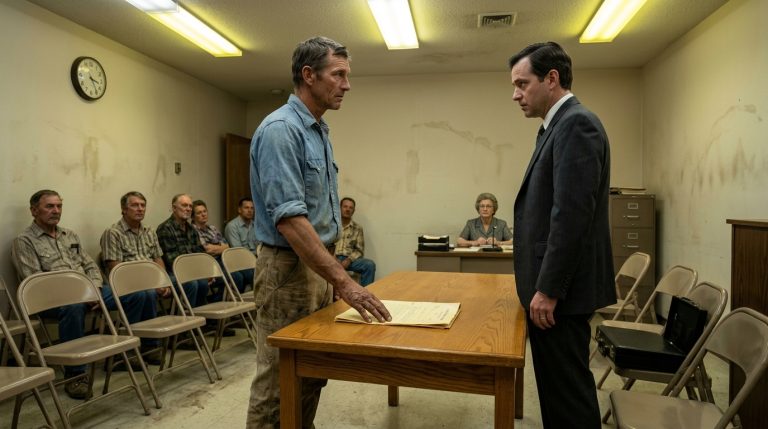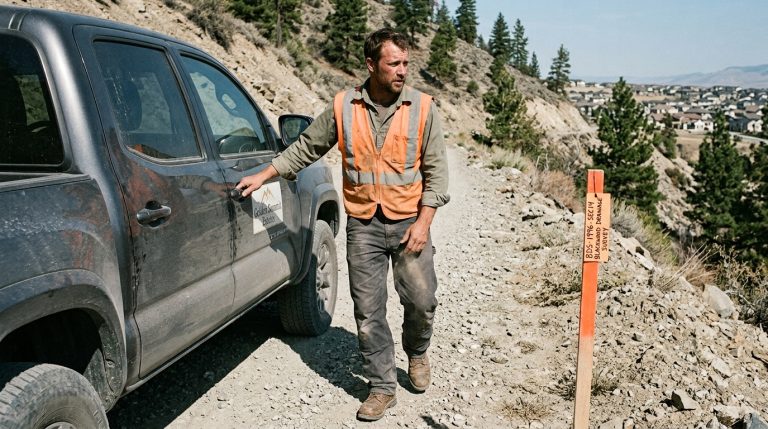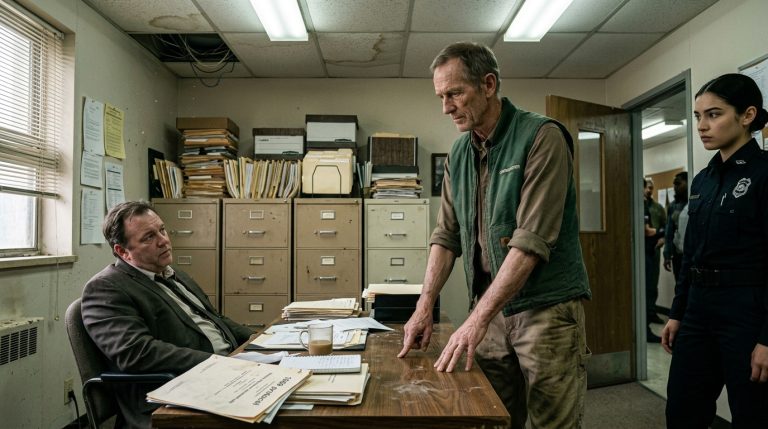
A stolen piece of land becomes the battleground for a lonely man’s final stand against corruption
CHAPTER 1: THE RED-AND-BLUE MIDNIGHT
“Step back from the gate,” the deputy said, his boots grinding dry clay into the asphalt.
The strobe of red and blue cruiser lights cut through the dusty Oregon pines, turning the dry needles on my lawn into a rhythmic, bleeding purple. Behind my back fence, the screaming was raw, wet, and fueled by cheap grain alcohol. The HOA president’s son was back there, kicking at the rusted sheet-metal panels of my barrier, his laughter echoing off the dry creek bed.
“I’m on my own property,” I said. My voice was low, level, keeping the vibration out of my throat. I touched the latch of the gate—a heavy latch of pitted, corroded iron that smelled of rain and iron filings. “They crossed the line. Again.”
At the perimeter line, Celeste Harrow stood under the amber glow of the streetlamp, her clipboard tucked under her arm like a shield of state. Her HOA badge was pinned to her stiff linen lapel, catching the strobing blue light. She didn’t look at her son. She didn’t look at the shattered beer bottles littering the ditch. She looked straight through me.
“This homeowner has been hostile since the day he moved in,” Celeste told the deputy, her voice a polished, rhythmic instrument of quiet threat. “Aggressive. Uncooperative. We have documented concerns about the safety of our residents. My son and his friends are on common easement land. He has every right to be there.”
“This land isn’t HOA property, ma’am,” I said, pointing past the fence toward the survey line where the wild blackberries grew over old barbed wire. “The boundary stops ten feet before the creek.”
Celeste’s jaw tightened, a tiny muscle twitching beneath her flawless foundation. She didn’t look back at the chaos. “The Sage Brook Ridge charter is absolute. We will handle this internally. Deputy, please instruct this man to return to his dwelling.”
The deputy sighed, his utility belt creaking as he pulled a faded county map from his clipboard. He squinted under his flashlight, his thumb tracing the desaturated lines of the plat. “The map says…” He trailed off, frowning at the discrepancy between his screen and the printed sheet Celeste offered.
But Celeste didn’t wait for him to finish. She stepped closer to the gate, the scent of lavender perfume and dry dust washing over the fence. “You don’t get to decide the rules here,” she whispered, her voice too quiet for the deputy’s body camera to catch. “We dictate the edges of this neighborhood. If you can’t afford the standards, you can leave.”
An hour later, the cruisers were gone, their taillights bleeding into the dark pines. The shouting behind the fence had died down to a low, mocking murmur.
I walked the perimeter with my heavy maglite, the beam cutting through the dry, suspended dust. The rusted iron chain on my back gate was cold in my hand. I pulled it tight to check the links, expecting the familiar slack of the old padlock.
But the flashlight beam caught something else.
Hanging from the chain was a heavy, unfamiliar block of steel—a industrial-grade padlock, brand new, coated in a greasy black residue. Stamped into the side of the metal casing was a single, clean inscription: Property of Apex Security Group. My old brass lock was gone, cut away, and the cold weight of this new, uninvited steel hung on my gate like a closed eye.
CHAPTER 2: THE SIDEWALK STANDOFF
My thumb rubbed against the greasy black residue on the lock. It was cold, smelling faintly of kerosene and industrial sulfur. The metal didn’t belong to this gate; the old brass padlock I had bought at the local hardware store lay somewhere in the tall, dry grass, likely sheared off with bolt cutters. I kept the maglite beam pinned on the polished steel body of the lock, tracing the stamped letters of Apex Security Group.
A twig snapped in the dark near the creek bed.
I didn’t turn the flashlight toward the noise. Instead, I clicked the beam off, letting the thick, starless dark of Juniper Bend swallow me. My chest tightened against the cold pine air. They were still out there, just beyond the boundary line, waiting for me to make a loud mistake. I stood in the absolute silence of my backyard, my fingers lingering on the cold, heavy steel of the uninvited lock, feeling the dry rust of my own chain pressing into my palm. I wouldn’t give them a reaction. I backed away slowly, my boots making no sound on the packed, dry clay of the path, until the back door clicked shut behind me.
Sleep didn’t come. I spent the remaining hours of darkness sitting at the kitchen table, the county parcel map spread out under the low amber light of the stove.
By 7:15 a.m., the morning sun was nothing but a pale gray wash through the kitchen window, illuminating the dust motes suspended in the stale air. A sharp, rhythmic rap vibrated through the solid oak of my front door. It wasn’t a neighborly knock. It was the heavy, deliberate strike of knuckles backed by authority.
I opened the door to a wall of bodies.
Celeste Harrow stood on the top step, her clipboard held flat against her chest like an iron plate. To her left was an older man with a plastic, unblinking smile—Richard, the HOA treasurer—and to her right stood a tall, broad-shouldered man in a navy polo shirt with Apex Security Group embroidered in gold thread over his chest. His arms were crossed, his eyes hidden behind dark aviator glasses despite the overcast morning.
“We are conducting a compliance inspection,” Celeste announced, her voice cutting through the quiet morning air like a cold blade. She didn’t wait for an invitation. She took a step forward, her polished leather shoe hovering just over the threshold.
“You’re standing on my property, Celeste,” I said, my hand remaining firmly on the edge of the heavy wooden door. I didn’t widen the opening. “And your security contractor put a lock on my back gate last night. That’s trespass.”
The security guard didn’t move his arms, but his jaw tightened. He adjusted his stance, his heavy boots squeaking against the damp concrete of my porch.
“The Sage Brook Ridge Homeowners Association has an easement corridor behind your fence, lot seventeen,” Celeste said, her tone smooth, rehearsed, as if she were reading from a court filing. She flipped a page on her clipboard, the paper crisp and loud. “Under section four of the community charter, the board has the right to secure all common access points to prevent unauthorized hazards. Your camera modifications and hostile attitude have forced us to establish safety protocols.”
“That’s not an easement,” I replied, keeping my eyes locked on hers. “That’s my back lot. Parcel-796. The county records don’t show any easement corridor.”
The word hung in the air between us. Celeste’s smile didn’t falter, but Richard’s plastic grin slipped for a fraction of a second, his eyes darting toward the clipboard.
“We have the administrative filings right here,” Celeste said, tapping the paper with her gold pen. “The board has approved a special enforcement fee for non-compliance. Seven hundred and fifty dollars per day, retroactive to the initial incident. If you refuse to allow the security team to complete their inspection of the corridor, the daily assessment will double.”
The security guard slowly reached into his pocket, pulling out a rugged smartphone, and raised the camera lens directly toward my face. He didn’t say a word. He just stood there, recording, waiting for me to raise my voice, waiting for the anger to show.
“The county clerk’s office opens in thirty minutes,” I said, my voice dropping an octave, completely calm. “I suggest you check your administrative filings again, Celeste. Because if that lock is still on my chain when I get back, the sheriff won’t be looking at a noise complaint.”
I pulled the door shut, the latch clicking home with a solid, metallic ring that echoed through the quiet house. Through the frosted glass panel, I watched their distorted shadows linger on the porch for a long, silent minute before they finally turned and retreated toward the sidewalk.
CHAPTER 3: THE ARCHIVAL DESCENT
The heavy vibration of the door latch settling into the frame hummed through the palm of my hand. On the other side of the frosted glass, three shadows lingered, silent and distorted, before slowly dissolving into the pale morning light of Juniper Bend. I did not move until the faint, wet crunch of their tires on the gravel driveway died away entirely. The house felt too quiet, the cold air smelling faintly of the kerosene residue from the back gate. I couldn’t stay here waiting for the next knock. I grabbed my keys, the county parcel map, and the old leather jacket hanging by the door, and headed out to the garage.
The drive to the county seat was twenty-two miles of cracked asphalt, the tires of my truck humming a monotonous, low-frequency song against the road. The sky remained a flat, limestone gray, pressing down on the tops of the damp pines. Every mile felt like a physical weight, a slow-motion descent from the isolated, manicured clean of Sage Brook Ridge to the gritty reality of the county records building. My grandfather had always told me that land was the only thing worth fighting for because it was the only thing that couldn’t walk away. I remembered his old hand tracing a map of this valley decades ago—a map where the creek was wide and free, long before Celeste Harrow’s development syndicate paved over the natural runoffs.
The county archives building was a low-slung concrete block, its facade stained with rust-colored water marks from the gutter leaks. Inside, the air was cold, smelling of ancient paper, moldering leather binders, and the sharp chemical tang of dry-toner copy machines.
I walked past the empty reception desk, my boots echoing off the worn linoleum. An old-fashioned counter of dark oak separated the public area from the rows of tall, steel shelving where the county’s history lay bound in heavy canvas volumes. Behind the counter sat a woman with silver hair pulled into a tight bun, her eyes scanning a massive desktop monitor.
“Need to pull a plat map and filing history,” I said, placing my fingers on the cool oak surface. “Parcel-796. Sage Brook Ridge area.”
She didn’t look up immediately. Her fingers tapped a slow, dry rhythm on her keyboard before she turned her head. “Parcel-796 is in section twelve. You’ll want the administrative records for the unincorporated boundary line.”
“I need the original deed filings too,” I added, my voice steady. “And any recent boundary adjustments submitted under administrative clarifications.”
She pointed toward a heavy metal cart near the corner. “You’ll have to pull the physical binders for anything before 1998. The digital database only goes back thirty years. Anything older is down in the basement annex.”
I nodded and pushed through the swing gate, the cold metal of the latch biting into my skin. The stairs to the basement annex were narrow, the concrete steps chipped and dusty. Down here, the light was hummed by flickering fluorescent tubes that cast long, jittery shadows across the rows of grey filing cabinets.
I found the drawer labeled Sage Brook Ridge: Historical Plats.
The folders were thick, their manila tabs worn and soft from decades of handling. I pulled the file for Parcel-796 and laid it flat on a steel viewing table. The paper was heavy, a blue-line print from 1974. My fingers traced the boundary—the solid, unbroken line that ran straight through the wild blackberries, leaving the back lot entirely outside the HOA’s legal domain.
Then I saw the discrepancy.
Tucked into the back of the folder was a single, crisp sheet of paper that didn’t match the yellowed texture of the rest. It was a printed PDF, timestamped just three months ago. It was titled Administrative Clarification: Corridor 17-B. On this map, the boundary line had been subtly nudged, a dotted line sweeping outward to swallow the entire strip of land behind my fence.
I held the page up to the harsh fluorescent light. The signature field at the bottom was blank. There was no county surveyor’s stamp, no registry ID number. But tucked in the margin, printed in tiny, pale blue ink, was a routing code: APX-SUB-796.
A cold sensation settled under my ribs. It wasn’t a mistake. It was a deliberate, systematic fabrication, filed quietly into the county’s physical records without official sign-off, waiting for someone to look closely enough to see the seam. I pulled out my phone and took three crisp, high-resolution photos of the unsigned document, the physical evidence of Celeste’s shadow play freezing on my screen.
CHAPTER 4: THE IRON STAKES
The screen of my phone stayed bright, casting a pale glare over the yellowed edges of the ancient 1974 blueprint resting on the metal viewing table. The three photos I had just taken of the fabricated boundary adjustment were locked into my local memory storage. I could still smell the dry, moldering scent of old linen files, but my heart was beating a heavy, rhythmic cadence against my ribs. I slipped the phone into my jacket pocket and closed the manila folder. I slid the drawer of the metal cabinet shut, the squeal of its ungreased runners echoing down the concrete walls of the basement.
I ascended the chipped concrete steps back to the main lobby, bypassing the silver-haired clerk, and pushed through the heavy glass exit doors. The sky had darkened to a deep, bruised charcoal, and the first drops of a cold mountain rain began to splatter against the hood of my truck.
By the time I drove back onto Juniper Bend, the rain was falling in steady, heavy sheets, turning the dry clay of the roadside ditches into slick, red-brown mud. I parked near my driveway and stepped out, the cold water immediately soaking through my collar.
A white utility van was parked across the street, its engine idling with a low, wet vibration. Stenciled in faded black letters on the side panel was the name of the local engineering firm I had contracted: Miller & Associates Land Surveying. Inside the cab, the surveyor sat checking a rugged tablet. When he saw me approach, he grabbed a bright yellow surveyor’s transit on a wooden tripod and pushed his door open, stepping out into the downpour.
“You the owner of Lot 17?” he asked, squinting against the rain as he pulled a heavy orange safety vest over his shoulders.
“I am,” I said, pointing toward the side path that led to the back lot. “The boundary line runs along the blackberry thicket. I need the physical stakes set today. Under the 1974 plat designation for Parcel-796.”
“We’ll get the pins located first,” he replied, lifting a heavy magnetic locator and a canvas bag filled with long, pointed iron stakes capped in bright pink plastic. “The rain is going to make the ground slick, but the iron pins should still be under the topsoil.”
We walked side-by-side down the muddy path toward the back gate. My eyes immediately locked onto the heavy, greasy black padlock belonging to the Apex Security Group. It still hung from my chain like an unblinking steel eye, slick with rain.
The surveyor paused, setting his equipment case down in the wet grass. He didn’t ask about the lock. He set up his transit tripod on the gravel driveway, adjusting the brass leveling screws with practiced, methodical turns of his fingers. He peered through the lens, aligning his sights with a concrete county monument stone located at the corner of the adjacent street.
“Hold this prism pole right at the fence junction,” he directed, handing me a bright red aluminum rod tipped with a glass reflector.
I took the pole, stepping into the thick clay mud near the fence. The cold water was running down my sleeves, making my fingers feel stiff and clumsy, but I held the rod perfectly vertical. I stood completely still, my boots sinking into the shifting earth, feeling the vibration of the wet wind against the metal pole.
Through the rain, I saw the security contractor’s navy-blue vehicle crawl slowly down the street, its tires throwing up dirty sprays of water. The vehicle came to a stop just past my driveway, its engine running, the dark tinted window rolling down just two inches to allow a camera lens to peek through.
“I’ve got the first marker,” the surveyor called out, his voice muffled by the sound of the rain hitting the pine needles. He walked over with a heavy steel sledgehammer and one of the iron stakes. He drove the stake deep into the mud at my feet, the metallic clang of the hammer striking the iron cap ringing out through the damp woods.
“According to the original county plat,” he muttered, wiping water from his forehead as he adjusted his transit toward the creek, “your property line actually extends another fifteen feet past this wooden fence. The HOA’s common path is completely on your deeded land.”
I looked down at the bright pink cap of the iron stake, driven firmly into the wet clay. It was a physical barrier of law and iron, a line that Celeste Harrow could not cross without breaking the state’s penal code. But as the surveyor reached for the next stake, my phone buzzed inside my wet pocket, a single, sharp vibration that felt cold against my leg.