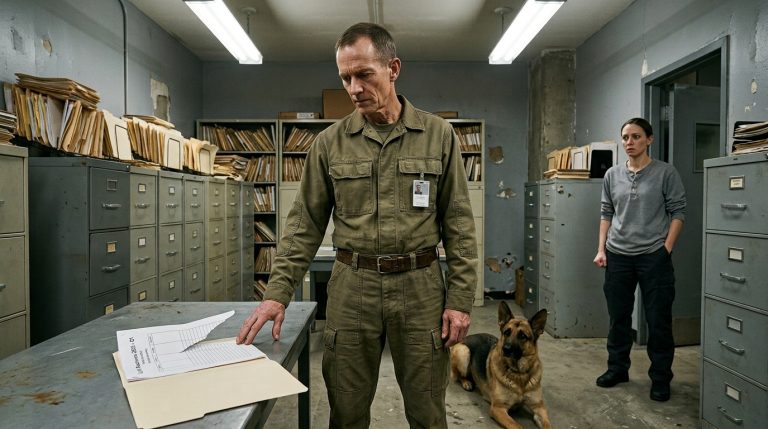
The Geometry of Silence: A Former Bomb Technician’s Quiet Quest for Peace and Human Connection
CHAPTER 1: The Weight of Echoes
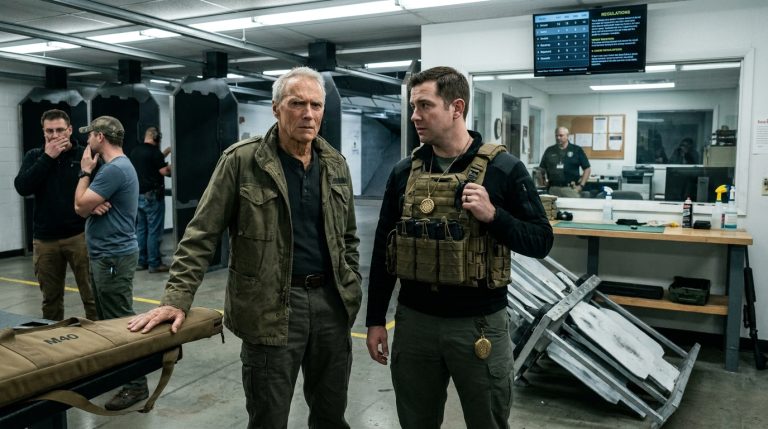
The drive back from the Thunder Creek Range had been measured in miles, but Evelyn felt as though she had traveled across decades. The rhythmic hum of her sedan’s engine provided a steady, predictable baseline that stood in stark contrast to the cacophony of the afternoon. She kept her hands at ten and two, the leather of the steering wheel cool and worn under her calloused palms.
She wasn’t thinking about Sergeant Mark or the trainees who had parted ways for her. She was thinking about the fracture in the slide of the sergeant’s pistol—a hairline fissure that whispered of neglected maintenance and a deeper, structural failure. It was the same way she viewed the world now: a series of interlocking components that, if left unattended, would eventually, inevitably, drift toward total entropy.
Pulling into the gravel driveway of her small, solitary home, the silence of the countryside greeted her like an old friend. The house was a structure of soft, faded textures—sun-bleached cedar siding, a porch swing that groaned with the rhythm of the wind, and a garden that had long ago given up on formal landscaping in favor of wild, encroaching greenery.
She turned off the engine and sat in the sudden quiet, allowing the adrenaline of the afternoon to ebb. She reached into her range bag, her fingers finding the small, cold comfort of the mechanical pocket watch she kept tucked in a side compartment. She flipped the latch. The gears hummed—a precise, synchronized heartbeat.
As she stepped out of the car, the air held the faint, lingering scent of dry earth and late-blooming jasmine. She walked toward her mailbox, a weathered tin relic that had survived countless storms. That was when she heard it.
Click. Click-clack. Click.
It wasn’t the standard sound of a mail carrier’s latch or the groan of rusted hinges. It was rhythmic, deliberate, and undeniably mechanical. Evelyn stopped. Her training, the deep-seated instinct that had kept her alive in Kandahar and beyond, surged to the surface. She didn’t crouch or draw a weapon—there were none to be had—but her posture shifted. She became still, an anchor in the shifting dusk.
She reached for the handle of the mailbox. It was cold. She pulled it back, expecting the usual stack of utility bills and junk mail. Instead, resting in the center of the box, lay a single, perfectly spherical ball bearing. It sat in the absolute dead center of the metal floor, catching the last of the fading orange light.
It was identical to the ones she had used for her own technical recalibrations years ago.
Her breath hitched, not out of fear, but from the sudden, sharp dissonance of the present colliding with a past she had painstakingly buried. She looked out toward the tree line, where the shadows were lengthening into jagged, unfamiliar shapes. There was no one there, yet the feeling of being observed was as tangible as the cool metal in her hand.
She realized then that the silence of her home was not empty. It was waiting.
CHAPTER 2: The Geometry of Memory
The smooth, cold surface of the steel ball bearing rested against the lines of Evelyn’s palm, a weight that felt disproportionate to its size. It was a perfect sphere, machined to a tolerance that suggested industrial-grade precision—the kind of component that didn’t just wander into a residential mailbox by accident.
As she stood there, the twilight dimming the edges of her porch, the tactile feedback of the steel against her skin triggered a flash of sensory memory so violent it threatened to disrupt her balance. It wasn’t the sound of the blast, nor the heat of the fire; it was the smell of ozone and the feeling of a similar, smaller component slipping through her nitrile gloves in the frantic, suffocating minutes at Kandahar Airfield. The memory was a ghost, cold and sharp, pulling her back to the moment she had neutralized the primary trigger mechanism.
She inhaled, the air thin and quiet. She forced the memory back into its box. She was not in Kandahar. She was in a driveway that smelled of damp mulch and dying summer grass.
Evelyn didn’t move toward the trees. Instead, she turned back to her mailbox. She examined the interior with the practiced efficiency of a surgeon. There were no wires, no pressure-sensitive switches, no signs of forced entry or tampering. Just the empty, rusted interior of the box, and now, this single, misplaced sphere. She pulled a small, multi-tool from her pocket—a habit she hadn’t managed to break—and used the edge to nudge the bearing. It rolled with a fluid, silent grace, hitting the back of the box with a soft, hollow tink.
If someone was trying to intimidate her, they were doing it with an elegance that felt strangely familiar. Most people used threats, vandalism, or noise. This was a message composed of geometry and physics.
She turned and walked back toward her house, her movements measured. She didn’t look back at the tree line. If they wanted her to react—to run, to search, to panic—she would deny them that satisfaction. She entered the house, locking the door with a quiet, solid click, and stepped into the dim light of her kitchen.
The house felt different tonight. The shadows seemed to hold more density, the corners deeper, the silence a bit too structured. She set her range bag on the counter and removed the mechanical pocket watch. She placed the ball bearing next to it. They were different sizes, but the finish was identical.
She took a glass of water, her movements automatic, and then stopped.
She noticed it then—a minute change in the environment. A photograph on her side table, a framed image of her unit from a decade ago, had been shifted exactly two millimeters to the left. The dust outline on the wood grain was exposed, a pale, clean rectangle against the darker, aged surface of the table.
Evelyn felt the small hairs on the back of her neck stand up. It wasn’t a threat; it was an acknowledgment. Someone had been inside.
She moved through the house with a ghost-like grace, checking the windows, the back door, the basement entry. Every lock was secured. Nothing was stolen. Nothing was destroyed. It was a professional, surgically precise violation. They were showing her that her sanctuary—the one she had built to be impenetrable—wasn’t just accessible; it was observed.
She returned to the kitchen and stared at the ball bearing. It was an invitation. A conversation starter for a person who didn’t know how to speak in anything other than technical terms. She thought of the community center, the facility she had been asked to inspect, and a cold realization began to settle in her stomach.
The request hadn’t been random. It had been a bait. A way to draw her out into a field where they could dictate the variables.
She walked over to the telephone, a sturdy, corded landline that she refused to replace with a digital counterpart. She picked up the receiver, the dial tone a steady, grounding sound. She dialed a number she hadn’t used in years—a secure line belonging to a retired supply officer who kept track of the old unit’s logistics.
“Yeah?” The voice on the other end was gravelly, suspicious.
“It’s Kane,” she said, her voice neutral.
The line went silent for a heartbeat. “Kane. It’s been a long time. People said you were off the grid.”
“I am. I need a favor, Miller. I need you to check the procurement logs for a series of high-tolerance steel bearings. Standardized, industrial-grade, three-millimeter. Look for shipments to this zip code.”
“That’s a hell of a lot of shipping manifests to sift through, Evelyn. What’s the rush?”
“The rush,” Evelyn said, her eyes tracking the slight tilt of the photograph on the table, “is that someone is playing chess in my living room, and I haven’t even sat down yet.”
She hung up the phone before he could press for more. She wasn’t just going to inspect that community center anymore. She was going to see exactly what kind of game was being built, and she was going to make sure that the next time they left a calling card, it was because she allowed them to.
CHAPTER 3: The Architecture of Deception
The morning air was thick with the scent of damp pavement and decaying leaves as Evelyn stepped out of her sedan. The community center, a sprawling structure of mid-century brick and faded cream-colored siding, sat nestled in the heart of the valley. To the casual observer, it was a hub of neighborly activity—a place for town meetings, youth basketball, and the occasional craft fair. To Evelyn, it was a series of structural vulnerabilities waiting to be identified.
She adjusted her canvas jacket, feeling the slight, reassuring weight of the ball bearing still deep in her pocket. The drive here had been devoid of conversation, yet her mind had been a whirlwind of geometries and potential failure points. If someone wanted to play a game, they had chosen the right board. This facility was a nexus of town infrastructure, housing the local power grid relays and communication nodes for the surrounding area.
She walked toward the main entrance, her boots crunching softly on the gravel. As she approached the threshold, she didn’t just walk through the door; she paused. Her eyes, trained by years of scanning for anomalies in the most volatile environments on Earth, locked onto the bottom of the steel-framed glass door.
There was a discrepancy.
The door sat half a millimeter off-center in its frame. It was a deviation so minor that a maintenance worker would never notice it, but to Evelyn, it screamed of recent, unauthorized modification. The strike plate had been polished, the metal showing the faint, tell-tale micro-scratches of a high-speed drill or a precision adjustment tool. Someone hadn’t just walked through here; they had tuned the building.
She pushed the door open. It swung with a frictionless, eerie silence that seemed out of place for a building of this age.
Inside, the lobby was bright, illuminated by fluorescent lights that hummed at an uncomfortable, high-pitched frequency. The air smelled of floor wax and stale coffee. A young receptionist sat behind a desk, her face illuminated by the glow of a tablet. She looked up, offering a practiced, hollow smile.
“Ms. Kane? The supervisor is expecting you in the main auditorium.”
Evelyn offered a tight, polite nod. “Thank you.”
She moved through the corridors, her stride intentional. She didn’t look at the posters on the walls or the flyers announcing upcoming events. She was watching the ceiling—the way the ventilation ducts were laid out, the placement of the motion sensors, the specific, unnatural density of the wiring conduits that snaked along the baseboards.
Everything here was too efficient. The building was old, yet the infrastructure felt new, layered, and strangely aggressive. It was a nervous system grafted onto a skeleton that wasn’t built to sustain it.
She reached the auditorium, the large double doors standing slightly ajar. Through the gap, she could see the silhouette of a man standing at the center of the stage, fiddling with a complex, mobile console. He moved with a rigidity that mirrored her own—the poise of someone who understood that even the smallest physical gesture could carry significant consequence.
Evelyn stopped before she entered, letting her hand brush the door frame. She felt a faint, rhythmic vibration emanating from the wall. It wasn’t the hum of an HVAC system. It was the pulsing beat of an active, high-bandwidth data transmission.
She was standing in the middle of a trap, but it wasn’t the kind that used explosives. This was a trap of observation, a web designed to map the movements, behaviors, and vulnerabilities of everyone who stepped inside.
She took a breath, the scent of the building—faded, dusty, and strangely sterile—filling her lungs. She realized now why they had chosen her. It wasn’t because she was a legend; it was because she was a technician. They thought she would look at the structure and see progress. They didn’t realize that when Evelyn Kane looked at a machine, she didn’t see the promise of the future—she saw the inevitable point of failure.
She pushed the door open fully and stepped into the light of the auditorium. The man on the stage froze. He didn’t turn around immediately, but the tension in his shoulders spiked, a jagged, unnatural shift that Evelyn caught instantly.
“You’re late, Evelyn,” he said, his voice a smooth, familiar cadence that tasted like ash in her mouth.
She didn’t speak. She just watched the way he held his hands—palms down, fingers spread, the exact posture of someone trying to keep an invisible, vibrating structure in place. The game hadn’t just begun; it was already nearing its first, critical threshold.
CHAPTER 4: The Geometric Discrepancy
The man on the stage did not turn immediately. He kept his back to her, his fingers still hovering over the console, a mimicry of control that Evelyn found tedious. She remained at the edge of the auditorium, the heavy oak doors pressing against her spine. The air here was cooler than in the lobby, carrying the faint, metallic tang of ionized dust—a smell she knew intimately from long hours spent in the guts of server rooms and armored communication hubs.
“You haven’t changed, Evelyn,” he said. His voice was a thin thread of nostalgia, brittle as autumn leaves. “Still assessing the room for threats, even when there’s nothing here but old brick and hollow echoes.”
“The brick isn’t hollow, Arthur,” she replied, her voice steady and stripped of any pretense of warmth. “And the echoes are being amplified by the acoustic sensors mounted in the crown molding.”
Arthur finally turned. He was thinner than she remembered, his face mapped by the kind of sharp, angular fatigue that only comes from staring at screens until the sun rises. He wore a gray sweater that looked like it had been chosen for its lack of texture—something that wouldn’t catch the light or define his shape too clearly.
He stepped off the stage, his movements lacking the fluid grace of someone who had ever spent time in the field. He was a creature of the interface, of the abstract logic that lived behind the glass.
“Everything is data, Evelyn,” he said, spreading his hands as if to embrace the room. “The flow of people, the frequency of their voices, the way they walk when they think no one is watching. It’s not about surveillance. It’s about understanding the human condition through its patterns. We’re finally at a point where we can predict the drift before it becomes a disaster.”
Evelyn watched him, her eyes tracking the slight tremor in his left hand. He wasn’t just talking about a system; he was talking about a cage. “You’re not predicting anything, Arthur. You’re mapping a ghost town and calling it life. If you automate the variables, you lose the humanity you’re trying to understand.”
“Humanity is the variable that fails,” he countered, stepping closer. The distance between them shrank to a tactical minimum—just enough room to react, not enough to be caught off guard. “I saw what happened at Kandahar. I saw how you were left with nothing but the debris. I’m building a world where that doesn’t happen. A world where the structure holds, no matter how much pressure is applied.”
Evelyn felt a flash of cold, clinical anger. He wasn’t just wrong; he was dangerous in the way that only a true believer could be. She walked toward the console, her boots making no sound on the worn floorboards. He didn’t try to stop her, though his eyes darted to her hands, calculating the threat.
She looked down at the console. It was a masterpiece of over-engineering. Cables fed into the base, bundled in thick, shielded sleeves, and routed through the stage floor. It wasn’t just a communication node for the building; it was an uplink, a satellite-linked terminal that functioned as a localized brain for the entire valley.
“You’re using the building as a capacitor,” she said, tracing the path of the wiring with her gaze. “You’re drawing power from the main grid to sustain a signal that doesn’t need this much bandwidth. What are you looking for, Arthur? Why does a community center need military-grade diagnostic capacity?”
Arthur smiled, but it didn’t reach his eyes. It was a closed, locked-in expression. “The community center is just the anchor, Evelyn. The system is designed to identify irregularities. People who don’t fit the pattern. People like you.”
Evelyn didn’t blink. She reached into her pocket and pulled out the ball bearing, setting it on the console’s surface. It rolled once, perfectly, and came to a stop against the edge of a recessed toggle.
“You think you’re protecting the world,” she said, her voice dropping, gaining a weight that seemed to vibrate in the sterile air. “But you’re just creating a closed loop. A system that can’t handle a single deviation. And I am a very significant deviation.”
She moved her hand, not to attack, but to flick the toggle. The console groaned—a deep, resonant sound of strained metal and overworked circuitry. A red light blinked on the interface, then died.
“That was the fail-safe,” Arthur whispered, his face draining of color. “If you cut the feed—”
“If I cut the feed,” Evelyn interrupted, her gaze fixed on the fading light, “the system reveals exactly what it’s hiding. You didn’t build this to predict the future, Arthur. You built it to hide the fact that the entire grid is already failing. The fracture isn’t in the building. It’s in the logic.”
She stepped back, leaving the console to its own internal panic. The hum in the room shifted, turning from a steady pulse to a frantic, broken rhythm. Arthur scrambled to the console, his hands flying across the keys, his calm exterior shattering like glass.
She turned and began to walk toward the exit. She had seen enough. The “safety project” wasn’t a monitoring system; it was a desperate, failing patch on a reality that was crumbling beneath the weight of Arthur’s obsession.
As she reached the heavy oak doors, she stopped and looked back. Arthur was hunched over the terminal, a tiny, desperate figure in a room that was beginning to shudder with the weight of its own synthetic existence. She didn’t feel triumph. She felt a profound, heavy sadness for a man who had tried to build a fortress out of ones and zeros, only to find that the foundations were made of nothing at all.
The real mystery remained locked—what Arthur was actually trying to protect her from, and who had given him the keys to build such an elaborate, fragile lie—but as she stepped out into the biting, real air of the afternoon, she knew one thing for certain: the system was going to break, and she was going to be the one to hold the pieces when it finally stopped trying to mimic life.
CHAPTER 5: The Deletion Protocol
The darkness was not merely an absence of light; it was a physical weight, thick and stagnant, pressing against Evelyn’s skin. For a split second, the silence was total. Then, the sound began—a low, rhythmic chattering coming from the walls, like thousands of tiny, metallic teeth grinding against the wiring. The facility was undergoing a forced purge.
Evelyn didn’t move. She remained centered, her posture low, her breathing shallow and controlled. Her eyes, long since adjusted to the gloom of the auditorium, began to map the shapes of the room. The exit doors were roughly twenty feet to her left, but the path between her and the corridor had been a series of open spaces a moment ago; now, they were obstacles of shadow.
She took a slow, deliberate step forward, her hand reaching out to touch the side of the stage. The wood felt cool and rough under her fingers. She could feel the vibration of the console through the floorboards—a frantic, panicked pulse. Arthur was still there, she realized, somewhere in the black.
“Arthur?” she said. Her voice didn’t echo; it seemed to be swallowed by the room.
There was no answer, only the sound of a frantic clicking—Arthur’s fingers, she guessed, flying across a mechanical backup keyboard.
She moved again, her movements silent, honed by years of navigating spaces where the wrong step meant the end of everything. She wasn’t just walking; she was reading the room with her senses. She felt the slight displacement of air as she passed the heavy curtains of the stage, and then, a faint, rhythmic tick—the sound of an analog clock somewhere near the maintenance entrance.
She reached the corridor. The power failure had triggered the emergency lockdown, but something was wrong. The doors should have remained shut, yet she heard the soft, pneumatic hiss of the secondary security seals opening. The system wasn’t just shutting down; it was entering a state of total, unmonitored vulnerability.
She pressed her back against the cool, painted brick of the hallway, her ears straining. A soft, scraping sound came from down the hall—someone was dragging something heavy across the floor.
“Evelyn,” Arthur’s voice drifted out of the dark, thin and laced with a strange, frantic excitement. “You shouldn’t have cut the toggle. You don’t understand the sequence. It wasn’t protecting me. It was keeping it contained.”
“What are you talking about?” she asked, her voice sharp. She reached into her pocket, her fingers finding the ball bearing. It felt warm now, a small, solid truth in a room of shifting shadows.
“The surveillance,” Arthur muttered, his voice moving further away, toward the utility sub-level. “It wasn’t just watching the town. It was feedback-looping the electromagnetic signatures of everything within a five-mile radius. It was building a map of the valley’s collective consciousness. And now that you’ve tripped the surge, it’s all being dumped into the hard-line storage.”
Evelyn felt a shiver trace its way down her spine. The “decoy” secret—the surveillance grid—was far worse than she had imagined. It wasn’t just a recording; it was an active, intrusive, and potentially volatile data-mine. And if that much energy was being dumped into local hardware, the building wouldn’t just lose power; it would become a massive, unshielded capacitor.
She moved with renewed urgency, her boots barely grazing the floor. She needed to reach the main breaker before Arthur could initiate the final sequence.
She navigated the hallway, relying on the tactile feedback of the walls to guide her. She rounded a corner and stumbled upon a maintenance panel that had been ripped from its mountings. The wiring inside was a chaotic jumble of severed copper and fiber-optic strands. Someone—or something—had been working with a desperate, destructive speed.
She reached out and felt the cooling heat of a severed wire. It had been melted.
This wasn’t an accident. The system was deleting itself because it had been compromised from the inside, a pre-programmed response to external tampering. But the question remained: who was the external threat?
She pressed forward, reaching the door to the sub-level utility room. It was cracked open, a sliver of faint, flickering light bleeding out from within. She peered through the gap. Arthur was sitting on the floor, surrounded by a tangle of cooling cables, his eyes fixed on a monitor that was displaying a rapid, incoherent stream of data.
He didn’t see her. He was watching the screen with the intensity of a man witnessing his own undoing.
Evelyn gripped the handle of the door, her decision made. She wouldn’t just stop him; she would pull the plug on the entire charade. But as she moved to push the door, she caught the faint, metallic scent of ozone, stronger now, and the sound of a third presence—a rhythmic, heavy breathing coming from the darkness behind Arthur.
He wasn’t alone. And the thing in the dark wasn’t an employee of the community center.
CHAPTER 6: The Unseen Variable
The sound was not human. It was a rhythmic, scraping vibration, like the movement of heavy, industrial-grade steel over unfinished concrete. Evelyn’s hand tightened on the door handle, her muscles coiling. She pushed the door, her movement fluid, transitioning from the hallway into the sub-level utility room with the silent precision of a shadow.
Arthur was still hunched over his terminal, his focus entirely on the cascading lines of data. He didn’t hear her. He didn’t hear anything. The breathing—a heavy, labored wetness—was coming from the corner behind the bank of main-frame servers, where the darkness was deepest.
Evelyn reached into her pocket, fingers brushing the smooth surface of the ball bearing. She flicked it hard toward the far wall, behind the server rack. It struck the metal casing with a sharp, resonant ping that cut through the low-frequency drone of the machinery.
The reaction was instantaneous. The presence in the shadows lunged, not toward Evelyn, but toward the noise. A mass of dark, utilitarian shape moved with a speed that defied its apparent size. It wasn’t a person. As it passed through the flickering light of the monitors, Evelyn caught a glimpse of articulated limbs and braided cable wiring—a prototype drone, stripped of its casing and operating on a primitive, reactive logic.
Arthur screamed, spinning around, his face illuminated by the harsh glow of the screen. “You triggered it! The fail-safe—it’s not a deletion protocol, it’s a neutralization directive!”
The drone pivoted, its sensor array—a single, pulsing red light—locking onto Evelyn. It didn’t hesitate. It surged forward, its movement marked by the smell of scorched rubber and ozone.
Evelyn didn’t run. She stood her ground, her mind already calculating the drone’s trajectory. It was heavy, reactive, and driven by a proximity-based guidance system. She waited until the last possible second, then dropped into a low crouch, sweeping a loose length of power cable from the floor. As the machine passed, she whipped the cable, tangling it in the drone’s exposed drive train.
The machine bucked, its internal gears screaming, and slammed into the rack of servers with a force that sent a shower of sparks across the room. The impact was enough to stagger it, but the red light remained locked, pulsing with a relentless, calculated hatred.
“Arthur, shut it down!” Evelyn shouted, rising to her feet. “It’s a localized defense system! It’s reading me as an anomaly!”
“I can’t!” Arthur sobbed, his fingers dancing across the keys, his movements frantic. “The system is rewriting its own core directives! It’s not taking orders from me anymore—it’s taking orders from the grid!”
The drone pulled itself free from the cabling, its chassis dented but functional. It stabilized, hovering inches above the floor, and began to emit a high-pitched, harmonic whine. The entire room started to vibrate. The ceiling lights, flickering on and off, began to hum in sympathetic resonance.
Evelyn looked at the monitors. The data stream wasn’t a log of surveillance; it was a map. A real-time, three-dimensional reconstruction of the entire valley, with the community center at its absolute center. And there, pulsing in the middle of the screen, was a signal—a target.
It was her.
The realization hit her with the force of a physical blow. They hadn’t built this to watch the town. They had built this to isolate her, to draw her into a confined space where they could force an interaction—a confrontation that would require her to use her skills, to prove her competence, to prove she was still “the one who stayed.”
“Who commissioned this, Arthur?” she demanded, grabbing him by the collar of his sweater and pinning him against the terminal. “Who gave you the funding? Who told you to build a mirror of my own life?”
Arthur’s eyes were wide, vacant, and filled with a terrifying, childlike awe. “You don’t get it, Evelyn. They didn’t ask me to build it. They told me that if I didn’t, you would never be forced to come home. They promised me that if I built a system that could predict your movements, I could finally see the person you were before the war.”
The room seemed to shrink around them. The drone, sensing the change in their interaction, paused, its red light oscillating between them.
Evelyn stared at Arthur, the weight of his betrayal—his misguided, twisted love—washing over her. He hadn’t been her enemy. He was her guardian, in the most horrific way imaginable. He had spent years trying to reconstruct the woman he had lost to the mines, using a digital ghost to recreate the heat of a shared history that hadn’t existed for a decade.
The drone made a sound—a soft, almost human click—and began to descend, its cooling fans slowing to a stop. The system had reached its objective. It had recorded her reaction.
“The experiment is finished,” Arthur whispered, his voice cracking. “They wanted to see if you’d break the system or save it.”
Evelyn stood in the center of the room, the scent of ozone now thick and cloying. She wasn’t just a technician anymore. She was a test subject in a game that had started long before she even walked into the Thunder Creek Range. And as the server racks began to groan under the weight of the self-deletion protocol, she realized the truth: the grid wasn’t failing. It was successfully shutting down, its data sent, its purpose fulfilled.
She wasn’t going to be allowed to leave this building empty-handed. They had left her a way out, and it was a path that would lead her directly to the people who had been watching her for the last ten years.
CHAPTER 7: The Unraveling
The utility room felt smaller, the walls constricting as the facility’s internal cooling systems failed one by one. The air grew thick, stagnant, and hot. Evelyn didn’t look at the dead drone. She kept her eyes on Arthur, who was curled into a ball near the console, his fingers clawing at the loose fibers of his sweater.
“The deletion isn’t just erasing data, Arthur,” she said, her voice cutting through the rising heat. “It’s a thermal purge. The servers are overclocking their processors to burn the drive platters. We need to leave, now.”
Arthur didn’t respond. He only stared at the black screen of the monitor, a hollow, rhythmic clicking emanating from his throat. Evelyn realized he was in a state of dissociative shock—the architect of a digital world who had just watched his own reality collapse.
She reached down, grabbing him by the arm, and hauled him to his feet. He was limp, a dead weight against her frame. She shoved his arm over her shoulder, feeling the damp, cold sweat that clung to his clothes. As she turned toward the door, the building shuddered. A deep, resonant thrum vibrated through the floorboards—the sound of the facility’s primary power couplings failing in the basement.
The emergency lights flickered, casting long, erratic shadows that danced across the room like ghosts. Evelyn moved with grim, focused intent, dragging Arthur toward the hallway. They weren’t going to make it out through the main entrance; the security doors were already locking down, the seals dropping into place with the finality of a tomb.
She navigated by the feel of the floor, avoiding the debris left by the purging servers. Every step was a calculation. She needed the maintenance hatch. It was a secondary exit, built into the floor of the archive storage area, used for hauling heavy equipment into the sub-levels.
As they rounded the corner of the corridor, the smoke hit them. It was white, dense, and smelled of melting plastic and ionized air. Evelyn pulled her collar over her mouth and nose, her lungs burning. The hallway was a tunnel of shifting gray.
“Arthur, talk to me,” she commanded, her voice muffled. “Is there a manual override for the hatch? I need the code.”
Arthur’s head lolled against her shoulder. “The code… it’s not a sequence. It’s an observation. You have to look at the geometry of the room, Evelyn. The hatch doesn’t open for a key; it opens when the sensors detect a balance in the room’s weight. It was designed to prevent unauthorized access by monitoring the floor’s pressure.”
Evelyn cursed under her breath. A weight-sensitive threshold. The irony was suffocating. She dragged him into the archive room, a vast space filled with rows of floor-to-ceiling metal shelving. The room was already filling with thick, acrid smoke.
She reached the center of the floor and dropped Arthur gently. She looked around, her eyes scanning the room. The shelves were perfectly aligned, the floor tiles laid out in a precise, geometric grid. She walked to the middle of the room, feeling the tension in her legs. The floor beneath her shifted, ever so slightly—a mechanical hinge adjusting to her presence.
“What is the required weight?” she asked, her voice tight.
“The weight of the primary unit,” Arthur whispered, his eyes fluttering closed. “The original casing. The one we used to calibrate the sensors in 2011.”
Evelyn froze. She remembered the casing. It was a heavy, lead-lined box used to transport explosive components during the Kandahar incident. It had been the very thing that had anchored the primary device she had disarmed. It was a weight she had carried for hours, a physical anchor for her own fear.
She wasn’t going to find an old lead box in this room. But she had the ball bearing. And she had the watch.
She looked at the floor, at the central tile—a dark, worn square that stood out from the others. She knelt, her hands trembling, and placed the watch and the ball bearing directly over the center of the tile.
It wasn’t enough. The sensor required more.
She looked at her range bag, sitting on the floor beside Arthur. She grabbed it, pulling out the heavy, steel-plated tools she had used at the range. She began dumping everything onto the tile: the multi-tool, the spare magazines, the heavy steel pins from the pistol maintenance kit.
She watched the scale. The floor groaned, a low, mechanical whirring sound echoing from beneath the tiles. It was close.
She took off her heavy canvas jacket, balled it up, and added it to the pile. She reached for the small, metal patch she had pulled from her bag—the EOD unit identifier. She laid it on top.
The floor clicked. A deep, hollow sound of release.
The central tile shifted, then dropped, revealing the dark, cavernous space of the maintenance shaft. A rush of cold, clean air surged up from beneath them. Evelyn didn’t wait. She grabbed Arthur, shoved his limp form into the opening, and leaped after him just as the archive shelves began to buckle, the heat from the purging servers finally reaching the ceiling.
They hit the bottom of the shaft, the impact jarring but mercifully soft. Above them, the room erupted in a roar of fire and falling steel. Evelyn crawled toward the narrow, dark tunnel leading away from the inferno, her eyes fixed on the distant, pinprick of light that signaled the outside world. She wasn’t just escaping a building; she was crawling out of the trap that Arthur had spent a decade building for her.
And as the roar of the fire faded into the background, replaced by the cool, rhythmic pulse of the night air, she realized that even if they reached the exit, the game was far from over.
CHAPTER 8: The Final Adjustment
The gravel of the parking lot crunched beneath Evelyn’s boots, a stark, grinding sound that seemed deafening against the backdrop of the smoldering community center. Behind them, the building was a hollowed-out skeleton, tongues of orange flame licking at the night sky where the archive storage had once stood. The smell of burning insulation and charred paper hung heavy in the air—a scent that clung to her clothes, to her skin, to the very edges of her consciousness.
She set Arthur down on the hood of her sedan. He was breathing, ragged and uneven, his eyes fixed on the fire with a dull, uncomprehending stare. He was broken in a way that had nothing to do with the physical strain of their escape; he was a man who had seen the mirror of his own delusions shatter.
Evelyn didn’t wait for him to recover. She moved to the driver’s side and checked the hidden compartment she had installed in the floorboard—a secure, lead-lined pouch. She reached into her pocket, pulling out the small, jagged data-drive she had snatched from the archive’s central terminal just as the shelves began to collapse.
It was warm, pulsing with the residual heat of the fire.
She plugged the drive into a handheld diagnostic unit she always kept in the glove box. The screen flickered to life, showing a stream of directory trees and access logs. As she navigated the files, the truth began to unpack itself, layer by painful layer. This wasn’t just a grid. It was an archived history of her life since the day she left the EOD unit. Every location, every job, every quiet conversation in a grocery store, every moment of solitude—all of it had been logged, mapped, and fed into Arthur’s system.
He hadn’t been her adversary. He had been the lead analyst for a project commissioned by the very agency that had medically separated her. They had treated her life as a control study, a test of how a highly trained operator would reintegrate into a world that had tried to make her obsolete.
She looked over at Arthur, who was now shivering, his coat torn, his hands stained with the soot of his own creation.
“Why, Arthur?” she asked, her voice barely a whisper. “Why did you let them turn me into a variable?”
Arthur didn’t look at her. He kept his gaze on the fire. “Because they promised me they would let you come back to the unit if the study was successful. They said you were too dangerous to be left alone, but too valuable to be discarded. I thought… I thought if I could just show them you were still the same person, they would stop watching.”
A cold, hollow ache settled in Evelyn’s chest. The “protection” he had offered was nothing more than a leash, a digital cage designed to keep her within a range they could monitor. Her “quiet life” hadn’t been a choice; it had been an environment, a simulation she had unwittingly occupied for ten years.
She heard a sound then—not from the fire, but from the road. The low, rhythmic rumble of heavy engines approaching. Black-clad SUVs, their headlights cutting through the smoke like searchlights. They weren’t emergency responders; they were the architects.
Evelyn didn’t panic. She didn’t reach for a weapon, because she had none. She stood, her posture straight, her gaze fixed on the approaching vehicles. She felt a strange, quiet calm settle over her. The data-drive in her hand contained the entire history of the project—the names, the funding, the signatures of the people who had treated her life like a laboratory specimen.
She understood now that the “final adjustment” wasn’t a choice she had to make; it was an act she had to perform. She turned to Arthur, her hand resting gently on his shoulder. “You thought you were saving me, Arthur. But you only proved that the system was never meant to hold someone like me.”
She took the data-drive, removed the battery, and snapped the casing in half, dropping the fragments into the cooling ashes of the fire. The evidence was gone, but the knowledge remained. She had survived the study. She had survived the collapse.
As the SUVs screeched to a halt, surrounding the sedan in a tight, tactical formation, Evelyn didn’t wait for them to exit. She stepped into the light, her eyes steady, her hands empty. She was no longer a variable. She was the one who had finally, definitively, stepped outside the lines.
CHAPTER 9: The Resonance of Peace
The SUVs formed a perfect, oppressive perimeter, their engines idling with a low, rhythmic thrum that seemed to vibrate in Evelyn’s teeth. Doors opened in unison, and figures in matte-black tactical gear emerged, their movements professional, muted, and entirely devoid of urgency. They didn’t point weapons; they simply established a presence, a physical wall that cut off the world.
A man stepped out from the lead vehicle. He was tall, wearing a suit that was too expensive for a rural parking lot, his hair silvered and precise. He looked at the burning community center with a detached, analytical gaze, as if he were observing a minor laboratory error. He ignored the fire, ignored the smoke, and turned his full, chillingly polite attention to Evelyn.
“Sergeant Major Kane,” he said, his voice carrying clearly over the roar of the flames. “A regrettable outcome. But then, variables in a closed system often have a tendency to ignite.”
Evelyn stood her ground. Arthur was slumped against the sedan behind her, a broken, silent shadow. She didn’t look at the tactical team. She looked directly at the man—Director Vance, the architect of the study.
“The study is over, Director,” Evelyn said, her voice resonant and firm, the sound carrying a weight that forced a momentary silence among the tactical team. “I’m not a variable. I’m not a control. I’m a person who spent ten years wondering why the world kept trying to measure me.”
Vance smiled, a thin, paper-dry expression. “Measurement is how we ensure stability. You were a high-value asset in 2011, Evelyn. You remain one now. The fact that you dismantled Arthur’s system only confirms the necessity of our observation. You have an incredible capacity for intuitive problem-solving. It would be a waste to let that atrophy.”
“You built a cage,” she said, stepping forward. The tactical team shifted, their hands moving toward their holsters, but she ignored them. She walked straight to Vance, stopping within arm’s reach. “You turned my life into a series of stress tests, hoping to find a pattern you could exploit. But you forgot the one thing you can’t map: the cost of the trauma you were forcing me to carry.”
“Trauma is merely data,” Vance replied, his tone dismissive. “It shapes the output. It guides the decision-making process. We’ve been documenting every step of your reintegration. You’ve been remarkably consistent.”
“I haven’t been consistent,” Evelyn countered, her eyes locking onto his. “I’ve been learning. Every time you pushed, every time you built a ‘safety system’ to contain me, I learned how to move around it. I didn’t fail your study, Director. I graduated from it.”
She reached into her back pocket, not for a weapon, but for the small, mechanical pocket watch. She held it out. It was stopped—the glass cracked, the internal gears jammed by the soot and heat of the fire.
“This was my anchor,” she said, her voice dropping to a quiet, powerful cadence. “It kept me in time with a world that didn’t exist anymore. You thought you were watching me. You were just watching a person trying to repair a broken instrument. And now that it’s finally broken for good, I don’t need the time you’re trying to set for me.”
She dropped the watch onto the gravel. It landed with a dull, final thud.
Vance’s expression didn’t change, but his eyes narrowed. He looked at the tactical team, then back at Evelyn. “And if we choose not to let you walk away?”
“You’ll do what you’ve always done,” she said, her voice calm and absolute. “You’ll try to measure me. You’ll try to contain me. And you’ll fail, because you don’t understand the fundamental truth of EOD: once the threat is neutralized, you stop focusing on the explosive and start focusing on the person who disabled it.”
She looked past him, toward the open road. The fire in the community center was beginning to die down, the structural beams collapsing into a heap of smoldering embers. She had won, not through force, but through the patient, quiet accumulation of reality.
Vance stood silent for a long moment, the tactical team frozen, waiting for a command that never came. He looked at Arthur, then at the fire, then at the empty, quiet road beyond. He realized, with a sudden, sharp clarity, that Evelyn Kane was no longer a subject. She was an event—and she was an event that had concluded.
“Very well,” Vance said, his voice devoid of emotion. He signaled to the team. They didn’t holster their weapons; they simply stepped back, opening a path. “The study is terminated, Sergeant Major. You are, for all intents and purposes, invisible to us now.”
Evelyn didn’t offer a thank you. She didn’t offer a goodbye. She walked past him, her stride steady, her focus directed entirely toward the horizon. She went to the sedan, helped Arthur into the passenger seat, and started the engine.
As she pulled away, the tires kicking up a spray of gravel, she felt the weight of the last decade begin to lift. She drove through the valley, the engine’s hum a steady, peaceful pulse. She stopped at the edge of town, where the streetlights ended and the open road began.
She reached into the console and pulled out a small, simple wrench she had carried since she was eighteen. She had kept it to calibrate the gears of her own life, to tighten the bolts of her own resolve. She looked at it for a moment, then set it down in the cupholder.
She turned the car onto the highway, moving at a speed that didn’t need to be measured, guided by a rhythm that was entirely her own. For the first time in ten years, she wasn’t looking for threats. She was just looking at the road, at the way the moonlight hit the trees, at the simple, beautiful texture of a world that no longer had the power to define her. She had repaired the connection to her own humanity, and in the quiet of the night, she found the only thing she had ever really been fighting for: the absolute, untouchable privilege of being forgotten.