The Weight of Iron: A Veteran’s Quiet Defense of Truth in a World of Gleaming Facades
CHAPTER 1: The Weight of Steel
The range was a cathedral of synthetic noise. Carbon-fiber bipods clicked like nervous insects, and ballistic computers pulsed with glowing blue digits, calculating windage for targets that hadn’t even been spotted yet. It was a sterile, precision-engineered environment that made Raymond feel like a ghost haunting his own life.
He pulled the M40 from its canvas case. The smell of Hoppe’s No. 9 rose to meet him—a sharp, stinging fragrance that instantly transported him back to the humid, iron-scented air of the Khe Sanh perimeter. He saw the flash of an incoming round, the grit in his teeth, and the face of the man who had handed him this rifle before the line broke.
Tyler stood a few feet away, his own rifle—a modern chassis model—resting heavily on the bench. He looked nervous, his eyes darting toward the other shooters who were already whispering and nodding toward them.
“Grandpa,” Tyler murmured, leaning in close, his voice thick with frustration. “They’re watching. Can we just… can we just use one of mine? It’s not worth the stares.”
Raymond ignored him, his focus entirely on the scope’s reticle. He noticed a small, jagged scratch on the side of the receiver—a mark he’d made with a casing when they were under fire in ’68. It was a map of a moment he had carried in his blood for years. He ignored the hum of the electronic devices surrounding them, retreating into the internal stillness required to operate a bolt action.
“Tyler,” Raymond said, his voice dry and steady. “Look at the far plate. Not the ones they’re pointing at. The one on the ridge, tucked into the granite. The one they think is out of range.”
Tyler squinted, his rangefinder chirping. “That’s twelve hundred yards, Grandpa. Even the pros here aren’t shooting that today. The wind is erratic.”
Raymond just shifted his weight, pressing his cheek against the walnut. The stock was cold, unyielding, and honest. It didn’t need a computer to tell him the wind was dying, a brief, silent window where the valley held its breath. He felt the rifle’s soul meet his own.
He didn’t notice the instructor, Brett Conway, walking toward them, a smirk etched onto his face. He didn’t notice the snickering of the men in the neighboring lanes. All he saw was the target, the ghost of the ridge, and the slight, subtle tension in the bolt.
His finger touched the trigger. It wasn’t a choice; it was a reflex born of survival. The shot broke, a crisp, sharp report that cut through the synthetic chatter of the range like a blade.
Silence followed—not just in their lane, but across the entire line. Raymond worked the bolt, the sound of metal-on-metal sliding back and forth echoing like a heartbeat. He chambered the second round. He didn’t check the wind. He didn’t look at the computer. He simply exhaled.
But as he lined up the second shot, a small, polished object caught the light in his periphery—a brass locket dangling from the range master’s tactical gear. It was the exact design of the one he had tried, and failed, to return to his comrade’s family so many years ago. The sight of it sent a cold, sharp jolt through his chest that had nothing to do with the war.
CHAPTER 2: The Bench of Forgotten Promises
The silence following the second shot was absolute, a void in the middle of the high-country air that felt thick enough to touch. Raymond didn’t move. His cheek remained pressed against the walnut stock, his eye tracking the target through the fixed nine-power scope. He wasn’t looking at the paint-chipped steel anymore; he was staring at the range master, Brett Conway, who stood ten paces to the left, his hand resting casually on his hip. Dangling from a cord on Brett’s tactical vest was the brass locket—a dull, tarnished oval with a distinct filigree pattern. It was the same design as the one he had clutched in his shaking fingers in 1968, the one he had failed to return to Sarah Miller’s doorstep because the world had ended before he could reach the door.
“That’s a hell of a grouping, sir,” Brett said, his voice stripped of its earlier mockery, replaced by a cautious, professional neutrality. “But let’s get you cleared. Liability protocols.”
Raymond didn’t rise. He could feel the pulse of the rifle against his shoulder, the familiar vibration of the steel that had seen more history than the young man standing in front of him could ever comprehend. He pulled his head back, the scent of stagnant oil and ancient earth clinging to his skin. He looked at the locket, then up at Brett. The instructor stiffened, sensing the shift in the air, his hand instinctively moving away from the vest as if he realized, too late, that the locket had been noticed.
“Where did you get that?” Raymond asked. His voice was soft, barely audible over the distant whistle of the wind, but it carried the authority of a command.
Brett blinked, his brow furrowing. “This? Just something I picked up. Estate sale in the valley. It’s part of a, uh, historical display kit. We like to emphasize the lineage of the gear here. It’s a branding thing. Keeps the clients interested.”
“A kit,” Raymond repeated. He stood up, his joints popping with the dry, rasping sound of old machinery. He left the M40 on the bench, the barrel still warm. He didn’t care about the rifle now. He looked at the locket with a scrutiny that made Brett take a nervous half-step back. “That wasn’t part of a kit. That was a promise.”
“Look, sir,” Brett began, his confidence crumbling into the dry dust of the firing line. “I don’t know what—”
A sudden, jarring metallic crash echoed from the back of the range office. A large rack of steel silhouettes had tipped over, the heavy plates slamming into the gravel with a violence that made every shooter on the line jump. The distraction was total. It was a chaotic, discordant sound that broke the tension of the moment, sending a dust cloud into the air that obscured the instructors and the other shooters.
Tyler stepped forward, gripping his grandfather’s elbow. His face was pale, his eyes darting toward the commotion. “Grandpa, leave it. Let’s just… let’s just pack up. You made the shot. You proved them all wrong. That’s enough.”
Raymond didn’t pull away, but he didn’t move toward the office either. He watched the range staff scrambling to reset the steel, their movements rushed and clumsy, lacking the methodical precision of a real fire team. He saw the way they handled the equipment—with a casual, careless disregard that felt like an insult to the steel itself. The locket swayed against Brett’s chest as the instructor pivoted toward the noise, the brass catching the harsh, flat light of the morning. It looked entirely out of place against the modern, tactical fabric of his vest.
“It’s not a brand,” Raymond said to the air, his eyes tracking the sway of the locket. He felt the cold iron of the M40 behind him, a silent witness that understood exactly what he was feeling. He had spent fifty-seven years trying to bury the memories of the men who had been left behind, and now, in a place built for sport, the physical evidence of his failure was swinging in front of his eyes.
“We need to move, Grandpa,” Tyler urged, his voice tight. “The instructors are going to be back over here in a second, and they’re already looking at us like we’re a problem.”
Raymond looked at his grandson, seeing the genuine fear and the protective instinct in the boy’s eyes. Tyler wasn’t just worried about the social awkwardness; he was worried about Raymond breaking. He thought the old man was unraveling. Raymond realized then that he couldn’t explain—not yet. The promise was too heavy, too jagged with old, unhealed trauma to be handed over in a conversation on a firing line.
“Fine,” Raymond said, his voice rasping. “Help me with the case.”
He leaned over the bench, his fingers tracing the stock of the M40 one last time before tucking it into the soft, worn canvas. He felt the weight of it—the missing weight of the missing men. As he zipped the case shut, he caught Brett Conway’s gaze. The instructor was looking at him with a mixture of curiosity and sudden, deep-seated unease, as if he realized that the “museum piece” on the table was tied to something far more dangerous than just marksmanship.
They turned toward the truck, the crunch of gravel under their boots sounding like the marching rhythm of a patrol. Every step was a conscious effort, a fight against the urge to go back and take what was rightfully theirs—or at the very least, to force the truth of the locket into the light. The wind had picked up, sweeping across the ridges, carrying the metallic scent of iron and the distant, dry promise of a coming storm.
Raymond looked back once. The range was returning to its normal rhythm—the sterile, synthetic noise of technology masquerading as skill. But he knew. He knew that the locket wasn’t just a trinket from an estate sale, and he knew that the people running this range were playing a game they didn’t understand.
“Grandpa,” Tyler said as they reached the truck, his hand hovering over the door handle. “What was that? What was with the locket?”
Raymond sat in the passenger seat, closing his eyes against the brightness of the sun reflecting off the granite. “That,” he said, his voice flat and hard as the stone around them, “is a question we’re going to have to find the answer to. But not here. Not with them watching.”
He laid the canvas case across his knees, his hands resting on top of it like he was guarding a tomb. The truck was quiet, the air inside smelling of old upholstery and the dry, dusty scent of the Idaho wilderness. He waited, letting the silence settle around them, knowing that the journey had just begun.
CHAPTER 3: The Ghost in the Rearview
The gravel road leading away from the firing range was a washboard of dried mud and loose stone, the truck rattling with a rhythmic, mechanical complaint. Raymond stared straight ahead through the windshield, his jaw set. He didn’t look back again, but the locket—that tarnished, impossible scrap of brass—was etched into his retinas. He could feel it burning in his memory, a link to Sarah Miller and the promise that had sat like a cold stone in his gut for over half a century.
“You’re not going to say anything, are you?” Tyler asked, his voice barely rising above the engine’s idle hum. He kept his eyes on the road, but his knuckles were white against the steering wheel. “Grandpa, we can’t just leave it. If you saw something back there… if that locket is important…”
“It’s not important to them, Tyler,” Raymond said, his voice as dry as the Idaho scrub. “To them, it’s a prop. A way to sell a fantasy of what it means to be a soldier to people who want to buy the feeling without paying the price.”
“So, what? We just let it go?”
Raymond turned his head slightly, his gaze fixing on his grandson. The boy’s face was earnest, clouded by a mix of confusion and a burgeoning, protective anger. “We don’t ‘let it go.’ We just don’t fight a battle on ground the enemy has already mapped out. That range… it’s not about training. It’s about appropriation.”
As he spoke, a dark SUV pulled out from a side trail, blocking the narrow track ahead. It was a modern, high-clearance vehicle, matte black, with no markings. It stopped squarely in their path, idling with a low, aggressive rumble that vibrated through the floorboards of Tyler’s truck.
Tyler hit the brakes, the truck coming to a shuddering halt in a cloud of dust. “What the hell?”
Raymond didn’t reach for a weapon—he didn’t have one—but his hand tightened over the canvas case. He felt the cold, hard outline of the M40 beneath the fabric. His mind instantly cataloged the environment: the steep embankment to the left, the drop-off to the right, and the way the SUV was positioned to ensure they couldn’t maneuver. It was a classic intercept.
Two men stepped out of the SUV. They were dressed in the same sterile, high-end tactical gear as the range instructors, but there was a different tension in their posture. They weren’t there to sell a course. They moved with a practiced, predatory fluidness.
“Stay in the truck,” Raymond ordered, his voice shifting into the tone he hadn’t used since the valley floor at Khe Sanh.
“Grandpa, no—”
“Stay,” Raymond commanded.
He opened the door and stepped out into the dry, swirling dust. The air was thick with the scent of sagebrush and the sharp, ozone-tinged smell of the coming afternoon. He didn’t slouch, and he didn’t try to look like a seventy-six-year-old retiree. He stood with the effortless, centered balance of a man who had spent his life standing in the path of storms.
One of the men, a thick-necked individual with a radio earpiece, stepped forward. He didn’t look at Raymond’s face; he looked at the canvas case tucked under Raymond’s arm.
“Mr. Holcomb,” the man said, his voice devoid of any professional warmth. “We noticed you left in a bit of a hurry. There was a protocol oversight back at the range office. We’d hate for a guest to leave with property that doesn’t belong to them.”
Raymond felt the M40’s weight, its reassuring, static presence against his side. “The only thing I’m carrying is my own,” he said.
“We think otherwise,” the man countered, stepping closer. He looked at the truck, then back to Raymond. “That rifle is older than the policy covering our facility. We have an interest in historical items. If you’d like to avoid an unpleasant conversation with local law enforcement regarding the legality of that receiver’s serial number, you’ll hand it over.”
It was a blatant, calculated move—a threat wrapped in a thin layer of legal intimidation. Raymond looked at the man’s eyes and saw exactly what he expected: the hollow, hungry look of a man who dealt in commodities, not history.
“My serial number is documented in records that were burned before you were born,” Raymond said, his voice dropping into a low, dangerous register. “And if you want this rifle, you’re going to have to do something you’re clearly not trained for. You’re going to have to reach out and take it.”
The man hesitated, the shift in Raymond’s posture—the subtle, lethal stillness—registering on some primal level. He wasn’t looking at a frail old man anymore. He was looking at someone who had operated in the dark, someone who had stood on a ridge when the world had been set on fire.
The silence stretched, broken only by the tick-tick-tick of the cooling engine and the wind whipping through the dry grass. Raymond didn’t blink. He didn’t retreat. He simply existed in the space, his presence filling the road like a physical barrier.
“We’ll be in touch, Mr. Holcomb,” the man finally said, his bravado slipping. He turned and gestured to his partner. They retreated to the SUV, the doors clicking shut with a heavy, expensive sound. The vehicle turned, kicking up a spray of rock and dirt, and sped off toward the main highway, leaving them alone on the mountain pass.
Tyler exhaled a long, shaky breath, leaning out the window. “What was that? What did they want, Grandpa?”
Raymond didn’t answer immediately. He climbed back into the truck, his legs feeling the strain of the long day, the adrenaline receding into a cold, hollow ache. He looked at the canvas case again, his thumb brushing over a patch of worn, frayed stitching.
“They didn’t want the rifle, Tyler,” Raymond said, his eyes scanning the horizon. “They wanted to see if I’d fold. They wanted to know if I still remembered how to hold a line.”
He stared out the window as the truck started moving again, the wheels finding the path. The locket was back in his mind, but it was no longer just a memory. It was an object of value—to them, and to him. He understood now that he hadn’t just walked into a range; he had walked into a trap. And he knew, with a grim, hard clarity, that he wasn’t going to let them have the last word.
“Take me home, son,” Raymond whispered. “We have a lot of work to do.”
CHAPTER 4: The Master Sergeants Secret
The highway stretched out before them, a ribbon of asphalt cutting through the high desert. The sun was dipping lower, casting long, bruised shadows against the granite crags that lined the valley. Raymond kept his gaze locked on the road, but his mind was back at the range, dissecting the exchange with Master Sergeant Valois. The man had reacted to the serial number on the M40 with a shock that was far too deep for simple professional recognition. It wasn’t just respect for an “original”; it was the look of a man who had stared into a grave and found someone standing inside it.
“Grandpa,” Tyler said, breaking the silence. He was gripping the wheel, his knuckles pale. “Those guys back there. They weren’t just range security. They didn’t have a badge, and they didn’t have a uniform. That was… that was coordinated.”
“It was,” Raymond agreed. He reached out and rested his hand on the canvas case again, his fingers tapping a slow, rhythmic pattern against the stock inside. The vibration of the truck traveled through his arm, a steady, grounding force. “They’re protecting something. They think the story ends with the sale of a kit, or the rental of a lane. They don’t know that some stories have teeth.”
“What story, though? It’s a rifle. You saved my life—I mean, you saved the range’s reputation—by shooting that plate. Why would they care?”
Raymond looked at his grandson. Tyler was young, raised in a world where things were made of plastic and programmed by code. He didn’t understand that history—real history, the kind written in blood and spent brass—couldn’t be owned or partitioned.
“The rifle isn’t just an M40, Tyler. It’s a logbook,” Raymond said softly. “In ’68, the gear wasn’t standardized the way it is now. We were cobbling together solutions with whatever the armorers could scrape off the floor. That rifle… it was tuned for a specific mission. One that never made it into the official after-action reports.”
Suddenly, the scent of burning sagebrush outside the window flared, a sharp, bitter tang that snaked into the truck’s vents. For a heartbeat, the smell shifted. It wasn’t sage anymore. It was the heavy, cloying odor of wet earth and charred vegetation—the exact smell of the perimeter at Khe Sanh when the rains turned the world into a slurry of mud and iron.
Raymond’s breath hitched. He saw the flicker of a silhouette in the scrub, a ghost in a boonie hat moving through the smoke. His hand flew to his side, fingers curling into a fist, his heart hammering a frantic, dissonant beat against his ribs. It was the phantom—the intrusion of the past, as visceral and violent as a physical blow. He felt the cold touch of the rifle, the memory of the locket, the weight of the man who had died to save him, all pressing in, turning the truck cabin into a bunker.
“Grandpa?” Tyler’s voice was sharp, laced with genuine alarm. “You okay? You look like you’ve seen a ghost.”
Raymond forced himself to inhale, the air thin and dry, scrubbing the phantom smell from his lungs. He focused on the dashboard, the ticking of the clock, the dust motes dancing in the late afternoon sun. He had to be the anchor. He couldn’t afford to drift.
“I’m fine,” he managed, his voice raspy. “Just the elevation. It catches up to you.”
They drove in silence for another ten miles, the landscape slowly transitioning from high-altitude desert to the rolling, rusted foothills near the town where they’d booked their hotel. Raymond watched the signs, his eyes narrowing. He knew this road. He had studied it on the maps he’d obsessively poured over in the quiet hours of the night back in Ohio—the research that had finally brought him here.
“We’re going to the depot,” Raymond said suddenly.
Tyler glanced at him. “The old surplus depot? The one the range uses for its ‘historical archives’?”
“That’s the one.”
“Grandpa, that place is private property. It’s got security, cameras, the works. If those guys are connected to the range, they’ll be watching it.”
“They’ll be watching the front gate,” Raymond replied, his tone pragmatic and cold. “They won’t be watching the history. They think the history is just the inventory. They don’t know it’s written in the rust.”
He looked out the window, his expression unreadable. He felt the weight of the promise he’d made to Sarah Miller’s brother, a promise that had been kept in the dark for over half a century. He knew the locket on that range master’s chest wasn’t just a trophy; it was the final piece of evidence he needed to close the ledger. And if he had to dismantle the entire operation to get it back, he would.
They pulled into a roadside pull-off, the truck crunching to a halt on the dirt. Raymond watched the road behind them, checking for any sign of the matte-black SUV. The highway was empty, just the vast, uncaring expanse of the mountains under a darkening sky.
“Tyler,” Raymond said, leaning over to lock eyes with the boy. “What we’re about to do isn’t about shooting. It’s not about marksmanship. It’s about balance. You spot for me, you watch the perimeter, and you keep your head down. But if we’re going to do this, we do it my way. No shortcuts. No guesswork.”
Tyler looked at his grandfather, really looked at him—seeing past the faded Carhartt and the gray hair, seeing the man who had stood his ground against a world of fire. He nodded, a slow, deliberate movement.
“I’m in, Grandpa,” Tyler said. “Whatever it is.”
Raymond nodded back. He picked up the canvas case, the weight of it familiar and grounding. He didn’t need to speak the rest of it. The truth was coming, and for the first time in fifty-seven years, he was finally on the offensive.
CHAPTER 5: The Dinner of Buried Truths
The drive from the pull-off to the hotel in the valley was a grueling exercise in restraint. Raymond sat with his hands resting on his knees, his eyes tracing the horizon where the sun was now bleeding a deep, bruised violet against the jagged peaks. Tyler was quiet, his focus on the road, but every few seconds he would glance over at the canvas case sitting between them. The tension in the cab was like a tightly coiled spring, ready to snap at the slightest touch.
When they finally pulled into the hotel parking lot, the neon sign sputtered, casting a weak, flickering yellow light across the asphalt. It was a utilitarian place, the kind of establishment that catered to travelers passing through rather than those with a mission. Raymond moved with a stiff, deliberate gait as they walked into the lobby, his presence drawing a momentary, puzzled glance from the clerk behind the desk. He didn’t acknowledge it; his focus was entirely on the map he had folded in his jacket pocket—a topographic chart of the old supply depot.
“You’re going tonight, aren’t you?” Tyler asked once they were inside their room, the door clicking shut behind them. The small, cramped space felt stifling.
Raymond placed the canvas case on the bed and began to methodically loosen the brass buckles. “I’m going to see what’s behind the fence. If they’re using those relics to drive their brand, they’re keeping them somewhere. And if my rifle’s brother-in-arms is on that list, I’m going to find it.”
“Grandpa, you’re seventy-six. You just walked out of a confrontation with two men who were armed. If you go back there, it won’t be a conversation.”
“I’m not looking for a conversation,” Raymond said, his voice level. He pulled the M40 from the case. The walnut stock caught the dim light of the room, the wood appearing almost black, scarred with the history of 1968. He ran his thumb over the receiver, feeling the familiar, cold texture of the metal. “I’m looking for a correction. A closing of the books.”
He set the rifle down and sat on the edge of the bed. He felt the fatigue of the day settling into his marrow, a dull, aching exhaustion, but he pushed it aside. He had spent fifty-seven years waiting for this, and he wasn’t about to succumb to his own mortality now. He looked at Tyler. The boy was frightened, his eyes wide and uncertain, but there was a flicker of something else beneath the fear—a growing, steady resolve.
“Why is this so important?” Tyler asked, his voice barely a whisper. “The locket. The rifle. The stuff they’re doing at the range. It’s just… it’s just stuff. Why are you risking everything for it?”
Raymond looked at his grandson, seeing the same questioning gaze his own wife had held for decades. He thought of the rainy ridge at Khe Sanh, the mud, the screams, and the way the world had tilted when his friend had handed him that rifle and told him to go.
“Because,” Raymond started, his voice thick, “when a man dies for a piece of ground, he leaves a piece of himself behind. We call it a ‘record.’ We call it ‘history.’ But to the ones who were there, it’s a living thing. If you let people like those guys at the range strip it, exploit it, and turn it into a commodity, you aren’t just selling a product. You’re desecrating the memory of every person who couldn’t come home to tell their own side of it.”
He didn’t explain the promise to Sarah Miller’s brother, not yet. The weight of that was still too great, too fragile to expose to the light. But he saw the shift in Tyler’s expression. The boy was starting to understand.
“I’ll drive,” Tyler said, his voice suddenly firm. “You can’t go alone. You’ll need a spotter. You taught me that, remember? Every shooter needs a spotter.”
Raymond looked at him for a long, silent moment, then nodded slowly. “I remember.”
They ate a meal of lukewarm takeout in the room, the food tasting of cardboard and salt. It was a somber, transactional dinner. Raymond cleaned the M40, his movements automatic, his mind already mapping the route to the depot. He watched the light in the parking lot outside, counting the intervals between the flickering neon, waiting for the cover of full darkness.
Every minute that ticked by felt like a physical weight, pulling him closer to the reckoning. He looked at his hands—weathered, scarred, and trembling slightly—and then he looked at the rifle. It was the only thing in the world that felt real, the only thing that hadn’t changed, hadn’t rusted, hadn’t been exploited.
“Get your gear,” Raymond said, standing up. The fatigue was still there, but it was eclipsed by a singular, sharp clarity. “We’re going to see what they’re hiding.”
The night was cool, the air crisp with the promise of autumn. They stepped out into the darkness, the parking lot silent save for the distant hum of the highway. Raymond moved toward the truck, his senses keyed to the environment, his eyes scanning for the matte-black SUV. The game had shifted. They were no longer just observers; they were moving into the center of the conflict, and the ground was about to get very unstable.
CHAPTER 6: The Archive of Stolen Valor
The transition from the cold night air to the stagnant, recycled atmosphere of the depot was jarring. Raymond moved forward, his hand steady on the forearm of the M40. Behind him, Tyler followed, his breathing heavy and uneven, the boy’s flashlight beam dancing erratically across rows of metal shelving. This wasn’t an archive. It was a graveyard of American steel.
Shelves stretched into the dark, burdened with crates marked in faded stenciled lettering. These weren’t just parts; they were legacies. Raymond passed crates labeled with dates from the late sixties, their surfaces coated in a fine, silver-gray dust that hadn’t been disturbed in decades. He moved with a hunter’s precision, his eyes scanning the aisles for the one thing he knew had to be here: the inventory log.
“Grandpa,” Tyler whispered, stopping in front of a glass-fronted cabinet. His flashlight beam steadied, highlighting a display that made Raymond’s blood turn to ice. It was a collection of personal effects—watches, rings, and lockets, all tagged with names and dates. There, in the center of a velvet-lined tray, was the twin to the locket Brett Conway wore. It was tagged: Miller, Sarah. Recovery ID: 77-B.
Raymond felt a spike of adrenaline so sharp it was almost blinding. He stepped forward, his knuckles white as he gripped the rifle. He hadn’t been wrong. The range wasn’t just using the history; they were harvesting it, treating the personal tokens of the fallen like inventory in a pawn shop.
“They’re selling them,” Tyler said, his voice trembling with a mixture of horror and realization. “They aren’t just display pieces. They’re liquidation stock.”
Raymond didn’t answer. He turned to the desk at the end of the aisle, a scarred industrial surface covered in piles of paperwork. He began to flip through the files, his fingers moving with a frantic, controlled efficiency. He found it near the bottom of a stack: a thick, leather-bound ledger. He opened it, the pages brittle and smelling of iron.
It was a systematic record of assets. Names of veterans, locations of recovery, and the corresponding market value for the “relics” salvaged from their personal effects. It was cold, calculated, and entirely devoid of humanity. As he traced the entries, Raymond’s eyes landed on a specific line: Rifle M40, Serial #881-S. Status: Held for Private Acquisition.
The breath left him in a sharp, painful gasp. The serial number was etched into his memory, the same one he had looked at through the sights on that ridge at Khe Sanh. It was the rifle his friend had died holding.
“They’re planning to auction it,” Raymond said, his voice sounding hollow. “The rifle, the locket, all of it. They have a buyer list.”
“We have to stop them,” Tyler said, his hand hovering over his phone. “We can call the police, the local news, someone—”
“No,” Raymond interrupted, closing the ledger with a soft thud. “You don’t call the law on people who own the law. They’ve structured this so it looks like legitimate reclamation. We need more than evidence. We need to cut the throat of the operation.”
A sudden sound—the metallic clack of a door opening at the far end of the facility—ripped through the silence. Flashlight beams cut through the gloom, sweeping across the rows of shelving. They had been tracked.
“Out,” Raymond commanded, pushing Tyler toward a narrow utility corridor he’d spotted in the floor plan. “Go to the truck. Get the comms ready. I’m not leaving without the ledger.”
“Grandpa, we can’t leave you!”
“Go!”
Raymond didn’t wait for an argument. He ducked behind a stack of crates, the shadows swallowing him. He heard the heavy thud of boots on the concrete floor, the voices low and tactical. They were close. He gripped the M40, the cold metal an extension of his own body. He wasn’t the man he had been at twenty, but the intuition, the sense of spacing and timing, remained as sharp as a razor.
He moved in the dark, silent as a whisper. He caught the silhouette of one of the guards, a man dressed in the same gear as the range security, moving toward the display cabinet. Raymond didn’t hesitate. He shifted, his movements fluid, and stepped into the man’s peripheral vision, his presence a sudden, jarring reality.
“Looking for something?” Raymond asked, his voice steady.
The guard spun, his weapon coming up, but Raymond was already moving, his shoulder slamming into the man’s chest, driving him back into the shelving with a force that sent crates cascading to the floor. He didn’t want to hurt him, but he needed them to know the cost of the game they were playing.
He grabbed the ledger and darted into the dark, his heart hammering against his ribs, his breath coming in short, controlled bursts. The facility erupted into noise—shouts, the heavy slam of doors, the aggressive sweep of lights.
He reached the utility corridor, the metal door cool and rough under his palm. He slipped through, hearing the guard behind him scrambling to follow. He had the ledger. He had the truth. And as he began to run, the physical exhaustion of the day finally began to break through the armor of his resolve, but he didn’t falter. He knew what was at stake.
He reached the end of the corridor, the cool night air hitting his face. He burst out into the scrub, the stars above mocking the chaos behind him. He sprinted toward the truck, the weight of the rifle, the ledger, and the fifty-seven years of silence all pressing down on him.
He reached the truck, Tyler’s engine already roaring to life, the headlights sweeping the darkness like twin spears. He dove into the passenger seat, the heavy door slamming shut just as a bullet sparked off the tailgate.
“Go!” Raymond roared.
The truck lurched forward, tires spinning in the dirt before finding traction, and they tore away from the depot, the darkness rushing in to swallow them whole. Raymond looked down at the ledger, his hands shaking. He had the ammunition now. But he knew the hardest part was still ahead.
CHAPTER 7: The Last Stand on the Ridge
The truck lurched, then died, the steering wheel going limp in Tyler’s hands as they coasted into a shallow ditch on the shoulder of the mountain pass. The silence that followed was terrifying—only the tick-tick-tick of the cooling manifold and the distant, hungry roar of the SUV pursuing them from the darkness.
“Tyler, get out!” Raymond shouted, already grabbing the canvas case and diving out the passenger door. He rolled into the dry, abrasive dirt of the embankment, his breath coming in ragged gasps. He didn’t look at the engine. He didn’t care. He knew what had happened; a stray bullet from the depot must have nicked the fuel line or the radiator. It didn’t matter. They were exposed, and they were stopped.
Tyler scrambled out after him, his face pale and ghostly in the moonlight. “Grandpa, they’re right behind us! If they catch us here—”
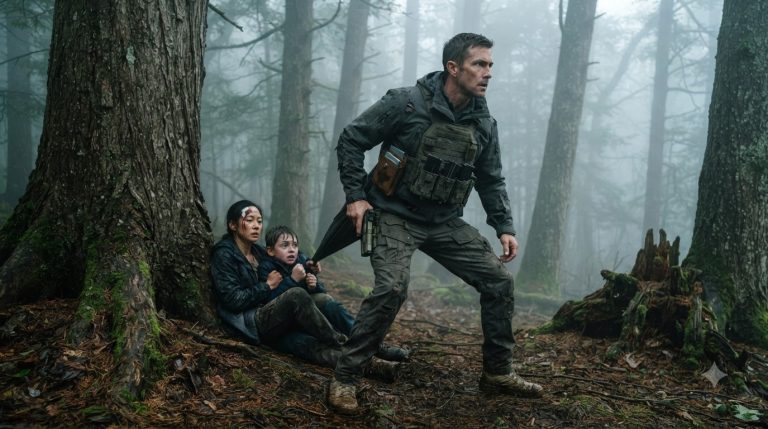
“They won’t catch us here,” Raymond said, his voice dropping into a cold, lethal calm. He found his footing on the side of the ridge, his eyes scanning the terrain. He knew this slope. It was rugged, broken ground, perfect for a man who knew how to utilize shadow and silhouette. He moved with a grace that belied his age, reaching a natural outcropping of granite that overlooked the road.
He unzipped the canvas case. The M40 felt like an extension of his own nervous system. He worked the bolt, the sound sharp and definitive in the cool, mountain air. He didn’t need a scope; he didn’t need the modern ballistic calculators or the Kestrel wind meters. He relied on the memory of the wind, the feel of the elevation, and the tactile connection to a rifle he had carried through hell and back.
Below them, the headlights of the SUV swung around the bend, sweeping the road in long, invasive arcs. The vehicle slowed, then stopped. Doors opened. Men in tactical gear stepped out, their flashlights probing the scrub, the beams cutting through the darkness like searchlights.
“Stay low,” Raymond commanded, his cheek resting against the walnut stock. He wasn’t aiming at the men. He was aiming at the SUV’s front tire, his finger resting lightly on the trigger. He wasn’t going to escalate this into a firefight; he was going to dismantle their ability to pursue.
Crack.
The rifle barked, the report rolling across the ridges like thunder. The front tire of the SUV disintegrated in a spray of rubber and metal. The vehicle dropped, lopsided, its headlights angling into the ditch. The men scattered, ducking behind the open doors, their flashlights swinging wildly toward the hillside.
“They’ve got night vision,” Tyler whispered, clutching his own chest, his eyes wide. “They’ll spot us!”
“Let them,” Raymond said, his voice a low rasp. He cycled the bolt—clack-clack—the movement fluid and polished. He wasn’t a target; he was an obstacle. He sighted the second tire. Crack. Another blowout. The SUV was effectively pinned, a grounded, useless heap of metal.
The men began to return fire, the sounds of suppressed weapons popping like dry branches snapping. Rounds hissed overhead, kicking up dust and stone, but Raymond didn’t flinch. He adjusted his position, his eyes locked onto the muzzle flashes. He was reading them, anticipating their movement, his pulse steadying into the rhythm of the hunt. He wasn’t fighting for land; he was fighting for the ledger, for the locket, and for the promise that had waited nearly six decades to be kept.
“We need to move, Tyler,” Raymond said, sliding backward behind the granite. “They’ll flank the ridge in three minutes. We head toward the high trail. It’s too narrow for them to track us with the SUV.”
“What about the truck?”
“The truck is dead. Like them.”
They retreated into the darkness, moving through the waist-high sagebrush with practiced, low-profile movements. Raymond led the way, his senses hyper-attuned to every sound—the scrape of a boot on rock, the shifting of wind through the crags. He felt the weight of the ledger tucked into his jacket, the physical proof of the depot’s crimes against the memory of men who could no longer speak for themselves.
As they ascended, the ridge widened into a narrow, rocky spine. Below them, the men were beginning to organize, their voices drifting up, harsh and tactical. Raymond knew they were angry now, and that made them predictable. He didn’t turn back. He focused on the path ahead, his breathing rhythmic, his heart steadying into the familiar cadence of a patrol.
He looked at Tyler, who was following close behind, his movements shaky but determined. The boy was learning. He was learning that the world wasn’t a series of data points or transactional interactions, but a place where truth was fought for and earned, often in the quiet, dark corners that people chose to ignore.
They reached the summit of the trail, the night sky opening up above them, the stars cold and distant. Raymond stopped, turning to look back at the valley. The SUV was a dark, brooding shape against the road, the men below looking like insects in the glare of their own flashlights. He had the ledger. He had the truth. And as he turned to face the long, winding descent into the next valley, he knew that the final act of this story wouldn’t be fought at the range or in the depot, but on the ground where the truth mattered most.
He didn’t speak. He didn’t need to. He simply tightened his grip on the rifle, adjusted the strap of the case, and began to move. The night was theirs, and for the first time in a long, long time, Raymond Holcomb felt the heavy, suffocating silence of the war beginning to lift.
CHAPTER 8: The Ledger Closed
The men emerged from the darkness like specters, flashlights cutting jagged lines through the mountain air. Brett Conway was in the lead, his face twisted not by the professional detachment he’d shown at the range, but by raw, jagged greed. Behind him, three others fanned out, weapons raised. They stopped twenty paces away, trapped on the narrow spine of the ridge.
“Drop it, Holcomb,” Conway shouted, his voice cracking with the strain. “You’re an old man with a relic. You have no idea what you’re messing with.”
Raymond didn’t drop it. He didn’t even flinch. He stood firmly, his boots planted on the broken shale, the M40 leveled—not at them, but at the heavy metal briefcase one of the guards held. It was the auction kit, the container holding the physical tokens of stolen lives.
“You speak of relics as if they’re inventory,” Raymond said, his voice carrying clearly over the wind. “But these things aren’t commodities. They are the only remains of men who died to keep your kind of cowardice from consuming the world.”
“They’re dead!” Conway stepped forward, eyes wild. “And their history is just debris. We’ve turned that debris into a functioning model. We’re providing the service of preservation!”
“You’re stripping the bones of the dead,” Raymond countered. He signaled to Tyler, who moved silently behind a pillar of granite, ready. Raymond knew the layout now; the men were clumped, overconfident, believing that age had rendered him passive. They relied on their superior numbers, never expecting a veteran of the Khe Sanh perimeter to use the terrain itself as a weapon.
Raymond fired. Not at the men, but at the loose shale beneath their feet. The shot hit with surgical precision, shattering the unstable rock. The ground beneath the group shifted, a mini-landslide of granite and gravel cascading off the ridge. The men stumbled, their formation collapsing as they fought for balance, their flashlights spinning into the void.
In that second of chaos, Raymond surged forward. He didn’t fight like a man his age; he moved with the brutal, kinetic efficiency of his youth. He shoulder-checked the man with the briefcase, the impact sending the case flying open, its contents—lockets, rings, medals—scattering like confetti across the mountain floor.
Conway lunged for his weapon, but Raymond was already there, the stock of the M40 whipping around in a tight, practiced arc that caught Conway in the jaw, spinning him into the dirt. The others hesitated, blinded by the sudden loss of footing and the absolute, terrifying resolve in Raymond’s eyes.
“Pick it up,” Raymond commanded, gesturing to the scattered relics. “Pick it all up, and keep walking. If you turn back, the next shot isn’t going to be at the ground.”
The men scrambled, terrified by the cold, river-water intensity in the old man’s gaze. They gathered the relics with trembling hands, their tactical arrogance shattered by the reality of a man who had stared into a much larger abyss and hadn’t blinked. As they retreated down the trail, disappearing into the dark, Conway cast one last look back—a gaze filled not with malice, but with a sudden, dawning realization of his own utter insignificance.
Raymond watched them go until the sound of their boots faded into the wind. Then, the adrenaline broke. He sank onto a slab of granite, the M40 resting across his knees.
Tyler stepped out from the shadows, his face etched with awe. He approached slowly and knelt by the scattered items. He picked up the locket—the one tagged Miller, Sarah—and held it out to his grandfather.
“You did it,” Tyler whispered.
Raymond took the locket. It was cold, tarnished, and heavy. He closed his eyes, the smell of the iron and the mountain air merging into a singular, peaceful memory. He thought of Sarah Miller’s brother, the man who had looked at him before the line broke and told him, Just make sure the truth makes it home.
“It’s not just about the items,” Raymond said, his voice soft, the jagged edges of his resolve finally smoothing out. “It’s about the fact that they’re ours again. They don’t belong to a catalog, and they don’t belong to a balance sheet. They belong to the people who earned them.”
He reached out and, with the gentleness of a man who had spent a lifetime holding onto something fragile, he handed the locket to Tyler. “You make sure these get back to the families, Tyler. That’s the rest of the promise.”
The transition was subtle. The silence on the mountain, which had once felt like a barrier, now felt like a blanket. The ghost of the ridge at Khe Sanh seemed to withdraw, satisfied. The M40 felt lighter, its purpose fulfilled. He had come here to protect a legacy, but he had ended up reclaiming his own soul.
They sat there for a long time, watching the first gray light of dawn begin to bleed over the horizon. The range was miles away, a small, insignificant scar on the valley floor. The depot was just an empty building in the dark.
Raymond looked at his hands. They were still, no longer trembling. He touched the walnut stock of the rifle—the companion that had stayed with him for fifty-seven years. He would clean it, oil it, and put it back in its canvas case, and it would remain quiet. But the silence no longer echoed. It was just peace.
“Let’s go home, son,” Raymond said, standing up. He felt the weight of his seventy-six years, but for the first time, it was a weight he could carry. They began the long walk down the mountain, leaving the past behind, one step, one breath, and one clear, quiet realization at a time.