The Silent Ledger of Bryn Holloway: A Story of Unbroken Resolve and Undeniable Vindication
CHAPTER 1: THE ESCALATION AT THE TABLE
The heavy silver Montblanc pen lay right beside my crystal water glass, its polished barrel catching the warm overhead light of the dining room.
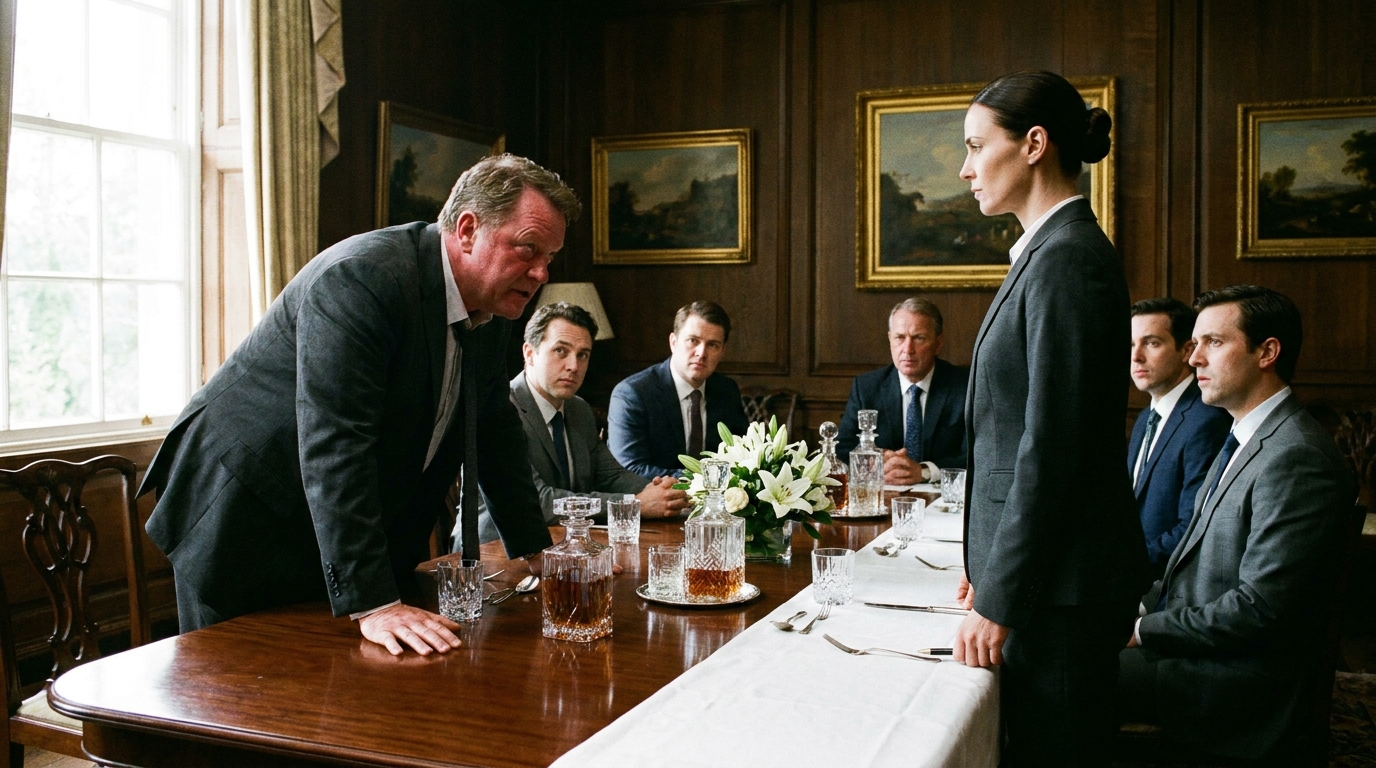
Cade rested his elbows on the mahogany table, swirling three fingers of scotch while six of his top regional associates chuckled at his latest punchline.
“Bryn wouldn’t last seventy-two hours out there without my corporate credit card,” Cade said, his voice carrying easily over the clink of silverware and the soft hum of the air conditioner. “She runs her little laptop projects, sure, but at the end of the day, somebody’s got to pay the mortgage.”
Two men in tailored suits nodded into their napkins, while an executive’s wife flashed me a tight, sympathetic grimace.
I picked up the Montblanc pen, silently unscrewing the threaded cap until the metal threads aligned with a faint, mechanical click.
“Right, sweetheart?” Cade added, turning his head slowly toward me, his eyes glassy from his third glass of whiskey.
I didn’t laugh, nor did I reach for the water glass to mask the pause.
The ambient chatter at the far end of the table faltered, dying out as the silence stretched across the polished wood.
Cade’s smile stiffened, the crease between his brows deepening as he set his glass down hard enough to rattle the ice against the crystal. “What’s the matter, Bryn? Lost your sense of humor?”
“I heard you,” I said softly, resting the uncap-less pen flat against the white linen tablecloth.
Cade leaned forward, his palm slamming flat onto the surface, causing the dessert spoons to jump. “If you’re so miserable sitting at my table, there’s the front door—beg me to stay, or get out tonight.”
The room went completely dead.
I stood up without dragging the chair, picked up the silver pen, dropped it into my side pocket, and walked toward the foyer stairs.
CHAPTER 2: UNSHELTERED STEPS
The cold leather of the steering wheel felt stiff under my palms as I threw the car into reverse.
I didn’t turn around to see if Cade had followed me to the porch; I didn’t need to. The porch light flickered off, a passive-aggressive sign that he expected me to circle the block and come crawling back before the ice in his glass melted.
My left hand sank into my coat pocket, fingers brushing against the solid, metallic cool of the silver Montblanc pen.
Four years of thirty-four-percent profit margins kept in a private offshore ledger, and I hadn’t even bothered to book a hotel room for tonight.
I pulled out onto the main arterial road, the wet asphalt humming beneath the tires as the rain turned into a steady, gray mist.
My phone on the passenger seat lit up, buzzing against the leather cushion. Cade’s caller ID flashed twice before dying. Then came the text: Stop being dramatic. The front door is unlocked for another twenty minutes.
I didn’t answer; I tapped the screen dark and slid the phone face-down into the cup holder.
Instead of heading toward the highway, I pulled into the parking lot of a twenty-four-hour diner behind a row of closed retail banks.
The fluorescent sign buzzed overhead, casting a harsh, flickering light across the cracked dashboard of my station wagon.
I opened my laptop on the passenger seat, the screen illuminating the cabin with a pale blue glow that reflected in the wet side mirror.
My finger hovered over the trackpad, pulling up the secondary encryption key for my independent firm’s master account.
On the backseat floorboards sat my two canvas suitcases—no pre-paid apartment key, no carpeted hallway waiting across town, just sixteen thousand dollars in unallocated liquid retainer funds and three encrypted clients who only knew my voice through a satellite line.
A tap on the driver’s side window made me freeze.
Outside stood an old man in a yellow rain slicker, pointing down at my front tire with a rusted tire iron.
“You’re riding on a flat, lady,” he rasped through the glass, his voice barely cutting through the engine’s dull idle.
I looked in the side mirror and saw the rear right wheel slumping low against the wet concrete, the rubber pinched against the rim.
I closed the laptop with a quiet click, tucked the Montblanc pen back into my inner jacket pocket, and reached for the door handle.
CHAPTER 3: THE COLD MACHINERY
The rubber was completely sliced along the sidewall—an old utility staple stuck through the tread like a rusted needle.
The man in the yellow slicker wiped his nose with the back of his sleeve, leaning his weight against the tire iron. “Spare’s under the trunk liner, I reckon. But you ain’t changing it in this downpour without a decent jack.”
“I have a bottle jack under the driver’s seat,” I said, unzipping my coat just enough to pull my work gloves from the side pocket. “And twenty dollars if you hold that flashlight steady.”
He didn’t argue. He clicked on a heavy plastic lantern, bathing the wheel well in sharp white light while I got down on one knee against the damp pavement.
My hands worked on instinct—loosening the lug nuts before cranking the rusty iron piston until the wheel cleared the rim.
Living with Cade for twelve years had taught me one fundamental truth: if you wait for someone else to fix your breakdown, they will charge you for the rest of your life.
Twenty minutes later, the compact spare was bolted tight, my knuckles brushed red from the icy rain, and the old man was pocketing my folded bill.
I didn’t head to a hotel. I drove straight to a 24-hour workspace facility on the south edge of the industrial park—a windowless brick building where independent contractors rented desks by the hour.
By 2:15 AM, my laptop was connected to the high-speed line, two hot mugs of black vending-machine coffee sitting on the laminate table next to my silver Montblanc pen.
I pulled up the central server logs for Mercer Logistics, Cade’s firm.
For four years, Cade had assumed I was sitting in the spare bedroom browsing home decor blogs while he signed quarterly distribution agreements.
He never noticed that his firm’s entire compliance routing framework relied on a proprietary software license registered under my maiden name’s single-member LLC.
I clicked the management console, unscrewed the cap of the Montblanc pen, and executed a silent update to the API access tokens.
I didn’t lock him out. I simply removed my auto-renewal authorization, letting the software revert to its standard thirty-day audit cycle.
Without my background maintenance scripts quietly cleaning up missing bill-of-lading entries, his client portals would begin generating automated compliance flags by morning.
My phone buzzed against the desk. A email notification popped up on the screen—a direct inquiry from Apex Freight, Cade’s second-largest enterprise client.
Bryn, we haven’t received the updated compliance clearance for Q3. Cade’s assistant said you handle the portal backend. Can you confirm status?
I set the pen down, staring at the glowing text. I didn’t forward the email, nor did I reply with excuses.
I simply typed a concise, professional note: Please contact Cade Mercer directly for all administrative and operational matters moving forward.
I clicked send, closed the laptop lid, and leaned back in the plastic chair, feeling the cold exhaustion finally sink into my shoulders as the first domino clicked against the second.
CHAPTER 4: FRACTURES IN THE ARMOR
A sharp knock rattled the glass door of my rented workspace pod, breaking the hum of the fluorescent lights overhead.
I didn’t flinch. I slowly capped the Montblanc pen, its metallic click echoing against the bare drywall, before opening the door to find Marcus—Apex Freight’s senior operations manager—holding a thick leather folder.
“Bryn,” Marcus said, his collar unbuttoned, a faint sweat sheen glinting on his forehead. “Cade isn’t answering his personal line, and his main office secretary is claiming the server migration is just a temporary glitch.”
“It isn’t a glitch, Marcus,” I replied, stepping back to let him see the glowing monitor. “The API keys expired at midnight. The automated verification protocols for your Q3 shipments require manual compliance clearance.”
Marcus dropped the heavy folder onto the laminate table, his eyes darting across the error codes. “Cade told us last quarter that your consulting group was just an internal administrative buffer. He said you only handled basic data entry.”
“Cade says a lot of things at dinner parties,” I said quietly, reaching down to align the red leather-bound ledger resting on the edge of the desk. “The reality is that my LLC holds the distribution architecture license. Without my digital signature, every truck leaving your bay tomorrow morning is legally unverified.”
Marcus pulled out a chair, sitting down with a heavy sigh that smelled faintly of stale coffee. “He’s going around telling clients you took off with company assets after a domestic disagreement. He’s threatening to freeze your joint accounts by noon.”
“Let him try,” I said, tapping the trackpad to display the LLC’s independent tax filings. “Those accounts were severed three years ago. The retainer fees Apex paid were routed directly through my proprietary network key, not Cade’s personal accounts.”
Marcus stared at the breakdown, his jaw tightening as the realization settled in. “He doesn’t even know how his own backend works, does he?”
“He never bothered to ask,” I said, standing up and tucking my laptop into my satchel. “He assumed I was just keeping myself busy while he paid the bills.”
My phone vibrated violently against the desk. Cade’s name flashed on the screen, followed by three rapid-fire text messages: Where are the master encryption keys? You have ten minutes to send them over or I’m filing a police report for corporate sabotage.
I didn’t type a reply. I showed the screen to Marcus, whose face hardened into a mask of pure corporate pragmatism.
“Tell him to file it,” Marcus muttered, pulling out his own phone and dialing his legal team. “Because if my fleet is grounded at six tomorrow morning, Apex is pulling our contract and suing Mercer Logistics for breach.”
I pulled my coat over my shoulders, picked up my two canvas suitcases, and walked out into the corridor, leaving Cade’s second-largest client standing in the middle of my office.
CHAPTER 5: THE CORNERED COUNTERMOVE
“—and if you don’t bring those compliance keys to my lawyer’s office by two o’clock, Bryn, I’m signing an emergency injunction,” Cade snapped, his breath raspy over the line. “I’ll have a judge freeze every dollar in your name before the bank closes.”
I pulled the phone away from my ear, clicked the end-call button without saying a word, and walked toward my station wagon.
At 1:55 PM, I pushed open the frosted glass doors of his attorney’s suite in the financial district.
Cade was already sitting at the end of a long oak conference table, his tie loosened, a dark coffee stain ringing his dress shirt collar.
Beside him sat his attorney, Mr. Vance, who had two thick manila folders spread across the mahogany surface.
“You made a massive mistake coming here alone, Bryn,” Cade said, leaning back in his chair, a manic, strained smile pulling at the corners of his mouth. “You think you can play corporate hardball because you handled a few administrative files? Vance has already drafted the filing. You misappropriated proprietary software developed during our marriage.”
I walked over to the table, pulled out a chair, and sat down directly across from him.
From my coat, I pulled out the silver Montblanc pen and set it squarely in the center of the oak surface.
“Show her the asset claim, Vance,” Cade ordered, slapping his hand against the wood. “Let her see what happens when she tries to destroy my company over a bitter impulse.”
Mr. Vance cleared his throat, adjusting his wire-rimmed glasses with a slight tremble in his hand. “Mrs. Holloway… or Mrs. Mercer… my client’s position is that your consulting entity operates as a subsidiary of Mercer Logistics—”
“Read the corporate registration date on page four, Mr. Vance,” I interrupted softly.
The attorney paused, flicking through the pages of his own folder until his eyes stopped on a stamped state seal.
“The LLC was formed eighteen months before I ever met Cade,” I said, my voice completely steady. “The proprietary routing system wasn’t developed during our marriage. I licensed it to Mercer Logistics under a limited five-year vendor agreement.”
Cade’s smile vanished. He jerked forward in his seat, glaring at his lawyer. “What is she talking about? She didn’t have a business before me. She didn’t have anything!”
“Page nine,” I continued, tapping the barrel of the Montblanc pen against the wood. “That’s the vendor agreement Cade signed four years ago when he wanted to cut third-party software overhead. He signed it right after a holiday party, assuming it was a standard IT maintenance waiver.”
Mr. Vance’s face drained of color as he scanned the signature line on the document I had provided through my counsel an hour earlier.
“Cade,” Vance whispered, leaning over to his client. “This isn’t a spousal asset. This is an independent vendor contract. If she terminates the API license for non-payment, Apex Freight isn’t the only client that can freeze your receivables—every regional carrier you sub-contract with will be legally required to suspend operations.”
Cade slammed both fists onto the table, his chair scraping violently against the hardwood floor. “She tricked me! She sat in my house, eating my food, using my internet, and set a trap!”
“I didn’t set a trap, Cade,” I said, unscrewing the cap of the silver pen with a slow, deliberate twist. “I simply built a business while you were busy telling everyone I couldn’t survive without you.”
“I’m not paying you a dime!” Cade roared, his eyes bloodshot, veins bulging along his neck as he pointed a trembling finger at my face. “I’ll burn the company to the ground before I let you walk away with a single contract!”
“You won’t have to burn it,” I replied, screwing the cap back onto the pen with a final, quiet click. “It’s already falling down.”
CHAPTER 6: THE QUIET AFTERMATH
“You think this makes you clever?” Cade spat, his voice dropping into a harsh, erratic whisper. “Vance, tell her. Tell her we’re filing a counter-claim for tortious interference. I’m taking half of your client retainers.”
Mr. Vance closed his manila folder with a heavy, final thud. “Cade, sit down. We have no legal standing, and Apex Freight just canceled their distribution master contract three minutes ago via certified email.”
Cade blinked, his chest heaving under his stained collar as he looked from his lawyer to the unsigned papers between us.
“Sign the corporate release, Cade,” I said, sliding my silver pen across the wood toward him. “Or the audit logs go directly to the state licensing board before five o’clock.”
He grabbed the pen, his fingers trembling so violently that the point tore through the first signature line, leaving a jagged black blotch across the parchment before he shoved the paper back toward me.
He didn’t wait for his attorney to hand him his briefcase. He turned on his heel, slammed the conference room door so hard the glass pane rattled in its frame, and walked out into the corridor.
Mr. Vance let out a low, exhausted breath, stamped the remaining legal copies with his notary seal, and pushed the original file into my hands. “It’s finished, Mrs. Holloway. The separation is absolute.”
I slipped the Montblanc pen back into my coat pocket, picked up my satchel, and walked out of the building.
The rain had stopped, leaving the downtown pavement damp and dark under the afternoon sun.
I drove out to my new lease—a modest, quiet two-bedroom brick office with a small desk facing the window, signed and paid for that very morning with my own verified business funds.
I sat down at the wooden desk, set my coffee cup next to the trackpad, and opened my laptop.
There were no emergency notifications flashing across the screen, no angry text messages buzzing against the desk, and no demands for my silence or my gratitude.
I unscrewed the cap of the silver pen, drew a single, clean line through the final balance entry in my red leather ledger, and clicked the book shut.