The Architect of Silence: How One Woman’s Quiet Precision Dismantled a Kingdom of Engineered Lies
CHAPTER 1: The Weight of Stillness
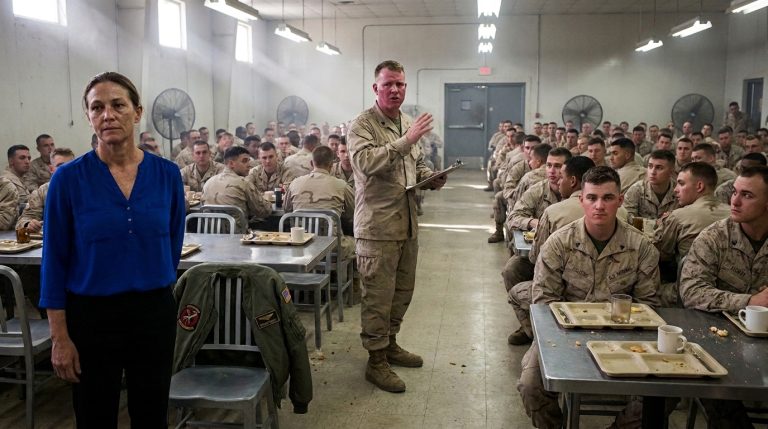
The chow hall at FOB Dagger was not a place for contemplation. It was a cavern of sheet metal and bad lighting, vibrating with the aggressive pulse of three hundred souls operating at maximum capacity. The air was a thick, suspended sludge of diesel exhaust and scorched rice, a texture that settled on the tongue like wet ash.
Commander Grant Thorne sat at the head of the long table, the undisputed gravity well of the room. He was a man composed of hard angles and calculated volume, his voice a rhythmic, percussive weapon that kept his subordinates in a state of perpetual, anxious alignment. He was deep into a story about a drop-in raid, his hands moving through the air with the grace of a man who owned the very oxygen he was displacing.
Around him, the chorus of younger operators offered the expected ripples of laughter, a rhythmic tide of validation. Thorne thrived on it; the sound was the fuel for his engine, the proof of his hierarchy.
Then, there was the corner.
Dr. Evelyn Reed occupied a small, two-top table near the blast-hardened wall. She was a study in profound, alien stillness. While Thorne was a storm of noise, she was the eye. Her khaki shirt was unwrinkled, her posture a vertical line of perfect, economical grace. She was currently engaged in the slow, mechanical cleaning of her wire-rimmed glasses, a microfiber cloth moving in precise, circular orbits.
The clatter of the chow hall—the scraping of metal trays, the shouted conversations, the slamming of heavy doors—seemed to break against her solitude like water against stone. She didn’t look up. She didn’t flinch. She simply existing in a space that Thorne’s magnetic reach could not penetrate.
Thorne paused, the punchline of his story dying in his throat as the rhythmic silence from the corner registered. He looked over, his eyes narrowing. It wasn’t the refusal to listen that grated on him; it was the fact that her indifference was so absolute it threatened to render his entire performance invisible. To Thorne, silence was a vacuum, and he was pathologically driven to fill it with himself.
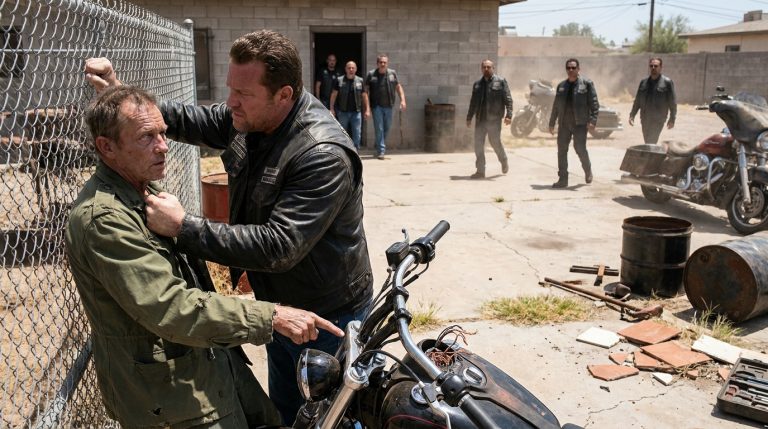
He pushed his chair back. The metal legs shrieked against the linoleum, a sound like tearing fabric that silenced the immediate area. Thorne rose, his stature seemingly expanding, and began to traverse the room. His walk was slow, deliberate—the measured pace of a man who believed his presence alone was a mandate.
He stopped in front of her table. He didn’t speak. He simply stood, allowing his massive frame to block the overhead fluorescent lights, casting a long, shadow-drenched shroud over her work.
Evelyn Reed did not look up immediately. She finished the final pass on her right lens, held the glasses up to the light to check for smudges, and then, with agonizing deliberation, settled them back onto the bridge of her nose. Only when the frames were perfectly seated did she lift her head. Her eyes, cool and gray as an unpolished stone, met his.
“Is there something you require, Commander?”
The voice was a flat, surgical instrument. There was no fear in it—no deference, no hesitation. It was a query stripped of all social hierarchy, a simple, cold-blooded observation of a nuisance.
Thorne felt the heat prickle at the back of his neck, a sharp, unpleasant friction. He had expected a reaction he could mold, a flicker of vulnerability he could exploit to restore his dominance. Instead, he was met with a mirror that reflected only his own agitation.
“This is a forward operating base,” Thorne said, his voice dropping into that low, dangerous register he used for threats. “And you are taking up space that belongs to men who are actually doing the work.”
Reed looked down at her book, the pages thin and dense with technical schematics. “I am precisely where I am authorized to be, Commander,” she replied, her tone never wavering. “Efficiency is rarely found in the middle of a shouting match.”
She didn’t just ignore him; she categorized him. And in the sharp, sudden quiet that followed her statement, Thorne realized with a jolt of genuine, terrifying clarity that he had just been dismissed by the one person on the base he couldn’t afford to lose.
CHAPTER 2: The Geometry of Friction
The silence in the chow hall did not return to its previous state. It had been punctured, stretched thin by the weight of Thorne’s heavy, retreating boots. Evelyn Reed remained seated, her hands resting on the laminated surface of the small table. She watched the way the light caught the dust motes dancing in the air, a chaotic, swirling pattern that felt entirely predictable compared to the man who had just stood over her.
She picked up her microfiber cloth, her movements as controlled and rhythmic as a ticking clock. She knew the mechanics of ego as well as she knew the architecture of the satellite array. It was a predictable variable: heat, expansion, collision. Thorne was a localized pressure system, and he would not simply dissipate because she had refused to engage. He would reorganize. He would escalate.
She stood, her chair making only the faintest sound against the floor, and exited the chow hall. The corridor was a narrow, dimly lit vein of corrugated steel, smelling of industrial cleaner and the dry, persistent scent of the desert that bled through the ventilation shafts. As she walked, her mind drifted—a rare, intrusive flicker—to a training facility in Virginia, years ago. A senior instructor had tried the same tactic, using volume and physical intimidation to override a protocol breach he hadn’t understood. She remembered the way his face had turned that same shade of flushed, desperate red when he realized the system didn’t care about his rank. It was a phantom memory, a cold, sharp echo that reminded her that humans were the least reliable components in any secure network.
She reached her workspace, a converted shipping container that served as her secure hub. The interior was sparse: a desk, a high-density workstation, and a series of encrypted drives locked in a wall-mounted safe. As she sat down, the familiar hum of the server banks began to soothe the irritation Thorne had caused. It was a clean sound. Honest.
She opened her encrypted log.
[2026-07-04 16:12:00] – Subject: Commander G. Thorne. Incident: Public confrontation, Chow Hall. Nature: Attempted physical intimidation. Status: Unresolved. Escalation probable.
She logged the entry with the same detached precision she used for code debugging. It was not about grievance; it was about documentation. In the event of a total network failure, the human errors surrounding the maintenance ports would be the first things investigators would look for. She wasn’t just a technician; she was the architect. An architect didn’t get angry at the wood for warping under heat; she simply noted the flaw and planned for the inevitable break.
A sudden, sharp knock at the door disrupted her focus. It was not the tentative tap of a subordinate, but the firm, rhythmic strike of someone who carried their own authority.
Reed did not look up from the screen immediately. She finished the line of data entry, saved the file, and then rotated her chair.
Master Chief Petty Officer Aaron Sullivan stood in the doorway. He was a lean, weather-beaten man, his uniform pressed with a sharpness that defied the grime of the base. His eyes, deep-set and weary, held a quality of observation that Reed recognized immediately. He was a collector of patterns, just as she was.
“Commander Thorne is currently briefing his inner circle in the tactical bay,” Sullivan said. His voice was gravelly, low, and devoid of the performative boom Thorne relied on. He didn’t enter the room; he remained in the threshold, watching her with a cautious, steady gaze. “He’s feeling the edge of the blade, Doctor. He won’t let this slide.”
Reed adjusted her glasses, her posture remaining perfectly upright. “The Commander’s emotional regulation is outside the scope of my responsibilities, Master Chief. I am here to ensure the integrity of the Series 9 downlink.”
Sullivan offered a thin, ghost of a smile. It didn’t reach his eyes, which remained fixed on the console behind her. “You’re the first person on this base who hasn’t flinched at him in five years. That alone is going to make you a target. Thorne doesn’t just want you to leave; he wants you to admit he’s the authority here.”
“Authority is a function of competence,” Reed repeated, her tone matter-of-fact.
“In the real world, maybe,” Sullivan replied, stepping slightly further into the room. “But out here, in the dust? Perception is the only currency that counts. If he can’t break your focus, he’ll try to break your environment. He’ll find a way to make it look like you’re the one failing, not him.”
Reed looked back at her monitors. The scrolling green data was steady, the sync rates perfect. “Then he will find himself very disappointed, Master Chief. I have accounted for every possible failure point.”
She felt Sullivan’s gaze linger for a moment longer before he turned to leave. As the heavy steel door clicked shut, the silence of the container seemed to amplify, a heavy, expectant quiet. Reed sat still, the reflection of the data streams shimmering on the lenses of her glasses. Thorne wasn’t just a problem to be avoided; he was an anomaly that was beginning to threaten the project’s threshold parameters. She picked up a small, black stylus and tapped it against the desk, once, twice. The friction was beginning to build. And as any good engineer knew, once the friction reached a critical point, a spark was inevitable.
CHAPTER 3: The Auditors Record
Master Chief Sullivan walked out of Dr. Reed’s container and into the raw, abrasive air of the base. The wind was picking up, carrying the fine, talcum-like grit that defined life at FOB Dagger. He pulled his collar up, but the dust still found its way into the creases of his neck, a constant, abrasive reminder of the environment he served in. He wasn’t thinking about the storm, though. He was thinking about the way Reed had looked at him—not with the standard deference paid to his rank, nor the fear shown to Thorne, but with the flat, analytical clarity of a scientist observing a specimen.
He made his way toward the administrative office, a repurposed trailer that smelled perpetually of stale coffee and hot electronics. His mind was a catalog of thirty years of service, a library of faces and failures, and Evelyn Reed was a book he didn’t quite know how to categorize.
Inside the office, he sat at his desk, the space cramped and lit by the sickly yellow glow of overhead fluorescents. He pulled the day’s duty logs toward him. This was the mundane machinery of war—patrol schedules, fuel consumption reports, weapon maintenance logs. He spent an hour scanning the rows of data, looking for the usual discrepancies: a misplaced decimal point, a missed signature. But today, he was looking for something else. He was looking for the shadow of Thorne.
He cross-referenced the patrol logs with the access records for the secure tactical sub-grid. There it was, subtle but unmistakable. Two nights ago, at 02:00 hours, there had been an unauthorized manual override at the primary communications node. The log identified the credentials as ‘Admin-Alpha,’ a high-level override code that should have required a multi-signature authentication. Only, the record showed only one: Thorne.
Sullivan sat back, the chair groaning under his weight. Thorne had been playing with the firewalls, likely trying to force a diagnostic scan to show off his tactical “versatility.” He hadn’t just been posturing; he had been compromising the very systems he was supposed to be protecting. The arrogance was staggering.
He didn’t report it. Reporting it to the current base commander would be a circular exercise in futility; Thorne had groomed the current leadership to look the other way, or worse, to view his “aggressiveness” as an asset. Instead, Sullivan did what he had done his entire career: he started a parallel file.
He reached into the bottom drawer of his desk, pulling out a plain, government-issue notebook—identical to the one he had seen on Reed’s desk. He began to write, his pen moving with the methodical, unhurried pace of a man building a case.
Date: 04 July. Subject: Commander G. Thorne. Incident: Unauthorized access to sub-grid nodes. Reference: Log ID 8892-Alpha. Observation: Systematic disregard for protocol in favor of ego-driven performance.
He wasn’t acting on emotion. Sullivan had seen men like Thorne break before, and the pattern was always the same: they built a facade of strength that was inherently brittle because it lacked a foundation of true competence. They survived as long as the environment remained stable, but as soon as the pressure spiked, the cracks widened.
He paused, looking up as the door creaked open. A young Corporal, one of the newer recruits, stepped in, looking nervous.
“Master Chief? The Commander wants a review of the personnel files for the upcoming security rotation. He says the current roster is… ‘inefficient.’”
Sullivan looked at the kid. The boy was shaking slightly, his eyes darting toward the door as if expecting Thorne to walk in at any moment. The fear in the room was palpable, a thick, suffocating thing that Thorne had cultivated like a garden.
“Tell the Commander I’ll get to it when the audit is complete,” Sullivan said, his voice flat and neutral.
“He said… he said he wanted it on his desk by end of shift, Master Chief. Or he’d come down here to ‘assist’ with the process.”
Sullivan didn’t blink. He simply returned his gaze to the notebook. “Tell him the audit takes as long as it takes. Dismissed.”
The Corporal scrambled out, clearly relieved to be escaping the crossfire. Sullivan watched the door close. He felt the weight of the moment. Thorne was pushing harder, desperate to solidify his control before the shifting winds of the base turned against him.
He went back to his logbook. He added another detail: Observation: Atmosphere of intimidation directed at junior staff. Intent: Forced compliance through threat of personal intervention.
He knew, with a certainty that settled in his bones, that this wasn’t just about personnel files or patrol rotations. This was a slow-motion collision. On one side, a man desperate to be a legend; on the other, a woman who simply existed as a force of nature. Sullivan was the only one in the middle, the witness and the record-keeper. He closed the book, the thud of the cover sounding like a gavel in the quiet room. The storm outside was intensifying, the howling wind rattling the frame of the trailer. The base was a ship in a tempest, and the captain was actively trying to tear out the navigation controls. Sullivan stood, tucking the notebook into his inner jacket pocket, right against his chest. He would keep his eyes open. The truth, as Reed had demonstrated, didn’t need to be shouted; it just needed to be documented.
CHAPTER 4: The Fracture of the Shamal
The transition from a manageable tension to a full-blown catastrophe began with the light.
Inside the tactical trailer, the overhead fluorescents didn’t just flicker; they dimmed, casting long, erratic shadows that seemed to claw at the walls. Outside, the wind had ceased its erratic buffetings and shifted into a constant, low-frequency roar that vibrated the metal skin of the base. The shamal had arrived. It was a solid wall of iron-red dust, erasing the horizon and turning the world into a claustrophobic, monochrome nightmare.
Commander Grant Thorne stood in the center of the Tactical Operations Center, his hands planted firmly on a console. He was breathing heavily, his chest rising and falling with an aggressive cadence. Around him, the room was a hive of frantic, disciplined movement. Technicians were shouting over the rising howl of the storm, their voices tight with the thin, metallic edge of impending failure.
“Status!” Thorne barked. The sound of his voice was jarring, an attempt to assert dominance over the wind, but it sounded hollow, thin against the encroaching chaos.
“Comms are unstable, Commander!” the lead technician yelled back, his fingers flying across his keyboard. “The satellite link is oscillating. We’re losing packet integrity.”
Thorne leaned over the technician’s shoulder, his shadow pinning the man to the console. “Force the handshake. I don’t care about integrity, I care about the uplink. We are tracking a target, not watching a movie. Override the safety protocols if you have to.”
“I can’t, sir! The system architecture—”
“I don’t care about the architecture!” Thorne’s shout was a physical force, causing the technicians to flinch. “I am the ranking officer! You will find a way to make it connect, or I will find someone who can.”
The technician stopped, his face pale, and began inputting commands. The console groaned under the strain, lines of code flashing red. Thorne watched the screen with a predatory intensity, his jaw set in a hard, uncompromising line. He was convinced, at the core of his bruised ego, that this was merely a technical hurdle, a challenge to his will that he could beat into submission with enough volume and force.
Evelyn Reed stood in the back of the room, her presence so quiet that the staff barely registered her. She had arrived minutes ago, not at Thorne’s request, but because she had felt the exact moment the base’s internal clock sync had begun to drift. She watched the primary diagnostic monitor. The error was beautiful in its complexity: a cascading failure triggered by the atmospheric shift, a perfect storm of technical oversight. Thorne, in his ignorance, was trying to hammer a screw into a clock mechanism.
She didn’t intervene. Not yet. She observed. She watched how Thorne pushed his subordinates, how he leaned into the danger, his posture rigid and unforgiving. He was a man who looked at a mountain and demanded it move, entirely unaware that the mountain was already collapsing.
A sudden, violent tremor shook the container. The lights cut out completely for three seconds, replaced by the red, pulsing glow of the emergency power supply. When they came back on, the primary satellite feed screen went blank.
“Signal lost,” the technician whispered, his voice stripped of all professional inflection.
Thorne turned, his face a mottled, angry red. He paced the small area of the TOC like a caged animal. “This is unacceptable. This is incompetence.” He looked around the room, his eyes scanning the faces of his staff, looking for a target for his frustration. His gaze finally landed on Reed. She was perfectly still, her hands clasped in front of her, her face reflecting the red strobe of the emergency lighting.
“You,” he growled, stepping toward her. “You’re the systems expert. Tell me why my network is dead.”
Reed didn’t blink. She met his gaze with a terrifying, cool indifference. “The network is not dead, Commander. It is merely protecting itself from an unauthorized diagnostic override.”
Thorne froze. The air in the room seemed to go thin. The howl of the shamal outside grew louder, a discordant, maddening sound that filled the silence.
“What did you say?” he hissed, stepping so close his jacket brushed her shoulder.
“I said the system has entered a lockdown state,” she replied, her voice steady and rhythmic. “The protocols you are forcing are being interpreted by the system as an external threat. You aren’t losing the uplink, Commander. You are effectively destroying it.”
Thorne’s hand reached out, his fingers twitching toward her shoulder as if to grab her, but he stopped. The entire room had gone dead silent. The technicians, the analysts, even the officers who usually hung on his every word—they were all watching. Thorne stood there, trembling, trapped between his desperate need for control and the clinical, freezing truth of the woman in front of him.
He didn’t know it yet, but the trap was set. He had spent his entire career building a house of cards, and he had just handed the architect the matches.
CHAPTER 5: The Cassandra Override
The air in the Tactical Operations Center felt as though it had been ionized. The constant, low-frequency hum of the servers had been replaced by the ragged, rhythmic clicking of the emergency power relays—a dry, mechanical heartbeat struggling to sustain the base’s dying nervous system.
Thorne stood motionless, his shadow stretching long and jagged across the floor tiles. He was still staring at Reed, his hand hovering in the empty space between them. For a man who had built his existence on the concept of absolute, unyielding forward momentum, he had reached a sudden, grinding halt. The room was deathly quiet, the only sound the frantic scratch of the shamal against the exterior of the container, a sound like thousands of fingernails clawing at the metal.
“Move,” Reed said. Her voice was not a request; it was a spatial instruction, as detached and authoritative as a line of code.
Thorne’s throat worked, a dry, guttural sound of frustration. He looked at the technician, then back at Reed. “You think you’re in charge here? You think a few fancy words and a mysterious tablet make you the god of this machine?”
He didn’t wait for an answer. He turned sharply, his combat boots hammering against the metal grating as he lunged for the main console. He intended to physically pull the server rack’s power feed, a final, desperate act of destruction that would at least ensure that if he couldn’t control the system, no one could.
He didn’t make it.
The console itself groaned, a spark of blue-white electricity dancing from the port as the system entered its final, defensive stage. The emergency power’s erratic pulse caused the rack to shudder, and Thorne slipped, his heavy frame slamming into the edge of the desk. He hit the metal with a sickening thud, his breath escaping him in a sharp, involuntary wheeze.
Reed didn’t move to help him. She stepped around the sprawling, struggling figure, her movements economical and fluid. She reached the main maintenance port just as the secondary breakers began to blow.
“The diagnostic fail-safe is active,” she said, her voice remaining perfectly level, even as the room plunged into a deeper, dimmer shade of red. “The system is isolating all non-essential hardware to preserve the core kernel. If you continue to fight the throughput, the entire node will wipe its own memory to protect its security architecture.”
The lead technician, still huddled at his workstation, looked up at her, his eyes wide. “What do I do, ma’am?”
Reed pulled a small, ruggedized tablet from her vest pocket—a device that looked entirely out of place amidst the heavy, military-grade hardware. “Connect this to the maintenance port. Now.”
The technician scrambled to obey. Thorne, regaining his footing, staggered toward them, his face a mask of purple, vein-throbbing rage. He looked like a cornered animal, his eyes wild and unfocused. “Stop! That’s an order! I will have you court-martialed for—”
“You will be having a very long conversation with the Inspector General, Commander, but it won’t be about me,” Reed interrupted. She tapped the screen of her tablet, and for a fleeting second, the red strobe of the emergency lighting caught the reflection of a complex, cascading interface. It wasn’t standard military software. It was something deeper, a layer of logic that looked more like architecture than code.
“Password,” she commanded.
The technician hesitated, then typed: P-A-L-A-D-I-N-7-9-4.
The effect was immediate and physical. A low, vibrating thrum began to emanate from the floorboards, the frequency increasing until it rattled the teeth in Thorne’s jaw. The main diagnostic screen—previously a void of dead red—erupted into a symphony of emerald-green. Streams of data, complex and beautiful, began to cascade down the display, a torrential flow of information restoring the system to full operational status.
Thorne stood paralyzed, watching the screen. He was witnessing the impossible. He had spent his entire tenure here believing he was the pilot of this ship, never realizing he was merely a passenger in a vessel he had no capacity to understand.
The room began to brighten as the auxiliary power stabilized, and the high-bandwidth link flickered to life. A crystal-clear satellite map of the region appeared on the primary wall display, the terrain rendered in stunning, real-time detail.
Reed stood up, her posture returning to that state of calm, impenetrable verticality. She pulled the tablet away and began the methodical process of wiping it down with her cloth. Thorne watched her, his face gradually draining of color, replaced by the hollow, empty look of a man watching his foundation crumble. He tried to speak, to frame some defense, to grasp at the shreds of his authority, but his voice wouldn’t come.
The silence in the TOC was absolute. It was the silence of a hundred soldiers realizing, in one unified moment, that the predator they had been feeding was nothing more than a ghost.
Reed turned to the technician. “The system is restored. Maintain the sync at 0.004 millisecond increments. If it drifts again, initiate the Cassandra override manually.”
She looked at Thorne one last time. There was no triumph in her expression, no malice, no pity. Just a profound, distancing apathy. He was not a man to her; he was a variable that had been accounted for and effectively zeroed out. She turned and walked toward the door, her pace steady and unhurried, leaving the Commander of FOB Dagger standing in the wreckage of his own illusions.
CHAPTER 6: The Briefing Room Ambush
The corridors of FOB Dagger were narrow, claustrophobic arteries of corrugated steel. As Evelyn Reed walked away from the Tactical Operations Center, the rhythmic tap of her boots on the metal floor grating seemed to echo with an unnatural, piercing clarity. She did not look back. She did not need to. The structural integrity of the base was no longer her concern; she had stabilized the nodes, and that was the only metric that mattered.
Behind her, in the TOC, Commander Grant Thorne remained frozen. He was still watching the door, his posture a jagged, broken reflection of his earlier swagger. The red strobe of the emergency light had settled into a steady, pulsing glow, illuminating the wreckage of his command. His chorus—the younger operators and support staff who had once echoed his every sentiment—were suddenly, jarringly busy. They were staring at their screens, adjusting gauges, tapping at keyboards, their heads bent at angles that screamed of calculated avoidance.
The air in the room was no longer filled with the weight of his voice; it was filled with the weight of his irrelevance.
Thorne turned, his face tight, the vein in his temple throbbing like a trapped insect. He ignored the eyes he felt on his back. He had one final, desperate move. The briefing room. The high-level operational session was still scheduled to begin in twenty minutes. If he could reassert his command structure there, if he could project a final, decisive image of leadership to the assembled officers, he could perhaps anchor his status before the news of his failure permeated the entire base.
He moved through the corridor, his pace uneven. He was a man who had always walked with a predatory grace, but now, he dragged his boots. Each step felt heavier than the last, as if the floor itself was resisting his progress. He arrived at the briefing room to find it filling up. Analysts, team leads, and mid-level officers were filing in, their hushed conversations dying down the moment he entered.
He didn’t wait. He saw Reed standing near the back, her tablet in hand, already reviewing data for the next phase of the operation. The sight of her—calm, composed, utterly unaffected by the chaos of the last hour—was like a physical assault.
“You,” Thorne said, his voice a jagged, gravelly rasp. He pushed his way through the room, the officers scrambling to step out of his path. The friction in the room was palpable; you could feel the way the air shifted as he moved, a turbulent, localized distortion.
Reed didn’t look up immediately. She was finishing a notation on her screen, her finger tracing a line of data with clinical precision. Only when she was done did she raise her head. Her expression was the same neutral, glass-like surface Thorne had faced earlier.
“The room is for mission planning, Commander,” she said, her voice quiet but carrying clearly across the expectant silence of the briefing room. “I suggest you take your seat.”
“I am the ranking officer!” Thorne roared. The sound was too loud, too desperate; it didn’t command; it pleaded. “I am making a command decision. You are a distraction. You are a security risk. Get out of my briefing room.”
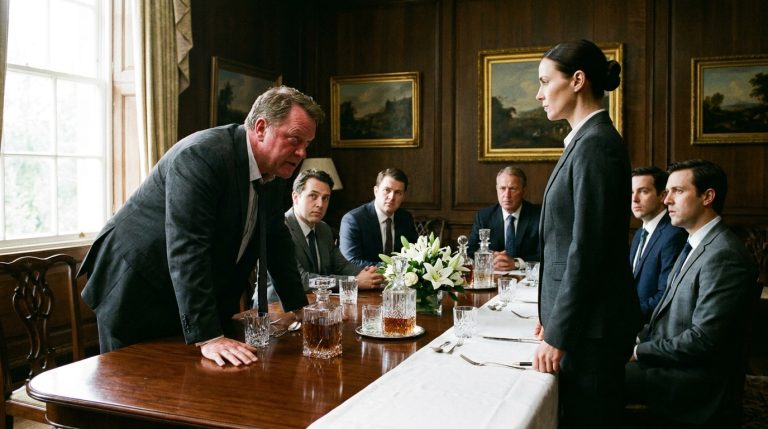
He reached out, his hand clamping onto her upper arm. His fingers were white-knuckled, digging into the khaki fabric of her vest with a violence that made the officers standing nearby gasp. It was a stupid, base-level move, a primal reaction from a man who had run out of chess moves.
Reed did not flinch. She didn’t lean away. She simply looked down at the hand clamped on her arm, then back up at his eyes. Her gaze was not fearful; it was chillingly, scientifically observant. She was cataloging the erratic pulse in his neck, the slight tremor in his grip, the desperate, hollow madness in his eyes.
“Commander,” she said, her voice dropping to a low, cold monotone that seemed to freeze the blood of everyone listening. “I would advise you to reconsider your course of action. Your nervous system is already operating at a deficit. Escalation will only accelerate your systemic failure.”
Thorne’s face turned a violent, blotchy purple. “I am in command here!” he shouted, his voice cracking. He yanked at her arm, trying to force her toward the door.
The room was a pressure cooker, the air thick with the smell of dust and the metallic tang of impending disaster. Every person in the room—every veteran, every analyst—was watching, their breath held. It was the micro-second before the cliff edge, the heartbeat of silence before the final, irreversible drop. Thorne was a man who had spent his life fighting for air, and in his desperation, he had finally reached out to choke the very thing that provided it. He didn’t know it, but he was standing on the precipice of his own history, and all he had to do was let go to fall.
CHAPTER 7: The Generals Entrance
The briefing room door hit the wall with a report like a gunshot. The sound cracked through the tension-thick air, drawing every eye toward the entrance. General Wallace stood in the threshold, his silhouette framed by the harsh, flat light of the corridor. Behind him, Master Chief Sullivan stepped into the room, his eyes immediately locking onto the scene at the rear.
Thorne’s hand was still clamped around Evelyn Reed’s arm, his face a mask of purple, vein-throbbing fury. For a heartbeat, the room was a tableau of suspended animation. Then, the reality of the situation hammered home. The General wasn’t here for a routine inspection. His presence was a seismic event, a total realignment of the base’s power hierarchy.
Thorne’s grip loosened. His fingers, white-knuckled and trembling, lost their hold on the khaki fabric as if the air around the General were chemically corrosive. He stumbled back, his boots scuffing the floor in a desperate, clumsy attempt to find his footing, to pull his spine into some semblance of a military posture.
“General,” Thorne stammered, the word slipping out like a broken piece of machinery. “Sir, I… we were not expecting you.”
General Wallace ignored him. He didn’t even acknowledge the Commander’s existence. He strode into the room, his gait measured and powerful, the sound of his boots rhythmic and cold against the floor. Every officer in the room was scrambling to their feet now, the clatter of chairs and the frantic rustle of movement sounding like the frantic scurrying of insects beneath a boot.
The General stopped exactly three feet from Evelyn Reed. He looked at her arm, where the indentation of Thorne’s fingers remained visible, a stark, angry mark on her skin. His jaw tightened, the muscles bunching. Then, in a movement that felt to the onlookers like a violation of the laws of physics, he clicked his heels and snapped into a rigid, perfect salute.
“General Reed, ma’am,” Wallace said. His voice wasn’t the booming, performative roar Thorne favored; it was a sharp, clear blade of absolute respect. “I apologize for the abysmal reception you’ve received at this facility.”
The silence that followed was not just an absence of sound; it was a total vacuum. The room felt as if the oxygen had been sucked out of it. General Reed. The title hit the gathered officers like a physical blow. Thorne, standing nearby, looked as if he were having a stroke. The color had drained from his face so rapidly that his skin looked like parchment stretched over a skull. His mouth hung open, but no sound emerged.
General Wallace didn’t give them time to process the collapse. He turned his head—slowly, deliberately—until his gaze locked onto Thorne. The look in his eyes was not anger. It was the detached, clinical stare of an administrator closing a file that should have been shredded years ago.
“Commander,” Wallace said, his tone razor-thin. “Do you have any concept of who you just assaulted?”
Thorne could only shake his head. It was a pathetic, involuntary motion.
“Let me illuminate you,” Wallace continued, his voice resonating with cold intensity. “You are looking at Lieutenant General Evelyn Reed of the United States Air Force. You may know her by her call sign, Cassandra. She is the chief architect of the very networks you rely on to keep your SEAL teams from being slaughtered in the dark. The systems you’ve been ‘managing’ here were designed by her. The override you dismissed as ‘dumb luck’ two days ago was her personal signature, a trapdoor she built into the logic of this facility specifically to reveal the depth of command incompetence.”
Wallace took a step closer, crowding into Thorne’s personal space. The Commander was shrinking, his broad shoulders slumping, the barrel of his chest appearing to cave in.
“She has been here, under civilian cover, because she doesn’t trust field commanders like you to handle her technology,” Wallace said, his voice dropping to a low, dangerous growl. “She is not a guest on this base. In every way that matters, this base is a guest on her network. And you, Commander, have just demonstrated exactly why she had to be here.”
Wallace didn’t wait for a rebuttal. He signaled to Sullivan. The Master Chief stepped forward, his face a stone mask.
“Commander Thorne,” Sullivan said, his voice carrying the weight of thirty years of institutional history. “You are relieved of your command, effective immediately.”
The words were the sound of the final nail being driven into the coffin. Thorne didn’t argue. He didn’t bluster. He simply stood there, his gaze fixed on a point on the floor, his entire reality having been systematically uninstalled. As two junior officers stepped forward to flank him, he looked not like a fallen leader, but like a man who had finally realized he was a ghost in his own life. Sullivan took him by the arm, not with the violence Thorne had used, but with the firm, clinical detachment of a guard escorting a prisoner to a cell.
The room remained in a state of suspended shock. As the door closed behind the broken, shuffling shell of what used to be Commander Grant Thorne, the officers began, one by one, to turn their attention back to the woman in the khaki shirt. The air felt cleaner now, the static of Thorne’s ego replaced by a cold, sharp, and undeniable truth.
CHAPTER 8: The Weight of the Horizon
The silence in the briefing room was no longer pregnant with anticipation; it was heavy with the finality of a shutter closing. The officers had dispersed, their movements muted and hurried, as if they were afraid that staying too long might somehow attach them to the memory of Commander Thorne’s spectacular disintegration. General Wallace and Lieutenant General Evelyn Reed were the only ones left, standing among the discarded chairs and the lingering, stale scent of dust and ozone.
Wallace walked toward the wall display, where the satellite map remained active, a vibrant, pulsing window into the operational theatre. He looked at the data for a long moment, then turned to face Reed. The icy, commanding fury he had directed at Thorne was gone, replaced by a weary, human acknowledgment.
“He was a symptom, Evelyn,” Wallace said, his voice softer now, lacking the razor-sharp edge of his earlier address. “A loud, abrasive, and ultimately irrelevant symptom of a culture that prioritizes the performance of command over the substance of it.”
Reed picked up her tablet. She didn’t look at the map. She tapped the screen, her movements as calm and deliberate as they had been the night they met. “The data I collected confirms the systemic nature of the issue, John. It wasn’t just him. The environment fostered that kind of brittle ego. My override didn’t just expose his failure—it forced the system to bypass the human element entirely. That is the ultimate truth of the Series 9 upgrades.”
She looked up, her gray eyes steady behind the wire-rimmed glasses. “The truth is that the technology no longer requires the kind of ‘leadership’ Thorne thought he was providing. It requires oversight, integration, and absolute fidelity to the logic of the network. He was fighting a war against a future that had already rendered him obsolete.”
Wallace nodded slowly. “And now?”
“Now, the maintenance protocols are locked to the new configuration,” she said, her voice matter-of-fact. “The base will function. The mission will succeed. My work here is finished.”
She walked to the end of the long briefing table, where she had left her small, microfiber cloth. It was sitting on a scrap of paper—the remains of her badge that Thorne had snatched and discarded earlier. She picked it up. The plastic was cracked, the edges frayed, a physical testament to the friction of the last few days. She smoothed the cloth over it, a simple, ritualistic movement of repair. She wouldn’t fix the plastic, but she cleared the dust, honoring the process of restoration even in something as trivial as a contractor’s ID.
“You’re heading to the Horn of Africa?” Wallace asked.
“Yes,” she said. “The logistical bottlenecks there are reaching a critical threshold. The current command structure is already showing signs of the same degradation I observed here.”
She turned toward the door, her pace steady. As she walked, she looked at her arm, where the faint, fading red marks of Thorne’s grip remained. She didn’t feel anger. She didn’t feel triumph. She felt only the clarity of a system that had been serviced.
The walk to the landing pad was an unbroken line through the base. The personnel she passed didn’t look her in the eye—they looked at the ground, or at their work, a quiet, respectful distance maintained by the sudden, brutal recognition of who she was. They had learned the lesson that the most powerful thing in the room was not the one shouting, but the one who understood the mechanics of the world well enough to rewrite them.
Outside, the shamal had broken. The sky was an endless, bruised purple, the air cleared of the abrasive grit. The wind was still, and the horizon stretched out, vast and indifferent. A black, sleek transport helicopter sat waiting on the pad, its rotors beginning a slow, rhythmic churn.
Reed stepped into the cabin, the space cool and sterilized. She sat down, fastened her seatbelt, and pulled out her tablet. She didn’t watch the base recede as the helicopter lifted off; she didn’t look at the small, pressurized kingdom of noise and grit that had nearly broken under the weight of its own ego. She opened a new file, her mind already navigating the complex, interlocking challenges of the next theatre of operations.
She was not a hero. She was not a villain. She was the architect. She was the one who ensured that when the world fractured, the systems held. As the helicopter banked toward the horizon, leaving the fading, dust-choked silhouette of FOB Dagger behind, she began to type. The work was there, the data was waiting, and the silence—that beautiful, perfect silence—was exactly what she needed to begin again.