The Weight of the Wings: A Study in Institutional Friction and the Cost of Command
CHAPTER 1: The Calculus of Control
The mess hall was not just a place to eat; it was a geography of power. Every chair, every table, and every scrap of conversation was governed by a hierarchy that shifted in real-time, invisible to those who didn’t know how to track the currents. Captain Davis, however, operated with the clumsy confidence of a man who thought he owned the map.
He leaned in, his smile sharp, a serrated edge designed to cut through Sierra’s silence. He didn’t see the woman who had spent five hundred hours over hostile, mountainous terrain, fighting the sluggish, tacky resistance of a cockpit flooded with her own dying hydraulics. He saw a civilian—a flaw in his otherwise polished reality.
“I’m going to have to ask you to come with me,” Davis said.
The sound of his chair scraping against the floor wasn’t just a noise; it was a declaration. It fractured the rhythm of the room, forcing the lieutenants into a stiff, uncomfortable silence. Sierra watched him. She didn’t look at his eyes; she looked at the silver bars on his collar, the way he held his posture to project authority that hadn’t been tested by anything heavier than a budget report.
She felt the cold, hard weight of the flight jacket draped over her chair. Her hand twitched, a reflexive movement to touch the patch—the Reaper, the dripping line—but she kept her hands folded on the tray. To reveal it now would be to admit he had won. If she played the “hero” card, she was just an anomaly. She needed him to be the one to break the law of decorum first.
“This is a secure facility, Ma’am,” Davis pushed, his voice rising, drawing the focus of the nearest tables. “I don’t have a record of a visitor log for you. You don’t belong here.”
The air in the room didn’t just vibrate; it hung suspended, thick with the smell of institutional cafeteria food and the impending collapse of a career. Sierra traced the rim of her water glass. The glass was cool, damp, and steady. It was the only thing in the room that wasn’t trembling under the weight of Davis’s ignorance.
She realized then, with a familiar, bone-deep exhaustion, that the room had shifted. It was no longer about lunch. It was a test of survival in a world that insisted on seeing a uniform rather than a pilot. She could see the reflection of the room in Davis’s eyes—shallow, narrow, and entirely devoid of anything that mattered.
She looked past him, scanning the room for the exits, assessing the geometry of the space just as she had assessed the fuel state of her crippled aircraft that night over the mountains. She felt the sudden, icy draft from a door opening somewhere behind her, a sensation that mirrored the wind rushing through a breached canopy. The connection was immediate—a sudden, sharp memory of cold air, blue light, and the frantic, rhythmic blinking of a fuel warning light that screamed of impending catastrophe.
The silence grew heavy, unbearable. A piece of cutlery hit the floor, and in the sudden vacuum of sound, the realization hit her: Davis wasn’t just a nuisance. He was an anchor. And if she didn’t cut the line, he would drag them both into a crash that he wouldn’t survive.
CHAPTER 2: The Architecture of the Void
The sound of the chair scraping against the linoleum still echoed in the rafters of the mess hall like a gunshot in a canyon. Captain Davis stood frozen, his hand still suspended in that insulting, dismissive come-on gesture. He was waiting for her to break. He was waiting for the apology, the explanation, the inevitable shrinking of a civilian caught in the gears of a machine she didn’t understand.
Sierra stood. She did not rush. She moved with the slow, terrifying economy of a pilot checking a dead engine. Her royal blue blouse—the color of a storm-tossed horizon—was a stark, alien contrast to the sea of desert-tan utilities surrounding them. She felt the weight of every gaze in the room. Some were curious, some were bored, but a few, the ones belonging to the senior NCOs, were sharp with a sudden, dawning recognition.
“I’m waiting, Captain,” she said. Her voice wasn’t loud, but it cut through the din of the ventilation fans with clinical precision.
Davis blinked. The color in his face shifted from a frustrated red to a blotchy, uncertain pink. He hadn’t expected the stillness. Most people, when confronted with the full weight of the Marine Corps’ institutional machinery, defaulted to frantic energy—stuttering excuses, sweating, reaching for pockets to produce identification that proved their worth. Sierra gave him none of that. She stood, collected her tray, and held his gaze with eyes that seemed to look right through the uniform to the hollow core of his authority.
For a split second, the sensory input of the room blurred. The smell of grease and burnt coffee evaporated, replaced by a phantom scent—the sharp, chemical bite of aerosolized JP-8 jet fuel. It was a phantom pain of the mind. She was back in the cockpit, the canopy cracked, the red warnings blinking like a heartbeat in the dark. The memory was a sudden, intrusive phantom, unbidden and cold. It grounded her, centering her in the only thing that had ever been real: the mission. If she could survive the sky falling, she could survive a captain with a bruised ego.
“Is that a threat, ma’am?” Davis managed to ask, his voice cracking just enough to signal the beginning of his undoing.
Sierra didn’t blink. She knew the mechanics of his fear. He was terrified of being wrong, not because of the regulations he cited, but because the rules were the only armor he had. If she were actually one of them—if the patch on the jacket meant what he was beginning to suspect it meant—then his entire framework of ‘who belonged’ and ‘who didn’t’ would collapse.
“It’s a weather forecast,” Sierra replied. She didn’t move toward him; she simply let the silence grow. It was a pressure cooker now. She saw one of the lieutenants glance toward the door, his posture shifting, his hands coming up to adjust his belt—a sign of deep, instinctual unease. They were sensing the shift in the barometric pressure of the room. The predator-prey dynamic was flipping. Davis was no longer the one conducting the hunt; he was the one trapped in the cage of his own making.
She stepped away from the table, her movements fluid and devoid of hesitation. She didn’t look at the other Marines; she looked at the space in front of Davis, as if he were merely an obstacle she was calculating a path around. Her proximity to him was a tactical choice. Up close, the fragility of his resolve was visible in the frantic pulse at his temple.
“I’m finished with my meal, Captain,” she said, her voice a low, steady drone that denied his authority. “And you have a decision to make. You can walk away, or you can continue this performance for the benefit of your subordinates. But I would suggest you consider the cost of the second option.”
Davis’s hand dropped. The gesture felt hollow. He was visibly vibrating with the need to assert control, but the room had already abandoned him. The silence was absolute. No one was eating. No one was whispering. Two hundred Marines were watching a game of chess they didn’t fully understand, but they knew who was holding the queen.
Sierra didn’t wait for his answer. She stepped past him. It was a small movement, barely a few feet, but it felt like crossing a threshold. As she walked, she caught the eye of a Master Gunnery Sergeant sitting at a nearby table. His expression was unreadable, but there was a flicker of something in his eyes—a nod, a recognition. He knew. The dragon wasn’t sleeping; she was simply waiting for the right moment to burn the bridge.
She walked toward the mess hall exit, her steps measured, every sound of her boots on the linoleum a hammer blow against the tension that Davis had tried to weaponize. She didn’t look back, but she could feel the heat of his frustration following her like a physical force. She wasn’t free of him yet—not by a long shot—but the architecture of the conflict had shifted. She was no longer a visitor. She was a storm, and the base was about to realize that the atmosphere had changed.
As she reached the heavy metal doors, she felt the weight of the jacket on her arm. It was a burden, a history of fire and ice, and she was carrying it into a confrontation that was just beginning to unfurl. She knew the Colonel would be coming. She knew the bureaucracy would eventually try to smooth over the cracks, but today, she would ensure that the lesson wasn’t just taught; it was etched into the floorboards.
CHAPTER 3: The Geometry of Exposure
The air in the hallway outside the mess hall was different—thinner, cooled by industrial air conditioning, and scrubbed of the scent of grilled chicken and fear. Sierra didn’t stop moving. She walked toward the center of the concourse, her boots striking the polished floor with a rhythmic, steady cadence that felt like a heartbeat in an empty house. She didn’t look back at the doors she had just exited. She knew, with the practiced intuition of a pilot who had spent a career reading the micro-movements of an adversary, that Davis was currently experiencing a violent internal reorganization.
He wouldn’t let it go. Men like him—men who wore their rank like a permanent second skin—didn’t know how to exist without the armor. When the armor was dented, they didn’t strip it off; they hammered at it, trying to beat it back into a shape that felt safe. She could almost picture him in there, standing amidst his lieutenants, his pulse hammering against his collar, trying to manufacture a narrative that would save his face.
She turned the corner toward the administrative wing. She had a briefing to prepare for, but the interruption in the mess hall had introduced a variable she hadn’t accounted for. Her presence on base was no longer a background operation; it was a focal point.
A shadow detached itself from the wall near a darkened stairwell. Master Gunnery Sergeant Cole. He wasn’t standing at attention—that wasn’t his way—but his posture was a locked door. He leaned against the bulkhead, his arms crossed over a chest that looked like a granite block.
“Major,” he said, the greeting neither a salute nor a casual nod. It was an acknowledgment of status.
“Gunny,” Sierra replied, stopping a few paces away. She could see the fatigue etched into the lines around his eyes. He’d seen a lot of things, she realized, and most of them had left him with a healthy disdain for the politics of the officer class.
“The Captain is… agitated,” Cole said, his voice a low, gravelly rasp. He didn’t say ‘Captain Davis.’ He just said ‘The Captain,’ as if the title were a synonym for a specific type of trouble. “He’s currently on the horn with the Squadron Adjutant’s office. He thinks he’s finding a hole in your clearance.”
Sierra let out a short, dry breath that might have been a laugh if there was any humor in it. “Let him hunt. There are no holes in my clearance, Gunny.”
“I know that,” Cole said, shifting his weight. “But he’s convinced himself that if he can prove you’re an impostor, he’s not wrong about his approach. It’s a dangerous kind of logic. Makes a man do stupid things to be right.”
Sierra looked at him—really looked at him. She saw the weariness of a lifer who had watched too many young officers destroy their own careers over minor grievances. “Why tell me this?”
“Because,” Cole said, looking down the long, linoleum-floored corridor. “I’ve seen what happens when the ‘Black Sheep’ squadron forgets who they are. We’re supposed to be airmen. Not bureaucrats. And I’d prefer not to spend my afternoon filling out incident reports because a Captain decided to play detective.”
He pushed off the wall, standing fully erect. He was an imposing figure, a man who had clearly earned every inch of his rank in environments far more hostile than a climate-controlled headquarters building. “Colonel Jensen is on his way, Major. He’s not happy. But he’s the right kind of angry. He understands that this is a symptom, not just an isolated event.”
Sierra nodded. The information was useful, but it didn’t change the tactical reality: the “decoy” secret—her alleged lack of proper base access—had now evolved into a hunt for her records. Davis was doubling down on the lie to protect his fragile reality. It was a classic miscalculation. He was so focused on the bureaucracy that he was ignoring the person standing in front of him.
“Thank you, Gunny,” she said.
“Don’t thank me, Major,” Cole replied, already turning to walk away. “Just keep your head down until the Colonel arrives. And, for the record? The patch. It’s a good one.”
He left her there, alone in the silence of the corridor. Sierra stood for a moment, her mind running a diagnostic on her own position. She felt the phantom weight of the flight jacket on her arm again, a symbol of a life that was both her greatest pride and her deepest scar. The institutional friction here was palpable, a grinding of gears that left iron dust in the air.
She turned and continued toward the briefing room. As she walked, her focus shifted inward. She found herself scanning the environment with a heightened sensitivity—the way the light hit the floor, the hum of the electronic security locks on the doors, the slight, almost imperceptible tremor in the hand of a passing junior officer who saw her and looked away in a panic. The whole base felt brittle, like a hull stressed beyond its rating.
She reached the briefing room door and tapped her access card against the reader. The light turned green with a soft, mechanical click—a sound of finality. She pushed the door open. The room was empty, cold, and smelled faintly of floor wax. She stepped inside and locked the door behind her.
She wasn’t hiding. She was waiting. And while she waited, she took a moment to look at her own reflection in the darkened glass of the briefing screen. She saw a woman in a blue blouse, eyes clear, hair pulled back, expression neutral. She didn’t look like a warrior. She looked like a ghost haunting the corridors of a life she no longer fully recognized. But deep down, beneath the quiet, the feeling of the tacky hydraulic fluid on her hands was still there, a memory as sharp and vivid as if it had happened ten seconds ago instead of years. She tightened her grip on her folder. She was ready.
CHAPTER 4: The Anatomy of a Legend
Sierra did not move toward the door immediately. She watched the silhouette against the frosted glass, a distorted, shifting shape that mirrored the instability of the base’s current atmosphere. She took a breath, the air in the room stale and cool, and checked her watch. She was waiting for the Colonel. This wasn’t the Colonel.
She rose from the chair, the movement deliberate, and crossed the room with the silence of a predator. She didn’t look through the peephole; she simply flipped the manual deadbolt and pulled the door open.
Standing there was a junior administrative clerk, a young corporal with a face that looked like it had been scrubbed clean of all personality. He was clutching a thick, gray-bound folder to his chest like a shield. His eyes were wide, darting to the hallway behind him before snapping back to Sierra.
“Major Knox?” he stammered, his voice thin.
“Corporal,” Sierra said, her tone level, devoid of any warmth. “You have a reason for interrupting?”
“I… I was told to bring this, Ma’am,” he said, thrusting the folder forward. “It’s a request for a records reconciliation regarding your JSO-AD credentials. It came through the Squadron Adjutant’s office five minutes ago.”
Sierra felt the shift. It was subtle—a microscopic adjustment in the pressure of the room. Captain Davis wasn’t just sulking; he was actively weaponizing the base bureaucracy. By questioning her credentials through an official records request, he was trying to create a paper trail that would justify his confrontation. It was a classic move: tie the opponent up in red tape until they couldn’t breathe.
She took the folder. The cover was cold, embossed with a seal that felt heavy in her hand. “Who signed this?”
“Captain Davis, Ma’am. He said it was an urgent audit.”
Sierra opened the folder. The pages were crisp, smelling of laser toner and bureaucratic indifference. She scanned the top sheet—a standardized request for verification of flight hours, mission logs, and security clearances. It was dense, designed to take hours, if not days, to properly audit. It was a distraction, a deliberate attempt to pull her away from the scheduled briefing and force her into a defensive, subservient role.
“Thank you, Corporal,” she said, closing the folder with a sharp snap that made the clerk flinch. “You can inform the Captain that I will review this once my briefing is concluded.”
“He… he said it needed to be completed immediately, Ma’am. He’s in the admin suite. He said if you don’t comply, he’ll have to escalate the incident to base security.”
Sierra felt the familiar cold knot tighten in her stomach. It wasn’t fear—she had been under fire; she knew what true danger felt like. This was the cold, suffocating pressure of institutional pettiness. Davis was going to force an escalation. He wanted to make this a scene, to bring the MPs in, to turn her professional arrival into a security incident. He was gambling that she would lose her composure if he pushed hard enough.
“Corporal,” she said, her voice dropping to that precise, dangerous frequency that stopped the clerk’s frantic fidgeting. “Return to your office. Tell the Captain that I am a guest of the base commander, and my presence here is cleared at the highest level. If he has a problem with my credentials, he can take it up with Colonel Jensen in five minutes. Do you understand?”
The clerk looked at her, his expression caught between the terror of disobeying an officer and the paralyzing fear of his own chain of command. “Yes, Ma’am.”
“Go.”
He turned and bolted down the hall, his boots echoing sharply. Sierra watched him disappear around the corner, then turned back to the room. She looked at the folder in her hand—a mass of paper, a weapon of ink and malice. It was the “decoy” secret in practice; the idea that her status was somehow fraudulent, a lie that Davis was feeding to the base to justify his own insecurity.
She tossed the folder onto the briefing table. It hit the polished surface with a hollow thud.
The hallway outside went quiet again, but the calm was deceptive. She could feel the friction rising. The base was a finely tuned machine, and Davis was jamming a wrench into the works. She walked back to the window, watching the flight line. In the distance, a pair of jets were taxiing, their engines creating a shimmering heat haze that distorted the tarmac.
The memory hit her again—not the trauma of the mission, but the absolute clarity of it. The way the fuel pressure gauge had dropped. The way the controls had felt. The way she had stayed in the formation, a protective ghost, when everyone else had turned back. She hadn’t been worried about her records then. She hadn’t been worried about a Captain’s ego. She had been worried about the person on her wing.
She turned away from the window, her gaze landing on the heavy metal door. She knew exactly what was coming. The MPs, the Colonel, the inevitable confrontation where Davis would try to lay out his “audit” like a smoking gun. She needed to be ready.
She walked to the briefing screen and tapped the control panel. The map of the mission area filled the display—a complex, layered topography of high-altitude corridors and restricted zones. She started to re-sequence the slides. She would keep the briefing focused on the facts, on the reality of the mission, and on the hard, unvarnished truth of what it took to operate in the field.
If Davis wanted a fight, he would get one. But he wouldn’t get it on his terms. He wouldn’t get it in the halls of bureaucracy. He would get it in the light of professional accountability, where the only thing that mattered was the weight of the wings you earned, and the absolute refusal to abandon the mission. She adjusted her blouse, smoothing out the fabric, and checked the clock. Four minutes. The storm was coming, and she was the anchor.
CHAPTER 5: The Friction of Authority
The door did not merely open; it was forced inward by the momentum of a group that clearly expected resistance. Captain Davis stood at the forefront, his face a mask of pale, strained intensity, his eyes darting to Sierra as if expecting to find her cowering behind the briefing screen. Behind him were two base security personnel, their expressions neutral, their hands resting near their holsters. And behind them, standing like a pillar of storm-cloud granite, was Colonel Jensen.
The air in the room, previously stale and quiet, instantly pressurized with the arrival of the command staff. Sierra didn’t move. She stood behind the briefing table, her posture relaxed, her hands resting flat on the cool, synthetic surface of the conference desk. She looked at the Colonel, then at Davis, and finally at the two security guards.
“Major Knox,” Colonel Jensen said. His voice was not the booming command of the mess hall; it was a low, measured tone that carried the weight of an oncoming avalanche. He didn’t look at Davis. His focus was entirely on Sierra.
“Colonel,” Sierra replied, her tone matching his in its quiet, disciplined reserve.
Davis took a step forward, his chest puffed out, his face twitching with a nervous, adrenaline-fueled arrogance. “Sir, I’ve completed the initial audit as requested. There are inconsistencies in the Major’s travel logs and the secondary verification of her JSO-AD credentials. I strongly suggest we move this to the security processing center to prevent any further compromise of base integrity.”
He was playing the card he had manufactured, the ‘decoy’ secret, and he was doing it with the desperate, jagged enthusiasm of a man who didn’t realize the trap he had stepped into. He held the gray folder out toward the Colonel, his fingers trembling slightly.
The Colonel didn’t take the folder. He didn’t even look at it. He stood perfectly still, his eyes locked on Sierra, while the room went so quiet that the electronic hum of the briefing projector felt like a roar.
“Captain Davis,” the Colonel said, his voice still low, but now carrying a dangerous, razor-sharp edge. “Are you aware of the protocol for requesting an audit of a guest officer from Special Operations Command?”
Davis faltered. The sudden shift in the Colonel’s tone hit him like a physical blow. “Sir? I… I was following the standard operating procedure for potential security anomalies.”
“The standard operating procedure,” the Colonel said, walking slowly into the center of the room, “requires a direct authorization from my office, supported by a formal written request from the branch liaison. Not a back-of-the-envelope calculation conducted by a squadron adjutant.”
He finally looked at the folder, then at Davis. “Do you have that authorization, Captain?”
Davis went silent. The pale red of his face drained away, leaving him looking sickly and small. He shifted, his feet shuffling on the carpet, the sound agonizingly loud. “Sir, I… I thought the urgency—”
“Urgency does not bypass the chain of command,” the Colonel interrupted. He turned to the security personnel. “You are relieved. Return to your posts.”
The guards didn’t hesitate. They stepped out of the room, their expressions carefully blank. They knew when they were in the splash zone of an officer’s career-ending event, and they were eager to be elsewhere. The door clicked shut, leaving only the Colonel, Sierra, and the crumbling remains of Captain Davis.
“Captain,” the Colonel said, his voice now a low, resonant growl. “You have spent the last three hours attempting to dismantle a career that was built in blood and fire. You have done so based on your own prejudice, disguised as security procedure.”
He took a step toward Davis, closing the distance until he was towering over him. Davis looked as though he might collapse.
“Your reassignment is effective immediately,” Jensen continued. “You are to report to the base headquarters office of Sergeant Major Thorne for a complete inventory of your administrative duties. You will not return to the Black Sheep squadron area until further notice. You will then, under the guidance of Major Evans, be responsible for the total revision of the base’s professional conduct and joint-service integration curriculum. You will stand in front of every junior officer on this base and explain, in detail, the difference between professional standards and your own, personalized brand of ignorance.”
“Sir,” Davis croaked, his voice barely audible. “I… I was only trying to protect…”
“You weren’t protecting anything, Captain,” the Colonel said, his voice dropping to a whisper that echoed off the walls. “You were protecting your own mirror. And the reflection is pathetic.”
He gestured toward the door. “Get out of my sight. Now.”
Davis turned, his movements jerky and uncoordinated. He didn’t look at Sierra. He couldn’t. He stumbled toward the door, his hand fumbling for the handle, and exited the room. The door swung shut, leaving behind a silence that felt like the aftermath of a combat sortie.
The Colonel turned to Sierra. His expression softened, though the underlying tension remained. “Major, I apologize again. This should not have happened.”
Sierra looked at him. She saw the man behind the rank—the leader who had spent his life navigating the same jagged institutional landscape. “It happens, Colonel. It’s part of the job.”
“It shouldn’t be,” he said. He looked at the folder Davis had left on the table. “You have a briefing to finish. I will leave you to it.”
He turned and walked toward the door, stopping only to glance back at her. “I’ll see you at the debrief, Major.”
When he was gone, Sierra finally let out a long, slow breath. The friction that had been tearing at the edges of her concentration for hours finally began to dissipate. She walked to the briefing table and picked up the gray folder. She didn’t open it. She took it to the shredder in the corner, fed the entire stack of documents into the slot, and watched as the machine chewed the paper into meaningless strips.
She felt the weight of the day pressing in on her—the exhaustion, the lingering scent of the cockpit from the memory, the sheer, grinding effort of existing in a room where she was constantly being evaluated. But as the last of the paper vanished into the bin, she felt a flicker of clarity. Davis was gone. The immediate threat was neutralized. But the structure remained. The institution was still the same, and there would be other Davis’s, other rooms, other moments where she would have to justify her presence. She walked back to the desk, her reflection in the dark glass once again staring back at her. She wasn’t just a pilot. She was a standard-bearer, and that was a load she would carry until the day she finally walked away from the sky for good.
CHAPTER 6: The Long Equilibrium
The shredder had stopped, leaving behind only the faint, acrid scent of ozone and pulverized documents. Sierra stood in the center of the briefing room, the stillness heavy and profound. The confrontation was over. The physical threat of Captain Davis had been excised from her immediate operational horizon, and the Colonel had moved to stabilize the institutional failure. Yet, the air in the room remained charged, an atmospheric reminder that while a battle had been won, the underlying war against assumption was far from settled.
She walked to the briefing table and began to methodically disassemble the equipment. She folded the map, cleared the screen, and placed her materials into her satchel. Every movement was practiced, efficient, and devoid of unnecessary force. She was cooling down, bringing her own internal systems back to a state of equilibrium. The adrenaline that had sustained her during the standoff was fading, replaced by the familiar, heavy fatigue of a long-haul mission.
A soft knock came at the door. Not the rhythmic, aggressive hammering of the security detail, but a measured, respectful tap.
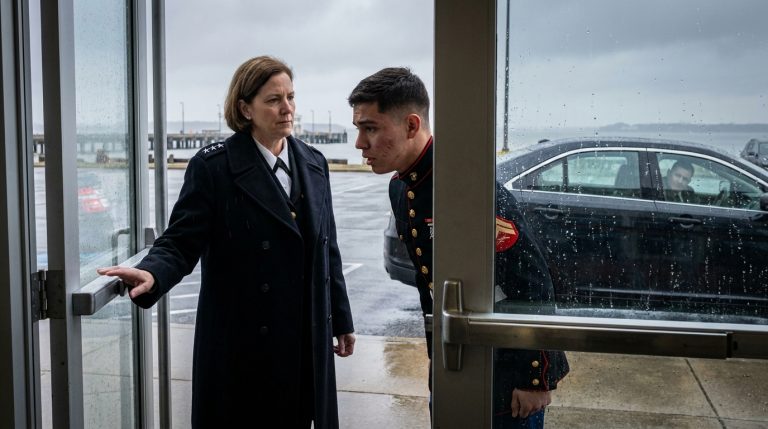
Sierra opened it. Major Evans stood there, the officer who had arrived with Colonel Jensen. She was in her dress blues, her posture immaculate, her eyes carrying a weary understanding.
“Major,” Evans said. “The Colonel requested that I check in on you. He’s finalizing the transfer for Captain Davis now.”
Sierra stepped aside to let her into the room. “Thank you, Major. I appreciate the courtesy.”
Evans walked to the center of the room, looking around at the sterile space. Her gaze settled on the shredder, then back to Sierra. There was a moment of silence, a shared recognition between two women who had spent their careers navigating the same sharp-edged corridors of authority.
“I grew up in the Corps,” Evans said, her voice soft, lacking the sharp, tactical edge of the command staff. “I’ve seen the way they look at us. The way they look for the seams in the uniform, hoping to find a reason to dismiss the work.”
Sierra didn’t respond immediately. She watched the way the fluorescent light caught the polished brass of Evans’s collar insignias. “It isn’t just the uniform, Major. It’s the history. They’re protecting a version of the past that doesn’t exist anymore, and they’re willing to sacrifice the present to keep it standing.”
“Does it ever stop?” Evans asked, a flicker of genuine vulnerability piercing her professional facade.
“No,” Sierra said. “But it changes. Every time we walk into one of these rooms, every time we demand the standard be applied fairly, we’re doing the work. It’s not a victory of a single day. It’s a slow, grinding process of attrition. We make it impossible for them to hold onto the old assumptions.”
They stood in the quiet of the room, two people who had earned their place in a world that hadn’t wanted them there. It was a moment of deep, silent connection—a “5-pillar” closure not through bombastic declarations, but through the shared, quiet reality of the life they had chosen.
“I have the updated training curriculum,” Evans said, reaching into her pocket and pulling out a digital drive. “The Colonel wants you to review it before it’s disseminated. He wants your mark on it.”
Sierra took the drive. It was small, cold, and possessed a weight that felt significant. It wasn’t just a curriculum; it was a physical artifact of the change she had catalyzed. She walked over to the desk, sat down, and pulled a small, worn leather notebook from her satchel. She took out a pen—the same one she had used to log her flight hours years ago—and began to write a few notes, a symbolic act of repairing the narrative that had been damaged in the mess hall.
“Tell the Colonel I’ll have it to him by the end of the day,” Sierra said.
Evans nodded, a look of profound respect in her eyes. “He knows. He’s already requested you for the next joint-operations planning cycle. He wants you at the table, Major.”
When Evans left, the room returned to its natural state of absolute, ringing silence. Sierra stood up and walked to the window. The sun was beginning to dip below the horizon, casting a long, amber glow across the flight line. The jets were parked, their metallic surfaces reflecting the dying light.
She felt the exhaustion finally taking root, pulling at her shoulders, but it was a good kind of tired. She had held the line. She had refused to be the victim of the institution’s myopia, and in doing so, she had forced the institution to adjust its own trajectory. She picked up her bag and walked toward the exit.
She passed the mess hall as she left the headquarters building. It was empty now, the chairs pushed in, the floors gleaming under the industrial cleaners. The memory of the confrontation—the anger, the threat, the sheer arrogance of Davis—felt distant, a ghost story that had been resolved by the cold, hard application of truth.
She stepped out into the evening air. It was cool, crisp, and smelled of dry earth and impending night. She walked toward the parking area, her pace steady. She wasn’t rushing. She had nowhere to be but here, in the present, a place she had earned with every minute of her flight time, every hour of her service, and every moment of her refusal to be anything less than what she was. She reached her car, unlocked it, and slid into the driver’s seat. As the engine turned over, she caught her reflection in the rearview mirror one last time. The woman looking back wasn’t a ghost anymore. She was exactly where she needed to be.