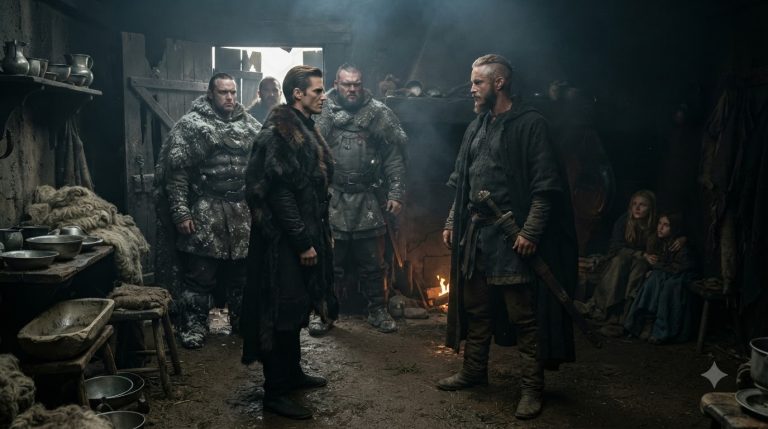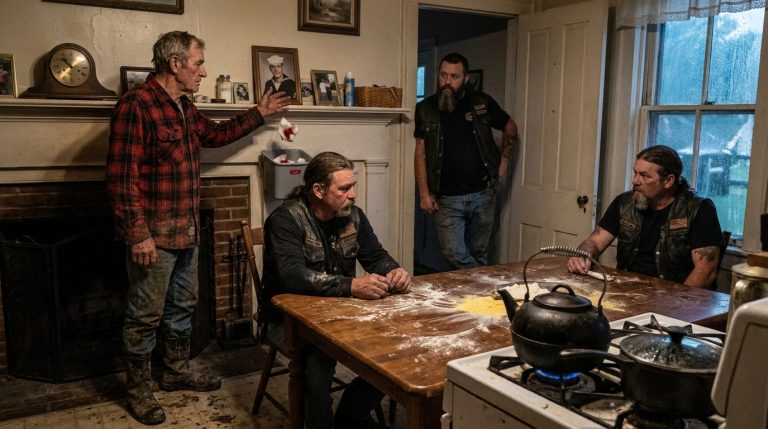
The Rusted Iron of San Bernardino: A Veteran Outlaw Returns to Unearth a Decades-Old Betrayal
CHAPTER 1: THE GATE AND THE RUMBLE
The iron door didn’t slam; it clicked shut with a dry, mechanical finality that stayed in Henry’s teeth long after the bolt slid home.
He stood on the asphalt shoulder with a brown paper bag in his hand. The paper was grease-stained from the storage locker, holding a leather cut that smelled of old rain and road dust.
A gravel truck ground its gears half a mile down the state highway, the blue exhaust hanging heavy in the cool morning fog.
Henry didn’t look back at the razor wire or the concrete guard towers shrinking behind him. Twenty years of gray light and measured steps had trained his knees to expect resistance from the earth.
He shifted the bag to his left hand, his thumb catching the frayed seam where the pocket reinforcement had torn back in nineteen-eighty-something.
Then the ground shifted beneath his heavy boots.
It wasn’t an earthquake; California rattled often enough that men learned to tell the difference between tectonic slip and something manufactured. This was a low, rhythmic thrumming that started in the soles of his feet and climbed straight up his spine.
The air grew thick with a sudden, sharp scent of unburned high-test fuel and hot oil.
Henry froze, his hand tightening around the paper bag until the cheap twine handle tore.
Around the sweeping curve of the interstate off-ramp, chrome caught the pale California sunrise and threw it back in a jagged, blinding sheet.
Machines filled both lanes from shoulder to shoulder, a dense wall of iron moving at a steady, creeping idle.
There were no sirens, no state troopers clearing the path, just five hundred heavy-frame motorcycles rolling forward with the heavy, unhurried momentum of an incoming tide.
Henry’s jaw tightened, the skin pulling thin and white across scarred bone.
He didn’t drop his stance or reach for a ghost that wasn’t there. He simply waited, his eyes narrowing against the glare, watching the front row separate as a single, low-slung Panhead peeled away from the pack.
CHAPTER 2: THE DESERT PARLAY
The screen door of the bar groaned on a rusty spring, venting a stale mix of stale beer and old floor wax into the sunlight.
Three black SUVs idled by the asphalt apron, their tires crunching against loose stones without a trace of hesitation.
Dale’s enforcers didn’t check the perimeter or look at the cluster of heavy machines lining the highway; they moved with the narrow, deliberate focus of men used to collecting debts that nobody wanted to pay.
A young prospect named Marco dropped a plastic crate of water bottles by the fender of a parked bike, his fingers still damp from the ice.
The largest of the enforcers caught Marco by the back of his fresh, unseasoned cut, dragging him sideways across the gravel before the boy could square his shoulders.
Marco didn’t yell, but his boots kicked up a gray cloud of dust that settled on the toes of Henry’s heavy work boots.
Three enforcers pinned the boy against the side of an idling SUV while a fourth flicked open a long-nosed utility lighter with a sharp, metallic click.
The flame caught on the synthetic backing of the bottom rocker patch, sending a thick, acrid smell of burning plastic and cheap dye into the clean desert air.
Henry didn’t reach for the iron in his belt or raise his voice above the rumble of the idling engines around him.
He stepped across the loose stones, his boots grinding a slow, deliberate rhythm into the dirt until he stood three feet from the man holding the lighter.
The enforcer looked up, his jaw set in a heavy, defensive grin designed to signal an authority he didn’t actually own.
Henry didn’t swing; he simply placed the flat of his palm against the man’s chest and pushed with thirty years of prison yard weight behind it.
The enforcer stumbled back two steps, his boot catching on a grease-stained concrete block.
Henry knelt beside Marco, his fingers hooking into the warm, smoking wool of the ruined patch to peel it away from the charred leather underneath.
“You earned this,” Henry said, his voice dropping into the quiet space beneath the engine noise. “No one can burn what you earned.”
Marco took the ruined scrap with trembling fingers, his breath coming in short, uneven hitches as he stared down at the black ash staining his palms.
The enforcers regrouped by the open SUV doors, their shoulders tight and their eyes darting toward the circle of older men who had stopped drinking to watch from the doorway.
They didn’t draw a weapon or issue a threat; the absolute stillness of the old man kneeling in the dirt carried more weight than any drawn blade.
The driver slammed his door shut with a hollow thud, and the vehicles swung around in a tight, gravel-spitting arc toward the northbound highway.
Tyler pushed through the crowd of leather-clad men, his face pale under a layer of road dust and dried sweat.
“My father didn’t just let you take the fall,” Tyler said, his voice hard enough to cut glass as he pulled a folded sheaf of bank records from his inside pocket. “He built the case. He paid the witnesses to point at you while he signed the transfer orders.”
The men who had been talking quietly by the jukebox stepped out onto the porch, their boots hitting the wooden planks in unison.
Roy Stills spat a stream of dark tobacco into the weeds by the foundation, his old eyes fixed on the empty stretch of highway where the SUVs had vanished.
“We gave him twenty years of peace,” Roy said, his hand resting on the grip of his heavy iron-head. “Looks like he spent it building a cage for the wrong wolf.”
Henry stood up, dusting the gray ash from his knees with a slow, mechanical motion that left no room for argument.
“I’m going to see Dale,” Henry said, turning back toward the Panhead idling on the shoulder. “Alone. Two men. That’s how this gets settled.”
Tyler shook his head, his hand dropping to the throttle of his own machine as the rest of the yard began to stir with a low, dangerous murmur.
CHAPTER 3: THE LONE APPROACH
The Panhead’s front tire crunched over loose gravel as Henry left the highway shoulder behind, pointing the long forks toward the perimeter fence of Oakland.
The morning fog had burned off, leaving a pale, flat sun that cast sharp, unblinking shadows across the rusted razor wire looping above the gates.
He didn’t look over his shoulder to check for the convoy; he knew Tyler and the rest were falling back miles behind him, wrapped in their own silence.
The compound gate hung wide open on its heavy steel hinges, a silent invitation left out in the open air like bait in a trap.
Henry dropped the heel of his boot against the paving stones to steady the machine, his eyes scanning the empty yard for movement.
A row of high-end, fuel-injected bikes sat lined up near the main office door—machines with spotless chrome and custom paint that had never smelled of raw oil or ditch water.
He cut the ignition, the sudden silence rolling over him like a physical weight as the hot exhaust ticked in the quiet courtyard.
The heavy timber double doors of the main hall stood cracked open by three inches, letting out a faint hum of central air conditioning that felt entirely wrong for a clubhouse floor.
Henry reached inside his jacket, his fingers brushing against the stiff, folded edge of the nineteen-fifty-seven charter tucked safely against his ribs.
He stepped across the threshold, his rubber soles gripping the gray concrete floor with a slow, deliberate suction.
The long hall stretched out before him in dim, artificial light, flanked by rows of empty chairs and walls stripped clean of every photograph that didn’t fit the new corporate ledger.
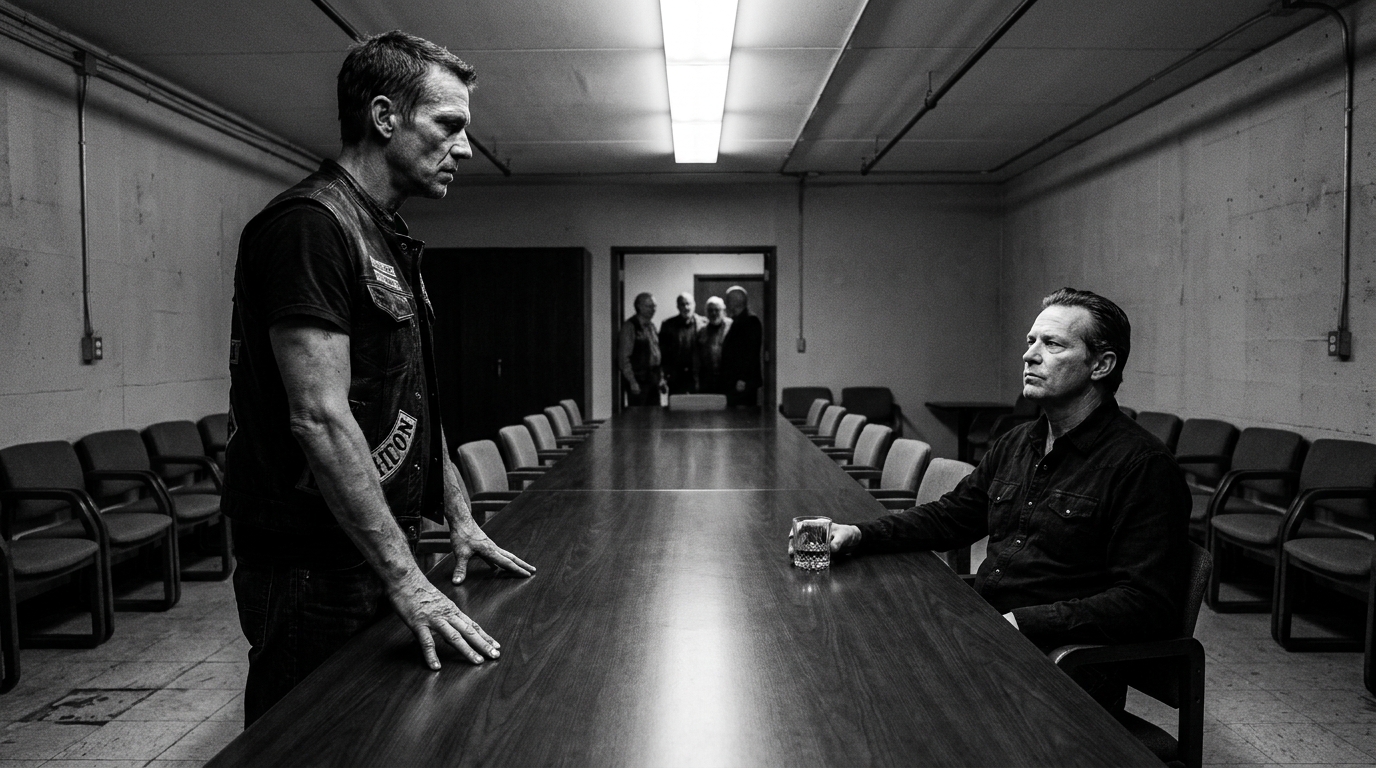
At the far end of the long conference table, Dale sat motionless under the glare of an overhead fluorescent tube, his hands spread flat across the dark wood.
A heavy crystal tumbler of amber whiskey sat untouched beside his right elbow, catching the pale light like a drop of dried blood.
“You took your time getting here, Henry,” Dale said, his voice carrying down the empty room without a hint of warmth.
Henry walked the length of the table, his footsteps echoing off the concrete walls like hammer blows on an empty anvil.
He stopped twelve feet from the president’s chair, resting both palms on the polished edge of the mahogany.
“The roads are full of things that take time to clear, Dale,” Henry said, his gaze locked onto the silver hair pulled back from his old friend’s forehead.
Dale didn’t flinch, but his thumb twitched against the wood, tapping out a rapid, nervous rhythm that betrayed the calm posture he was trying to hold.
“You brought an army to the county line,” Dale said, his chin lifting an inch as he leaned back into his leather chair. “And yet you walked through that front gate by your lonesome.”
“An army gets in the way when two men have an account to settle,” Henry said, his voice dropping into a flat, level register.
Dale’s eyes narrowed, a cold, calculating glint flashing behind his heavy eyelids as he weighed the silence pressing in from the empty hallways outside.
CHAPTER 4: THE TABLE OF RECKONING
Dale’s fingers stopped tapping against the dark wood.
He reached out slowly, his knuckles brushing the side of the untouched glass of whiskey before pulling his hand back into his lap.
“You think walking into this room changes twenty years of bookkeeping,” Dale said, his voice dropping into a dry, gravelly scrape that lacked any real authority.
“Books can be cooked, Dale,” Henry said, his arms remaining straight and locked against the edge of the table. “A foundation either holds weight or it rots from the bottom up.”
Dale’s jaw tightened as he leaned forward, the fluorescent light catching the hard, defensive squint in his eyes.
“I kept this club alive while you were sitting in a concrete box eating government beans,” Dale shouted, his fist coming down hard enough to rattle the crystal tumbler. “The feds were ready to wipe us off the map in two thousand and four. Someone had to make a clean break.”
“You didn’t make a break,” Henry said, his tone flat and unyielding. “You made a trade.”
Henry reached slowly into his inner jacket pocket, his fingers closing around the stiff, folded edges of the paper he had carried across the state line.
He didn’t throw it or slam it down; he slid the nineteen-fifty-seven handwritten charter across the polished wood until it stopped right against the base of Dale’s whiskey glass.
“Six names signed that paper,” Henry said, watching Dale’s eyes drop to the yellowed ink at the bottom edge. “Mine was first. Yours was third. We promised we wouldn’t trade a brother’s freedom for our own comfort.”
Dale stared down at the signatures, his breath hitching audibly in the quiet room as the reality of the faded ink settled over him.
“Times changed, Henry,” Dale muttered, his fingers twitching toward the corner of the paper as if he wanted to brush it away. “The old ways don’t pay the rent.”
The heavy oak door behind Henry clicked open with a soft, metallic latch.
Tyler stepped into the room, holding his mobile phone out flat on his palm like an offering.
The screen glowed with an active call indicator, the speaker amplifying a low, continuous rumble of five hundred engines idling just outside the compound fence.
“Every chapter president from here to the coast is listening, Dale,” Tyler said, his voice terrifyingly calm as he held the phone toward the center of the table. “They heard every word you just said.”
Dale’s face lost its remaining color, his mouth opening slightly as he looked from Tyler’s hard eyes back to the open speaker on the phone.
CHAPTER 5: THE UNMAKING OF A PRESIDENT
Henry didn’t swing a fist or raise a boot; he simply stepped forward into the narrow gap, his heavy canvas coat absorbing the impact of Dale’s charge.
The older man hit Henry’s chest and bounced back against the edge of the mahogany table, his fingers scrabbling uselessly against the polished grain.
“The line is open, Dale,” Henry said, his voice flat and steady against the frantic breathing of the man who had traded a brotherhood for a title. “Every patch from here to the coast heard the math.”
Dale spun around, his face dark and mottled with raw fury as he glared at the open speaker glowing on Tyler’s palm.
“You think a bunch of kids on rented iron can tear down twenty years of order?” Dale snarled, his voice cracking on the final syllable as he reached for the crystal tumbler to hurl it across the room.
Henry caught Dale’s wrist mid-motion, his grip locking around the bone with the unyielding pressure of a bench vise.
“It wasn’t twenty years of order,” Henry said, twisting the arm just enough to force the glass back onto the wood without a drop spilling. “It was twenty years of hiding behind a desk.”
The heavy oak front doors swung wide open behind them, the sound of five hundred heavy-frame engines idling in unison shaking the window glass in its iron frames.
Roy Stills walked into the hall first, his boots hitting the concrete floor with a heavy, deliberate rhythm followed by a dozen senior chapter presidents.
They didn’t draw weapons or raise a shout; they simply filled the room, wall to wall, until the space felt impossibly small and suffocating.
Roy stopped ten feet from the table, his weathered eyes locked entirely on the black t-shirt Dale wore beneath his unbuttoned cut.
“The vote was called outside,” Roy said, his voice carrying the dry authority of a desert wind. “And it didn’t need a conference call.”
Dale tried to pull his arm free, but Henry’s grip remained anchored like a rusted bolt in seasoned oak.
Roy reached out with a scarred, heavy hand, hooking his fingers into the shoulder seams of Dale’s presidential vest.
With one slow, wrenching pull, the heavy leather tore away from the lining, the silver-threaded rockers ripping free with a sound like tearing canvas.
Dale stood there in the center of the hall, stripped of his patch, his rank, and his authority, reduced to a single man standing in an empty room.
“You’re done, Dale,” Roy said, dropping the heavy leather onto the floor beside the 1957 charter.
Dale didn’t look at the floor; he stared straight ahead at the wall where his own photographs had hung for two decades, seeing only blank white drywall.
Tyler stepped forward, holding out the folded charter toward Henry with both hands.
“The chair is yours,” Tyler said, his voice quiet against the rumble of the yard outside.
Henry shook his head, pushing the paper back toward the young man’s chest.
“The club doesn’t need an old man looking backward,” Henry said. “It needs the man who carried the truth when the weight got heavy.”
CHAPTER 6: THE LONG ROAD NORTH
The engines of the rear guard popped and settled as the last convoy scattered toward their respective state lines.
Henry didn’t start the motor right away.
He left the kickstand down on the asphalt turnout, his eyes fixed on the gray line where sea met sky.
The wind off the water carried the sharp smell of salt and cold kelp, scouring away the stale odor of the Oakland conference hall and twenty years of prison lint.
A young rider with a fresh, unweathered patch on his vest pulled his machine to a stop ten feet away, cutting his engine with a nervous twitch of his wrist.
“You need anything before I head south, old-timer?” the boy asked, his voice cracking slightly under the weight of the silence.
Henry looked up, his gaze steady and clear as he shook his head.
“No, son,” Henry said. “I’ve got everything I came back for.”
The kid nodded once, kicked his starter, and rolled south down the coastal highway until the hum of his pipes vanished beneath the crash of the surf.
Henry swung his leg over the saddle, his boot finding the heavy iron starter pedal with a familiar, comforting weight.
He pushed down once.
The Panhead caught immediately, the deep, rhythmic thrum vibrating straight up through his palms and settling deep behind his ribs where the cold had lived for too long.
He pulled the clutch, clicked the heavy foot-shift into first, and rolled out onto the empty asphalt.
The road ahead stretched north into the gathering dusk, clear and wide under an open sky.
He didn’t look back at the compound gates or the history buried in the dust behind him.
The road didn’t care about the years lost in the gray light, and neither did the man riding it.
Henry twisted the throttle, letting the iron engine sing against the wind as he chased the fading light up the coast.