The Yellow Porch Light That Drew Eight Hundred Riders Through the Mountain Storm to Save a Forgotten Home
CHAPTER 1: THE MIDNIGHT KNOCK
Thunder cracked across the valley, rattling the loose windowpanes in their warped frames. Rain drove against the siding in heavy, rhythmic sheets, turning the gravel drive into a churning creek. Walter set his heavy ceramic coffee mug down on the wooden side table with a dull clink. He looked across the dim room at his wife.
Eleanor was already moving toward the front entry. Her steps were even, carrying no hesitation across the worn floorboards. She reached out and pulled the heavy wooden door wide open to the night air. Thirty soaked leather jackets gleamed under the porch light, dripping water onto the dry floor. Most of them stood armed, every one of them a stranger with water streaming down scarred skin.
“Get inside before you all catch pneumonia,” Eleanor said. Her voice was steady, cutting cleanly through the roar of the wind.
Walter stepped up right behind her, his shoulders broad beneath his flannel shirt. He took in the scale of the men, the heavy boots, the soaked leather, the raw exhaustion etched into their faces. He reached past his wife, pushing the screen door wide open to clear the threshold. He waved his hand in a broad, heavy arc.
“Boots off in the mudroom,” Walter said, his voice flat and practical. “Don’t worry about the floors.”
Thirty men filed into the narrow corridor in silence, stripping off dripping outerwear and hanging them over every available knob and rail. Walter scanned the group with the sharp, practiced eye of a man who had measured risks in swamps decades ago. One man held a bleeding forehead; another favored a shoulder hung entirely out of joint. Eleanor took it all in with a single, sweeping glance born of forty years spent watching over classrooms of children who needed care.
“Walter,” Eleanor said, turning her head slightly. “Get the first aid box from the bathroom.”
“The big one’s already getting it,” Walter answered, watching a towering biker bend down to assist his peer.
CHAPTER 2: THE KETTLE AND THE HEARTH
Walter stepped back from the mudroom entrance, wiping his hands on a rag he kept tucked in his back pocket. The thirty men moved through the narrow hallway with heavy, deliberate footfalls, carrying the distinct scent of damp leather, machine oil, and mountain rain. Not a single voice echoed off the low plaster ceiling; they simply occupied the space, waiting for direction with the disciplined stillness of soldiers caught in a sudden downpour.
“Lin closet is at the top of the stairs,” Eleanor called out from the warmth of the kitchen, her voice cutting over the hiss of the stove. “Take all of them. There are blankets in the cedar chest at the foot of the bed in the back room. Use those too.”
The bearded leader stared at her through the doorway for a long, quiet second, his rough hands resting against his thighs.
—Ma’am, you don’t even know us.
—I know you’re cold, Eleanor said, not breaking her rhythm as she tossed chunky root vegetables into the simmering broth. That’s enough for me.
Walter pulled the wounded man with the forehead cut closer to the kitchen table, motioning for him to sit under the harsh glare of the overhead bulb. The cut was jagged, weeping red down past the man’s eyebrow, but the biker didn’t flinch as the antiseptic bit into the torn tissue. Across the room, another rider with a swollen, drooping shoulder sat hunched over, his breathing shallow and tight. Walter didn’t ask questions; he simply stepped around the table, placed a calloused hand over the joint, and drove the bone home with one sharp, practiced snap.
The man let out a long, shuddering breath that rattled the mugs on the nearby counter.
—Thank you.
—Don’t thank me yet, Walter muttered, tossing the bloody gauze into the small bin by the sink. My wife’s about to feed you.
The heavy iron pot began to bubble, releasing rich waves of garlic, beef, and earthy carrots into the tight, damp air of the farmhouse. Eleanor worked with absolute economy of motion, her hands measuring flour and cornmeal by sheer memory rather than cups. While the stew thickened, Walter fed lengths of seasoned oak into the living room stove, the dry wood catching instantly and casting a deep, amber glow across the worn floorboards.
The bikers drifted into the common areas, finding space against the walls and stairs, watching the older couple move with a silent, watchful intensity.
CHAPTER 3: THE GHOST ON THE MANNTLE
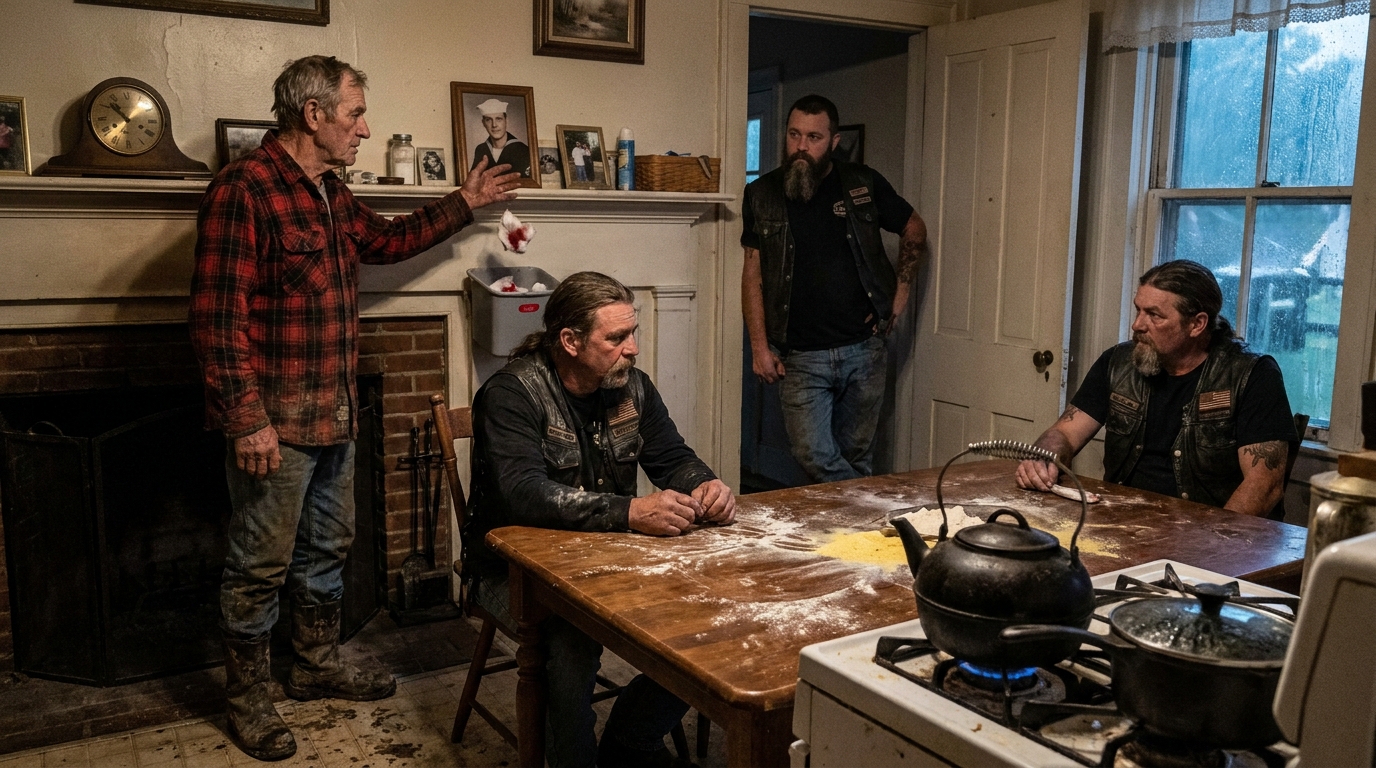
The woodstove crackled, sending a steady wave of dry heat across the room to push back the lingering dampness of the mountain storm. Dale Jr. stared fixedly across the common space, his rough hands resting flat against the scarred grain of the wooden table.
Walter wiped a final smear of antiseptic from the young rider’s forehead and stepped back, his joints popping faintly in the quiet room.
—Sir, you should know who you let into your house, the bearded leader said, his voice low and gravelly from hours of fighting the wind.
Walter didn’t blink.
—I know who’s in my house. I’m looking right at them.
—We’re a chapter out of the mountains. We wear the colors.
—Yep, Walter said, tossing the bloodied cotton into the trash bin. You see the patch. I see the patch. And you’re still sitting by my stove.
The biker’s gaze shifted away from Walter, drifting upward past the mantel to the small, framed portrait resting beside an old brass clock. It showed a young man in crisp white dress uniform, standing straight with a sailor’s white hat squared on his head, smiling with eyes that held the exact shape of Eleanor’s.
—That your boy? the leader asked, his voice softening just a fraction against the heavy wood.
Walter’s expression tightened, the lines around his eyes deepening as he looked at the frame.
—He was. Twenty-three years since he went down.
The room grew dense with a sudden, suffocating weight, broken only by the steady pop of burning oak inside the iron box. Dale Jr. stood up slowly, his knuckles pressing against the table edge as he mapped the lines of Walter’s face against the photograph.
CHAPTER 4: THE COLUMN OF EIGHT HUNDRED
Morning broke over the ridge with a sharp, washed-blue sky that stripped the last shadows from the flooded creek beds. Walter stood on the front porch with a heavy coffee mug in his hand, watching the final thirty bikes ease down the gravel drive in a quiet, orderly line.
The silence lasted barely two hours before the low, unified hum began to build against the horizon once again.
Eleanor stepped out onto the freshly swept boards, wiping her hands on a clean dish towel as her eyes scanned the distant bend in the road. The low rumble swelled rapidly, vibrating right through the soles of their boots until the air itself seemed to shudder under the weight of an approaching column.
—Walter, she murmured, her fingers tightening around the cotton cloth.
The first headlamps rounded the tree line, cutting twin shafts of hard white light through the bright morning sun. Then twenty bikes appeared, followed immediately by fifty, then a relentless sea of chrome and leather stretching as far as the eye could see. Trailers stacked high with fresh timber, rolls of heavy architectural shingles, and crates of provisions filled the middle of the procession.
The column flowed into the side pasture in precise, rhythmic waves, engines cutting out one by one until an absolute hush settled over the property.
Dale Jr. walked toward the porch steps, pulling off his dark sunglasses to reveal eyes reddened by dust and lack of sleep.
—You fed thirty of ours last night, the leader said, his voice carrying clearly across the silent yard. In our world, that debt doesn’t get settled with a handshake.
Walter set his coffee mug down on the railing with a dull clink, his weathered hands curling into tight fists at his sides.
CHAPTER 5: RAISING THE RAFTERS
The afternoon sun beat down directly on the exposed timber frames as dozens of booted feet moved rhythmically overhead. Walter stood near the woodpile, his axe resting against a chopping block, watching a dozen men hoist fresh sheets of plywood into position.
A crew foreman walked over, wiping sweat from his forehead with a grease-stained rag.
—We found three rafters rotting clean through by the chimney, the foreman said, pointing upward. Wouldn’t have held another heavy winter.
Walter crossed his arms over his chest, his expression hard and unyielding against the sudden revelation of structural decay.
—Fix them right, Walter muttered. I don’t want any shortcuts on my roof.
—No shortcuts on this property, the foreman replied, turning back toward the ladders.
Inside the small kitchen, Eleanor stood surrounded by half a dozen women organized by Maggie, the camp kitchen lead. Piles of fresh provisions from the trailer crates covered every counter surface, transforming the modest cooking space into a bustling mess hall.
—You sit down right there on the porch rocker, Maggie said, gently guiding Eleanor toward the door with a warm hand on her shoulder. You’ve done enough cooking for a lifetime, ma’am.
Eleanor sank into the wooden rocker, her hand resting on the smooth armrest as she watched the transformation unfold across her yard.
CHAPTER 6: THE FINAL GUARD
Dale Jr. stepped back from the porch railing, his fingers brushing the edge of the brass clasp before looking up into Walter’s weathered eyes. The roar of eight hundred engines had faded into the distance hours ago, leaving only the steady chirp of crickets settling into the long grass along the drive.
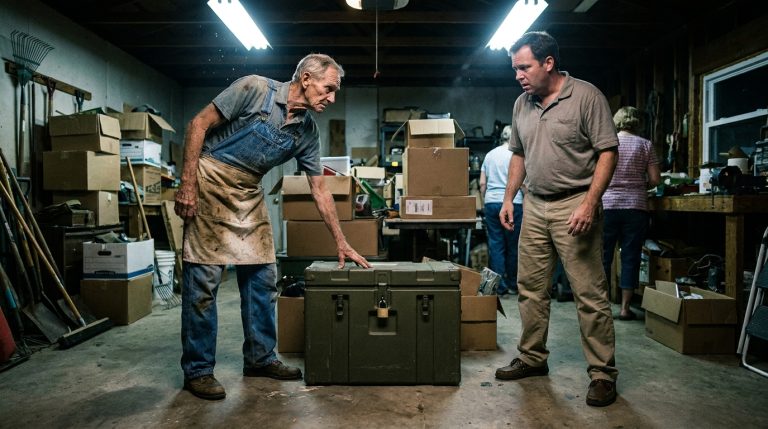
Walter lifted the lid of the container, exposing the tightly folded wool of an American flag and the dull sheen of a service medal pinned to the corner.
—My father left that to me, Dale Jr. said, his voice dropping into a rough, quiet register. He always said it belonged with the man who carried him out.
Eleanor stepped closer, her hand sliding smoothly into Walter’s rigid elbow. She didn’t speak, letting the shared warmth of their decades together anchor the space between the two men.
Walter’s throat worked once, hard, before he looked past the box at the freshly painted white columns of their restored home.
—Your father earned every breath he took after sixty-eight, Walter said, his voice flat and unyielding. And so did you.
—Ride safe, son, Eleanor added, her tone carrying the quiet authority of a woman who had seen the world and measured its worth.
The leader nodded once, turned on his heel, and walked down the steps to where his single machine waited by the edge of the graveled yard. He kicked the starter, the engine catching instantly with a deep, low rumble that shook the evening air before smoothing into a steady rhythm. He pulled away down the lane, his single tail light shrinking until it vanished entirely around the distant tree line.
Walter picked up the broom leaning against the corner of the porch and swept a stray wood shaving off the clean boards.
Eleanor turned and walked back through the oak doorway into the warm light of the kitchen, her hand trailing over the solid surface of the new counter.