A Worn-Out Biker Buys a Cheap Appalachian Cabin and Unearths a Century-Old Dynasty of Silence
CHAPTER 1: THE AUCTION AND THE WARNING
The county courthouse smelled like damp wool and floor wax.
Ray sat in the very last row, his worn ball cap pulled low over his eyes, keeping his hands steady in the pockets of his jacket.
The auctioneer rattled through descriptions of foreclosed plots and rotting timberland with the flat, rhythmic boredom of a man reading a grocery list.
When he reached lot number forty-two, the room didn’t just quiet down; it flattened out into something heavy and deliberate.
Nobody bid five hundred dollars.
Not a single hand went up in the rows ahead of him.
The woman sitting directly to his right shifted her weight, the fabric of her coat rustling loud against the wooden bench, while the man behind him offered a sharp, dry cough that sounded like a warning.
Ray raised two fingers without looking around to see who was watching.
The hammer fell with a dry crack that echoed off the high plaster ceiling, and the clerk behind the desk looked up, staring at Ray with a cold, hollow pity.
Outside on the stone steps, the autumn air hit his face with the sharp smell of woodsmoke and wet asphalt.
An old woman with white hair pulled back so tight it stretched the skin around her eyes stepped directly into his path, blocking the exit.
“You don’t want that place,” she said, her voice dry as dead leaves.
Ray didn’t stop walking, just adjusted the strap of his duffel bag over his shoulder.
“Already bought it,” he replied.
“Then sell it back,” she urged, grabbing his sleeve with fingers like wire. “Take the loss. That cabin’s got a darkness to it that doesn’t wash out with soap.”
Ray looked down at her hand, then met her gaze, seeing the genuine weight of history behind her pale eyes.
“I’ll be fine,” he said, gently pulling his arm away.
She shook her head, watching him with quiet resignation as he stepped past her toward his truck.
“The last three men who lived there, they all left in the middle of the night,” she called out to his back. “No warning. Just packed what they could carry and drove away.”
Ray opened the truck door, hoisted his German Shepherd, Duke, into the cab, and cranked the ignition.
He didn’t believe in ghosts, and he had seen enough real horror in sixty-eight years of hard living to know that living men were far worse than anything buried in the woods.
He put the truck in gear and drove straight toward the mountains.
CHAPTER 2: THE THREEDAY SILENCE BROKEN
The third night had been quiet until the scratching started.
It wasn’t the sound of mice behind the dry lathe and plaster.
It was heavy, purposeful, and driven by a desperate panic that Ray had never heard come out of that German Shepherd before.
Duke threw his weight against the floorboards near the cold-water pump, his claws tearing through layers of painted pine with a sickening splintering sound.
Ray threw off his woolen blanket, the cold mountain air hitting his bare arms like a sheet of ice.
“Duke. Heel,” Ray ordered, his voice dropping into the low, flat register that usually stopped the dog dead in his tracks.
The animal didn’t even twitch an ear, whimpering low in his throat as dark blood smeared across the splintered wood.
Ray crossed the room in two strides, grabbed the dog by his heavy leather collar, and dragged him back.
Duke fought him, snapping his jaws once at the empty air before pressing his nose back down to the gaping hole, whining a high, thin note that tightened the skin across Ray’s neck.
Ray dropped to one knee, the damp chill rising straight up from the earth through the floor joists.
He slid his fingers into the torn gap, feeling the rough edge of iron buried just six inches down in the foundation mortars.
It wasn’t a water pipe or an old cellar cleanout.
It had the heavy, cold weight of cast metal that hadn’t seen open air since the last century.
Ray stood up, his joints popping in the silence, and walked out to the truck parked fifty feet from the porch.
He came back carrying a heavy iron crowbar and a battery-powered drop light, his breath pluming white in the dark kitchen.
He jammed the flat chisel end of the bar into the gap Duke had opened and leaned his full weight onto the steel shaft.
The old timber groaned, protesting with a dry shriek before giving way in a cloud of dust and ancient sawdust.
It took twenty minutes of slow, grinding leverage to pry the surrounding boards away from the obstruction.
When the full outline of the iron hatch was finally exposed, the smell rolled up out of the gap like a physical blow.
It wasn’t just mold or stagnant water.
It was that sweet, chemical rot Ray recognized from old timber yards and forgotten root cellars where things had leaked and dried over decades.
A heavy, square padlock the size of a fist held the hatch closed, its surface pitted and eaten away by orange rust.
Ray raised the crowbar over his shoulder, caught his balance on the uneven joists, and brought the heavy metal down onto the padlock with a solid crack.
The lock held.
He swung a second time, his shoulders burning, and the brittle iron cracked down the middle with a sharp ping.
He hooked his fingers under the heavy iron ring of the hatch and pulled.
The hinges screamed, fighting him every inch of the way before the heavy iron door fell backward against the floorboards with a dull, echoing thud.
A gust of freezing air rushed up from the dark, smelling sharply of wet stone and old dust.
Duke backed away from the opening, his hackles raised stiff along his spine, growling deep in his chest as the flashlight beam cut into the black void.
The stairs went straight down into the mountain, steep and narrow, disappearing into an absolute silence that felt heavier than the dirt above it.
CHAPTER 3: THE DESCENT INTO THE PAST
The air rising from the stone opening tasted of old iron and wet earth that hadn’t seen the sun in a hundred years.
Duke held back near the wood-burning stove, refusing to put another paw toward the descent.
Ray switched on his heavy-duty flashlight, checking the beam’s battery life with a quick glance before stepping downward.
The stairs were cut directly into native limestone, each step uneven and slick with a fine film of condensation.
He counted twenty steps, then thirty, the walls narrowing until his shoulders brushed the damp rock on either side.
The silence down here was absolute, heavier than the night outside, broken only by the solid thud of his work boots hitting stone.
At the bottom of the shaft stood a heavy oak door with rusted iron hinges, closed tight against the dark.
Ray pushed his palm against the warped wood, and it swung inward with a dry, protesting groan.
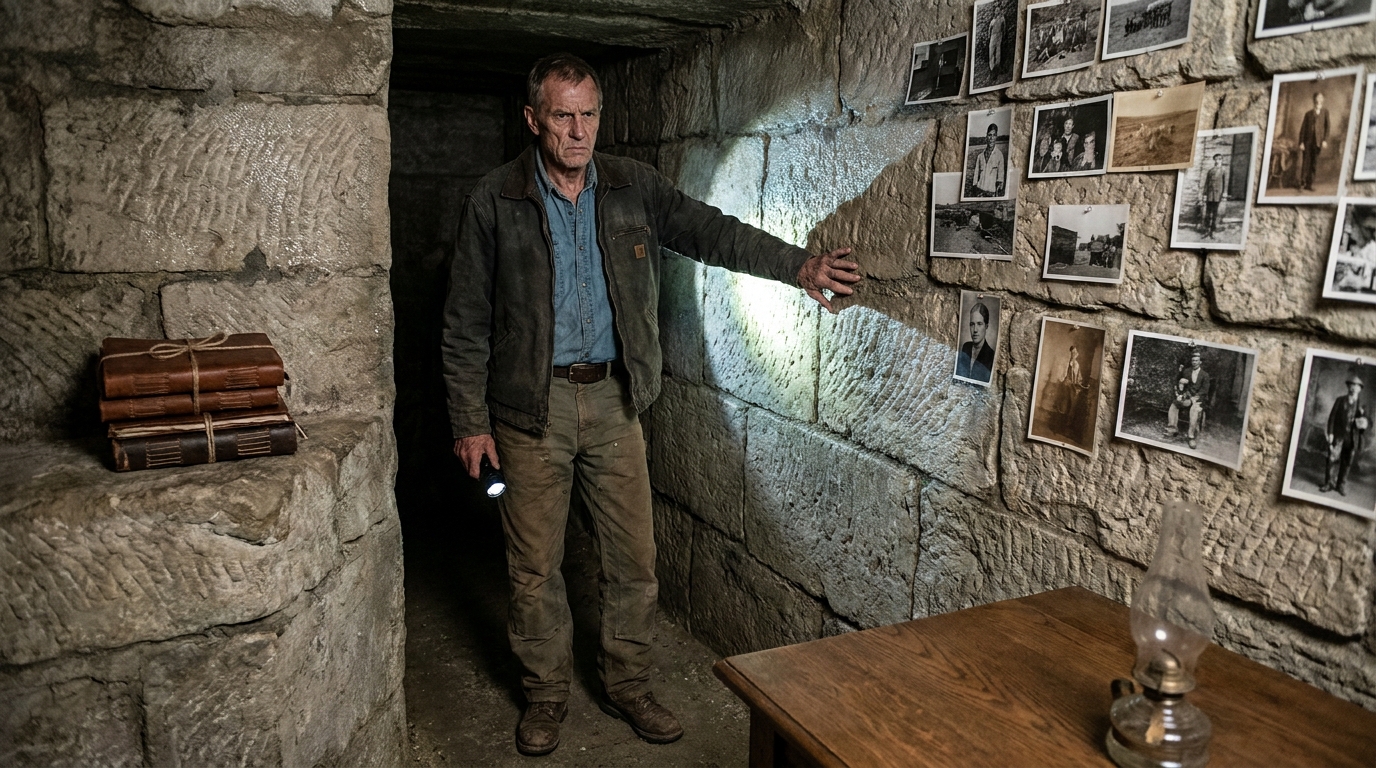
The beam of his flashlight swept across a small room lined completely with cut stone blocks.
In the center sat a heavy oak table holding an unlit oil lamp that smelled faintly of kerosene.
Stacked neatly along the left wall were forty-seven leather-bound journals, tied with coarse twine and marked with faded ink dates.
The oldest tag read 1891; the most recent showed 1967.
Ray stepped closer, picked up the top volume, and flipped the stiff leather cover.
The handwriting inside was painfully neat, executed with an old steel-nib pen that detailed dates, names, and precise locations.
He dropped his gaze to the right wall and stopped breathing.
Dozens of black-and-white and sepia photographs were pinned directly into the mortar joints, showing children ranging from small toddlers to teenagers.
They weren’t posed portraits; they were frozen moments of sheer terror, captured in dim light.
Beneath each photograph, written in that same meticulous script, was a name and a date of disappearance.
Ray scanned the surrounding wall space, his light catching deep chisel marks crisscrossing every square foot of exposed stone.
The same name was carved into the rock hundreds, perhaps thousands of times—Elias Thornton.
The founding father of the county.
The man whose bronze statue stood untouched in the middle of the town square while generations of families whispered about missing kin.
Ray stood motionless in the dead air, his fingers tightening around the flashlight handle as the full weight of the dynasty’s secret settled over his shoulders.
He had no digital backup, no cloud storage to ping an alert, and no phone signal down in the heart of the mountain.
He only had his own eyes, a pocketful of dry batteries, and the grim realization that walking back up those stairs meant picking a fight with every powerful man in the county.
CHAPTER 4: THE DRIVE TO CHARLESTON
The dashboard clock glowed green in the predawn dark as Ray pointed the truck south toward the interstate.
He didn’t have his phone recording anything, and he didn’t have digital files to hand over, relying entirely on a stack of water-damaged field notes and his own direct word.
Two hours of unbroken highway brought him to the brick facade of the state police barracks in Charleston.
The front desk smelled of industrial floor cleaner and stale drip coffee that had been sitting on the burner since the previous shift.
Ray laid his handwritten logbook flat on the scarred laminate counter without a word.
“I need to talk to someone about a cold case,” Ray said, his voice flat and steady. “Forty-seven of them.”
The desk sergeant looked up from his crossword puzzle, his eyes lingering on Ray’s worn canvas jacket before glancing down at the paper.
Ten minutes later, Ray sat across from two detectives in an interrogation room stripped of any comfort.
Detective Carr, the younger one with sharp military posture, slid a plastic evidence bag across the table containing nothing but an empty phone case.
“Walk us through it,” Carr said, leaning forward. “Without digital files, we’re relying entirely on your physical memory.”
Ray kept his hands flat on the cold metal table, detailing the auction, the dog, the hatch, and the stacked journals with the cold precision of a man recounting inventory.
The older detective, Morris, sat back in his chair without taking a single note, his tired eyes studying Ray’s face like he was looking for a crack in the story.
When Ray finished, Morris stood up and walked out of the room without explanation.
He returned five minutes later carrying a heavy laptop, which he set down and turned toward Ray.
On the screen was a sepia-toned photograph of a bearded man standing in front of a church in 1892.
“Elias Thornton,” Morris said quietly. “Town founder, philanthropist, buried with full civic honors.”
“He wasn’t a philanthropist,” Ray replied, his fingers tapping once against the table. “He was a predator who left his name carved into stone five feet beneath my kitchen floor.”
Carr shifted in his seat, the leather creaking in the small room.
“You understand what this means,” Carr said, his voice dropping an octave. “The Thorntons own half the county judges and bankroll the prosecutor’s office. Walking in here without digital backup is kicking a hornet’s nest bare-handed.”
Morris looked between the two of them, his jaw tight.
“Call the federal bureau,” Morris ordered, looking directly at Carr. “This isn’t a local matter anymore.”
CHAPTER 5: THE ARSON ATTEMPT AND THE WAR
The motel room was dark except for the amber digital numbers glowing on the microwave across the room.
Ray lifted the receiver before the second ring could rattle the plastic base.
“They tried to take the cabin about twenty minutes ago,” Morris said on the other end, his voice tight with suppressed fury.
Ray kept his boots planted flat on the carpet, his hand resting near Duke’s warm flank.
“Federal agents caught him half a mile down the timber road with a five-gallon red can of fuel,” Morris continued. “Nineteen years old. Last name is Thornton.”
Ray stared at the streaked motel window reflecting the empty parking lot outside.
“They aren’t waiting for the grand jury,” Ray said.
“They don’t know how to do anything else,” Morris snapped back over the line. “The family lawyers are already filing emergency injunctions down at the county courthouse, screaming about illegal search and trespass. They think they can bury this under paper like they’ve done for a hundred years.”
Ray listened to the heavy hum of the highway traffic outside the thin walls.
“Paper doesn’t burn down stone basements,” Ray said quietly.
“No, it doesn’t,” Morris agreed, his tone shifting into something cold and calculated. “Which is why federal marshals just secured search warrants for three other properties registered to the family across the next county. We found references to them in the back of those journals.”
Ray let out a slow breath, feeling the tension settle deep into his shoulders.
“They’re cornered,” Ray said.
“Which means they’re going to fight dirty,” Morris warned before the line went dead with a sharp click.
Ray set the phone back on its cradle, the plastic casing cold beneath his palm.
Duke lifted his head, letting out a low, warning huff toward the door as headlights swept across the drawn motel curtains.
The local power structure was throwing everything they had at the perimeter, but the walls were already cracking from the inside out.
CHAPTER 6: THE WEIGHT OF THE TRUTH
The miles rolled past beneath the rubber tires in a steady, monotonous hum that finally drowned out the echoes of the mountain.
Duke rested his heavy head across Ray’s thigh, his breathing deep and even as the Tennessee sun warmed the windshield.
The newspaper clipping sat folded on the dashboard beneath a packet of plain receipts, detailing the dedication ceremony back in the county.
Forty-rettees now stood planted in a neat crescent outside the restored cabin, each one bearing a small brass tag with a child’s name.
The bronze statue of Elias Thornton sat in a dark municipal warehouse four states away, its face covered in gray canvas while city councils debated what to do with a monument built on lies.
The grand juries had finished their work, handing down indictments that stuck because the paper trails and the hidden cellar rooms refused to stay buried.
Families who had spent fifty years wondering what happened in the dead of night finally received the hard, bruising comfort of certainty.
Ray pulled the truck into a gravel rest stop off the interstate, cutting the engine with a dry click.
He stepped out onto the sun-baked asphalt, grabbing a paper cup of black coffee from a vending machine before leaning against the metal side of his truck bed.
A family walked past him toward the picnic tables, two young children chasing each other with loud, untamed laughter while their parents strolled hand in hand.
Ray watched them for a long moment, feeling the familiar ache of a life spent running from ghosts that turned out to be flesh and blood.
He took a slow sip of the bitter coffee and looked down at the dog waiting patiently by the truck door.
“Time to go, Duke,” Ray said.
The german shepherd hopped up into the cab without hesitation, settling back down into the passenger seat as Ray slid behind the wheel.
He put the truck in gear, pulled back onto the open highway, and drove south into the quiet blur of the afternoon.