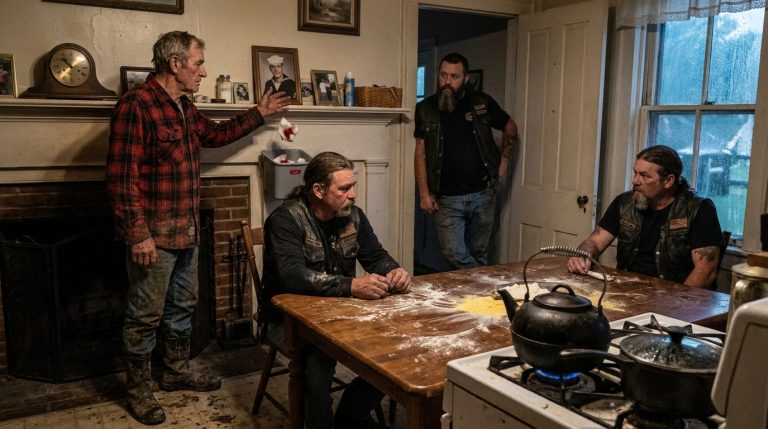
The Iron Fence Line and the Gritty Reclamation of Cascadia Hills
CHAPTER 1: THE OUTPOST INTRUSION
The smoke off the Weber grill didn’t smell like hickory; it smelled like fat burning on rusted iron, and it wasn’t my smoke.
I stood on the edge of the brick patio, the heat from the midday sun baking the dry clay of the yard until the air tasted like dust. A man I had never seen before—thick-necked, wearing a faded canvas apron that belonged in my garage—turned a row of cheap hot dogs with my brass tongs. Behind him, the chlorine stench of the pool kicked up as three kids hit the water, the splash coating the parched flagstones. A silver Civic sat idling on the grass, its tires crushing the thin, dry turf I’d spent three months trying to coax out of the limestone.
My mind stalled, spinning on the sheer friction of the scene. This wasn’t a county park. It was thirty yards of hard-won dirt tucked against the Cascadia greenbelt.
“You’re out of the spicy brown,” the man said, not looking up. He scraped a metal spatula against the grate, a harsh, screeching sound of steel on carbon. “Only got the yellow stuff. Kids won’t eat it.”
“Who are you?” I asked. My voice was quiet, leveled by the dry heat.
He pointed a greasy thumb toward the side gate. “Karen said it was community use. Said the guy who lived here didn’t use the lot anyway.”
I turned. Karen Thompson was standing by the cedar fence, her khaki capris stiff with starch, a metal clipboard tucked under her arm like a shield. She was adjusting a rusted iron sprinkler riser at the boundary line, her fingers tracing a strip of bright orange surveyor’s ribbon tied around the zinc pipe. She didn’t look like an invader; she looked like an appraiser checking a foreclosure.
I walked over, the dry grass crunching like dry tinder under my boots. “Karen. Get them off my lawn.”
She didn’t flinch. She adjusted her polarized sunglasses, the glare off the lenses hiding her eyes. “It’s not your lawn, Jake. Not technically. If you read the original subdivision charter from ninety-eight, this entire southern wedge is classified as a shared ecological easement. You’re just the custodian.”
“The deed says otherwise,” I said. “The county surveyor stamped it. I pay the tax on every foot of this clay.”
“Deeds are subject to community covenants,” she replied, her voice flat, transactional. She tapped the aluminum edge of her clipboard against the rusted fence post. “You don’t use the space. It’s dry, it’s unmaintained. We’re putting it to use.”
I looked down at her hands. She wasn’t just holding her standard HOA violation log. Tucked beneath the aluminum frame was a damp, yellowed envelope addressed to me—the official land registry notice I’d been waiting on from the county clerk, the one that had been missing from my locked mailbox since yesterday afternoon.
But it wasn’t the stolen mail that made the air go cold in the midday heat. It was the ground beneath her starchy white sneakers. The dry Arcosa clay near the rusted sprinkler riser had split, a dark, jagged fissure two inches wide snaking directly toward the foundation of my house, smelling faintly of stagnant water and old iron.
CHAPTER 2: THE EASEMENT CITATION
The silence that settled between us was as thick as the heat rising from the parched earth. Karen’s eyes remained masked behind her dark lenses, but her thumb pressed tighter against the edge of the aluminum clipboard, pinning the damp, yellowed corner of my missing county land registry envelope.
“The earth shifts, Jake,” she said, her voice dropping into a dry, flat register that matched the scraping sound of the spatula behind us. “That’s what clay does when you don’t water it. It’s a violation of code 4-B. Unmaintained turf leading to structural erosion.”
“You have my mail, Karen.” I didn’t reach for it. I didn’t make a sudden movement. I just looked at her fingers, the skin slightly calloused and dusty from handling the rusted zinc riser. “That came from my box. The locked one near the curb.”
A small, rhythmic ticking sound started from the sprinkler riser—a slow, uneven leak deep inside the valve body, weeping water into the shifting silt below our feet. The water didn’t pool; the thirsty ground swallowed it instantly, widening the dark fissure by a fraction of a millimeter.
Karen didn’t blink. She slid her clipboard down, obscuring the envelope with a smooth, practiced tilt of her wrist. “The association has a right to intercept and evaluate municipal disputes that threaten local home values. This is an official easement citation.”
She reached into her side pocket and pulled out a folded sheet of heavy, textured paper. It wasn’t standard printer paper. It was heavy bond, the kind used for legal filings, carrying a faint blue stamp at the header. She thrust it toward my chest. The dry paper rasped against my shirt like fine-grit sandpaper.
“What is this?” I asked, taking the document. The edges felt gritty, dusted with the fine gray residue of Arcosa silt.
“A notice of public ingress,” she said, already stepping backward toward the safety of the lawn mower’s path. “A utility assessment team will be entering Sub-Sector 44-D—which includes the southern thirty feet of this lot—starting tomorrow morning. You are required by the bylaws to keep the access gates unlocked. If you obstruct them, the fine is five hundred dollars per day.”
I didn’t look down at the paper immediately. My eyes stayed on her boots as she turned. She walked with a stiff, calculated gait, her heels sinking slightly into the soft, uncompacted soil of the greenbelt boundary where the grass died out completely.
Sub-Sector 44-D. The phrase tasted like copper in my mouth. It wasn’t standard HOA terminology.
I waited until her khaki figure rounded the corner of the cedar fence before I unfolded the document. The paper was cold despite the heat of the afternoon. At the bottom, beneath the standard boilerplate text about community maintenance and structural safety, was a tiny, faint watermark in the corner. It wasn’t the Cascadia Hills logo. It was a stylized, geometric emblem of a drilling rig, with the small, faded letters Arcosa Exploration embossed directly into the grain.
The wind shifted, carrying the heavy, metallic smell of old diesel and hot oil from the greenbelt trail behind my house. Someone was working back there, deep in the trees where the property lines became a gray maze of unmapped thickets.
I tucked the paper into my pocket and walked toward the split in the clay. I knelt down, the heat radiating off the parched soil burning through the knees of my jeans. I reached out, my fingers brushing the rusted metal of the sprinkler riser. Tied tightly around the neck of the pipe, hidden beneath the bright orange surveyor’s ribbon, was a second tag—a small, weatherworn plastic disc stamped with the letters KELSO-AMES.
The plastic was brittle, already flaking away under the dry heat, but the name was bitten deep into the synthetic surface. It was an engineering name. A survey marker.
The grill behind me gave a final, metallic pop as the burner was cut. The man in the canvas apron began gathering his gear, his movements quickening as if he knew the boundary lines of this yard had just become a live wire. I stood up, the dry wind catching the edge of my pocket, the heavy citation paper scraping against my hip with every step I took back toward the shadow of my house.
CHAPTER 3: THE IRON SANCTUARY
The engine of my old F-150 didn’t catch on the first turn; it gave a dry, metallic rattle that vibrated through the steering column before finally roaring into an uneven, rumbling idle. I backed out of the driveway without looking toward Karen’s immaculate front lawn, though I felt the weight of her unseen observation from behind her plantation shutters. The gritty county citation paper in my pocket seemed to heat up against my thigh, a constant physical reminder of the encroaching line she had drawn in my backyard.
I drove south, away from the manicured, soft-edges of Cascadia Hills and toward the industrial bypass where the suburban greenbelt collapsed into gravel pits and salvage yards. The air outside changed rapidly, losing the faint, chemical sweetness of sprinkler water and taking on the raw, heavy grease of heavy machinery.
Twenty minutes later, the truck
CHAPTER 3: THE IRON SANCTUARY
The brittle yellow plastic of the Kelso-Ames tag crumbled between my thumb and forefinger, leaving a smear of gray, mineral-heavy dust on my skin. I didn’t brush it off. I stood up from the cracked soil, my joints popping in the dry heat, and stuffed the fragments into my pocket alongside the heavy citation paper.
My house sat silent behind me, a static monument of wood and brick threatened by a slow, invisible pull in the ground. The Weber grill was cold now, a thin layer of white ash already settling over the grease-spattered flagstones where the intruder had stood. I walked past it, my boots leaving dull prints in the thin dust of the patio, and headed straight to my truck parked in the driveway.
The cab of the pickup was an oven. The steering wheel burned through the palms of my hands as I gripped the worn leather, the engine catching with a rough, low rumble that vibrated through the floorboards. I didn’t look back at Karen’s house as I backed out of the cul-de-sac. I locked my eyes on the road ahead, navigating the pristine, manicured curves of Cascadia Hills until the suburban asphalt gave way to the cracked, oil-stained concrete of the county highway.
Ten miles south, the trees thinned out, replaced by the corrugated steel silhouettes of the industrial valley. This was the raw edge of the county, where the city’s refuse came to rust.
I pulled through the chain-link gates of Ironclad Recovery, the truck bouncing over deep ruts filled with dark, stagnant runoff water. The air here didn’t smell like fresh-cut lawns; it smelled of sulfur, old grease, and the sharp, nose-burning tang of welding slag. Mountainous heaps of crushed steel, skeletal chassis, and stripped engines rose like jagged monuments around a central workshop.
I cut the ignition. The quiet was immediate, broken only by the rhythmic, heavy clink of a metal hammer striking steel somewhere deep inside the main bay.
I stepped down from the cab, the soles of my boots grinding into the black slag that served as a driveway. Standing near an elevated grease rack was Tank.
His real name was Thomas, but his silhouette explained the transition. His shoulders were a broad, seamless block of muscle draped in a grease-darkened denim vest, his thick forearms coated in a layer of soot and iron dust as he wrenched a stubborn oil pan from an old chopper engine. He didn’t look up when my boots crunched on the gravel, but the hammer strokes stopped.
“You look like you just dug up a grave, Jake,” Tank said. His voice was a low, gravelly vibration that seemed to come from his boots. He set the wrench down on a metal workbench with a heavy clatter.
“Worse,” I said, walking into the shade of the tin roof. “The county land registry is gone from my mailbox, and Karen Thompson just handed me an easement citation for my own backyard.”
Tank wiped his greasy palms on an ancient red rag that had turned nearly black from soot. He squinted at me through the dim light of the shop, his eyes tracking the posture of my shoulders, the tight line of my jaw. “She’s pushing the line.”
“She’s digging it,” I replied, pulling the folded legal document from my pocket and flattening it against the scarred iron surface of his workbench. “She’s calling my yard Sub-Sector 44-D. And she’s got a surveyor’s mark back there with Kelso-Ames stamped on the plastic.”
Tank stopped wiping his hands. His fingers remained wrapped in the stained rag, his gaze dropping to the paper. His eyes lingered on the faint embossed watermark of the drilling rig in the corner. For a second, the only sound was the lazy hum of a fat horsefly bouncing off the hot tin ceiling.
“Arcosa,” Tank muttered, his voice dropping an octave. “That’s not an HOA name, Jake. That’s extraction money.”
“I don’t care what they call it,” I said, my hand flat on the cool metal of the bench. “I need a physical barrier on that dirt. Something they can’t bypass with a clipboard and a safety vest.” I leaned in, the smell of iron and raw kerosene between us. “You still need a spot for the ceremony, Tank? My yard is thirty yards of dry clay. But it’s mine. And I want fifty motorcycles parked on it.”
Tank looked at me, a slow, grim crease forming at the corner of his mouth, exposing the hard, pragmatic edge of a man who had spent his life defending small patches of territory from corporate scrap-buyers. He tossed the rag onto the oil pan, a dull, wet slap.
“Darla’s got three flatbed trailers of iron pipe and structural timber sitting in the south yard,” Tank said, his voice tightening with a quiet, dangerous resolve. “We’ll start hauling by dusk.”
CHAPTER 4: SETTING THE STAKES
The heavy iron tailgates of Tank’s flatbeds didn’t just rattle; they slammed like artillery against their frames as we crossed the threshold back into Cascadia Hills. I led the way in my F-150, watching the rearview mirror as two massive, rust-scaled flatbed trucks—stacked high with black iron pipe, industrial scaffolding, and rough-cut timber—crept over the pristine asphalt of the subdivision. The quiet of the cul-de-sac was systematically dismantled by the grinding of low-gear diesel engines and the screech of worn brake pads.
I pulled into my driveway, the truck’s tires catching on the loose gravel at the edge of the parched lawn. Behind me, the first flatbed backed up slowly, its air brakes hissing a sharp, white cloud of pressure that drifted across the boundary line toward Karen’s perfectly green hedge.
Tank climbed down from the cab before the truck had fully stopped, his heavy work boots hitting the curb with a dull thud. Before he even looked at the backyard, he reached into his cabin and pulled out a thick, grease-darkened ledger bound in cracked black leather. He tossed it through my open passenger window. It landed on the dashboard with a heavy, dust-puffing thud. The gold-embossed lettering on the spine was almost completely worn away, but if you caught the light right, you could still read the words: The Kelso-Ames Ledger.
“Keep that out of sight,” Tank said, his voice barely lifting over the rumble of the idling flatbeds. “My uncle was a county road commissioner back in eighty-nine when they first surveyed this ridge. He kept his own copies of the grading reports. You’re going to want to read what they wrote about the soil before we start digging deep.”
I nodded, sliding the ledger into the glove box and latching it shut. “Let’s get the perimeter up before she calls the county deputies.”
Within minutes, my quiet backyard became an active staging ground. Four of Tank’s road crew—broad-shouldered men with oil-stained knuckles and faces hardened by years of highway asphalt work—began sliding the massive twelve-foot iron pipes off the flatbeds. The metal screamed as it slid against metal, a raw, high-frequency vibration that set my teeth on edge. They dropped the pipes onto the dry, cracked grass, each impact sending a shudder through the parched Arcosa clay.
I picked up a heavy post-driver, the oxidized iron handle cold and rough against my palms. We began driving the vertical support anchors directly along the disputed boundary line, three feet inside my deeded property. Every strike of the heavy iron sleeve against the steel stakes sent a dull, metallic ring through the quiet neighborhood, a rhythmic declaration of ownership.
At the edge of the asphalt, a shadow fell across the curb.
Karen Thompson stood there. She hadn’t walked onto my property—not with fifty tons of industrial steel and five massive men in greasy denim occupying the space—but she was close enough to smell the exhaust. Her clipboard was pressed flat against her chest like a breastplate. Her face was pale, the skin around her jaw tight and bloodless as she watched the heavy iron frames rise along the boundary. Her phone was already pressed to her ear, her lips moving in a rapid, silent cadence, though her eyes never left mine.
Suddenly, a sharp, high-pitched hiss cut through the noise of the hammers.
On the second flatbed, a worn hydraulic line near the hoist cylinder split under the pressure. A fine, dark mist of hydraulic fluid sprayed across the dry dirt at the very edge of the property line, coating the parched grass in a slick, oily sheen.
Tank cursed, slamming his hand against the truck’s bed to signal the operator to cut the pressure. I walked over to where the fluid had sprayed near the sprinkler riser. The dark, chemical oil was pooling on the surface, but as I looked closer, the earth wasn’t absorbing it the way dry clay should. Instead, the ground beneath the fluid felt strangely spongy under my boot, bubbling slightly as if a pockets of trapped air and wet, shifting silt were rising from deep below the surface to meet the chemical spill.
I knelt, touching the edge of the slick. The ground was cold—far too cold for a July afternoon—and the soil beneath the dry crust felt like wet flour, shifting listlessly under the slightest pressure of my finger.
I looked up. Karen was still watching from the curb, her phone slowly lowering from her ear. She wasn’t looking at the iron fence posts we were driving into the ground. Her eyes were fixed entirely on the small, dark puddle of hydraulic fluid and the wet, shifting silt bubbling up from the dark seam in the earth.
CHAPTER 5: THE DECOY STAKE
The dark slick of hydraulic fluid expanded across the cold, spongy silt, widening like an ink stain on wet wool. I didn’t look back up at Karen. My fingers sunk into the wet earth near the fence post, feeling a deep, unnatural chill radiating from beneath the clay crust. The ground here didn’t have the solid, packed resistance of undisturbed native soil. It felt loose, fluid, and unstable—an aggregate that had been saturated for far too long.
As the hydraulic oil stripped away the top layer of dry dust, a glint of metal caught the late afternoon light.
I scraped at the mud, my fingernails dragging against fine grit. Five inches down, buried right against the base of my cedar post, was a thick copper-clad steel rod. It wasn’t an HOA boundary marker. Stamped directly into the flat brass cap at its top was a serial sequence: ARCOSA-TRANS-8821.
A low vibration buzzed through the metal rod, so subtle I only felt it because my hand was pressed flat against the cap. It was a high-frequency pulse, the distinct hum of automated subsurface diagnostic equipment transmitting telemetry.
“Jake.” Tank’s heavy voice broke the hum. He stepped over the iron pipe laying on the grass, his massive boots sinking a full inch into the soft spot we had just uncovered. He looked down at my hand, then at the brass cap. “That’s a pipeline benchmark. They’ve already surveyed the easement.”
“They didn’t just survey it,” I said, my voice tight as I wiped the greasy mud off my palms onto my jeans. “They planted a live probe. They’re mapping a route.”
Behind us, at the edge of the asphalt, the door of a white utility van slid open with a metallic rattle. A man wearing a high-visibility vest and carrying an electronic receiver stepped out, looking toward my fence line. Karen immediately walked over to him, pointing her clipboard directly at where we stood. They spoke in hurried, low whispers, their faces obscured by the glare of the hot sun bouncing off the van’s windshield.
I stood up, the wet clay clinging to my boots. “They’re trying to force the easement before the county updates the registry. That’s why she intercepted my mail.”
“They’re moving fast,” Tank muttered, his hand resting on the heavy post-driver. “They know once we pour concrete for these anchor sleeves, they can’t run their lines without a court order. If they want this dirt, they have to stop us before the wedding setup is locked down.”
The surveyor from the van started walking toward my property line, his receiver unit emitting a sharp, rhythmic pinging sound that grew faster as he approached the copper rod. Karen followed two steps behind him, her face set in a hard, triumphant mask.
“This is an active utility corridor,” the surveyor said, his voice loud and clinical. He didn’t look at me; his eyes were locked on his handheld screen. “Any temporary structures or physical barriers erected within Sub-Sector 44-D are in direct violation of state utility code 790. We are authorized to clear obstructions.”
I stepped directly between him and the copper rod, the mud squelching under my weight. “This is private property. Your benchmark is five inches inside my deeded line, and you don’t have a utility easement recorded with the county clerk.”
The surveyor stopped. His receiver gave a long, continuous tone as it detected the heavy iron pipes stacked behind me. “The HOA has signed a temporary access agreement. We have a right of entry.”
“The HOA doesn’t own this dirt,” I said, my voice dropping into a hard, quiet register. I pulled the wet, folded citation paper from my pocket and flicked it toward him. “And neither does Arcosa.”
Karen’s jaw tightened. She reached out, her fingers catching the surveyor’s sleeve to hold him back, but her eyes stayed locked on mine. There was no hesitation in her face, only a cold, calculating assessment of the heavy iron posts we had already driven into the ground. She knew she had the corporate weight of Arcosa behind her, but she also knew that if those motorcycles arrived before the concrete dried, the physical reality on the ground would change the game completely.
I reached into my pocket, my fingers brushing against the crumbled fragments of the Kelso-Ames tag. The real truth wasn’t on her clipboard, and it wasn’t on the surveyor’s receiver. It was buried deep in the glove box of my truck, locked inside the yellowing pages of the ledger Tank had given me.
CHAPTER 6: THE IRON CONVOY
The surveyor’s hand stayed frozen on his electronic receiver, but the screen’s rhythmic pinging was suddenly swallowed by a deeper, low-frequency hum. It didn’t start as a sound; it began as a vibration in the soles of my boots, a physical tremor traveling up through the cold, wet Arcosa silt. Under my feet, the water pooled around the copper-clad rod rippled in concentric, perfectly spaced circles.
Karen’s head snapped toward the entrance of the cul-de-sac. The surveyor took a slow step backward, his boots sliding off the wet clay onto the dry, manicured turf.
The rumble deepened, transitioning from a distant thunder to a physical wall of sound that vibrated the cedar fences. One by one, the heavy iron machines rounded the corner. These weren’t the quiet, whispering commuter bikes of the city; they were massive, long-frame cruisers, their custom pipes throwing out a hot, raw exhaust that cut straight through the sweet smell of suburban pine.
Fifty motorcycles rolled into the street in a tight, double-column formation. The sheer physical mass of the convoy pushed the hot air before it, a wave of wind carrying the smell of unburnt gasoline and hot oil. At the head of the column was a blacked-out road king, its front forks gleaming like polished bone. The rider’s boots were scarred with grease, and his leather vest bore the heavy, stitched patch of the Southern Sons.
They didn’t speed. They moved at a slow, marching pace, the low-end torque of fifty big-twin engines shaking the picture windows of the surrounding houses.
Karen’s clipboard came up, pressed tight against her chin as if to block the noise. Her face went from pale to a dull, ashen gray. Several garage doors down the street began to clatter upward. Neighbors I hadn’t seen in months—people who usually stayed locked behind their double-glazed glass to avoid her citations—stepped out onto their driveways, holding coffee mugs, their eyes wide.
The lead rider cut his engine directly at the curb of my yard, the sudden silence of his machine replaced by the metallic ticking of hot cylinder fins. Behind him, forty-nine other engines died in a staggered, mechanical wave, leaving only the smell of hot steel and tire rubber hanging in the heavy air.
Tank stepped toward the curb, his massive frame dwarfing the white utility van. He didn’t yell; he didn’t have to. The quiet that followed the engines was total.
“Jake,” Tank said, not taking his eyes off the surveyor. “The rest of the staging crew is right behind us. We’re going to start unloading the generator rigs and the lighting trusses. You want them inside the perimeter?”
“Inside,” I said, my voice carrying clearly through the silence. “Right along the boundary line. Put the heavy diesel generator right over the copper rod.”
The surveyor looked at Karen, his fingers twitching against the plastic grip of his receiver. He knew the math. Two county deputies in a patrol car weren’t going to clear fifty heavy-duty road cruisers parked legally along a public easement, and they certainly weren’t going to force a physical confrontation over a disputed, unrecorded corporate survey line.
Karen took three quick steps toward the lead rider, her voice high and thin as she tried to project over the residual heat of the engines. “This is a private residential development. You have no authorization to assemble here. The association bylaws strictly prohibit commercial-grade vehicle parking and loud acoustic disturbances.”
The rider didn’t look at her. He reached down, turned a brass fuel petcock on his tank, and slowly pulled off his leather riding gloves. He looked at me, a dry, dusty crease of a smile breaking through his beard.
“Darla sent the catering vans,” the rider said, ignoring her completely. “They’ve got a flatbed full of oak logs for the spit. Where do we pile the wood, Jake?”
“Right on the clay,” I said, pointing to the dry, cracked patch where the hydraulic fluid had spilled. “We need to weigh that spot down anyway.”
I turned my back on Karen and walked toward my garage, the heavy soles of my boots scraping against the gravel. The physical power in the cul-de-sac had shifted, not through a court order or a legal filing, but through the sheer weight of steel and iron. But as I reached for the handle of the garage door, my hand paused. The ground beneath my concrete foundation gave a tiny, almost imperceptible shudder—a silent, deep settling that had nothing to do with the roar of the engines.
CHAPTER 7: THE KILL SWITCH
The cold aluminum handle of the garage door vibrated against my palm, a low, structural hum that traveled up my arm and settled as a tight knot in my stomach. It wasn’t the resonance of the fifty motorcycle engines idling at the curb. This vibration came from deep within the earth, a dull, heavy scritch of shifting subterranean layers—the exact same sound I had heard thirty years ago when the old timber casing of an abandoned water well collapsed on my family’s dry-land farm.
I pulled the garage door upward. The rusted spring shrieked, a sharp bite of metal on metal that cut through the low thrum of the bikers settling into the yard.
Inside the dim, concrete-floored space, the air was stagnant, smelling of old lawnmower oil and dry rot. I walked straight to my truck, popped the glove box, and pulled out The Kelso-Ames Ledger. I opened the cracked black leather cover, my thumb catching on the rough, yellowed pages. My eyes ran down the faded typewriter ink of the 1989 county geological survey for Sub-Sector 44-D.
…sub-surface instability detected between coordinates 12 and 15… significant voiding in the Arcosa Silt layer due to historical hydraulic runoff… high risk of structural shear if drainage patterns are altered.
The paper was brittle, dry enough to snap if I turned the pages too fast. “They knew,” I whispered to the empty garage.
Outside, the sun was dropping behind the dense greenbelt, throwing long, skeletal shadows across the brick patio. The ceremony had wrapped with a roar of applause, and now the reception was in full swing. The heavy, greasy smell of roasting pork mixed with the sweet, clean scent of twilight pine. The band Tank had hired—a local three-piece playing blues through an old, battered tube amplifier—was thumping out a heavy, rhythmic bassline that rattled my kitchen windows.
But the light was changing. The golden hour had dissolved into a desaturated gray, the shadows swallowing the property line where we had driven the iron posts.
I walked out of the garage, slipping a heavy, thirty-inch steel crowbar from my workbench into the sleeve of my canvas jacket. Its weight was a reassuring, solid presence against my ribs. As I rounded the corner of the house toward the patio, the yard was illuminated by the warm, amber glow of the Edison bulbs Darla had strung between the cedar posts. The bikers were clustered around the spit, their low, gravelly laughter blending with the clink of glass bottles.
Then, the world went black.
The music didn’t just stop; the amplifier died with a loud, wet thwack of collapsing current. The string lights flared once—a brilliant, blinding white—and then snapped out, plunging the yard into the absolute darkness of the forest edge.
“What the hell?” a voice called out near the food trucks.
A heavy, static silence rushed in to fill the void. I stood frozen on the flagstones, my eyes straining to adjust to the sudden dark. In the gloom, the smell of ozone—sharp, metallic, and hot—drifted from the side of my house, right where the main utility panel was mounted.
I didn’t call for Tank. I didn’t wait for a flashlight. My fingers wrapped around the cold, hexagonal steel of the crowbar in my sleeve.
I moved in silence, my boots sliding noiselessly through the dry grass along the eastern wall of the house. The smell of burning insulation grew stronger, mixed with the damp, earthy scent of the split clay. As I turned the corner into the narrow utility alley, the faint silhouette of a figure became visible against the pale gray of the neighboring house.
Karen.
She was standing in front of the rusted zinc electrical box, her body tense, her breathing coming in ragged, shallow gasps. In her gloved hands, she held a long, flat steel bar—not a standard tool, but an industrial-grade pry bar she had wedged directly into the main breaker housing.
“Step back, Karen,” I said, my voice flat, leveled by the dark.
She gasped, her head snapping toward me. The pale light from the rising moon caught the sharp edges of her face, stripping away the manicured suburban mask to reveal a desperate, feral glare. She didn’t drop the bar. She held it tight, her knuckles white against the metal.
“You’re going to ruin everything,” she whispered, her voice trembling but sharp with venom. “You and your white-trash circus. You don’t understand what’s under this dirt, Jake. If you don’t let them run the easement line, this entire cul-de-sac is going down.”
CHAPTER 8: THE MARSHALLS LEDGER
The smell of scorched plastic and crisping copper wire hung heavy between us, a toxic cloud that tasted of acid and old pennies. Karen’s shoulders were hunched, her fingernails dug so hard into the rubber grip of her pry bar that the material groaned under the strain. I didn’t swing my crowbar. I didn’t take a threatening step. I simply let the flat, blunt weight of my steel bar rest against my thigh, its cold face a solid counterweight to her frantic energy.
“The cul-de-sac isn’t going down because of my yard, Karen,” I said, my voice barely louder than the dry rustle of the cedar needles overhead. “It’s going down because you sold the easement to Arcosa to cover up what’s actually happening to the silt.”
Her gaze flicked down to the heavy steel in my sleeve, then back to my face. The whites of her eyes were wide, catching the pale, filtered moonlight. “You think you’re so smart because you found some old county files? You don’t know the volumes. You don’t know the load-bearing limits of Sub-Sector 44-D. If they don’t pump the stabilizer slurry into the lower shelf, the moisture shifts. The whole ridge slides. I’m saving this block.”
“By bypassing the environmental registry?” I asked. “By letting a private extraction company run high-pressure conduits through a shifting sinkhole zone so you don’t have to report the structural failure to the state?”
She opened her mouth to speak, her fingers tightening on the bar, but the words died in her throat as a bright, clinical white beam of light sliced through the alleyway.
The light didn’t wobble. It was held with the steady, practiced grip of a professional, pinning Karen directly against the scorched gray metal of the electrical box. The high-intensity LED illuminated the tiny, floating flakes of white ash and charred insulation drifting between us like winter frost.
“Don’t move that bar, ma’am,” a calm, authoritative voice commanded from the mouth of the alley.
I turned my head slightly, squinting against the glare. A tall, thick-set man stepped into the narrow passage. He wasn’t wearing biker leather or casual backyard attire. He wore the dark, heavy turnout pants and structured blue work shirt of the county emergency services. On his collar, two gold bugles gleamed in the flashlight beam.
It was Chief Miller, the county fire marshall—and Tank’s oldest friend, who had spent the last hour sitting quietly at the reception table near the spit.
He walked with a slow, deliberate pace, his heavy, steel-toed uniform boots crushing the dry twigs underfoot with a rhythmic, snapping sound. In his left hand, he carried a thick, red-bound document organizer—his own municipal ledger of code compliance and safety easements.
“Chief,” Karen stammered, her hands slipping slightly on the pry bar. She tried to pull her shoulders back, to summon the cold, administrative posture that had ruled the neighborhood for a decade, but her voice was thin and wet. “This is an internal association matter. A utility emergency. The home owner was harboring unapproved commercial electrical equipment—”
“I was standing fifty feet away when the main grid breaker tripped, Mrs. Thompson,” Miller said. He stopped three feet from her, his flashlight beam shifting down to the wedge of her steel bar buried deep in the charred primary busbar of the service panel. “And what I’m looking at right now isn’t a utility emergency. It’s deliberate sabotage of a residential grid, a class-C felony under county safety ordinance 412.”
He didn’t wait for her to reply. He reached out, his heavy gloved hand gently but firmly wrapping around the shaft of her pry bar, sliding it out of her grip with a dry, metallic rasp. He tossed it onto the dirt. It landed with a dull, hollow clink right next to the split in the clay.
“Jake,” Miller said, his eyes never leaving Karen’s pale face. “You have that surveyor’s benchmark code we found under the fence?”
“ARCOSA-TRANS-8821,” I said. “And the original grading reports from eighty-nine are locked in my truck.”
The Fire Marshall nodded once, a slow, grim motion. He opened his red ledger, his pen scratching against the gridded paper with a dry, persistent hiss. “I’ve already flagged the Arcosa permit. They filed for a simple agricultural irrigation bypass. No mention of subsurface stabilization or high-pressure slurry lines. If they’ve been using an HOA proxy to clear physical obstructions on private deeds without a municipal sign-off, the state regulatory board is going to lock down this entire sector by sunrise.”
Karen’s hands fell to her sides. Without the clipboard, without the rules to hide behind, her fingers looked small, wrinkled, and gray in the cold light of the flashlight. She looked down at the mud on her shoes, her shoulders finally collapsing inward as the weight of the physical truth—stamped, logged, and witnessed—settled over the alleyway.
“The generator is already running, Chief,” Tank’s voice rumbled from the dark behind Miller. He stepped into the light, his massive frame completely blocking the exit. “We’ve got the wedding lights back on. But we’re going to need a county sign-off to patch this main box before the band can pack up.”
“I’ll pull the municipal emergency permit now,” Miller said, his pen finishing a final, sharp stroke on his clipboard. He looked at Karen, his voice flat and devoid of heat. “But first, we’re going to wait right here for the county sheriff’s unit to arrive. Tampering with a live grid during an active public assembly carries a mandatory hold. I suggest you stay very still, Mrs. Thompson.”
The dry wind shifted, carrying the low, rhythmic thrum of the biker band starting back up on the patio, the sound of laughter drifting over the cedar fence. But here, in the cold shadow of the wall, the only sound was the slow, steady drip of water leaking from the rusted riser, soaking into the deep, hidden void below.
CHAPTER 9: THE SETTLEMENT IN THE CLAY
The wet, rhythmic hiss of the leaking riser was the only sound that bridged the gap between the dark alley and the gravelly hum of the arriving patrol cars. The blue and red strobe lights didn’t flash with suburban cheer; they cut through the cedar branches in sharp, clinical sweeps, casting long, rhythmic shadows across the cracked foundation of my house.
Karen didn’t run. She stood paralyzed, her fingers twitching against her sides, staring at the thick, leather-bound volume of The Kelso-Ames Ledger that Tank held like an indictment.
“It’s all in here, Karen,” I said, my voice low, carrying the gritty weight of the dust settling around us. “The eighty-nine geological report. Sub-Sector 44-D was never meant to be built on. The developers found massive fissures in the Arcosa Silt, but they bypassed the county limits by filing it as a municipal drainage easement. You knew the whole cul-de-sac was shifting toward my property line.”
She looked at the ledger, then at the deep, dark split in the clay near her shoes. “If the county inspectors found out, the properties would have been condemned,” she whispered, her voice finally breaking, stripping away the last of her administrative armor. “I wasn’t trying to steal your yard, Jake. I was trying to force Arcosa to pump the stabilization slurry under the road before the asphalt collapsed. I had to keep it off the public record. If the buyers knew, the values would have gone to zero.”
“So you decided to sacrifice my lot,” I said, my boots crunching on the dry soil as I stepped closer. “You wanted an unrecorded runoff buffer on my deeded land to bury the structural failure.”
Chief Miller stepped forward, his heavy hand resting on the charred frame of the electrical panel. “By-laws don’t cover up structural fraud, Mrs. Thompson. And they certainly don’t excuse sabotaging a residential grid to stop an inspection.”
A county deputy appeared at the corner of the wall, his boots leaving heavy, deep impressions in the soft, unstable silt. He didn’t offer a dramatic speech; he simply took Karen by the arm, his fingers firm against her starch-stiff khaki sleeve. She went quietly, her head bowed, her prized metal clipboard left leaning against the rusted zinc face of the ruined breaker box. Her reign over Cascadia Hills ended not with a bang, but with the dry, hollow click of a patrol car door latching shut in the dark.
The night faded slowly. By three in the morning, the heavy rumble of the fifty motorcycles rolled out of the cul-de-sac, their low-end exhaust notes shaking the last of the loose dust from my window frames. The neighborhood didn’t celebrate with loud cheers; it simply exhaled, a deep, collective sigh of relief that settled over the parched lawns.
When the sun finally broke over the greenbelt, the light was desaturated and pale, casting a cold, metallic glare over the backyard. The heavy iron posts we had driven along the boundary line stood like sentinels, their raw welds gray and solid against the morning mist.
I knelt by the parched property line, the early chill biting through my denim jacket. The split in the earth was still there, but it was no longer a hidden threat. Tank’s crew had brought in a flatbed of heavy, structural clay and crushed limestone, dumping it near the fence to stabilize the slope.
I reached out, my fingers wrapping around the cold, oxidized brass of the leaking sprinkler riser. With a heavy pipe wrench, I turned the packing nut, feeling the rusted threads bite and hold. I wrapped a clean strip of white Teflon tape around the zinc joint, tightening it until the slow, weeping leak finally stopped. I scooped up a handful of the fresh, mineral-rich clay and packed it tight around the base of the pipe, sealing the seam where the earth had tried to open up.
“It’ll hold,” a voice said from behind me.
I looked up. Tank was standing there, a thermos of black coffee in his scarred hand. He didn’t offer a sentimental smile, but the hard, pragmatic lines of his face had softened in the morning light. He handed me a cup.
“We checked the roadbed,” Tank said, taking a slow sip. “The county is bringing in the grouting rigs tomorrow. They’re going to stabilize the whole sub-sector under municipal supervision. You saved the street, Jake.”
I took the warm cup, the heat radiating through the metal skin into my calloused palms. I looked out over the quiet yard, past the iron fence lines to where my neighbors were already opening their blinds, no longer afraid of who was watching from the curb.
“I didn’t save the street,” I said, my voice steady as I looked at the packed clay around the riser. “I just secured my backyard.”