The Oil-Stained Legacy of a County Road Where Justice Is Forged in Cold Iron and Silent Grit
CHAPTER 1: THE MIDNIGHT KNOCK
The sideways rain hit the windshield like handfuls of gravel, turning the dark Wisconsin county road into a slick, featureless mirror. Ethan killed the dashboard lights to save the dying battery, plunging the interior into a suffocating gloom. The alternator gave out three miles back, leaving him with an engine temperature dropping faster than the autumn air. His fingers were already stiff, clumsy against the plastic steering wheel.
Outside, the November wind howled across the frozen cornfields, rattling the chassis of the stalled sedan. No headlights cut through the horizontal sheets of water. No cell signal blinked on the dead screen of his phone. He sat shivering for twenty minutes, his breath pluming in foggy bursts against the glass until his boots grew numb. A quarter mile up the road, a single amber light flickered through a dense cluster of bare pines like a distant ember.
He pushed the driver’s side door open against the violent gale and stepped straight into a puddle of freezing mud. His sneakers soaked through instantly, icy water flooding up to his ankles. He pulled his thin denim jacket tighter across his chest, the fabric offering zero defense against the needles of rain. Every step toward that distant glow felt like walking across broken glass.
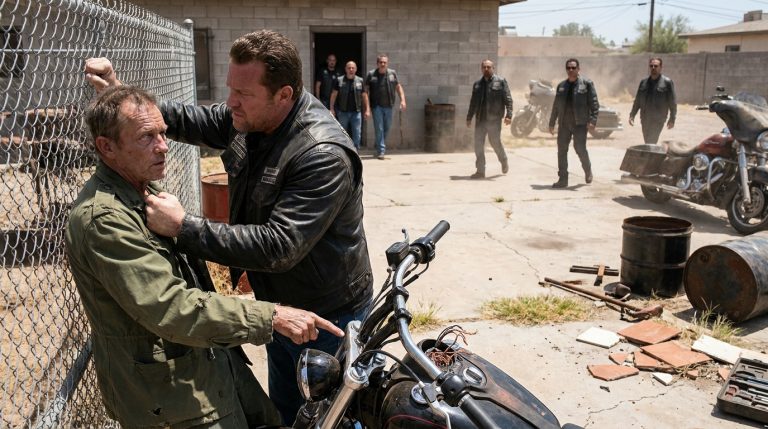
The low cinder block building loomed out of the dark, surrounded by mud-splattered pickup trucks and a row of heavy motorcycles parked under a corrugated metal overhang. The sight of the double-winged skull banners pinned behind the rain-streaked windows made his chest lock up. He stopped with his hand half-raised, the instinct to turn back screaming through his veins. But his body was shaking too hard to make the retreat.
He balled his fist and struck the heavy wooden door twice. It swung inward instantly, pulled by an unseen hand. The thick, stale haze of cigarette smoke and engine oil rolled out into the freezing night, carrying the low murmur of a muted television. Eight men sat in the dimly lit garage-turned-lounge, their leather vests bearing the heavy insignia of the Hells Angels. Absolute, suffocating silence dropped over the room.
The sergeant-at-arms, a mountain of a man with a shaved head and forearms crisscrossed with faded ink, shifted his bulk away from the door frame. His eyes were flat, hard, and entirely devoid of panic. He looked down at the soaked, shivering nineteen-year-old standing on the threshold. Get in here before you die, the man said. Ethan crossed the threshold, the sudden radiating heat hitting his skin like a physical wall as the heavy door slammed shut against the storm.
CHAPTER 2: THE CUBICLE AND THE FILE
Ten years had replaced the freezing Wisconsin rain with the sterile, buzzing hum of a Milwaukee public defender’s office. Ethan rubbed the bridge of his nose, the erratic flicker of the overhead fluorescent light pulsing behind his eyes. He shifted his weight. The office chair leaned perpetually to the left, a mechanical failure he had given up trying to fix six months ago.
“Waukesha County.” —Marcus, his supervisor, didn’t even break stride as he dropped the file and kept walking down the narrow aisle of cubicles. “Bar fight. Simple assault.”
“I’m at forty-seven active cases, Marcus,” Ethan said to the man’s retreating back.
“Make room. It’s a quick plea. Cut and dry.”
Ethan pulled the folder closer. The arrest report was thin, printed on cheap, graying paper that felt chalky against his fingertips. He flipped the cover open and scanned the summary. A roadside bar. An altercation. The arresting officer’s notes claimed the defendant had thrown a heavy punch, breaking another patron’s nose.
He flipped to the back to read the witness statements.
Ethan stopped chewing on the plastic cap of his pen. The details didn’t align. Two separate patrons had given statements to a responding deputy. One claimed the defendant was actively trying to break up the fight. The other explicitly stated the defendant had never swung his fists at all.
He flipped back to the booking inventory, searching for the missing piece of the puzzle.
Wallet. Keys. Cell phone. One leather vest. Club patches.
The air in the cramped cubicle suddenly felt very thin. Ethan moved his finger up the page to the top right corner, staring at the typed name of the client.
Dale Menjer.
The name hadn’t registered at first. But the vest did. His mind snapped back to a cinder block garage. He saw a lean man in his forties, grease permanently embedded in the deep cracks of his knuckles, pulling on a jacket and walking out into a blinding storm without asking a single question. He saw the tow truck backing out into the dark.
Ethan stared at the black ink on the page. He checked the zip code of the arresting precinct. It was the exact same stretch of rural county highway.
The deadbolt of his apartment clicked.
Ethan didn’t bother turning on the kitchen lights. He walked straight past the laminate counter, down the short hallway, and aggressively pulled open the bi-fold door of his bedroom closet. He shoved aside winter coats and cheap, polyester suits he only wore for trial.
Way in the back, hanging on a thick plastic hook that had bent under its sheer weight over the decade, was the jacket.
He pulled it out into the dim amber light of the streetlamp filtering through his blinds. It was heavy. Faded leather, worn soft by years of sitting in the dark. He ran his thumb down the left sleeve. The texture changed beneath his skin, growing slicker, rougher. An old oil stain, set deep into the hide. He lifted the collar closer to his face. It still smelled faintly of raw garage exhaust, old leather, and cold rain.
Ethan carried the jacket out to the small kitchen table. He set it down flat, smoothing out the sleeves with the palms of his hands.
He sat across from it in the silence. The refrigerator hummed a low, vibrating drone. Outside, a siren wailed in the distance, fading into the city noise. He was a broke, exhausted public defender making less than a first-year high school teacher. He had absolutely no time, zero institutional leverage, and no business picking a fight with a rural county DA’s office that actively hated outsiders.
But Dale Menjer was currently sitting on a steel bench in a concrete holding cell.
Ethan pulled his cracked cell phone from his pocket and opened his work email. He typed in the address for the Waukesha County prosecutor handling the docket.
Reject the plea offer, Ethan typed, his thumbs hitting the glass screen with heavy, deliberate strikes. We are going to trial.
CHAPTER 3: THE AMENDED CHARGE
“Hold up on that plea rejection,” Marcus tossed an auxiliary arrest supplement onto the laminate table. “DA’s office just refiled overnight.”
Ethan didn’t look up from his screen. He tapped the glass anyway, sending the email into the digital ether, before reaching for the new paperwork.
“They upgraded the docket,” Marcus said, his voice dropping an octave as he leaned against the doorframe. “Aggravated assault with a deadly weapon. They added a knife to the report.”
Ethan stared at the words typed in stark black ink.
A knife.
He flipped back through his own carbon copies of the original booking sheet, his eyes scanning the property inventory line by line. Wallet. Keys. Cell phone. Leather vest. There was no mention of a blade, no evidence bag number, no physical weapon logged into evidence.
“Who filed the supplemental statement?” Ethan asked, his voice flat and dangerous.
“The arresting deputy,” Marcus muttered, checking his watch. “Patrol division out of the county line. Good luck fighting that downtown.”
Ethan pushed past him into the main hallway, ignoring the ringing desk phones and the stale smell of carpet cleaner. He walked straight to his terminal and pulled up the body camera logs for the Waukesha County precinct. The system showed the footage had been logged five days late, flagged with an administrative delay that reeked of bureaucratic stonewalling.
He pressed play on the grainy digital file.
The audio crackled with static before the wide-angle lens resolved into the interior of a dimly lit roadside tavern. Dale was sitting down, his hands resting flat and visible on the wooden tabletop. The deputies pushed through the front door, their boots heavy against the floorboards, hands already hovering over their service belts.
Dale stood up slowly, palms completely open.
The man with the bleeding nose was already standing three feet away, his face marked before the deputies even crossed the threshold. The camera angle caught every movement, clean and undeniable. There was no weapon in Dale’s hands. There was no sudden lunge.
Ethan leaned closer to the monitor, his eyes tracking the officer’s service history in a separate window. Three prior arrests involving members of the same motorcycle club over the last twenty-four months. Three separate bookings. Three identical dismissals when the state’s case collapsed under basic judicial review.
It wasn’t police work. It was a targeted, grinding cycle of institutional harassment designed to break a community through sheer procedural exhaustion.
Ethan reached for his coat, sliding his arms into the sleeves with sharp, mechanical efficiency. He had forty-eight hours before the pre-trial motions hearing, and his client was sitting in a concrete box while the state built a case out of thin air.
CHAPTER 4: THE EMPTY WITNESS CHAIR
The phone rang four times before a flat, guarded voice clicked on the line.
“Yeah?”
“This is Ethan Callaway, defense counsel for Dale Menjer,” Ethan leaned his forehead against the cold steering wheel, watching the wipers sweep away gray water. “We need to go over your timeline for the pre-trial motions tomorrow morning.”
A heavy sigh drifted through the speaker, accompanied by the muffled rustle of cheap fabric.
“I can’t do it,” the witness said, the words tight and constrained.
Ethan straightened up, his fingers tightening around the cracked plastic of the handset. “What do you mean you can’t do it? You gave a formal statement to the deputy stating Dale never threw a punch.”
“My parole officer called me an hour ago,” the man’s voice dropped into a gravelly whisper. “Said if I step foot near that courtroom to testify for a club member, they’re slapping a violation on my record. I got eighteen months left on paper. I can’t risk going back inside.”
The line went dead with a sharp click.
Ethan stared at the dark screen of his phone. The system had moved its pieces with ruthless precision, cutting off his only corroborating civilian witness without a single fingerprint left on the administrative order.
He sat alone in the quiet car while the engine ticked as it cooled down. The prosecutor had a fabricated weapon enhancement, an officer willing to rewrite history in a supplemental statement, and a stacked county docket that looked favorably on municipal arrests.
He had a client trapped behind steel bars, a restricted body camera file, and a ten-year-old leather jacket hanging in a dark bedroom closet across the city.
Ethan shifted the car into drive, his jaw set hard against the mounting pressure. He didn’t have backup, and he didn’t have an institutional safety net. He had forty minutes before the evening lockdown, and he needed to walk into that jail visitation room to tell his client they were standing entirely alone against the bench.
CHAPTER 5: CROSSEXAMINATION IN THE GRAY
The courtroom air smelled of damp wool and floor wax as the prosecutor rested his case.
Ethan stood behind the defense table, his knuckles pressing white against the dark mahogany wood. The arresting officer sat at the witness stand, his uniform blouse pressed to absolute perfection, a row of service ribbons catching the overhead light. The man’s face was a mask of practiced, institutional boredom.
“Officer,” Ethan began, his voice cutting through the quiet room without any theatrical flourish. “Direct your attention to the night of the arrest. When you and your partner entered the tavern, where was my client positioned?”
“Standing near the front table,” the officer stated smoothly, never blinking. “Aggressive posture. Hand near his waistband.”
Ethan didn’t raise his voice. He simply reached down, picked up a digital tablet, and plugged a cable into the courtroom’s main evidence display.
“Let’s look at the record,” Ethan said.
The courtroom screens flickered to life, projecting the timestamped body camera footage directly onto the wall behind the jury box. The video rolled with stuttering frame rates. The door pushed open. The deputies stepped inside. And there, frozen in sharp, high-definition clarity, sat Dale Menjer—entirely seated at the table, both open palms resting flat and empty on the wood.
A sharp murmur rippled through the wooden benches behind the gallery.
The officer’s jaw tightened, a sudden twitch of muscle pulling at the corner of his mouth. “The subject shifted his position immediately after the recording began.”
“The recording runs continuously from the threshold, Officer,” Ethan countered, stepping forward into the well of the court. “There is no shift. There is no concealed blade. In fact, no knife was ever recovered from the scene, was it?”
“Standard protocol sometimes—”
“Yes or no, Officer. Was a knife logged into evidence?”
The silence stretched thin and brittle across the room. The officer’s fingers curled into tight fists against the arms of the witness chair, his professional composure cracking under the weight of the undeniable digital proof. “It was discarded during the scuffle.”
“By a man whose hands never left the table?” Ethan’s voice dropped into a cold, level register. “Or is this the fourth time in two years you’ve manufactured a weapons charge against members of this specific club?”
The prosecutor leapt to his feet, shouting an objection that the judge barely bothered to acknowledge with a lazy wave of his hand.
Ethan didn’t stop there. He turned to the clerk’s table, reached into his worn leather bag, and pulled out a heavy, faded garment with an oil-stained left sleeve. He laid it flat across the defense table, right where the jury could see every frayed seam.
“Ten years ago, on a freezing night just three miles from this courthouse, my car died in a blinding rain,” Ethan said, looking past the jury directly into the eyes of the men and women sworn to weigh the facts. “I was a nineteen-year-old kid with nowhere to go. I knocked on a door that everyone in this county told me to fear. The men inside didn’t ask who I was, what I wore, or what I could pay. They gave me dry clothes, they fixed my engine, and they sent me home.”
Dale stared down at the old leather jacket resting on the wood, his eyes suddenly bright, a thick knot forming visibly in his throat.
“The state wants you to look at patches and see a threat,” Ethan said, turning back to face the bench. “I look at them and see the only people in this county who showed up when the rest of the world looked away. The charges are fabricated. The weapon is a ghost. And the defense rests.”
CHAPTER 6: THE OPEN DOOR
“You remember me,” Burch said, stepping forward from the row of idling machines.
His voice was a low, gravelly rumble that carried across the plaza. He walked with a slight limp, his heavy boots clicking against the flagstones, but his gray-trimmed beard and calm eyes were entirely unchanged from that stormy night ten years ago.
“I remember,” Ethan replied, adjusting the strap of his briefcase.
Burch didn’t offer a grand speech or a theatrical display of gratitude. He simply reached out and shook Ethan’s hand, his grip hard, dry, and unyielding.
“You did good, kid,” Burch said, using the exact same tone he had used to order a bowl of chili for a freezing nineteen-year-old. “You stood at the door.”
Dale stood beside them, blinking rapidly against the spring glare as he looked down at his own hands, finally free of the steel bracelets that had bound him for days.
The other club members stepped up in silence, offering firm handshakes and brief, respectful nods before mounting their bikes and kicking the engines to life. The low, synchronized rumble of heavy exhaust echoed off the brick facade of the courthouse as they rolled out in a single, orderly file toward the county line.
Ethan watched them disappear around the corner, then turned and walked back to his sedan parked in the municipal lot.
The drive back to Milwaukee took the long route, keeping off the interstate entirely. He let the engine hum at a steady, unhurried pace along the winding county blacktop, the old leather jacket resting quietly on the passenger seat beside him like an old friend keeping watch.
The apartment when he returned was dim and cool. He didn’t turn on the television or check his work phone. He hung the faded jacket back in the deep recess of the bedroom closet, right where it belonged, on the heavy plastic hanger that had carried its weight for a decade.
Monday morning arrived with the exact same industrial soundtrack.
The fluorescent light above his cubicle buzzed with its familiar, dying rattle. The desk still leaned stubbornly to the left, and the coffee machine in the breakroom hissed like a cornered animal.
Marcus dropped a fresh stack of files onto the edge of the wobbling desk.
“New intake,” Marcus said without looking up. “A homeless veteran picked up for sleeping in the park, and a mother booked for taking baby formula.”
Ethan pulled the folders toward him, opening the top cover with a steady, practiced motion.
He didn’t hesitate. He pulled out a yellow legal pad, uncapped his pen, and began writing down the intake details line by line.
Outside his glass partition, the hallway filled with the shuffle of nervous footsteps and the low murmur of desperate voices waiting in the public gallery.
A sharp, hesitant knock tapped against the open door frame.
Ethan looked up from his desk. A young man stood in the threshold, wearing a thin jacket and clutching a crumpled piece of paper, his eyes wide with the raw, trembling fear of someone who had nowhere else left to turn.
Ethan set his pen down, stood up from his leaning chair, and motioned toward the empty metal seat across from his desk.
“Sit down,” Ethan said, his voice steady and calm. “Tell me what happened.”
The young man walked into the office, and the heavy door remained wide open against the noise of the hallway.