The Rust on the Chrome Cannot Silence a Boy Who Remuses to Quit the Impossible Fight
CHAPTER 1: THE RUSTED RELIC
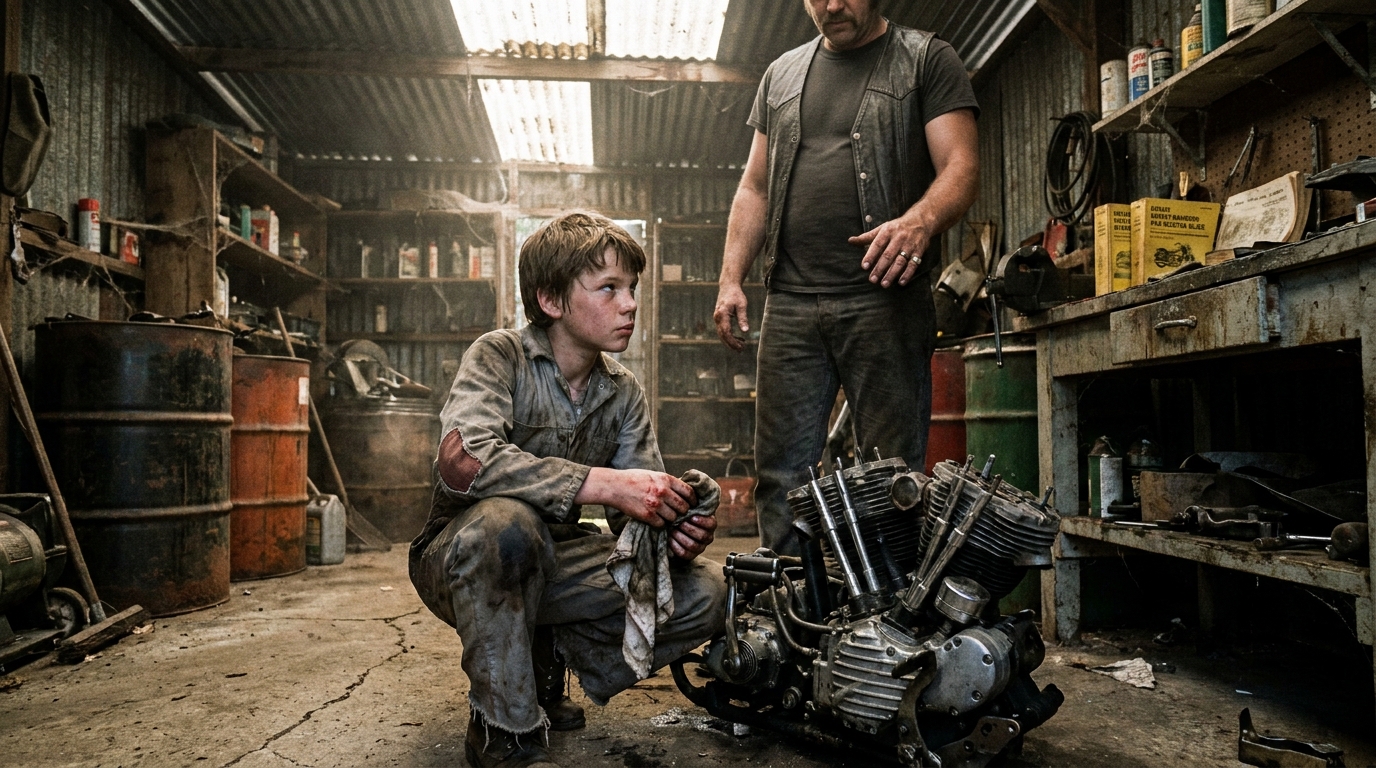
A wrench cracked against bone, drawing a smear of dark blood across rusted chrome, but thirteen-year-old Eli Marsh didn’t even pull his hand back. He shook his scraped knuckles once, wiped them on his dungarees, and shoved his fingers right back into the seized machinery. The garage smelled of stale grease and decades of trapped dust. Outside, the Ridley wind rattled the loose corrugated tin roof, but inside, there was only the sound of metal fighting against stubborn metal.
Frank stood by the workbench, his boots shifting heavily against the cracked concrete floor. The old man watched the boy through narrowed, cataract-clouded eyes, rubbing his thumb over the jagged scar on his left knuckle. That motorcycle had sat motionless in the exact same dark corner for forty years, covered by a heavy gray tarp that had long since rotted at the seams. Every mechanic in the county had looked at it, shaken their heads, and walked away.
“It’s dead iron, kid,” Frank muttered, his voice gravelly and worn from years of silence. “Leave it be.”
Eli didn’t look up from the engine block. His fingernails were rimmed with black oil that looked like it had settled into his skin for good. He didn’t have fancy tools, a heated workshop, or any business tearing down a 1966 Harley-Davidson FLH Electra Glide. What he had was a basic socket set, a flashlight with dying batteries, and a stubborn streak wide enough to block a highway.
“It’s just stuck,” Eli said, his voice flat and steady. “It ain’t broken.”
Frank let out a dry, humorless breath that sounded like dry leaves scraping across pavement. He remembered the last man who rode that bike out of town before the noise stopped forever. He remembered the way his brother Ray used to kick-start it on crisp autumn mornings, shaking the windowpanes of the entire house. For forty years, Frank had walked past the tarp every single day, keeping his eyes fixed straight ahead, pretending the past didn’t exist under that blanket of dust.
Eli reached down, his fingers brushing against the left side of the fuel tank where a deep, crescent-shaped dent marred the black paint. It was an old mark from an old fight, one nobody talked about anymore. Eli didn’t ask about it. He just gripped his rusted socket wrench tighter and leaned his weight into a stubborn bolt that shrieked in protest against the quiet afternoon.
CHAPTER 2: THE BLOCKED DOOR
The dual exhaust of a black Dodge Ram cut through the evening air, vibrating the rusted tin sheets of the garage wall. Eli didn’t turn around. He kept his knees pressed against the cold concrete, his fingers curled around a greasy rag as he wiped down the cylinder head. The heavy footsteps crunching across the gravel driveway didn’t sound like neighbors bringing over pie or kids cutting across the yard.
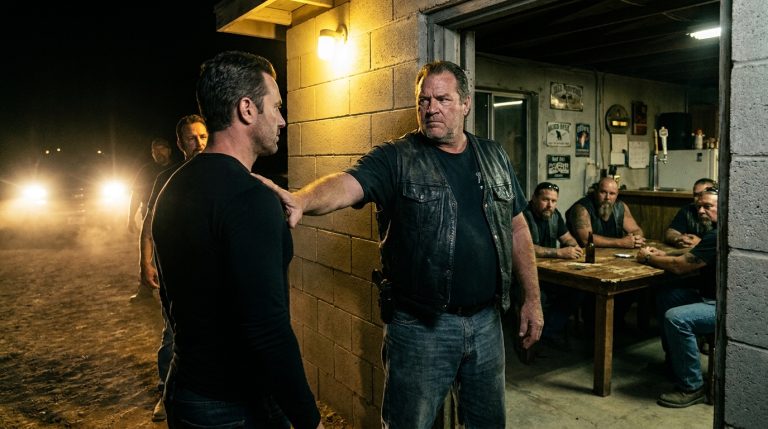
Vince Keller didn’t knock on the wooden side door. He pushed it open with the flat of his palm, letting the afternoon wind sweep in a cloud of dry dust and exhaust fumes. His leather vest carried the faded insignia of a brotherhood that Ridley had spent forty years trying to forget. He stood in the narrow doorway, his broad shoulders blocking out the fading light, staring down at the half-rebuilt machine with an expression of cold, unearned entitlement.
“You’ve got dirt all over a piece of history that doesn’t belong to you, kid,” Vince said, his voice flat and steady, carrying the weight of a man accustomed to people stepping aside.
Eli didn’t look up immediately. He slowly folded the rag in half, pressing the grease deep into the gray fabric before raising his chin. His mother’s warning echoed in the back of his mind, but the immediate reality of the garage—the cold steel, the smell of burnt oil, the unfinished work—kept him firmly planted. He was thirteen, and his knuckles were raw, but he had spent six hours getting that bolt to seat right.
“Frank said I could be in here,” Eli said, his voice dropping into a flat, level register that didn’t sound like a boy talking to a grown man.
Vince took two slow steps into the dim workspace, his heavy boots grinding against the grit on the floor. He didn’t look at Eli; his eyes were locked on the crescent-shaped dent in the fuel tank, the physical anchor of a past he believed the club held exclusive rights to. He reached out a thick, ringed finger and tapped the chrome handlebars, a deliberate gesture of dominance meant to remind everyone in the room who held the leverage.
“Frank doesn’t own what he thinks he owns,” Vince said, leaning down slightly so his shadow fell entirely across the engine block. “That machine carries a debt. And debts don’t get wiped out just because an old man forgets how things work.”
Frank stepped out from the shadows near the corner storage shelves, his thin frame trembling slightly beneath a faded flannel shirt. The old man’s hands were buried deep in his pockets, his knuckles white as he clenched them into tight fists. He looked at Vince, then down at Eli, the conflict between forty years of quiet avoidance and a boy’s stubborn refusal to quit tearing right through him.
“Get out, Vince,” Frank said, his voice cracking slightly before he forced the words straight. “The bike stays here.”
Vince didn’t raise his voice. He didn’t need to. He just smiled, a thin, humorless tightening of the mouth that made the small room feel suddenly airless. He turned his gaze back to Eli, weaponizing the boy’s low social status and youth as a silent insult, assuming the pressure would break them both before the sun went down.
“We’ll see how long that stubbornness holds up when the sun comes up tomorrow, kid,” Vince said, turning sharply on his heel and walking back out into the gathering dark without another word.
CHAPTER 3: THE LOCKED OUTCAST
The brass key turned two full rotations in the deadbolt, throwing a heavy metal tongue into the jamb with a sharp finality. Frank didn’t look at Eli when he pulled the key out, his chest rising and falling in shallow, rigid jerks. The old man kept his eyes glued to the workshop floor, his fingers curling tight around the cold ring of brass as if letting go would mean admitting he had already lost.
“I’m sorry, kid,” Frank muttered, his voice scraped raw and thin. “They know where I live. They remember everything about Ray. You can’t fight a ghost with a wrench.”
Eli stood on the gravel outside the threshold, his bicycle leaning against the peeling white siding of the house. He didn’t yell, and he didn’t slam his boots into the dirt. He just looked at the newly installed lock, shining bright and clean against forty years of grime. His mind didn’t process the word final; it only calculated the spacing of the hinges and the age of the pine door frame.
“A lock only holds what you let it hold,” Eli said, his voice entirely steady.
Frank flinched at the words, turning away toward the house without another syllable. The screen door squeaked, slapped shut, and left the backyard wrapped in an oppressive, heavy silence. Eli walked back to his bicycle, straddling the crossbar, but he didn’t pedal down the street toward home. Instead, he wheeled the machine around the side of the garage, pushing through overgrown blackberry bushes until he reached the small, rusted window near the rear corner.
The glass was coated in decades of spiderwebs and soot, completely opaque from the outside. Eli crouched down in the damp mulch, pulling a small flathead screwdriver from his back pocket. He didn’t have the key, and he didn’t have Frank’s permission anymore, but the engine inside was half-stripped, and a seized piston didn’t care who held the deed to the property. He wedged the tip of the tool under the old wooden window stop, applying slow, calculated pressure until the dry pine groaned and gave way.
CHAPTER 4: THE MIDNIGHT BENCH
The wooden pane groaned, swinging inward on rusted hinges to release a thick wave of trapped mildew and old oil into the chilly night air. Eli didn’t hesitate. He hooked his elbows over the sill, hauled his weight upward, and dropped silently onto the concrete floor inside. The garage was pitch black except for a thin sliver of moonlight cutting across the fender of the Harley.
He didn’t turn on a lamp. Drawing attention was the one luxury he couldn’t afford.
Working entirely by touch, Eli reached into the tool tray and gripped his scarred wrench, moving his fingers across the cold metal with practiced familiarity. The memory of Ray Dalton’s disappearance hung in the silence of the room, a phantom shadow that every old-timer in Ridley refused to talk about. Frank thought locking the door would bury the past, but the seized engine didn’t care about locked doors or club intimidation. It only cared about torque, pressure, and time.
Eli set the socket onto a loose head bolt, leaning his entire body weight into the turn. The metal resisted, binding tight against Ridley’s damp night air, before snapping loose with a loud, metallic crack that echoed off the tin roof like a pistol shot.
Outside in the driveway, gravel crunched sharply under the weight of a heavy boot.
The low rumble of an idling truck engine vibrated through the floorboards right beneath Eli’s sneakers. The headlights didn’t flash, but the shadow of a broad shoulder cut cleanly across the dusty windowpane. Vince Keller had come back sooner than expected, testing the perimeter, looking for any sign that the lock had been bypassed. Eli froze mid-motion, his hand still clamped over the wrench, listening to the heavy footsteps stop right outside the wooden side door.
CHAPTER 5: THE FINAL STAND
Vince Keller didn’t wait for an answer after the first knock. He struck the pine panels again, his shoulder hitting the frame with enough force to rattle the latch against the newly installed deadbolt. Frank stepped out of the back hallway, his face drained of color, his hands trembling as he stared at the trembling wood. The Ridley wind howled outside, driving a cold draft through the broken rear window where Eli stood half-hidden in the shadows.
“Open up, Frank,” Vince shouted through the grain, his voice thick with unearned entitlement. “We’re not playing games today. That iron leaves in the back of my truck, or things get unpleasant for everyone on this block.”
Frank reached for the doorknob, his fingers hesitating half an inch from the brass. Forty years of conditioned fear and avoidance pulled at his arm like lead weights. The club’s entire leverage rested on the assumption that an old man alone would always fold when the noise got loud enough. But Frank glanced toward the workbench, catching the reflection of a grease-stained thirteenth-year-old boy standing firm amid a sea of discarded parts.
Eli didn’t run. He didn’t hide behind a stack of tires. He stepped forward into the dim light of the single overhead bulb, holding his scarred wrench across his palm like a scale.
“The door stays locked,” Eli called out through the gap in the transom, his voice cutting cleanly through the club leader’s threats without a single quiver of hesitation.
Vince slammed his boot against the base of the door, splintering the dry paint around the threshold in a desperate, furious counter-move to force compliance.
“You’re trespassing on club property, kid, and you’re dragging an old man down with you,” Vince roared, his face flushing dark as the friction of resistance drained his composure. “Open this door right now or you’ll regret the day you ever touched a wrench!”
Frank’s hand dropped away from the doorknob, the trembling in his fingers suddenly vanishing into a cold, steady stillness. The old man looked at the battered gas tank, remembering his brother Ray’s quiet defiance, and realized the club’s entire power was just smoke built on intimidation. He didn’t have a legal title to wave around anymore, but he had something heavier: a boundary that wouldn’t budge.
“You heard the boy,” Frank said, his voice ringing out loud and clear through the wooden panels. “Don’t come back to this house again.”
Outside, the heavy boots shuffled backward off the gravel porch, the engine of the Dodge Ram revving in a furious, impotent display of rage before tires squealed against the asphalt and faded down the road.
CHAPTER 6: THE ROAR OF TRUTH
Eli primed the carburetor one last time, his thumb pressing down on the brass valve until a drop of fuel pooled on the casing. He didn’t rush. The garage doors stood wide open, letting the bright morning sunlight cut straight through forty years of accumulated dust and darkness.
Frank stood right beside the heavy rear fender, resting his palm flat against the black metal of the gas tank, directly over the crescent-shaped dent left by his brother Ray four decades ago. The old man’s breathing was slow and steady, untroubled by ghosts or threats.
Eli wrapped both hands around the knurled kickstarter arm and threw his full weight downward.
The machine didn’t cough or sputter. It caught instantly with a deep, chest-shattering roar that bounced off the wooden fence lines and rattled the windows down the entire block. The heavy exhaust pipe shook the concrete floor, sending a clean, rhythmic pulse straight up through the soles of their shoes.
Neighbors stepped out onto their front porches, shielding their eyes against the morning glare as the chrome caught the sunlight and held it. Nobody shouted or clapped, because that sound carried a weight that words couldn’t touch. It was the sound of a promise kept against every odds, a final answer to a forty-year silence.
Frank closed his eyes for a long second, his jaw tightening as old grief finally gave way to something solid and enduring. Eli kept his hand steady on the throttle, listening to the clean rhythm of every single cylinder firing in perfect harmony.
The bike sat idling in the driveway, rumbling low and deep in the autumn air. It wasn’t just a machine anymore. It was proof that when the whole world says something is finished, a little stubborn common sense is all it takes to bring it back to life.