The Echo of the Ridge: A Silent Master’s Final Lesson in Grace and Unseen Valor
CHAPTER 1: THE WEIGHT OF THE WIND
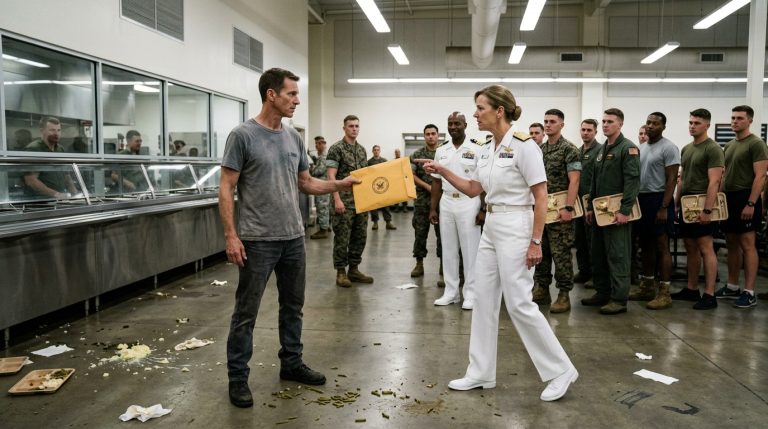
The air in the briefing room was thick with the scent of floor wax and the stale, nervous energy of twenty-six men who had been built to believe they were invincible. Staff Sergeant Cody Renner stood near the front, his posture a masterclass in calculated confidence, his eyes tracking the four-star General as he prowled the front of the room. It was supposed to be a day of validation—a ceremony of the modern elite.
At the very back, near the door that led to the utility closet, Harland Webb stood behind his rolling cart. He didn’t look at the General. He didn’t look at the candidates. He was watching a stray smear of boot polish near the baseboard, his rag moving in small, rhythmic circles.
“Twenty-six candidates,” the General’s voice cut through the stillness like a serrated blade. “The best of the best. And yet, when I ask for a shooter, you stare at the floor like you’re waiting for the tiles to confess your sins.”
Renner felt a familiar itch of resentment. He had spent three days scrubbing this schoolhouse into a temple. He didn’t need a lecture on nerve from a man who hadn’t pulled a trigger in decades, even if he wore four stars. He shifted his weight, catching the eyes of a few other candidates. A smirk passed between them. They were professionals. They knew the math of a 1,400-yard cold-bore shot. It was a statistical impossibility, a fool’s errand designed to humble them.
“Sir,” Renner started, his voice steady, projecting the kind of easy, unbroken confidence that had earned him two service rifle championships. “The wind on the Potomac is gusting at ten knots. With iron sights, the margin for error is nonexistent. We’re trained for precision, not theatrics.”
The General turned, his eyes narrowing. “Precision. Is that what you call it?”
Harland’s hand stopped. Inside his faded gray pocket, his fingers brushed against the cold, jagged edge of the dented brass cartridge. It was a phantom weight, one that had anchored his spine for fifty-one years. He felt the vibration of the room—the cadence of men who measured their worth by their confidence, not their silence.
The General walked toward the back, his gaze passing over the candidates as if they were nothing more than empty brass casings. He stopped just feet from Harland, but he didn’t look at the janitor. He looked at the window, where the loblolly pines stood motionless in the morning heat.
“You speak of precision, Staff Sergeant,” the General said, his voice dropping into a register that made the room grow colder. “But you’ve forgotten the most basic truth of the trade. You don’t own the shot. The environment owns it. And until you realize you’re just a guest in the air, you’ll never see what’s staring you in the face.”
Harland felt the air in the room shift. He reached into his pocket, his knuckles white, the brass casing pressing into his thumb. He knew that wind. He knew the way it curled around the riverbank, the way it teased the grass.
“I’ll take it,” he said.
The silence that followed was absolute. It wasn’t the silence of respect; it was the silence of a vacuum, a sudden, sharp intake of breath. Renner laughed. It was a dry, hollow sound, dripping with a condescension that filled the room.
“Sir,” Renner said, grinning, his body angled toward his peers, inviting them into the punchline. “Respectfully, Mr. Webb here cuts our grass. Why don’t we let the old-timer get back to his cart before he hurts himself?”
Harland looked at Renner. He didn’t see a threat. He didn’t see an antagonist. He saw a young man terrified of the shadow he didn’t know he was casting. The old man stepped out from behind the cart. He wasn’t hunched; he was still. He was the only thing in the room that wasn’t vibrating with ego. He looked past the shiny ranks, past the General, and out the window toward the unseen ridge that waited for them all.
CHAPTER 2: THE MATHEMATICS OF SILENCE
The laughter didn’t dissipate; it just changed frequency. It curdled into something tighter, more brittle, as Staff Sergeant Renner stepped aside with a sweeping, mocking gesture. He looked at the candidates, his grin fixed, a neon sign of his own discomfort. He expected a fumble. He expected the old man to struggle with the weight of the rifle, to gasp for breath, to provide the comedic relief that would finally wash away the General’s cold, judgmental stare.
Harland didn’t give him that.
He walked to the mat. The grass under his feet was damp, the dew of the morning not yet burned off by the Virginia sun. He didn’t look at the rifle as if it were a strange, dangerous animal. He looked at it as a man looks at a tool he has spent a lifetime maintaining. He knelt. His movement was not the fluid grace of a twenty-year-old athlete; it was the mechanical, deliberate folding of a structure. Bone stacked on bone. There was no wasted energy, no hesitation. He lowered his body with the precision of a clockmaker setting a gear.
He settled the rifle. His left elbow dug into the earth, creating a pivot point that felt as stable as a stone cairn. He didn’t rush to the sight. He lay there for a moment, simply feeling the rhythm of the wind.
The gusts were unpredictable, swirling off the Potomac lowlands. They would snap the flags hard to the left, then die completely, leaving the range in a dead, deceptive lull. Harland didn’t look at the flags. He felt the shift in the air against his cheek, the subtle change in the temperature. He was reading a language written in the movement of the grass blades a hundred yards away.
Renner stood two paces behind him, his arms crossed, his posture radiating a rigid, desperate need for validation. “Sir,” Renner said to the General, his voice pitched just loudly enough for the formation to hear, “I have to emphasize, the cold bore is a test of data, not just technique. Without a ballistic computer or a spotter, this is essentially a blind bet.”
The General didn’t look at him. His eyes were locked on Harland’s back. “Silence, Staff Sergeant. You’ve had your turn to speak.”
Harland heard the words, but they were distant, like the hum of a hive he had no intention of disturbing. He shifted his weight, adjusting the rifle’s buttstock into the pocket of his shoulder. The weight of the steel was familiar, a heavy, cold comfort. It was a weight he had carried in one form or another for over half a century.
He drew a breath. It was a shallow, controlled intake, pulling the cool, damp air deep into his lungs. He felt the pulse in his own throat, the steady, rhythmic thrum of a heart that had learned to stay quiet under pressure long before any of these boys had been born. He squeezed his eyes shut for a heartbeat, visualizing the distance—fourteen hundred yards. A dinner-plate target, shrinking in the heat shimmer.
The wind hit him then. A sudden, violent gust ripped across the firing line, catching the edge of his mat and threatening to peel it back. A younger, less experienced man might have reacted, shifting his weight to compensate, losing the perfect alignment of his bones. Harland didn’t move. He became part of the ground. He let the wind pass over him, his focus narrowing until the only things that existed in the world were the front sight post and the shimmering, distant white square.
His finger touched the trigger. It wasn’t a pull; it was an act of surrender. He took up the first stage of the trigger, feeling the resistance, the minute mechanical tension. He was waiting for the world to stop moving. He was waiting for that singular, infinitesimal gap in the chaos where the air, the rifle, and his own heartbeat aligned.
Around him, the world felt suspended. The candidates had stopped whispering. The General stood like a statue, his hands clasped behind his back, his expression unreadable. Even the birds seemed to have gone silent, leaving only the snapping of the range flags and the distant, rhythmic creak of the old man’s cart parked near the equipment shed.
Harland’s vision cleared. The white plate was there, a speck of promise in the blur of the heat shimmer. The wind died as abruptly as it had arrived.
He didn’t think about the General. He didn’t think about Renner’s mockery or the career-defining stakes of the shot. He thought about a ridge in the Republic of Vietnam. He thought about the smell of rain-soaked earth and the crushing, heavy silence of a hide. He thought about the weight of the friend he hadn’t been able to save, and the brass casing sitting in his pocket—a leaden anchor to a world that never stopped calling to him.
He eased the last of his breath out.
The rifle cracked.
It was a sharp, flat report that punched a hole in the morning silence. The recoil hit him, a solid shove against his shoulder, but he didn’t fight it. He rode the movement, his cheek firmly against the stock, his eye tracking the flight path with an intensity that burned. He didn’t blink. He didn’t adjust. He watched the white plate, waiting for the impact.
One second passed. Then two.
Across the range, the air hung heavy with the smell of cordite and damp earth. Twenty-six elite candidates leaned forward as one, their faces masks of disbelief, their breath held in the collective uncertainty of the moment.
Then, it came.
A clear, musical chime—a bell ringing at the end of the world. The steel plate struck dead center, the sound ringing out across the lowlands with a purity that silenced the doubt in every man’s heart. The plate danced on its chain, a white ghost spinning in the morning light.
Harland didn’t cheer. He didn’t celebrate. He simply let out the remaining air in his lungs, his body relaxing into the mat, his finger coming off the trigger with the same slow, deliberate care he had used to press it. He remained motionless for a long moment, staring downrange, listening to the chime as it slowly faded into the sigh of the wind.
He had fulfilled the promise he had made fifty-one years ago. He had made the shot, not for the General, not for the school, but for the man who was no longer there to see it. He worked the bolt, the metal clicking with a clean, satisfying snap, and retrieved the spent brass. He held it in his palm, the heat of it radiating against his skin, and carefully, with a steady hand, tucked it back into his pocket.
Only then did he rise, his hip protesting the movement, his eyes finally finding the faces of the young men who stood frozen in their ranks.
CHAPTER 3: THE SILENCE OF THE RIDGE
The ring of the steel plate didn’t just fade; it seemed to leach the oxygen from the air. Harland stood slowly, his old joints clicking with a familiarity that had nothing to do with the tension of the moment. He didn’t look at the General, and he certainly didn’t look at Staff Sergeant Renner. He looked down at the mat, his hands moving with rhythmic, practiced motions to fold it into a tight, neat rectangle.
His hands were trembling, just slightly. It wasn’t fear, and it wasn’t the recoil. It was the sudden, vertiginous return to the present. For those few seconds behind the rifle, he hadn’t been a seventy-eight-year-old groundskeeper in a faded gray shirt; he had been a young man again, back on the ridge, the weight of the rifle an extension of his own breathing. Now, as the damp morning wind hit his sweat-slicked face, the distance of those fifty-one years rushed back in.
The range master was the first to break. He stumbled forward, his spotting scope still in his hand, his eyes wide and unfocused. He stopped a few feet from Harland, staring at the old man as if he were a ghost who had forgotten how to remain invisible.
“Sir,” the range master stammered, his voice cracking. “That was… that was fourteen hundred yards. With iron sights. The wind value alone… it shouldn’t have been possible.”
Harland didn’t answer. He picked up his folded mat and tucked it under his arm. He didn’t want to explain the wind, and he didn’t want to explain the weight of the brass in his pocket. Explanations were for men who still believed that words could bridge the gap between what was felt and what was understood. He just wanted to get back to his cart. He had a patch of weeds near the equipment shed that needed his attention, a task that, unlike the shot he had just taken, made perfect, quiet sense.
The General took a step forward, his polished boots heavy on the damp earth. The four stars on his shoulder seemed to catch the morning light, but for the first time since he had arrived, they looked like mere decoration—a fragile, formal construct in the face of something raw and ancient.
“Gunnery Sergeant,” the General said. It wasn’t an order. It was an inquiry, hushed and cautious, as if he were addressing someone he had only just realized he was standing on holy ground.
Harland finally stopped. He turned, the mat still clutched firmly under his arm. His face was a mask of ingrained, lifelong modesty. “Just Harland, sir. I’m just here to keep the grass down.”
Renner was still standing near the formation, his face a disaster of conflicting emotions. The smirk was gone, replaced by a pale, twitching confusion. He looked at the candidates, looking for someone to share the joke with, but he found only wide eyes and the kind of heavy, respectful stillness that you usually only see at a funeral.
The weight of the silence began to press down on Renner. He had spent his career polishing the brass, mastering the electronics, and wearing his service rifle championships like armor. He had believed that the modern tools were the apex of the craft. And yet, this man, this old man who smelled of cut grass and two-stroke oil, had just stripped away the veneer of his expertise with a single, ringing note on a piece of steel.
Harland looked at Renner, not with anger, but with a weary, profound sadness. He saw the young man’s pride shattering, and he knew exactly how painful that was. He had been young and proud once, too. He had been so certain that the world was built on skill and that skill was something you could quantify, measure, and display. He hadn’t yet understood that the world was built on what you were willing to leave behind, and what you were forced to carry.
“It ain’t about the rifle, son,” Harland said, his voice quiet, barely audible over the gusting wind. “It’s about being still. You spend so much time making noise that you forget how to listen. The wind tells you where it’s going before it ever gets there. You just have to be quiet enough to hear it.”
He didn’t wait for a reply. He turned and started the slow, heavy walk back toward his cart. His left hip caught, a sharp, familiar jab of pain, but he didn’t alter his pace. He walked with the heavy, rhythmic gait of a man who had walked across hard country for a very long time and knew exactly how much distance remained to be covered.
Behind him, the formation didn’t move. The General didn’t move. Even the wind seemed to have lost its edge, swirling gently around the empty range. Alvarez, the candidate who had sat with Harland at the picnic table, watched the old man’s back. He looked at the way Harland walked, the slight hitch in his step, and he felt a sudden, sickening jolt of realization. He remembered the sandwich wrapped in wax paper, the way the old man had looked at the range with such a haunted, distant intensity.
Alvarez took an involuntary step forward, his heart hammering against his ribs. He wanted to call out, to ask, to apologize for every time he had ignored the man with the cart, but his throat had closed up. He watched Harland reach his cart, place the mat carefully inside, and pick up the rake.
The old man began to work, his movements slow and steady, his gaze fixed on the earth. He was already back in the rhythm, back to the simple, necessary labor of his day.
The General remained on the firing line, his eyes still fixed on the old man’s retreating figure. He reached up and touched the brim of his cover, his hand lingering there for a long moment, as if he were trying to find a balance he had somehow lost. The schoolhouse, the briefing, the meticulously scrubbed and polished grounds—it all suddenly felt like a stage set, a fragile, hollow play that had been interrupted by the sudden, brutal intrusion of the real.
Renner finally let out a ragged, shuddering breath. He looked down at his own hands, the hands that had won championships, the hands that were supposed to be the best. They felt heavy, clumsy, and utterly inadequate. He felt the gaze of his students, and for the first time in his life, he didn’t know what to say. The armor of his expertise had been pierced, not by a better rifle, but by a truth he hadn’t even known was a threat.
Harland raked the spent brass into the coffee can. The metallic clink-clink was the only sound in the world. He was the only one on the range who seemed to understand that the shot was over, that the performance was done, and that there was still work to be finished before the sun went down.
CHAPTER 4: THE SHADOW OF THE RIDGE
Harland snapped the lid onto the coffee can. The sound was flat and final, echoing against the equipment shed’s corrugated metal walls. He didn’t look up. He knew they were watching him—the General, Renner, and those twenty-six young men whose entire world had just been tilted on its axis. He could feel their eyes like physical pressure on his back, a weight he hadn’t asked for and didn’t know how to shed.
He pushed the rolling cart toward the shed, his hip throbbing in rhythm with every step. He didn’t rush. To rush was to admit that the morning had been anything other than a workday. He reached the shed, pulled the heavy sliding door open, and stepped into the cool, shadowed interior where the air smelled of floor wax, solvent, and the slow decay of fifty years of history.
He heard the crunch of boots on the gravel behind him. He didn’t stop. He placed the coffee can on the workbench next to a pile of weathered manuals and a set of rusted pliers. He picked up his rag and wiped his hands, his fingers lingering on the brass casing he’d dropped back into his pocket. It felt warmer now, as if the shot had finally released the cold, stagnant energy it had held for half a century.
“Mr. Webb?”
The voice was young, hesitant, and laced with the kind of awe that Harland found almost physically painful. It was Alvarez. The boy who had sat with him at the picnic table. The boy who had listened to the silence.
Harland turned slowly. Alvarez stood in the doorway, blocking the shaft of sunlight that cut across the shed’s dusty floor. The candidate’s face was pale, his eyes wide, tracking the old man with a look that wasn’t just admiration—it was a dawning, terrifying realization. Alvarez wasn’t looking at a groundskeeper anymore; he was looking at a living, breathing history book he’d been treating like furniture.
“You should be on the line, son,” Harland said, his voice level and devoid of any performative weight. “The General expects his candidates to be focused.”
“I… I can’t,” Alvarez replied, his gaze drifting to the workbench, to the old gear and the hand-me-down tools. “I remember what you said. About the waiting. About being still inside it.”
Harland leaned back against the workbench, the edge of the wood digging into his spine. He saw the boy’s eyes darting around the shed, noticing the subtle, misplaced artifacts of a life Harland had tried to keep quarantined: a folded flag sitting on the back shelf, a half-used bottle of gun oil, and then, resting on the corner of a grease-stained manual, a small, black-and-white photograph. It was a picture of two men, lean and sun-darkened, propped on their elbows in elephant grass.
Alvarez took a step toward it. His hand hovered in the air, trembling. “Who are they?”
Harland felt a sharp, cold spike of adrenaline. He had been careful—he had been invisible for nineteen years. He had kept the ghosts in the window sill at home, and the brass in his pocket, but he had never meant to bring the ridge into the light. He pushed himself off the bench, his movement sudden and sharp, and stepped between the boy and the photograph.
“It’s just trash, Alvarez,” Harland said, his voice harder than he intended. “It’s a long time ago. It doesn’t mean anything to the men who are standing on that line today. The only thing that matters is the wind and the shot. You get lost in the past, and you’ll find yourself buried by it.”
“You weren’t just a janitor,” Alvarez whispered, his voice rising, a tremor of agitation breaking through his composure. “Renner is out there talking about how it’s impossible. But I saw you. I saw how you moved. You’re the one, aren’t you? From the film.”
Harland looked at the boy. He saw the fire in Alvarez’s eyes—a desire for a shortcut, a hope that if he just stood close enough to the legend, he could inherit the stillness. It was a dangerous, seductive lie.
“There is no ‘one,'” Harland said, his voice dropping to a low, gravelly rasp. “There is only the work. You want to be a sniper? You stop looking for heroes. You start looking at the grass. You start listening to the air. You start understanding that the moment you think you’re special, you’ve already lost the edge.”
He reached out and closed his hand over the photograph, flipping it facedown on the workbench. The paper was dry and brittle, the texture of a memory that was finally losing its shape.
“Get back to the line, Corporal,” Harland said. “And stop looking for ghosts in the shed. They don’t have any advice for you.”
Alvarez hesitated, his eyes lingering on the workbench one last time, searching for a deeper truth in the dust and the tools. He looked at Harland, really looked at him, and for a moment, the old man saw the boy’s entire world view shifting—the arrogance, the swagger, the belief in the machine—all of it settling into the hollow ache of uncertainty.
Alvarez turned and walked out of the shed. The crunch of his boots on the gravel sounded like bone grinding on stone.
Harland waited until the sound had faded. He exhaled, his shoulders slumping. He looked at the photograph, his thumb tracing the worn edge of the paper, the images of two young men who had once walked on the edge of the world. He had kept them safe for nineteen years, and today, he had exposed them to the cold, bright light of a range that didn’t know how to speak their language.
He reached into his pocket and squeezed the dented brass. It didn’t feel like an anchor anymore. It felt like a warning. The silence had been broken, and now, the noise would come. He looked out the shed door at the candidates, their faces turned toward the range, their attention now entirely, dangerously fixed on the man in the gray shirt.
He knew what was coming. The questions, the archives, the unsealing of the records. He had wanted to finish his time here in the quiet, in the margins of the work, but he understood now that the ridge hadn’t been left behind. It had been waiting all along, patient and still, for the right moment to reclaim its debt.
He didn’t know what the General would do, or what the school would force him to be, but as he stood in the dusty, quiet shadow of the shed, Harland Webb finally understood that his nineteen years of silence were over.
CHAPTER 5: THE WEIGHT OF THE ECHO
Harland stepped out of the shed, the rake balanced across his shoulders, but his movement faltered. The General was waiting. He hadn’t left the range area. He was standing near the edge of the gravel path, his hands clasped behind his back, his posture as rigid as a guard of honor. Behind him, at a respectful distance, the twenty-six candidates remained huddled, their conversation gone, their eyes fixed on the old groundskeeper like pilgrims awaiting a revelation.
The General didn’t move as Harland approached. He watched the old man with a gaze that had softened from professional appraisal to something deeply, unsettlingly personal.
“Gunnery Sergeant,” the General said, the title falling into the air with a weight that seemed to bruise the quiet.
Harland stopped, the rake’s handle digging into his palm. He tried to project the invisibility he had mastered for two decades, but the eyes of the candidates were too sharp, their curiosity too hungry. “I’m just Harland, General. And I’ve got a lawn to finish.”
“The lawn is pristine,” the General said, his voice flat. He took a single step forward, narrowing the distance. “I’ve spent the last hour reviewing the range logs from nineteen sixty-eight and sixty-nine. The records were sparse, but the commendation drafts… the ones buried in the basement of the archives… they were remarkably descriptive.”
Harland felt a cold, sharp tremor in his left hip, a phantom echo of the blast that had shattered him fifty-one years ago. The smell of the range—the dry, hot scent of oxidized iron and cut grass—began to twist, replaced by the suffocating, cloying humidity of the Vietnamese highlands. He could hear the snapping of twigs, the distant, muffled thwip of a sniper round passing through heavy brush.
He closed his eyes for a second, fighting the phantom sensation of mud drying on his uniform. “Those records weren’t meant for the light, sir. They were written by a dead man, for a man who didn’t come home. They don’t have anything to do with the training of these boys.”
“They have everything to do with it,” the General countered, his voice rising just enough to draw the attention of the nearest candidates. “You represent a standard that I thought was lost to history. You stood behind me, emptying my trash, while I lectured these men about a legacy they didn’t know you were guarding.”
Harland looked past the General, his gaze landing on the spot where the white steel plate still stood in the distance, a small, stubborn mark in the shimmering heat. He saw Staff Sergeant Renner, who was watching them with an expression of stunned, hollow defeat. The younger man’s hand was resting on the barrel of a modern precision rifle, his knuckles white, his posture slumped. The sight of Renner’s disillusionment hit Harland with a strange, jagged empathy.
“You’re making a mistake, General,” Harland said, his voice dropping into that low, level register that silenced everything around them. “You think that if you name it, if you pin it on a wall, you can own it. You think that if you make it a ceremony, you can give these boys something they didn’t have to earn.”
“I am giving them the truth,” the General said.
“No,” Harland corrected, his eyes flashing with a sudden, sharp intensity. “You’re giving them a ghost. And ghosts don’t teach you how to stay alive. They don’t teach you how to be still when the world is screaming at you. All you’re doing is making them look for a shortcut. You’re making them look for a hero, and you’re making them forget that the only thing that matters is the man next to them.”
The General’s face tightened. He was a man accustomed to the weight of authority, but he was clearly struggling to hold his ground against the sheer, unvarnished weight of Harland’s presence.
“They deserve to know,” the General persisted. “They deserve to know who walked among them.”
“They deserve to find their own ridge,” Harland said. “And they won’t find it if they’re looking at a photograph of me.”
Harland walked past him. He didn’t look back. He kept his stride rhythmic and deliberate, his eyes fixed on the horizon, but he could feel the range erupting into a low, frantic murmur. He heard the sound of gear being moved, the sharp, authoritative bark of the range master trying to regain order, and the sound of boots moving, not in the cadence of a drill, but with a restless, searching urgency.
He reached the end of the gravel path, but he couldn’t stop. The phantom sensation of the jungle was closing in, the sound of the grass bending, the phantom weight of Daniel Reyes’ body against his back. He leaned the rake against the equipment shed and sat down on the weathered picnic table—the same table where he had sat with Alvarez.
He pulled the dented brass casing from his pocket and laid it on the wood. The metal was pitted and worn, a relic of a firing pin and an explosion that had ended his life, even if his heart had kept beating.
He didn’t notice Alvarez approaching until the young candidate stopped at the edge of the picnic area. Alvarez didn’t say anything. He just looked at the brass casing, then at Harland’s tired, weathered face. The boy’s arrogance had been stripped away, leaving something raw and exposed in its place—a young man who was finally, painfully aware of how little he knew.
“I’m going to lose the course, aren’t I?” Alvarez asked, his voice soft, as if he were afraid to break the silence.
Harland looked at him. “You won’t lose the course, Alvarez. You’ll just stop trying to win it. There’s a difference.”
Harland stared out at the Potomac, the sunlight glinting off the water like shards of broken glass. He felt the tension rising in the distance, the way the atmosphere of the range was thickening, preparing for a storm that had been fifty-one years in the making. He knew that the General wouldn’t stop, that the archives would be opened, and that the quiet life he had built on the margins of the school was rapidly coming to an end.
He reached out and tapped the brass casing. “Danny Reyes had the best eyes I ever knew. He didn’t win anything. He just did the job until the job couldn’t be done anymore. If you want to know who I am, you look at that, not at me.”
Alvarez nodded, but his eyes remained on the old man, searching for something he couldn’t name. Harland felt the heavy, suffocating pressure of the memory, the jungle closing in, the phantom weight growing heavier with every passing second. He knew he had reached the point where he couldn’t stay in the present anymore, and he couldn’t return to the past. He was caught, suspended between two worlds, waiting for the final, inevitable release.
CHAPTER 6: THE UNSEALING
The silence on the range had deepened, turning from an awkward pause into a heavy, suffocating blanket. The General stayed fixed near the firing line, but his authority had become a secondary concern. The real shift was happening in the ranks. The candidates were drifting, their disciplined lines fraying as they circled toward the picnic area like iron filings caught in a magnetic field. They were no longer looking at the white steel plate; they were looking at the man in the gray shirt.
Harland didn’t look up from the picnic table. He felt Alvarez’s gaze burning into the side of his face. The boy’s breathing was ragged, his hands clenching and unclenching at his sides.
“You didn’t answer me,” Alvarez said, his voice straining against the quiet. “If you carried him four miles… if you did all that… why did you come here? Why work for the people who let the story die?”
Harland looked at the brass casing. He didn’t see the picnic table anymore. He saw the cold, gray dawn when he had finally walked into the perimeter wire at Hill 55. He saw the faces of the Marines who had taken the body of Danny Reyes from his arms. He remembered the blank, clinical eyes of the officers who had asked him questions he couldn’t answer—questions about distances, about kills, about the ‘confirmed engagement’ metrics that meant nothing to a man who had lost his own shadow.
“I didn’t come here to work for them,” Harland said, his voice so quiet that Alvarez had to lean in to hear. “I came here because this is the only place left where the rhythm of the fire sounds the same. I spent years trying to forget the sound of the world ending, but the truth is, I never wanted to. I just wanted to find a place where the noise didn’t hurt.”
He looked up, his eyes meeting the General’s gaze. The General had walked over, drawn by the gravity of the conversation. He stood at the end of the table, his face drawn.
“The archives are being unsealed, Harland,” the General said. It wasn’t an announcement; it was a surrender. “My aides have already contacted the records office. By morning, the full report of Hill 55 will be on my desk. Every distance, every engagement, every detail the Pentagon deemed too improbable to publish.”
The weight of the words landed like hammer blows. Harland felt the last of his defenses crumble. He had spent nineteen years keeping the ridge at a distance, treating it like a foreign country he had visited in a dream. But the General was dragging the ridge into the sunlight, into the wax-polished reality of a modern military base.
“You’re going to destroy it,” Harland said, his voice flat. “You’re going to turn it into a slide deck. You’re going to take a man’s life and reduce it to a bullet trajectory.”
“I’m going to set it right,” the General replied. “It’s not just about you. It’s about the standard. These boys need to know that there are things worth holding onto, even when the world tells you to let them go.”
Renner had edged closer, his face twisted in a mixture of shame and intense, desperate curiosity. He looked at the dented brass, then at Harland’s weathered hands. “I thought you were a janitor,” he whispered, the words coming out as a confession. “I thought you were just taking up space. I spent three days resenting you for existing, and you were the standard the whole time.”
Harland looked at Renner. He saw the way the young instructor was trying to reconcile his arrogance with the reality of the man in front of him. It was a messy, painful process, and Harland realized he couldn’t help him with it. He couldn’t carry Renner’s realization the way he had carried Danny.
“You’re still looking at the wrong thing,” Harland said, standing up. His hip burned, a white-hot reminder of the reality he lived in. “You think the standard is the shot. The standard isn’t hitting the target. The standard is the waiting. It’s the ability to hold onto something that matters when everything else is falling away.”
He picked up the brass casing and held it out. It sat in the palm of his hand, a small, ugly piece of metal that had cost everything. Alvarez reached out, his fingers grazing the cold, ridged surface. The boy’s face changed, a look of profound, dawning understanding washing over him. It wasn’t the thrill of the hit anymore; it was the gravity of the cost.
Suddenly, the wind on the range shifted again, a cold, sharp gust that sent the dried leaves skittering across the pavement. Harland looked toward the horizon, toward the lowlands where the river cut through the Virginia woods. He felt the phantom jungle closing in, the sound of the wind through the elephant grass, the sudden, sharp, terrifying smell of the ridge.
He knew what was coming. The morning would bring the reporters, the formal ceremonies, the relentless dismantling of his anonymity. The quiet routine of his nineteen years—the 4:00 AM coffee, the slow drive, the smell of cut grass—was gone.
He didn’t try to stop it. He didn’t try to hide. He just stood there, a man in a faded gray shirt who had carried the dead for fifty-one years and was finally, exhausted, beginning to set the weight down. He felt the eyes of the twenty-six candidates on him—not as a janitor, not as a legend, but as a man who was finally visible.
The range was no longer a place of training. It was a place of reckoning. And for the first time since Hill 55, Harland didn’t feel the need to be still. He felt the need to walk, to step out of the shadows, and to face the light that had been burning for him all these years.
CHAPTER 7: THE WEIGHT OF THE BLUE COAT
The parade deck at Quantico was a vast, open sea of gray concrete, scrubbed clean by the morning rain until it reflected the pale, overcast sky. Harland stood near the center, his hands hanging stiffly at his sides. The borrowed dress blue coat felt like a suit of armor designed for a man he didn’t recognize. The sleeves were a hair too long, the collar bit into his neck, and the brass buttons caught the light with an aggressive, polished shine that felt fundamentally dishonest.
He was not supposed to be here. He had spent his life avoiding the center of the circle, preferring the quiet periphery where the grass grew and the brass was swept. But Otis Pruitt, his back bent like an old, weary tree, had stood at his kitchen table and refused to leave until Harland agreed.
“You don’t get to die a janitor, Harland,” Pruitt had said, his voice thick with the gravity of their shared silence. “You don’t get to decide that your life was only yours to keep. You’re the standard. And the standard has to be seen.”
So, here he was, standing in the middle of a silence so profound it felt like the air itself had solidified. The twenty-six candidates were present, arranged in a formation that looked like a jagged, protective wall around the center of the deck. They were older now, their faces marked by the reality of their service, but as they looked at Harland, their eyes carried that same hungry, searching expression.
Staff Sergeant Renner was there, standing at the edge of the formation. He had requested permission to speak, to apologize—a public penance for the arrogance he had discarded the day the steel target rang. Harland saw him, his posture impeccable, his expression one of hard-won humility.
The General walked forward, the four stars on his shoulder catching the dull light. He carried a small, velvet-lined box. Behind him, the wind whispered across the deck, carrying the scent of damp pavement and the distant, rhythmic hum of the base.
Harland felt the phantom weight of the ridge—the humidity, the suffocating presence of the elephant grass, the memory of Daniel Reyes’ cooling skin. It was all there, a living, breathing architecture of the past that lived inside his own ribcage. He knew that when the General pinned the medal to his chest, he wasn’t just honoring a service record; he was putting a period on a sentence that had been running through his blood for fifty-one years.
“Gunnery Sergeant Harland Webb,” the General began. His voice didn’t rattle windows today; it was quiet, personal, and carried the weight of a man who understood he was witnessing something he could never truly understand. “For extraordinary heroism under fire on the ridge of Hill 55…”
Harland stopped listening to the words. They were just labels, thin, fragile constructions that meant nothing to the man who had actually lived through the climb. He was thinking of the way Danny used to whistle when he was nervous, a soft, low tune that had been the only comfort in the suffocating darkness of the jungle.
He felt the prick of the pin as the General fastened the medal to the coat. The metal was cold against his chest, a stark, metallic contrast to the warmth of the brass casing tucked away in his inner pocket. He looked out at the formation, at the men who had spent their lives looking for a shortcut, and he felt a sudden, profound sense of peace. He had done his part. He had carried the weight, he had set the standard, and now, he was finally being allowed to stand down.
The ceremony ended with a silence that seemed to stretch on for minutes. No one moved. No one spoke. Harland turned toward the formation, his hip burning, but his movements were steady. He caught Renner’s eye and gave a small, almost imperceptible nod—a signal that the debt was paid, the arrogance forgiven, and the work of being a man was something that had to be done in the quiet, not on a parade deck.
He walked off the deck, his footsteps echoing against the concrete. The weight of the blue coat felt lighter now. He wasn’t Harland the janitor, and he wasn’t Harland the legend. He was just Harland, a man who had walked through the fire, carried his friend home, and finally found the courage to stop running from the echo.
As he reached the edge of the parade deck, he paused to look back. The candidates were still standing in their formation, a silent, disciplined monument to the lesson he had accidentally taught them. The ridge wasn’t in the jungle anymore. The ridge was in them. And for the first time in his life, Harland felt that the shop was, indeed, not just his.
The wind blew across the deck, carrying the faint, clean scent of the coming rain. He turned and walked toward the waiting tan Ford, his pace slow, unhurried, and entirely, finally, his own.
CHAPTER 8: THE LAST WAITING
The tan Ford pickup idled in the driveway of the clapboard house, its engine coughing once before dying into a heavy, absolute silence. Harland sat behind the wheel for a long time, the engine heat radiating through the dashboard. The dress blue coat, now folded neatly on the passenger seat, felt like a borrowed skin he was all too happy to shed. He stepped out of the truck, his hip protesting the movement, and walked toward the house that had been his anchor for decades.
Inside, the air was still, cool, and smelled faintly of lavender and old paper—the scent of Elana. It was a space designed for patience. He walked through the narrow hallway, his boots clicking softly on the floorboards, until he reached the living room. The afternoon light slanted through the window in a long, golden ribbon, illuminating the dust motes that danced in the quiet air.
He went to the window sill, where he had kept his vigil every evening for so many years. He placed the medal—the cold, heavy weight that the General had pinned to his chest—down beside the framed photograph of Elana and the second picture of two boys in the elephant grass. He looked at the three items for a long time. They weren’t trophies. They were the artifacts of a life that had finally, exhaustively reconciled itself.
He reached into his pocket one last time and drew out the dented brass casing. He held it between his thumb and forefinger, feeling the small, jagged edges of the metal. For fifty-one years, this had been his tether. It had been his reason to wake, his reason to breathe, and his reason to stay quiet when the world around him grew loud with its own nonsense. He had carried it through nineteen years of trash cans and raked brass, through the indifference of a thousand young Marines, and through the quiet, steady love of a woman who had learned to hold him while he fought wars in his sleep.
He walked to the small wooden desk in the corner of the room. He picked up a small, hand-carved box he’d kept in the drawer. He placed the brass casing inside, next to the other mementos he had gathered over the years—a dry, pressed flower from Elana’s garden, a letter that had never been sent, and a sliver of cloth from a uniform that no longer existed. He snapped the lid shut. The sound was soft, a final, definitive closure.
He realized then that he wasn’t carrying the weight anymore. The ridge had moved from his shoulders into the history books, and from his blood into the memories of the men who had finally learned how to look at him. The “standard” wasn’t something he had to guard; it was something he had left behind for the next man to find.
He sat in the chair facing the window. He was tired—a deep, marrow-level exhaustion that felt like it had been accumulating since 1969. He watched the light slowly dim outside, the shadows lengthening across the lawn he had tended with such stubborn, quiet care.
He thought of Alvarez. He thought of the look on the boy’s face when he had realized that the real work wasn’t the hit, but the waiting. He knew the young man would carry that lesson. He knew that somewhere, on a range just like the one at Quantico, a young Marine was learning to be still, learning to listen to the wind, and learning that the person emptying their trash was a story waiting to be honored.
Harland leaned his head back against the cushion and closed his eyes. The house was quiet, and for the first time in his life, the silence didn’t feel like an absence. It felt like a presence. It felt like peace. He breathed in, a long, slow intake of the evening air, and felt the rhythm of his own heart, steady and unhurried.
He didn’t need to be on the ridge anymore. He didn’t need to be behind the rifle. He didn’t need to be the standard. He was just Harland Webb, a man who had survived the fire, kept the watch, and finally arrived at the place where the waiting was done.
As the last of the light faded from the room, he felt a final, gentle sensation—not of loss, but of completion. He had been a guardian of the silence, and now, the silence was guarding him.