The Echo of the Trident: A Retired Master Chief’s Final Mission to Preserve a Legacy of Grace
CHAPTER 1: The Weight of a Cold Tray
The mess hall at Camp Pendleton had a way of swallowing sound. Five thousand marines and sailors, the clatter of silverware against government-issued plastic, the low-frequency hum of a thousand conversations—it all blended into a singular, industrial white noise. Then, the slap happened. It wasn’t the slap that broke the silence; it was the sudden, absolute void that followed, like a vacuum being pulled over the entire hangar.
Jack Carter stood with his tray tilted at an impossible angle. The mashed potatoes, a cold, pale lump, hit the polished concrete floor with a wet, final sound. He didn’t move. He didn’t flinch. The red mark beginning to bloom across his jaw was a secondary concern; the primary one was the weight of the pink-crayon letter pressed against his lower back, inside his jeans. Daddy, I love you. Please come home safe.
He felt the gaze of five thousand people—a weight more tangible than any ruck he’d ever carried. Behind him, Corporal Briggs was still vibrating with the adrenaline of his own cruelty, his chest puffed out, a grin plastered on his face that was supposed to look like confidence but looked only like fear wearing a mask.
Jack slowly bent down. His movements were deliberate, measured. He didn’t look up at Briggs. He focused on the texture of the potatoes, the way they smeared against the cold gray floor. He felt the cold, familiar steel of his own internal discipline wrapping around his heartbeat, slowing it down. He wasn’t the man who had held a ridge for forty-one hours in Solder City. He was just a father who had promised to be home for taco night.
Don’t, he told himself, the voice echoing in the chamber of his own mind. You are not that man anymore.
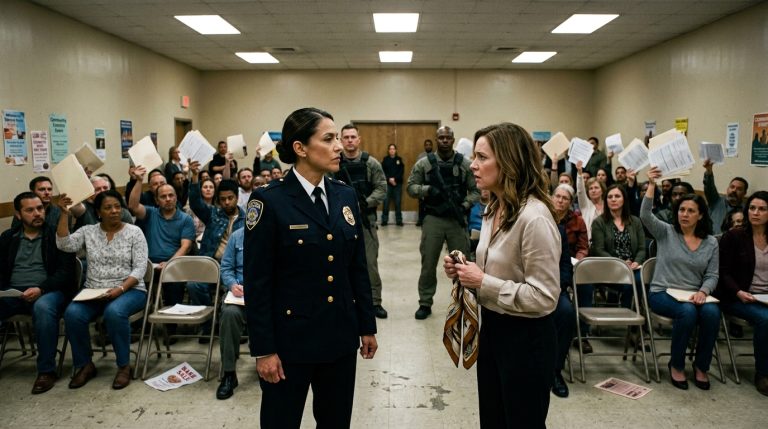
He gathered the food into the napkin, his hands steady, calloused, and utterly unthreatening. When he stood back up, he found Admiral Sarah Hayes standing at the end of the aisle. She was a statue of white dress uniform, her eyes scanning the room with the predatory focus of a hawk. She didn’t see a retired operator; she saw a disruption. She saw a civilian who had broken the order she had spent her life cultivating.
As she strode toward him, her footsteps rang out like a metronome, counting down the last seconds of the world as Jack knew it. He saw the way she carried her shoulders, the slight, involuntary flinch of a woman who had fought too hard for too long to be heard. He felt a sudden, sharp spike of empathy that bypassed his own situation entirely. She was exhausted.
She stopped inches from him, her shadow cast over the mess left on the floor. “You,” she said, her voice a serrated blade. “Who are you?”
Jack reached into his pocket. He didn’t reach for a weapon, but he saw the tension ripple through the marines standing in the line. He pulled out the folded, heavy manila envelope—the one with the CNO’s seal. As he looked up, he saw the moment her eyes shifted, the slight widening of her pupils as she recognized the crest of the Chief of Naval Operations. And then, he saw the flicker of something else—a disturbing, almost frantic shift in the room’s energy behind her.
He hadn’t been looking at the Admiral. He had been looking at the reflection in the polished glass of the kitchen window behind her. There, reflected in the distorted silver surface, he saw Marcus Whitfield, the Chief of Staff, watching the interaction with a smile that didn’t reach his eyes—a smile that held the icy, calculating rhythm of a man who had already decided that the day’s events were going according to a very different plan.
Jack looked back at the Admiral, his expression neutral, his internal alarms screaming. The slap hadn’t been the start. It had been the catalyst. The tray was on the floor, the secret was in his hand, and the trap—a trap he hadn’t even known he was walking into—had finally closed.
CHAPTER 2: The Admirals Cold Shadow
The concrete floor felt different beneath Jack’s knees than the sand in the Hindu Kush, but the sensation of being watched was identical. In the silence of the mess hall, the air had grown dense, pressurized by the presence of Admiral Sarah Hayes. She stood six feet away, a beacon of starched white fabric and uncompromising authority, but Jack wasn’t looking at her medals. He was looking at her shadow—a sharp, dark intrusion that cut across the spilled food.
The smell of the mess hall, a cloying mix of institutional bleach and burnt coffee, suddenly warped. For a fleeting second, it became the metallic, frozen scent of an aircraft hangar in the Bearing Sea, a ghost of a memory that had no business existing on a Tuesday morning in California. It was the V-2 of a phantom long buried. He felt the cold creep up his spine, but he forced his hands to remain still as he finished scooping the last of the green beans onto his napkin.
“I asked you a question, mister,” Admiral Hayes repeated. Her voice wasn’t just loud; it carried the resonance of a weapon being readied.
Jack stood up slowly, ensuring his movements were fluid, devoid of any combat-reflex spikes that might trigger a tactical response from the surrounding marines. He stayed within the Admiral’s personal space, careful to keep his posture relaxed, his weight shifted to the balls of his feet—not to fight, but to leave. He caught sight of Whitfield again, still by the window. The Chief of Staff’s expression had shifted into one of practiced concern, a mask that didn’t quite hide the predatory observation behind it.
“My name is Jack Carter, Admiral,” Jack said, his voice dropping into the quiet, conversational register he used when he needed to neutralize tension rather than escalate it. “I’m here on personal business. I apologize for the disturbance.”
Sarah Hayes didn’t look convinced. She looked like a woman who had spent twenty-two years fighting to stay on the path, and she wasn’t about to let a man in a faded gray t-shirt turn her mess hall into a circus. She took a half-step closer, her eyes scanning the room, catching the glint of amusement in Corporal Briggs’s eyes and the nervous shifting of the marines at the nearby tables.
“Personal business,” she echoed, the words tasting like ash in her mouth. She gestured to the folder in his hand, the one with the CNO seal that he had retrieved during the silence. “You think you can walk onto an active naval installation, disrupt the discipline of my command, and hide behind a piece of paper? You’re not military, Mr. Carter. I know what a veteran looks like, and you… you look like a man who hasn’t worn a uniform in a long, long time.”
Jack felt the weight of the envelope in his hand. He hadn’t wanted to use it. The CNO’s authorization was an atomic option, a sledgehammer meant to crack a nut, and he had hoped to navigate this quietly, as a ghost. But Briggs had forced his hand, and Whitfield was watching. The trap was already beginning to tighten its coils.
“With respect, Admiral,” Jack said, his eyes locking onto hers with a steady, unblinking clarity that seemed to catch her off guard, “I’m not here to disrupt your command. I’m here because I was asked to deliver this.”
He held the envelope out. She hesitated, her hand hovering near her belt. For a moment, the entire room seemed to hold its breath. The silence was so profound that Jack could hear the distant, rhythmic thrum of a drone overhead—a reminder of the world outside this hangar.
“Lieutenant,” Hayes barked without taking her eyes off Jack. Her aide, a young woman named Park, rushed forward.
“Take it,” Hayes ordered, still staring at Jack.
As Park reached for the manila envelope, Jack’s gaze flicked once more to the south wall. Whitfield had turned away. He was now talking to the deputy, his hands tucked neatly into his pockets, his posture relaxed. It was too relaxed. It was the posture of a man who knew exactly what the next move would be.
The Admiral’s attention snapped back to Jack. She was no longer looking at him with suspicion; she was looking at him with an active, burning frustration. She felt the power balance shifting, and she hated it.
“You’re not going anywhere, Mr. Carter,” she said, her voice turning icy. “Lieutenant, alert the gate. I want him detained until I’ve verified the contents of this package. If this is a joke, or a bypass, or some contractor scheme, I will see to it that you are escorted off this base in handcuffs.”
“I understand, Admiral,” Jack said. He kept his voice low, measured, a mirror to her intensity. He realized then that he couldn’t just walk away. The threat wasn’t the Admiral, and it wasn’t the Corporal—it was the invisible thread connecting the armory to the man he had yet to name. He needed her to see the truth, but he couldn’t show it to her until he was sure the man in the expensive watch wasn’t listening.
As he was led away by two base security officers, he didn’t look at Briggs. He didn’t look at the crowd. He kept his eyes on the floor, mapping the route, measuring the distance to the holding cells, and calculating exactly how much time he had before the ghosts of Solder City forced him to stop being a father and start being a target.
He was in the belly of the machine now, and the only way out was through the heart of the Admiral’s own suspicion.
CHAPTER 3: The Diner Convergence
The holding room was a study in beige—the walls, the floor, the absolute lack of imagination that defines military confinement. Jack sat on a stainless-steel bench, his forearms resting on his knees. He didn’t pace. He didn’t check the door. He waited. He knew the internal calculus of an Admiral like Sarah Hayes. She had to verify; she had to be sure. But every second he spent behind that door was a second Fisel Albaker could use to adjust his own game board.
When the heavy door finally groaned open, it wasn’t the guards. It was Admiral Hayes herself. She walked in, her white blouse slightly rumpled, her hair pulled back into a knot that spoke of hours of frustration. She didn’t look at him at first. She walked to the far wall, stopped, and sighed—a long, ragged sound that she immediately stifled.
“The CNO’s office confirmed your status,” she said, her voice stripped of the morning’s vitriol. She turned to face him, and for the first time, Jack saw the exhaustion beneath the rank. “They gave me a clearance code that shouldn’t exist. They told me to give you back your bag and to apologize for the… inconvenience.”
Jack stood, his movements efficient. He saw her eyes flick toward his hands, checking for tension. “I don’t need an apology, Admiral. I need the gate logs from 0600 and five minutes of your time in a place where your Chief of Staff can’t hear us.”
“Whitfield,” she muttered, the name leaving her lips like a curse. She stepped closer, her brow furrowed. “He’s been my Chief of Staff for six months. He’s a full colonel. He has a Bronze Star, Jack.”
“He has a reason,” Jack replied, keeping his voice low. He didn’t elaborate. He didn’t need to. He saw the way she went still—the way a commander goes still when they realize the structural integrity of their own office is compromised.
She opened the door, and they walked out into the corridor. The base was in full swing, the sounds of distant drills and transport vehicles filtering through the vents. As they crossed the threshold into her private office, Jack caught a faint, jarring note of discord: the smell of sandalwood and expensive, imported cologne. It was out of place in a wing of the building that smelled exclusively of toner and floor wax. He glanced at the Admiral’s desk; the chair was slightly turned, as if someone had just vacated it in a hurry.
“You have a visitor,” Jack said, his eyes scanning the room.
“I have a meeting scheduled with Whitfield in ten minutes,” she said, her hand resting on the back of her chair.
“He’s been here already,” Jack noted, pointing to the slight indentation in the cushion. “And he’s wearing a scent that isn’t military regulation. Sandalwood.”
Hayes’s eyes narrowed. She leaned over her desk, her fingers tapping against a leather-bound planner. “He’s my Chief of Staff. He has access to my office at all hours. But if you’re suggesting—”
“I’m suggesting that you look at your schedule, Admiral. Not the one on the screen, but the one in your trash.”
She hesitated, then leaned down and pulled a crumpled document from the wastebasket. She smoothed it out. Her face went pale. It was a redacted duty roster, but someone had scribbled a series of timestamps in the margin. They matched the delivery schedule of the armory shipments.
“He’s been monitoring the transfers,” she whispered, the realization hitting her with the force of a physical blow. “But why? He’s a colonel. He doesn’t need to steal optics.”
“He’s not stealing them for the money,” Jack said. He walked to the window, watching the movement of personnel in the courtyard below. He was looking for a pattern, a rhythm, anything that didn’t fit. “He’s stealing them because he’s being painted into a corner. And if we go to Vinnie’s Diner at 2000 hours—without your detail, without your aide, just you and me—we’re going to find out exactly who is holding the brush.”
“Vinnie’s?” She laughed, a sharp, humorless sound. “That’s a hole in the wall. It’s off-base.”
“Exactly,” Jack said, turning to look at her. “He won’t be expecting an Admiral in civilian clothes. He thinks he’s negotiating a deal. Let’s show him what a negotiation looks like when you’re standing in the dark.”
The Admiral stood for a long time, looking at the folder, then at the man who had been a ghost only hours ago. She took a deep breath, the decision hardening in her posture.
“I’ll have to sign out,” she said. “If I’m caught…”
“If we’re caught, you’re just having dinner with an old friend,” Jack reminded her. “The trick is making sure it’s the last dinner he ever has.”
They moved to the door. As they left, Jack paused, his hand on the frame. He looked back at the office, the scent of sandalwood still clinging to the air like a taunt. He knew now that layer one was the simple corruption—the greed and the fear. But underneath that, deeper than any arms deal, was the hunt. And he was the one being hunted. He just needed to make sure he was the one holding the leash when the sun went down.
They walked out into the California heat, two figures in a world that was about to fracture, neither of them noticing the black sedan idling quietly near the perimeter fence, watching the office windows with the patient, unblinking intensity of a predator who had all the time in the world.
CHAPTER 4: The Anatomy of a Traitor
Jack didn’t leave the office immediately. He stood by the window, watching the Admiral’s silhouette as she moved to the door to double-check the lock. The room felt smaller now, filled with the ghosts of paper trails and the lingering, synthetic scent of sandalwood. His own reflection in the darkened window looked back at him—a man with silver at the temples and eyes that had seen the price of secrets.
“If we’re going to do this,” Hayes said, her voice dropping to a near-whisper, “we need to know what we’re looking for in his records. If he’s hiding a money trail, it won’t be in the base ledger. He’s too smart for that.”
“He’s not smart,” Jack corrected, turning away from the window. “He’s desperate. And desperate men make the same mistake every time: they keep a secondary record. A safety net, in case the people they’re working for decide they’re more valuable as a liability than an asset.”
Jack walked over to the desk, his movements measured. He noticed the slight scuff marks on the hardwood floor beneath the desk—a clear sign that a heavy safe had been moved or accessed frequently. He knelt, checking the perimeter.
“Look at this,” he said, gesturing to the floor. “He’s been pulling this out every single night. Whatever he’s keeping, it isn’t digital.”
Hayes knelt beside him, her dress whites a stark contrast to the dust of the floor. She traced the scuffs with a gloved finger. “This is a restricted area. If he’s keeping a physical ledger here, he’s violating a dozen protocols. Why would he risk it?”
“Because he doesn’t trust the cloud,” Jack said, his mind drifting to the V-4 of his own perceptions—the creeping paranoia that maybe he wasn’t just chasing a thief, but a shadow. He felt a sudden, sharp pang of doubt. Was Whitfield a mastermind, or just a man drowning in a medical debt that the military refused to cover? “Sarah, what do you know about his home life? Really know?”
Hayes sat back on her heels, her expression darkening. “His youngest, Riley. Five years old. Leukemia. The insurance company fought the treatment coverage for months. I tried to pull strings, I tried to get the command to authorize an exception, but the bureaucracy is a stone wall.”
“And that’s the opening,” Jack said. “He didn’t betray the base. He betrayed the institution that betrayed his son.”
They spent the next hour in a meticulous, silent search. They bypassed the obvious—the drawers, the filing cabinets—and moved to the infrastructure of the room. Jack checked the baseboards, the lighting fixtures, and the ventilation. He found it behind a loose panel in the wall, tucked away in a space that would have required a tool to access. It was a simple, black leather-bound planner.
As Hayes opened it, the pages revealed a history of quiet, systematic decay. There were names—not names of arms dealers, but names of local civilian medical providers and a recurring entry for a private account in the Cayman Islands. But there was also a loose piece of paper, a napkin from a diner called Vinnie’s, with a single hand-drawn map of the armory’s security rotation.
“This is it,” Hayes whispered, her voice trembling. “This is the proof.”
“No,” Jack said, his eyes scanning the map. “This is the decoy. He left this for us to find, Sarah. Look at the date.”
Hayes squinted at the bottom of the napkin. “It’s dated for tomorrow. Why would he leave a map of tomorrow’s rotation in his wall?”
“Because he knows we’re coming,” Jack realized. The skin on the back of his neck prickled. The smell of ozone in the room intensified, a sensory warning that he had ignored. He realized then that the sandalwood scent hadn’t been an accident—it had been a calling card.
He moved to the door and eased it open, checking the hallway. It was empty, but the overhead lights were flickering in a rhythmic, pulsing pattern.
“Get your sidearm,” Jack commanded, his voice tight. “Now.”
“What’s happening?”
“The trap,” Jack said, his heart hammering against his ribs. “He didn’t want us to find the ledger. He wanted us to think we had the upper hand so he could draw us out to Vinnie’s. The map isn’t for the armory. It’s for us.”
Hayes stood, her hand going to the holster at her hip. The professionalism in her eyes had been replaced by a raw, combat-hardened focus. “If he’s waiting for us at the diner, he has the advantage of terrain.”
“Not if we change the terrain,” Jack said. He grabbed the burner phone he’d taken from Whitfield earlier and keyed in a series of numbers. He didn’t dial; he just held the call button.
“Who are you calling?”
“The only person on this base who isn’t being watched,” Jack said. “Ortega. We’re going to need a different exit than the one they’re counting on.”
As they stepped out into the corridor, the silence of the base felt heavy, pregnant with the threat of what awaited them beyond the gates. The transition from the safety of the office to the vulnerability of the hallways was a physical jolt. Jack stayed a half-step behind the Admiral, his eyes constantly moving, searching for the tell-tale sign of a watcher. He knew they were being observed, not just by the security cameras, but by eyes that belonged to a man who had waited nineteen years for this specific moment.
The game had shifted. They were no longer investigators; they were targets. And as they walked toward the stairwell, Jack felt the familiar, cold weight of his past settling back onto his shoulders, a burden he knew he would have to carry to the very end.
CHAPTER 5: The Midpoint Pivot
The darkness wasn’t just an absence of light; it was a physical weight, thick with the scent of stagnant air and old dust. Jack reached out, his hand finding the Admiral’s shoulder, his fingers feeling the rigid, defensive tension of her frame.
“Don’t move,” he whispered, his voice barely audible.
Above them, somewhere on the landing, the faint sound of a boot scraping against concrete echoed—a deliberate, slow pace. It wasn’t the hurried movement of someone responding to a power failure. It was the deliberate stalk of a predator who had cleared the board and was now moving in to finish the game.
“Is this your team?” Hayes breathed, her voice tight against his ear.
“No,” Jack said, his mind already mapping the stairwell. He knew the layout of the Pendleton headquarters by heart, the echoes of a thousand drills playing out in his memory. “Stay behind me. We’re moving to the maintenance crawlspace behind the paneling.”
They moved in unison, every step practiced. The air felt charged, a pre-storm pressure that made the hair on Jack’s arms stand up. As they rounded the turn in the stairwell, a sliver of moonlight cut through a high-set window, illuminating a set of heavy, tactical-grade boots standing on the landing above them. The intruder wasn’t hiding. He was waiting.
Jack felt a cold clarity settle over him. The “arms deal” he and Hayes had been chasing—the ledger, the ledger-maps, the petty corruption—it was all sand. He realized then that Whitfield hadn’t been the architect; he had been the bait. The true target had been Hayes from the beginning, and he, the ghost of Solder City, had simply been the variable that forced the game to start early.
He pushed the Admiral into the narrow recess of the maintenance panel just as a high-intensity tactical light sliced through the darkness. The beam hit the wall where they had been standing a second before, illuminating the dust motes dancing in the air.
“Admiral,” a voice called out—a voice that was calm, modulated, and entirely without accent. It was the voice of a man who had practiced his patience for nineteen years. “I know you’re here. And I know your friend is with you.”
Hayes stiffened, her hand reaching for her sidearm. Jack held her wrist, his grip firm. He didn’t look at her; he was watching the shadow cast by the light. The intruder was holding a suppressed rifle, the silhouette unmistakable. It wasn’t standard-issue; it was custom, long-range, and lethal.
“Who are you?” Hayes shouted, her voice echoing into the void.
“Someone who believes in balance, Admiral,” the man replied. He took another step down. The metal stairs groaned under his weight. “You have credit for a kill that wasn’t yours, and your friend… he has a life that he shouldn’t have been allowed to keep.”
Jack felt the weight of the moment. Layer one—the stolen rifles and the sick child—shattered into nothingness. This wasn’t about base security. It was about the debt of Solder City.
“Ortega,” Jack whispered into the burner phone, his voice a ghost of a sound. “The west exit. Now.”
“I’m at the perimeter,” Ortega’s voice crackled, barely a whisper. “But I have three hostiles in the parking lot. You’re pinned, Jack. If I fire, the base goes to full lockdown, and Hayes is done.”
Jack didn’t answer. He looked at Hayes, then at the rifle barrel now visible as it swept the darkness. He had to make a choice: protect the Admiral and her career, or draw the fire and give her a chance to break the connection to the armory and the Al-Baker network.
He didn’t hesitate. He stepped out of the shadows.
“Here,” Jack said, his voice ringing out with a deliberate, calm finality.
The light snapped toward him, blinding and brutal. For a second, the world turned white. He didn’t flinch. He saw the shadow of the man—a man of average height, wearing a watch that caught the stray moonlight—and he moved.
He didn’t go for his weapon. He went for the power box on the wall, throwing his entire body weight into a strike that shattered the reinforced casing. The stairwell erupted in a shower of sparks, the building’s emergency power grid finally failing entirely as the shorts cascaded through the system.
In the sudden, total blackness, Jack lunged. He didn’t know if he would come out of it, but he knew one thing: he had finally forced the hunter into the dark.
CHAPTER 6: The Staging Ground
Jack’s body slammed into something hard—a metal railing—before he could even register the physical impact of the tackle. The air in the stairwell was thick with the scent of ozone and singed wire. He didn’t think; he reacted. He rolled, his hands instinctively searching the darkness for the weight of the man he’d engaged. He found a grip on a sleeve, the fabric coarse and heavy with tactical gear, and wrenched it, dragging the intruder down with him toward the mid-landing.
They hit the concrete with a bone-jarring thud. Jack felt a sharp, searing pain in his shoulder, but he ignored it, his focus narrowed to the sound of his opponent’s breathing. It was steady, disciplined. A professional.
“Sarah, move,” Jack hissed, his voice a low, gravelly command.
He felt a sudden shift in the air—the Admiral was not retreating. She had closed the distance, her presence a quiet, lethal anchor in the gloom. He heard the metallic slide of her service weapon, the sound of a safety being disengaged.
“I’m not going anywhere,” she whispered back.
Jack shoved his attacker, using the momentum to pin the man’s arm against the stairwell wall. His hand found the man’s throat, but his fingers hit a hard, metallic collar—not a weapon, but a device. He pressed his advantage, driving his knee into the man’s midsection, but the intruder didn’t grunt. He just twisted, his body fluid and strong, and sent a devastating, short-range elbow into Jack’s ribs.
Jack gasped, the air fleeing his lungs. He retreated, his back hitting the cold concrete of the stairs. As he moved, his hand brushed against something lying on the step—a piece of gear the intruder had dropped. He grabbed it and jammed it into his pocket, his pulse hammering a erratic, frantic rhythm in his ears.
“You’re fighting a shadow, Master Chief,” the man said. His voice was a thin, emotionless thread in the dark. “You’re protecting a woman who doesn’t even know why you’re here.”
Jack didn’t dignify the taunt. He swung his fist, the impact connecting with the side of the man’s jaw. The intruder reeled, but before Jack could capitalize, the man unleashed a sweep that knocked Jack’s feet out from under him. He tumbled back, his vision swimming with white flares.
“Sarah, fire!” Jack roared.
The roar of the Admiral’s weapon was deafening in the confined space. The muzzle flash illuminated the stairwell for a fraction of a second, revealing the intruder—not a ghost, but a man of average build, his face obscured by a tactical mask. The bullet sparked off the metal railing, and the man didn’t hesitate. He launched himself toward the emergency exit, the door swinging open with a heavy, metallic clang.
“Don’t follow him!” Jack yelled, grabbing the Admiral’s arm as she started to move. He felt the tremor in her body—a combination of rage, adrenaline, and the shock of having fired her weapon in her own headquarters.
They stood in the sudden, eerie silence of the stairwell, their breathing the only sound. Jack could feel the warmth of his own blood trickling down his side, a visceral reminder that this had moved beyond tactical games. The man was gone, having vanished into the sprawling, unmonitored architecture of the base.
“Who was that?” Hayes asked, her voice shaking despite her efforts to control it.
Jack reached into his pocket and pulled out the piece of gear he’d snagged. It was a radio transceiver, small and encrypted, with a single, glowing light blinking in a series of sequences. He looked at it, his heart sinking. It wasn’t a military-grade unit; it was a custom-tuned receiver, programmed to a frequency that bypasses the base’s internal comms entirely.
“That,” Jack said, his voice grim, “is how they’ve been moving the rifles off the base without us knowing.”
“The rifles?” Hayes asked, confused. “But he said—”
“He lied,” Jack cut her off. “The rifles were never the point. He came here to draw us into this stairwell so he could confirm that you were protected by a ghost. He knows who I am, Sarah. He’s known since the moment I stepped onto Pendleton.”
Jack stood, his ribs screaming in protest. He felt the weight of the radio in his palm, a piece of technical evidence that confirmed the scope of the conspiracy. It wasn’t just about the arms dealer; it was about the Al-Baker network, the patient, nineteen-year-old vendetta that had finally found its target.
“We need to get to the armory,” Jack said, his voice regaining its cold, tactical edge. “If he’s leaving the base, he’s going to use the rotation to slip out. And he’s going to leave a trail.”
“And if he’s not leaving?” Hayes asked, her hand resting on the holster. “If he’s still here?”
Jack looked at the open exit, the dark, rain-slicked concrete of the loading dock beyond. He could smell the coming storm—a metallic, ozone scent that promised chaos.
“Then he’s waiting for us to make the next mistake,” Jack said. He started moving, his walk heavy, his mind racing. He knew the armory security rotation. He knew the gaps in the perimeter. But more than that, he knew the man who had just tried to kill him would never stop until he finished the debt. And as he moved into the dark, he realized the only way to end the vendetta was to turn himself into the bait.
CHAPTER 7: The Long Nights Vigil
The loading dock was a cavernous maw of shadow, illuminated only by the rhythmic, amber blink of a distant perimeter light. Jack didn’t stop moving. He grabbed Hayes’s arm, pulling her into the shelter of a stack of shipping crates. His breath hitched—a sharp, ragged sound—as his side flared with pain. He touched his ribs, his hand coming away wet with dark, viscous blood.
“Stay low,” he rasped, his focus already scanning the horizon.
He didn’t need a scope to know where the man was. The shooter had positioned himself on the rise overlooking the armory access road, a perfect vantage point that gave him command of the entire western quadrant. It was a kill-box, designed with the clinical precision of a man who didn’t just want to eliminate a target—he wanted to orchestrate a tragedy.
“He’s on the ridge,” Jack whispered, his voice steadying as the tactical reality took hold. “He has an elevated position. If we cross this open ground, we’re exposed.”
Hayes looked toward the armory, then back at Jack. Her expression was set, the fear stripped away to leave only the cold, hard resolve of an officer who realized the rules had been rewritten. “He wants me in the open. He wants a public execution to seal the lie.”
“He wants to settle a score,” Jack corrected, pulling the encrypted radio from his pocket. He keyed the mic, hoping Ortega was still in range. “Ortega, I’m at the loading dock. He’s on the north ridge, six hundred yards out. You have the angle?”
The response was a static-filled hiss, then a voice that sounded like grinding gravel. “I’m in position, Jack. But he’s not alone. There’s a second team on the perimeter fence. They’re moving to lock the exits.”
Jack closed his eyes, the gravity of the situation sinking in. This wasn’t just Albaker’s vendetta; it was a coordinated strike to cleanse the entire chain of command. If the base went into lockdown, the local police and NCIS would move in, and in the ensuing chaos, the Al-Baker network would simply vanish, leaving behind a dead Admiral and a disgraced, rogue Master Chief.
“Ortega, listen to me,” Jack said, his voice a low, urgent hum. “Don’t engage the second team. They’re the distraction. If you take the shot, take it on the ridge. That’s the center of gravity.”
“Jack—”
“Take the shot, Ortega.”
Jack dropped the radio and turned to Hayes. “We have to move. We can’t stay behind these crates. We need to reach the armory interior. It’s reinforced. If we get behind the blast doors, we can dictate the pace.”
“And what about you?” she asked, her voice uncharacteristically soft. “You’re losing blood.”
“I’m an old man, Admiral. I’ve survived worse.” Jack forced a smile, though it felt like a crack in a frozen lake. “Besides, I’ve got a promise to keep. Taco night. Remember?”
They moved. It was a brutal, agonizing crawl across the concrete, the biting wind tugging at their clothes. Every foot of ground felt like a mile. Jack watched the ridge, his eyes straining against the darkness. He saw a faint, almost imperceptible shift in the brush—the tell-tale shimmer of a high-end thermal optic being adjusted.
There.
He didn’t shout. He didn’t point. He just stopped, his body tensing for the inevitable. He saw the flash—a tiny, star-bright spark in the brush—and he tackled Hayes, driving her into the dirt just as a bullet shattered the crate where her head had been a second before.
The sound of the shot arrived a heartbeat later, a dry, muffled thwack that seemed to vibrate in his very marrow. Then, silence.
From the direction of the perimeter fence, the sudden, violent roar of Ortega’s rifle erupted. It was a beautiful, thunderous sound, a symphony of kinetic energy that cut through the night like a blade. Jack didn’t look back. He scrambled to his feet, hauling Hayes up with him, and they bolted for the armory’s side entrance.
They hit the reinforced steel doors, Jack fumbling for the override key he’d pulled from the intruder’s belt in the stairwell. The mechanism groaned, the tumblers sliding home with a heavy, final thud. They fell inside, the sudden, sterile silence of the climate-controlled facility wrapping around them like a shroud.
Jack slumped against the wall, the adrenaline beginning to ebb, leaving behind a cold, hollow exhaustion. He looked at Hayes. She was breathing hard, her eyes wide, her hand still gripped around her pistol.
“We’re in,” she said, though her voice lacked conviction.
Jack slid down the wall to the floor. He looked at the row upon row of rifles, the heart of the base’s defensive capability, and he realized with a sinking heart that the real test was only beginning. The man on the ridge was still out there, and he was patient.
“He’s not done,” Jack whispered, his eyes closing. “He’s just waiting for us to feel safe.”
He pulled the pink-crayon letter from his pocket—the paper now smudged with dirt and a smear of his own blood. He smoothed it out, a small, fragile tether to a world that suddenly felt a million miles away. He had to finish this. Not for the Navy, not for the stars on her shoulder, but for the life he was trying to drag back from the edge.
The armory lights flickered once, then turned to deep, pulsing red—a power-grid alarm. Somewhere in the distance, a door creaked open, the sound of measured, deliberate footsteps entering the building. The hunt had entered its final act.
CHAPTER 8: The Light on Frayed Edges
The rhythmic click of boots against the concrete floor grew louder, amplified by the sterile acoustics of the reinforced vault. Under the pulsing crimson glow of the emergency alarm, the shadows stretched and contracted like breathing lungs. Sarah stood with her service weapon lowered but ready, her frame casting a long, crimson shadow across the crates of small arms. Jack remained on the floor, his back flat against the cold metal casing of an optics rack, his fingers still lightly pressing the smudged crayon letter inside his palm. He didn’t reach for a holster. He simply watched the threshold.
The silhouette that stepped into the vault was elegant, almost delicate, completely divorced from the heavy tactical build of the operator Jack had fought in the stairwell. The man wore a civilian coat, his hands open and raised slightly away from his sides, empty. On his left wrist, the expensive face of a Breitling watch caught the rhythmic flash of the emergency light, casting a tiny, repetitive glint of silver across the rows of black rifles.
“Nineteen years,” the man said. His English was perfect, modulated with the soft, deliberate precision of a diplomat rather than a soldier. He stopped ten feet from the door, his eyes fixing directly on Sarah, ignoring Jack entirely. “I followed a paper trail across three separate continents, Admiral. The official after-action reports from Solder City. The commendations. The bureaucratic registry. It all pointed to a single name: Lieutenant Commander Sarah Hayes. The JTAC who directed the fire that struck down Khaled Albaker.”
Sarah’s eyes narrowed, the barrel of her weapon remaining steady. “You’re Fisel,” she said, her voice an anchor in the red gloom. “The brother.”
“The brother who remembers,” Fisel Albaker replied softly. He did not look like a monster; he looked like a man hollowed out by the sheer weight of his own memory, a living embodiment of a broken vessel. “The weapons transfers, the Marine colonel with the dying child—they were never the objective. Marcus Whitfield was simply a doorway. A way to map your schedule, to know your routes, to ensure that when the debt was paid, it was paid on the soil you commanded. I wanted to dismantle everything you built, piece by piece, before the end.”
“You built the trap out of a father’s desperation,” Jack spoke up from the floor, his voice cutting through the mechanical hum of the vault. He leaned his head back against the metal rack, his eyes fixed on the ceiling lights. “But you read the map wrong, Fisel. The military machine is a vast, clumsy thing. When a classified operator pulls a trigger in a dark valley, the bureaucracy doesn’t put his name on the ledger. It’s too dangerous. It leaves a footprint. So they find a name that’s already on the ground. A command element. A JTAC who was clearing the building next door.”
Fisel’s head snapped toward Jack for the first time, his brow furrowing as the first fractures of doubt showed on his face. “What are you talking about?”
“Sarah didn’t kill your brother,” Jack said, his voice dropping into a quiet, heavy register that filled the spaces between the red flashes. “She wasn’t even on the ridge. She was four hundred yards away, dragging a wounded sailor out of a collapsing courtyard while the mortar rounds were still falling. I know, because I was the man on the glass. I was the shooter who held the breath. I am the one who closed Khaled’s eyes.”
A profound, suffocating silence fell over the vault. The red light washed over Fisel’s face, catching the sudden, visceral realization that his two decades of careful, meticulous planning had been aimed at an administrative illusion. The target he had hunted was a shadow, and the true author of his grief was the tired, silver-templed man sitting in a faded gray t-shirt on the floor of a supply cage.
“No,” Fisel whispered, his hand moving toward the small pocket of his coat—a final, desperate counter-move, his fingers gripping the casing of the encrypted transceiver he had used to coordinate the perimeter team. “The ledger is absolute. The Navy doesn’t lie to its own history.”
“The Navy protects its ghosts,” Sarah said, stepping forward, the absolute authority of her command returning to her posture. “And you just walked into the center of the machine.”
Before Fisel’s fingers could depress the terminal key to signal his secondary team, the secondary radio frequency Jack had intercepted in Chapter 6 took effect. Jack reached up and flipped the manual breaker on the optics rack. The encrypted transceiver in Fisel’s hand didn’t transmit an escape route; instead, the pre-seeded security override Jack had relayed to Donovan through the burner phone closed the circuit. The massive hydraulic vault doors behind Fisel slammed shut with a deafening, final groan of interlocking steel, sealing the exit completely.
The outer security locks clicked into place. A second later, the side access panel hissed open, and Master Chief Donovan stepped through, flanked by four armed military policemen. Their weapons were up, their movements disciplined and bloodless. They didn’t fire; they didn’t need to. Fisel Albaker’s hand slowly fell away from his coat pocket, his shoulders slumping as the psychological collapse took him entirely. He stared at Jack with the hollow, defeated look of a man who realized he had spent his life chasing a reflection in a broken mirror. He surrendered to the law without a sound.
Three days later, the sterile, crimson glare of the Camp Pendleton armory was nothing more than a fading memory, replaced by the soft, golden haze of an early spring afternoon in El Cajon. The air smelled of dry earth, orange blossoms, and the faint, sweet scent of warm corn tortillas rising from the kitchen.
Jack sat on a weathered wooden bench in the shade of a small backyard patio, a fresh strip of black athletic tape held between his fingers. On his lap lay the old, faded green canvas duffel bag—the one that had carried his secrets into Pendleton and back out again. The handle had been frayed and torn during the scuffle in the stairwell, the old tape sticky and peeling with dust. Slowly, methodically, Jack peeled away the old layers, exposing the raw, green webbing underneath. He took his time, smoothing out the frayed edges, finding a quiet rhythm in the simple maintenance of a tool that had survived the long road. He wound the new tape tightly around the grip, his calloused thumbs pressing the edges down until the handle was whole, firm, and clean once more.
The screen door jingled open, and Sarah Hayes walked out onto the patio. She wasn’t wearing her dress whites; she wore a simple pair of civilian jeans and a soft, faded blue shirt. The sharp, rigid edges of the command uniform were gone, leaving behind a woman who looked like she had finally allowed herself to take a deep, unobstructed breath. She carried two white ceramic mugs of coffee, the steam rising lazily in the afternoon air.
“Donovan finished the final processing with NCIS this morning,” she said, sitting down on the bench beside him, handing him a mug. The warmth of the ceramic seeped into Jack’s palms. “Marcus Whitfield’s plea was entered into the record. The administrative exemption went through. His son’s treatment at the hospital is fully funded, off the books, guaranteed through the duration of the care. His family is protected.”
Jack took a slow sip of the coffee. It was strong, hot, and sweet—completely unlike the bitter sludge of the base diner. “And your command?”
“The CNO closed the file,” she said, a small, genuine smile touching the corners of her eyes. She looked out toward the small garden plot where the tomato plants were starting to take root in the dark soil. “The letters are filed away where the sun doesn’t shine. I’m staying at Pendleton. But I’m taking a week off first.”
“Good,” Jack said, his hand resting flat against the newly repaired handle of his bag. “A commander needs to reflect. Not just react.”
“I learned that from a sniper,” she noted softly, her eyes meeting his with a deep, silent understanding—a shared burden that had finally been lifted from both their shoulders, leaving behind something whole and resilient, like gold poured into the cracks of a broken bowl.
From the far side of the yard, near the chicken coop, a loud laugh cut through the quiet. Emma came running across the grass, her oversized soccer jersey flapping around her knees like a flag of truce. She held a single, brown egg carefully in both hands, her blue eyes shining with the absolute, unbothered joy of a nine-year-old child whose father had come home exactly when he said he would.
“Daddy, look!” she shouted, stopping by the edge of the patio, her face bright with a smile that contained no ghosts, no secrets, and no dynamic hooks. “Henrietta laid another one! Can Sarah stay for dinner?”
Jack stood up, his ribs aching only slightly as he brushed a stray piece of athletic tape from his knee. He looked at Sarah, then down at his daughter, the gold light of the setting sun catching the silver at his temples.
“The lady is definitely staying for dinner, Emma,” Jack said, holding out his hand to help Sarah up from the bench. “Because tonight is taco night, and we don’t break promises in this house.”
They walked inside together, the screen door clicking shut behind them with a soft, familiar sound, leaving the long war out in the dark where it belonged.