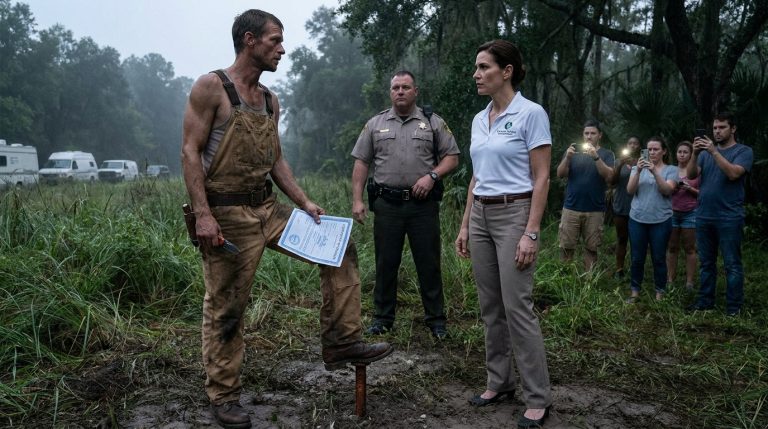
The Surveyor’s Line: Why Some Boundaries are Written in Iron, and Others in Blood
CHAPTER 1: THE RED INTRUSION
The bass didn’t just vibrate the glass in the windowpane; it rattled the iron skillet hanging from the hook beside my stove. That was the first thing that registered—not the melody, which was nothing but a repetitive, synthetic thud, but the metallic clink of cast iron against timber. It was a rhythmic, artificial pulse that didn’t belong in a valley where the only early-morning sounds were the crows arguing in the pine tops and the low hum of the county tractor clearing the state ditches.
I left my coffee steaming on the pine table. My boots crunching on the dry weeds by the porch felt real, but the sight waiting on the gravel driveway did not.
A strip of cheap, synthetic scarlet fabric had been rolled out across my property line, its edges pinned down with rusted landscape staples. It looked like a long, bleeding gash against the dry gray limestone. A man in a sweat-stained green polo was swearing under his breath, trying to force a plastic peg into a heavy metal bracket of a commercial sugar spinner. Beside him, three rows of white vinyl folding chairs sat in the dry dirt, arranged with the geometric precision of a military tribunal.
“You can’t park that there.”
The woman who spoke was standing by my fence post, her high heels sinking half an inch into the soft loam of my ditch. She had a glittery sash slung across her shoulder that caught the hard morning light, and her fingers were busy tapping a silver pen against a clipboard.
“This is my driveway,” I said. My voice was flat, carrying the gravelly rasp of twenty years of early shifts. “You’re parked on state-surveyed gravel. My gravel.”
She didn’t look up from her clipboard. “The county cleared the permit. We have administrative easement for the Hidell Logistics regional outreach program. It’s communal.”
I walked toward the edge of the red carpet. The air smelled of burned sugar and diesel exhaust from a idling box van parked twenty yards down the road. Underneath the sweet smell of the cotton candy machine, there was another scent—thin, chemical, like scorched copper wiring.
I looked down at the fence line. My survey post, a solid three-foot rod of galvanized steel driven into the clay five years ago, was missing its yellow plastic cap. The ground around the base of the post had been freshly turned, the dark, damp under-soil exposed to the dry air. A small brass tag, stamped with three letters I had never seen in any county land registry, lay half-buried in the loose dirt.
On the tag, barely legible under a crust of dry mud, were the words: Protocol-44.
“Who authorized this?” I asked, keeping my hands flat at my sides, my eyes tracking the heavy black extension cord they had run from my outdoor utility box directly into their sound system.
“Derek did,” she said, her tone dripping with the casual authority of someone used to talking over customer service representatives. “And if you don’t move that truck in five minutes, I’m going to have the county sheriff clear it for us.”
I reached into my pocket, my fingers brushing the cool, notched key of my patrol unit, but I didn’t pull it out. Instead, I looked past her, toward the generator hum coming from the back of the box van. The license plate was covered by a magnetic strip advertising a local party rental service, but the steel bumper beneath it had the heavy-duty tie-downs of a municipal transport vehicle.
“Go ahead,” I said. “Call him.”
CHAPTER 2: THE FLASH OF BRASS
The metal tag was cold—colder than the morning air deserved. It sat in the palm of my hand, heavy and rough-edged, smelling faintly of sulfur and wet earth where it had been wedged near the base of my steel survey post. On the gravel driveway, the bass from the massive black speakers still hit with a low, bone-deep thrum, but my focus had narrowed entirely to the six inches of freshly turned clay at my feet.
The woman with the glittery sash—the one who called herself a hostess—was already holding her phone to her ear, her manicured thumb tapping against the glass screen with a sharp, plastic click. She was watching me, her mouth set in a thin, hard line that tried to mimic authority but only managed to look desperate.
“Yes, county dispatch?” she said, her voice rising to carry over the thudding music. “I have a hostile property owner at the outreach site. He’s interfering with a cleared public event. I need a deputy out here immediately.”
I didn’t answer her. I didn’t even look up at her. I knelt down by the exposed base of my fence post, my boots scraping against the dry gravel.
There was a discrepancy in the ground here. The clay wasn’t just disturbed; it had been dug out with a narrow trenching shovel, then hastily packed back down with the flat of a boot. I reached into the loose soil, my fingers brushing past a thick, ribbed black plastic sleeve. It wasn’t an extension cord. It was a high-pressure municipal water line bypass, tapped directly into the county main that ran along the eastern boundary of my ditch.
They weren’t just stealing my electricity through the side breaker. They had tapped the water.
A heavy-duty brass valve sat in the dirt, sweating cold condensation against the dry earth. Stenciled in white paint across the side of the bypass casing were two words: Hidell Logistics.
The puzzle pieces didn’t fit. A local charity event—especially one thrown by a woman who looked like she’d never touched a shovel in her life—doesn’t bring a trenching crew to tap a municipal water line under a state trooper’s driveway. You don’t lay heavy infrastructure for a one-day cotton candy stand.
“They’re on their way,” she said, sliding her phone into a small leather clutch with a sharp snap. “Ten minutes. I suggest you move your truck before the county tow truck does it for you.”
“The ground’s wet,” I said, my voice quiet against the vibration of the speaker stack.
She blinked, her sunglasses sliding down the bridge of her nose. “What?”
“The clay under your feet,” I said, standing up slowly and wiping the dark, mineral-heavy dirt off my palms onto my jeans. “It hasn’t rained in three weeks, but this ditch is holding two inches of standing water. You didn’t just plug in a margarita machine. You tapped the county main. That’s a class-three utility diversion.”
For a fraction of a second, the confidence in her eyes flickered. It wasn’t the look of a stubborn homeowner or an annoyed neighbor; it was the sharp, calculating look of a subcontractor who had just realized she’d hit an unmarked gas line. Her hand drifted back toward her clutch, her fingers twitching against the leather.
Behind her, the low, guttural rumble of a diesel engine sounded from the bend of the county road. It wasn’t the high-pitched whine of a flatbed tow truck. It was the heavy, rhythmic thrum of a state patrol unit.
Two white-and-gold cruisers rounded the gravel curve, their tires kicking up a thick, choking cloud of gray limestone dust that drifted across the red carpet. The red and blue lights didn’t flash; they simply burned steady in the bright morning glare.
Officer Rojos stepped out of the lead unit, his Stetson tilted low to shield his eyes from the sun. He looked at the balloon arch, the white vinyl chairs, and then at me, standing by the wet trench with a piece of dirty brass in my hand.
“Morning, Marshall,” Rojos said, his hand resting casually on his utility belt. He looked down at the muddy water pooling around the hostess’s designer heels. “Looks like you’ve got a leak.”
“It’s not a leak, Rojos,” I said, tossing the small brass tag onto the hood of his patrol car with a metallic clink. “It’s a tap.”
Rojos leaned over, his eyes narrowing as he read the stamped lettering on the brass. His posture went rigid, the easy-going county demeanor vanishing in an instant as his hand moved away from his belt and rested flat against the grip of his sidearm. He didn’t look at the woman with the sash. He looked at the wood line behind my garage.
“Marshall,” he murmured, his voice dropping an octave. “Where did you pull this out of?”
“Six inches down. Right next to the main boundary marker,” I said. “They called it an easement.”
Rojos turned slowly, his face hardening as he looked at the woman. “Ma’am. Shut the music off. Right now.”
CHAPTER 3: THE HIDDEN SURVEY
The bass didn’t die instantly; it choked. A high-pitched, metallic squeal tore through the speakers as someone inside the box van yanked a master cable from the mixing board. The sudden silence that rushed into the driveway was physical, thick with the sound of settling dust and the rapid, uneven breathing of the woman in the glittery sash. Her chin was still tilted up, but her chest rose and fell in short, shallow jerks.
Rojos didn’t wait for her to speak. He stepped past her, his heavy leather duty belt creaking as his boots crunched across the red carpet. He stopped at the edge of the muddy trench, looking down at the wet, black plastic sleeve and the bright brass bypass valve.
“Rojos,” I said, keeping my voice low. I tapped the small, stamped metal plate sitting on the hood of his patrol car. “This isn’t a standard residential tap. Look at the thread diameter. That’s a three-inch high-pressure line. You don’t use that to mix margaritas or spin sugar. You use that to run industrial cooling units or wash down heavy transport decks.”
The deputy bent down, his gloved fingers tracing the wet rim of the pipe. He pulled them back covered in slick, yellowish clay. “The county main has a shutoff three miles north at the junction,” he muttered, looking back over his shoulder toward his partner, who was already writing down the license plate of the box van. “But this… this isn’t on the county utility grid, Marshall. I know this line. It was laid back in ninety-eight for the old quarry bypass, then capped when the company went under.”
“It was capped,” I agreed, “but someone reopened the valve. And they didn’t do it with a standard wrench.”
I turned away from the trench, leaving Rojos to handle the hostess, whose voice was starting to rise again in a shrill, defensive stream of legal jargon and empty names. I didn’t care about her excuses anymore. The answer wasn’t on the driveway; it was in the deed box.
The screen door of my house gave a light, metallic click as I let myself back inside. The air in the hallway was cool, holding the stale, comforting scent of yesterday’s chicory coffee and old timber. I walked past the living room—where the picture frames still sat tilted on their hooks from the bass—and went straight to the small desk in the corner of my bedroom.
The black metal lockbox was heavy, its key tucked into the inside band of my service hat on the shelf above. I turned the brass lock, the mechanism releasing with a solid, dry click.
Inside, tucked beneath my military discharge papers and the deed to the property, was a yellowed, oversized sheet of heavy linen paper. It was the original land plat from 1954, hand-drawn in faded blue ink by a surveyor named Miller. I laid it flat across the pine desk, my fingers tracing the faded property lines.
My gravel driveway was marked clearly, defined by a series of straight, hard lines that ended at the edge of the state road. But as my eyes followed the boundary coordinates, a physical discrepancy caught my attention.
At the bottom corner of the plat, right where my fence met the county ditch, was a small, hand-inked circle. Next to it, written in a cramped, archaic script, were the letters C.R.
I pulled a magnifying glass from the drawer and leaned closer, the lens catching the gray morning light filtering through the blinds. The letters stood for the Calaveras Registry—an obsolete, pre-statehood land tracking system that had supposedly been dissolved in the late seventies when the county modernized its tax maps.
But the brass tag in my pocket didn’t belong to the modern county grid. The stamp on it—Protocol-44—matched the cold, bureaucratic numbering system of the old Calaveras files.
I ran a thumb over the dry, chalky texture of the paper. Underneath the old ink, someone had recently drawn a faint, precise pencil line, bypassing my western fence line and cutting directly through the center of my garage. It wasn’t surveyor’s ink. It was graphite, freshly laid, the silver sheen of the lead catching the light as I tilted the page.
The back door of the box van slammed shut outside, the sound echoing through the timber walls of my house.
I folded the map, sliding it into the breast pocket of my denim shirt. As I stepped back out onto the porch, the sun was higher, burning off the morning mist and leaving the air dry and smelling of heated iron. Rojos was standing by the hostess’s car, his clipboard in hand, but the woman was gone, her rented van idling in the middle of the road like an abandoned piece of machinery.
On my porch steps, half-hidden by the shadow of the overhang, lay a single, discarded white delivery envelope. It wasn’t there ten minutes ago. The shipping label was printed with a heavy, bold logo that made my chest tighten: Hidell Logistics.
And right below the address line, in small, red typewriter font, was the destination code: Calaveras Block 4, Plot 12. My land.
CHAPTER 4: THE HIDELL LEDGER
The white envelope didn’t belong on the cedar planking of my porch. It lay perfectly flat in the sharp geometric shadow cast by the roofline, its surface unblemished by the gray limestone dust that the patrol cars had stirred up. I looked past it down the drive. Rojos was still leaning against the hood of his unit, his pen moving methodically across the legal pad pinned to his clipboard, his partner checking the padlock on the rear doors of the idling van. The hostess was gone, leaving only the smell of bad exhaust and the wet clay filling the open trench.
I reached down. The cardboard paper of the parcel was thick, the kind used for high-security manifests, sealed with an overlapping strip of reinforced filament tape. My name wasn’t on the delivery label. It read Resident Agent, followed by the grid coordinate Calaveras Block 4, Plot 12.
My thumb caught the edge of the tear
CHAPTER 4: THE HIDELL LEDGER
The heavy stock of the envelope felt rough under my thumb, the fibers scraping dryly against my skin as I picked it up from the shade of the porch line. Outside, the idle of the abandoned rental van was a low, mechanical throat-clearing that seemed to vibrate the very ground beneath my boots. Rojos was still down by the patrol unit, his pen scraping against his pad, but the immediate crisis of the morning had shifted. The noise was gone, leaving only the structural evidence of something far larger burying its teeth into my property.
I flipped the packet over. The back seal wasn’t standard glue. It was a thick, secure strip of security tape, cross-hatched with reinforcement threads that snapped like brittle twigs under the blade of my pocket knife.
Instead of legal forms or a corporate letterhead, the contents inside were bound in a stiff, dark-gray canvas cover. It was an internal manifest ledger, the spine held together by industrial steel staples that showed signs of light rust at the joints. I stayed on the porch, leaning my shoulder against the weathered support beam, letting my shadow fall over the open pages.
The first page didn’t list items or costs. It was a matrix of coordinate points, all formatted in the string structures used by the historical state surveyor offices before the digital migration. My eyes traced down the column until they hit the bold line near the center: Calaveras Block 4, Plot 12. Next to the entry, where the owner’s name should have been registered under my deed, the line read simply: Vacant Transit Node / Sub-Registry Looped.
My jaw tightened. A sub-registry loop was an old administrative error where two overlapping historical maps left a plot invisible to modern automated tax systems. They hadn’t just accidentally picked my driveway because it was flat; they had flagged it inside their system as a dark zone—a piece of earth that legally didn’t exist on the active county screens.
I turned the page. The paper shifted with a heavy, satisfying rattle.
Inside were twenty other plots, all listed under similar Calaveras designations, stretching across four adjacent counties. Every single one was noted as an off-grid location without an active homeowners association. The notes in the margin, written in the small, precise font of an old mechanical typewriter, outlined a systematic timeline for site acquisition. The method was uniform: deploy an unpermitted community or charitable pop-up structure, occupy the physical space for seventy-two hours to establish administrative presence under regional utility access clauses, and then execute the structural asset transfer through the looped database.
The hostess hadn’t been an event planner. She had been the anchor point for a corporate land-grab that used the noise of a charity gala to mask the physical installation of commercial infrastructure.
A sharp, metallic clatter broke the silence down by the road.
I looked up from the ledger, my hand closing over the gray canvas cover. Two men in unmarked gray work shirts had emerged from the tree line on the opposite side of the ditch, where the main county water line ran. They weren’t looking at Rojos or the patrol units. One of them carried a long iron T-wrench—the kind used to lock down municipal main valves—while the other was uncoiling a spool of braided steel cable from the bed of a plain, unbranded utility truck parked on the shoulder.
They were moving toward the exposed trench near my driveway post, their strides deliberate and hurried. They weren’t trying to hide their work; they were trying to recover the bypass valve before the state investigators could log the serial numbers stamped into the casing.
I slipped the ledger under my arm, my boots striking the wooden steps as I broke out of the shade and into the hard, white heat of the gravel path.
CHAPTER 5: THE COURTHOUSE CONFRONTATION
The heel of my boot dug into the dry limestone, sending a tiny spray of gray pebbles across the border of the red carpet. The two men in the unmarked gray shirts stopped. The one holding the T-wrench had his hand wrapped around the iron shaft, his knuckles white against the dark, unpainted metal. The other, holding the spool of steel wire, kept his eyes fixed on my right hand, which was resting flat against the side of my thigh where my old duty holster used to sit.
“That’s far enough,” I said. My voice didn’t carry any anger—just the flat, heavy certainty of a man who had spent fifteen years enforcing lines in the dirt.
The man with the wrench glanced toward the road where Rojos was still logging details on his clipboard. “We’re just sub-contractors, pal. We were told to retrieve the bypass valve. Public utility easement.”
“There is no easement,” I said, holding up the gray canvas ledger with my left hand so they could see the stamped municipal binding. “And you’re standing five feet inside my deeded boundary line. If you touch that brass valve, I’m having Deputy Rojos book both of you for destruction of state evidence and grand utility larceny.”
The man with the wire spool looked at his partner, then slowly let the heavy reel slide down his leg until it rested against his boot. “We don’t want any trouble with the troopers.”
“Then leave the tools,” I said. “And step away from the truck.”
I didn’t wait for them to argue. I walked past them, the heat from the utility truck’s radiator wash hitting my face in oily waves. From the bed of my pickup, I grabbed my heavy steel vehicle boot—a bright yellow, industrial-grade tire lock I’d kept from my active service days. With three swift, practiced movements, I slammed the clamp over the front left wheel of their truck, driving the locking pin home with a heavy, metallic clank.
“Under State Code forty-seven, this vehicle is detained as material evidence of an active land-grabbing operation,” I told them. “If you try to drive it off, you’re adding felony evasion to the docket.”
The driver’s mouth twitched, but he didn’t move a muscle.
I turned back to my own truck, threw the gray canvas ledger onto the passenger seat, and climbed in. The steering wheel was hot enough to sting my palms, but I ignored it, shifting the transmission into gear. The tires spat gravel as I backed out of the driveway, leaving the two workers standing by the trench like fence posts under the midday sun.
The three-mile drive into town was a blur of washboard dirt and rising dust. The gray powder settled over my dashboard, sticking to the sweat on my forearms, but my focus was locked on the municipal building at the end of the valley.
The county annex was a low, yellow-brick structure built in the sixties, its air conditioning units humming a dull, rattling song against the brickwork. Inside, the air was cold and smelled of floor wax, stale coffee, and eighty years of rotting paper records. My boots clicked sharply on the terrazzo floor as I bypassed the front reception desk and went straight down the hall to the Office of Land Records.
Behind the counter sat a man in a crisp linen suit, his fingers tapping lazily against the glass of a tablet. He had a gold signet ring on his pinky, and a leather briefcase sat open on the table beside him, packed with the blue-bound folders of Hidell Logistics.
He looked up as I entered, his eyes scanning my dusty jeans and denim shirt with a slow, patronizing indifference.
“Can I help you, sir?” he asked, his voice smooth, carrying the hollow politeness of a city lawyer.
I laid the gray canvas ledger flat on the counter between us, the steel staples hitting the glass with a sharp, heavy crack. I placed the small brass tag stamped with Protocol-44 directly on top of it.
“The Calaveras Registry is dissolved,” I said, my voice dropping into the quiet register I used when a stop was going bad. “But your company has been using the old database loop to flag private, non-HOA plots for illegal utility installation. You’ve got five hours before the state attorney general freezes your regional assets.”
The man in the suit didn’t flinch. He looked down at the brass tag, then at my face, a slow, cold smile spreading across his lips. “Mr. Marshall, I presume. You have a very nice driveway. But if you think a retired trooper with a handful of outdated surveyor notes can halt a multi-county transit development, you don’t understand how the machinery of this state actually runs.”
He leaned forward, his gold ring catching the fluorescent glare of the ceiling lights. “By five o’clock today, the county board will ratify the administrative easement for Block Four. Your land is already gone. You’re just fighting over the dirt.”
CHAPTER 6: THE IRON BOUND
The lawyer’s smile remained fixed, a thin, polished veneer that didn’t reach his eyes. He expected me to argue, to raise my voice, or perhaps to make a desperate appeal to the county clerk standing ten feet away behind the frosted glass partition. He didn’t know that twenty years of state service teaches you to look past a man’s face and watch his hands. His left hand was hovering just an inch above his open leather briefcase, his index finger tapping a nervous, erratic rhythm against the brass clasp.
He was waiting for five o’clock. But the clock on the wall read exactly two-fifteen.
“The board won’t be ratifying anything today,” I said, my voice cutting through the hum of the air conditioning with a low, steady scrape.
I didn’t reach for the ledger. Instead, I reached into the breast pocket of my denim shirt and pulled out the folded, yellowed linen map from 1954. I laid it open across the glass counter, right next to the rusted steel staples of the Hidell Logistics manifest. My finger pressed down on the small, hand-inked circle marked C.R.
“You based your entire acquisition strategy on the assumption that the Calaveras Registry was dead,” I said. “You used Protocol-44 to loop these twenty plots through the database so the modern automated system would flag them as vacant. But you didn’t read the registry’s original 1889 charter.”
The lawyer’s finger stopped tapping. His hand went perfectly still.
“Under Section Nine of the Calaveras bylaws,” I continued, tracing the faint graphite line that cut through my garage, “any tract registered under the historical registry cannot be subdivided, leased, or subjected to public easement without a physical, wet-ink signature from every bordering titleholder. An administrative board vote cannot override a sovereign historical charter. The state supreme court settled that in seventy-two.”
The side door to the records office clicked open. Nate from County Code Enforcement stepped in, his boots squeaking on the fresh floor wax. Behind him was Sheriff Langston, his broad shoulders filling the doorframe, a thick stack of federal detainer warrants held in his gloved hand.
Nate looked at the ledger, then at the lawyer, whose face had slowly drained of color, leaving his skin the shade of wet limestone. “The state utility commission just pulled the telemetry from the quarry main, counselor,” Nate said, placing a yellow carbon copy on the counter. “The serial numbers on that three-inch brass valve bypass match the inventory stolen from the state yard in June. Your transport truck at Marshall’s place is registered to a shell company owned directly by Hidell.”
Langston stepped forward, the heavy brass rings of his duty belt clinking against his key ring. “Federal investigators just locked down your county server access, son. Wire fraud, grand utility theft, and systematic property clouding. You’re going to want to close that briefcase.”
The lawyer looked at the silver tag on my counter, then at the sheriff. The smugness didn’t shatter; it simply dissolved, leaving behind the exhausted, hollow look of a gambler who had finally run out of cards. He slowly closed his leather case, the brass latches clicking shut in the silent room.
The late afternoon sun was dropping behind the ridge when I finally pulled back into my driveway. The air had cooled, carrying the sharp, sweet smell of damp pine needles and the clean scent of settling dust. The red carpet was gone, chopped into three-foot strips and tossed into the back of a county waste truck. The inflatable swan had been deflated, lying like a discarded white skin in the dry grass of the ditch.
The silence of the valley had returned, deep and absolute.
I walked to the corner of the fence line where they had dug the trench. The mud had dried into a stiff, gray crust. I knelt down in the dirt, the dry clay crumbling under my palms as I cleared the debris from the base of my boundary marker.
I took the three-foot galvanized steel survey post I’d retrieved from the back of my truck. Positioning it exactly over the state-certified coordinates, I picked up my heavy iron sledgehammer. The first strike rang out through the trees, a clean, resonant note of iron hitting steel that echoed off the timber walls of my house.
Clang.
With every blow, the post sank deeper into the hard clay, binding itself to the bedrock below. I drove it down until only six inches remained above the surface, solid, unyielding, and true. I pressed the bright yellow plastic cap securely over the top, sealing the boundary in steel and plastic.
By seven, the gravel driveway was swept clean of the gray powder. A small wood fire was crackling in the iron pit near my porch, the dry cedar smoke drifting lazily toward the stars. Nate was sitting on a folding chair by the tailgate of my pickup, a paper plate of grilled sausage in his hand, while two of my neighbors from down the ridge stood near the garden bed, their laughter light and easy against the evening quiet.
I stood at the edge of the gravel, my boots digging into the clean, coarse stone. My neighbor, an old farmer named Thomas who had lived on the adjacent plot for forty years, walked over and handed me a cold jar of cider. He didn’t say anything about the trial, or the lawyers, or the sirens that had filled the morning. He just looked down at the freshly driven yellow-capped post, then up at the dark, quiet ridge.
“Lines look straight, Marshall,” Thomas said softly, his voice a dry whisper in the autumn air.
“They are, Thomas,” I said, taking a slow sip of the cider. “They are.”