The Shadow of Enforcement: A Calculated Campaign Against Petty Tyranny and Concrete Hypocrisy
CHAPTER 1: THE EDGE OF COMPLIANCE
The dusk over the development was the color of a wet slate shingle. From the low vantage of the cedar patio, the shadows cast by the perimeter pines didn’t stretch; they cut across the manicured grass like long, dark blades. The air smelled faintly of cut rye and the cold, alkaline damp of concrete footings curing two blocks over.
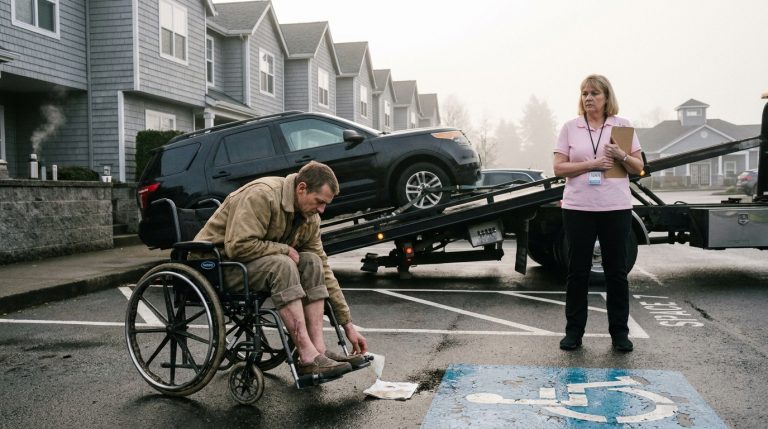
Denise stood exactly three inches outside the property line, her heels buried in the fescue. Her clipboard was tucked under her arm like a riot shield, the aluminum edge catching the last sour glare of the setting sun. She didn’t look at the man sitting in the chair. Her eyes remained locked on the pressure-treated cedar ramp that skirted the front door—specifically the three-eighths-inch galvanized bolts securing the handrail to the concrete landing.
“The board didn’t ratify the variance,” she said. Her voice lacked heat. It had the dry, rehearsed clarity of an eviction notice left out in the rain. “The management company issued the letter without a quorum signature. As far as the community covenants are concerned, it’s an unapproved exterior modification.”
Miller let his hands rest on the cold, matte-finish rims of his wheels. His thumbs traced the textured rubber, calculating the friction required to pivot exactly ninety degrees if the conversation required a shift in posture. In the desert, you learned that heat was a resource; you didn’t waste it on shouting into the wind. You saved it for the march.
“The letter bears the corporate seal, Denise,” Miller said. His tone was level, dropped into the lower register that usually made people look for a supervisor. “It was delivered via certified mail fourteen days before the contractor broke ground. The specs are within the three-degree grade required by the state.”
“The state doesn’t govern our aesthetic guidelines,” she countered, finally dropping her gaze to meet his. Her pupils were pinpoint sharp behind wire-rimmed spectacles. “Section Four, Paragraph B clearly defines permissible frontage materials. Cedar wasn’t on the approved list for this fiscal year. You have thirty days to return the entryway to its original configuration.”
She turned before the last syllable cleared her lips, the clip on her board snapping against the paper with a dry clack.
Miller didn’t follow her with his eyes. Instead, he looked down at the gravel bordering the ramp. Right at the base of the lowest support post, half-buried under the black mulch, lay a small piece of torn yellow carbon paper—a scrap from a certified mail receipt that didn’t match the tracking number on his own master file. The signature line visible on the torn edge didn’t belong to the clerk at the management office; it was written in the tight, aggressive cursive he had just watched disappear down the sidewalk.
CHAPTER 2: THE ANATOMY OF A BREACH
The yellow scrap felt brittle between Miller’s calloused fingertips, a thin sliver of dead weight that didn’t belong in the clean fescue. Down the street, the rhythmic, metallic tink-tink-tink of Denise’s clipboard clip grew fainter, swallowed by the damp evening air, but the implication of that cursive stroke remained right there in his hand. It wasn’t the fluid, standard signature of the Nexa-Compliance Group’s office staff. It was a tight, downward-sloping scrawl that he had seen on every aggressive neighborhood memo for the last three months.
He wheeled backward slowly, the rubber tires grinding into the gravel margin with a low, wet crunch. The cedar ramp beneath him felt solid, but the air around it had changed. He kept his breathing measured—four counts in, four counts out—refusing to let the sudden spike of adrenaline dictate his movements. Inside the townhouse, the quiet was absolute, broken only by the hum of the refrigerator and the steady drop of humidity as the storm system moved over the ridge.
Miller positioned himself at the desk, clearing away three neatly stacked IT trade journals. He pulled the heavy, steel-backed master binder from the lower drawer. The original approval letter sat beneath a clear plastic sleeve. He slid the newly discovered yellow scrap next to it. Under the white glare of the halogen desk lamp, the mismatch was stark. The certified mail receipt number on his official document ended in four-zero-nine; the scrap he had just salvaged from the mulch bore the prefix for a completely separate corporate run, stamped with the hidden header: Internal Reference – The Aegis Directive.
The phone on the corner of the desk didn’t ring, but its indicator light pulsed a slow, green rhythm.
He didn’t call the management company yet. In a tactical retreat, you never alert the forward scouts until you’ve mapped the secondary tree line. Instead, he pulled up the online homeowner portal, logging into the community’s document repository with his standard consultant credentials. The interface was sluggish, built on an outdated architecture that he had offered to patch twice during the annual meetings. He navigated past the public bylaws, past the minutes of the spring budget session, down into the raw directory folders where the architectural variance logs were archived.
A three-digit file tag caught his eye: Ledger-99.
When he clicked the link, the screen didn’t display the standard PDF. A system error box popped up, demanding an administrative token from the Nexa-Compliance Group’s central server. Miller leaned forward, his forearms resting against the cool, beveled edge of the oak desk. His reflection in the dark window glass showed a face entirely devoid of expression. Denise hadn’t just made a mistake; she had actively locked the gate behind her.
A sudden, sharp rap against the front windowpane made him halt. It wasn’t a knuckle; it was the distinct, plastic strike of a ballpoint pen.
Miller rolled to the window, pulling the vertical blind back less than an inch. Outside, the streetlamps had flickered to life, casting long, fractured shadows across the blacktop. A white sedan sat idling at the curb, its wipers sweeping rhythmically against the glass. Through the rain-streaked windshield, he could see the silhouette of the driver—the line of the shoulder rigid, the head tilted slightly toward his unit. The car didn’t belong to Denise. It carried the commercial vinyl lettering of the management firm’s regional inspection unit, static and waiting in the dark.
CHAPTER 3: THE THREETOZERO TRIBUNAL
The vibration of the idling sedan hummed through the windowpane, a low, mechanical thrum that Miller felt in his jaw before he processed it through the glass. The white vehicle sat beneath the yellow glare of the streetlamp, its commercial lettering catching a greasy sheen from the rising mist. The driver didn’t shift gears. They remained a static silhouette behind the sweep of the wipers, an unblinking eye sent by the Nexa-Compliance Group to anchor the perimeter.
CHAPTER 4: THE UNSIGHTLY CITATION
The double doors of the community center met with a heavy, pressurized sigh, cutting off the low murmur of the board members behind him. Miller didn’t clear the main exit corridor immediately. Instead, he maintained a uniform velocity down the linoleum corridor, the high-tensile rubber of his tires barely leaving a trace on the polished grey finish. In the brass crossbar of the external entry door, he could see the silhouette of the polo-shirted property manager lingering near the inner portal, waiting for the sound of his departure before returning to Denise’s side.
The rain outside had stopped, leaving the asphalt roads of the community looking like cracked glass under the midday overcast. When Miller reached his threshold, the cedar ramp felt rock-solid under his chair—a cold contrast to the regulatory fiction Denise had spun in the tribunal.
He slipped his key into the lower deadbolt, but before the mechanism could rotate, his right tire met a resistance that wasn’t there when he left. Resting flat against the weather stripping of the doorframe was a stiff, oversized tyvek envelope, unaddressed but stamped with a red wax emblem that bore the administrative imprint of the Nexa-Compliance Group. It hadn’t been processed through the regional post office; the edges were entirely dry, untouched by the morning mist.
Miller pulled the envelope inside, letting the door lock slide home with a heavy click. He did not go to his desk. He positioned his chair in the center of the kitchen tile, where the natural northern light exposed every fine line on the page.
The document within was single-spaced, printed on a heavy bond paper that felt rough against his thumbs. The header didn’t carry the standard fine tracking sequences. It was explicitly labeled as a Secondary Operational Notice under the Aegis Directive.
“Pursuant to Article IX, Section Three (Community Harmony and Visual Standards),” the text read, “all resident structures and equipment visible from common area thoroughfares must conform to the neutral palette index. The placement of non-standard mobility apparatus, mechanical platforms, or unsightly wheeled fixtures on uncovered patio surfaces constitutes an uncorrected nuisance.”
Miller’s gaze narrowed on the specific phrasing: unsightly wheeled fixtures.
The psychological logic of the attack was completely transparent. Denise wasn’t targeting the architecture anymore; she was attempting to restrict the physical extension of his body. By redefining the very tool that allowed him to navigate his home as an exterior violation, she was setting the parameters for a total blockade. If he left the chair on the patio, he faced an escalating tier of fines; if he brought it inside, he became an invisible prisoner within his own four walls.
He reached down to the armrest of his chair, his fingers tracing the cold, satin-finished aluminum frame. A minor physical discrepancy caught his touch—a small, square piece of blue adhesive tape affixed near the rear wheel housing, marked with a hand-written tracking string: L-99-SEC. The inspectors who had been idling in the white sedan the previous night hadn’t just been watching his windows. They had walked his perimeter while he was analyzing the portal codes, physically tagging his personal property for cataloging.
He picked up his desk phone, dialing the direct line for the state’s regional fair housing compliance officer. The line clicked twice, transitioning into a sterile automated queue.
As the digital hold tone droned through the speaker, Miller reached for his steel ruler and a fresh yellow legal pad. He didn’t waste energy on anger. Anger was an unstable compound; it degraded under pressure. Instead, he began a systematic list of every internal measurement of his entryway, cross-referencing the federal spatial requirements against the community’s restrictive covenants. The decoy secret was clear—Denise was claiming a simple administrative ledger error regarding materials—but the velocity of her escalation suggested a deeper structural panic. They didn’t just want the ramp down; they needed the entire record of his residency expunged from the master file before the next regional audit.
CHAPTER 5: THE BLUE INTERVENTION
The sharp, heavy impact of gloved knuckles against the solid oak of the front door vibrated directly through the floorboards. Miller paused, his steel drafting ruler frozen mid-line on the yellow legal pad. The rain-slicked wood of his porch outside had absorbed the weight of the approach, but the sheer force of the summons left no doubt about the authority behind it.
He slid the legal pad under the heavy binder containing the original certified mail receipt, locked his wheels, and spun ninety degrees toward the hallway.
When he threw the latch, the afternoon light spilled across two figures in navy tactical synthetic. The senior officer, a sergeant with deep creases around his eyes and a silver nametag that caught the cold glare of the entryway light, kept his hands loose near his utility belt. The younger officer stood a half-step back, his gaze darting immediately from Miller’s face to the cedar ramp, and then down to the blue adhesive tape labeled L-99-SEC still stuck to Miller’s rear wheel housing.
“Mr. Miller?” the sergeant asked, his voice low and weary,carrying the flat cadence of someone who had already spent his shift resolving domestic border disputes over untrimmed hedges. “I’m Sergeant Davis. This is Officer Vance. We received a municipal code and civil disturbance complaint regarding an obstruction of the public easement and the storage of prohibited materials on the frontage.”
Miller did not back his chair up to let them in. He remained anchored in the threshold, his chest forming a physical barrier in the narrow frame. “The frontage is private deeded property, Sergeant. The structure is an approved accessibility ramp, and the ‘material’ in question is the medical mobility device I am currently sitting in.”
The younger officer, Vance, shifted his weight on the wet concrete of the top landing, his boots making a faint squeak. He looked down at his digital notepad, then back up, his cheeks flushing slightly. “The complainant registered the item as ‘unauthorized industrial hardware left in plain view of the common thoroughfare.’ She cited HOA Code Section Four.”
“The state vehicle and traffic law, as well as the federal housing guidelines, classify this device as an extension of my person, not an industrial fixture,” Miller said. His voice was cold, level, and entirely empty of defensive posture. “If you enter this property to tag or remove this device, you are executing an unlawful seizure of a prosthetic instrument.”
Sergeant Davis let out a slow, controlled breath that smelled faintly of stale gas-station coffee. He reached out, his thick fingers gently tapping the shoulder of his junior partner, signaling him to lower the tablet.
“We’re not tagging anything, Mr. Miller,” Davis said, his tone softening into something resembling professional exhaustion. He looked past Miller’s shoulder, his eyes tracing the clean interior lines of the townhouse, completely devoid of the chaotic clutter described in the dispatch log. “We are required to respond to all physical complaints filed through the municipal desk. But I’ve been in this precinct for twelve years. I know a paper war when I see one.”
Before Miller could reply, a sharp heel-strike sounded from the asphalt path behind the officers. Denise emerged from the mist, her yellow clipboard held tight to her chest like armor, her hair slightly damp under the gray drizzle.
“Is he complying?” she demanded, her voice cutting through the damp quiet of the afternoon. “I gave the department the specific administrative reference hours ago. That vehicle violates the neighborhood visual index, and the ramp has been stripped of its structural authorization under Ledger-99.”
Sergeant Davis turned slowly, his boots grinding a small deposit of wet gravel into the landing. “Ma’am, this is a civil property dispute. There is no active code violation here that falls under municipal criminal enforcement. The resident is using approved medical equipment on his own entryway.”
“The rules of this association are legally binding—” Denise began, her silver pen snapping down hard against her board.
“The rules of your association do not override state transit exemptions or federal fair housing statutes,” Davis interrupted, his voice dropping into a firm, non-negotiable register that made Denise’s jaw tighten. “We are clearing this call as a civil matter. Do not use the municipal dispatch desk to referee board meetings again.”
Davis turned back to Miller, his gloved hand rising to touch the brim of his cap in a brief, silent gesture of respect. “Thank you for your service, sir. We’ll note the file as resolved.”
As the two officers turned to navigate the cedar ramp back to their cruiser, Miller watched Denise. She stood frozen at the edge of the asphalt, her eyes locked on the blue tape on his wheel, her fingers twitching against the metal clip of her board. She hadn’t expected the law to walk away from her gates; she had built her entire fiefdom on the assumption that everyone bowed to the same letterhead.
CHAPTER 6: THE SILENT MEASUREMENT
The sound of the patrol car’s tires rolling down the wet asphalt slowly dissolved into the hum of the distant highway. Denise remained standing on the curb for three long seconds, her fingers white where they clamped the side of her yellow board, before she spun on her heel. The hard plastic of her loafers made a sharp, dry scratch on the unsealed curb—a sound that Miller filed away as he reversed his chair onto the cedar landing. He didn’t lock his door. He went straight to the hall closet, reaching for the heavy tactical utility belt he’d kept in a sealed canvas trunk since his discharge.
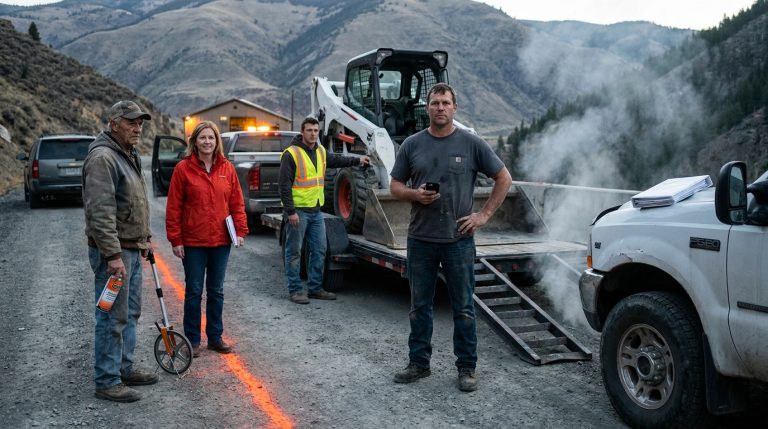
He didn’t pull out a weapon. He pulled out a high-grade professional wheel-odometer, a twenty-five-foot steel measuring tape with an anodized aluminum case, and a high-intensity red laser level.
By midnight, the community was entirely dark, the suburban sky suffocated by low, damp clouds that choked out the stars. Only the rhythmic, amber flash of a failing sodium bulb near the pool house broke the uniformity of the shadows. Miller moved down his ramp, his tires slicing through the thin film of rainwater on the asphalt with a faint, continuous hiss. He didn’t use a flashlight. He navigated by the pale, ambient glow of the security pylons, his eyes adjusted to the desaturated grey tones of the night.
His first stop was the concrete pathway leading to the main clubhouse entrance.
He positioned his chair parallel to the bottom step, sliding the steel blade of the measuring tape out until the tip pressed against the vertical riser. The spring-loaded steel made a sharp shhht in the quiet night air. He locked the slide.
Seven and a half inches.
He moved the laser level to the upper landing, casting a thin, crimson line across the face of the brick column. Under the provisions of the regional building code—standards explicitly adopted under the Nexa-Compliance Group’s own master charter—any change in level greater than a half-inch required a continuous handrail with a specific graspable surface. There was none. The concrete was raw, crumbling at the edges where water had pooled and frozen during the winter cycles.
He rolled to the pool gate, his wheels tracing the perimeter fence. The padlock on the maintenance shed was stamped with a small, brass serial plate: NEXA-PROP-09. He positioned his odometer against the bottom track of the gate.
Twenty-eight inches.
The federal minimum clearance for any public or common-use doorway was thirty-two inches. A wheelchair could not clear the frame without the occupant scraping their knuckles raw against the raw chain-link mesh. Miller pulled his phone from his chest pocket, capturing the digital reading on the wheel-odometer alongside the serial plate of the gate.
Then he saw the discrepancy.
Near the base of the pool house concrete foundation, partially obscured by a decorative box of overgrown juniper, was a freshly poured utility patch. The concrete was a lighter, unweathered grey, still smelling faintly of lime and damp sand. Embedded directly into the patch was a heavy brass survey marker, its face stamped with the registration code: Aegis-044-RESERVE.
Miller leaned forward in his chair, his fingers brushing the cold, abrasive surface of the brass disk. The marker didn’t denote a utility line or a water main. The registration prefix was identical to the code on the yellow scrap of carbon paper he had found in his mulch—the header linked to the Aegis Directive.
He took three high-resolution photographs, the red laser level casting a perfectly horizontal line across the brass face to document the elevation deficit of the surrounding walkway. The pool gate was too narrow, the ramp at the community center was entirely absent, and the curb cuts along the main drive were non-existent, yet the association’s annual financial report had listed a sixty-thousand-dollar disbursement for “Accessibility Infrastructure Maintenance” under Ledger-99 just three months prior.
The money had been allocated, the compliance markers had been physically driven into the ground, but the actual concrete had never been poured. The physical infrastructure of the community had been left in the dark ages, while the funds meant to level the ground had disappeared into the very ledgers Denise was trying to protect by forcing his ramp down.
A sudden rustle in the juniper bushes behind him made him freeze.
Miller clicked the laser level off, the red line vanishing instantly. He didn’t turn his head. He listened to the wet, uneven sound of breathing coming from the shadow of the pool house chimney—the distinct, heavy scent of cheap peppermint cover-up and damp wool drifting through the damp night air.
CHAPTER 7: THE DISCOVERY BREACH
The absolute silence of the pool house courtyard magnified the rough intake of air from the dark side of the masonry chimney. Miller didn’t spin the chair to confront the sound. He kept his posture relaxed, his hands flat against the high-tensile rims, his gaze remaining fixed on the brass survey marker stamped Aegis-044-RESERVE. A lesser intellect would have broken cover; Miller simply waited for the physical friction of the environment to force the hand of the observer.
A silhouette shifted within the damp leaves. It wasn’t Denise. The grey, papery face of the retired field auditor emerged into the pale amber glare of the sodium light. He held a leather-bound tablet container in his left hand, his knuckles white where they gripped the seam. His breathing remained shallow, but the defensive urgency in his eyes confirmed he had witnessed the entire surveying run.
“You won’t get the server logs from the front end, Miller,” the man said, his voice dropping into a raspy half-whisper that barely carried over the steady drip from the roof gutters. “Denise isn’t the origin. She’s the shield. Every compliance citation she generated was logged to trigger an automatic deletion protocol in Ledger-99 the moment you filed an external appeal.”
Miller turned his head exactly ten degrees, his eyes locking onto the man’s right shoulder. “The data isn’t gone. A sixty-thousand-dollar infrastructure allocation requires a physical validation token from the Nexa-Compliance Group. You didn’t delete the ledger; you quarantined it under the Aegis Directive header to cover the withdrawal footprint.”
The auditor’s mouth twitched, a small spasm of muscles near the corner of his lip. He didn’t deny it. Instead, he stepped out onto the wet concrete walkway, his loafers making a damp, suctioned sound against the unsealed surface. He reached down, sliding a compact, high-density flash drive from the leather tablet sleeve, and held it out across the two-foot gap separating their frames.
“They used a shell entity to clear the compliance certificates,” the auditor whispered, his eyes scanning the dark perimeter windows of the surrounding townhouses. “The infrastructure fund is empty. If the state housing authority opens a structural audit based on your ramp denial, the entire master account collapses. Take the drive. The original signature files for the variance are in the root folder.”
Miller reached out, his calloused fingertips making a dry rasp against the plastic casing of the drive as he pulled it into his palm. He didn’t say thank you. In a strategic pursuit, an informant wasn’t an ally; they were a structural failure in the enemy’s system. He slid the drive into the internal zipper pocket of his canvas pouch, his thumbs instantly locking back onto the metal rims of his wheels.
“The state filing goes out at 0800,” Miller stated, his tone flat, final, and empty of inflection. “If your name is on the ledger metadata, the compliance board won’t filter you out.”
The auditor didn’t answer. He turned and retreated into the shadow of the perimeter pines, his footsteps fading into the soft mulch before the double doors of the main courtyard could even cycle. Miller reversed his chair, the rubber tracking a clean, straight line back toward the entry road.
By the time he reached the threshold of Unit 114, the blue light of his desk lamp was already cutting through the vertical blinds, illuminating the stack of federal housing law printouts waiting on the oak surface. The decoy secret—the administrative error regarding cedar materials—had dissolved completely. The core truth was now resting in his pocket, a sequence of encrypted ledger entries showing a multi-year embezzlement scheme disguised as neighborhood enforcement. Denise hadn’t just been protecting the neighborhood’s visual index; she had been protecting a prison of non-compliant concrete that was worth hundreds of thousands of dollars in unspent public funds. He slid the drive into the USB port, his screen instantly updating as the decryption sequence began to pull the internal emails of the Nexa-Compliance Group into plain view.
CHAPTER 8: THE COMPLIANCE RECKONING
The final line of the encrypted file on the screen shifted from blue to a solid, unblinking white. The metadata was complete: every transaction transferring capital out of the community’s accessibility infrastructure reserve had been authorized through a sub-ledger marked Ledger-99, stamped with the direct administrative credential of Denise’s personal office. Outside, the pre-dawn darkness didn’t fade gradually; it was broken by the sudden, harsh flash of amber light bars reflecting off the wet pine needles at the development’s perimeter entrance.
Miller shifted his hands on the cold aluminum rims of his wheels, moving toward the front door with an unhurried, measured momentum. He didn’t check his phone. The 0800 threshold had crossed precisely three minutes prior, and the systematic groan of heavy diesel engines moving down the neighborhood corridor confirmed that the state fair housing enforcement unit had initiated their structural intervention.
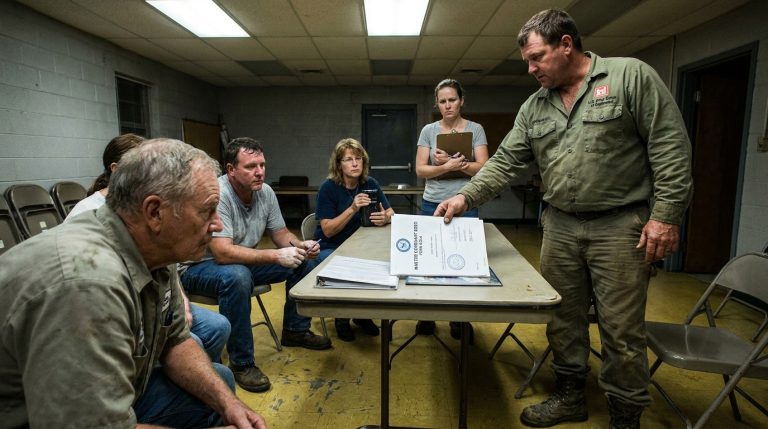
When Miller rolled out onto his cedar landing, the morning air was thick with the alkaline tang of unsealed mortar and cold exhaust. A convoy of yellow state transport vehicles and commercial flatbeds had already claimed the center thoroughfare, their tires straddling the manicured fescue borders. Two state marshals stood at the base of the community center steps, their clipboards containing the formal receivership order issued under the state accessibility compliance statute.
Denise was already on the pavement. Her yellow clipboard was gone, replaced by a frayed paper folder that she clutched against her beige trench coat like a shield. Her face had lost its rigid, administrative definition; her mouth was clamped into a narrow line, her foot twitching in a brief, frantic pattern as a state engineer set a heavy steel transit level directly onto the non-compliant clubhouse riser.
“This is an unwarranted disruption of private residential property,” she argued, her voice rising into an uncharacteristic, strained register that broke against the rumble of an idling backhoe. “The board is currently reviewing its contractor schedules. We have internal protocols under the Aegis Directive to handle these updates dynamically.”
The lead marshal didn’t look up from his ledger. He adjusted his glasses, his finger tracing a direct line down a certified court mandate bearing the seal of the regional housing authority. “The corporate shield for the Nexa-Compliance Group was dissolved by administrative order at midnight, ma’am. The asset reserve has been frozen pending a full forensic evaluation of the infrastructural ledger. You are no longer authorized to direct physical adjustments to these common areas.”
A flatbed truck carrying iron railings backed into the pool lane, its reverse alarm emitting a sharp, rhythmic beep-beep-beep that echoed off the brick townhouses. From the far corner of the path, the grey-faced auditor watched the equipment roll in, his hands shoved deep into his pockets, his posture entirely passive as a construction crew began driving jackhammers into the narrow pool gate frame.
Denise turned toward Miller’s unit, her loafers dragging across the gravel margin until she stood exactly two inches from his cedar ramp. Her shoulders were tense, her fingers trembling against the edge of her folder as she looked up at him. “You did this,” she muttered, her words sharp, transactional, yet stripped of their former institutional weight. “You brought this ruin inside the gates. You destroyed the structural valuation of this entire development for a three-degree piece of wood.”
Miller looked down at her from the landing, his arms resting flat against his chair’s armrests, entirely unreadable. “Rules are rules, Denise,” he said, his tone dropping into the level register of a completed contract. “You asked for equal enforcement. I simply allowed the parameters to apply to you.”
She attempted to step forward, her mouth opening to deliver a final procedural objection, but the movement was cut short. A state deputy stepped between her and the ramp, placing a formal administrative separation notice directly onto her paper folder. Her reign had not ended with an explosive legal judgment or a dramatic admission; it had simply collapsed under the weight of her own bureaucratic mechanism, dismantled by the very laws she had dismissed as external interference.
By noon, the atmosphere in the courtyard began to settle into a new, resonant quiet. Denise’s white sedan had been cleared from the curb, replaced by a neat stack of grade-certified cedar beams and compliance frames. The thunderous roar of the machinery had faded, leaving only the steady, industrious clink of trowels and the smell of fresh concrete dust drifting through the afternoon light.
Miller rolled down his ramp, the cedar solid and quiet under his wheels. He stopped at the edge of his property line, where the small piece of yellow carbon paper had been cleared away by the wind. He reached into his side pouch, pulled out a small brass nut that had shaken loose from his left brake housing during the midnight run, and slowly tightened it with a compact steel wrench until the thread locked home with a clean, metallic snap.
An older resident from three doors down walked past, her cane clicking rhythmically against the newly poured concrete curb cut at the corner of the drive. She didn’t shout a greeting; she simply nodded toward Miller as she cleared the incline without having to lift her frame. Miller nodded back, letting his hands rest on his wheels as the sun finally cut through the pine branches, casting long, clean lines of light across a ground that was finally, legally level.