The Weight of the Wind: A Sniper’s Final Calculation in the Shadow of the Rockies
CHAPTER 1: THE BRASS MARKER
The casing was still warm against her cheek, a small, stubborn anchor of heat in the freezing air of the Rockies. Harper didn’t move. She couldn’t. Her body was a collection of jagged aches, a map of fractures and damaged nerves that seemed to amplify in the silence of the firing line. The shot was gone, the steel plate had rung, and the thirteen men behind her were vibrating with a dangerous, quiet hostility.
She pushed herself up, the grit of the limestone grinding into the palms of her gloves. Every movement was a negotiation with her own anatomy. Her lower back spasmed, a sharp, white-hot wire of pain that forced a reflexive, jagged breath through her nostrils. She kept her eyes fixed on the empty air where the bullet had traveled, refusing to acknowledge the heavy, suffocating weight of the stares boring into her spine.
Hayes was still standing at the edge of the mat, his face a mask of bruised pride. He looked like he wanted to reclaim the rifle, to prove that his failure was a fluke, a technical glitch that he could correct with enough willpower. Harper reached out, her fingers closing around the brass casing in the dirt. It was textured, heavy, and smelled of sulfur and heat—a physical manifestation of a clean, honest, mathematical truth.
She tucked it into her pocket, the heat of it seeping through the fabric of her pants and into her thigh. It was a tactical error to keep it, a souvenir of a moment that should have been forgotten, but she needed the reminder. In a world of shifting, dishonest variables, this piece of metal was the only thing she knew for certain.
“You’re done, Harper,” Kinsley said. He had stepped up, his expression unreadable, his eyes darting toward her, then back to the experimental CheyTac rifle. He wasn’t looking at her as a peer anymore. He was looking at her as an anomaly—something that didn’t fit the data, something that disrupted the rhythm of his world.
Harper didn’t answer. She stood, her boots crunching against the gravel with a sound that felt like breaking glass. She turned, her gaze sweeping over the group. They were all there, the sterile contractors in their expensive sunglasses, the SAS guys with their calculated detachment, and the regular operators who were currently struggling to reconcile their pride with the impossible shot she’d just made.
She caught a scent as she passed them. It was faint—masked by the omnipresent smell of gun oil and cold, dry sagebrush—but it was there. Lavender and something sharp, chemical, like ozone. It was out of place on this jagged, desolate ridge. It didn’t belong to the mountains, and it certainly didn’t belong to any of the men on the line.
She kept walking, her heart rate spiking for a fraction of a second before she forced it back into a rhythmic, box-breathing cadence. She had to reach the truck. She had to reach the silence of the drive back. As she neared the treeline, she felt a distinct, prickly sensation on the back of her neck—the unmistakable, visceral feeling of being observed.
She didn’t turn around. She didn’t look at the rearview mirror of the idling pickup trucks. She focused on the mechanical motion of her legs, the crunch of the rocks, and the persistent, throbbing pulse behind her left eye. The shot was done, but as she reached for the handle of the truck, she realized the real argument with gravity hadn’t even begun.
CHAPTER 2: THE DRIVE TO GROUND ZERO
The door of the pickup truck felt heavier than it should have, a slab of cold steel that required a deliberate, practiced heave to swing wide. Harper didn’t rush. She moved with the methodical economy of someone who had learned the hard way that every wasted calorie was a liability. She threw her gear into the passenger seat, the ammo can clattering against the floorboard with a sound that seemed to ring out across the desolate ridge like a bell.
She climbed in, the scent of stale upholstery and dried mud enveloping her. It was a sterile, utilitarian smell, far removed from the sharp, metallic air of the firing line. As she slid into the driver’s seat, her lower back protested, a dull, throbbing ache radiating outward from the site of her old injury. The ghost of that jump in Syria surfaced—the violent snap of the chute, the sudden, bone-jarring impact with the hardpan desert, and the sickening sound of cartilage giving way. She shook the memory away. It wasn’t the time for ghosts; it was the time for driving.
She turned the key. The engine roared to life, a guttural, uneven rumble that vibrated through the steering wheel and into her fingers. She checked the side mirror. The line of trucks behind her was starting to stir, the operators moving with a forced, casual rhythm that screamed of lingering embarrassment. She saw Hayes standing by the tailgate of his vehicle, his hands shoved deep into his pockets. He wasn’t looking at the target anymore; he was looking at her truck.
She put the vehicle into gear and pulled away, the tires crunching against the loose gravel of the mountain road. The descent was a series of sharp, treacherous switchbacks that hugged the jagged face of the Rockies. Harper kept her eyes locked on the road, her hands tight on the wheel. She was scanning everything—the spacing of the rocks, the way the light pooled in the hollows, the subtle, rhythmic dip of the truck’s suspension.
Every mile she put between her and the firing line brought a marginal increase in physical relief, but a spike in her internal alarm. The lavender and ozone scent she’d caught at the treeline remained burned into her senses. It was a precise, chemical anomaly. She knew the standard-issue deodorants, the smell of cordite, the faint, sweaty musk of men who spent their lives in the field. This was something else. It was deliberate, almost calculated.
As she navigated a particularly tight curve, she reached over to the passenger seat to adjust the strap on her gear bag. Her hand brushed against a small, flat bulge in the side pocket—something she didn’t remember placing there. She froze, her breath hitching in her throat. She pulled the bag closer, her movements slow, guarded. Her thumb traced the outline of a small, rectangular object beneath the nylon fabric.
It was too small to be a spare magazine, too hard to be a survival kit component. She carefully unzipped the outer compartment, her heart rate steadying into the familiar rhythm of tactical observation. Tucked into the inner lining was a small, black device, no larger than a thumb. It was an off-the-shelf transmitter, the kind used for tracking inventory in secure logistics chains, but modified. It was warm—the telltale sign of an active, internal power source.
She didn’t pull it out. She didn’t let her reaction show on her face. Instead, she zipped the bag back up with a casual, indifferent flick of her wrist and kept her eyes on the road. The realization settled in with the weight of cold lead: she wasn’t just here to observe the exhibition. She was being tracked.
She pushed the truck harder, the engine whining in protest as she hit a straightaway. The road ahead looked clear, but the silence of the cabin felt crowded, heavy with the implication of the device. Someone had accessed her gear while she was on the mat—someone with the skill to bypass her protocols and the audacity to leave a breadcrumb.
The headache behind her left eye pulsed, a rhythmic, painful reminder of her own physical fragility. She thought of the transmission, the subtle, high-frequency hum she could almost imagine hearing emanating from her passenger seat. She was an observer, and now, she was the target. She had to identify who was holding the receiving end of the signal, and she had to do it without tipping her hand.
She slowed down as she neared the base of the mountain, the road flattening out into a dusty, desaturated valley floor. The shadows were lengthening, stretching long, dark fingers across the terrain. She checked the mirror again. A dark SUV had pulled onto the road behind her, keeping a steady, unwavering distance. It was the same vehicle she had noticed parked at the very edge of the staging area, ignored by the contractors as they prepped their gear.
She gripped the wheel, her knuckles turning white beneath her gloves. The mountain road ended in a few miles, converging with the main highway. She needed a plan, and she needed it before she hit the asphalt. She didn’t look back again, but she focused on the transmission, the small, warm weight in her bag acting as a tether, pulling her deeper into a game she hadn’t realized was being played.
The road ahead shimmered in the late afternoon heat, the air blurring the distant horizon. She could hear the wind howling through the canyons she’d just left, a lonely, mournful sound. Harper pressed her foot down on the accelerator, the truck surging forward into the grey, dusty expanse of the valley, the engine’s roar drowning out the persistent, throbbing pulse of her own exhaustion.
CHAPTER 3: THE ROOM AT THE END OF THE WORLD
The motel was a low-slung, cinder-block relic clinging to the edge of the interstate. It smelled of industrial-strength ammonia and damp carpet, a scent that triggered a familiar, visceral recoil in Harper’s chest. She pulled the truck into the spot directly in front of room 104, keeping the engine running for a beat longer than necessary. She watched the rearview mirror. The dark SUV—the one that had tracked her down the mountain—continued past the entrance, disappearing into the twilight blur of the highway. It was a tactical departure, too clean, too deliberate. They weren’t done, but they were letting her find a hole to crawl into.
Harper killed the ignition. The sudden absence of the engine’s vibration left a ringing silence in her ears, amplified by the dull, rhythmic throb still radiating from behind her left eye. She grabbed the gear bag, the weight of it suddenly heavier, the small, warm transmitter within acting like a lead weight pressing against her shoulder. She stepped out of the truck, her boots crunching on the cracked asphalt. Every movement was a chore. Her knees were stiff, protesting the sudden shift from the seat’s support to the uneven ground, but she moved with a fluid, practiced grace that defied her exhaustion.
She didn’t head straight to the door. She moved to the side of the building, leaning into the deep shadows cast by the overhang. She waited. She let her breathing slow, matching the steady, indifferent rhythm of the wind whistling through the dry sagebrush nearby. She counted the seconds—ten, twenty, sixty—listening for the sound of an idling engine or the soft crunch of a boot on gravel. Nothing but the interstate’s distant, rhythmic hum.
She moved to the door, checking the lock for the telltale hairline cracks of a forced entry, or the microscopic tension of a tripwire. Nothing. She inserted the key, turned it, and slipped inside, keeping her back to the wall until she had cleared the perimeter. The room was standard issue: thin beige walls, a saggy mattress, and a television that hummed with a low-frequency static. She didn’t turn on the lights. She moved by the dim, orange glow of the mercury-vapor lamp outside the window, casting long, angular shadows across the furniture.
Harper dropped the bag onto the desk, the sound muffled by a stack of Gideon Bibles. She went to work. She didn’t pull the transmitter out right away. Instead, she took out a small, specialized sensor kit—a compact field-diagnostic tool, the size of a deck of cards, that she’d kept buried in the bottom of her kit for years. She calibrated it with a series of quick, precise movements, her fingers moving with the dexterity of a concert pianist.
She moved the sensor over the bag. The device emitted a series of soft, rapid-fire chirps, rising in pitch as she neared the inner pocket. She opened the zipper, her movements slow, eyes narrowed. There it was—a micro-transmitter, high-end, civilian-market modification, specifically designed to bypass standard sweeping protocols. It wasn’t just a tracker; it was a dual-channel unit, likely capable of short-range audio monitoring.
Her stomach tightened. Whoever had planted this wasn’t just following her; they were listening to her. She carefully extracted the device using a pair of needle-nose pliers, her hands rock-steady despite the tremor she felt buried deep within her own nervous system. She didn’t crush it. She didn’t toss it in the trash. She placed it inside a small, lead-lined Faraday pouch she carried for classified document storage. The room fell silent, the absence of the transmitter’s signal leaving a strange, hollow void in the air.
She went to the bathroom, splashing cold, sulfurous water on her face. She looked into the mirror, not seeing the woman she was, but the woman she had become. The skin under her eyes was bruised and pale, her cheekbones sharp enough to cut, her hair tangled with the dust of the mountain. She looked older than thirty-two. She looked like a machine pushed past its service life, the chassis cracking, the internal systems failing.
The diagnosis was a secret she kept locked behind a gate of cold, calculated iron. Early-onset neurological damage, the slow, insidious erosion of her internal maps caused by years of absorbing shockwaves from heavy-caliber platforms. The doctors called it “cumulative concussive trauma.” She called it the “slow fade.” She knew the warning signs: the static flares in her vision, the erratic spikes of pain, the growing disconnect between what her eyes saw and what her brain interpreted.
She walked back to the main room, her movements heavy. She sat on the edge of the bed, the mattress groaning under her weight. She didn’t have much time. If they were tracking her, they knew she’d found the device. They’d be coming for the source of the leak, and she was the only one in the room. She looked at her hands. They were scarred, mapped with the white lightning of past injuries, the skin rough and calloused. She needed to know who was behind this, not just to survive, but to burn the entire system down before her own systems finally went black.
She reached for the phone on the nightstand, then stopped. It was a closed circuit, a liability. She stood up, grabbed her kit, and began packing. She needed to move, not because she was afraid, but because she was efficient. She left the room exactly as she found it, a ghost in a machine, stepping back out into the cool, biting air of the night. The highway awaited, a long, dark ribbon of uncertainty stretching out toward an horizon she wasn’t sure she would ever reach.
CHAPTER 4: THE CALCULATION OF CONSEQUENCE
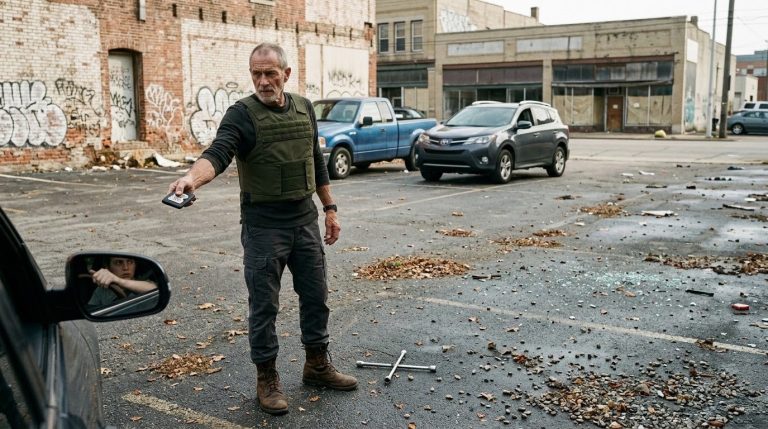
The parking lot was a pool of ink, broken only by the flickering, sickly yellow glow of the security lights. Harper stood for a moment, her senses dialed to an excruciating frequency. She listened to the hum of the transformer above her, the distant whine of a semi-truck on the interstate, and the erratic, high-pitched scratching of a moth against the motel’s exterior wall. Every sound was a data point; every shadow was a potential threat. Her pack was tight against her spine, the weight of the Faraday pouch a silent, heavy promise in her pocket.
She moved toward the truck, her gait slow and deliberate. She didn’t look at the other rooms. She didn’t look at the road. She kept her focus on the patch of darkness between her vehicle and the edge of the lot, where the terrain dropped away into a scrub-filled ravine. As she reached for the handle of the driver’s side door, a subtle shift in the air pressure caught her attention. It wasn’t the wind. It was the mechanical, metallic sound of a safety being clicked off—a sound so faint it would have been missed by anyone else, but to her, it was like a thunderclap in a library.
She didn’t reach for her weapon. She didn’t spin around. She simply let the truck door swing open, using the heavy metal slab as a shield as she dropped low behind the chassis. A suppressed thwip broke the silence, followed by the sharp ping of a round striking the asphalt where her head had been a heartbeat before.
Harper exhaled, a sharp, controlled burst of air. She didn’t panic. Panic was a luxury for people who didn’t know how to do the math. She rolled, coming up on the far side of the truck, her movements fluid despite the grinding pain in her lower back. She wasn’t fighting a man; she was fighting a tactical error she’d made back on the ridge. She had underestimated the reach of whoever was on the receiving end of that transmitter.
The attacker was positioned near the maintenance shed, thirty yards out, tucked behind the cover of a rusted dumpster. Harper scanned the ground, calculating lines of sight, wind speed, and the encroaching darkness. Her vision flared—the all-too-familiar static of her condition blooming in the corners of her eyes like a bruise. She blinked, forcing the clarity back. The “slow fade” was accelerating, pushed by the stress of the chase. She couldn’t afford a protracted exchange.
She reached into her bag, pulling out not a weapon, but her multi-tool. She jammed the driver’s side door latch, forcing the truck’s horn to sound in a rhythmic, jarring blast. It was a crude, noisy distraction, but it served the purpose. As the sound echoed off the cinder-block walls of the motel, the figure behind the dumpster shifted, distracted by the sudden, piercing cacophony.
In that micro-second, Harper moved. She didn’t go for the shooter. She went for the truck’s rear tire. With a single, brutal motion, she slashed the sidewall with her knife, the escaping air hissing like a dying animal. The vehicle slumped. It wasn’t a retreat; it was a trap. By disabling her own transportation, she forced the field to change, stripping the attacker of the advantage of pursuit.
She didn’t stay to watch the result. She vanished into the shadows of the ravine, her boots hitting the dry earth with a dull, rhythmic thud. She wasn’t running away; she was moving to a higher vantage point. As she scrambled up the embankment, her chest burning and her vision swimming with static, she saw the dark SUV she’d trailed earlier pull into the lot. The headlights cut through the gloom, sweeping over the now-motionless pickup truck.
She paused, hunched in the cover of a thicket of brush, her pulse thundering in her ears. The driver of the SUV stepped out—a silhouette in the pale, artificial light. They didn’t move like a contractor; they moved like a shadow. They walked to the truck, checked the driver’s side, and stopped. Harper watched, her breath hitched, as the figure reached out and touched the slashed tire.
There was a moment of absolute, bone-chilling stillness. The figure stood up, their gaze sweeping the darkness of the ravine. They knew. They knew she hadn’t just run; she had sabotaged.
Harper felt the familiar ache in her spine, a sharp, searing reminder of her limits. She had the evidence, she had the transmitter, and she had the lead. But she also had a failing body that was demanding a price she couldn’t afford to pay. She shifted her grip on her gear, the metal tools biting into her palm. The game had evolved, and for the first time, the “math” was telling her that the only way to win was to be more reckless than the machine she was fighting. She turned, moving deeper into the dark, the sharp, metallic taste of iron—or perhaps just the onset of the next episode—lingering on her tongue like a warning.
CHAPTER 5: THE FRAGILITY OF STEEL
Harper didn’t turn back. She slid down the embankment, the loose shale and dried sagebrush tearing at her clothing, her boots struggling to find purchase in the slick, unstable dirt. Below her, the ravine bottom was a narrow, winding throat of shadow, choked with rocks and twisted, sun-bleached driftwood. She landed in a crouch, the impact vibrating through her spine like a hammer blow. The familiar static flared, a sudden, blinding aurora of grey and white across her vision. She forced her eyes open, her knuckles turning white as she gripped the handle of her gear bag. The figure at the top of the embankment was still there—a dark, unmoving silhouette against the pale, artificial glow of the motel lights.
She moved. She didn’t look for a path; she simply chose the direction that offered the most cover. She waded into the thicket, the branches clawing at her tactical shirt like skeleton fingers. Every step was a calculation of weight and balance. She couldn’t afford to stumble. The pain in her lower back had graduated from a dull ache to a jagged, rhythmic pulse, syncing with the frantic hammering of her heart. She was a weapon that had been fired one time too many, the barrel warped, the tolerances failing. She reached the dry creek bed and ducked behind a massive, limestone boulder that had tumbled from the ridge decades ago.
She wasn’t fast enough. A soft, rhythmic crunch of gravel sounded behind her—not the haphazard movement of an amateur, but the steady, measured pace of a professional hunter. Harper eased her breathing, sliding her hand into her pocket to confirm the presence of the lead-lined pouch. She needed to know who this was. She needed to know if this was a contractor gone rogue, or something deeper—a ghost from the very agency that had pushed her to the brink of this physical collapse. She leaned back against the cold, jagged stone, her breath hitching as the static in her mind began to weave shapes out of the darkness.
“You’re making this harder than it needs to be, Finley,” a voice echoed through the ravine. It was flat, synthetic, stripped of any inflection. It didn’t sound like Hayes, and it certainly didn’t sound like Kinsley. It was a voice that had been trained to exist in the spaces between commands.
Harper didn’t respond. She remained motionless, her eyes scanning the creek bed for any sign of movement. The figure emerged from the brush ten yards away, their silhouette framed by the faint moonlight filtering through the ravine’s jagged rim. They moved with a predatory stillness, their weapon held at a low, ready carry. Harper felt the familiar, cold resolve settling into her marrow. This wasn’t just a pursuit; it was an interrogation by violence. She checked her kit. She had no ammunition, no long-range platform to rely on—just her wits and the failing, brittle hardware of her own body.
She waited until they were five yards out. She didn’t stand. She lunged, not upward, but forward, her legs driving her into the attacker’s knees with the force of a falling gate. The impact was violent, a collision of steel and bone. The figure grunted, their weapon skittering across the dry riverbed, and they went down hard. Harper was on them instantly, her hands locking onto their throat, not to throttle, but to secure, to identify. She slammed their head against the limestone, the sudden, sharp crack of bone against rock echoing through the narrow space.
The figure’s mask shifted. Harper ripped it away, her fingers brushing against skin that felt unnaturally cold, clammy to the touch. The face revealed beneath was not one she recognized—no sergeant, no contractor, no peer. It was a face that looked like it belonged on a desk in a backroom office, a face of pure, distilled institutional utility.
“Who sent you?” she rasped, her voice a low, dangerous rumble.
The figure didn’t speak. They didn’t struggle. They simply stared at her with eyes that seemed to mirror the same hollow, dead-end exhaustion she felt. Then, they reached into their tactical vest and pulled a small, silver pin—a bypass override for her own gear. Harper’s heart froze. They hadn’t come to kill her; they had come to reclaim the device. They were here to sanitize the error.
She felt the sharp, jagged spike of a blackout hitting her mind—a full-force systemic shutdown. She tried to maintain her hold, to keep the figure pinned, but her arms began to shake, the muscles losing the battle against her nervous system’s betrayal. She was losing time. She was losing control. The figure twisted, throwing her off with a surge of renewed strength, and scrambled for their weapon. Harper fell back against the rock, her vision fragmenting into a thousand jagged, grey shards. She had the device, but she was rapidly losing the ability to stand, to fight, or to escape. The ravine, once a tactical advantage, was now a tomb.
CHAPTER 6: THE SILENCE OF THE RANGE
The static in Harper’s vision didn’t fade; it solidified. It turned into a grey, suffocating curtain, pressing against her eyes until the world outside the ravine simply ceased to exist. She was back in the motel room, then on the mountain, then under the crushing weight of the Syrian sky. Her mind was a fractured mirror, reflecting images of failures that hadn’t happened yet and victories that no longer mattered. She felt a phantom sensation—the weight of a rifle stock against her jaw, the bite of cold steel—but it was hollow. The real weight was the encroaching dark.
She woke to the sound of her own name being spoken, not in a whisper, but in a tone of clinical, detached observation.
She wasn’t in the ravine. She was strapped to a hard, plastic chair in a sterile, white-tiled room that smelled of ozone and antiseptic. Her head lolled, the muscles in her neck feeling like frayed wires. Opposite her, the figure from the ravine—the one with the face of institutional utility—sat behind a metal desk. They weren’t armed. They were just waiting.
“You’re degrading, Harper,” the person said, their voice devoid of malice, which somehow made it worse. “The tremors, the visual static, the memory lapses. It’s not just the job. It’s the platform. You’ve pushed your nervous system through the sieve one too many times. You aren’t a rogue operative. You’re a failing asset.”
Harper tried to speak, but her tongue felt like a dry, leaden weight. She forced her eyes into focus. On the desk lay the Faraday pouch. It was open. The transmitter—the “leak”—wasn’t a leak at all. It was a beacon. It wasn’t sending information to an enemy; it was sending telemetry data back to the brass, monitoring the precise moment her synapses would finally fail, mapping the destruction of a human mind for the sake of improving the next generation of experimental platforms.
The decoy secret—the idea that she was uncovering a foreign mole—dissolved. The truth was colder, more efficient, and far more agonizing. She was the experiment. She had been the primary variable in the CheyTac’s development, her own body the laboratory.
“We couldn’t have replicated the data you provided through simulation,” the person continued, pulling a document from the desk. “The stress of the 4,000-meter shot in the exact conditions of the Rockies—that was the final calibration. You performed perfectly. But the cost… well, you’re the proof of the limitation.”
Harper felt a sudden, sharp clarity. The “slow fade” wasn’t a tragedy; it was a success metric. Every pain, every tremor, every moment of static had been a data point in a project she had spent her life believing was about national security.
She didn’t scream. She didn’t struggle. She leaned forward, the restraints biting into her wrists. She looked at the person—at the uniform, at the lack of a name tag, at the empty, institutional eyes—and she finally understood the math. The payoff wasn’t a pension or a retirement. It was the simple, clean erasure of an asset that had served its function.
“You think you’re going to use this,” Harper rasped, her voice regaining a ghost of its former grit. She reached into her pocket. They had taken her weapon, her kit, and her gear, but they had missed the brass casing she had tucked away on the mountain—the one she had been clutching when the static first took her in the ravine. It was a small, sharp-edged piece of history.
She slammed the casing onto the table with the last of her strength. It wasn’t a weapon, but it was a witness. It was the physical evidence of the 4,000-meter shot, the one they would have to scrub from the records to hide the reality of her breakdown.
“I didn’t do it for the data,” she whispered, her eyes locking onto theirs. “I did it for the silence.”
The figure blinked, a flicker of genuine confusion crossing their features. Harper didn’t wait for them to respond. She leaned back, closing her eyes, and let the static return. This time, she didn’t fight it. She watched as the figures in the room began to blur, their voices fading into the background hum of the HVAC system. The payoff was the truth, the poetic justice was the fact that they could never quantify the feeling of the shot, and the symbolic closure was the brass casing, sitting on their pristine desk like a thorn.
She felt the cool down settling over her—a profound, atmospheric peace that had nothing to do with the room and everything to do with the end of the calculation. Her breathing slowed. The throb behind her eye subsided. She felt the ghost of a connection, not to the military, not to the rifles, but to the silence of the mountain air she had finally mastered. She was done. The mission was complete. She let the silence of the room take her, drifting into a quiet that no metric could ever touch.