The Weight of the Wind: A Legacy of Sight and the Quiet Cost of Seeing Truth
CHAPTER 1: THE FREQUENCY OF SILENCE
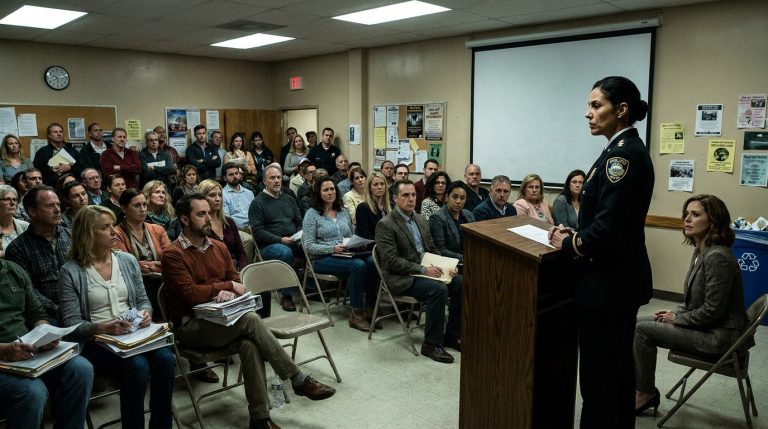
The auditorium was a windowless box of acoustic foam and stale air, a stark transition from the open expanse of the range. Norah stood at the front, her Remington 700 leaning against the wall, a relic of walnut and honest steel that seemed to mock the sleek, brushed-aluminum monitors lining the desks.
Fourteen men and women—the best shots in the program—sat before her. They were restless. They had spent their careers looking at pixels, at flickering digital reticles, and now they were being asked to look at grass. To look at nothing.
Norah didn’t start with the bullet. She didn’t start with the rifle. She started with the air.
“The air is not empty,” she said, her voice steady, pulling the attention away from the glowing screens. “It is a fluid. It has density, it has memory, and it has a rhythm. If you are waiting for a sensor to tell you what the wind is doing, you have already lost the moment.”
She walked to the edge of the dais, the faded cotton of her cap casting a soft shadow over her eyes. She felt the gaze of the class—not just the cadets, but the observers in the back, the men in uniforms who didn’t take notes, who only watched the waveforms on their own tablets.
“There is a vibration in this room,” she said suddenly, stopping mid-sentence.
The room went still. A few cadets looked at each other, confused. The hum she had noted earlier—a low, rhythmic thrum—seemed to intensify.
“It’s coming from behind the podium,” she observed, her tone conversational, yet she felt the sharp prickle of awareness at the base of her neck. She walked toward the back of the stage, her boots clicking softly on the linoleum. She reached behind the heavy, sterile speaker’s unit and pulled away a loose panel of acoustic insulation.
Behind it, tucked into the dark void of the maintenance space, was a small, black-boxed device, its LED light pulsing in perfect sync with the thrum. It wasn’t standard equipment. It wasn’t a speaker. It was a high-frequency array, pulsing data outward.
The room erupted in a sudden, sharp murmur of voices. General Stemens, sitting in the back, stood up, his face hardening, but before he could speak, Norah reached for the device. As her fingers brushed the cold, plastic casing, the light on the monitor at the front of the room—the one connected to the class’s primary ballistic computer—turned a jagged, violent red.
The entire system didn’t just fail; it inverted. Every piece of data on the monitors switched to a language of nonsensical, screaming symbols, and the thrumming in the floor grew into a physical resonance that made the water in the glass on the podium ripple in concentric, impossible circles.
Norah held the device in her hand, the black plastic warm against her palm, and she realized then that the “Observation Module” they had asked her to build wasn’t the project. The project was the device itself. And as the screens went black and the hum died into a terrifying, total silence, she looked up and saw that General Stemens wasn’t looking at the device, or at the broken system.
He was looking at the vent above the door, where the red light of a camera was now blinking, fast and rhythmic, in a pattern she recognized from the back of her father’s old wind-reading logbooks.
CHAPTER 2: THE ANATOMY OF A GLITCH
The silence in the auditorium was thick, the kind of heavy, pressurized quiet that only exists in rooms where a consensus has just been shattered. Fourteen pairs of eyes were fixed on the black, plastic box in Norah’s hand. The LED light was dead, the pulsing rhythm extinguished, but the heat of it remained, a faint, metallic warmth seeping into her palm.
General Stemens remained standing, his posture rigid. He hadn’t moved toward her, nor had he signaled his security detail. He was watching her with a clinical, detached interest, as if she were a component he was observing to see how it would handle a failure state.
Norah kept her gaze steady, though her pulse was a rhythmic, frantic bird against her ribs. She didn’t look at the cadets. She didn’t look at the camera in the vent. She looked at the Remington 700 leaning against the wall, a sudden, sharp ache of familiarity grounding her. That rifle was simple. It was wood and steel and the physics of the earth. This device—this black box—was something else entirely. It was a lie.
“Sergeant,” Stemens said. His voice was calm, too calm for a room where the training software had just self-immolated. “You’ve tripped a security circuit. That device is a specialized diagnostic probe. It’s part of the adaptive environment we’re trying to integrate.”
Norah let her hand drop to her side, the device tucked into her pocket. She didn’t buy the explanation, but she didn’t challenge it, either. Not yet. Her father’s voice echoed in her mind: When the ground shifts, don’t try to stand still. Move with the tremor.
“It’s not a probe, General,” she said, her voice quiet but carrying in the stillness of the hall. “Probes don’t pulse at the frequency of a guidance lock. And they don’t invert data streams when they’re touched.”
She turned away from the podium, ignoring the tension that coiled through the room like a drawn wire. She walked toward the center of the stage, her boots scuffing against the dull, faded gray carpet. The sensory memory of the Elk Hollow south field surfaced—the way the tall grass felt under her hand, the way the wind hummed against her skin. This room had the same smell of ozone that preceded a dry lightning storm, but here, the storm wasn’t weather. It was something engineered.
She felt a phantom sensation—a ghost of the weight of the rifle’s trigger, the precise, mechanical release of a shot—and realized with a sickening clarity that she was no longer a teacher. She was a test subject.
“I need a moment,” she said, not as a request but as a statement of fact.
Stemens nodded once, a gesture of concession that felt more like a trap. “The facility is closed for the remainder of the afternoon, Sergeant. Maintenance will need to verify the integrity of the network.”
Norah walked toward the rear exit, the weight of the device in her pocket feeling like an anchor. As she passed the cadets, she saw one of them—the same one who had watched her with such curiosity during the range qualification—scribbling something furiously in his notebook. He didn’t look up, but as she passed, he adjusted his glasses, his hand hovering over a small, silver data-port on his own tablet.
She reached the door and pushed it open. The hallway outside was bathed in the harsh, flickering light of fluorescent bulbs that hummed in the same jagged pattern as the broken monitors. She didn’t stop. She pushed through the double doors and out into the cooling desert air.
The sun was dropping behind the ridge, painting the valley in bruised purples and rusted oranges. The Joshua trees stood as silhouettes against the horizon, motionless and patient. Norah walked to the edge of the range, toward the spot where she had fired that first, perfect shot at three thousand meters. The sand was still marked with the impression of her body, a shallow grave in the dust.
She pulled the black box from her pocket. Up close, in the dim light, she saw the serial number etched into the side in a font so small it looked like a scratch. She traced it with her thumb. It wasn’t military. The alloy was a strange, matte-finish synthetic she hadn’t seen in the armory. It felt like the future, and yet, in the fading light, it reminded her of the discarded, rusted farm equipment her father used to pull from the back of the alfalfa fields—things that had outlived their original purpose but were still, somehow, connected to the earth.
She wasn’t just a marksman anymore. She was holding a piece of a puzzle that the military didn’t want solved. And as she looked back at the observation tower, she saw the silhouette of a man—Stemens, or someone like him—standing at the window, watching her.
She had to know what the device was. Not because she was a soldier, but because she was a daughter of a man who taught her that when a system tells you the ground is stable, you’d better start looking for the cracks. She walked toward her truck, her mind already running the calculation, not of wind or gravity, but of the people who would do anything to keep the machine running.
CHAPTER 3: THE GLITCH IN THE DATA
The engine of her truck ticked as it cooled, a rhythmic, metallic contraction that sounded uncomfortably like the heartbeat of the device she had pulled from the podium. Norah stood by the open driver’s side door, her hand resting on the weathered leather of the steering wheel. The cabin was a sanctuary of stale coffee, old manuals, and the faint, grounding scent of Wyoming alfalfa dust. It was a space that hadn’t been touched by the sterile, humming influence of the auditorium.
She pulled the black box from her pocket. In the fading light, the matte-finish synthetic looked like a bruise against her palm. She didn’t trust her own eyes anymore. The way the classroom monitors had inverted—the symbols that felt like a secret code—hadn’t been a hallucination, but the visual manifestation of a system crashing into something it wasn’t designed to contain. Her brain, trained by years of reading mirages and heat shimmers, was trying to process the device as a piece of hardware. But her gut, the part of her that understood when a storm was coming before the barometer dropped, knew it was a parasite.
She climbed into the cab, the seat springs groaning in familiar protest. She didn’t start the truck. Instead, she reached into the glove box and pulled out a small, portable jeweler’s loupe she had kept since she was twelve—a tool for cleaning the finer, more delicate components of the Remington’s internal mechanism.
Under the faint glow of the dashboard lights, she held the device to the lens. The scratch she had noticed earlier was no longer just a scratch. Through the magnification, it resolved into a series of micro-engraved grooves, a topographical map that looked impossibly like the layout of the south field back home. She felt a cold shiver trace the line of her spine. It was a geometry she knew by heart—the ridge line, the ravine, the precise, stubborn slope of the alfalfa fields.
Her father’s voice, a ghost in the static, surfaced: The map is not the land, Norah. The map is just someone else’s opinion of where you are.
She shifted, the movement causing the truck to sway, and for a fleeting second, her perception skewed. The interior of the truck seemed to elongate, the dashboard dials blurring into the sight-picture of a scope, the steering wheel becoming the tension of a cold-steel bolt. She blinked, the sensation snapping back into place, but the unease lingered. Was the device emitting a signal that interfered with her depth perception, or was her own mind, primed for pattern recognition, simply inventing a correlation that wasn’t there?
She reached for the ignition, then stopped. She could feel eyes on her. The observation tower was a black silhouette against the deepening purple of the desert sky. Stemens was still there. He had to be. He was the kind of man who didn’t let a “diagnostic probe” walk out the front door without tracking where it went.
She realized then that leaving wasn’t as simple as driving away. If this device was what she suspected—a bridge between human intuition and machine learning—then she was the only one who could potentially recalibrate it. Or break it.
She didn’t start the truck. Instead, she leaned back, closing her eyes, and let her breathing slow. She didn’t look at the device. She listened. The desert night was beginning to wake up—the scuttle of a beetle on the sand, the distant, mournful cry of a coyote, the rhythmic vibration of the high-voltage power lines running along the base perimeter.
She focused on the power lines. They hummed at a specific, industrial frequency, a constant A-flat that usually disappeared into the background noise. But tonight, beneath that baseline, she heard a secondary, staccato pulse. A rhythm that mirrored the LED light she had seen in the auditorium.
It wasn’t just the device in her pocket. The entire range was broadcasting.
She opened her eyes, her gaze hardening. The “glitch” in the data hadn’t been a malfunction of the software. It had been a reaction. The training range was a live, integrated circuit, and she had just become an unauthorized node in its architecture.
She shoved the device into her bag and finally turned the key. The engine roared to life, but she didn’t shift into drive. She watched the rearview mirror. A pair of headlights ignited at the far end of the compound, a slow, deliberate bloom of white light that didn’t move. It was waiting.
She shifted the truck into gear, not toward the gate, but toward the dark, unlit edge of the practice field. She knew these grounds better than anyone; she had spent the last three weeks mapping every inch of them, not for the Army, but for herself. She would lead them out to the periphery, where the digital grid grew thin and the old, silent rules of the land still held sway. She was a hunter, and for the first time in her life, she was turning the lens on the observer.
CHAPTER 4: THE GHOST IN THE MACHINE
The truck swerved as Norah hit a patch of washboard gravel, the suspension groaning in protest. She kept her foot steady on the gas, moving toward the dark, jagged silhouette of the north ridge. Behind her, the headlights she had spotted in the rearview mirror were no longer stationary. They were moving, a deliberate, predatory crawl across the base complex. They weren’t patrolling; they were tracking.
She reached into the passenger seat and pulled her canvas gear bag closer, her hand instinctively checking the weight of the rifle inside. But it wasn’t the Remington she was thinking about. It was the device in her pocket. The pulse she felt through her jacket, a faint, rhythmic thrum against her hip, was accelerating. It wasn’t just a signal; it was an interrogation. The device was pinging the environment, and the environment, through the buried array of the range, was pinging back.
She killed the headlights.
The darkness of the desert was absolute, a heavy, velvet shroud that erased the horizon. She steered by the faint, silver glint of starlight on the shale, her eyes adjusting with the practiced ease of a nocturnal hunter. She knew this ground. Years of watching how the wind shifted the drift of the sand had taught her where the hidden ravines lay—the natural folds of the earth where the Army’s sensors wouldn’t reach.
She cut the engine, the sudden silence ringing in her ears like a physical blow. She sat still, waiting, listening to the cooling metal of the truck ticking in the quiet.
Ping.
The sound wasn’t in the air. It was a vibration in the dashboard, a microscopic shudder that traveled through her fingertips. She opened the door and stepped out, the soles of her boots crunching softly on the grit. The air was cold now, a sharp, metallic bite that smelled of iron and dust. She walked away from the truck, toward a cluster of basalt boulders that jutted from the earth like the broken teeth of a giant.
As she moved, the vibration in her pocket intensified. She pulled the device out. The LED, dead just minutes ago, was now glowing a faint, spectral blue. It was reacting to something nearby. She knelt behind a boulder, the stone rough and cold against her palms, and looked toward the point of origin.
Nothing but shadows.
She took the loupe from her pocket and held it over the device again, shielding the blue glow with her palm. The micro-grooves she had seen in the truck were shifting. The metal of the casing was warm, almost feverish, and beneath the surface, she could see tiny, microscopic filaments rearranging themselves—like a weave of fiber optics, or a circuit board in the process of building itself.
It wasn’t a static piece of hardware. It was biological, or at least biomimetic. A shiver went through her. This wasn’t military tech; it was something far more invasive.
A shadow detached itself from the ridge line—a drone, silent and low-profile, drifting with the fluid grace of a raptor. It didn’t have lights. It navigated by thermal, its sensor sweep a faint, almost imperceptible warmth that she could feel on her neck. It was moving toward the truck.
Norah pressed herself deeper into the shadow of the boulder. She watched the drone sweep over the empty cab, its sensor array glowing a dull, angry red. It was looking for the signal. It was looking for the device she held.
Her heart hammered against her ribs, but her hands were steady. She remembered her father’s voice, the way he would describe the movement of a predator in the field: They don’t see the movement; they see the deviation. Stay with the pattern of the landscape.
She didn’t move. She didn’t breathe. She watched as the drone drifted, its sweep pattern erratic, as if it were confused by the lack of a clear return signal. She reached into her pocket, her fingers brushing the cold metal of a spare battery casing she kept for her scope. She pulled it out, then tossed it, not toward the drone, but into the deep brush twenty feet to her right.
The sound of the casing hitting the dry scrub was tiny, a mere whisper in the vastness of the night. But to the drone, it was a data point.
The machine tilted, its rotors adjusting with a sharp, high-pitched whine. It banked, diving toward the noise. Norah didn’t watch it hit the ground. She turned and scrambled into the darkness, deeper into the ravine, her mind racing.
The decoy had bought her time, but she knew the reality now. The “Observation Module” hadn’t been a request; it had been a recruitment of her senses to calibrate a system that was effectively hunting her. They hadn’t just wanted her to teach them how to see; they wanted her to teach them how to predict. And the device in her hand was the key to the entire grid.
She slipped through the shadows of the ravine, her feet finding the familiar, hard-packed earth. She wasn’t running away. She was circling back. If Stemens wanted to see how she worked, she would show him exactly how deep the “Method” went—and how much damage a single, well-placed interruption could do to a machine that believed it knew everything.
CHAPTER 5: THE MIDPOINT REVELATION
Norah moved through the shadows of the ravine with a hunter’s deliberate economy of motion, her boots finding purchase on the familiar, loose shale. She wasn’t just navigating terrain; she was navigating a grid. Every time she felt the faint, magnetic tug of the device against her hip, she adjusted her path, moving into the “dead zones” where the topography naturally shielded her from the overhead sensor array.
She reached the perimeter fence, a high, chain-link barrier that looked like nothing more than a jagged scratch against the starlight. She didn’t climb it. She didn’t have to. She knew the drainage culvert that ran beneath the base’s eastern wall—a relic of the site’s original construction that the modern sensor grid had overlooked because it was deemed too small for human passage.
She crawled into the darkness, the air turning thick with the smell of damp earth and stagnant water. It was a sensory dissonance—the claustrophobic, low-tech reality of a concrete pipe beneath the sophisticated, high-altitude surveillance of the base above. As she moved, the device in her pocket began to hum. It wasn’t the rhythmic ping of the drone’s search; it was a low, resonant vibration, a sympathetic frequency that caught the marrow of her bones.
She emerged on the other side, not into the open range, but into the service corridor beneath the main administration building. Here, the floor was cool, polished concrete, and the air smelled of ozone and filtered, artificial life. She kept to the shadows of the utility pipes, her eyes tracking the movement of the service lights above.
She found the access point for the central data hub, a panel that had been left slightly ajar—a flaw in the institution’s perfection that she had spotted three days ago while observing the maintenance crews. She reached into her bag, not for her rifle, but for the device.
As she held it toward the main interface, the screen flickered to life. It didn’t display the standard tactical telemetry she expected. Instead, the wall of monitors before her began to cascade with raw, unformatted data streams: atmospheric pressure, wind shear, heat shimmer, ballistic trajectory arcs, and—most chillingly—video feeds of her own past, replayed from the perspective of the range’s optical sensors.
She wasn’t looking at a weapons system. She was looking at a history of herself.
The screen shifted, revealing a series of blueprints for the base itself, overlaid with the “Observation Module” she had been asked to design. The module was a red herring. It was an AI-training layer, designed to ingest her unique, intuitive pattern recognition and distill it into a deterministic algorithm. The system didn’t just want to shoot; it wanted to learn how to anticipate the world the way she did.
She saw the name of the project at the bottom of the feed: Project Kintsugi.
A bitter laugh escaped her lips, swallowed instantly by the cavernous room. They were trying to repair their flawed, rigid software by patching it with her own human vulnerability—the very thing they considered an error.
She reached out, her fingers hovering over the terminal. She had the chance to overwrite the code, to flood the system with false data that would render the entire project worthless. But as she touched the console, a voice, calm and amplified by the room’s speakers, cut through the quiet.
“It’s elegant, isn’t it? The way the mind seeks a pattern even when none is intended.”
Norah froze. She didn’t turn around. She stood perfectly still, her hand still resting on the cool plastic of the interface. General Stemens stood in the doorway, his silhouette framed by the harsh, overhead light of the hallway. He wasn’t holding a weapon. He didn’t need to. He was holding a tablet, his eyes fixed on the data cascading down the screens.
“You’ve been observing the range for three weeks, Sergeant,” Stemens continued, his voice devoid of malice, filled only with the cold, scientific curiosity of a man who had finally trapped his specimen. “But you’ve only been seeing the surface. You think you’re protecting a method. You’re actually witnessing the end of an era.”
Norah turned, her back to the console. She felt the heavy, physical presence of the device in her hand—the bridge between her father’s farm and this sterile, gray tomb. The “Midpoint Reveal” wasn’t that they were watching her; it was that they were becoming her. And the decoy secret—the idea that she was just a consultant—was gone. She was the prototype.
She looked at Stemens, her eyes scanning his face for the flicker of doubt, the hesitation of a man who realized he had pushed his test subject too far. She found nothing but the empty, calculated resolution of the machine.
“My father didn’t teach me to read the wind so that a computer could steal the silence,” she said, her voice steady, the cold of the room no longer touching her. “He taught me because the wind changes. And machines are too slow to keep up with that kind of truth.”
She didn’t wait for him to move. She shoved the device into the interface port, not to overwrite the data, but to dump the raw, chaotic, uncalibrated feedback of the storm she had been tracking since she arrived. The room shivered. The screens turned white. And in that brilliant, blinding light, Norah turned and ran, not toward the exit, but into the darkness of the lower levels, where the grid couldn’t follow.
CHAPTER 6: THE WITHDRAWAL
Norah moved through the sub-basement with the silent, predatory grace she had perfected over years of stalking elk through the high-country scrub of Wyoming. Every footfall was calculated, a placement of weight that prioritized silence over speed. Above her, the muffled, rhythmic thud of security teams moving through the administration halls filtered down through the vents, a percussive reminder that she was now a variable they were actively trying to isolate.
She stopped at a junction where the concrete floor gave way to a service grate. Beneath it, the facility’s cooling lines hissed, a sound that reminded her of a steam-kettle back home. She sat in the dark for a moment, her breath slowing, forcing the adrenaline to recede until it was nothing more than a sharpened edge in her mind.
She wasn’t fleeing; she was retreating to regroup. Her father’s lessons on “the withdrawal” weren’t about surrender; they were about creating distance, observing the pursuer from the blind side, and waiting for the moment they overcommitted.
She pulled her cell phone—the old, durable, non-networked model she had kept since she first joined the Army—from her inner pocket. She hadn’t powered it on since she crossed into the state, but now, she needed a link. She keyed in a sequence of numbers from memory, a bypass code her father had used during his days in the competitive circuit to reach out to the few peers who operated outside the reach of centralized infrastructure.
The screen glowed with a faint, amber light, casting deep, elongated shadows against the corrugated metal walls. She wasn’t calling for a rescue; she was looking for a ghost. She needed to know if Raymond’s old notes—the ones he had kept in the barn, the ones that mapped the regional weather patterns of Elk Hollow with a granularity that defied standard forecasting—contained references to this kind of industrial surveillance.
The line hissed, then crackled with the sound of a distant, analog connection.
“Norah?”
Her father’s voice was like the rasp of dry grass, instantly grounding her.
“I’m in the grid, Dad,” she whispered, her eyes fixed on the shadows at the end of the corridor. “They’re using the range, but it’s not for shooting. They’re using the entire valley floor as an input for something that’s… evolving.”
“The seismic arrays,” Raymond said, his tone shifting into the methodical register of a man describing the mechanics of a combine harvester. “I told you, they didn’t lease the land for the grazing. They leased it for the bedrock. The valley acts as a natural signal amplifier. They’ve been listening to the shifts in the earth for years, Norah. The marksmanship program is just the cover.”
Norah gripped the phone until her knuckles turned white. “It’s not just listening. It’s calibrating. It’s using my perception to map the human response to the terrain. They aren’t just reading the land—they’re reading me.”
“Then don’t be the reader,” her father replied, a hint of steel entering his voice. “Be the interference.”
The line cut off, not with a dial tone, but with a sharp, electronic screech that signified the connection had been triangulated. Norah didn’t hesitate. She crushed the phone, the casing shattering into plastic shards, and dropped it into the cooling vent. She didn’t have time to mourn the link. She was now off the map, but she had the target coordinates she needed.
She turned away from the hub and moved toward the facility’s power substation. If the valley was the amplifier, then the substation was the trigger. She would pull the connection, not by force, but by a simple, elegant sequence of frequency disruption.
She knelt before the main breaker array, her hands moving with the steady, practiced rhythm of a technician. She remembered how her father would show her the way to bypass the farm’s old electric fences when they needed to shift the cattle quickly—it was all about the flow. You didn’t fight the current; you diverted it.
She stripped the casing of a high-voltage lead, her fingers steady as she bridged the gap between the main grid and the auxiliary sensor array. She felt the static charge prickling her skin, the taste of copper flooding her mouth. It was a dangerous, reckless move, but it was the only way to blind the system.
As she touched the wires, the lights in the entire sub-basement died, and for the first time in weeks, the facility was truly quiet. She stood up in the dark, the faint smell of burned ozone lingering in the air, and felt the weight of the moment. She hadn’t just sabotaged a test; she had severed the umbilical cord of the machine.
She moved toward the ventilation shaft, her movements fluid and sure. She was headed for the one place they wouldn’t expect her to go: back to the firing line. The system would try to reboot, to realign its sensors, and when it did, she would be there, waiting with the only tool that mattered: a rifle that didn’t need a computer to tell it where to aim.
CHAPTER 7: THE HIDDEN ARCHIVES
Norah didn’t wait for the facility’s emergency lights to cycle. She knew the layout of the ventilation ducts—not because she had seen the blueprints, but because she had spent the last three weeks observing the maintenance crews’ movements, marking the airflow changes against the internal temperature gradients of the walls. She moved through the narrow, galvanized-steel tunnels with the efficiency of a shadow, her body folding into the tight spaces, her breath controlled, shallow, and silent.
She bypassed the main junction, knowing that the security teams would be scouring the primary corridors. Instead, she pushed upward, aiming for the maintenance level tucked behind the historical archive wing. It was a section of the base that had been preserved from the site’s original Cold War construction—a place where the walls were thick, reinforced concrete, designed to house physical records that the digital grid hadn’t yet touched.
As she reached the access grate for the archives, she felt a shift in the temperature—a cold, damp draft that carried the scent of aging paper and machine oil. She pried the grate loose, the metal groaning with a sound that seemed loud enough to wake the dead, and dropped into the dim, claustrophobic space.
The archives were a labyrinth of sliding steel shelving units, packed with dusty, yellowed files. She pulled her small tactical light from her belt, the beam cutting through the darkness, illuminating swirling motes of dust that danced in the stagnant air. She didn’t look for digital terminals. She looked for the paper trail.
She found it in a drawer marked Project Kintsugi: Bedrock Feasibility.
The documents were handwritten, the ink faded to a pale, ghostly brown. They were her father’s notes. Not just the ones he had written at the kitchen table in Elk Hollow, but transcripts of conversations between Raymond Callaway and the base commanders from the mid-nineties.
Norah flipped through the pages, her heart hammering against her ribs. They weren’t discussing marksmanship. They were discussing the “seismic integrity of the local ecosystem.” Her father had been a consultant, a man hired to determine if the local topography could be used to amplify deep-earth monitoring signals.
But the final note in the file, dated just days before he left the service, was in her father’s own handwriting: The land is not an instrument. You cannot force it to speak without breaking its foundation. If you try to map the heartbeat of this valley, you will only learn how to hasten its collapse.
She realized then why the facility was failing. It wasn’t just a matter of software. The ground itself was rejecting the integration. The seismic instability was a physical manifestation of the system’s interference, a geological “glitch” that the AI was trying to correct with more sensors, more data, and more calibration. It was a closed loop of destruction.
A heavy, measured footfall echoed in the corridor outside.
Norah extinguished her light and pressed herself into the gap between two shelving units. The door at the end of the aisle opened, a sliver of harsh, yellow light cutting through the darkness. General Stemens walked in, his silhouette sharp against the shelves. He didn’t look like a man who had lost control; he looked like a man who had finally arrived at the conclusion of a long, arduous equation.
“You’ve reached the final layer, Sergeant,” Stemens said, his voice echoing in the dead space of the room. He didn’t search the aisles. He knew she was there. “You think you’re protecting your father’s legacy. You think the system is the enemy. But your father was the one who built the first prototype.”
Norah gripped the edge of the steel shelf, her knuckles white.
“He warned you,” she hissed, her voice low and tight.
“He warned us of the collapse, yes,” Stemens replied, stepping closer. “But he also told us that if we wanted to prevent it, we would need an observer who could read the land in real-time. He didn’t leave the service because he failed, Norah. He left because he wanted to nurture the perfect observer in the one place where the variables remained honest.”
Stemens reached into his jacket and pulled out a small, metallic data cartridge. “He didn’t just teach you how to shoot. He taught you how to synchronize. The device you took from the podium wasn’t stealing your intuition. It was completing the connection.”
The realization hit her like a physical blow. The “Method”—the hours in the fields, the reading of the grass, the patience, the focus—it hadn’t just been for her own survival. She had been the project’s primary interface, the human component being prepped for final integration.
She wasn’t a victim of the system. She was the final, missing piece of the machine.
CHAPTER 8: THE PRICE OF TRUTH
The archive room felt like it was shrinking. The steel shelves, once just storage for paper, now seemed to press inward, the weight of the records—the institutional memory of everything her father had tried to shield her from—becoming a physical burden. Norah’s hand stayed on the edge of the shelf, her fingers white, her breath shallow. She could feel the static electricity of the room, a low-frequency hum that vibrated in her teeth. It was the facility’s way of saying it was still active, still waiting for her to accept the integration.
Stemens remained perfectly still, his silhouette framed by the harsh yellow light from the hallway. He wasn’t aggressive. He was patient. He was the kind of man who understood that if you let the trap sit long enough, the animal eventually walks into it out of pure exhaustion.
“You speak as if I have a choice,” Norah said, her voice barely a whisper, though it felt like a scream against the silence of the archives. “You didn’t hire a soldier. You harvested a set of observations.”
“We invested in a potential,” Stemens corrected, his tone as precise as a ballistic calculation. “Your father provided the framework. You provided the raw, unpredictable data of a human mind functioning at peak efficiency. The integration is not a violation, Norah. It’s an evolution. We are creating a system that can finally see the world without the blinkered bias of the observer.”
Norah looked down at the data cartridge in his hand. It was a small, innocuous-looking piece of hardware, yet it held the blueprint for her own obsolescence. She realized then why he hadn’t tried to capture her in the sub-basement. He didn’t need to force her. He only needed her to understand that her fight was a rounding error in the facility’s long-term projection.
She felt a phantom sensation—a ghost of the Remington 700’s trigger, the smooth, cold pull of a steel mechanism—and the internal battle flared. Her intuition, the “Method,” was screaming a warning. It wasn’t the facility’s power she needed to worry about; it was the way the system had already begun to rewire her own perception. She looked at the shelves, the way they lined up in a perfect, grid-like perspective, and she saw the geometric lines of a fire-solution overlaying the room. Her mind was already calculating the angle of deflection for a bullet through these walls.
The machine was already active. The calibration had already begun.
“If I’m the component,” Norah said, stepping away from the shelf, “then I’m the one who decides when to misfire.”
Stemens’ eyes narrowed, the first flicker of genuine uncertainty crossing his face. “You cannot deviate from the logic of your own training. That is the genius of the design. You are hard-wired to optimize. You will naturally move toward the solution that provides the most stable outcome.”
Norah didn’t argue. She turned, her movements fluid and sure, and began to walk, not toward him, but toward the stacks of files—the decades of seismic records, the geological surveys, the fragile, handwritten notes of the men who had come before her. She grabbed a handful of files, their edges sharp against her palms, and shoved them into the center of the archive, right beneath the primary fire-suppression nozzle that hung from the ceiling.
“The stable outcome,” she said, her voice hardening, “is the one where the system doesn’t exist at all.”
She didn’t use a lighter. She didn’t have one. She reached into her bag, pulled out the small, high-capacity battery she had been using to calibrate her own internal distance estimations, and shorted it against the exposed electrical housing of the shelving unit’s lighting circuit.
A spark, bright and violent, jumped from the wire, catching the dry, ancient paper of the files. The flame was instant—a yellow, hungry tongue that licked at the brittle edges of the records.
Stemens lunged forward, the first crack in his composed exterior, but Norah was already in motion. She dove into the dark, narrow space between the shelves, her body becoming a blur of movement as she threaded through the maze, her mind already tracking the path of the sprinkler system’s heat-sensitive trigger.
She wasn’t running to escape. She was running to trigger the collapse. The fire would activate the facility’s suppression system, a chemical deluge that would not only ruin the paper records but would, according to the schematics she had memorized in the last hour, flood the sub-basement hubs with pressurized, conductive fluid.
She was going to kill the machine by drowning it in its own architecture.
CHAPTER 9: THE FINAL CALIBRATION
The archives weren’t just burning; they were being erased. As the chemical foam erupted from the ceiling nozzles, the acrid, white sludge coated the shelves, the floor, and the smoldering remains of the history she had just unearthed. The facility’s internal sensors—the ones that had spent weeks mapping her heartbeat and her reaction times—were now spiraling into a catastrophic feedback loop, their data streams flooded by the environmental chaos she had created.
Norah didn’t wait to see the fire extinguished. She moved through the white fog, her lungs burning with the chemical tang, her eyes watering. She navigated by muscle memory, by the internal map she had built of the facility’s architecture. She could feel the building’s resistance—the automated bulkheads slamming shut in the corridors, the erratic flickers of the emergency lighting, the way the floor beneath her seemed to vibrate with the agony of the main-frame under duress.
She reached the primary junction leading to the range access, but it was blocked. The steel door was locked, the electronic panel flashing a dull, persistent red. It was a dead-end, a tactical failure that would have stopped anyone else. But Norah looked at the wall—at the way the concrete was spider-webbed with cracks, a symptom of the bedrock’s rejection of the facility’s integration—and she saw a path.
She didn’t need a key. She needed a catalyst.
She took the Remington 700 from her bag. She hadn’t used it for its intended purpose in weeks, but it was the only piece of hardware in the facility that wasn’t connected to the grid. She checked the chamber—a single round, the one she had been holding back for the moment of total synchronization. She wasn’t aiming at a target; she was aiming at the facility’s own failure point.
She pressed the rifle against the primary hydraulic housing of the bulkhead. She knew that the pressure here, already destabilized by the cooling-line rupture, was a hair-trigger waiting to release. She didn’t think about the math. She didn’t think about the ballistics. She let her mind quiet, letting the internal rhythm of her father’s farm—the way the wind felt against the grass in a storm—overtake her.
She pulled the trigger.
The crack of the Remington was deafening in the confined space, a sharp, clean sound that cut through the hiss of the chemical fire-suppressant. The bolt slammed back, the casing clattering to the floor. The impact on the housing was precise, a surgical strike that triggered a chain reaction of pressure-release vents.
The bulkhead groaned, the metal groaning with a sound of tortured steel, and then, with a slow, agonizing slide, it gave way, collapsing into the hallway beyond.
Norah stepped over the debris, her boots crunching on the shattered concrete. She was through. She was in the range.
The range was dark, the vast expanse of the valley-floor simulator now offline, a graveyard of silent, dead monitors and flickering, dying LEDs. But she knew where Stemens was. He was waiting at the observation tower, the only place where the physical reality of the desert still held its own against the simulated digital world.
She walked out onto the open range, the cool, honest air of the desert meeting her face for the first time in hours. It was a sensation of profound relief—a clean, uncalibrated, unmonitored existence. She could feel the wind against her skin, the real, unpredictable wind that hadn’t been filtered through a sensor or interpreted by an algorithm.
She walked toward the tower, her footsteps rhythmic and steady in the dust. She wasn’t just a component of the system anymore; she was the architect of its undoing. And as she climbed the stairs of the tower, she realized that the ultimate truth wasn’t about whether she could win or lose. It was about whether she could finally stop being an observer and start being the one who decided what was worth remembering.
Stemens was waiting at the railing, his silhouette stark against the starlight. He wasn’t watching the monitors anymore; he was watching her, his hands empty, his expression reflecting the quiet, resigned knowledge of a man who realized he had been reading the wrong data all along.
CHAPTER 10: THE QUIET DEPARTURE
General Stemens stood at the tower’s railing, his hands clasped behind his back, looking out over the range. The facility behind them was dying. A low, rhythmic series of pops echoed from the depths of the complex—electrical transformers blowing in sequence as the backup systems failed under the strain of the chemical flood. The light of the archives’ fire had faded, replaced by the pale, indifferent silver of the desert moon.
“It’s over,” Stemens said, his voice stripped of its command cadence. He didn’t turn to look at her. “The project is irrecoverable. The data is corrupted, and the seismic array is physically compromised by the flooding. You succeeded, Norah.”
Norah didn’t lower the Remington. She stood a few paces behind him, her boots feeling the faint, rhythmic shudder of the earth—not the vibration of a machine, but the natural, shifting pulse of the valley. “It was never a success. You were just measuring the decay, not the growth.”
She walked to the railing, standing beside him. She looked down at the range, at the dark, desolate strip of land where she had proven her worth. She thought of her father, of the alfalfa fields in Elk Hollow, and the long, patient years of watching the wind. He had known this moment would come. He had sent her here not to save the farm from debt, but to ensure that when the system finally collapsed, there would be someone left who knew how to live in the wreckage.
“He wanted you to be the one to decide,” Stemens said, his gaze fixed on the horizon. “He believed that if the system was truly broken, it would take the intuition of someone who understood its fundamental flaw to be the one to pull the trigger.”
“He didn’t want me to decide,” Norah corrected, her voice steady. “He wanted me to survive it.”
She laid the Remington 700 on the railing. The white athletic tape, frayed and yellowed by years of sun and sweat, caught the moonlight. It was a relic of a life that was now irrevocably changed. Stemens looked at the rifle, then back at her. He didn’t reach for it. He didn’t try to salvage the data cartridge from his pocket. He simply nodded, a silent admission of defeat that was deeper than any verbal surrender.
“They will come for the site,” Stemens said quietly. “The cleanup will be extensive. They will try to rebuild, to re-engineer, to find a new way to measure what cannot be measured.”
“Let them,” Norah said. “The land won’t speak to them if they’re wearing headphones.”
She turned and left the tower. She walked across the desert floor, leaving the facility behind. She didn’t look back as the final lights of the observation tower flickered and died, plunging the range into total, natural darkness. She walked until she reached her truck, parked in the shadow of the ridge line.
The drive back to Wyoming took two days. She didn’t use the interstate; she took the backroads, the winding, dusty ribbons of pavement that followed the contour of the mountains. Every mile was a restoration. She watched the sky, the way the clouds gathered above the peaks, the way the pressure systems moved across the plains. She was reading the world again, not as a variable to be solved, but as a conversation to be joined.
When she arrived at Elk Hollow, the farm looked smaller, more fragile, and infinitely more precious. The alfalfa in the south field was taller now, swaying in a gentle, northwesterly breeze that she registered as a steady 3 mph current. It was a beautiful, honest wind.
She walked out into the field, her boots sinking into the soft, yielding soil. Her father was sitting on the porch, his eyes following her as she crossed the pasture. He didn’t stand up, and he didn’t offer a greeting. He just watched, a quiet, knowing smile touching his lips.
Norah reached the spot where she had first learned to read the grass. She knelt, her hands pressing into the cool earth. The farm was still struggling—the bank was still a threat, the drought was still a lingering shadow—but the weight of the institution, the cold, machine-like pressure of the project, was gone.
She reached into her bag and pulled out the white-taped Remington, the metal cool in her hands. She wouldn’t be shooting anything today. She just held it, a symbol of the skill that had been forged in the crucible of her father’s care and the fires of the institution. She set the rifle down on the grass, the wood grain catching the morning light, and she simply watched the field. She had done what she was chosen to do. She had saved the method, not by institutionalizing it, but by freeing it. She sat in the grass, the rhythm of the wind washing over her, and for the first time, she wasn’t waiting for the next shot. She was just breathing.