When Her Family Forged Her Name, They Learned Too Late What Strong Really Meant
CHAPTER 1: THE COLD DISCHARGE
The plastic hospital ID band pinched the skin of my wrist every time I turned the lock.
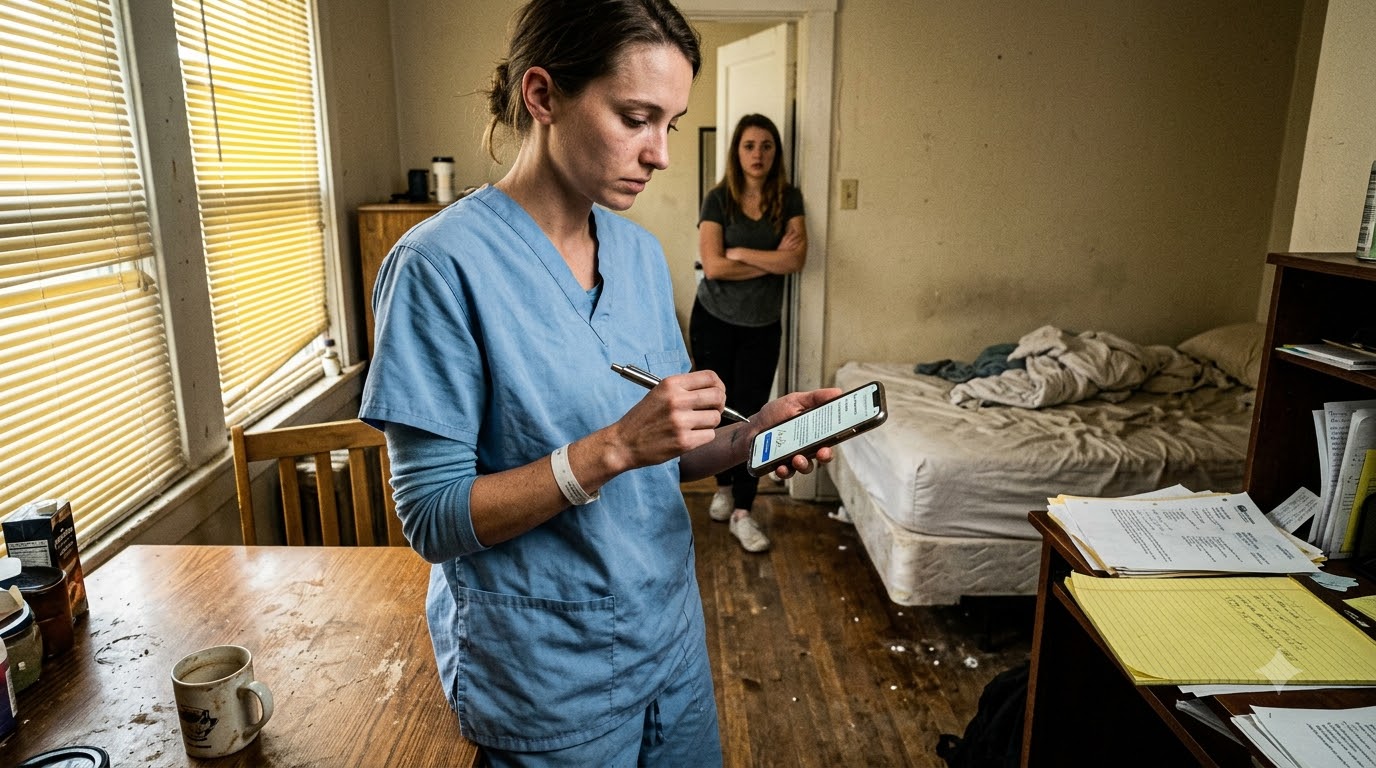
My studio apartment smelled like stale coffee and dust, exactly as I had left it three days ago before I walked onto the graduation field and hit the turf. The evening sun cut through the blinds in thin, yellow slices. I didn’t turn on the lights. I just set my canvas tote bag on the counter, sat on the edge of the unmade bed, and let my boots drop to the floor one by one.
The phone on the nightstand didn’t ring. It vibrated against the bare wood, a harsh, metallic rattle that sounded like a teeth-gritting buzz.
Screen lit up: Mom (92).
Beneath the missed calls sat a string of text notifications, the preview text truncating into neat little blocks of panic.
Pick up the phone, Averly.
Your sister’s situation is urgent.
Don’t do this now.
I picked up the heavy stainless-steel ballpoint pen resting beside my clinical notes. The metal was cool against my palm. I pressed the clip into the meat of my thumb until it bit, anchoring the lightheaded sway still lingering from the IV fluids.
I didn’t open the texts from my mother. I opened the media attachment sent by my father twenty minutes prior.
It was a poorly cropped photograph of a document. Official header: First Keystone Financial — Notice of Verification Requirement. Below it, in crisp black type, was the principal amount: $64,800.00.
Co-Signer / Secondary Guarantor: Averly M. Corbin.
My eyes moved to the signature line at the bottom. The loop of the ‘A’ was rounded, soft, curving inward at the tail. I don’t sign my name with a curve. I haven’t since I was nineteen, when I filled out my first lease on the apartment in Willow Crest and my hand cramped from three copies. The person who signed this document had copied the exact slants from that old lease page sitting in my mother’s filing cabinet back home.
They hadn’t called the hospital. They hadn’t answered Dr. Whitaker when the ER room phones rang at 2:00 AM. But the moment the bank demanded a voice confirmation on a forged line, my phone became the most important object in Pennsylvania.
A soft knock sounded at the door frame. Jessa stepped in, holding a brown paper bag with two plastic soup containers. She took one look at my face, set the bag on the small wooden table, and walked over.
“You’re gray, Averly,” she said flatly. “Sit back.”
“I am sitting.”
“Lie back, then.” She looked down at the glowing screen in my hand. Her eyebrows pulled together as she caught the numbers on the PDF preview. “What is that?”
“My graduation gift,” I said. My voice was raspy, dry as paper. I clicked the metal pen once. Snap. “It’s a sixty-four thousand dollar loan.”
Jessa leaned down, taking the phone straight from my fingers. She scrolled with her thumb, her face hardening with every inch of text. “They put your name on this? While you were in the emergency room?”
“They put it on two weeks ago,” I said, pointing at the execution date near the seal. “They just need me to answer the bank’s security check today, or the underwriting reverses and hits their primary asset.”
Jessa looked around the room, as if searching for an adult, a authority figure, a lawyer—anything. “We need to call someone. A legal aid clinic. A lawyer.”
“No,” I said. The word came out steady, cold, surprising even me. The metal pen clicked again in the quiet room. “No lawyers. I don’t have three grand for a retainer, and I’m not waiting on a clinic backlog while they draft letters. I know how bank verification forms work. I fill out patient insurance charts every day.”
I stood up. The floor stayed solid beneath my feet this time. I walked over to the desk, pulled out a fresh yellow legal pad, and unclipped the steel pen.
“They think I’m still the person who takes the blame for the broken vase so Harper doesn’t cry,” I whispered, setting the phone beside the pad. “They think I’ll hit confirm because I always hit confirm.”
The phone in Jessa’s hand began to vibrate again. Gerald Corbin calling.
I looked at Jessa. She looked at me, her knuckles white around the phone’s casing.
“Put it on speaker,” I said.
CHAPTER 2: THE PAPER TRAIL
“—you pick up on the first ring when your father calls, Averly, we don’t have time for your childish silent treatment!”
My mother’s voice didn’t come through the speaker like a person talking. It came through like steam escaping a radiator—high, sharp, and totally unbothered by the fact that three days ago I was laid out on a gurney with IV lines in both arms.
In the background, the familiar rumble of my father clearing his throat sounded like gravel turning in a cement mixer.
“Averly,” Dad said, his tone dropping into that heavy, authoritative register he used whenever the lawnmower broke or the property taxes came due. “Did you look at the attachment? First Keystone needs the verbal confirmation by five o’clock. The underwriter is holding the file.”
I didn’t answer right away. I pulled the worn stainless-steel pen across the paper, drawing a straight, dark line under the bank’s loan reference number.
Snap. I clicked the top. Snap.
“Averly!” Mom snapped. “Are you listening? Your sister is sitting right here in tears. The apartment complex won’t release the keys to her new place without the lender’s clearance on the deposit loan, and the dealership is holding the crossover on the lot until the primary guarantor verifies!”
Jessa’s eyes went wide. She looked from the phone to me, her jaw slack.
A dealership. A luxury crossover. Not rent for a falling-down apartment in Willow Crest. Not a emergency medical bill for my father’s back.
A brand-new car for Harper.
“I have the document open on my laptop,” I said. My voice was low, flat, stripped of the breathless apology I had spent twenty-seven years offering them. “I’m looking at the signature page.”
“Good,” Dad said, ignoring the change in my tone completely. “So call the 1-800 number on the second page. Tell them you authorized the joint credit check and that you’re co-signing the sixty-four thousand. It takes two minutes.”
“That isn’t my signature, Dad.”
The line went dead quiet for two full seconds. Not even the sound of my mother’s shallow breathing came through the speaker.
Then came a wet, fluttering sigh from Denise Corbin. “Oh, don’t start this. You always do this—you turn every tiny family favor into a giant court trial. It’s a formality! You have the higher credit score because of your hospital job—”
“I don’t have a high credit score because of a hospital job, Mom,” I cut in, the metal clip of the pen pressing deep into my thumb. “I have a credit score because I worked forty hours a week through four years of undergrad and two years of a master’s program while eating canned soup in a basement apartment.”
“Averly Gerald Corbin,” my father warned, his voice taking on that sharp edge meant to make me straighten my back. “We raised you to be dependable. We paid for your soccer uniforms when you were ten. We gave you a roof over your head. We needed a bridge loan for Harper’s fresh start, and you are the only one in this family equipped to stand behind it.”
“You pulled my 2021 lease agreement out of the Willow Crest house,” I said smoothly, tracing the rounded tail of the forged ‘A’ on my pad. “You used a high-resolution scanner, isolated my signature, and dropped it onto a First Keystone digital application.”
“That’s a lie!” Mom shrieked. “Gerald, tell her!”
“Averly,” Dad said, his voice lowering into a dangerous, clipped whisper. “You are talking about your parents. You watch your mouth.”
“It’s a federal felony,” I said.
Jessa leaned back against the counter, crossing her arms, a slow, grim smile touching her lips as she watched me.
“A felony?” Mom let out a high, artificial laugh that sounded like dry glass scraping together. “Listen to her! Miss Master’s Degree! Miss Big City Hospital! You think because you wear a white coat you can talk down to the people who changed your diapers? We are your family!”
“If First Keystone calls me,” I said, leaning over the phone, “I am going to tell the fraud division that I did not sign that document. I am going to tell them the signature was lifted from a four-year-old housing form.”
“You wouldn’t dare,” Dad growled. The mask of the tired, hard-working father was slipping now, revealing the cold, cornered anger underneath. “You do that, and they deny the application instantly. They’ll red-flag our primary accounts. They could freeze the house equity line.”
“Then you better call them before five o’clock and withdraw the application,” I said.
“Averly, please!” Mom’s voice suddenly flipped, dropping the anger and diving straight into pitiful, choked sobs. “Harper can’t handle this kind of stress! Her nerves are shot! You know how delicate she is! If she loses this apartment, she has to move back into her old room, and she’ll be humiliated! Is that what you want? To humiliate your little sister after everything she’s been through?”
“What has she been through, Mom?” I asked quietly. “Besides getting everything she ever asked for while I collapsed on a cement stage three days ago?”
“You fainted because you didn’t drink enough water!” Mom spat, the tears vanishing instantly, replaced by pure, ugly venom. “You always were a drama queen! ‘Look at me, I worked a twelve-hour shift!’ ‘Look at me, I got a degree!’ You think you’re better than us!”
I looked at the yellow pad. Beside the loan number, I noticed something tucked into the edge of my old rental file folder sitting on the desk—a yellowing bank statement from four years ago, sent to the Willow Crest address while I was in dorms. Across the top, stamped in red ink from an old inquiry: Signature Verification Request – Denied / Pending Primary Contact.
They hadn’t just done this once. They had been trying this for years.
“The loan application gets withdrawn by four-thirty,” I said, my voice dropping an octave, completely free of anger, completely full of stone. “Or I call First Keystone’s regional fraud office at four-thirty-one.”
“Averly—” Dad started.
I reached out and hit the red circle on the screen.
The silence that hit the room was sudden, heavy, and clean.
Jessa took a slow breath. “You’re shaking.”
I looked down at my right hand. The fingers wrapped around the steel pen were dead steady, but my left arm was trembling against the wood of the table.
“I’m not shaking because I’m scared,” I said, staring at the yellowing 2022 bank statement sticking out of my file folder. “I’m shaking because I just realized this loan wasn’t the first one.”
CHAPTER 3: THE FIRST PRESSURE
The paper felt brittle, slightly damp from years spent in a humid basement in Willow Crest.
“Denied / Pending Primary Contact.”
The date on the top right was November 14, 2022. I was a senior in college then, living off peanut butter and double shifts at the hospital cafe, wondering why my debit card occasionally declined when I tried to buy laundry detergent.
Jessa pulled a wooden stool over, her shadows stretching long across the floorboards as the sun dipped behind the brick apartment complex across the alley. “What does that stamp mean, Averly?”
“It means they tried to take out a twenty-thousand-dollar personal line when I turned twenty-three,” I said, my voice steady, almost detached. “The automated fraud filter caught it because the address on the application was my dorm, but the billing address they entered was my parents’ house.”
“They tried it twice?”
“They tried it four years ago,” I corrected, turning the page. On the back, in faint pencil, my father’s handwriting held a list of numbers—my Social Security digit combinations, my mother’s old credit card balance, and a single underlined phrase: Averly score: 740. “They didn’t just stumble into this sixty-four-thousand-dollar loan last week. They’ve been monitoring my credit profile like an investment account.”
My phone screen flickered on the desk. No ring this time. Just a notification banner at the top of the screen.
First Keystone Automated Alert: Verification Window Closing in 45 Minutes for Reference #FK-90812.
I picked up the heavy stainless-steel pen. Snap. I didn’t reach for my mother’s contact line. I opened the main web portal for First Keystone Financial, bypassed the personal customer service line, and navigated directly to the Secure Fraud Submission directory.
“You’re not going to call them back?” Jessa asked, her voice tight with caution. “Your dad sounded like he was about to drive up here.”
“Let him drive,” I said. “Brighton is three hours away. By the time he reaches the turnpike, the file will already be locked in the fraud database.”
I didn’t have a lawyer to write a cease-and-desist letter on thick, cream letterhead. I didn’t have a financial advisor to file an injunction. I had a phone camera, a desk lamp, and a yellow legal pad.
I smoothed the yellowed 2022 statement flat on the desk. Beside it, I aligned the printed PDF of the new $64,800 loan application.
I took three high-resolution photos of the signature blocks side by side. The curved ‘A’ from four years ago matched the curved ‘A’ on today’s form down to the millimeter. It was a static image file—pasted into the signature field digitally, not written by a human hand with pressure and friction.
“Look at the tail end of the ‘y’,” I told Jessa, pointing the steel pen at the screen. “A real signature bleeds slightly on paper when you lift the point. A pasted image has a hard pixel edge. Anyone in risk management can see that in five seconds.”
My phone vibrated violently against the wood.
Harper Corbin calling.
I let it buzz. Once. Twice. Five times. Then it cut to voicemail.
A second later, a text popped up.
Averly please. Mom is having chest pains. Dad is yelling. Just sign the online portal link or everything is ruined. Why are you doing this to us?
I looked at the text, feeling a strange, hollow quiet settle behind my ribs. The old guilt—the deep, ingrained reflex that used to make me drop my books and run to the car—didn’t hit. The chest pains were a scheduled appointment in our house; they happened every time the electric bill was due or Harper failed a class.
I opened the First Keystone fraud portal, attached the three side-by-side photos, typed my full legal name, and entered my social security number for identity verification.
In the explanation box, I wrote four sentences:
I am the listed secondary guarantor on loan reference #FK-90812. I did not execute, authorize, or consent to this signature. The signature present on the document is a digital copy lifted from a prior residential lease without my knowledge. I am officially declaring this application fraudulent.
I held my thumb over the blue Submit Claim button.
“Once you hit that,” Jessa said quietly, her hand resting lightly on the edge of the desk, “there’s no taking it back. They’ll pull the whole file. They might flag your parents for identity theft.”
“They flagged me for five years of debt I didn’t incur,” I said.
I pressed the button.
The screen refreshed instantly: Claim #FR-4401 Received. Case File Locked Pending Investigator Assignment. Reference #FK-90812 Status: FROZEN.
I laid the pen down on the yellow pad.
The clock on the microwave read 4:22 PM. Eight minutes before their deadline.
My phone screen flared again, this time with an incoming call from an unknown 1-800 number. The caller ID read: First Keystone Regional Risk Management.
CHAPTER 4: THE UNMASKING
“This is Averly Corbin,” I said clearly.
“Ms. Corbin, my name is Vance with First Keystone Risk Management,” a clipped, professional voice came through the speaker. “I am reviewing Fraud Report #FR-4401 attached to application #FK-90812. We have a freeze on the disbursement, but I need to complete the identity verification audit with you directly.”
“I am ready,” I said.
Jessa leaned closer to the desk, her eyes fixed on the glowing phone screen.
“I have the digital application open,” Vance said, the sound of rhythmic keyboard clicking softly humming over the line. “The primary applicant listed is Gerald Corbin, with Denise Corbin as secondary, and yourself listed as the primary guarantor. The application claims an asset backing tied to a custodial account opened at our Willow Crest branch in 2019.”
I froze. “A custodial account?”
“Correct. Account ending in 4022. It lists you as the beneficiary, with Gerald Corbin as the managing trustee.” Vance paused, the typing stopping abruptly. “The application attempted to draw against the collateral balance of that account to satisfy the debt-to-income ratio for this $64,800 vehicle and personal credit allocation.”
The room seemed to shrink.
My grandfather had left a modest bond portfolio when he passed in 2018—five thousand dollars meant to help me pay off textbooks during my nursing undergrad. My father told me at nineteen that the money was used to cover his knee surgery deductible. He said there was nothing left.
“Mr. Vance,” I said, my thumb pressing so hard into the stainless-steel pen that the metal edges left a white dent in my flesh. “What is the current balance of account 4022?”
“Ms. Corbin, as the named beneficiary who has reached the age of majority, you have full view access,” Vance replied carefully. “The account shows an active line of credit drawn against it continuously since August 2021. The current total liability charged against your personal credit profile under that sub-account is $14,200.”
Layer 1 was never just a sixty-four thousand dollar car loan for Harper.
Layer 1 was the bait. Layer 2 was the anchor they had strapped to my ankles five years ago while I was sleeping on a twin mattress in a Brighton dorm, eating cheap noodles so I wouldn’t have to ask them for fifty bucks. They hadn’t just used my name once—they had turned my identity into an off-balance-sheet slush fund to finance Harper’s lifestyle while telling me I was “the strong one” who needed to work harder.
“I never signed the trustee authorization in 2021,” I said. My voice didn’t shake. It went ice cold. “I was twenty-two years old and living in Massachusetts.”
“We are looking at the digital signature uploaded for that 2021 authorization right now,” Vance said. His tone shifted, dropping the routine customer service cadence into something sharp and focused. “It is identical to the signature on today’s flagged application. The pixel mapping is a exact match.”
“Because it’s a copy of my 2021 apartment lease,” I said. “I am on the fraud portal right now. I am uploading my Massachusetts driver’s license, my hospital employment contract from 2021, and my Brighton residential lease.”
“Received,” Vance said almost instantly. “I see the uploads populating.”
A loud click cut through the line, followed by a sudden burst of static.
“—Averly!” My father’s voice exploded into the call. “Mr. Vance, do not listen to her! This is a private family matter! My daughter is currently suffering from a medical episode—she was hospitalized three days ago for exhaustion and she isn’t in her right mind!”
Gerald Corbin had patched himself into the risk management line using the bank’s automated prompt system.
“Mr. Corbin,” Vance said coldly. “This is a recorded line on a secure risk audit. You are not authorized to interject on the guarantor’s verification interview.”
“I am the primary applicant!” Dad bellowed, his voice straining with that familiar, booming arrogance he used to steamroll store clerks and neighbors. “Averly, hang up this phone right now! You are ruining your sister’s life over a misunderstanding! We put that account in your name to protect your future!”
“You put fourteen thousand dollars of debt in my name to buy Harper’s clothes while I worked double shifts in an emergency room!” I said, my voice cutting straight through his shouting like a blade through paper. “And today you tried to add sixty-four thousand more so she could drive a luxury car while I lay in an ER bed with nobody in the waiting room!”
“We gave you a family!” Dad roared. “You think you got to where you are on your own? You ungrateful little bitch—”
“Mr. Corbin,” Vance interrupted, his tone chillingly precise. “This call is officially recorded. Your application #FK-90812 is formally rejected under Section 8 of the Federal Financial Fraud Prevention Act. Furthermore, account 4022 is immediately frozen, and a full forensic audit of all linked credit lines under Averly Corbin’s Social Security number is now underway.”
“You can’t do that!” my mother shrieked in the background, her voice distant but frantic. “Gerald, do something! The dealership is calling!”
“Averly,” my father growled, his breath heavy and ragged against the receiver. “You fix this right now, or you don’t have a family anymore. You hear me? You are dead to us.”
I looked down at the stainless-steel pen resting on the yellow pad. I picked it up, clipped it neatly to the front pocket of my scrub top, and leaned over the speaker.
“I died to you the night you left me on that sofa with a hundred and two fever so you could go to Harper’s recital,” I said. “Don’t ever call this number again.”
CHAPTER 5: THE TRAP CLOSES
“Ms. Corbin, I have formally severed Mr. Corbin’s connection to this call,” Vance said, his voice flat, professional, and entirely unbothered by my father’s screaming match. “Because you are the sole verified account holder for your primary identity files, I need your explicit final instruction regarding Case #FR-4401.”
Jessa slid a glass of water onto the desk beside my pad. My throat felt like sand, but I didn’t touch the glass. I picked up the stainless-steel pen again, pressing the barrel against the edge of the desk.
“What are my options, Mr. Vance?”
“Option one,” Vance said, reading straight off a institutional risk script, “we process a civil administrative freeze. The application is cancelled, the sub-account is closed, and the primary borrower—Gerald Corbin—is issued a demand notice to clear the fourteen thousand dollar deficit on account 4022 within thirty days.”
“And option two?”
“Option two is a full referral to regional law enforcement for criminal identity theft and digital document forgery. That process begins automatically if you sign the formal affidavit of non-authorization I just dispatched to your verified email.”
The room was silent except for the faint hum of the refrigerator in the corner.
This was the moment where my mother expected me to burst into tears. This was where my father assumed my deep-seated panic over “family reputation” would force my hand to pick option one, absorb the hit, and pay off the fourteen grand over time just to keep peace in Willow Crest.
“Ms. Corbin?” Vance prompted. “Which path are we logging?”
“Send the affidavit,” I said.
Jessa let out a sharp, quiet breath.
“Understood,” Vance replied without a second of hesitation. “The affidavit has been pushed to your inbox. Once you execute it via your verified digital credential, the criminal referral file automatically opens, and all associated accounts linked to your Social Security number are locked permanently to external inquiries.”
“Thank you, Mr. Vance.”
“Have a good evening, Ms. Corbin. And for what it’s worth—get a credit freeze placed on all three major bureaus tonight.”
The line went dead.
I opened my email inbox on the laptop. The message from First Keystone Risk Management sat right at the top, marked with a red urgency tag. I opened the document, scrolled to the bottom affidavit line, and used my trackpad to draw my real, angular, sharp signature across the line.
Submitted.
Not even three minutes later, my phone didn’t just ring—it erupted.
A new three-way call notification flashed across the screen: Denise Corbin & Gerald Corbin.
I picked up the phone, set it on speaker, and didn’t say a word.
“—you evil, selfish, cold-hearted little monster!” my mother shrieked instantly, her voice breaking into ragged, frantic gasps. “The bank just called Gerald! They froze his primary checking account! They froze the equity line on the house! We can’t even run the credit card for Harper’s apartment deposit!”
“You used my name as collateral for a fraud scheme, Mom,” I said smoothly.
“It wasn’t fraud!” my father shouted in the background, his voice muffled as if he were pacing back and forth across the kitchen linoleum in Willow Crest. “It was family money! You owe us for every single year we put food in your mouth! You think you can just hire some fancy city lawyer and destroy us?”
“I didn’t hire a lawyer, Dad,” I said, looking at the empty space on my desk where a retainer agreement would have sat if I had three thousand dollars to burn. “I didn’t need one. You left a trail of forged PDFs across three different banking portals. All I did was answer the phone and tell the truth.”
“Harper is locked in her room crying!” Mom sobbed, switching back to her favorite weapon, her voice rising into an hysterical pitch. “She can’t move into her apartment! The dealership called her two minutes ago and told her the crossover order was cancelled! You’re destroying your sister’s life! She’ll never recover from this humiliation!”
“Harper is twenty-four years old,” I said, setting the steel pen down with a quiet clink against the desk lamp base. “She can get a job at the cafe like I did. She can take the bus.”
“Averly, listen to me,” Dad interjected, his tone suddenly shifting from rage into a low, desperate bargaining tone—the desperate counter-move of a cornered man who realized his authority was completely gone. “We can fix this. Call the bank back. Tell them you made a mistake. Tell them you forgot you gave us permission back in 2021. If you do that, they’ll unfreeze the equity line. I’ll pay off the fourteen grand myself—I swear it!”
“You don’t have fourteen grand, Dad,” I said flatly. “And I don’t give permission.”
“If you don’t do this, the bank is handing the file to the county prosecutor!” Mom screamed, her control shattering completely into pure terror. “Do you want your father to go to jail? Is that what you want, Averly? To put your own father in prison over a car?”
I leaned back against the headboard of my bed, looking out the window at the bright city lights of Brighton.
“I’m not putting anyone in prison,” I said softly. “The decisions you made four years ago did that. Don’t call me again.”
I didn’t wait for my mother to scream. I didn’t wait for my father to bargain. I tapped the red button, opened my mobile carrier settings, and permanently blocked every single number associated with Willow Crest, Pennsylvania.
CHAPTER 6: THE NEW NORMAL
Jessa picked up the two brown paper soup containers from the kitchen counter and brought them over, setting one right on top of my yellow legal pad.
“They’re blocked?” she asked softly.
“Every single one,” I said. “Mom, Dad, Harper, and the landline in Willow Crest.”
I unclipped the stainless-steel pen from my scrub shirt and laid it in the wooden desk drawer. I closed the drawer until the latch clicked shut. No more notes. No more photos of forged signatures. No more tracking loans or waiting for bank calls.
The silence that filled my small Brighton apartment wasn’t the heavy, anxious quiet of my childhood bedroom, where I used to lie staring at the ceiling waiting for the next argument to break out. It was light. It felt like fresh air after hours in an unventilated hospital room.
Two weeks later, the final formal resolution letter from First Keystone arrived in my physical mailbox downstairs.
I didn’t open it standing in the dark hallway. I carried it upstairs, sat by the open window where the morning breeze moved the white cotton curtains, and unsealed the envelope with a butter knife.
Case #FR-4401 Official Determination:
Primary guarantor identity fraud confirmed. Averly M. Corbin has been completely disassociated from application #FK-90812 and custodial line #4022. All adverse credit inquiries have been expunged from all three credit reporting bureaus. The primary applicants have been referred to civil recovery channels.
Through distant neighbors back in Pennsylvania, small pieces of news filtered through over the following months. Gerald had to sell his fishing boat and take on weekend night shifts at a logistics warehouse to settle the bank’s civil demand on the defaulted sub-account. Harper didn’t get her luxury crossover or the high-end apartment; she took a job at a local retail store in town and moved into a shared basement flat two miles from our parents’ house.
For the first time in twenty-seven years, I wasn’t the safety net. I wasn’t the person holding the roof up while everyone else complained about the rain.
I picked up my ceramic coffee mug, the porcelain warm against my fingers, and looked out over the sunlit rooftops of Brighton.
My shift at the clinic started in an hour. I wasn’t running on three hours of sleep, I wasn’t checking my bank account balance with a knots in my stomach, and I wasn’t waiting for a panic call from Willow Crest.
I took a slow drink of the hot coffee, set the cup down on the wooden sill, and smiled at the quiet.