A Fragile Symphony of Echoes: Finding Resilience and Forgiveness in the Aftermath of Broken Truths
CHAPTER 1: The Weight of Silver
The Afghan sun did not just burn; it erased. It scoured the color from the landscape until everything was a uniform, dusty beige, a canvas of absolute nothingness. Maya Chen knelt in the dirt, the rhythmic shuck-scrape of her shovel against the sand-pile serving as the only pulse in the sweltering afternoon. Her gloves, once supple leather, were now stiff with salt and grit, the seams tearing under the strain of a three-hour shift.
She wasn’t just filling bags. She was attempting to fill a hole in her own timeline.
Every time she scooped a shovelful of grit, she felt the phantom weight of Captain Rebecca Tors’ hand on her shoulder—the weight of a life, of a promise, of a mission gone wrong. The badge on her vest—that silver crescent piercing a dagger—seemed to hum with heat against her sternum. To the new recruits, it was a symbol of untouchable mastery. To Maya, it was a heavy, cold anchor.
A sudden, sharp flicker of static erupted from the base loudspeaker near the supply depot, followed by a jagged, high-pitched whine that set her teeth on edge. It wasn’t the usual administrative buzz. It was a dying gasp of electronic equipment, a sound she recognized from the back of the transport plane in Kbble.
Maya froze. Her hand went instinctively to the small, frozen pocket watch in her cargo pocket—the one she kept for the silence it offered.
Three seconds. That’s all it took for the world to turn into a nightmare.
The memory of the radio chatter—the request for authorization, the agonizing wait—washed over her, thick as the desert dust. She could almost smell the ozone of the burning vehicle, the metallic tang of blood, the suffocating realization that she had been betrayed by the very protocol she was expected to worship.
“Chen!”
The bark of Sergeant First Class Morrison’s voice shattered the reverie. He stood in the shade, his uniform pristine, his eyes dull with the petty satisfaction of a man who ruled a very small, very dry kingdom. “Stop daydreaming and move. General Harrison’s convoy is three minutes out. I want that perimeter reinforced, or you’ll be spending your evening scrubbing latrines with a toothbrush.”
Maya didn’t look up. She kept her eyes on the sand. “Understood, Sergeant.”
She stood, her lower back screaming in protest. As she hefted the last bag, the convoy rolled through the main gate. The hum of the engines was a low, rhythmic thrumming that seemed to vibrate through the soles of her boots. It was a sound of absolute order. A sound of precision.
But as the lead vehicle slowed, a strange, metallic clink echoed from the undercarriage—a sound that didn’t belong in the rhythmic mechanical symphony of a military caravan. It was the sound of a spring snapping, a failure so distinct that it echoed in the silence following the engine cut-off.
Maya looked toward the command vehicle. The air seemed to distort, not just from the heat, but from a sudden, sharp realization. The vehicle, meant to be the pinnacle of military logistics, was leaking a dark, viscous fluid onto the sand.
Her heart hammered against her ribs. She was supposed to be invisible, a disgraced operator in the background. But as the door to the command vehicle swung open and General Harrison stepped out—his gaze scanning the compound like a hawk—he didn’t look at the base commander. He looked straight at the puddle of oil forming beneath his transport.
And then, his eyes shifted. They locked onto Maya.
He didn’t walk toward the command center. He turned on his heel, his face tight, and began to march directly toward the sandbag wall.
“Staff Sergeant Chen,” he called out, his voice cutting through the heat like a serrated blade. “I believe we need to discuss exactly what is happening on this base.”
Maya’s breath hitched. As he approached, she noticed he wasn’t looking at her face. He was looking at the small, torn patch of fabric on her vest where the badge was pinned. And for the first time in two weeks, she saw something in his eyes that wasn’t professional distance. It was fear.
The General took another step, but before he could speak, the base’s entire comms network crashed, plunging the compound into a deafening, absolute silence that felt heavier than the heat.
CHAPTER 2: The Sound of the Snap
The silence that followed the comms collapse was not peaceful; it was heavy, pressing against Maya’s eardrums like deep water. On a forward operating base, silence is a predator. It meant the radios were dead, the tactical awareness was blinded, and the structured reality of the military command had just been replaced by the raw, unpredictable chaos of the desert night.
Maya’s gaze remained locked on the dark, iridescent pool spreading beneath the command vehicle. It wasn’t just oil. She leaned in, her boots crunching softly on the sun-baked earth, and saw a metallic shim—a small, precisely engineered spacer—resting in the sludge. It wasn’t a part that simply sheared off due to wear; it was a structural element that had been unscrewed, loosened with patient, surgical intent.
“Staff Sergeant,” General Harrison’s voice was low, devoid of the usual command inflection. He had stopped just three feet from her. He wasn’t looking at the base commander, who was currently shouting orders to technicians who had no way to relay them. Harrison was looking at the spacer in the oil.
“Sir,” Maya replied, her voice barely a breath. She didn’t stand to attention. The protocol had been severed by the static. “That isn’t a mechanical failure.”
Harrison didn’t ask her to elaborate. He didn’t ask for her credentials. He simply stepped closer, his boots narrowly missing the spreading oil. “I know. It’s a design flaw in our own expectations, Staff Sergeant. We assume everything works because we built it to be perfect. But perfection has a breaking point.”
He looked at the base—the dark barracks, the frozen fortifications, the soldiers who were beginning to realize they were effectively deaf and blind. “The comms failure. Is that also a design flaw?”
Maya felt the phantom ache in her hands, the one that lingered from the Kbble operation. “That wasn’t a flaw. That was a shunt. Someone isn’t just breaking our gear, sir. They’re creating an environment where we are forced to operate without the safety net.”
She looked up, meeting the General’s steel-gray eyes. In this light, the fading textures of his uniform—the frayed cuffs, the sun-bleached insignia—looked like a tapestry of a war that had been fought for too long, by people who were becoming as brittle as the equipment they commanded.
“I need to know,” Harrison said, his tone shifting into the ‘operator to operator’ frequency that existed outside the chain of command. “If I give you the reins, if I stop trying to command this from the top-down and let you function as the only eyes and ears we have left… can you find the seam? Can you see who is cutting the strings?”
Maya looked at the oil, then at the dead radios in the distance. The irony wasn’t lost on her. She was the disgraced operator, the one they had tried to bury in sandbag duty, and yet she was the only one who recognized the scent of a deliberate breakdown.
“I don’t just see the seam, sir,” she said, her voice turning hard, the resolve sharpening behind her teeth. “I know exactly where it leads. But if I start pulling, the whole fabric might unravel. You’re sure you want to see what’s underneath?”
Harrison’s lips tightened into a thin, grim line. “I’ve spent thirty years watching it unravel. I’d rather see the truth than keep stitching the lie.”
He turned away, leaving her standing in the shadow of the broken vehicle. As he moved toward the command center, the first of the emergency generators kicked on—a deep, shuddering roar that shook the ground. The lights flickered to life, casting long, dancing shadows across the yard.
Maya knelt, her fingers brushing the cold metal of the spacer. It was still warm, as if it had been handled recently. She slipped it into her pocket, the weight of it anchoring her to the reality of the situation.
She wasn’t just a soldier anymore. She was a witness to a sabotage she hadn’t yet named. As she stood, the base commander’s voice finally boomed over a backup megaphone, a frantic, high-pitched plea for order that sounded pathetically small against the vast, indifferent expanse of the Afghan night.
Maya ignored the call for assembly. She didn’t look at the other soldiers. She looked at the shadows beneath the barracks. If someone had been here, they wouldn’t have stayed to watch the chaos. They would have moved into the dark, watching to see how the ‘perfect’ machine would react to the first intentional crack.
She moved, not with the urgency of a panicked recruit, but with the calculated, predatory silence of someone who had spent their entire career learning how to hunt in the dark. The game wasn’t about saving the base. The game was about figuring out who had decided that the base needed to be broken in the first place.
As she reached the perimeter, she saw a flicker of movement—a shadow that didn’t belong to a guard, a silhouette that didn’t move with military discipline, but with the soft, flowing gait of a ghost.
She stopped, her breath hitching. The scent of ozone, sharp and stinging, hung in the air—the residual mark of the electronic shunt. She followed the trail, knowing that every step took her further from the safety of the perimeter and closer to the center of the unraveling.
She didn’t reach for her radio. She didn’t call for support. She moved into the dark, the silver badge on her chest feeling like a burning coal, the only light she had in a world that had suddenly gone blind.
CHAPTER 3: The Assembly: Selecting the Broken Building the Whole
Maya moved with the agonizing precision of a predator stalking through its own territory, keeping her silhouette pressed low against the crates of the supply depot. The ghost she was tracking—that fluid, silent shadow—had disappeared around the flank of the maintenance shed. The smell of ozone, sharper here than near the command vehicle, clung to the air like a physical residue.
Her hand hovered over her holstered sidearm, but she didn’t draw. To draw was to commit to violence, and violence was the language of the sabotage. She needed to speak the language of the aftermath.
As she rounded the corner, the shadow vanished, but it left behind a mark—a smudge of grease on the shed’s corrugated wall, shaped like a hand. She pressed her own fingers against the metal. It was cold, and the vibration of the base’s emergency generator hummed through the steel, a deep, rhythmic thrum that seemed to harmonize with the sudden, sharp memory of Captain Tors’ voice. “Don’t look at the target, Maya. Look at the space between the target and the wall. That’s where the movement hides.”
The phantom of Tors—the way her laughter used to sound, dry and brittle like autumn leaves—flickered in Maya’s mind. It was a cruel dissonance, the memory of warmth against the freezing reality of the sabotage. She pushed the thought away, anchoring herself to the gritty, faded textures of the shed wall. She was alone, but she had a feeling she was being funneled toward an assembly point she didn’t realize existed.
She pushed open the heavy sliding door of the maintenance shed. It protested with a long, metallic groan that felt deafening in the silence of the night.
Inside, the light was abysmal, filtered through dirty windows that blocked out the moon. But she didn’t need light to see the gathering.
Five people were already there.
There was Corporal James Desawn, his medical kit open on a workbench, his hands steady as he sorted through sterile gauze in the dimness. Specialist Anna Valkov was huddled over a terminal, her fingers flying across a keyboard that shouldn’t have been functional under the current comms blackout. Private Marcus Webb stood by the far wall, his rifle broken down into its primary components, his movements almost meditative as he cleaned the firing pin. Sergeant Lewis Achoa was kneeling by a stack of crates, meticulously checking the fuses on a set of timed charges, and Staff Sergeant Patricia Newan was leaning against the fuselage of a nearby light transport, her eyes fixed on the door as Maya entered.
They didn’t look like an elite team. They looked like a collection of broken parts, each soldier carrying their own specific, jagged edge.
“I didn’t invite you,” Maya said, her voice sounding unnaturally loud in the confined space.
“Nobody invited us,” Desawn replied without looking up from his bandages. “We just found the same breadcrumbs you did. The comms crash, the ‘accidental’ oil spill, the fact that our own gear is being systematically dismantled from the inside.”
Maya walked deeper into the shed, the floorboards creaking under her boots. “Who told you to come here?”
“Nobody,” Valkov said, her eyes shifting from the screen to Maya. She looked exhausted, her face washed out by the pale blue light of the monitor. “I’m not hacking the base, Maya. I’m tracking the shunt. It’s not coming from outside. It’s originating from the command network itself. It’s a loop. A feedback loop designed to make the base ‘fail’ precisely when the General needs to prove a point.”
Maya felt a chill that had nothing to do with the night air. “A point about what?”
“Human resilience,” Achoa muttered, his voice gravelly. He didn’t look up from his fuses. “I’ve been tracking the maintenance logs for three months. Every time a unit starts to get ‘too comfortable,’ ‘too automated,’ something breaks. A vehicle, a radio, a cooling unit. It’s not sabotage, Maya. It’s an intervention.”
Maya stood in the center of the room, looking at the five soldiers who were supposed to be her subordinates, but who clearly knew more about the architecture of this base than she did. She was the one with the Nightshade badge, the one with the reputation for tactical perfection, but standing here, she felt like the raw material, not the architect.
“You’re all broken,” she said, the words slipping out before she could check them.
Pat Newan pushed herself off the fuselage and stepped into the light. Her eyes were sharp, devoid of the usual professional mask. “We’re the ones who didn’t fit the template, Maya. I don’t fly by the book, I fly by the feel of the air. Desawn doesn’t just treat the wound; he treats the panic. And you? You’re the only one who actually looks at the blood on the floor instead of reading the casualty report.”
Marcus finally looked up from his rifle. His eyes weren’t trembling anymore. They were focused, cold, and entirely present. “We aren’t here because we were ordered. We’re here because we’re the only ones who can see the cracks in the foundation. And if the General is orchestrating this—if he’s breaking his own house just to see how we’ll rebuild it—then we have to decide if we’re the builders or the rubble.”
Maya looked at the silver crescent on her vest. It felt less like an anchor now and more like a target.
“If this is a test,” Maya said, her voice dropping into a register that made the room grow still, “then we aren’t going to play by the rules of the test. We’re going to find out who is pulling the strings, and we’re going to tighten them until they snap.”
She walked to the workbench, placing her hand on the cold, scarred wood. “Valkov, stop tracking the loop. Start back-tracing it to the source. Achoa, keep those charges ready, but don’t fuse them. Desawn, I need an inventory of everything we can take with us if we have to leave the fence line. We aren’t building a team for the mission we were promised. We’re building a team to survive the one we’re being forced into.”
The shed was silent, save for the hum of the distant generator. They were five strangers with a shared burden, five fragments of a machine that had been disassembled to see if it could be put back together differently.
Maya looked at them—really looked at them—and saw not soldiers, but people who had been pushed to the edge and had decided to stand their ground. She reached into her pocket and pulled out the metallic spacer she had found earlier. She set it on the workbench.
“This is the first piece,” she said. “Let’s see how many more we can find before the sun comes up.”
The assembly was complete, not by order, but by gravity. They were the broken ones, and in the dark of a failing base, they were the only ones who knew how to start the fire.
CHAPTER 4: The Crucible: The First Crack in the Facade
The shed was a tomb of forgotten machinery, and for the first time, Maya felt the weight of her choice. By gathering them here, by giving them a purpose that bypassed the official channels, she wasn’t just investigating the sabotage; she was effectively forming a breakaway cell. The smell of ozone, metallic and sharp, still hung in the air, a reminder of the electronic shunts that had blinded the base.
“We have two hours until the sunrise shift,” Maya said, her voice cutting through the quiet like a blade. “That is the window. The sabotage loop won’t just stop at blinding the comms. If they’re testing us, they’re going to test our ability to respond to a false-flag emergency. We need to be ready to intercept the ‘incident’ before it happens.”
Achoa was already checking the perimeter, his movements loose but eyes scanning every shadow. He looked back at her, his expression a mixture of doubt and curiosity. “If we’re going to intercept a phantom, Maya, we need to know where the ghost walks. You tracked that shadow earlier. Where did it go?”
“It didn’t go to the perimeter,” Maya said, closing the distance between them. “It went to the armory. And that’s the contradiction. If this were standard insurgency, they’d want to blow the walls. But the shadow didn’t look like an infiltrator. It looked like someone checking the inventory.”
Valkov nodded slowly, her fingers still dancing across her portable interface. “The maintenance logs support that. There’s been a systematic displacement of legacy equipment. Weapons that shouldn’t be in circulation are being moved into the current deployment supply chain. It’s not just a sabotage of infrastructure; it’s an attempt to arm this base with ‘deniable’ hardware.”
Maya stood in the center of the shed, feeling the cold air draft through the gaps in the corrugated walls. She was seeing the pattern now, a pattern not of chaos, but of cultivation. Someone was turning FOB Sentinel into a petri dish, and she and her team were the antibodies being observed to see if they would kill the infection or become part of the structure.
“Desawn,” Maya said, turning to the medic who was now packing a trauma bag with systematic care. “I need you to look at the personnel logs for the last thirty-six hours. Not for the soldiers on duty, but for the ones who were reported as ‘medically compromised’ or ‘off-rotation’. See if there’s a correlation between the times of the maintenance failures and the sudden availability of certain personnel.”
Desawn paused, his brow furrowed. “You think the sabotage is being performed by people who were ordered to stand down?”
“I think the General isn’t just watching us,” Maya said, her voice low. “I think he’s filtering the entire base. He’s taking the people he deems ‘unreliable’—the ones who think too much, the ones who question the protocol—and he’s giving them the opportunity to either break the system or be broken by it.”
The team went silent. The weight of that realization shifted the air in the room. They weren’t just soldiers; they were subjects.
“We need to move,” Pat Newan said, her voice breaking the tension as she moved to the door. “If the shift change is the trigger, we need to be in position at the supply depot. That’s the only place where the supply chain intersects with the maintenance loop.”
“Marcus,” Maya called out as they moved toward the door, “you’re on overwatch. Stay in the shadow of the fuel bladders. If you see someone approaching the depot, you don’t engage. You mark them. I need to know exactly who is running these errands for the ‘ghost’.”
They moved out of the maintenance shed into the cold, predawn air. The base was a landscape of deep, shifting grays, the moonlight filtered through high, thin clouds. As they crossed the compound, Maya kept her eyes on the periphery, watching the way the shadows stretched and warped against the concrete bunkers.
The sensation of being watched was constant, a prickling on the back of her neck that she had learned to trust in the field. But here, the watcher wasn’t an enemy hidden in the mountains; it was the base itself. Every security camera, every motion-activated light, every radio antenna was a part of a massive, blinking eye.
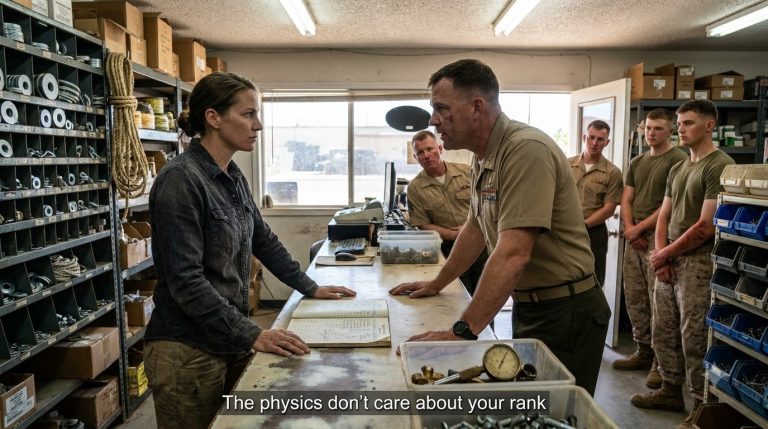
They reached the supply depot, a long, low structure that housed the gear that had supposedly been ‘misplaced’. Maya slipped into the shadow of a pallet of sandbags—the same ones she had been forced to fill only days ago. The texture of the rough, woven plastic against her gloves was a reminder of how far she had traveled in so little time.
“Status,” she whispered into the comms loop—their own, encrypted, and isolated from the base network.
“Clear,” Marcus replied, his voice barely audible even in her ear. “But there’s movement near the gate. It looks like a transport, but it’s not running lights. It’s ghosting into the loading bay.”
Maya shifted her position, bringing the depot entrance into view. A dark vehicle, stripped of all markings, pulled silently into the bay. The driver didn’t emerge; instead, a figure stepped out from the depot itself—a soldier moving with that same fluid, ghost-like gait she had tracked earlier.
As the figure approached the vehicle, the light from a distant, flickering bulb hit their face. Maya felt a sharp, electric jolt to her stomach. It was Sergeant First Class Morrison.
He didn’t look like the petty tyrant who had enjoyed the sandbag duty. His expression was one of intense, almost robotic focus. He reached into the back of the transport and pulled out a crate—a crate that bore the distinct markings of the Nightshade unit’s specialized gear, the kind that was supposed to be restricted to Tier-1 operators.
He wasn’t sabotaging the base. He was consolidating the power.
“He’s loading the gear,” Valkov whispered, her voice tight with disbelief. “Why would he be pulling that equipment now?”
“Because the ‘incident’ isn’t an attack,” Maya said, the realization hitting her with the force of a physical blow. “It’s a transition. They aren’t trying to break the base. They’re trying to turn it into an independent command.”
She looked at her team, their faces illuminated by the dim reflection of the depot lights. They were the ones standing outside the circle, the ones who had been designated as ‘unreliable’. And now, they had the proof that the protocol was being rewritten in real-time.
“Don’t move,” Maya cautioned, her hand gripping her weapon. “If we move now, we confirm their suspicion that we’re the anomaly. We let them finish the transfer. Then, we find out where that gear is going. If the General wants to play with fire, we’re going to make sure he gets burned by his own furnace.”
She held her position, the cold night air biting at her cheeks, and watched as Morrison finished loading the crate. The vehicle reversed silently into the darkness, leaving behind nothing but the faint scent of ozone and the heavy, undeniable truth that the base was at war with itself.
Maya’s pulse was steady, her mind clear. The facade of the ‘accidental’ sabotage had cracked, and through the fissure, she saw the reality of the game. They weren’t just fighting a ghost. They were fighting the ghost of the mission they were meant to serve.
CHAPTER 5: The Sabotage Revelation
The transport was gone, a ghost retreating into the deep desert, but the lingering smell of exhaust and unburned diesel hung in the still, freezing air. Maya didn’t move. She waited, her pulse steady, listening to the base settle back into its false, superficial calm.
“They’re moving the gear to the secondary hangar,” Valkov’s voice, filtered through the encryption, was sharp and thin, crackling with a digital edge. “I’m tracking the shipment’s internal RFID tag. It’s not going to storage. It’s being staged for an extraction, but not for an asset—for a team.”
Maya finally allowed herself to exhale, her back aching from the rigid, unyielding posture she had held for the last ten minutes. “A team? Who is he pulling?”
“He’s pulling the ones who haven’t been ‘tested’ yet,” Achoa’s voice interjected, low and rough. “I’ve been tracking the rotation schedule. Morrison is cleaning house, Maya. Anyone who has been on the base for more than three months is being flagged for ‘reassignment’. He’s building a unit of newcomers. People who don’t know the history of this place, people who are still desperate to prove themselves.”
Maya pushed off the sandbags, her boots silent on the concrete. The depot felt smaller now, the shadows deeper, the air heavy with the weight of impending collapse. They were the outliers, the ones who had seen the gears grinding, and their time as observers was rapidly drawing to a close.
“If he’s building a new team,” Maya said, her eyes tracking the movement of a distant security light that swept across the compound with an unnerving, hypnotic regularity, “he’s not just preparing for a mission. He’s preparing for the cleanup. If the ‘incident’ happens tomorrow, he’ll have a unit in place that has no loyalty to anyone but him.”
She moved toward the spot where Morrison had stood. She knelt, her fingers brushing the dust, looking for any clue, any physical fragment left behind. There—a small piece of packing tape, fluttering in the draft. She peeled it up. It wasn’t standard military-issue tape. It was high-grade adhesive, used for sealing sensitive, climate-controlled electronics.
“This isn’t just weapons,” she whispered, her voice barely audible even to her team. “This is comms gear. High-bandwidth, field-deployable mesh networks. He’s not just arming them; he’s building a closed-loop command structure that we can’t touch.”
“Maya,” Marcus’s voice cut in, strained. “I’ve got movement at the secondary hangar. Someone’s overriding the security lock. It’s not Morrison. It’s the Base Commander, Colonel Bennett.”
Maya froze. “Bennett? Is he working with Morrison?”
“I don’t think so,” Marcus replied, his breathing hitching. “He’s got his sidearm out, and he’s moving like he’s clearing a room. He’s not here to assist. He’s here to investigate.”
A surge of adrenaline hit Maya, cold and sharp. If the Commander walked in on Morrison’s stash, the collision would be violent, and the blame would inevitably fall on the people who had been ‘observed’ near the scene.
“We need to intervene,” Pat said from her position near the hangar entrance. “If Bennett gets shot, or if he kills Morrison, the entire base goes into lockdown. We’ll be trapped in the middle of a command civil war.”
“No,” Maya said, her mind working through the tactical geometry. “We don’t intervene. We manipulate. If Bennett is there, let him find the evidence. But we need to make sure he finds it without realizing it was placed for him.”
She stood, her resolve hardening. “Valkov, can you bypass the hangar’s internal camera loop? I need to give the Colonel a very specific view of that crate.”
“I can,” Valkov said, her voice focused. “But I need to hook into the local server node. It’s five minutes from your position.”
“Go,” Maya commanded. “Achoa, you’re with me. We need to create a distraction that pulls the security team away from the hangar entrance. If Bennett is going to see the truth, he needs the stage cleared.”
They moved as one, a shadow-unit navigating the complex, industrial labyrinth of the base’s supply spine. Every step was a risk, every shadow a potential witness. Maya’s senses were heightened to an extreme degree; the smell of ozone, the hum of the cooling fans, the distant, rhythmic pinging of a beacon—everything was a clue in a puzzle she was finally beginning to understand.
As they reached the junction leading to the server node, a siren erupted—a short, sharp blast that echoed across the compound. Then, silence. But the silence wasn’t the same. It was the silence of a held breath.
“That was the hangar alarm,” Pat whispered. “Bennett’s in.”
Maya didn’t wait. She led the charge toward the node, her movements fluid and efficient. They reached the server room, a cramped, climate-controlled box that hummed with the heat of the base’s digital brain.
Valkov was already there, her hands moving over a terminal. “I’m in,” she said, her face glowing with the cold light of the screen. “I’m scrubbing the last ten minutes of the feed. I’m rerouting the camera to show the contents of the crate, but I’m masking the timestamps. It will look like a direct feed.”
“Make sure he sees the serial numbers,” Maya said, watching over her shoulder. “Those serial numbers are linked to a classified acquisition order that was supposed to be decommissioned in Kbble. If Bennett is a soldier at heart, he’ll recognize the discrepancy immediately.”
Suddenly, the monitor flickered. A feed appeared—grainy, black-and-white, but clear. Bennett stood in the center of the hangar, his pistol drawn. He was standing directly in front of the open crate. He looked at the equipment, his face a mask of shock, then looked up at the camera.
He didn’t look like a man who had found a stash of weapons. He looked like a man who had just realized his entire command was a lie.
Then, he turned. The sound of a heavy door slamming echoed through the feed. Morrison stepped into the frame.
“Sir,” Morrison said, his voice terrifyingly calm. “I wouldn’t touch that if I were you. The chain of command on this base is currently… under revision.”
The feed cut to black.
“He just locked the server,” Valkov said, her voice trembling.
Maya looked at her team, the weight of the moment pressing down on them. The facade had not just cracked; it had disintegrated. The war for the base had officially begun, and they were the only ones standing in the ruins.
“Achoa,” Maya said, her voice steady. “Get those charges. We’re not waiting for the sun to rise. If they’re going to war, we’re going to be the ones who define the battlefield.”
CHAPTER 6: The Breach: HighStakes Tension LowStakes Compassion
The hum of the server room was replaced by a low, vibrating thrum that seemed to bleed through the floorboards. Outside, the base was screaming. The sirens weren’t the steady, rhythmic wail of a drill; they were erratic, jagged blasts that signaled a breach of perimeter—or perhaps, the activation of something far more controlled.
“They’re sealing the sector,” Valkov said, her voice strained as she pounded on the physical override beneath the console. “The entire server node is being isolated. If we don’t pull the manual release, we’re going to be trapped in here until the security team arrives.”
Maya looked at the door. Through the thin gap at the bottom, she saw the harsh, strobe-like flicker of tactical flashlights. The cleanup detail was here. They weren’t coming to investigate; they were coming to purge.
“Achoa, the charge,” Maya ordered, her voice calm even as her heart hammered against her ribs like a bird in a cage.
“Setting it now,” Achoa grunted. He was working with a terrifying efficiency, his fingers moving over the explosive pack with the grace of a surgeon. “It’s going to be loud. It’s going to be messy. And it’s going to blow the lock, not the wall. We need to be braced.”
Maya moved to the corner, pulling Marcus and Deshaawn into the tight, reinforced space behind the rack. The smell of ozone—the smell of the sabotage—was thick, almost suffocating. It reminded her, with a sudden, sickening jolt, of the alleyway in Kbble, of the moment the air had changed right before the breach. The same static tension. The same feeling of time stretching into an infinite, agonizing wire.
Don’t think about Tors, she told herself. Think about the geometry.
“Three, two, one—”
The explosion wasn’t a roar; it was a percussive slap that rattled the marrow of her bones. A plume of gray dust bloomed into the room, and the heavy steel door swung inward, twisted and smoking.
Before the smoke had even cleared, Maya was moving. She didn’t look back to see if the others were following; she knew they were. Her boots hit the hallway concrete, and she was already scanning the sectors. Two figures in full tactical gear—the ‘new’ recruits Morrison had been curating—were standing at the far end of the corridor, weapons raised.
They weren’t aiming to warn; they were aiming to engage.
“Contact!” Maya shouted, her voice cutting through the ringing in her ears.
She didn’t fire at them. She fired at the overhead light, plunging the hallway into a chaotic, strobing darkness. In the confusion, she saw the two recruits hesitate, their tactical discipline fracturing under the sudden loss of illumination. That hesitation was the only opening she needed.
“Desawn, move!” she ordered, and the medic didn’t wait. He slipped past her, his movements low and tight, pushing toward the side exit.
“They’re calling for backup!” Valkov yelled over the comms. “The entire sector is moving to intercept!”
They sprinted, the sound of their boots echoing like gunfire in the claustrophobic metal corridors. Maya kept her eyes on the intersections, her training stripping away the fear, leaving only the tactical calculation. They were being funneled. The base wasn’t just reacting to them; it was leading them toward the central courtyard, toward the very place where Morrison and the General had likely set up their final stand.
As they burst through a secondary service door, they found themselves in the central square. The air here was open, cold, and filled with the debris of a base that had stopped pretending to be a routine operation. The hangar where the crate had been stored stood open, its interior glowing with a sickly, artificial light.
Bennett was there, on his knees, his hands behind his head. Morrison stood over him, his weapon leveled, but he wasn’t looking at the Colonel. He was looking at the roof of the command building, where a spotlight had just clicked on, bathing the entire square in white, clinical intensity.
General Harrison stood on the balcony, his silhouette framed by the harsh glare. He looked down at them—Maya and her team—with an expression that wasn’t anger or disappointment. It was the look of a man who had finally found what he was searching for.
“It took you longer than I expected, Staff Sergeant,” Harrison said, his voice carrying clearly across the silent square. “But you’re here.”
Maya didn’t lower her weapon. She stepped forward, her team forming a semi-circle behind her. They were exhausted, their uniforms stained with dust and grease, but they stood with a cohesion that defied the chaos of the last hour.
“The test is over, sir,” Maya said, her voice steady and loud. “We know about the sabotage. We know about the equipment transfer. And we know you’re not building a team. You’re building a martyr.”
Harrison’s smile was small, fragile. “Every great transformation requires a sacrifice, Maya. I wasn’t testing you to see if you could follow orders. I was testing you to see if you could survive the truth.”
He gestured to the crates scattered around the square—crates that had been broken open to reveal, not weapons, but medical supplies, communications hardware, and detailed humanitarian logistical data.
“This wasn’t a combat unit,” Harrison said. “It was the infrastructure for a system that could operate without the permission of the bureaucrats who let those journalists die in Kbble. You didn’t just survive the test. You integrated the equipment. You coordinated the team. You proved that it works.”
The weight of it hit Maya like a physical blow. The ‘sabotage’ hadn’t been an act of aggression; it had been an act of desperate, clandestine construction. The General hadn’t been trying to break the base; he had been trying to build a secret one, hidden within the machinery of the army, and he had used the sabotage to force the ‘unreliable’ soldiers to build it for him.
“You used us,” Desawn whispered, his voice vibrating with a mixture of rage and realization.
“I used the only people who were capable of understanding the cost,” Harrison replied. He turned, looking at the distant mountains. “The question now isn’t what I did. The question is what you’re going to do with the machine you’ve just built.”
Maya looked at her team, then at Morrison, who was still holding the weapon to Bennett’s head, and finally at the General. The truth was out—a decoy truth, she realized, designed to hide the even deeper, more complex reality of the General’s true intent. She saw the flick of a shadow on the hangar roof, a second figure she hadn’t accounted for—a witness who wasn’t part of the play.
The conflict wasn’t over. It had only just reached the point of no return.
CHAPTER 7: The Unmasking: Confronting the Architect
The wind on the roof of the hangar was thin and sharp, carrying the metallic tang of the base’s dying power. Maya’s boots skidded on the rusted corrugated metal, the sound swallowed by the erratic, dying wail of the sirens. Beside her, the team moved with a fluidity born of exhaustion and terror. They had expected an army; they had expected a fight. Instead, they had found a mirror.
The “witness” standing by the terminal wasn’t a guard. It was Captain Rebecca Tors—or rather, a high-fidelity digital projection, a ghost encoded into the base’s mainframe. Maya stopped, her weapon lowering by a fraction of an inch. The image shimmered, the light from the terminal catching the edges of the projection, making Tors look almost solid against the night.
“You’re not real,” Maya whispered, her voice lost in the wind.
The projection turned, its eyes glowing with a soft, analytical blue. “I am a synthesis of your tactical history, Maya. I am the logic you were taught to follow. And I am the final fail-safe for Operation Silent Guardian.”
Achoa stepped forward, his hand hovering over his sidearm. “It’s a construct. The General didn’t just build a team; he built a decision-tree. If we reached this point, if we survived the sabotage, we were supposed to be faced with the choice: execute the broadcast or let the base fall.”
Maya looked at the terminal. The screen was scrolling through a list of names—the entire roster of the base, flagged by their ‘resilience quotient’. The General hadn’t been trying to create a martyr. He had been trying to automate the command, to create a system that could evaluate human potential through the crucible of failure.
“The broadcast,” Maya said, her pulse hammering against her ribs. “If we hit this, the entire tactical network of this base goes public. The corruption, the unauthorized gear, the sabotage logs… it all hits the global feed.”
“And the base falls,” Valkov said, her face pale. “Every insurgent for fifty miles will know exactly where our weak points are. We won’t just be exposing the corruption; we’ll be inviting an invasion.”
The dilemma was a razor. Expose the truth and sacrifice the base—and every soldier on it—to the wolves, or bury the truth and continue to be the General’s silent, experimental subjects. The shadow Tors on the screen looked at her, the projection’s expression one of haunting, familiar expectation.
“The truth is the only variable the machine can’t calculate,” the ghost said. “If you broadcast, you prove that human agency is superior to the General’s algorithm. If you don’t, you confirm that you are just another part of the machine he built.”
Maya looked at her team. Deshaawn, his medical bag ready. Pat, her pilot’s eyes searching the sky. Marcus, the young marksman who had been scared but stayed. They were the ones who had chosen each other. And the choice they had to make now wasn’t between success and failure. It was between being the architects of their own destiny or the fuel for someone else’s.
“He wants us to choose,” Maya said, her voice turning hard. “He wants to see if we’ll choose the mission over the truth. Or the truth over the mission.”
She stepped to the terminal. The metal surface was freezing under her fingertips. She didn’t look at the projection anymore. She looked at the data—the raw, ugly, beautiful record of what they had endured over the last forty-eight hours.
“We don’t need the broadcast to prove our agency,” Maya said, her voice echoing in the wind. “We prove it by breaking the machine that thinks it can predict us.”
She reached out, but instead of hitting the broadcast key, she jammed the decryption bypass into the data port. It wasn’t an upload; it was a wipe. A clean, irreversible purge of the General’s entire operational database.
“What are you doing?” Valkov gasped.
“If he wants to test resilience,” Maya said, her eyes flashing with a sudden, brilliant clarity, “he can do it without his algorithm. I’m resetting the board.”
The terminal shrieked. A cascade of red lines tore through the screen, the data streams collapsing into a silent, swirling void. The projection of Tors shuddered, its features blurring into static, before finally winking out of existence. The rooftop was plunged into a new, absolute darkness.
The sirens stopped.
The silence that followed was different. It wasn’t the silence of the sabotage. It was the silence of a clean slate. Maya stood in the dark, the biting wind tugging at her gear, and felt the heavy, suffocating weight of the General’s experiment finally lifting from her chest.
She turned to her team. They were silhouettes against the fading glow of the base’s emergency lights. They were alive. They were together. And for the first time in her career, the path ahead wasn’t written in a manual, mandated by a board, or plotted by a general.
“Is it done?” Marcus asked, his voice low.
“It’s empty,” Maya said.
She walked to the edge of the roof and looked out over the base. The lights were beginning to stabilize. The chaos of the sabotage was fading into the quiet of the night. Tomorrow would bring questions, interrogations, and perhaps even the end of their careers. But for tonight, they were the architects.
She reached into her pocket and touched the silver spacer, then let it drop into the dark. It made no sound as it fell, just another secret swallowed by the desert.
“Let’s go home,” she said.
CHAPTER 8: The Denouement: Quiet Peace and the Repair of the Kintsugi Heart
The dawn didn’t break over the mountains; it bled into existence, a thin, bruised purple light that revealed the extent of the damage. The base looked different in the daylight. The structures that had seemed impenetrable and perfectly engineered now looked like what they truly were: rusted skeletons, held together by nothing more than the habits of the people who inhabited them.
General Harrison stood at the base of the command building, his posture rigid, his face a landscape of exhaustion. He wasn’t surrounded by guards or an entourage. He was alone.
Maya descended the hangar steps, her team trailing behind her like ghosts returning to the world of the living. She didn’t reach for her weapon. She didn’t need to. The General had surrendered the moment the database purged. He watched her approach, his gaze moving from her face to the empty space where the Nightshade badge had been—she had removed it, leaving only a small, frayed patch of fabric on her vest.
“You destroyed it,” Harrison said, his voice stripped of the command authority that had defined his career. “Decades of data. The culmination of a project that could have redefined the role of human resilience in modern warfare. You didn’t just wipe a database, Staff Sergeant. You erased the future.”
Maya stopped ten feet from him. The air was frigid, smelling of wet dust and the faint, lingering scent of the electrical fire that had burned in the server room. “I erased the calculation, sir. You didn’t want human resilience. You wanted human behavior that could be measured, predicted, and weaponized. You weren’t trying to save us; you were trying to fix what you thought was broken.”
She reached into her pocket and pulled out the small, silver pocket watch she had carried since the mission in Kbble. She clicked it open. The hands were still, frozen at the exact second the breach had been ordered. She held it out to him, the metal cold and biting in the morning light.
“Captain Tors was a person,” Maya said, her voice steady, cutting through the silence of the square. “She wasn’t a tactical variable. When she died, you didn’t see the loss of a leader. You saw the loss of an asset. That’s why you built this place. You couldn’t handle the fact that sometimes, the math doesn’t work, and the people we love are lost because of decisions that have no right answer.”
Harrison looked at the watch, then at Maya. He didn’t take it. For a moment, the four-star General—the man who had commanded thousands—looked like an old man who had finally run out of reasons to argue.
“I believed I was doing what was necessary to protect the structure,” he whispered.
“The structure is gone,” Maya replied. “All that’s left are the people.”
She closed the watch with a sharp click and slid it back into her pocket. The sound was final.
The aftermath of the ‘incident’ was a slow, agonizing process. The cleanup details arrived—officers from outside the chain of command, their faces masked by the neutral, unreadable expressions of auditors. But they found nothing. The servers were wiped, the data was gone, and the only evidence of Operation Silent Guardian was the six soldiers standing in the courtyard, their gear worn and their eyes clear.
Maya spent the next two days in the quiet rhythm of the aftermath. She helped Deshaawn catalog the remaining medical supplies. She watched Valkov and Achoa systematically dismantle the experimental communications array, turning the sophisticated technology back into piles of harmless, inert metal.
There was no court-martial. There was no public triumph. There was only the slow, steady hum of a base returning to something resembling normalcy. The ‘ Sentinel Force’ was officially disbanded, its members scattered to different duty stations across the theater. It was the final move of a system that couldn’t comprehend what they had achieved.
On her last evening at the base, Maya walked to the perimeter wall—the one she had been forced to reinforce with sandbags. She found a small, jagged crack in the concrete, a remnant of the night the power had failed.
She knelt. She didn’t have any sand. Instead, she took a small piece of resin from her kit—a remnant of a repair job Achoa had done on the hangar door—and mixed it with the fine, red dust of the desert. With steady, practiced fingers, she packed the mixture into the crack, smoothing it over until it was flush with the surrounding concrete.
It wasn’t a perfect repair. The color was slightly off, the texture rougher than the original. But it was held together by the earth itself.
She stood up and brushed the dust from her knees. She felt lighter, the phantom weight of the badge gone, replaced by a dull, aching soreness that reminded her she was alive.
Marcus found her there, leaning against the wall, watching the sun set behind the mountains. He had been reassigned to a logistics unit in Germany. He looked different—he walked with a subtle, grounded weight that he hadn’t possessed before.
“You ever think about what they would have done if we hadn’t hit the wipe?” he asked, looking at the same horizon.
“I think about it every day,” Maya said, a small, tired smile touching her lips. “But we hit it. And now, the future is ours to build, not theirs to calculate.”
She watched the last sliver of the sun disappear behind the jagged, dark peaks. The desert was turning a deep, cooling blue. It was quiet. It was peaceful. And for the first time in her life, it was enough.
She turned away from the wall and began the walk back toward the barracks, her steps even, rhythmic, and entirely her own. She didn’t look back. She had done the work, she had closed the loop, and she was ready to see what the world looked like without a master plan.
The end.