A Mother’s Silent Siege: Uncovering the Classified Truth Beneath the Granite Facade of Command
CHAPTER 1: THE GATEKEEPER
Captain Hayes held the pass for an agonizing heartbeat, the silence stretching taut as a wire. He didn’t look at the paper. He looked at the pulse jumping against the skin of Brenda’s throat.
“Recruit Adam Lo,” he repeated, his voice dropping into a register that felt designed to exclude the rest of the world. “You’re sure that’s who you’re here for, Ma’am?”
Brenda felt the air turn thin. The question wasn’t a clarification; it was a cage. She didn’t blink. She knew the rhythm of this game—the slow, deliberate erosion of confidence. She kept her posture loose, refusing to provide the physical manifestation of anxiety he was clearly fishing for.
“I’m quite certain,” she said, her tone steady, mirroring the granite stillness of his own jaw. She didn’t reach for the pass, even though her fingers itched to snatch it back. “Is there a problem with his file, Captain?”
Hayes finally shifted his gaze from her throat to her eyes. His irises were a flat, washed-out blue, devoid of the warmth expected of a man welcoming a mother to a graduation. He handed the paper back, but he didn’t pull his hand away immediately, forcing her to lean into his personal space to reclaim it.
“File status is… dynamic,” Hayes said. He leaned in closer, his voice dropping to a harsh, private rasp that caught the wind. “The graduation ceremony is for the scheduled cohort. Your son is currently marked as ‘unassigned’ for the public proceedings. If I were you, I would take that as a suggestion to return to the grandstands and wait for a notification that might not be coming today.”
Brenda felt a chill crawl down her spine, sharp as an ice pick. She looked past his shoulder, toward the sterile, gray horizon of the parade deck. A group of recruits marched in the distance, their movements synchronized with a mechanical, eerie precision. They all moved with the same forward-leaning hunger. She scanned the ranks, searching for the familiar slope of Adam’s shoulders, the slight hitch in his left stride.
She didn’t see him.
“He was cleared for this day three weeks ago,” Brenda said, her voice quiet. She noticed a discrepancy in the Captain’s uniform—a small, dark smudge of grease on his cuff, an odd detail for a man whose standard for appearance was perfection. It didn’t belong. “Unless the policy changed in the last hour, I have every right to remain here until the ceremony concludes.”
Hayes stood perfectly still, a sentinel of a truth she wasn’t permitted to know. “The policy hasn’t changed, Ma’am. But the reality of your son’s situation has shifted significantly.”
He looked down at his own clipboard, checking a list that wasn’t there, and his expression hardened into something that looked less like duty and more like a warning. Behind him, a black utility vehicle pulled silently into the checkpoint, its windows tinted to an absolute, light-swallowing black. The door opened just an inch, and a shadow shifted within, observing them both.
CHAPTER 2: THE PAPER TRAIL
The tinted window of the utility vehicle slid upward with a sound like a guillotine blade hitting wood. The engine purred—a low, predatory vibration that seemed to resonate through the soles of Brenda’s shoes—before the vehicle pulled away, leaving behind only the scent of ozone and cooling asphalt.
Brenda remained motionless. The Captain, Hayes, had not moved, but the angle of his chin had shifted. He was no longer looking at her; he was looking at the path she had just come from, his jaw set in a line of cold, practiced indifference. He was a barrier, not just of steel and policy, but of something far more opaque.
“I’ll be in the grandstands, Captain,” Brenda said, her voice sounding thin against the vast, empty expanse of the tarmac. She didn’t wait for a response. She turned and began the walk back, her pace measured. If she ran, she would be just another frantic civilian. If she walked, she was an observer.
The path back to the grandstands was a long, exposed stretch of concrete lined with razor-wire fencing that caught the midday sun. Every step felt like a calculation. Her mind involuntarily flickered to Adam at age ten, the way he used to obsessively sort his toy soldiers by unit, never losing a single piece. He had been a boy of order. If he were here, he would have found a way to reach her, or at least a way to signal he was safe. The absence of that order was the loudest alarm bell in her head.
She reached the perimeter of the public viewing area, where the murmurs of other parents formed a low-frequency hum of anticipation. She ignored the sea of expectant faces, focusing instead on the logistics of the base. She needed a way to verify the “dynamic” status Hayes had mentioned. There were official kiosks near the visitor center, but those were curated, filtered, and monitored.
Her gaze landed on a logistics delivery truck idling near the side entrance of the administration building. A driver, dressed in a faded green uniform that lacked the crispness of the combat-ready personnel, was arguing with a guard over a stack of invoices.
Brenda adjusted her bag on her shoulder, feeling the weight of the paper pass inside. She didn’t head for the information desk. She circled wide, moving behind a row of empty transport buses, her eyes tracking the delivery truck. She needed to know who was actually moving into and out of the barracks. If the graduation was happening, the logistics shouldn’t have changed.
The wind shifted, bringing with it the smell of industrial lubricant and stale coffee. She stopped by a maintenance gate, pressing her back against the cool, corrugated metal. Her heart was a steady, rhythmic thrum—the only thing in this place that felt real.
She watched as the driver of the delivery truck slammed his clipboard onto the hood of his vehicle and stormed off toward the administration building, leaving the back of the truck wide open. It was a breach of protocol, a lapse in the supposed perfection of this place.
Brenda didn’t think; she moved. She darted from the cover of the bus and reached the back of the truck in four long strides, her hands gripping the cold, vibrating metal of the tailgate. She peered inside, not looking for supplies, but for the manifest attached to the shipping crates. If Adam was being moved, his name would be on a transport list, not a graduation roster.
Her fingers brushed the edge of a crate, and she pulled a plastic-wrapped document from the hook on the side. She scanned the rows of names, her breath hitching in her throat as she saw the header: Cohort 4-Beta: Medical Disposition.
Adam’s name was the third one down, marked with a singular, jagged red line that crossed out his ID number. The sight of it felt like a blow to the solar plexus. The “medical anomaly” flag wasn’t just a administrative tag; it was a ghost.
She shoved the paper back into place just as a voice barked out from the nearby doorway.
“Hey! You! Get away from that vehicle!”
Brenda spun around, her heart hammering against her ribs, but her expression remained masked in a veneer of confusion. She looked toward the guard, lifting her hands in a gesture of non-threatening inquiry, even as the image of the red-lined name burned in her mind. The reality of the situation was no longer a question of her son’s location; it was a realization that Adam had been removed from the board entirely.
CHAPTER 3: THE DISCREPANCY
Brenda didn’t retreat. She didn’t apologize. She stood by the open tailgate, her fingers still hovering near the manifest, and forced her face into the expression of a confused, slightly overwhelmed civilian. She knew the guard’s posture—the hand resting near the belt, the weight shifted onto the balls of his feet—was not one of lethal intent, but of territorial assertion. He was a petty tyrant of the loading bay.
“I’m sorry,” Brenda said, her voice projecting just enough vibration to sound thin, reedy, and entirely non-threatening. She took half a step away from the truck, hands held wide. “The sign back there said ‘Visitor Logistics.’ I thought this was the overflow for the grandstand seating arrangements. I’m looking for my son’s unit—4-Beta.”
The guard, a man with a nametag that read Miller and skin the color of sun-baked brick, narrowed his eyes. He scanned her, his gaze dropping to her handbag, then back to the manifest crate. He hadn’t seen her touch the paper, she was sure of it. The speed of her retreat had been precise.
“There is no visitor access to the logistics hub,” Miller grunted, his hand sliding off his holster as his posture relaxed just a fraction. He didn’t buy her act entirely, but he was bored, and bored men were often the easiest to manipulate. “The grandstands are on the north side, across the parade deck. You’re lost. Turn around and follow the perimeter fence until you hit the main gate.”
“North side,” Brenda repeated, nodding as if memorizing the path. “Thank you. I think I took a wrong turn at the mess hall annex.”
“Yeah, well, don’t take another one,” Miller said, jerking his head toward the entrance. “Get moving. We’ve got a tight schedule today. The whole area is clearing out for the ceremony, and they don’t want anyone wandering the support lanes.”
Brenda turned, her movements slow, deliberate. She felt Miller’s eyes on her back as she walked away, a prickle of static tension against her shoulder blades. She didn’t head for the main gate. She turned the corner of the logistics bay, staying just out of his line of sight, and then picked up her pace.
She needed to get to the grandstands, but not to sit in them. She needed to observe. If Adam was part of a “Medical Disposition” cohort, there would be a movement pattern. She reached a vantage point behind a row of industrial dumpsters, where she had a clear, obstructed view of the central walkway leading from the barracks to the parade deck.
As she waited, she watched the other parents. They were vibrant, colorful, and loud—a stark contrast to the gray, rhythmic precision of the base. Then, she saw a couple standing near the front row of the bleachers. They were arguing, their voices carrying on the dry, stagnant wind.
“They said he was in the infirmary,” the woman said, her voice tight, brimming with a mix of fury and terror.
“I told you, they said he was in the process of discharge,” the man countered, his hands deep in his pockets, his shoulders hunched. “They wouldn’t let me see him. They wouldn’t even let me leave a package.”
Brenda froze. The woman’s description—the infirmary, the refusal of contact—was a mirror image of the silence surrounding Adam. She shifted, moving closer to the bleachers, shielding herself behind a parked utility van. The woman was holding a phone, scrolling through photos of a young man who shared Adam’s age, his uniform, his haircut.
It wasn’t just Adam.
The medical anomaly wasn’t a singular case. It was a purge. The realization settled over Brenda not with the shock of a cold shower, but with the heavy, suffocating pressure of a rising tide. She wasn’t fighting for her son’s graduation; she was standing on the precipice of a systemic disappearance.
She looked back at the logistics bay. If Miller and the others were moving gear, they weren’t moving it to clear the way for a ceremony. They were packing up a history. She needed to know where the transport vehicles were headed once they cleared the base gates.
She reached into her bag, her fingers grazing the edge of the paper pass, and then she felt something else—the small, silver pin she had tucked away earlier. She gripped it, using the sharp edges to ground herself. She had to stay visible, yet unseen.
She stood up from her crouch, her eyes scanning the area for the driver she had seen earlier—the one who had stormed off toward the administration building. If he was the one moving the manifest, he was her only link to the next destination. She had to catch him before he finalized his load-out.
The air felt thinner now, the stakes of the game shifting from a simple quest for answers to a desperate race against a clock she couldn’t see. She stepped out from behind the van, her silhouette blending into the shadows of the support buildings, moving with a singular, quiet purpose. She wasn’t a visitor anymore. She was a ghost in the machine, and she had exactly one chance to pull the lever that would reveal where they were taking the boys.
CHAPTER 4: THE SHADOWED CORRIDOR
The perimeter fence was a wall of teeth, the razor wire glinting with a malevolent, metallic hunger under the harsh midday sun. Brenda didn’t look up at it; she kept her head down, her movements honed by the quiet desperation of a mother who had realized the rules were designed to keep her out, not to keep her son in.
The administration building was a block of oppressive, windowless concrete. She moved along the backside, where the maintenance tunnels converged with the support structures. Her plan was fluid, reactive—a series of small, tactical decisions based on the shifting patterns of the base personnel. She had seen the logistics driver earlier, and he had disappeared into a side entrance near the barracks annex.
The smell here was different. It was the scent of industrial cleaner, damp earth, and the faint, unmistakable tang of electricity. As she rounded the corner, her boot caught on a loose cable, and she froze, her breath hitching in her throat. The sound of heavy, rhythmic boots on pavement echoed off the concrete walls—a patrol.
She pressed herself into a narrow recess between two storage sheds, her heartbeat a drum against the wood. Two marines walked past, their expressions carved into masks of bored professional duty. They weren’t looking for her; they were looking for threats, and Brenda, in her simple jeans and top, was invisible to them. She was a non-entity, a civilian piece of refuse to be ignored.
Wait for the rhythm, she told herself. Everything in this place had a cadence.
Once the sound of their boots faded into the hum of the base’s ventilation systems, she stepped out, her eyes locking onto the door the driver had used. It was slightly ajar—a flaw in the armor. She slipped inside, the sudden drop in temperature making her skin prickle.
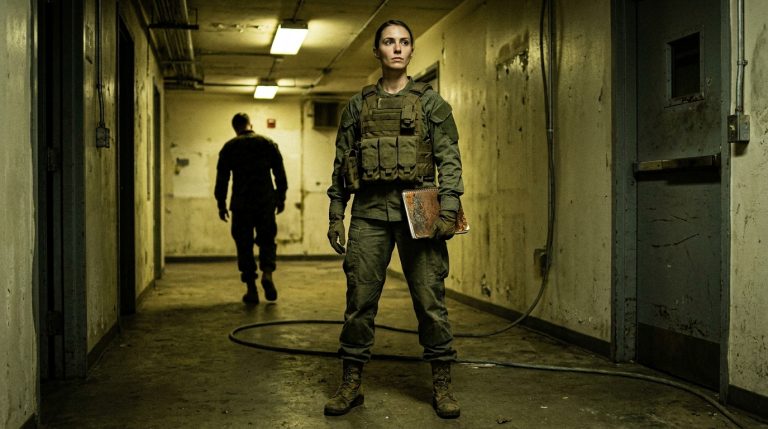
The corridor was long, narrow, and bathed in a sickly, flickering fluorescent light that cast distorted shadows across the linoleum. Every step she took felt like an intrusion upon a sacred, sterile silence. She wasn’t just in the barracks area; she was in the pulse of the facility.
She walked past rows of locker rooms that looked as if they hadn’t been touched in weeks. No personal items. No smell of worn athletic gear or sweat. Just the hollow, echoey silence of a place that had been scrubbed of humanity. This wasn’t a barracks for recruits; it was a storage locker for personnel who were currently being processed for something else.
At the end of the corridor, she saw a heavy, reinforced door with a glowing red keypad. A clipboard hung on the wall beside it, filled with daily status logs. She reached it, her hand trembling slightly as she grabbed the document.
Cohort 4-Beta: Finalization.
There were no graduation times. There were no parade assignments. There were only transfer coordinates to an off-site facility—a location she didn’t recognize, coded with a series of alphanumeric sequences that made no logical sense.
A sudden, sharp metallic click sounded from the far end of the hallway. Brenda whirled around. A light at the end of the corridor flickered and died, plunging the hallway into a gray, bruising twilight. She heard the soft, controlled slide of a door opening—not the one she was facing, but one further down.
She retreated into the shadows of a janitorial closet just as a figure walked into the corridor. It was Captain Hayes. He wasn’t wearing his hat, and his jacket was undone, revealing a sidearm that looked dangerously heavy against his hip. He was talking to someone on a radio, his voice a low, gravelly drone.
“The mother is still on-site,” Hayes said, his tone devoid of frustration—it was purely analytical. “Clear the north perimeter. Move the transport to the secondary extraction point. We can’t have any civilian interaction until the transfer is complete.”
Brenda’s breath stopped. The secondary extraction point. They were moving them now, while the ceremony was underway and the rest of the families were distracted by the pomp and circumstance of the parade deck.
She gripped the door frame of the closet, the metal biting into her palms. She needed to reach that transport. She needed to see who was inside those trucks. If she didn’t, the trail would go cold the moment they cleared the front gate. She watched Hayes stop at the red door, enter a code, and step inside, the heavy steel sealing shut behind him.
She waited for a count of ten, her mind racing through the logistics of the room. She was alone, trapped, and standing right at the edge of the truth she had been searching for. The shadow of the Captain’s authority was long, but as she looked at the keypad, she realized he had left one thing behind: a discarded access badge, dropped near the base of the door when he had reached for his sidearm.
It was a risk that defied every instinct she had, but as she looked at the badge, she knew she had no other choice. She stepped out of the shadows and toward the door, her path forward narrowing to a single, impossible point of entry.
CHAPTER 5: THE DECOY UNCOVERED
Brenda pressed the stolen badge against the reader. It chirped—a sharp, digital dissonance that felt like a scream in the quiet corridor. She held her breath, expecting the silence to be shattered by an alarm, but the heavy magnetic lock disengaged with a dull thud.
The door swung inward, revealing a small, sterile antechamber that smelled of ozone and clinical-grade disinfectant. It was a holding area, but not for prisoners. It was a digital archive. Rows of server towers lined the walls, their lights blinking in a rhythmic, pulse-like cadence that mirrored the heartbeat of the facility. At the far end of the room sat a terminal, its screen glowing with a soft, persistent blue light.
She moved toward it, her movements stiff, every muscle in her body wound tight like a coiled spring. She wasn’t just a mother anymore; she was an infiltrator, and the air around her felt heavy with the gravity of what she was about to find.
She bypassed the primary login, her fingers dancing over the keys with a frantic, practiced grace she didn’t know she possessed. She opened the directory marked Cohort 4-Beta. There it was—the file she had seen on the manifest, but now, it expanded into a sprawling, digital web.
Brenda’s eyes darted across the data. The “Medical Anomaly” flag wasn’t a biological sickness; it was a classification. The files indicated a series of neural-synchronization tests, psychological conditioning parameters, and—the final, devastating detail—a scheduled “Identity Erasure” protocol. The red line she had seen on the shipping manifest wasn’t a cancellation; it was the mark of a completed transition.
She felt the blood drain from her face. Adam wasn’t being treated for an illness; he was being wiped clean. The military wasn’t just recruiting him; they were replacing him with a ghost, a tactical asset stripped of his memories, his name, and his history. The decoy secret—the medical anomaly—collapsed, replaced by the crushing weight of the absolute truth.
A printer in the corner hummed to life, and a single sheet of paper began to emerge. Brenda didn’t reach for it. She stared at the screen, her reflection ghosting against the cold, blue light of the terminal. The irony was a jagged, piercing pain; she had come here to see her son graduate, and instead, she had found the blueprint for his non-existence.
Suddenly, the hum of the server room changed. The rhythmic blinking of the lights shifted, turning into a steady, flat-line red.
The door to the antechamber hissed open.
Brenda spun, her back hitting the cold edge of the terminal. Captain Hayes stood in the threshold. He wasn’t surprised. He wasn’t angry. He was calm, his hand resting on the sidearm at his hip, his eyes fixed on her with a detached, clinical observation.
“You were never meant to find the archive, Mrs. Lo,” Hayes said, his voice as flat and unyielding as the concrete walls of the barracks. “But you were always the most likely to look. That’s why you were flagged.”
Brenda’s heart hammered against her ribs, but she stood her ground, her fingers curling around the edge of the terminal. She was cornered, trapped in the very machine that was erasing her son.
“Where is he?” she demanded, her voice cutting through the clinical silence of the room.
Hayes stepped forward, the heavy boots echoing on the steel floor. “He is exactly where he needs to be. You came here looking for a boy who graduated today. You’re going to leave here realizing that the boy you came for never existed. The asset is already in transit. There is no version of this reality where you get to take him home.”
The arrogance of his tone—the cold, systemic certainty that they owned everything, including the people they took—ignited a fire in Brenda’s chest that burned away the fear. She didn’t look at his sidearm. She looked at the terminal, then at the fire-suppression lever on the wall behind him. She was outmatched, outgunned, and running out of time, but she was the only one in this room who knew the value of what was being erased.
“You think you’ve wiped him clean,” Brenda said, her voice dropping into a dangerous, steady calm. “But you forgot one thing, Captain. You can take his history, you can take his name, but you can’t take the fact that he exists. And as long as he exists, someone is going to be looking for him.”
Hayes’s eyes narrowed, a momentary flicker of something that might have been human frustration crossing his face. He moved to close the distance between them, but Brenda didn’t wait. She lunged, not for the door, but for the fire-suppression system. If she couldn’t take him back, she would burn their archives to the ground.
CHAPTER 6: THE BREACH
The fire suppression system didn’t just hiss; it erupted. A massive, pressurized plume of chemical foam blasted from the ceiling, instantly turning the sterile server room into a chaotic, white-out squall. The noise was deafening—a roar of rushing air and mechanical discharge that masked the sudden, frantic shout of Captain Hayes.
Brenda threw herself to the floor, her cheek pressed against the cold steel plating. She didn’t look up. She scrambled toward the server rack, her fingers finding the tangled mass of cables that fed the central processor. She wasn’t an engineer, but she knew the language of destruction; she tore at the main bus cables with a primal, desperate strength, ripping them from their sockets.
The terminal screen flickered, pulsed once with a strobing, sickly light, and then died.
The red emergency lights above began to spin. Through the thick, drifting foam, she saw Hayes stumbling forward, his weapon drawn but useless in the total chaos. He was shouting, but the sound was devoured by the roar of the suppression system. He was a man who relied on order, on the quiet, whispered certainty of his protocols—and here, in the middle of a foaming, electronic death, he was just another panicked animal.
Brenda didn’t try to fight him. She didn’t need to. She used the momentum of the chaos to roll toward the side service door, the one she had been tracking since the moment she realized this place was a tomb for identities.
She kicked the door open and tumbled into the back hallway, sliding across the slick, foam-covered floor until she hit the wall. The hallway was empty, but the sound of heavy, armored footsteps was approaching from the front entrance.
She forced herself up, her lungs burning with the chemical tang of the fire-suppression agent. She moved toward the back exit, the one leading to the loading dock where the transport vehicles were being staged. She didn’t have a plan beyond the next step. She didn’t have a weapon. She only had the searing, white-hot clarity that Adam was still here, and that the “erasure” hadn’t finished.
She burst through the loading dock doors, the cold, sharp air of the evening hitting her like a slap.
Two men in tactical gear were loading a series of dark, unmarked containers into the back of a van. And there, standing near the driver’s side, was a young man in a plain, gray recruit uniform. He wasn’t wearing a name tape. He was staring at the horizon, his expression terrifyingly vacant, as if he were looking at nothing at all.
Adam.
Brenda’s breath hitched, a sob catching in her throat, but she swallowed it down. She didn’t scream his name. She didn’t run to him. She waited until one of the guards turned away to check the manifest, then she moved—a shadow against the metallic bulk of the loading bay.
She stepped into the dim light of the van, her hand closing over the sleeve of Adam’s coat.
He didn’t react. He didn’t even turn his head. He was a shell, a hollowed-out version of the boy she had raised. The heartbreak of it was a physical weight, a crushing pressure in her chest, but she didn’t let it break her. She leaned in, her lips inches from his ear, and whispered, “The toy soldiers, Adam. You never lost a single one. Sort them by unit. Now.”
For a second, there was nothing. Then, a tiny, almost imperceptible tremor moved through his hand. His eyes, vacant and glassy, flickered. A single, jagged breath escaped his lips.
“Mom?” he breathed, the word barely audible, a fragile thread of reality stitching itself back into his mind.
“Get in,” she commanded, opening the rear door of an adjacent utility truck.
He moved, not with the mechanical precision of the asset they wanted him to be, but with the clumsy, honest desperation of a frightened boy.
Captain Hayes burst onto the loading dock, his uniform soaked in white foam, his face contorted in a mask of pure, unadulterated fury. He leveled his weapon at them, but it was too late. Brenda had already pulled the door shut and slammed the truck into gear.
She floored it. The engine roared, the tires spinning on the slick pavement before biting into the asphalt. She drove straight through the gate, the barrier arm snapping like a twig against the force of the truck. She didn’t look back at the base, at the flashing red lights, or at the figure of the Captain standing alone on the dock.
She drove until the base was a dark, distant smudge in the rearview mirror. She pulled over on a deserted stretch of road, the silence of the night rushing into the truck through the cracked window.
She turned in her seat. Adam was sitting there, his hands trembling violently, his eyes finally beginning to track the world around him. He looked at his own hands, then at her, his face pale, ghost-like in the moonlight.
“They… they said I didn’t exist,” he whispered, his voice cracking.
Brenda reached out, taking his hands in hers. She felt the cold, the tremors, the sheer, profound exhaustion of his ordeal. She didn’t offer him a grand explanation. She didn’t try to fix the world. She just held him, her thumbs tracing the knuckles she had known since he was a child.
She reached into her pocket and pulled out the small, silver pin she had carried—the one that had been her anchor throughout the day. She pressed it into his palm, closing his fingers over it. It was a small, physical thing—something solid, something real.
“You’re here,” she said, her voice steady, finally, completely at peace. “And that is the only truth that matters.”
They sat there for a long time, the engine ticking as it cooled, the world outside settling into the quiet, cool stillness of the late night. They weren’t back to who they were before, and the road ahead would be long and marked by the scars of what had been taken, but for the first time in what felt like a lifetime, the air felt clean.