A Frayed Ribbon’s Resonance: How One Small Act of Defiance Rewove the Fabric of a Forgotten Life
CHAPTER 1: THE STALE AIR OF INDIFFERENCE
The pawn shop was a graveyard for intentions. Rows of dusty synthesizers, uncased guitars with rusted strings, and stacks of unloved electronics sat on shelves like headstones. Maya traced the condensation ring on her soda again. It was the most honest thing in the store—a temporary, fading mark of something that had once been cold and was now succumbing to the room’s ambient stagnation.
Then, the shift happened.
It wasn’t a sound. It was a pressure change, a subtle tightening of the shop’s air as if someone had just entered carrying a vacuum. She looked up.
An old man stood at the counter. He was an architectural paradox: a frame so thin it seemed held together by sheer stubbornness and a tweed coat that hung from his shoulders like a discarded skin. His back was a rigid, vertical line, an unspoken defiance against the gravity that clearly wanted to pull him to the floor.
He didn’t move. He didn’t speak. He simply placed a small velvet box on the counter. The movement was agonizingly slow, calculated. His fingers, gnarled like the roots of an ancient oak, remained on the lid, trembling with a high-frequency jitter that threatened to rattle the glass.
“I have these,” he whispered.
The voice was dry, a sound like autumn leaves skittering across pavement. Maya reached out, her fingers brushing the velvet. It was worn bald at the corners, the fabric thinned by years of nervous, repetitive touching. She lifted the lid.
Inside, nestled in satin that had long ago lost its luster, were the medals. A Bronze Star. A Purple Heart. A Distinguished Service Cross. The silver of the cross caught the dim, amber light of the shop, reflecting a dull, cold intensity. The ribbons were fraying at the edges, threads coming loose like the unraveling hem of a life.
Maya picked up the Purple Heart. It felt heavier than it should have, a dense, metallic concentration of sacrifice. She turned it over, the name Arthur Pendleton engraved on the back with sharp, clinical precision.
She could feel the hum of them—a low-frequency vibration of mud, cold, and a kind of courage that made the air in the shop feel suddenly claustrophobic. Mr. Henderson would see the silver content. He would see the collector’s premium. He would see a transaction that could be flipped for a thirty-percent margin.
Maya looked at Arthur. He wasn’t looking at her. His pale, watery eyes were fixed on the barred window, watching the gray, indifferent street outside. A muscle in his jaw twitched, a rhythmic, frantic pulse under the parchment-thin skin.
“What were you hoping to get for these?” Maya asked. Her voice was too steady, a thin veneer over the sudden, sharp ache in her chest.
He didn’t blink. He didn’t look at the money register. He looked at the emptiness of the street. “Enough,” he whispered. He paused, his throat working hard against a dryness that wasn’t just physical. “Enough for the week’s groceries.”
The word hung in the air: Groceries.
Maya looked at his shoes—polished to a mirror shine, though the leather was cracked and thin—and then back at the medals. She realized then that he wasn’t here to trade his past for luxury. He was here to trade his existence for sustenance. As she reached for her computer to start the standard, soul-crushing inventory, her gaze flickered to the security camera, then back to the man. She saw his hand slide deeper into his coat pocket, clutching something—not a weapon, but a small, crumpled piece of paper that looked like a final warning from a landlord, or perhaps a bill that outweighed his very life.
CHAPTER 2: THE DIGITAL ECHO
The office was a claustrophobic box, barely four paces across, smelling of stale coffee and the ozone of aging computer equipment. Maya stood frozen, the velvet box in one hand and her phone in the other, the screen’s light casting a pale, sickly blue glow over her skin. Beyond the thin plywood door, the shop felt impossibly far away, yet every creak of the floorboards under Arthur’s shuffling feet echoed like a thunderclap in her skull.
She should have put the phone down. She should have gone back out there, performed the performative dance of appraisal, and offered him the pittance policy mandated. But her thumb hovered over the screen, trembling. The image of the medals—the Distinguished Service Cross, the Purple Heart, the bronze star—looked stark and alien against the scarred laminate of the desk. They were objects of immense history reduced to digital pixels.
She typed. Her fingers moved with a frantic, stuttering rhythm, the keys clicking too loudly in the quiet. A 92-year-old veteran named Arthur Pendleton is at Henderson’s Pawn on Elm Street. He’s selling his Distinguished Service Cross, his Purple Heart, and his bronze star to buy groceries. This is not okay. I’m stalling him for as long as I can. I don’t know what to do.
She hit Post.
The notification sound, a soft, chime-like ping, seemed to shatter the stillness of the room. She felt a sudden, sharp nausea. It was the feeling of a jumper finally leaving the ledge—that moment when gravity is no longer a choice but a consequence. She peeked through the narrow, grime-streaked window of the office door.
Arthur was still seated in the rickety plastic chair. He looked smaller now, a frail geometry of angles against the dark, clutter-filled backdrop of the shop. He wasn’t moving. He was staring at his own hands, his fingers rhythmically curling and uncurling, tracing the phantom weight of medals that were currently sitting on Maya’s desk.
A memory ghosted through Maya’s mind—her own mother, years ago, sitting at a kitchen table with a stack of bills that seemed to grow like mold. She remembered the specific way her mother’s shoulders had slumped, not from age, but from the relentless, grinding pressure of simply existing in a world that didn’t care for the fragile. She saw that same slope in Arthur’s posture now. It was a silhouette of quiet, systemic abandonment.
Her phone buzzed. Once. Then again.
The first ping was a like. Then a comment. “Where is this shop? I’m ten minutes away.”
Then another. “This is a disgrace. People like this shouldn’t have to choose between history and a meal.”
The notifications began to cascade, a digital waterfall of indignation. Maya’s breath hitched. She watched the counter climb: 50, 100, 200. The screen became a strobe light of human reaction. It wasn’t just sympathy; it was a sudden, violent reclamation of empathy. People who had been drifting through their own lives, shielded by their own trivial concerns, were being forced to look at Arthur through her lens.
She leaned against the wall, her heart hammering against her ribs with such force she could feel it in her teeth. This was the point of no return. If Henderson walked through the door now—if he saw her using the shop’s time to stir up a digital riot—she would be gone. But the fear was being outpaced by something else, a terrifying, exhilarating clarity.
The shop floor remained silent, save for the hum of the old fluorescent lights. Arthur remained in his corner, a relic of a time that valued sacrifice, currently waiting in a place that only valued silver content. He looked up, his pale, watery eyes drifting toward the office door.
Maya ducked, pressing her back against the cool, painted cinderblock of the wall. Her face was flushed, her skin burning. She was no longer just an employee of Henderson’s Pawn. She was a conduit. She was the one who had finally pulled the thread that might unravel the entire, ugly sweater of their community’s indifference.
Outside, the first real-world sound cut through the store’s static—a car door slamming shut, followed by the rapid, purposeful clicking of footsteps on the pavement outside. It wasn’t Henderson’s heavy, dragging gait. It was faster. Sharper.
Someone was already here.
Maya looked down at the phone. The post had been shared three hundred times in the last four minutes. She realized then that she hadn’t just posted a plea; she had ignited a beacon. The shop felt as if it were vibrating, the floorboards beginning to resonate with the approach of people who had been waiting for an excuse to care.
She took a long, steadying breath, the air in the office tasting of dust and cold, damp concrete. She had to go back out there. She had to keep playing the part of the clerk, the faceless agent of the machine, while the world outside began to wake up. The duality of it—the lie she was living versus the truth she had unleashed—felt like a physical weight pressing against her lungs.
She shoved the phone into her pocket, the screen still flickering with incoming notifications, and gripped the handle of the door. The brass felt freezing beneath her damp palm. She couldn’t see the future, but for the first time in her life, the path ahead wasn’t a gray blur of minimum-wage routine. It was a sharp, jagged edge.
She opened the door. The chime above the main entrance—the one that had announced Arthur’s arrival—rang out again, a thin, frantic sound. Another customer was coming in. The ripple was beginning.
CHAPTER 3: THE ROAR OF THE UNLIKELY
The shop door swung wide, admitting not a single customer, but a change in the weather. The air that rushed in was thick with the scent of hot engine oil, cured leather, and ozone. Maya gripped the counter, her knuckles turning bone-white as the small, dusty space was instantly colonized.
One by one, the motorcycles pulled up to the curb. They weren’t just vehicles; they were statements of heavy, idling power. The roar of the engines was a syncopated, rhythmic thud that vibrated through the floorboards and settled into the marrow of Maya’s bones. Through the grimy front window, she watched the street transform. Black leather, chrome, and deep-throated mechanical growls filled the narrow space between the storefronts, creating a blockade of steel that effectively severed the shop from the rest of the world.
Arthur, standing near the plastic chair, looked at the door with a confusion that bordered on alarm. His frame, usually so carefully composed, seemed to shrink. He looked for an exit, but the shop was now a cage of chrome.
“Maya,” he whispered, his voice cracking. “Who are these people?”
“I… I don’t know,” Maya lied, though her heart was already beginning to race with a frantic, pulsing rhythm. She knew exactly what she had done, even if she hadn’t anticipated the sheer, overwhelming scale of the response. The digital echo had found physical form.
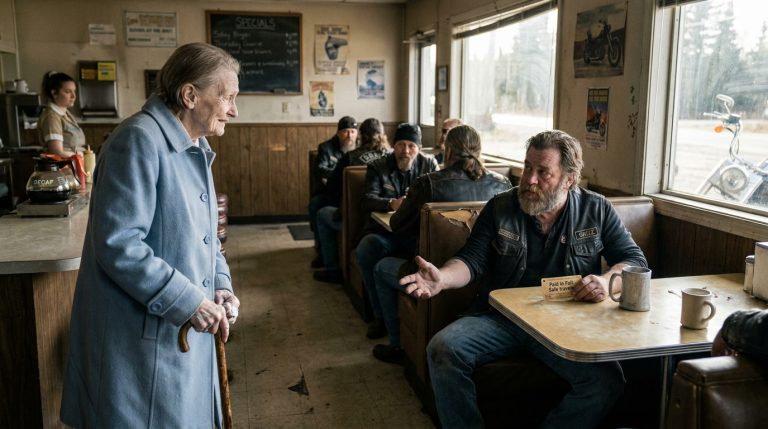
The door chimes danced again, a frail sound against the heavy silence that followed the killing of the engines outside. A man stepped into the shop. He was a mountain of a presence, a figure whose breadth seemed to force the very air to move around him. His leather cut was weathered, the patches on the back—a grim, stylized death’s head—seeming to absorb the dim light of the shop. On his chest, a smaller, hand-stitched patch read Sarge.
Two more men, built with the same solid, immovable architecture, flanked him, stationing themselves by the entrance like guardians of a temple. They didn’t look at the merchandise. They didn’t look at the displays of cheap watches or the racks of neglected cameras. They looked at Arthur.
Sarge’s gaze swept the room with the clinical precision of a man used to assessing terrain. When his eyes finally landed on the old veteran, the hardened expression softened, just for a fraction of a second, into something that looked suspiciously like reverence.
Maya felt the weight of her post on the desk behind her. She had uploaded a plea for groceries, but the community had sent an army. The air in the shop grew uncomfortably warm. The sheer number of men and women waiting outside, visible as silhouettes against the barred windows, created a pressure that made the skin on the back of Maya’s neck prickle.
“Arthur Pendleton?” Sarge’s voice was a low, resonant rumble. It wasn’t loud, but it possessed a gravity that demanded absolute attention.
Arthur swallowed hard, his posture reclaiming that stubborn, iron-rod rigidity. “That’s me.”
Sarge didn’t move forward immediately. He stood at the center of the room, letting the silence hang. The shop, which had been a place of quiet, stale disappointment only moments ago, was now humming with an electric, dangerous vitality.
“We saw the post,” Sarge said, his eyes flicking briefly toward Maya. He recognized the look in her eyes—the same frantic, desperate energy that had driven her to hit ‘share’. He gave her a single, sharp nod, a silent acknowledgement of the bridge she had built.
Maya felt a sudden surge of dizziness. She had wanted to help, to find a way to secure Arthur’s groceries, but this wasn’t charity—it was a deployment. She realized then that the decoy secret, the simple need for food, was being rapidly overshadowed by the presence of these men. They weren’t just here to buy groceries. They were here for something else, something hidden behind the medals in the velvet box.
Arthur’s hands trembled again, but this time, it wasn’t just age; it was the sheer, overwhelming impact of being seen. He had prepared to disappear, to trade his history for a few weeks of sustenance and then fade into the background of a forgotten life. He hadn’t planned on being hunted down by a legion of guardians.
“Mr. Pendleton,” Sarge continued, taking a slow, measured step forward. “My name is Sarge. And we’d like to have a word about those medals.”
Maya’s hand hovered over the counter. She felt the heavy, metallic weight of the Purple Heart in its velvet nest nearby. The secret was no longer hers to guard. The shop was crowded with the scent of exhaust and the heavy, undeniable presence of men who dealt in codes of conduct she was only just beginning to comprehend. She was no longer the clerk; she was the witness to a collision between two worlds—the world of bureaucratic apathy that had pushed Arthur to the edge, and the world of brotherhood that was now crowding into the pawn shop to pull him back.
The shop door remained open, a sliver of the gray, indifferent street visible behind the wall of leather-clad men. Maya took a breath, the air tasting of oil and grit, and looked at Arthur. His face was a mask of shock, but underneath, in the depths of those pale, watery eyes, the flicker of a forgotten pride was beginning to burn, brighter and hotter than it had in decades.
CHAPTER 4: THE BRIDGE OF IRON
The pawn shop had become a vacuum, drawing all movement toward the counter. Outside, the idling engines of a hundred motorcycles created a low-frequency hum that vibrated the display glass until it rattled in its frame. Inside, the three men—Sarge and his two guardians—stood like monoliths of scarred leather and resolve.
Sarge’s hand, vast and mapped with faint white lines of old injuries, remained on the counter. He wasn’t reaching for the velvet box. He was waiting. His eyes, clear and unnervingly perceptive, didn’t shift away from Arthur. He was giving the old man the one thing the world outside had denied him: time to formulate a reply that didn’t have to be a surrender.
Arthur stood straighter. The tremor in his hands, so constant and thin, seemed to dampen. He looked at the velvet box, his eyes tracing the fraying edges of the material. “You want to buy them,” he repeated, his voice brittle, a dry rustle of sound. “You’ve seen the post. You’ve seen the state of my… situation.”
“We’ve seen what we needed to see, Arthur,” Sarge replied, his voice devoid of pity. That was the most important thing—there was no condescension in his tone, no saccharine sweetness. He spoke to Arthur as a contemporary, an equal. “But the medals aren’t for rent. And they aren’t for groceries.”
Maya watched, her breath hitched in her throat. She looked at the velvet box. She had spent the last twenty minutes assuming this was a simple transaction of honor—a rescue mission for a man who had hit his breaking point. But as Sarge leaned in, his shadow eclipsing the display case, she realized the dynamic had shifted. The bikers weren’t acting out of a vague, communal guilt; they were acting out of a specific, shared understanding of what those medals actually cost.
Arthur’s gaze flickered to her, then back to the leather-clad giant. “I have… obligations,” Arthur said, the word emerging like a stone pushed uphill. “Medical. They don’t offer payment plans for dignity, Mr. Sarge.”
Sarge let out a short, sharp huff of air that might have been a laugh if there was any humor in the situation. “I know. My brother had a debt with the VA that outlived his service by ten years. They don’t care about the ribbon on your chest when the invoice lands on your table.”
The admission hung in the air, sudden and sharp. It stripped away the last layer of performative distance between them. Arthur shifted, his fingers brushing the edge of the velvet box. He was calculating, Maya realized. He was weighing his pride against the reality of the paper in his pocket—the final notice he had been clutching in the office.
“I didn’t ask for a crusade,” Arthur murmured, his eyes dampening with a sudden, sharp clarity. “I just wanted to make it through the week.”
“Nobody asks for a crusade, Arthur,” Sarge said softly. He reached into his vest, pulling out a heavy, braided leather strap. He didn’t offer money yet. He offered his presence, a tangible anchor in the middle of a shop that felt like it was spinning off its axis. “But when you’ve got armor that’s been in the dirt, you don’t trade it to the first person who offers you pennies on the dollar. You hold onto it. You let your brothers help you carry it.”
Arthur looked at Maya, then at the box. He hesitated, his knuckles white as he tightened his grip on the lid. The shop, despite the noise outside, felt suddenly quiet, concentrated into the few feet of space separating these two men—the soldier who had fought in Normandy and the biker who had fought in the Gulf. They were speaking a dialect of duty that Maya could only witness, not translate.
“If I accept this,” Arthur said, his voice stronger now, more deliberate, “I am not selling them.”
“We wouldn’t dream of taking them, sir,” the biker on the left said, his voice a gravelly monotone. “We’re just here to ensure they stay where they belong.”
Arthur looked down at the medals. He didn’t open the box, but he touched the lid with a tenderness that was almost painful to watch. The secret—the specific, gnawing debt that had driven him to the brink—was still locked away, yet the tension in his shoulders had begun to fray, unraveling into something softer, something exhausted.
Maya stood back, a silent observer in her own place of work. She felt the shop shifting under her feet. Mr. Henderson was going to return from lunch soon. He was going to find his store occupied, his inventory ignored, and his clerk standing in the middle of a gathering that defied every rule of retail. The fear of that looming confrontation flickered in her mind, a cold, sharp point of anxiety, but it was quickly swamped by the sheer weight of the moment.
Arthur’s hands stopped trembling. He took a long, steady breath, the first one that looked like it actually reached the bottom of his lungs. He didn’t look like a man who had been saved; he looked like a man who was beginning to understand that he wasn’t going to be allowed to vanish just yet.
“Then let’s talk,” Arthur whispered, a new, jagged edge of resolve in his voice. “But you’ll have to tell me how you knew it was worth saving.”
Sarge leaned back, his expression a mixture of profound respect and grim realization. The negotiation was no longer about a grocery bill; it was about the survival of a history that Arthur had been trying, and failing, to discard. The atmosphere in the shop shifted, turning from a rescue to a reckoning.
CHAPTER 5: THE ARCHITECTURE OF CARE
The bungalow looked less like a home and more like a patient on an operating table. The air was a thick, hazy suspension of pulverized wood, ancient insulation, and the sharp, chemical tang of fresh primer. Maya stood on the front porch—now reinforced and solid beneath her boots—and watched as the bikers swarmed the house. They were everywhere: on the roof, under the floorboards, inside the kitchen. It was an orchestrated chaos, a hive of leather and steel-toed boots working with a speed that felt predatory.
Sarge was in the kitchen, his massive frame hunched over a sink that was currently being ripped from the plumbing. He was sweating, a bead of moisture tracing the path of a scar along his temple. He looked up as Maya entered, his eyes squinting against the dust.
“This house is held together by spite and termites,” he remarked, gesturing to a wall where the drywall had been peeled away to reveal rotting studs. “Whoever built this didn’t intend for it to last through the decade, let alone for someone like Arthur to grow old in it.”
Maya didn’t answer. She was looking at the stack of bills she had pulled from Arthur’s kitchen drawer earlier—a mess of final notices, overdue medical invoices, and a foreclosure warning that looked like a death warrant. The “debt” was more than just a grocery budget. It was a cavernous, dark hole of thousands of dollars, a mountain of paper that Arthur had been trying to climb with nothing but a cane and his fading pride. The decoy secret of the “grocery money” felt incredibly fragile now, a thin piece of gauze placed over a gaping, infected wound.
She felt a vibration in her pocket. Her phone was buzzing again. The story had gone beyond the local community; it was national now. The influx of donations was staggering, a digital landslide of support that was growing so fast it was becoming a logistical nightmare. She was no longer just managing a shop; she was managing a relief fund. The responsibility felt heavy, a cold weight in her stomach.
She walked deeper into the kitchen. The sound of the plumbing being rebuilt was a jarring, discordant symphony of wrenches and swearing. One of the bikers, a man with a tattoo of a faucet on his forearm, stood knee-deep in the cabinet, his hands covered in sludge.
“The pipes are shot,” he muttered to Maya, not looking up. “I can patch it, but this whole system needs to be replaced. If we don’t, the first frost is going to turn this place into a fountain.”
Maya nodded, her mind racing. “How much for a full repipe?”
The plumber looked at her, his expression a mixture of grim amusement and pity. “More than a few Sunday roasts, kid. We’re talking professional, industrial-grade plumbing. It’s not just a fix; it’s an overhaul.”
Maya leaned against the doorframe, her vision blurring at the edges. The scale of the “Simple Repair” had been a delusion. The more they stripped back, the more they found the decay beneath—the rot in the joists, the faulty wiring that sparked whenever the overhead light was flipped on, the pervasive, quiet failure of a structure that was slowly collapsing inward.
She stepped out onto the porch again, needing the air. Arthur was sitting in the corner, wrapped in a thick wool blanket, watching the chaos with an expression of profound, almost painful disbelief. He looked smaller, frail.
“They’re tearing it apart, Maya,” he said, his voice barely a whisper above the whine of a circular saw. “They’re tearing it all apart.”
“They’re fixing it, Arthur,” Maya said, though the words sounded thin, insufficient.
“Are they?” Arthur’s eyes flickered to the wall where Sarge was currently hammering a brace into place. “Or are they just revealing how much of it was already gone?”
Maya felt a chill, despite the heat of the afternoon. Arthur’s words hit her with the force of a physical blow. She had wanted to save him, to give him a warm room and a full pantry, but she was realizing that she was dealing with a structural collapse that went far beyond the wood and nails. He was a man who had been defined by his survival, and now that his environment was being forcibly “repaired,” the very foundations of his identity were being exposed to the harsh, bright light of scrutiny.
The phone in her pocket buzzed again, a frantic, persistent rhythm. She didn’t look at it. She watched the dust motes dancing in the shaft of light cutting through the open door, a golden, swirling haze that obscured the true extent of the damage. They were moving too fast. They were trying to fix a lifetime of decay in a weekend, and the house—and perhaps the man—was beginning to fight back. The friction of the repair was palpable, a tension that hummed in the air, waiting for the moment when the structure would either hold or finally, inevitably, give way.
CHAPTER 6: THE HIDDEN LEDGER
The silence was heavier than the noise. After the frantic, industrial roar of the last forty-eight hours, the stillness in the bungalow felt like a physical weight, pressing against Maya’s eardrums. The repair crew had cleared out for the evening, leaving behind the skeletal remains of a house mid-metamorphosis: exposed wiring like raw nerves, patches of new, stark-white drywall, and the pervasive, lingering scent of sawdust.
Arthur was resting in the neighbor’s guest house, but Maya remained. She felt a phantom tug to finish the administrative work—to sort through the remaining stack of papers that had been discarded in the kitchen’s chaotic gutting.
She walked toward the small, cramped study at the back of the bungalow. It was a space the crew hadn’t touched, a small island of stagnation in a sea of renovation. The air here was different—stagnant, smelling of dust and dried-out ink. On the desk lay a leather-bound folder, hidden beneath a pile of outdated appliance manuals.
Maya’s fingers brushed the leather; it felt like skin, worn smooth by years of anxious handling. She opened it. It wasn’t a budget book. It was a ledger of disappearances.
Inside were handwritten lists, neatly categorized by value, date, and “Return Probability.” She scanned the entries, her heart rate spiking. These weren’t household expenses. They were items Arthur had sold over the last decade. A vintage watch. A silver tea set. A set of gold cufflinks. Each entry was marked with a brief, clinical note: Debt: Hospital 2018, Debt: Tax Lien 2020, Debt: Medication 2022.
The decoy secret—the simple need for groceries—dissolved in her hands. This wasn’t just a man who had hit a temporary snag; this was a man who had been meticulously, systematically selling his own life, piece by piece, to keep the creditors at bay. He hadn’t been failing to survive; he had been paying off a debt that was, by all accounts, infinite.
She flipped to the back of the folder. There, nestled in a pocket on the inside cover, was a single, folded sheet of paper. It wasn’t a receipt or a notice. It was a letter, addressed to no one, written in Arthur’s precise, shaky script.
“When the silver is gone, the anchor lifts. I am tired of holding on. The mission is long since over.”
Maya felt the floor tilt beneath her. The “intent to vanish”—the underlying, dark current that had been pushing Arthur toward the pawn shop—was laid bare in five sentences. He hadn’t been hoping for a miracle. He had been looking for a way to finish his final objective: the liquidation of his own existence.
She looked up, her gaze drifting toward the window. The setting sun cast long, bruised-purple shadows across the lawn. The repairs outside—the new porch, the fresh shingles—suddenly looked like a cruel, unintentional irony. They were trying to build a fortress for a man who had already decided to walk out the front door and never come back.
She heard a floorboard creak in the hallway.
Maya dropped the ledger, the sound of it hitting the desk echoing like a gunshot. She spun around. Arthur stood in the doorway, his silhouette framed by the dying light of the hallway. He wasn’t wearing his tweed coat. He looked smaller, thinner, his shoulders slumped in a way that suggested the heavy weight of the “anchor” had finally started to pull him under.
He didn’t look angry. He looked relieved, as if the secret he had been protecting with such desperate, frail claws had finally been wrestled from his grip.
“You weren’t supposed to find that, young lady,” he said, his voice quiet, lacking the brittle edge of his usual pride. He stepped into the room, his movements slow, deliberate. “It was the only part of the house I didn’t want the hammers to find.”
Maya couldn’t speak. She held the letter in her hand, the paper feeling like it was burning her skin. The “repaired” house felt like a lie. The “community” felt like a beautiful, well-intentioned distraction from the reality of a man who was already mourning his own ghost.
“The medals,” Arthur continued, his eyes tracing the spine of the ledger on the desk. “They were the last of the inventory. Once they were gone, there was nothing left to sell, and no reason to keep the books.”
He reached out, his hand finally steady, and took the letter from her. He didn’t crumble it. He smoothed the creases, his expression vacant, resigned. He stood with the uncomplaining stillness of a man who had finally realized that the rescue mission he never asked for was going to make his chosen exit infinitely more complicated.
Maya realized then that the conflict had changed. The external pressure—the bills, the rot, the foreclosure—was secondary. The real, grinding, inevitable struggle was Arthur’s own internal architecture. And she had, with the best of intentions, become the one who had accidentally brought the ceiling down on top of him.
CHAPTER 7: THE PASSING OF THE GUARD
The sky didn’t just turn gray; it bruised, a deep, sickly violet that drained the light from the bungalow’s unfinished living room. Sarge dropped the power drill he was holding, the metallic clatter sounding like a strike against a bell. He looked at the window, where the first heavy, fat drops of rain began to smear the glass.
“Storm’s coming in,” he said, his voice clipped. “We’re shutting down for the night.”
Maya stood in the study doorway, the ledger still gripped in her hands, her knuckles white. She looked at Arthur, who was staring out at the darkening lawn, his face a landscape of exhausted resignation. The room felt smaller than it had ten minutes ago. The presence of the bikers—usually a source of protective strength—suddenly felt stifling. They were massive men standing in a space that Arthur was trying to turn into a tomb.
“We aren’t leaving you alone,” Sarge said, catching the look on Maya’s face. He walked toward her, his movements heavy and deliberate. He didn’t look at the ledger; he didn’t need to. He could read the change in the atmosphere. The “repair” had reached a dead end, and now, they were face-to-face with the rot they couldn’t patch with wood and nails.
“He doesn’t want the house fixed, Sarge,” Maya whispered, her voice tight. “He wants to be finished. He’s been selling his life off, year by year, to pay for a debt that was never meant to be settled.”
Sarge stopped in front of her. The thunder rolled overhead, a low, guttural vibration that shook the windows in their frames. He turned to look at Arthur. The old veteran hadn’t moved. He was still watching the rain, his hands resting on his knees.
“Arthur,” Sarge said, his tone devoid of the formal respect he’d used before. It was raw, honest. “I know about the books. I’ve seen men carry ledgers like that before. You think you’re settling your account by clearing your desk, but all you’re doing is leaving the rest of us with the bill.”
Arthur turned his head. His eyes were not watery now; they were dry, piercing, and terrifyingly lucid. “The bill is mine to pay. I’ve lived past the expiration date, Sarge. You’re trying to build a shelter for a man who is already halfway out the door. You’re wasting your lumber.”
The tension in the room snapped. One of the younger bikers, who had been painting the baseboards, set his brush down with a jarring thud. He walked toward the center of the room, his jaw set. “We aren’t wasting anything, sir. We’re here because we don’t have anywhere else to be. You think you’re the only one who feels like the mission was finished a long time ago? We’re all just looking for a reason to stay in formation for one more shift.”
The room went silent. The rain began to lash against the siding, a frantic, rhythmic tapping that sounded like fingers drumming on a coffin. Maya felt a shiver run down her spine. The “Intent to Vanish” wasn’t a secret anymore; it was a contagion. It was the common language of these men—the veterans, the outcasts, the people who had survived their own wars only to find that the world didn’t know what to do with them afterward.
Sarge took the ledger from Maya’s hands. He didn’t read it. He simply set it on the workbench, the sound of the leather hitting the wood final and heavy. “We aren’t leaving, Arthur. And tomorrow, we’re finishing the roof. Not because it’s a good house, but because it’s a place where we’re going to sit and have coffee until you decide that the mission has changed.”
Arthur looked at the men surrounding him—the bikers, the laborers, the girl who had started it all with a single, desperate post. He looked at the half-finished walls, the exposed wires, the scattered tools. He looked like a man being besieged by a kindness he didn’t know how to combat.
“You’re stubborn,” Arthur murmured, a tiny, ghost-like smile touching his lips.
“It’s a requirement for the club,” Sarge replied, gesturing to the others.
Maya moved to the window, watching the rain wash the dust of the last few days from the siding. The storm was violent, a cleansing, chaotic force, but inside, the house held. The foundation, for all its rot, was standing. The “Passing of the Guard” was happening in real-time—not a formal handover, but a grueling, stubborn refusal to let the line break. She knew that tomorrow would bring the final confrontation, the moment when the reality of the ultimate truth would have to be integrated into the lives they were so desperately trying to stitch together. But for tonight, the house remained, a fortress of frayed, rusted, and stubborn human connections.
CHAPTER 8: THE FINAL SALUTE
The morning air was rinsed clean, smelling of wet cedar and the sweet, loamy dampness of the lawn. Maya stepped out onto the new porch, the wood solid and reassuring under her boots. It was a perfect, silent dawn. The bungalow, once a monument to neglect, now stood straight, its shingles tight, its paint smooth, a stubborn defiance against the rot that had nearly claimed it.
Arthur was already there. He was sitting in a deck chair, his hands resting on his knees. He wasn’t wearing his tweed coat; he was in a simple, heavy sweater that Sarge had brought him, his name embroidered over the heart. He looked, for the first time, like he belonged to the space he was occupying.
Sarge emerged from the side of the house, his boots muddy, his face etched with the exhaustion of a three-day battle with physics and decay. He stopped beside Arthur and didn’t speak; he simply leaned against the railing, watching the sun crest the horizon.
“I went through the ledgers again,” Arthur said, his voice steady. The tremor was gone. “I spent ten years trying to calculate the cost of my own existence. I thought if I sold everything—every memento, every scrap of silver, every medal—I could reach a zero balance. I could close the account and leave no debris for anyone else to sweep up.”
Sarge looked at him. “You forgot one thing, Arthur.”
“What’s that?”
“The value of the assets didn’t change because you put them in a pawn shop. You’re the asset. You always were.”
Arthur’s gaze drifted to the velvet box, which sat on the small side table between them. He reached out and opened it, the silver of the Distinguished Service Cross catching the morning light. It wasn’t a burden anymore. It was just metal—heavy, cold, and quiet. “The debt was never about the medical bills, was it?” Arthur asked, his voice barely a whisper. “The debt was the shame of being alive when so many others weren’t. I thought if I could just pay the world back for the oxygen I was taking, I could earn the right to leave.”
Maya leaned against the doorframe, listening. The truth of Layer 2 hung in the air—the realization that his entire “debt” had been an elaborate psychological construct, a self-imposed prison designed to facilitate his own vanishing. He hadn’t been fighting bankruptcy; he had been fighting the guilt of survival.
Sarge placed a heavy, steady hand on Arthur’s shoulder. “That’s a debt we’ve all got, Arthur. We spend our whole lives trying to pay it off, but we never will. The point isn’t to reach zero. The point is to keep the account open.”
The Payoff arrived then, not with a flourish, but in the arrival of the bikes. One by one, the street began to rumble. It wasn’t the menacing, industrial roar of the first night; it was a rhythmic, collective salute. Men and women on motorcycles began to line the curb, a hundred of them, pulling up in silence. They didn’t rev their engines. They stood by their bikes, their leather cuts catching the sun. It was an army of outcasts, a phalanx of steel and skin, all there for one man.
Arthur stood up. He didn’t use his cane. He walked to the edge of the porch, his back straight—not the forced, rigid posture of his earlier defiance, but something more natural, more earned. He looked at the line of bikes, at the men and women who had spent their weekend rebuilding his life, and he saw the Poetic Justice of it: he had tried to dismantle his own world to pay for his survival, only to have that same world rebuild him in the image of what he had fought for.
He took the velvet box, removed the medals, and pinned them to his sweater. He did it slowly, his fingers precise and steady.
“They asked me to lead the ride today,” Arthur said, turning back to Maya and Sarge. “They say the club is going to have a meeting here every Saturday. I suppose I’ll have to make enough coffee.”
The Denouement settled in, a deep, atmospheric peace that felt like the closing of a long, arduous chapter. The air was quiet, save for the soft clicking of the motorcycles cooling down. Maya walked over to the side table and picked up a small, broken pocket watch she had found in the study’s desk—the one she had been planning to fix. She handed it to him.
“I couldn’t get it running yet,” she said. “But I think we have time.”
Arthur took the watch. He didn’t look at the face; he just held it in his palm, feeling the weight. “Time,” he repeated, looking out at the house, the street, and the men waiting for him. “I think I’d like that.”
He walked down the porch steps, his gait even. As he reached the sidewalk, he paused, turning back one last time to look at the bungalow. It was sturdy, painted, and warm. He touched the siding, a soft, deliberate gesture of connection, before turning to walk toward the lead motorcycle. The character arc was resolved; the man who had wanted to be a ghost had chosen, instead, to be a presence. There was no grand speech, no sudden explosion of victory—only the quiet, relentless motion of a man deciding to live, one day at a time, within the home he had finally agreed to inhabit.