
The Ambassador of Arrogance Learns a Lesson in Grace From a Quiet Woman Holding a Silver Tray
CHAPTER 1: THE CRYSTAL HALL
The crystal chandeliers cast a golden glow over tables covered in crisp white linen. Eduard Valenar adjusted his tailored Brione suit jacket and raised his glass of French champagne with the absolute ease of a man who had never once doubted his own worth. Around him, the grand hall of the Boa Vista Palace hummed with the rich, heavy scent of fresh white flowers and expensive wines.
Outside, São Paulo pulsed with loud, restless energy. Inside, the room obeyed an entirely different set of rules—one built on old money, inherited status, and unspoken hierarchies. Eduard looked down the long table at the silver tray passing by, his cold blue eyes cataloging the woman holding it with swift dismissal.
Conceição Ferreira das Neves walked with slow, measured steps, her dark brown eyes absorbing every detail of the room with quiet composure. Her white apron was pressed with careful precision, and her worn black leather shoes bore the marks of thousands of miles walked with purpose. When she stepped closer to clear away empty glasses, Eduard blocked her path with a casual slide of his chair.
He turned to his companions, offering a careless smile designed for effortless superiority. He spoke in French, loud enough to carry across the neighboring tables.
“Look at this old maid,” Eduard murmured, his voice dripping with casual condescension. “She looks like my grandmother, but less distinguished.”
The table responded with a ripple of muffled laughter and raised glasses. Conceição did not blink, nor did her posture shift by a single millimeter. She simply reached for the tray, her hands remaining completely steady as she prepared to answer.
CHAPTER 2: THE PERFECT FRENCH
“Mon cher Édouard, je comprends le français depuis que j’avais 6 ans.”
The words did not carry anger. They carried the heavy, unshakeable weight of a classroom ledger shut with quiet finality.
Eduard’s mouth stayed open for a fraction of a second too long. His silver-styled hair, maintained with such surgical precision, suddenly felt too tight against his scalp.
“I have spoken it since your father gave me a copy of Molière during a diplomatic visit in 1978,” Conceição continued, her voice steady and clear. “He was much more educated than you are.”
Bernard, sitting to Eduard’s immediate right, stiffened instantly. His fingers twitched away from his wine glass as if the stem had turned hot.
Isabele didn’t look up from her paperwork, but the pen in her hand stopped moving entirely. The silence in the surrounding sector of the grand hall grew dense, pulling the attention of neighboring tables like a sudden vacuum.
Eduard tried to force a laugh, but the sound died in his throat before it could form. He shifted his weight, his Italian leather shoes scraping sharply against the polished marble floor.
“That is… an unexpected coincidence,” Eduard muttered, his French syntax slipping back into a clumsy, defensive stutter. “A clever trick of local hospitality.”
“It is not a trick, monsieur,” Conceição replied, her dark brown eyes meeting his without a trace of intimidation. “It is history. Your father spent three hours reviewing bilateral education protocols with me at Itamaraty. He understood that a title is only as valuable as the mind behind it.”
Dr. Alfredo Queiroz, seated three tables away, set his napkin down with a deliberate, audible click. He did not say a word, but his jaw tightened into a rigid line.
Eduard reached for his champagne glass, his fingers brushing the cold crystal before freezing in place. The casual assurance he had carried across eight hours of flight time had evaporated, leaving behind an uncomfortable, exposed vacuum.
Conceição adjusted her white apron with the calm rhythm of someone waiting for a student to solve an obvious equation. She did not raise her voice, nor did she lean closer to press her advantage.
“The letters you came to acquire are cataloged in lot seven,” she said softly, turning her shoulders toward the service cart. “They are part of the foundation’s permanent archive. They were never printed for export.”
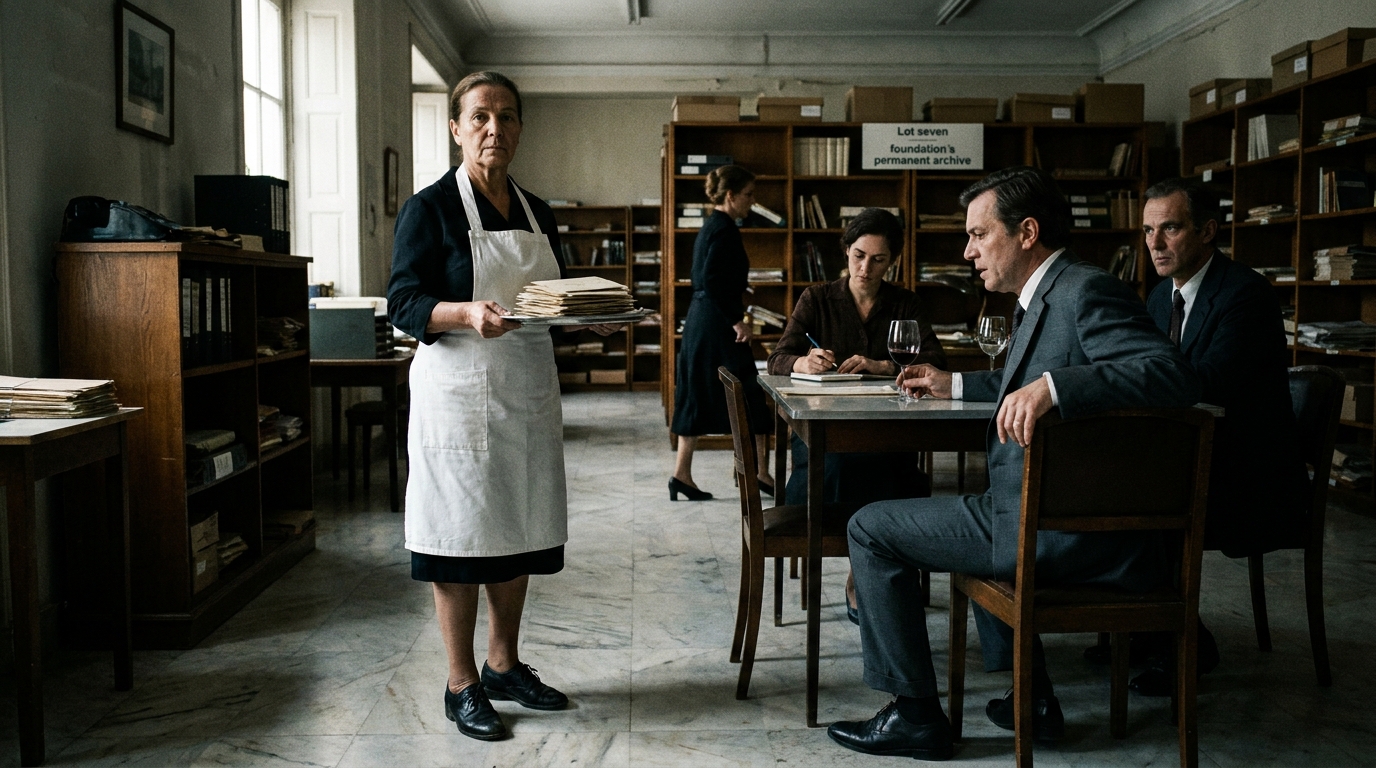
CHAPTER 3: THE GOLDEN ENVELOPE
Paulo Henrique Drumon crossed the polished marble floor with long, measured strides. His round glasses caught the golden light of the crystal chandeliers, but his expression remained tight with the vicarious embarrassment of a host watching an uninvited guest dismantle his own reputation.
He stopped directly beside Conceição, his posture shifting into an instinctive stance of deep, professional respect.
“Duke of Valcurt,” Paulo said, his voice level and sharp enough to cut through the muted hum of the surrounding tables. “Allow me to formally introduce Mrs. Conceição Ferreira das Neves.”
Bernard shifted nervously in his chair, avoiding eye contact with the table service. Isabele finally pushed her portfolio of auction lots downward, letting the papers slide out of view.
Paulo did not wait for Eduard to recover his breath. He listed the titles with the deliberate cadence of a court magistrate reading a formal indictment.
“Former plenipotentiary ambassador of Brazil to Belgium, Switzerland, and Portugal,” Paulo stated, turning slightly toward the stunned visitors. “Professor Emerita of Literature and Diplomacy at the University of São Paulo.”
A heavier hush settled over the dining hall, pressing down on the crystal glasses and silverware.
“And since 2019,” Paulo continued, his voice dropping into a register that commanded the entire room, “President of the Board of Trustees of the Foundation that organizes and finances this auction.”
Eduard’s jaw worked silently, his mouth opening and closing like a fish pulled onto a dry dock. The tailor-made Brione jacket suddenly felt like a heavy lead weight across his shoulders.
Frederique, the Swiss banker seated to his immediate right, made a slow and deliberate movement, sliding his chair a few inches away to establish a safe geographical boundary.
Conceição looked down at the golden envelope resting on the mahogany station. She adjusted her glasses with steady, unhurried fingers, pulling out a small wooden pencil from her apron pocket.
“Lot seven starts with a minimum bid of three hundred and eighty thousand reais,” she noted, her pencil scratching a sharp correction onto the margin of the official document. “Not two hundred and eighty. Correct it before opening the floor.”
The auctioneer stepped forward from the shadows, took the envelope with a hasty nod, and practically trotted toward the podium. Eduard watched him go, his chest tightening as the reality of his blunder finally set in.
CHAPTER 4: THE WEIGHT OF SILENCE
The ambient noise of the grand hall had flatlined into an oppressive vacuum. Eduard stared fixedly at the polished wooden surface of the table, his mind desperately trying to reassemble the shattered pieces of his worldview.
The premises he had lived by for fifty-four years—that pedigree was an inherent trait, that station was a birthright, and that the working class existed merely as backdrop—had just dissolved in under two minutes.
“Monsieur Valenar,” Conceição’s voice cut through the heavy quiet without a trace of mockery or malice. “You came eight hours by plane to possess a history you never bothered to understand.”
Eduard swallowed hard, his throat dry as sandpaper. He could not find a single defense, nor could he summon the arrogant retort that had felt so natural barely an hour ago.
Bernard shifted uncomfortably beside him, his gaze glued to the rim of his untouched water glass. Isabele kept her head bowed, her notes completely forgotten beneath her folded hands.
Dr. Alfredo Queiroz watched from the neighboring table with the cold, assessing expression of a man observing an educational specimen.
“I did not know,” Eduard managed to whisper, his voice stripped of its previous authority.
“That is precisely the point,” Conceição replied simply, turning away from the service station.
The silence that followed was heavier than any spoken insult. Eduard sat frozen in his chair, trapped inside the suffocating realization that his entire social stature had been built on empty air.
CHAPTER 5: THE SCHOLARSHIP TABLE
Conceição walked down the carpeted corridor toward the private dining annex, her dark brown eyes sweeping over the long wooden table where mineral water and simple cheese bread rested.
Eduard followed a few paces behind, his expensive Italian shoes sounding entirely out of place against the quiet floorboards.
“Sit,” Conceição said, gesturing to an empty chair with a calm, deliberate movement of her hand.
Eduard lowered himself into the seat, his posture stiff and defensive, his eyes fixed on the young adults seated around him.
A twenty-two-year-old woman named Iara sat across the table, her hands resting quietly over a thick folder of archival documents. She looked up with a serene composure that carried the weight of generations of unrecorded history.
“We document the economic impact of colonial relocation records,” Iara said, her French accent clean, precise, and entirely unyielding. “The archives show the labor patterns of those whose names were never entered into ledger books.”
Eduard opened his mouth to offer an automatic objection, a reflexive defense of his family’s legacy, but the words withered on his tongue.
The silence at the table was not an awkward vacuum; it was an educational space, heavy with undeniable facts.
“Your father understood that learning is an act of expansion, Monsieur Valenar,” Conceição noted, sliding a glass of water across the wood toward him. “You treated it like a badge of exclusion.”
Eduard stared at the glass, his fingers trembling slightly as he reached out to steady it. For the first time in his life, the inherited architecture of his world was not supporting him—it was judging him.
CHAPTER 6: THE NEW NORMAL
The ink flowed smoothly across the official bank letterhead from the castle of Brittany, locking the transfer of 1.2 million euros into the foundation’s account.
Eduard set the pen down in its tray, his fingers resting flat against the mahogany wood as he read the single sentence he had written: To correct an oversight, and with all my admiration.
Conceição received the letter the following morning. She opened the envelope with the calm, methodical precision of a professor reviewing a final thesis defense.
She folded the paper neatly, sliding it into her wooden desk drawer right beside the weathered copy of Molière from 1978.
Outside her lecture hall at the University of São Paulo, sunlight cut across the old stone corridors through tall, drafty windows.
Conceição stepped through the side door, her worn black leather shoes clicking softly against the floorboards as she walked to the front of the packed room.
Priscila sat in the third row, her notebook open, her pen poised above the blank white page with eager readiness.
When Conceição raised her chalk to write the first heading on the board, the classroom fell into an absolute, respectful silence.
Human dignity is never lost when it is challenged by ignorance; it is secured when a person chooses to stand firm, do the work, and let the truth speak for itself.