The Architect of Silence: A Colonel’s Final Stand Against the Forgotten Legacy of Her Own Blood
CHAPTER 1: THE WEIGHT OF THE ROSTER
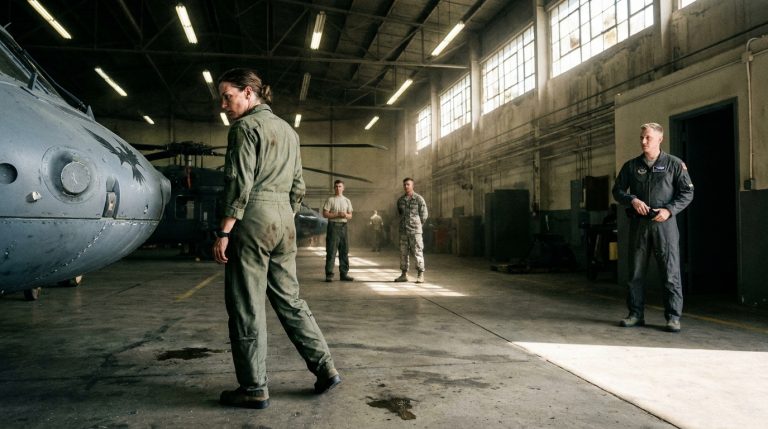
The fluorescent light in the corridor hummed with a sterile, rhythmic buzz that usually comforted me. Today, it felt like an interrogation. I stood exactly where the protocol required—feet at a parade rest that felt more like a combat stance—watching Captain Joel Stanton’s eyes scan the roster. He was young, his skin too smooth to have seen the kind of reality that lives behind a vault door, and his uniform was pressed with the frantic intensity of someone who believed the lines on a piece of paper were the boundaries of the universe.
He didn’t look at me. He looked at the list. He scrolled, clicked, and then scrolled again. His thumb hovered, a small, twitching instrument of bureaucratic power.
“Not cleared, lady,” he said, his voice flat, stripped of the curiosity that might have saved him.
He didn’t check the program designator. He didn’t look at my face to see the weight of the silver eagles on my shoulders—hidden, as always, under the plain, charcoal blazer. He simply dismissed me. Behind me, the line of officers—men and women who had moved through a hundred such checkpoints—shifted with a collective, unsettling rustle. I heard a chuckle. It was a soft, dry sound, like dead leaves skittering across pavement.
I didn’t move. My pulse didn’t quicken. I have spent twenty-five years living in the gaps between what people see and what is actually there. I felt the cold, hard reality of the SCIF door at my back—a massive slab of steel designed to stop everything from sound waves to high-frequency signals. I was on the right side of that door. He was standing in the way of a machine that would grind him into dust if he didn’t adjust his perception.
“Check the program designator, Captain,” I said. My voice was low, controlled, a blade wrapped in velvet. “Not the visitor roster.”
He blinked. The hesitation was a micro-fracture in his certainty. He held the tablet tighter, his knuckles whitening, his jaw tightening into that rigid, stubborn line I had seen on my father’s face a thousand times.
“I’ve checked twice,” he snapped, his voice rising, seeking the safety of the audience behind him. “Waiting room is down the hall. Coffee is free. Do not make me ask security to assist you.”
He hadn’t seen the signature block. He hadn’t realized that the “paperwork” he mocked was the foundation of the very existence he was protecting. I looked past him, through the slight gap between the heavy frame and the seal, and saw the shadow of Major Teague moving toward the door.
I didn’t need to speak again. The architecture of the conflict was already perfect. I had set the trap, not by planning it, but by simply existing as an anomaly in his perfect, orderly world. The heavy, pneumatic hiss of the vault seal began to break. The pressure in the hallway changed, shifting from the stagnant air of a waiting line to the sudden, sharp vacuum of a command decision.
Captain Stanton opened his mouth to deliver a final, stinging dismissal, but the door began to swing outward. The light from within the SCIF spilled into the hall—golden, intense, and revealing.
“Colonel,” a voice spoke from the threshold, and the entire hallway—the men, the captain, the very air itself—seemed to stop breathing.
The roster in Stanton’s hand suddenly looked like a death warrant. I didn’t smile. I didn’t need to. I simply stepped toward the door, my focus shifting from the captain’s crumbling facade to the work that waited on the other side.
CHAPTER 2: THE ANATOMY OF A CORRECTION
The vault door did not just open; it announced itself with a long, slow sigh of pressurized air that cut through the hallway’s stagnant silence like a razor. Major Teague stepped into the aperture, his face a landscape of disciplined neutrality, his eyes scanning the corridor until they locked onto mine. He didn’t blink. He didn’t hesitate. He simply stood there, a bridge between the sterile confusion of the hall and the high-stakes machinery humming behind the steel.
“She cleared you,” he said. The words were flat, devoid of cadence, the verbal equivalent of a tactical strike.
I watched Captain Stanton. His transformation was immediate and jarring. The smug, ironed-in certainty that had defined his posture seconds ago—the way he had held that tablet like a shield—withered. He looked at the tablet, then at the steel door, then at me. His grip on the device loosened. For a heartbeat, I saw the ghost of my father in his eyes—that stubborn, archaic conviction that the world was only as large as the rules one had personally memorized.
I didn’t offer him a grace period. I didn’t reach out to smooth the transition. I simply stepped past him, the air in the SCIF pulling me inward. It smelled of ozone, recycled air, and the faint, biting scent of high-grade electronics. The vault was a world of sharp edges and muted, shadow-blue light. It was the only place in the world where I was truly seen, and yet, it was the place I was least allowed to explain.
“Teague,” I said, my voice cutting through the quiet.
“Colonel,” he replied, his jaw set. He didn’t look back at the hallway, though I knew he was perfectly aware of the wreckage left in the corridor. “The review is prepped. The briefing materials are on the secure server. We’re waiting on the final sign-off for the Tier 3 ingress.”
I moved toward the console at the head of the table. As I sat, the movement triggered a flash of memory—the porch at Fort Campbell, the peeling paint, the feeling of waiting for three hours while my father walked past me to praise my brother’s plastic trophy. The sensation was so visceral that I almost caught my breath. I had spent twenty-five years perfecting the art of the ‘wait,’ of sitting quietly until the people in charge finally chose to acknowledge me.
Arithmetic, I told myself. Focus on the math.
I signaled Teague to join me. Stanton was still out there, suspended in the vacuum of his own error, holding a roster that no longer had a purpose. I could feel his uncertainty through the heavy metal of the door. He was waiting for the blow. Most senior officers would have delivered it—a lecture, a demerit, a public dismantling to prove who held the leverage.
“Captain Stanton,” I said, loud enough to carry through the partially open door.
The footsteps halted. The rustle of the line behind him ceased. He stood there, exposed, the target of a dozen pairs of eyes.
“Report to Major Teague’s office at 0600 tomorrow,” I said, keeping my gaze fixed on the secure display. “You’re going to be shadowing the visit control desk for the next sixty days. I want to see if you can learn to read a signature block before you decide who is allowed through a door.”
I heard a sharp intake of breath from the hallway. Teague didn’t look at me, but the corner of his mouth twitched—a sign of approval he would never vocalize. I didn’t want Stanton burned; I wanted him recalibrated. If the Army was going to keep building men who thought their tablets were the final authority, I would be the one to ensure they finally understood the weight of the ink they were holding.
“Yes, ma’am,” Stanton’s voice came back, thin and disciplined. He sounded like a soldier who had just realized the floor beneath him was not as solid as he’d believed.
I turned my attention to the console. The files bloomed on the screen—redacted, compartmented, protected. This was the work. This was the reality my family claimed to be proud of, while simultaneously relegating it to the status of ‘paperwork.’ The irony was a dull ache in my chest, a phantom limb that flared whenever I sat in these chairs.
Major Teague leaned in, his voice dropping to a low, professional hum. “The review is going to be contentious, Colonel. Ree wants a hard cut on the funding for the remote sensor array. He’s going to push for the transition to the orbital platform.”
“He’s looking at the cost, not the vulnerability,” I replied, my fingers moving across the interface. I could see the potential failures in the logic—the gaps where someone might ‘clear’ the wrong asset because the paperwork looked orderly enough. It was the same systemic laziness I’d seen in the hallway. Everyone wanted the clean, tidy story. Nobody wanted to do the work of looking at what was hidden in the margins.
“I’ll pull the audit logs from the previous cycle,” Teague offered.
“Do it. And keep Stanton on the desk,” I added, glancing at the heavy door. “If he’s going to be a gatekeeper, he needs to understand that a door is a barrier, not a suggestion. If he learns that here, he might actually be useful. If he doesn’t, we’ll move him to supply.”
I felt the weight of the decision. It was cold, calculated, and entirely devoid of the warmth my family expected of me. I had stopped performing the role of the ‘accommodating daughter’ in the hallway; I would certainly not perform it here. The transition from the corridor to the command chair had been seamless. My life had become a series of these thresholds, and for the first time, I wasn’t just walking through them—I was deciding who else was allowed to cross.
The room was silent again, but it was a functional silence—a silence of decision and command. I took a breath, the recycled air sharp in my lungs. Somewhere, in a town I was no longer rushing home to visit, my family was likely finishing a dinner where my absence was a quiet, comfortable fact. They were still telling the story about the paperwork. They still had no idea that the ink on the page was, for all intents and purposes, my heartbeat.
I looked at Teague. “Let’s begin.”
The work was the only thing that didn’t lie to me. It didn’t need to be loved, and it didn’t need to be understood. It just needed to be done right.
CHAPTER 3: THE ARITHMETIC OF EXILE
The office was quiet, save for the rhythmic, mechanical pulse of the ventilation system. It was a sterile sound, one I had lived with for over two decades, yet tonight it felt amplified, as if the room were recording my breathing, holding me accountable for the silence I was about to shatter. I sat in the hard-backed chair, the desk a flat, gray expanse before me. I didn’t need notes. The script I had written in my head over twenty-five years of Sunday dinners was already burned into my consciousness.
I reached for the handset. The plastic felt cool and strangely heavy. This was the tool of my distance—the satellite phone, the long-distance line, the digital tether that kept me connected to a world I wasn’t allowed to inhabit. I dialed, the numbers familiar, a sequence etched into my muscle memory. One, nine, eight, six. A year, a memory, a lie.
The phone rang. Each tone was a pulse of anticipation, a physical thrum against my ear. My father answered on the third ring. His voice, ‘big and warm’ as it had been at my brother’s reception, carried through the speaker with that familiar, seasoned gravel.
“Hello?”
“Dad.” I didn’t add anything else. I didn’t start with the weather or the news. I kept my voice level, the tone of a briefing officer laying out a situation report.
“Kate? Everything alright? You sound… distant.”
“I’m calling about the dinner, Dad. The anniversary,” I said. My hands were folded on the desk, knuckles pale against the dark fabric of my blazer. I could feel the cold, sharp edges of the decision I had made. There was no going back; this wasn’t a negotiation. It was the closing of a door. “I’ve been thinking about the way things are presented when I’m there. The jokes about the paperwork. The introductions.”
“Now, Kate, don’t you start,” his voice changed, dropping into that familiar, defensive gear. “It’s a family, for God’s sake. We’re just having a bit of fun. It’s been a long time since we’ve seen you, and then you start bringing up the old grievances? We’re proud of you, you know that.”
“You’re proud of the story you tell about me,” I corrected him. I didn’t let my voice rise. I didn’t let the emotion slip in. That was the trap—the expectation that I would be the one to beg for the truth. “But the story isn’t mine. And I’m done living in the version of me that makes you comfortable.”
There was a silence on the other end, long and thick, the kind of silence that usually preceded a lecture on the ‘real Army’—his Army. I waited. I wasn’t the daughter waiting on the porch anymore. I was the Colonel who decided who held the clearance.
“I don’t know what you want from me,” he said, and for a split second, I heard a tremor in his voice. It wasn’t confusion; it was the realization that the ground had shifted.
“I want the truth,” I said, my voice steady. “I’m done standing at the back of the frame. I’m done being the guest who writes the checks and answers the emails. Until you’re ready to see what I actually do—not the paperwork version, not the joke—I’m going to be keeping my distance. I’ll call Mom every Sunday. But I won’t be coming home for the holidays. Not until the joke retires.”
I hung up before he could respond. I didn’t wait for the argument, the justification, or the inevitable deflection about ‘service’ and ‘fair trade.’ The click of the receiver was final, a sharp, metallic sound that signaled the end of an era.
I set the phone down and stared at the dark screen. The silence in the office returned, heavier now, but it was mine. It wasn’t the silence of someone waiting to be included; it was the silence of a boundary maintained.
I looked at the commissioning photo on the shelf, the twenty-two-year-old in the image staring back at me with eyes that knew nothing of vault doors or the price of silence. She looked small, almost fragile, surrounded by the weight of expectations she hadn’t yet learned to carry. She had thought that being a ‘good sport’ was the price of admission. She had been wrong.
I stood up and walked to the window. The lights of the base were scattered below, a grid of order in the darkness. I thought about Stanton, sitting at his desk, learning what it meant to actually look at a document. I thought about my brother, with his notebook and his detective’s instinct, and the long, slow erosion of a family history built on lazy assumptions.
My phone buzzed—a vibration that rattled the glass of my water bottle. A text from my mother. ‘Kate? He’s quiet. What did you say?’
I didn’t answer. I didn’t have the words for her, not yet. This wasn’t about her, and yet, she was the one caught in the crossfire of our stubborn, iron-willed pride.
I walked back to the desk and picked up the leadership manual—the one I had held onto like an anchor. My fingers traced the spine, the 100 mph tape worn and smooth. My father had carried this through the mud of 1969 and the heat of his retirement, and he had used it to build a world where his daughter didn’t fit.
I had spent my life defending his world, securing the very nation that allowed his garage-bound workbench and his shadow-box to exist, and I had done it while he laughed at me in steak houses and VFW halls.
The weight of it wasn’t sadness. It was clarity. A cold, hard, crystalline clarity. I wasn’t fighting for his approval anymore. I was fighting for the right to exist in my own life. I looked at the calendar on my screen. The next few weeks would be the hardest. The phone calls, the guilt, the inevitable maneuvering of aunts and cousins. But I was ready. I had managed systems more complex than a family, and I knew how to hold a position.
I turned off the desk lamp. The room plunged into shadows, leaving only the soft, ambient glow of the server lights behind the secure partition. I left the office, my footsteps echoing in the hall—firm, deliberate, and entirely alone. The hallway was empty. The roster was gone. There was only the quiet, and for the first time in twenty-five years, that was exactly what I needed.
CHAPTER 4: THE ARCHIVE OF ERASURE
The invitation to the medal ceremony had been a calculated risk—a professional document sent into a personal theater of war. I hadn’t expected a response. When the RSVP cards didn’t return, the silence felt familiar, an old coat I had worn for half my life. But the house in Fayetteville didn’t just stay silent. It began to speak in the only way it knew how: through the physical debris of a family history that was beginning to fracture.
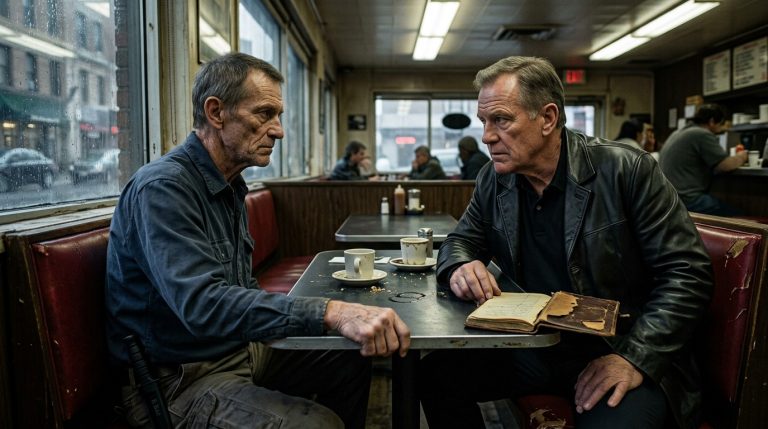
My mother called on a Tuesday, her voice strained, a high-tension wire pulled taut by the weight of things she wasn’t allowed to say. She told me about Doug. My brother, the cop, had finally stopped looking at my silence as a ‘problem to be solved’ and started treating it like a crime scene. He had spent the weekend in the hall closet, sorting through boxes of photos and documents that had been undisturbed for two decades.
“He’s quiet, Kate,” she whispered, the television humming in the background. “He’s been going through the old albums. He says… he says he doesn’t understand why there are so many gaps.”
The word ‘gaps’ hit me with the force of a physical blow. I wasn’t just missing from the photos; I had been surgically excised. I realized then that my father hadn’t just been careless. He had been an editor. He had curated a narrative of his life—his service, his son’s infantry career, his tidy, predictable world—and I had been the error that needed to be redacted to maintain the story’s structural integrity.
I didn’t wait. I took a leave of absence, the first one in years, and drove south. The road was a blur of gray asphalt and muted, desaturated green, a landscape that seemed to shrink the further I moved from the SCIF and the command console. I arrived in Fayetteville under a sky the color of a bruised lung.
The house looked smaller than I remembered. It sat on the lot like an anchor in a harbor that had long since dried up. I didn’t knock. I had my own key, a vestige of a time when I was still allowed to exist within these walls. I let myself in. The smell was the same: floor wax, stale coffee, and the faint, underlying odor of old paper.
Doug was in the hallway, the closet door open. He was sitting on the floor, surrounded by a sprawl of manila envelopes and glossy photographs. He didn’t look up when I entered. He held a photo in his hand—my commissioning portrait. It was creased, the edges frayed where someone had forced it into a frame that was too small, and then, apparently, discarded it.
“I found these behind the winter coats,” he said, his voice devoid of its usual, easy warmth. He handed me the photo. I looked at the young woman in the image, the second lieutenant with the sharp eyes and the clean, pressed uniform. My father had told the steakhouse audience I did ‘paperwork.’ He had looked at this woman, the one who stood at the threshold of a twenty-five-year career in signals intelligence, and he had decided she didn’t exist.
“Why, Kate?” Doug asked. He was a cop; he knew the scent of a cover-up. “I checked the dates on these. You were commissioned in 2001. You were in Afghanistan in 2009. These photos were taken during the exact times you were ‘away at a desk.'”
I felt the room tilt. The decoy secret I had lived with—that I was just ‘misunderstood’—shattered. This wasn’t about him not knowing what I did. This was about him knowing exactly what I did and choosing to bury it because it threatened his reality. If I was a Colonel in Intelligence, his ‘First Sergeant’s Daughter’ narrative was a lie.
“He didn’t want the paperwork to be real, Doug,” I said, my voice sounding foreign in the cramped hallway. “Because if it was real, he had to admit he didn’t know me. And that was a price he wasn’t willing to pay.”
I moved toward the closet. It was a museum of erasure. There were letters I had sent from Qatar, unopened. There were birthday cards from 2014, the ones I’d organized via satellite phone, still in their original envelopes, tucked into a box labeled ‘Misc.’ It was an archive of my exile, a calculated collection of evidence that I had been present, and that I had been ignored.
I picked up a manila envelope. It contained a set of orders—my promotion to Captain. I had left a copy on the kitchen table in 2005. It had been folded, then shoved into a drawer. I hadn’t been an ’email writer.’ I had been a threat to the family’s lazy, static peace.
“He knew,” Doug said, his voice turning hard. He stood up, the photo of the young lieutenant trembling in his grip. “He knew, and he just… he let us believe the joke. He let us turn you into a punchline so he could keep the VFW happy.”
The discovery wasn’t a release. It was an escalation. The truth didn’t make me feel better; it made the anger within me burn with the efficiency of a controlled reaction. I had spent years thinking I was the one who had to ‘manage the weather,’ when in reality, I had been the one being kept in the dark by the very people I was trying to protect.
My father’s heavy footsteps sounded on the hardwood in the kitchen. He stopped when he saw us—the two of us on the floor, the evidence of his editing laid out like a case file. He didn’t speak. He looked at the commissioning photo in Doug’s hand, then at the unopened letters I held, and his face—that mask of proud, weathered certainty—began to crack. It wasn’t the face of a man who was sorry. It was the face of a man who realized his defenses had been breached.
The air in the hallway turned cold, the weight of a quarter-century of lies pressing against the walls. We weren’t a family anymore. We were a chain of command that had finally been audited, and the results were disastrous.
CHAPTER 5: THE GLASS WALL
The silence was a physical thing, a pressurized chamber of old resentments and new, jagged realizations. My father’s hand, resting on the doorframe, looked fragile—the skin thin and spotted with age, the knuckles white from the strain of holding onto a narrative that had just disintegrated. He looked from the commissioning photo in Doug’s hand to the boxes of my ‘miscellaneous’ life, and for the first time in my memory, he didn’t have an order to issue. He didn’t have a joke to pivot to. He just stood there, anchored by the gravity of his own editing.
Outside, the first drumroll of thunder rattled the glass in the front door, a low, ominous sound that mirrored the tremor in the room. The sky had turned a bruised, electric purple, and the humidity began to climb, turning the air in the narrow hallway into something thick and difficult to breathe.
“You didn’t just forget, Dad,” I said. My voice was calm, a cold, surgical instrument. “You curated. You built a version of this family that didn’t have a place for a daughter who wasn’t a punchline.”
He looked at me then, really looked at me, not as the child he had once dismissed or the ’email writer’ he had invented for the VFW, but as the woman who had spent decades keeping the very world he claimed to love upright. His eyes, typically sharp and decisive, were clouded. He opened his mouth, and I braced for the old, reflex-driven defense—the talk about ‘service’ and ‘fair trade’—but it didn’t come.
“I was taught that the infantry was the army,” he muttered, his voice barely audible over the rain that had started to lash against the siding. “Everything else… it was decoration. I didn’t know how to place you, Kate. You were… you were something I hadn’t been trained for.”
“So you filed me under ‘paperwork’?” I stepped closer, the floorboards beneath my feet feeling like they were giving way. “You filed me under ‘nobody’ because it was easier than admitting you were out of your depth? You let your own son treat me like a joke for twenty years because you didn’t have a map for my life?”
Doug moved between us. He had been a cop long enough to know when a situation was about to turn violent, not in the sense of a physical strike, but in the sense of a systemic collapse. He placed the photo of the young lieutenant on the console table and stood up. His face was a mask of calculated neutrality, the same face he wore when he walked into a domestic disturbance call.
“The ceremonies, Dad,” Doug said, his voice hard. “The VFW nights. The neighbors. You knew what she did. Larkin told me. You knew, and you let everyone believe she was just ‘doing emails.’ Why?”
The rain intensified, a relentless, drumming roar against the roof that trapped us in the claustrophobic space of the hallway. My father sat down on the bottom step of the staircase, his movements slow, the way they had been when he practiced his own retirement. He looked at his hands, the hands that had built the shadow-box, the hands that had held his manual for thirty years.
“I thought I was protecting you,” he whispered. “If they didn’t know what you were, they couldn’t… they couldn’t use it against you. Or against us. The army is a small world, Kate. Once you’re in those rooms, you’re not ours anymore. You’re theirs. I didn’t want you to be theirs.”
The absurdity of it was a bitter, metallic taste in my mouth. He had been protecting me from a world I had already mastered, a world I had helped to build, while he remained stuck in a version of the military that hadn’t existed for decades. He had been holding the door shut, thinking he was keeping me safe, never realizing he was simply keeping me out.
“You were protecting yourself,” I said, the realization hitting me with the force of a final, necessary truth. “You were protecting the only identity you knew how to be. A First Sergeant. A father of a hero. You couldn’t be a father to a Colonel, because you didn’t know how to command that space.”
The thunder crashed, closer this time, shaking the house, and for a moment, the lights flickered and died. We were plunged into the gray, washed-out light of the storm, the shadows in the hallway stretching and twisting. In the darkness, the hierarchy that had defined our family for twenty-five years had finally, irrevocably dissolved. There were no orders left to give. There were no jokes left to tell.
My mother appeared at the end of the hallway, a silhouette against the gloom of the kitchen. She didn’t speak. She didn’t try to mediate. She stood there, watching the end of the narrative she had helped maintain by simply surviving it.
I looked at my father, bowed on the stairs, and I felt the last of the anger drain away, replaced by a cold, detached clarity. The glass wall I had been standing behind—the one that had protected me from their ignorance—was finally gone. I wasn’t the daughter on the porch anymore. I wasn’t the email writer. I was the person who had walked through the doors they were too afraid to open.
“The medal ceremony is in two weeks,” I said, my voice cutting through the sound of the rain. “I sent the invitations because I wanted to see if you were capable of walking through a door you hadn’t built yourself.”
I turned toward the front door. The rain was drumming a frantic, irregular rhythm against the metal. Doug stood by the console, his hand resting on the photo of the young lieutenant. He wasn’t looking at me; he was looking at our father. The case was closed. The evidence was in plain sight. There was nothing left to do but walk out into the storm.
CHAPTER 6: THE FINAL SALUTE
The auditorium was a cathedral of brushed steel and shadow. The rows of folding chairs were occupied, a sea of uniforms and civilian suits, but my focus remained locked on the four empty seats in the second row. The ceremony began with the familiar, rhythmic cadence of military protocol—the sharp clicks of heels, the rustle of the program, the sterile, amplified voice of the adjutant. I stood at attention, my dress blues feeling like a second skin, a suit of armor I had spent twenty-five years refining.
I watched the entrance. The ceremony was minutes away from the presentation, and the seats were still empty. A familiar, cold doubt pricked at my conscience—the old, ingrained belief that I was still standing on that porch at Fort Campbell, waiting for a bus that would never arrive. Major General Ree stood at the podium, his posture relaxed, a man who knew the value of the silence he was about to break.
Then, the rear doors groaned open. The sound was muffled by the carpeted expanse of the hall, but I saw the heads turn. Doug entered first, his suit rumpled from a long drive, his hand tight on the arm of my mother, who looked frail and luminous in her blue dress. Behind them, walking with a deliberate, measured gait that ignored the curious stares of the room, was Jean Ambrose. He wore a jacket and tie, and on his lapel, the brass diamond of a first sergeant caught the overhead light—a badge of a tribe I had never been permitted to join.
They didn’t look at the crowd. They walked straight to the second row and sat, my father taking his place on the aisle with the precision of a man reporting to a final inspection. He didn’t glance at me. He stared straight ahead at the podium, his jaw set in a line of immovable resolve.
Major General Ree began the citation. He spoke of two decades of safeguarding national interests, of decisions routed through names that couldn’t be printed, and of a career built in the shadow of ‘redacted’ files. It was an unclassified masterpiece of omission. He looked up from his notes, his gaze sweeping the room before landing on my parents.
“Most of us are allowed to be proud in public,” Ree said, his voice dropping into a tone of genuine gravity. “Colonel Ambrose has allowed the country to be proud on her behalf, in silence, for twenty-five years. I invite you all to consider what that costs.”
He signaled for the presentation. As I moved to the center of the stage, the world seemed to slow, the air between me and the second row thinning until it was almost transparent. Ree pinned the medal to my lapel. The weight of it was negligible—a piece of stamped metal—but the meaning was a physical force.
I turned back to the audience. I was looking for them. My mother was crying, her hand pressed against her mouth. Doug was grinning, that familiar, guarded grin of a man who had finally solved the case. And my father—the first sergeant who had spent a quarter-century editing his life—was rising.
He didn’t rise with the crowd. He rose before the command was given. He stood with a mechanical, practiced grace, his shoulders back, his heels meeting with a snap that resonated through the hall. He brought his hand up—the arm held at the precise angle taught in the manual currently sitting on his garage shelf—and he held it there. A salute.
It wasn’t a performance. It was a confession. In that rigid, starched gesture, he was acknowledging everything the manual couldn’t explain. He was admitting that the ‘paperwork’ had been a lie, and that the person standing on the stage was the only soldier he had ever truly known.
I returned it. I held the salute as long as he did, the two of us locked in a transaction that cleared every debt. The silence in the room was absolute, a void into which everything unsaid had finally been poured. When he lowered his hand, he didn’t look away. He nodded—once, short and sharp—and sat back down.
The ceremony drifted into the reception, a haze of handshakes and professional courtesies. Major Teague approached my father, and I watched the exchange from a distance. There was no awkwardness, only the quiet, mutual recognition of two people who understood the mechanics of the service. Captain Stanton stood at the door, his eyes catching mine as I passed. He didn’t speak, but he straightened, a subtle acknowledgment of the remediation that had, in its own way, salvaged us both.
Dinner at the house in Fayetteville was a quiet, domestic miracle. We sat at the same table where the ’email writer’ narrative had been manufactured for decades. There was no talk of SCIFs, no questions about my career, no performance of my accomplishments. We spoke of the weather, the upcoming harvest, and the way the porch board—the one that had been loose since 1986—had finally been fixed.
My father didn’t apologize in words. He didn’t have to. He stood up toward the end of the meal, walked to the garage, and returned with the shadow-box. He placed it on the table between us. It contained his ribbons, his diamond, and now, tucked into the lower corner, the commissioning photo of the young lieutenant he had once buried in a drawer.
“I didn’t have a manual for you,” he said, his voice quiet, stripped of the bravado that had once defined him. “I thought if I didn’t see you, I wouldn’t have to be afraid of losing you to a world I didn’t understand.”
“I was never lost,” I said, reaching out to touch the glass of the shadow-box. “I was just waiting for you to see who was actually standing there.”
My mother smiled, a tired, relieved expression that seemed to shed years. Doug poured the coffee, the clinking of the china the only sound in the room. The house felt different now—not empty, not full of ghosts, but simply, finally, a home.
I left at dawn. The drive back was long, the miles unfurling like a ribbon of resolution. I wasn’t the daughter who did paperwork. I wasn’t the Colonel who lived in a vault. I was just Kate. And for the first time in twenty-five years, the person who signed the most secret files in the government was the same person who had just had a quiet cup of coffee with a first sergeant who had finally learned to salute.
I reached my office by midday. I walked to the shelf, took down the leadership manual, and placed it next to the medal, the two objects sharing the space with a quiet, hard-earned peace. I sat at my desk, the silence of the room no longer a weight, but a sanctuary. I had stood my post. The door was open. And for the first time, I didn’t need to look back to see if anyone was watching.