The Iron In The Dirt: A Ridgecrest Valley Chronicle
CHAPTER 1: THE PAPER COLDCUT
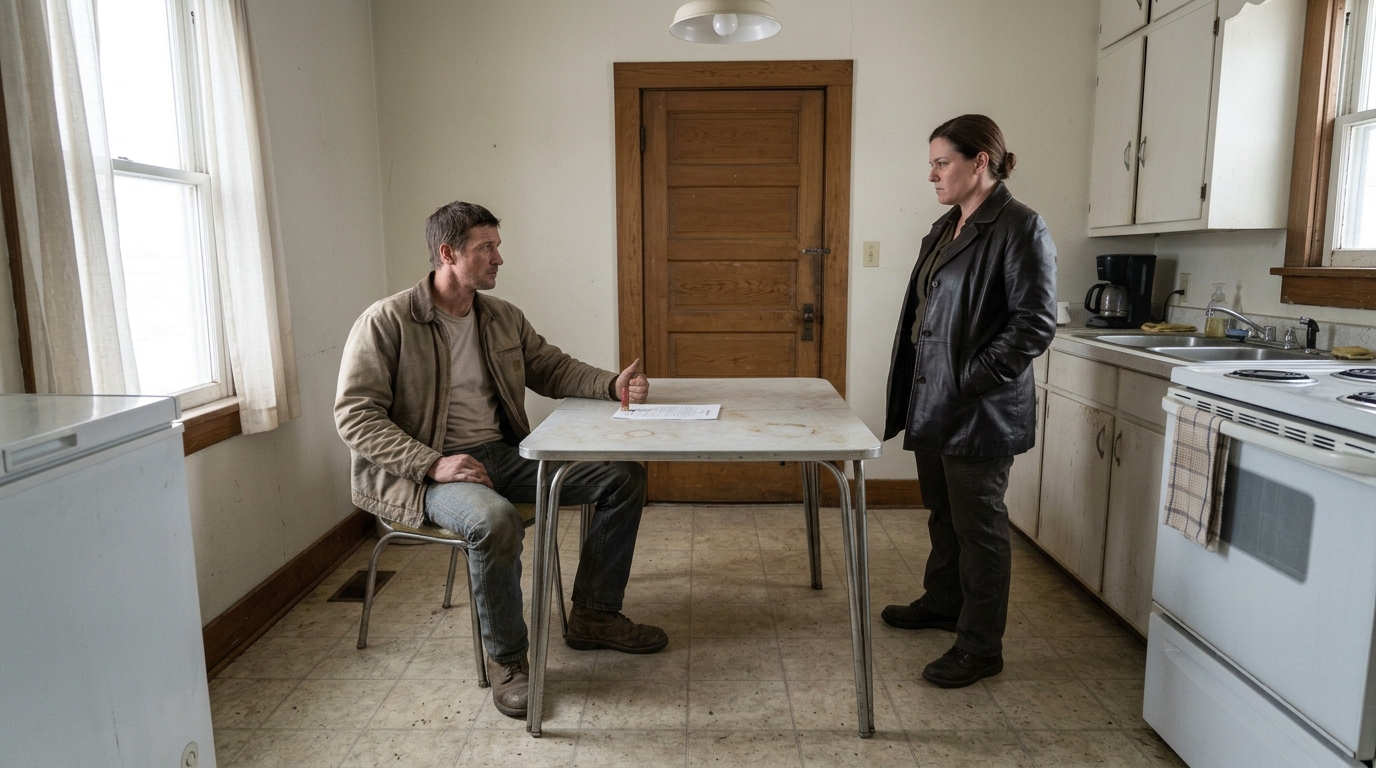
The door jam slammed into the pine casing before I heard her boots on the linoleum.
One second the kitchen smelled like stale percolator grounds and boiled eggs. The next, Lena Caldwell was standing inside my threshold, blocking the gray light from the porch. No knock. No greeting. Her leather coat reeked of diesel and wet dog.
She dropped a heavy Manila envelope onto the table. The paper hit the Formica with a dull, dense thud that rattled my tin mug.
“This land isn’t yours,” Lena said. Her voice didn’t carry heat. It was flat, clipped, conditioned by five years of running the Ridgecrest Valley HOA like a privatized precinct. “The mineral rights transferred to the board back in 2019. Pack your personal items. You have until the first of the month.”
I didn’t reach for the envelope right away. My thumb stayed pressed against the rim of a brass 12-gauge casing—spent, flattened at the mouth, sitting on the table next to Uncle Roy’s estate ledger. I rolled the brass edge hard into my calloused skin until the pinch registered.
“Roy’s deed is clear,” I said. My voice was dry, low in my chest. “Recorded in the county seat in ninety-four.”
“Check the enclosure,” she said. Her hands went into her coat pockets. Her shoulders were set, broad and rigid. “Signed and notarized. Your uncle knew the property taxes were drowning him. He made a deal with my father before his head went bad.”
I unclasped the brass brad and slid the top sheet out.
The ink on the signature line was dark blue, sharp, and untrembling. Roy E. Wilson. Dated March 14, 2019.
The brass shell casing stopped rolling under my palm.
Uncle Roy died in a hospital bed in San Angelo in September 2018. I helped the mortician lift his sixty-pound frame into the pine box myself six months before this ink supposedly touched the page.
I looked up from the sheet. Lena’s chin was tilted, her jaw muscles working a piece of mint gum. She wasn’t watching my eyes; she was watching my hands, measuring whether I was going to reach for the rifle rack behind the pantry door.
“He signed this in March?” I asked.
“He knew what was coming,” she replied without blinking. “Sign the formal quitclaim attached to page three to handle the mineral access smoothly, or the board files for immediate summary foreclosure on the outstanding assessment liens. Twenty-four thousand dollars in accrued maintenance penalties.”
“Roy was in the ground in March, Lena.”
Her eyelids twitched—a micro-fraction of a second where the cool composure buckled over raw calculation. Then her spine straightened.
“The county records say otherwise,” she said, her voice dropping an octave, tightening into a blade. “You’re living on dead weight, Wilson. You can leave with a settlement check for the timber rights, or you can leave with a sheriff holding an eviction writ. Make your choice by Friday.”
She turned on her heel, her boots chewing into the cracked linoleum as she walked out, leaving the screen door to slam twice against the frame.
I sat still. The diesel exhaust from her idling truck seeped through the screen, heavy and sour. I picked up the flat brass shell, turned it over, and scraped the rim across the blue ink of Roy’s signature. The paper tore slightly under the pressure. It wasn’t just land. They were digging for something underneath the dirt, and they had already started driving the stakes.
CHAPTER 2: WIRE AND HARD HATS
The tail lights of Lena’s F-250 faded into the red dust at the bend of the county road, but the rumble of her diesel engine hung in the valley for a long time.
I stayed at the table. My thumb rubbed the rough tear where the flattened 12-gauge casing had gouged the blue ink of Uncle Roy’s forged signature. The house was quiet again, save for the ticking of the wall clock and the low groan of the floorboards expanding in the morning heat.
Twenty-four thousand in bogus assessment liens. A transfer document signed six months after the man was buried. They weren’t trying to hide the lie; they were betting I didn’t have the stomach or the bankroll to drag it into the light.
I stood up, shoved the paper back into the Manila envelope, and tucked it inside my canvas jacket. I picked up my fence pliers from the counter and stepped out onto the porch.
The air was dry, carrying the scent of wild mesquite and sun-baked limestone. I walked down the steps, my boots sinking into the loose gravel of the driveway, heading west along the fence line that split Roy’s hundred and sixty acres from the ridge.
I didn’t make it four hundred yards before the hum of heavy equipment cut through the wind.
It wasn’t farm machinery. It was the high-pitched whine of hydraulic drills and the metallic clatter of heavy steel posts being driven into rock.
I broke into a fast stride, cutting through the scrub oak until the western property line came into view. Yesterday, there had been nothing here but rusted T-posts, four strands of sagging barbed wire, and Roy’s sun-bleached cedar stays.
Today, the wire was gone. Severed cleanly at the corner post, the frayed ends lying coiled in the dirt like dead snakes.
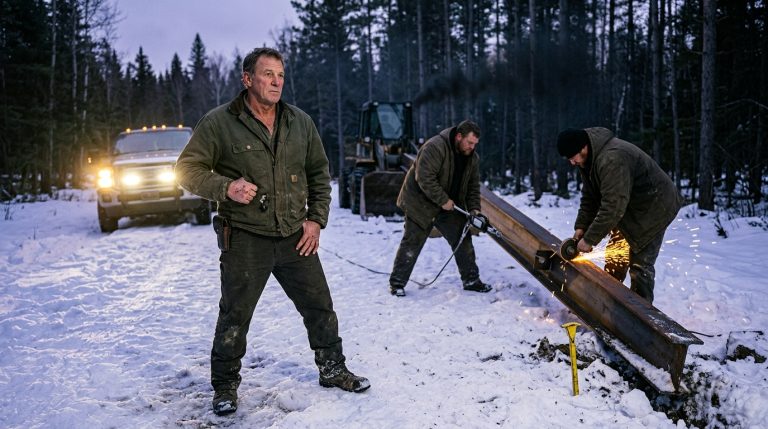
In its place stood a brand-new eight-foot chainlink fence. It stretched as far as the brush allowed, bright galvanized steel gleaming hot under the Texas sun. Every fifty feet, yellow aluminum signs were bolted to the mesh: NO TRESPASSING. AUTHORIZED PERSONNEL ONLY. RIDGECREST VALLEY HOA DEVELOPMENT ZONE.
On the far side of the chainlink, two yellow earthmovers were tearing a wide trench through the creek bed. Beyond them sat a flatbed trailer hauling a drill rig, its steel derrick already raised against the sky. Three men in hard hats and high-visibility vests stood near a white crew-cab pickup, blueprints spread across the hood.
Printed in bold black stenciling across the door of the truck was a designation code: RV-ENERGY / COUNTY PERMIT 11-B.
I walked straight up to the fence line. My fingers wrapped around the hot wire mesh.
“Hey!” I called out.
The wind carried my voice across the ditch, but the crew didn’t stop. One of the men in a hard hat glanced over his shoulder, whispered something to the worker beside him, and turned back to the blueprints. They ignored me the way you ignore a dog barking behind a gate.
I pulled my phone from my pocket and started taking photos. The fence line. The missing cedar posts. The heavy rig idling on my dirt. The permit number stenciled on the truck door. I counted five support vehicles, all bearing the same Ridgecrest Valley logo. This wasn’t a surveyor dropping stakes; this was an invasion force.
I turned away from the fence and cut across the dry Wash toward the neighboring property line. Gene Hollister’s place sat two miles down the ridge, hidden behind a thick canopy of juniper and oak. Gene had run cattle on this range for forty years before the HOA boxed him in. If anyone knew who was backing Caldwell’s play, it was him.
The walk took twenty minutes. My boots kicked up chalky dust, my throat dry, my mind running through the math. Drilling rigs didn’t mobilize on twenty-four hours’ notice. They had been staging those machines weeks before Lena ever dropped that envelope on my table.
I reached Gene’s gate. A battered John Deere tractor sat idling in the barnyard, and on the wrap-around porch stood Gene himself. He didn’t come down to greet me. He stood behind the wooden railing, a double-barreled 12-gauge resting casually over his forearm, his eyes shadowed under a sweat-stained Stetson.
“That’s far enough, boy,” Gene called out. His voice sounded like two dry rocks grinding together.
I stopped ten feet from the bottom step, raising both hands slowly. “It’s Luke, Gene. Roy’s nephew.”
Gene didn’t lower the gun. He squinted down at me, his jaw working a wad of tobacco. “I know who you are. I saw Lena’s truck head up your drive an hour ago.”
“She brought a forged deed,” I said, dropping my hands to my sides. “And there’s a chainlink fence running through my western pasture right now. They’ve got a drill rig parked in my creek bed.”
Gene spat over the railing. The brown liquid hit the dirt with a sharp hiss. “Ain’t your creek bed no more, Luke. You ought to get back in your truck and drive back to San Antonio.”
“It’s my land, Gene. Roy left it to me in his will.”
“Roy’s dead,” Gene said flatly. “And the men behind Caldwell don’t care about a piece of paper signed by a dead man. That ridge was spoken for long before Roy took sick.”
I stepped closer to the porch rail, ignoring the slight lift of the shotgun barrel. “Spoken for by who? The HOA doesn’t have the capital for a commercial rig. Who’s paying for the steel out there?”
Gene looked past me, his eyes tracking the thin plume of diesel smoke rising above the tree line on my western boundary. His weathered face tightened, deep lines carving into his cheeks.
“You go poking around those permits, you’re going to pull up more than oil, son,” Gene muttered, his voice dropping into a raspy whisper. “Caldwell’s got the county clerk in his pocket, and he’s got men in Austin who don’t like losing money. You want to stay breathing? You leave the fence where it is.”
“I’m not letting them steal Roy’s ranch, Gene.”
“Then you’re a fool,” Gene said, stepping back toward his open front door. “Talk to Sandra Vance down at the legal aid office in town if you want to waste your time with paperwork. But don’t come back down my driveway. I’ve got my own fence line to keep clean.”
The screen door slammed shut behind him, the deadbolt clicking home with a cold, final metallic snap.
CHAPTER 3: COUNTY VAULTS
The metallic snap of Gene’s deadbolt hit the humid air like a hammer striking iron.
I stood at the bottom of his porch steps for three slow breaths. The John Deere tractor idled twenty yards away, its exhaust pipe puffing thin rings of gray smoke into the oak leaves. Gene wasn’t coming back out. The old man had built his perimeter, and he was content to let Caldwell chew up my fences as long as the teeth didn’t reach his own wire.
I turned around, my boots grinding into his driveway gravel, and headed back toward my truck.
Twenty minutes later, the rusty Ford was bouncing down County Road 404 toward town. The steering wheel shook in my grip at forty miles an hour, the front alignment pulled hard to the left, but my mind was stuck on the three digits stamped into the side of that drilling rig. County Permit 11-B.
The town of Ridgecrest Valley didn’t have a stoplight, just a flashing yellow lantern hung over the intersection of Main Street and Federal Way. The county clerk’s office sat in the basement of the 1930s limestone courthouse—a squat building smelling of floor wax, mildew, and eighty years of damp property disputes.
I parked near the curb, pulled the Manila envelope from my canvas jacket, and walked through the heavy glass doors.
Behind the glass counter sat Sandra Vance. She wasn’t a county employee; she ran the small two-room legal aid clinic out of a partitioned office in the back corridor. Her gray hair was pulled into a tight bun, her spectacles hanging from a black cord around her neck. On the desk in front of her sat a cold cup of black coffee and a stack of tax assessment ledgers.
She looked up over her wire rims as my boots clicked across the terrazzo floor.
“You look like you’ve been dragging fence posts, Luke,” she said, her voice dry as parchment.
“Caldwell put eight feet of galvanized mesh through Roy’s western pasture this morning,” I said, leaning both hands against her counter. “And he’s got a drill rig sitting in my creek bed.”
Sandra didn’t jump. She reached for her coffee, took a small sip, and set the ceramic mug down with a soft click. “I told you last week, Luke. Warren Caldwell has had six board members rubber-stamping his land petitions since 2018.”
“He brought me a transfer agreement,” I said, pulling the envelope out and sliding the top sheet across the counter. “Signed March 2019. Roy was buried in September eighteen.”
Sandra picked up the page. Her fingers were long, knobby at the joints, covered in faded blue ink stains. She smoothed the paper flat, her eyes scanning the signature line. She didn’t look surprised; she looked tired.
“The signature is clean,” she whispered. “Too clean for a man who couldn’t hold a spoon his last three months.”
“It’s a forgery,” I said. “He’s using it to claim the mineral rights.”
Sandra stood up, unlocked the low wooden gate beside the counter, and motioned toward the narrow hallway behind her. “Come back here.”
I followed her past two rows of olive-drab filing cabinets into the clerk’s archive vault. The room was narrow, illuminated by a single overhead fluorescent tube that hummed like a angry hornets’ nest. She stepped up to a heavy steel drawer labeled RANCH & MINERAL TRANSFERS: 2018–2020 and yanked it open. The brass drawer slides shrieked from rust.
She flipped through the manila folders with practiced speed, her thumbs flicking past property codes until she stopped at a thick tab labeled WILSON ESTATE – ROY E.
She pulled the whole file, laid it flat on a steel inspection table, and flipped it open.
“Look at page two,” Sandra said, pointing a liver-spotted finger at a stamped document.
It was a geological survey authorization, issued by the county commissioners six months after Roy died. The header read: RIDGEREST ENERGY PARTNERS / AUTHORIZATION CODE: BRINE POCKET 9. Attached to the back was a preliminary assessment report estimating eight hundred thousand dollars in recoverable oil reserves.
“There’s your decoy, Luke,” Sandra said, her voice dropping into a low, raspy murmur. “This is what Caldwell is showing the board. He told them Roy defaulted on twenty-four thousand dollars in private tax liens held by the HOA. Caldwell claims the board absorbed the liens, paid off Roy’s delinquent county dues, and transferred the mineral access to keep the valley’s tax base afloat.”
I stared at the paper. “Roy didn’t owe twenty-four thousand dollars. He paid his land taxes out of his pension every October.”
“He did,” Sandra agreed, her thumb rubbing the corner of the survey. “Which means Caldwell generated fake lien notices, filed them in the secondary county ledger, and signed the transfer himself to ‘save’ the property from public auction. In the eyes of the board, Caldwell’s a hero who kept an out-of-town heir from letting the land default.”
I leaned over the table, my chest pressing against the cold steel edge. “And the oil?”
“Eight hundred thousand in crude is a lot of money for a small-town board,” Sandra said. “It pays off the county road bond and puts fifty grand in Caldwell’s pocket every quarter. That’s why the neighbors are staying quiet. Caldwell promised them a dividend check from the HOA reserve fund if the rig starts pumping.”
My eyes drifted down to the bottom corner of the assessment report, past the fake signature, to a small grey stamp hidden under a notary seal: PROJECT VANGUARD / SUB-STRATA FILE 44-A.
The name meant nothing to me, but the ink was fresh—darker than the rest of the six-year-old document.
“This survey isn’t just about crude, Sandra,” I said, my finger brushing the small stamp.
Sandra squinted through her spectacles, her eyebrows knotting together as she looked at the stamp. “Project Vanguard? I haven’t seen that file code on any of the board agendas.”
Before she could answer, the iron door of the archive vault creaked open. Heavy boots echoed against the concrete floor.
A tall man in a starched khaki shirt and a polished silver belt buckle stepped into the doorway, his broad frame filling the narrow opening. Ray Bledsoe, county councilman and vice-president of the Ridgecrest Valley Board, folded his arms across his chest. His face was tanned, leathery, his eyes small and unblinking under his silver hair.
“You’re in the restricted records section, Vance,” Bledsoe said, his voice smooth, echoing off the steel cabinets. “Public viewing hours ended at noon.”
“Luke is the rightful heir to the Wilson property, Ray,” Sandra said calmly, closing the folder with a deliberate snap. “He has a right to inspect his uncle’s tax ledgers.”
Bledsoe didn’t look at Sandra. His eyes stayed locked on me, dropping to my canvas jacket where the forged transfer document was stashed.
“Roy’s estate was settled by the board eighteen months ago, son,” Bledsoe said, stepping further into the room until he was three feet away. The smell of cheap cologne and peppermint off his breath filled the tight space. “You’re dragging up dirt that’s already been packed down. The survey is legal. The rig stays on the ridge.”
“Roy was dead when that paper was signed, Bledsoe,” I said, my hand staying flat on the closed file folder. “You signed off as the county witness.”
Bledsoe’s jaw worked slowly, a faint tick rising near his ear. He leaned in, his voice dropping into a razor-thin whisper. “You’ve got three days before the board executes the final lien foreclosure, Wilson. You can take the fifteen thousand dollar timber settlement Lena offered you, or you can find out how fast a county sheriff can execute a trespass warrant on a man with no legal standing. Get out of my vault.”
CHAPTER 4: SHREDDER LIGHT
Bledsoe’s breath stayed heavy in the narrow aisle, smelling of stale mint and wet wool.
My palm burned against the cold steel edge of the archive table. I didn’t reach for the Manila folder under my knuckles, and I didn’t back down an inch. I looked straight into the broken capillaries on the bridge of his nose, let two seconds of dead silence stretch between us, and then slowly pulled my hand back.
“I’m leaving,” I said, my voice barely a rustle. “For now.”
I turned, brushed past his shoulder—the thick canvas of my jacket catching on his belt buckle—and walked out into the corridor. Sandra followed three paces behind, the quick, rhythmic click of her low heels echoing off the limestone walls like a ticking clock.
We didn’t speak until we reached the courthouse parking lot. The sun had dipped below the western ridge, painting the sky in jagged streaks of bruised purple and dried blood.
“He’s panicking, Luke,” Sandra said, her hand trembling slightly as she pulled a ring of brass keys from her coat pocket. “Ray Bledsoe doesn’t come down to the basement vault past noon unless someone rang his bell. He knows you saw that survey code.”
“County Permit 11-B,” I said, leaning against the cold fender of my Ford. “And Project Vanguard. What is it, Sandra?”
“I don’t know,” she admitted, her thumb nervously tracing the edge of her key fob. “But if it’s stamped on a six-year-old survey with fresh ink, it means the board is hiding something bigger than an eight-hundred-thousand-dollar oil play. You need hard proof before Friday’s board meeting, or the county sheriff will carry out that eviction writ.”
My phone vibrated twice in my shirt pocket. A sharp, short buzz against my ribs.
I pulled it out. An unlisted local number. Single text message, no greeting:
They’re shredding the secondary ledgers tonight. Storage bay behind the community center. 10 PM. Don’t bring the law.
I showed the screen to Sandra. Her face went pale under the amber glow of the streetlamp overhead.
“It’s a setup,” she whispered. “If Bledsoe catches you on HOA property after dark, he’ll have the deputy pin a breaking-and-entering charge on you before morning.”
“If those ledgers go through a cross-cut shredder, my uncle’s land goes with them,” I said. “I’m going.”
“Then take my digital camera,” she said, reaching into her leather satchel and pressing a small, black Sony unit into my hand. “Don’t touch their doors. Don’t break a lock. Stand on public grass, shoot through the windows, and get clear.”
The match cut hit when the clock on the courthouse tower struck ten.
Four hours of cold waiting in the cab of my truck, parked half a mile down Cinder Lane under the drooping branches of a live oak, had turned my feet to ice. I killed the headlights, pulled the keys from the ignition, and stepped out into the black dust.
The Ridgecrest Valley Community Center sat on a three-acre parcel carved out of Roy’s old southern pasture. The main hall was dark, but around back, near the cinderblock maintenance shed, a yellow halogen floodlight cut a harsh cone through the rising fog.
I moved through the mesquite brush, my canvas jacket keeping the thorns from biting my arms. Every step was deliberate—heel to toe, avoiding dry twigs, my thumb pressed firmly against the flattened brass shotgun shell in my pocket to keep my focus sharp.
The low, mechanical whine of a heavy-duty industrial paper shredder vibrated through the damp night air. Chrk-chrk-chrk.
I crouched behind a stack of rotted pine pallets thirty feet from the open bay door of the storage unit.
Inside the floodlit bay, two men in work boots were hauling heavy banker boxes from the bed of a white unmarked panel van. They dumped the contents onto a folding plastic table. Standing in the center of the concrete floor, feeding thick stacks of yellowed tax ledgers and land deeds directly into the teeth of an industrial hopper, was Ray Bledsoe.
Beside him stood Lena Caldwell. She held a red grease pencil, ticking off line items on a clipboard before passing the corresponding files to Bledsoe.
“That’s the last of the 2018 assessment rolls,” Lena said, her voice carrying crisp over the hum of the engine. “What about the geological annexes for Brine Pocket 9?”
“Burn them in the oil drum out back,” Bledsoe grunted, not pausing his arm rhythm. “We don’t leave a paper trail for the state land commission. Once the foreclosure goes through on Friday, Vanguard takes title directly through the offshore shell.”
I lifted Sandra’s digital camera over the top pine slat of the pallet.
The viewfinder glowed soft against my cheek. I adjusted the optical zoom, bringing Bledsoe’s face into sharp focus—his starched shirt sleeves rolled up, his hands covered in gray paper dust, feeding Uncle Roy’s handwritten tax receipts straight into the blades.
Click. Click. Click.
The shutter was silent, but the flash auto-focus light blinked once—a tiny red beam cutting through the fog.
Lena’s head snapped toward the pallets. “Ray. Someone’s in the brush.”
Bledsoe didn’t hesitate. He dropped the file stack, reached under his jacket, and pulled a heavy black flashlight from his belt, blinding the space between us with a hundred-lumen beam.
“Step out!” Bledsoe roared, his voice echoing off the corrugated steel roof of the bay. “Now!”
I didn’t argue. I tucked the camera deep inside my canvas coat, stepped out from behind the pallets into the open light of the driveway, and raised both hands slowly into the cold air.
CHAPTER 5: THE HEARING GAVEL
The glare of Bledsoe’s flashlight burned hot against my eyelids, pinning me against the shadow of the storage shed.
My knuckles stayed locked around Sandra’s camera inside my canvas coat. Lena stepped toward me, her eyes tracking the slight bulge over my ribs. “Hand it over, Wilson,” she snapped, her voice tight over the mechanical whine of the shredder behind her.
I didn’t answer. I took two slow steps backward, feeling the rough bark of the live oak against my shoulder blades, and slammed my hand down on the power button of the camera through the fabric.
The match-cut hit forty-eight hours later with the sharp, hollow crack of a maple gavel against a mahogany bench.
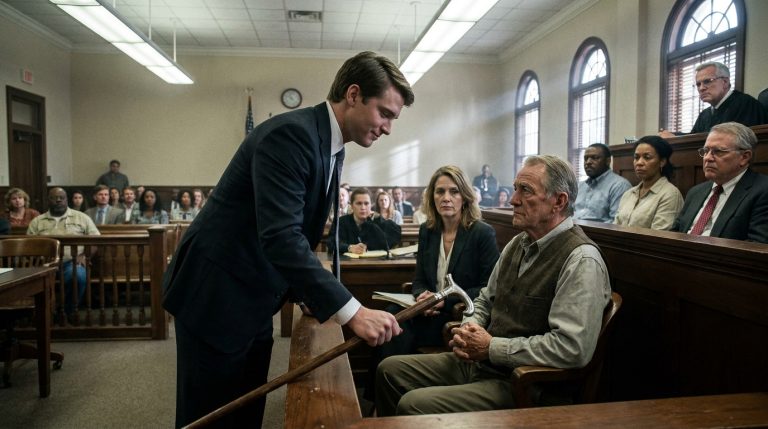
The District Courtroom in San Angelo was packed, the air heavy with the smell of wet wool, floor wax, and sixty nervous spectators jammed into three rows of polished oak pews.
Warren Caldwell sat across the aisle at the defense table, his hands folded over a leather ledger. Beside him sat Lena, her spine straight as a surveyor’s rod, and Ray Bledsoe, who kept thumbing his silver belt buckle with a rhythmic, nervous twitch.
Behind my table, Sandra Vance laid out four black-and-white glossy photographs across the railing.
“Your Honor,” Sandra said, standing up, her voice ringing clear off the high plaster ceiling. “We are requesting an immediate emergency injunction against the Ridgecrest Valley HOA to halt all drilling operations under County Permit 11-B.”
Warren Caldwell’s attorney, a man in a three-piece charcoal suit, didn’t even stand up completely. He merely leaned on his elbows. “This is a frivolous motion, Judge. The HOA holds valid mineral rights transferred by the late Roy Wilson under the 2019 assessment agreement.”
“Roy Wilson died six months before that signature was notarized,” I spoke up, stepping to the center aisle. My voice was low, flat, carrying the dry grit of the ranch dirt.
I set two physical items on the clerk’s bench.
The first was Uncle Roy’s certified death certificate from San Angelo General, stamped September 14, 2018. The second was the digital camera, its SD card locked into a sealed evidence bag.
“The defense claims a standard oil lease,” Sandra continued, sliding a second set of printed documents toward the judge. “Ma’am, these photographs were taken two nights ago at the HOA maintenance storage unit. They show Councilman Ray Bledsoe actively shredding secondary tax ledgers while the HOA president cross-referenced survey files.”
The courtroom stirred. A low rustle of whispers rippled through the back pews like wind through dry corn.
Caldwell’s jaw tightened. He turned his head toward Bledsoe, his brow furrowed into deep, bitter lines. “Your Honor—”
“Silence, Counsel,” Judge Rebecca Thorne said, leaning forward over her glass spectacles. She picked up the photographs, her thumb brushing the clear image of Bledsoe holding a stack of Roy’s receipts over the shredder hopper. “Mr. Bledsoe, is that you in this photograph?”
Bledsoe opened his mouth, his face flushing dark red, but Caldwell’s attorney cut in sharply. “My client was disposing of obsolete administrative records, Your Honor. It has no bearing on the mineral rights transfer.”
“It has everything to do with it,” Sandra said, her hand resting on a thick blue binder. “Because those records contain the original geological logs for Brine Pocket 9. This was never an oil play, Your Honor.”
The judge looked up from the bench, her eyebrows drawn. “Explain, Ms. Vance.”
“Warren Caldwell and Ridgecrest Energy Partners didn’t drill for crude,” Sandra said, her voice dropping into a razor-thin, deliberate cadence. “They falsified the crude oil estimates to buy out the valley residents through manufactured tax liens. The sub-strata surveys under Project Vanguard show the second largest lithium brine and industrial helium reservoir in West Texas, valued at forty-two million dollars.”
The word hit the courtroom like an iron bar dropping on concrete.
Warren Caldwell stood up so fast his chair screeched against the hardwood floor. “That land was defaulting! Roy Wilson couldn’t pay his assessments! We saved this valley from county bankruptcy!”
“You forged a dead man’s hand, Warren,” I said, stepping right up to the bar rail, looking him dead in the eye. “And you used County Permit 11-B to steal forty million dollars from your own neighbors.”
Judge Thorne slammed her gavel down twice—CRACK. CRACK.
“Sit down, Mr. Caldwell!” the judge ordered, her voice trembling with quiet fury. “I am issuing an immediate freeze on all assets held by Ridgecrest Energy Partners and the Ridgecrest Valley HOA. Mr. Sheriff, secure all remaining boxes in the storage unit behind the community center immediately.”
Caldwell didn’t sit. He stood froze behind his desk, his chest heaving, his face drained of all color as two county deputies stepped into the center aisle and took positions directly behind him and Bledsoe.
The gray mask had slipped, and underneath it was nothing but a cornered predator running out of room to turn.
CHAPTER 6: THE LONG COLD WIRE
The metal cuffs clicked around Caldwell’s wrists with a double-strike that echoed off the high plaster ceiling of the courtroom.
He didn’t look at Lena, and he didn’t look at the gallery. His shoulders slumped forward under his tailored jacket, his chin dropping toward his chest as the deputies guided him through the side exit door. The heavy oak door clicked shut behind him, cutting off the murmur of the gallery like a blade.
Sandra Vance slid the blue binder back into her satchel, her hands steady, her breath coming slow. “It’s over, Luke,” she whispered, setting a gentle hand on my forearm. “The county receiver took control of the HOA accounts ten minutes ago. Every fraudulent lien filed under County Permit 11-B has been struck from the books.”
I looked down at the rail where the four black-and-white photos still lay flat. “What about the lithium survey?”
“Project Vanguard is public record now,” Sandra said, leaning back against the wooden rail. “Brine Pocket 9 belongs to the landowners holding the surface deeds. Caldwell’s shell company is finished.”
The match-cut stretched across three weeks of quiet limestone dust and clear autumn skies.
The heavy chainlink fence along my western pasture didn’t stay up long. It took two days with a pair of forty-inch bolt cutters and a diesel flatbed tractor to haul eighty panels of galvanized mesh out of the creek bed.
By Tuesday afternoon, the noise of heavy machinery was gone from the ridge. The yellow earthmovers had been towed away on low-boy trailers, leaving nothing behind in the wash except wide caterpillar tracks cut deep into the dry red clay.
I walked the property line alone, a wooden box of heavy galvanized staples tucked under my arm and a pair of fence pliers gripped in my right hand.
The wind came out of the north, cold and dry, carrying the scent of wild cedar and distant rain. I stopped at the corner post where the old barbed wire had been severed three weeks ago.
Gene Hollister was already there.
He wasn’t carrying his shotgun. He sat on the tailgate of his worn Chevrolet truck, an iron wire-stretcher resting between his boots, a fresh spool of four-point wire sitting in the bed behind him.
He didn’t say a word when I walked up. He just reached into his coat pocket, pulled out a pair of leather work gloves, and tossed them onto the tailgate beside me.
I pulled the gloves on, picked up the iron stretcher, and hooked the teeth into the top strand of high-tensile wire.
“Rains’ll fill that creek bed by November,” Gene said, his raspy voice cutting through the wind as he leaned his weight against the tension lever.
“It will,” I replied, my boots digging into the limestone gravel as I pulled the wire taut against the cedar post.
I set a heavy steel staple over the wire, lined up my claw hammer, and drove the iron home into the seasoned wood. CLANG. CLANG. The wire hummed—a tight, high note that vibrated down the fence line for fifty yards.
“You keeping the whole hundred and sixty?” Gene asked, squinting down the ridge toward the dry wash where the drilling rig used to sit.
“Sixty acres along the creek are going into a permanent conservation easement,” I said, driving a second staple below the first. “Roy’s old pasture stays untouched. The rest goes into a community land trust—Sandra’s supervising the legal board. Any brine lease money goes straight into a fund for the valley residents Caldwell tried to squeeze out.”
Gene spat a brown stream of tobacco juice into the dust, his jaw working slowly. He looked down at the fresh wire, tested the tension with the heel of his boot, and gave a single, slow nod.
“Roy’d have liked that,” Gene muttered, reaching down to pick up the staple box. “He never was much for smooth talkers in starched shirts.”
We worked in silence for another two hours until the sun dropped below the rim of the ridge, painting the limestone hills in deep shades of violet and copper. Four strands of tight, bright wire stretched clean from the corner post to the oak grove at the property line, separating the ranch from the open road.
When the last post was stapled, I pulled off my leather gloves and reached into my coat pocket.
My fingers found the flattened brass 12-gauge shell—the one I’d rolled across the table the morning Lena dropped her envelope in my kitchen. I held it in my palm for a second, feeling the smooth, cold metal and the flat rim that had dug into my skin through every lie and courtroom battle.
I walked over to the corner post, set the brass casing into a small hollow in the weathered cedar headboard, and tapped it deep into the grain with the flat head of my hammer until it sat flush with the wood.
The valley was quiet now. No diesel engines. No drilling rigs. Just the wind through the mesquite and the long, cold line of wire holding the dirt together.