The Iron Ledger: A Grit-and-Diesel Tale of Suburban Border Wars and Hard-Won Survival
CHAPTER 1: THE COLD CALL ON MUDDY GROUND
The engine of the Cat 312 excavator coughed once, spitting a gray plume of diesel smoke into the humid Georgia heat, before the hydraulic line began to weep. Ethan Drummond wiped his palm against his thighs, leaving a dark smear of grease on his canvas work pants. Eight men were currently leaning against the tailgate of the F-250, watching him with the quiet, heavy expectation of people who lived invoice to invoice. The vibration of the idling machinery hummed through the soles of his boots, a familiar, rattling weight that usually kept him grounded. Today, it just felt like a clock ticking down.
Then his phone vibrated against his hip.
The screen was caked in orange Georgia clay, the caller ID showing a Roswell exchange he didn’t recognize. He answered with his shoulder pressed to his ear while he used an adjustable wrench to tighten the weeping fitting.
“Is this Ethan Drummond?” The voice was dry, clipped, and completely devoid of the polite drag common to the local suburbs. It was the voice of someone who managed people by email templates.
“Speaking,” Ethan said, the metal wrench slipping and barking his knuckle against the rusted engine cowl. He didn’t swear. He just swallowed the taste of iron in his throat.
“This is Patricia Morrison. President of the Magnolia Heights HOA. We had three major oaks drop across our main boulevard during the storm Tuesday night. The city says it’s private property. I need a crew with heavy iron out here by three o’clock.”
He looked at his crew. Miguel, his foreman, was squinting through the glare, silently calculating the remaining life on their excavator’s track pads. They needed the work. “I can be there to survey the site in an hour, Mrs. Morrison. But heavy iron doesn’t move without a signed deposit.”
“Just get here, Mr. Drummond. We have roads blocked and homeowners complaining.”
An hour later, Ethan pulled his truck past the stone monument of Magnolia Heights. The bronze letters spelling out the name were choked with shredded oak leaves. The neighborhood was an island of pristine brick houses, but the storm had torn through it like a claw, ripping up manicured lawns and scattering massive root balls across the asphalt.
Patricia Morrison was waiting at the boulevard turnoff, her white Lexus SUV parked perfectly parallel to a splintered mailbox. She didn’t offer a hand when he stepped out. She was wearing a cream-colored pantsuit that looked entirely too clean for the mud pooling around her designer shoes.
“It’s a disaster,” she said, gesturing toward a massive, three-foot-wide red oak that lay like a dead beast across the street. “Our residents can’t get their cars out.”
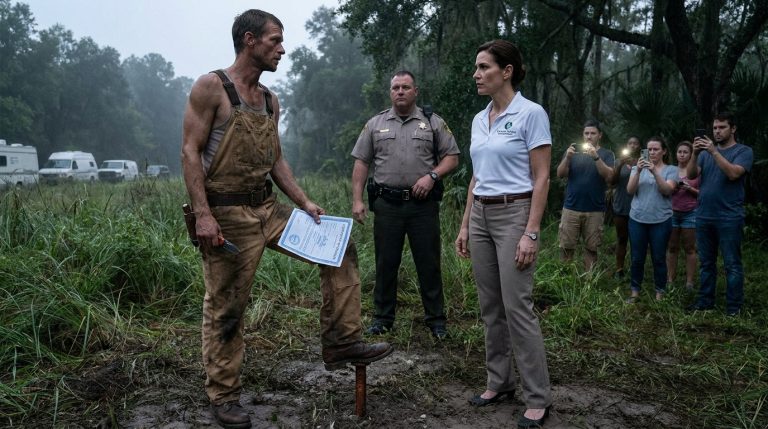
Ethan knelt by the oak’s base. His fingers brushed the rough bark, but his eyes caught something else—a physical discrepancy in the dirt beneath the uprooted root ball. The soil wasn’t the typical dense red clay of north Georgia; it was a loose, grayish silt that smelled faintly of old sulfur, shifting under the weight of his boot.
“This tree didn’t just blow over, Mrs. Morrison,” Ethan said quietly, his thumb tracing the crumbling, wet gray earth. “The ground underneath gave way first.”
Patricia’s posture went instantly rigid. The slight breeze caught her short, sharp hair, but her face remained entirely frozen. “It was the wind, Mr. Drummond. Just clear the wood. I don’t pay for geological opinions.”
CHAPTER 2: THE FRICTION OF PAPERWORK
The silence that followed her words was as thick as the humid Georgia air. Ethan let the grey, sulfur-scented silt trickle through his fingers, watching it coat the damp grass like ash. He stood up slowly, the joints in his knees popping with a dry, metallic click that mirrored the idle of his truck engine twenty yards away. His palm was stained dark where the dirt had mixed with the sweat and grease of the excavator’s cowl.
“The wind didn’t make this soil turn to paste, Mrs. Morrison,” Ethan said, his voice flat, retaining the low, steady rumble of a man who spent his life speaking over diesel engines. “But if you just want the wood gone, that’s what we’ll price.”
Patricia didn’t look at the dirt. Her eyes were fixed on the white Lexus, her fingers tapping a sterile, rapid rhythm against the glass of her phone screen. “Three weeks is too long. We have a board meeting on Thursday. I want your men clearing the main boulevard by Friday morning. And as I mentioned, our standard template runs on net-30 terms. The board doesn’t write checks on-site.”
She reached into the open passenger window of her SUV, her manicured hand shifting a leather tote bag to retrieve a stiff plastic clipboard. As she pulled the bag forward, the leather gaped open. Ethan’s eyes, trained to spot misaligned pins and hairline fractures in heavy steel, caught the edge of a thick, cream-colored document tucked inside. Stamped in red ink across the header were the words: The 109-A Environmental Report. Beneath it, a second folder bore a hand-written label: Roswell Silt-Vein.
She snapped the tote shut before he could read further, her expression remaining a mask of polished, suburban authority as she slid the clipboard toward him. “The contract template is standard. Sign it, scan it back to me by tonight, and we’ll secure the mobilization.”
Ethan took the board. The cold aluminum frame felt unyielding against his calloused hands. The paper was crisp, dry, and entirely removed from the gritty reality of the uprooted oaks behind them.
Net-30.
The words on the page seemed to shrink and expand. In his mind, the psychological phantom of Friday’s payroll began to claw at his chest. Twelve thousand dollars. That was the magic number his crew needed to feed their families, to keep Miguel’s truck running, to pay the interest on the Bobcat lease that was currently sitting in his yard with a cracked hydraulic pump. His father’s voice, raspy and smelling of cheap tobacco, echoed in the back of his mind: An honest day’s labor is paid when the sun goes down, Ethan. You let a suit hold your money for thirty days, and you’re just paying for their privilege to starve you.
But the yard was empty. The Georgia DOT jobs had dried up three weeks ago, and the bank account was a shallow puddle of triple-digit balances.
“Thirty days is hard for a crew of my size, Mrs. Morrison,” Ethan said, his thumb tracing the rough, rusted edge of the clipboard’s metal spring. “Fuel alone for the excavators is going to run five hundred dollars a day. I usually require fifty percent upfront to cover mobilization and diesel.”
“The board approved net-30,” Patricia replied, her voice dropping into an icy register that brooked no negotiation. “If Drummond Excavation cannot handle the cash flow of a premier residential contract, I can easily call Roswell Greenery. They have thirty men and six brand-new John Deeres.”
She was bluffing about the timeline—Roswell Greenery was booked out through the autumn—but she knew exactly where the leverage lay. She knew the mud on his boots wasn’t a fashion statement. It was his livelihood.
Ethan looked past her, toward the massive red oak. Its roots, still tangled with that strange, grayish silt, looked like skeletal fingers reaching for the sky. He felt the grit under his fingernails, the slow, scratching reminder of the earth’s weight.
“I’ll look over the terms,” Ethan said, refusing to give her the satisfaction of an immediate nod. “But any extra work—any stumps, any fence repairs, any drainage clearing beyond the fallen trunks—gets written down on a separate sheet. Initialed by you. On the day of the work.”
Patricia’s lips thinned into a straight, bloodless line. “Naturally, Mr. Drummond. We are a professional association. We expect everything to be documented.”
She turned, her heels clicking sharply against the asphalt as she climbed back into the leather-scented sanctuary of her Lexus. The door shut with a heavy, pressurized thud, sealing her away from the smell of sulfur and wet rot.
Ethan walked back to his truck, the aluminum clipboard heavy under his arm. He climbed into the cab, the vinyl seat cracking under his weight, and threw the clipboard onto the dashboard. The smell of old coffee and rusted iron chains filled the small space. He reached for his brass mechanical pencil, his fingers tracing the deep scratches on its barrel, and prepared to write the estimate that would either save his company or bury it in thirty days of silence.
CHAPTER 3: THE GRIND OF THE OAKS
The lead of the brass pencil snapped with a sharp, dry pop against the yellow pad. Ethan didn’t blow the graphite dust away; he smeared it into the paper with his thumb, leaving a dark, leaden bruise next to the number: $85,000. He clicked the eraser cap, feeding a fresh millimeter of carbon down the sleeve, and stared through the yellowed windshield of his Ford. Out on the asphalt, the dark outline of the red oak remained a silent obstacle under the gathering dusk. He knew the risk of signing onto net-30 terms with a woman who hid environmental surveys in her handbag. But his crew needed the diesel, and the bank didn’t care about the smell of the soil. He started the engine, shifted into drive, and let the heavy tires of the truck roll slowly out of the neighborhood, the frame groaning as he crossed the drainage dip.
By Friday morning, the quiet of Magnolia Heights was shattered by the high-velocity scream of two-stroke engines.
Ethan stood near the shoulder, his hands shoved deep into his grease-spotted vest pockets. The air was thick with the scent of vaporized bar oil, damp sawdust, and the sulfurous gray dust kicked up by the excavator’s tracks. Miguel was in the cab of the Cat 312, his hands light on the joysticks, coaxing the hydraulic arm to pin a two-ton section of the oak trunk against the blade.
“Watch that high side, Tommy!” Ethan called out, his voice cutting through the roar of the wood chipper.
Tommy, his face masked by plastic safety mesh and caked in fine pine dust, nodded and buried the bar of the Stihl 660 into the heart of the trunk. The chain spat large, wet chips of red wood. Suddenly, there was a high-pitched, metallic shriek—not the sound of wood meeting steel, but steel hitting old, forgotten iron. The saw bucked violently in Tommy’s grip. A sharp ping echoed off the brick facade of the nearest house as the chain split, whipping back against the aluminum guard with a sickening crunch.
Tommy cut the throttle instantly. The engine sputtered out, leaving only the low, heavy thrum of Miguel’s excavator idling in the background.
“Hit a spike,” Tommy muttered, lifting the saw to reveal the ruined, mangled teeth of the chain. “Deep in the grain. Must’ve been an old fence line from forty years ago.”
Ethan walked over, his boots crunching on the fresh mulch. He knelt beside the half-cut log. Deep within the rings of the oak, buried under three decades of growth, was a thick, rusted iron spike. The metal had corroded into the wood, staining the surrounding fibers a deep, bruised black. It was a physical barrier, silent and unyielding.
“We don’t have another sixty-inch bar chain in the truck,” Miguel said, leaning his head out of the cab of the Cat. “We’ll have to haul the trunk whole or use the hand wedges.”
“Get the iron wedges,” Ethan said, his hand tracing the cold, jagged edge of the split chain. “And the sledge. We don’t have time to wait for a delivery from the shop. We do it manually.”
As Tommy walked back to the utility box of the flatbed, a white Lexus cruised to a stop near the debris pile. The door opened, and Patricia Morrison stepped out, her crisp linen shirt a stark contrast to the dust-filled air. Under her arm, she carried a thick, black leather binder with gold-embossed lettering along the spine: The Morrison Ledger.
She didn’t look at the damaged saw or the sweat dripping from Tommy’s chin. Her eyes went straight to the stump of the oak, which still sat three feet above the manicured turf.
“Mr. Drummond,” she said, her voice cutting through the smell of exhaust. “I spoke with several board members yesterday. We’ve noticed the storm runoff is pooling near the eastern culvert. Since your machines are already here, we’ll need you to clear that drainage ditch. And these stumps—they can’t remain. They need to be ground down at least six inches below the sod.”
Ethan wiped a line of sweat from his forehead with the back of his hand, feeling the gritty grit of the bark dust. “The drainage ditch and stump grinding weren’t in the Thursday contract, Mrs. Morrison. That’s additional machine hours and tooth wear on the grinder.”
“It’s part of restoring the boulevard,” Patricia said, her fingers tightening around the edge of her black ledger. “Surely a professional operation doesn’t leave half a job behind. Just write the details down in your little book, and we’ll settle the variance at the end.”
Ethan pulled his small, grease-stained notebook from his back pocket. He felt the cold weight of the iron wedge Tommy had just dropped on the grass beside him. He wrote down the date, the request, and the estimated hours for the culvert clearing, then held the pad out toward her.
“Initial here,” Ethan said, his voice flat. “For the record.”
Patricia stared at the cheap paper, her nose wrinkling slightly. She took his brass pencil, her movements quick and resentful, and scribbled her initials—PM—next to the column. She handed the pad back, her eyes scanning the gray silt still clinging to the base of the uprooted tree.
“Just make sure it’s done by next Friday, Mr. Drummond,” she said, her tone dropping into a low, transactional whisper. “The board doesn’t like looking at ruins.”
She turned back toward her car, leaving Ethan standing in the dust. He watched her go, his thumb tracing the sharp, indented lines of her initials on the page, knowing every line of ink was a shield he would eventually have to carry into battle.
CHAPTER 4: THE ICEWATER BILL
Ethan stared down at the crisp, jagged PM carved into the yellow paper of his pad. The graphite dust still clung to the edges of the indentation. Slowly, he folded the page down and slipped the small notebook into his pocket. He didn’t look up as the white Lexus pulled away, its tires whispering over the grit-dusted asphalt. The heavy silence of the road closed in again, broken only by the sharp, metallic ping of Tommy’s hammer striking the iron wedge to split the remaining wood.
Three weeks passed in a blur of diesel exhaust, screaming grinders, and the relentless, bone-deep ache of twelve-hour shifts.
By the final Friday afternoon, Magnolia Heights had been returned to its pristine, manicured state. The massive fallen oaks were gone, the jagged stumps ground down six inches below the black dirt, and the eastern drainage ditch cleared so cleanly that the water flowed without a ripple. Ethan stood by the tailgate of his F-250, his fingers tracing the worn, pitted steel of the truck’s bed. The air smelled of freshly cut wood, damp soil, and the faint, bitter tang of hydraulic fluid from his machinery.
“Last load’s on its way to the landfill,” Miguel said, wiping a dirty sleeve across his forehead as he shut down the excavator. The engine died with a long, whistling sigh. “The boys are ready for that payroll check, boss.”
Ethan nodded, his throat dry. “I’m sending the final invoice now.”
He climbed into the cab of his truck, the vinyl seat cold against his back. From his dashboard, he took the heavy manila envelope containing the detailed invoice. It wasn’t just the original eighty-five thousand dollars; it included every single change order, every stump grind, and the drainage ditch clearing. The total stood at ninety-eight thousand, five hundred dollars. Every addition was meticulously documented, with the scanned sheets of Patricia’s initials attached to the back. He uploaded the document to the HOA portal and hit send.
The silence inside the cab grew heavy. For thirty minutes, the only sound was the wind rustling the remaining leaves overhead.
Then, his phone rang. The screen lit up with Patricia’s name.
Ethan pressed the receiver to his ear. Before he could speak, her voice cut through the line—devoid of the polished, suburban warmth she used in public, reduced to a sharp, frozen edge.
“This invoice is unacceptable, Mr. Drummond.”
Ethan tightened his grip on the steering wheel, his calloused thumb rubbing against the worn leather wrap. “Every dollar on that sheet is backed by a signed work order, Mrs. Morrison. You initialed the changes yourself.”
“My initials requested information on those tasks,” Patricia said, her voice dropping into a flat, level tone that felt as cold as dry ice. “They did not authorize additional charges. Our contract was capped at eighty-five thousand. The board will not pay a penny more.”
“That’s not how this works,” Ethan said, his voice dropping into a low, dangerous rumble. “The equipment ran for sixty extra hours. My guys worked through the weekend to clear your clogged culverts.”
“We will pay the eighty-five thousand once the net-30 term expires,” she replied, her words clipped and final. “Take it, or we will tie this up in court until your machines are repossessed. Have a good evening.”
The line went dead with a dry click.
Ethan slowly lowered the phone. Outside the windshield, the sun was dipping below the high rooflines of the brick estates, casting long, skeletal shadows across the empty street. He could hear the low murmur of his men waiting by the flatbed, unaware that the ground beneath their next payroll had just dissolved into thin air.
CHAPTER 5: THE LEGAL TRENCH
The phone in Ethan’s hand stayed silent, the screen fading to black and leaving only his greasy thumbprint reflected in the glass. He sat entirely still in the cab of the Ford. Outside, the dusk had swallowed the brick facades of Magnolia Heights, leaving only the amber running lights of his flatbed to cut through the shadows. The low, gravelly murmuring of Tommy and Jake by the trailer was a constant hum against the truck’s floorboards. They were waiting for their pay.
Ethan pushed the door open. The rusted hinge gave a dry, screaming complaint as his boot hit the packed gravel.
“Miguel,” Ethan said, his voice flat, dropping the word like a heavy tool. “Pack the chains up. Lock the excavator’s cab.”
Miguel stopped, a clean grease rag frozen halfway down a steel winch line. He looked at Ethan’s posture, then at the darkened phone in his hand. “She’s choking us?”
“She says she’s paying eighty-five, not a dime of the extras. And we wait the thirty days,” Ethan said. He didn’t let his chest rise with a sigh. He walked to the back of the bed, reaching into the steel tool chest to retrieve the heavy brass padlock for the trailer chains. The cold iron of the lock felt reassuringly thick in his palm. “We’re leaving the iron here. No more favors. I’m calling Shun first thing in the morning.”
Twelve hours later, Ethan was sitting in a basement office in downtown Decatur that smelled of water damage and old carbon paper. David Shun didn’t look like a lawyer who took corporate retainers. He wore a rumpled gray suit with frayed cuffs, and his desk was a fortress of cardboard boxes filled with probate files and boundary disputes.
A single fluorescent tube overhead flickered with a faint, rhythmic buzz, casting a cold, greenish light over the papers between them.
“They didn’t just reject the invoice, Ethan,” David said, his finger sliding a thick, blue-backed document across the scarred mahogany desk. The paper rasped dryly against the wood. “They filed. A formal counter-suit. Breach of contract, property damage, and civil fraud.”
Ethan’s jaw tightened, the muscle along his cheek twitching once. He reached out and touched the corner of the blue folder. “Fraud? We cleared every foot of their road. We ground down their stumps.”
“They’re alleging you used unauthorized heavy machinery that cracked their sub-grade drainage lines,” David explained, tapping a page of the filing. “They claim your Cat excavator caused eighty thousand dollars in structural settling near the entrance. It’s a classic starvation play. They know your cash flow is tight. If they tie you up in a construction defect suit, your insurance premium spikes, your credit line freezes, and you settle for whatever crumbs Patricia throws your way.”
Ethan turned the page. His eyes scanned the dense, legal jargon, but they stopped on a small, physical discrepancy on the third sheet. Attached to the complaint was a photocopy of a soil density test. The letterhead was partially cut off, but the bottom of the page bore a tiny, blurred logo: Roswell Silt-Vein Partners LLC.
It wasn’t a standard civil engineering firm. It was the same name he had seen on the folder inside Patricia’s leather tote bag three weeks ago.
“David,” Ethan said, his thumb pressing down on the blurred logo, his nail leaving a crescent mark in the paper. “They’re using their own people to test the ground. Look at the date on this soil test. It was conducted two days before we even rolled the excavator onto the property.”
David leaned forward, his spectacles slipping down his nose as he squinted at the page. The hum of the fluorescent bulb seemed to grow louder in the small room.
“They had an engineering assessment done before the storm?” David muttered, his index finger tracing the filing date. “But they’re claiming our digging caused the shifting.”
“They’re hiding something in that dirt,” Ethan said, his voice dropping into a hard, quiet register. “And they’re trying to make my company pay the bill to bury it.”
David leaned back in his chair, the old springs groaning under his weight. He looked at the grease still embedded deep in the lines of Ethan’s palms. “If we fight this, we have to go through full discovery. Depositions. It’ll cost fifteen thousand in filing fees and expert witnesses just to get Patricia under oath. Can you hold out that long?”
Ethan reached into his pocket, his fingers brushing the small, grease-stained notebook with Patricia’s initials carved into the paper. He thought of his men, of the empty yard, of the red oak roots sitting in that gray, rotten-smelling silt.
“We don’t crawl,” Ethan said. “Schedule the deposition.”
CHAPTER 6: THE DEPOSITION TRAP
The decision hung in the damp air of David Shun’s basement office like the smell of iron rust after a storm. Ethan’s thumb remained pressed against the blurred soil test logo, his skin absorbing the cold grit of the printed paper. He didn’t lift his eyes from the name Roswell Silt-Vein Partners LLC until David picked up his desk phone to place the call. There was no transition of time, no skipped hours in Ethan’s mind; the momentum of their defense dragged them straight into the sterile, white-walled conference room of the court reporter’s suite on the third floor of the Decatur courthouse.
The room smelled of dry carpet and ozone. In the center sat a long, faux-grain table, its surface polished so heavily it reflected the harsh glare of the fluorescent tubes overhead.
Ethan sat with his large hands flat on the table, his fingers feeling the cold, cheap veneer. To his left, David Shun was quietly organizing his files, the whisper of turning pages the only sound in the room besides the rhythmic, high-pitched clack-click of the court reporter testing her machine. That mechanical hum triggered a sudden, unbidden sensory memory—the metallic rattle of his father’s old steel tool chest when Ethan was twelve, the sharp tang of 3-in-One oil, and his father’s low voice reminding him that a man who hides behind paper is always afraid of the dirt.
The door opened, and Patricia Morrison walked in.
She was flanked by her attorney, a younger man in a crisp charcoal suit who carried a heavy leather briefcase. Patricia did not look at Ethan. She took her seat across the table, her cream-colored blazer perfectly pressed, her manicured fingers resting on her phone. But as she sat, her hand brushed the edge of her black leather binder—the Morrison Ledger—which she placed carefully on the polished table.
“We are on the record,” the court reporter announced, her fingers hovering over the keys.
For the first two hours, the deposition was a grueling exercise in deflection. Patricia’s voice remained smooth, controlled, and empty of emotion as she answered David’s questions.
“The board never approved any additional expenses,” she said, her head tilted at a precise, professional angle. “Mr. Drummond was contracted to clear the storm debris for eighty-five thousand dollars. The extras he claims to have performed were either part of his original scope or unauthorized volunteering.”
David Shun didn’t raise his voice. He reached into his battered briefcase and pulled out a stack of paper. The dry sheets rasped against each other as he slid them across the polished table, directly toward Patricia’s attorney.
“I am entering Exhibit D,” David said quietly. “These are the daily work logs from Drummond Excavation, dated September twelfth through September twenty-fourth.”
Patricia’s attorney glanced at them, his face expressionless. “We’ve seen these. They are self-serving logs created by the plaintiff.”
“Look at the bottom right corner of pages three, five, and seven, Mrs. Morrison,” David continued, his voice dropping into a steady, methodical rhythm. “There are handwritten initials. PM. Written in heavy, blue ballpoint ink.”
Ethan watched her face. For a fraction of a second, the muscles around her mouth tightened, the polished mask slipping just enough to reveal the hard, calculating calculation underneath. She didn’t reach for the papers. Instead, her hand moved subtly toward her black leather binder, her fingers tapping a frantic, silent rhythm against the gold-embossed spine.
“I initialed those sheets to acknowledge that Mr. Drummond was on-site,” Patricia said, her voice rising slightly, losing its smooth glaze. “It was not a financial authorization.”
“You initialed directly under the line reading ‘Authorized Additional Scope: Stump grinding and eastern culvert excavation at one hundred and twenty dollars per machine hour,'” David said. He leaned forward, his elbows resting on the table. “You are the president of an association representing over three hundred homes, Mrs. Morrison. Are you testifying under oath that you sign legal documents without reading the line immediately above your pen?”
Her attorney leaned over, whispering quickly into her ear. Patricia’s breathing grew shallower, her shoulders tensing under the clean linen of her blazer.
Ethan slowly reached into his pocket and pulled out his brass mechanical pencil. He placed it on the table, the heavy metal clicking against the wood. He didn’t speak. He just watched her eyes dart toward the pencil, then down to the blue ink of her own initials on the paper. The trap was set, the steel jaws of her own documentation closing around her, but the absolute truth of why she had tried so hard to starve him out still lay locked inside the dark pages of the ledger she held so tightly against her chest.
CHAPTER 7: THE SILTVEIN DISCLOSURE
The deposition room remained frozen, the hard blue ink of the PM initials on the paper seemingly vibrating under the glare of the fluorescent lights. Patricia’s hand stayed paralyzed near the gold-embossed spine of the Morrison Ledger, her gaze locked onto the heavy brass pencil resting between them on the veneer. She didn’t defend herself; her lawyer’s pen stopped scraping. Ethan let the silence sit for three slow, measured breaths, then stood up, his chair legs scraping a dry, metal-on-concrete groan against the floor.
He didn’t wait for her to recover. He turned his back on the sterile room, leaving David Shun to handle the formal suspension of the day’s questioning, and walked straight out into the heavy, late-afternoon heat of the courthouse parking lot.
The metal door of his F-250 was hot enough to burn his palm as he pulled it open. He climbed into the cab, the smell of baked vinyl and old chain grease rising to meet him. He had just reached for his keys when his phone began to vibrate against the steering column.
The screen showed a private number.
Ethan pressed the phone to his ear, his fingers catching the gritty texture of dust on the speaker. “Drummond.”
“Ethan? It’s Carol. From the board.” Her voice was a hushed, breathless rush, competing with the low hum of air conditioning on her end. “I’m calling from my car. I saw what happened in the deposition. Patricia is desperate. She’s trying to call an emergency closed-door meeting tonight.”
Ethan leaned his head back against the vinyl headrest, his eyes tracking a hairline crack in the dashboard. “She lied under oath, Carol. She signed for every machine hour.”
“It’s worse than that,” Carol whispered, her voice dropping into a tense, rapid register. “The ninety-eight thousand dollars wasn’t the problem. The reserve fund is completely gone, Ethan. She didn’t spend it on landscaping or pool repairs. Last year, she found the Roswell Silt-Vein.”
The name hit the cab like a dry gust of wind. Ethan sat up, his boots shifting on the rubber floor mat. “The soil test. The grey dirt under the oak tree.”
“The eastern section of the subdivision was built over an old municipal dump site that was never fully reclaimed,” Carol said, the words spilling out in a panicked torrent. “The clay is shifting because of chemical runoff underneath—a massive sinkhole is forming under the back lots of houses twelve through eighteen. Patricia found out when she commissioned the 109-A Environmental Report six months ago. If that report got out, property values would drop sixty percent overnight. Her own house would be worthless.”
Ethan’s hand tightened on the steering wheel until his knuckles went white. “So she hired her own company, Roswell Silt-Vein Partners, to run a sham containment project. She used the HOA reserve funds to pay them off to keep it quiet.”
“Yes,” Carol breathed. “She used almost ninety thousand dollars from the emergency reserves to buy concrete slurry to inject into the shifting silt, masking the damage. But when the storm hit, it tore the trees up anyway and exposed the grey clay. She didn’t have the money to pay your invoice because she’d already spent the reserves on the cover-up. If she approved your extra charges, she’d have to open the ledger to the entire board to justify the budget increase. She had to sue you, Ethan. She had to make you the scapegoat to keep the state inspectors from looking at the ground.”
The pieces fell into place with a sickening, metallic clink. The storm hadn’t just knocked down trees; it had ripped the scab off a toxic, shifting lie. Patricia Morrison wasn’t just a difficult client. She was a cornered animal trying to bury her own decay under the weight of his small business.
“Where is the original report, Carol?” Ethan asked, his voice low, steady, and relentlessly focused.
“It’s in the ledger,” Carol said, her breath catching. “She keeps the physical copy of the 109-A report and the Roswell Silt-Vein payout receipts in the Morrison Ledger. She has it with her. If she destroys those documents tonight, we have nothing.”
Ethan turned the key in the ignition. The diesel engine roared to life, a vibrating wall of noise that drowned out the quiet suburban sounds of the courthouse lot. “She won’t destroy them,” Ethan said, shifting the truck into reverse. “Because we’re coming for the ledger.”