The Iron Shore of Caldwell County: A Novel of Rusted Sovereignty and Generational Endurance
CHAPTER 1: THE ACCREDITED WATER
The lake pulled the morning fog into its center, a gray skin that smelled of iron, wet loam, and the slow decay of oak leaves sinking into the shallows. Clint Hargrove stood where the red clay met the water, his boots sinking two inches into the silt before finding the hard, unyielding river stone his grandfather had dumped here forty years ago. His knuckles were dry, stained with the gray grease of a tractor engine he’d spent the night trying to silence. The silence of the farm was different now. It didn’t have Merritt Hargrove’s rhythmic, heavy boots clearing the porch steps. It just had the wind through the loblolly pines and the low, flat slap of the water against the pilings.
The pop of small gravel broke the rhythm. Two pairs of clean white sneakers came down the slope from the Stonebridge Meadows line, stepping precisely around the wild blackberry briars. Bev and Trish wore matching blue polo shirts with the gold-stitched crest of the development over their left breasts. One carried a leather folio clamped beneath her arm like an extra rib; the other held a plastic badge on a neon lanyard.
“Honey, this is a managed community,” Bev said, her voice dropping like dry gravel onto a tin plate. “You don’t just show up here without authorization.”
Clint didn’t turn his head immediately. He watched a blue heron lift off from the far reedy point, its wings heavy and silent in the mist. “My grandfather built the dock you’re looking at in eighty-three,” he said. His voice was low, rough from three days of speaking only to funeral directors and neighbors bearing cold casseroles. “The cedar underneath it is older than your subdivision.”
Trish stepped forward, her shoes clicking against a dry pine limb. “The rules changed when the parcel lines were stabilized, Mr. Hargrove. We’re doing the mid-quarter compliance sweep. If you don’t have a current lake use badge registered to your name or your father’s estate, the shoreline is restricted access. The board has an active maintenance covenant on the water quality.”
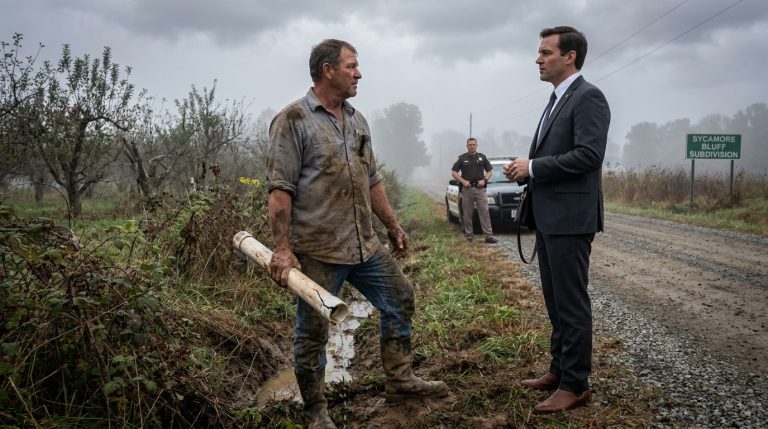
Clint turned then. The iron pin from the old smokehouse door was heavy in his right pocket, cold against his thigh. He looked past their starched collars toward the eastern tree line, where the decorative mailboxes began. He noticed something small then—a fresh wooden stake driven into the mud three feet inside his family’s historical fence line, its top painted a violent, neon orange. The wood was clean, unweathered by the lake air.
“Who drove that stake?” Clint asked, his eyes narrowing as he stepped toward the marker.
“That’s part of the new amenity demarcation,” Bev said, opening her folio with a sharp click of the brass binder rings. “The president authorized it on Tuesday. We have to clear the buffer zones before the seasonal kayak tags go out.”
Clint reached down and wrapped his grease-stained fingers around the raw pine of the stake. The wood resisted for a second, the dry clay gripping it tight, before it broke free with a wet, sucking sound. He didn’t drop it. He held it like a measuring rule, looking at the fresh ink stamped near the bottom: Property of Stonebridge Meadows HOA – Asset Management. The ink was still dark, untouched by the sun.
CHAPTER 2: THE RECKONING OF THE LINE
The raw pine of the stake was cold in Clint’s hand, the damp earth clinging to its pointed end like fresh blood. He didn’t drop it. He simply let its weight rest against his palm, his knuckles gray with grease, contrasting sharply with the pristine, laminated white of Bev’s folio.
Trish took a half-step backward, her clean white sneakers crunching onto a loose piece of gray shale at the edge of the ditch. Her hand rose instinctively to touch the neon lanyard around her neck, as if the plastic badge could ward off the sheer physical presence of a man who had spent the last forty-eight hours digging his father’s legacy out of the clay.
“This is a formal administrative demarcation, Mr. Hargrove,” Bev said. Her voice had lost its gravelly softness, tightening into the thin, high pitch of a woman who was used to her letters being answered by lawyers, not by a man in mud-spattered work boots. “The board authorized the buffer survey on Tuesday. If you interfere with the placement of the markers, we will be forced to file an official obstruction report with the county sheriff.”
Clint looked down at the neon orange paint on the wood. “The sheriff knows where the county line is, Bev. He also knows where my grandfather’s deed starts.” He took a slow step forward, not rushing, letting his boots sink with a heavy, deliberate rhythm into the wet silt. He held the stake out, the muddy point aimed directly at the space between them. “Take your timber with you. If I find another piece of painted pine on this side of the ditch, I’m putting it through the woodchipper.”
Bev’s jaw went rigid. She didn’t reach for the stake. Instead, she tucked her folio tighter under her arm, her fingers sinking into the fake leather. “We’ll let the management company handle this. Some people have to learn the hard way that they don’t own the world anymore.”
She turned on her heel, her sneakers catching on the low blackberry briars before she found her footing on the asphalt of the subdivision road. Trish followed her, her pace hurried, her eyes fixed straight ahead as if looking back would somehow make the red clay of the farm stick to her ankles.
Clint watched them until they crossed the invisible line where his grandfather’s unpaved gravel road met the black, oil-stained asphalt of Stonebridge Meadows. Only then did he drop the stake. It landed with a dull thud in the weeds, its neon orange tip pointing back toward the development like a discarded warning.
He walked up the rising slope toward the farmhouse, his shoulders stiff beneath his denim jacket. Every step felt heavier than the last. The wind had shifted, bringing the smell of cold chimney soot and dry grass from the upper pasture. He climbed the three pine steps of the back porch, the wood groaning beneath his weight with a dry, hollow creak that sounded like an old man clearing his throat.
Inside, the kitchen was quiet in a way that made his ears ring. The counters were still lined with covered aluminum pans—cold ham, potato salad in plastic tubs, and a half-empty box of glazed donuts from the church social. The air tasted of stale coffee and the cloying, sweet scent of yellow lilies that had begun to wilt in a jar by the sink.
Sitting directly in the center of the Formica table, propped against a salt shaker, was the white window envelope.
Clint tore it open with his thumb, the cheap wood-pulp paper splitting with a dry rasp. The letterhead was official: Stonebridge Meadows Homeowners Association – Executive Office.
NOTICE OF COMPLIANCE VIOLATION
Parcel: Adjacent 04-B (Hargrove/Puit Agricultural Holding)
Violation: Section 4.2 – Amenity Access Interference & Mailbox Non-Compliance.
Assessment: $150.00 (Daily accrual active until resolution).
Note: Property owner must ensure all private structures, including historical mailboxes and boundary indicators, conform to the 2016 general parcel stabilization survey.
“Stabilization survey,” Clint muttered. The words tasted like sand.
He knew the 1981 boundary lines by heart. His father had walked them with him every October, showing him the iron pipe driven into the creek bed and the three stacked quartz stones near the old walnut tree. “A line isn’t something a surveyor puts on a map, Clint,” Merritt had said, his hand rough on Clint’s shoulder. “It’s where your sweat stops and the next man’s begins. You don’t let them push it.”
Clint turned toward the basement door. The brass knob was cold, the latch dry and ungreased. He opened it, and the scent of the cellar rose to meet him—damp fieldstone, coal dust, and the heavy, sweet smell of cured pork that still clung to the concrete walls from winters long past. He descended the wooden steps one by one, his eyes adjusting to the dim, gray light filtering through the small ground-level windows.
At the far end of the cellar, past the rows of empty blue Mason jars, stood his grandfather’s old green military-surplus filing cabinet. Its steel drawers were scratched and rusted along the seams, the olive-drab paint bubbling near the brass pull handles.
Clint grabbed the handle of the bottom drawer and pulled. The metal shrieked against the tracks, resisting him until he threw his shoulder into it, popping the rusted seal with a sharp bang that echoed off the stone foundation.
He reached inside, his fingers brushing past old crop reports and yellowed receipts for fertilizer. At the very back of the drawer, wrapped in an oilcloth to protect it from the dampness, was the heavy, leather-bound volume: the Puit-Caldwell Deed Ledger.
The leather was dry, shedding tiny red-brown flakes that drifted down onto his knuckles like rust. He unbuckled the brass clasp and opened the ledger across his knees. The pages were thick, rag-paper sheets filled with his grandfather Elden’s meticulous, slanting longhand.
As Clint flipped through the 1981 plats, his fingers caught on a loose slip of pink carbon paper tucked between the ledger sheets. It was a receipt from the Caldwell County Assessor’s office, dated October 12, 1983.
The title at the top of the slip was clear: 1983 Tax Instrument 402.
He brought his flashlight closer, the yellow beam illuminating the faint, purple typewriter ink. The document recorded a minor property adjustment, but near the bottom margin, in his grandfather’s tight script, was a pencil note that made Clint’s thumb freeze against the page:
“Checked the stone line today. Surveyors tried to run the line five feet west for the timber cut. Showed them the Caldwell book. They backed off. Watch the road easement.”
Just below the note, another hand—newer, written in sharp black ballpoint—had added a single word with an arrow pointing to the easement boundaries:
Vanguard.
Clint’s chest tightened. He didn’t know what Vanguard was, but the ink was fresh enough that it hadn’t yet faded into the yellowing paper. He sat there in the silence of the cellar, the cold iron hinge pin heavy in his pocket, listening to the drip of condensation off the copper pipes. The line hadn’t just been crossed today. It had been shifting in the dark for years.
CHAPTER 3: THE ANCHOR IN THE DUST
The purple ink of the unrecorded receipt didn’t blur under the yellow beam of Clint’s flashlight. It sat clean on the paper, a cold reminder that history didn’t vanish just because someone built an asphalt road over it. He closed the thick leather-bound volume, the dry skin of the ledger crunching against his palms, leaving a fine orange residue. Slipping the pink carbon copy into his interior shirt pocket next to the weight of his father’s old pocketknife, Clint lifted himself off the wooden crate. His knees made a dull popping sound in the silence of the basement, a stark contrast to the steady drip of the copper water pipe behind the furnace.
He moved up the stairs deliberately, tracking his boots exactly on the center of each runner to damp the creak of the dry pine boards. Upstairs, the kitchen was still caught in the gray afternoon light, the smell of church lilies hanging low and thick near the ceiling. He picked up the heavy black receiver of the landline phone on the wall—the same phone his father had used to answer Darla’s first polite threat in 2019.
He dialed Constance Waverly’s office line from memory, his finger catching in the plastic rotor wheel with a dry click. The phone rang three times before her assistant routed it through.
“Clint,” Constance said, her voice dropping the standard professional lilt the moment she realized who was on the line. “I’ve been combing through the municipal zoning database for the 2016 Stonebridge filings. Something isn’t squaring with the county plat maps.”
“I’m in the basement,” Clint replied, his eyes tracing the red grease smudges on the white Formica counter. “I found Granddad’s old ledger. There’s a pink slip from eighty-three. Tax Instrument Four-O-Two. He wrote a note on the back about an easement cut, and someone else added a name in ballpoint. Vanguard.”
There was a distinct pause on the wire, the kind of quiet that happens when a surveyor realizes the benchmark they’ve been using is ten feet off true. “Vanguard Utility,” Constance murmured, the sound of her fountain pen scratching against legal cap paper echoing over the small speaker. “They didn’t just build the subdivision houses, Clint. The development corporation bought the eastern ridge through a holding company, but Vanguard retained the sub-surface industrial corridor rights for the natural gas bypass. If that tax instrument was never recorded in the county courthouse register, it means the HOA’s founding board didn’t just inherit a boundary. They inherited a liability.”
“They’re fine-tuning the line, Constance,” Clint said, his thumb tracking the edge of the violation notice still propped against the salt shaker. “Two women from the board were down at the water twenty minutes ago. They’re driving orange stakes three feet past the old walnut tree. They’re claiming an amenity access violation on the old mailbox post too.”
“Do not touch the markers they’ve placed today, and do not sign anything they slide under the door,” Constance instructed, her tone sharpening into the cold, calculated precision that made local land developers check their liability insurance. “The ‘amenity access compliance’ wording in that notice is a specific corporate shield. They are trying to establish a prescriptive easement by active use before the estate transfer clears probate. I’m driving out to the county records office in Lenoir now. I want to look at the physical ledger books, not the scanned files. There are things an official scanner misses—like glue lines or white-out on old plat margins.”
“I’ll be at the barn,” Clint said. “The old tractor generator needs a new brushes assembly anyway. I don’t like staying in the house when the air smells like funeral flowers.”
He hung up the receiver, the black plastic clicking cleanly into the cradle. He didn’t look back at the cold ham or the donuts. He walked out the back door, the screen door catching on the worn wooden jamb before the spring pulled it shut with a sharp twang.
The afternoon air was turning colder, the wind coming straight off the blue ridge of the mountains, bringing the scent of coming frost. Clint crossed the gravel yard toward the smokehouse, his eyes dropping to the ground out of habit. The gravel here was old, crushed river rock his father had hauled from the upper creek in the nineties. It didn’t look like the clean, white limestone they used to landscape the Stonebridge Meadows driveways. It was gray, cracked, and full of iron ore.
He didn’t stop at the smokehouse door, though the smell of old hickory and salt pepper cure still leaked from the cinder block joints like a shadow. Instead, he went straight to the equipment shed behind it, a long, low structure made of unpainted oak boards and corrugated iron roofing that hummed whenever the wind hit forty miles an hour. Inside, the shadow of the eighty-horsepower John Deere sat like a sleeping steer in the dark, its iron block cold to the touch, its oil smelling of zinc and old labor. Clint reached into the toolbox on the fender, his fingers finding the familiar shape of a half-inch socket wrench, the metal cold and reassurance enough for the work ahead.
CHAPTER 4: THE FRACTURED PLAIT
The half-inch socket wrench felt like a frozen iron bar in Clint’s grease-stained hand. He didn’t turn the bolt on the John Deere’s alternator. Instead, he let his grip tighten until the cross-hatched steel bit hard into his palm, an anchor against the sudden, out-of-place rumble of a high-end diesel engine pulling up the unpaved approach. The gravel path wasn’t meant for luxury suspension. It screamed under the heavy tread of an oversized pickup truck that came to a halt right where the property fence dissolved into wild sumac.
Clint stood up slowly, wiping his hands on a rag that smelled heavily of zinc and spent diesel fuel. He stepped out of the equipment shed’s corrugated shadow into the harsh afternoon glare. The truck idling at the margin bore no residential decals, but on the rear glass, partially obscured by a layer of fine red dust, was a small, faded square of vinyl—the stylized V logo of Vanguard Utility Easement operations.
The driver didn’t get out immediately. Through the tinted glass, a thick-set silhouette remained motionless, watching Clint through the side mirror. When the door finally swung open with a heavy, oiled click, it wasn’t Darla Fitch who stepped into the red clay. It was Gene, the longest-serving member of the Stonebridge Meadows board, wearing an old canvas field jacket that looked far too stiff for a man who spent his days signing neighborhood landscape allocations.
Gene didn’t cross the ditch. He stood beside the driver’s side door, his hand resting on the warm metal of the hood, his boots carefully clearing the wet briars Clint had left untrimmed.
“You’re working late, Clint,” Gene said, his voice flat, carries over the low thrum of the engine. “Your dad usually had that John Deere under a tarp by mid-afternoon.”
“My dad isn’t here to tuck it in,” Clint said, his forearm resting against the rusted latch of the boundary gate. He didn’t open it. The cold iron pin from the smokehouse door was a solid weight in his pocket, a silent counterweight to the man across the line. “And he didn’t leave the property line open for uninvited company.”
Gene looked down at the orange pine stake Clint had cast aside into the ditch earlier. A muscle in his lower jaw twitched, a tiny ripple beneath weathered skin. “Darla’s pushing the compliance sweep hard because the subdivision account is short on the easement ledger. She thinks your family water rights are the missing margin. But I know what Elden kept in that cellar.”
Clint didn’t move an inch. His eyes narrowed, catching a detail Gene hadn’t intended to show—a corner of thick, blue-lined paper sticking out from the field jacket’s interior pocket. The paper was old, the edge frayed and discolored by age, exactly like the sheets within the Puit-Caldwell Deed Ledger.
“What did Darla find in the 2016 stabilization plat, Gene?” Clint asked, keeping his voice transactionally level.
Gene looked toward the Stonebridge development, where the neat rows of decorative mailboxes began to gleam under the rising streetlamps. “She found a copy of a line marker agreement from the land platting. She thinks your grandfather signed away the eastern shoreline access during the final allocation to clear an old agricultural tax lien. She’s got the board convinced the farm is legally isolated from the water.”
“Granddad didn’t sign away a square inch,” Clint said. “He kept the logs.”
“He kept his logs, but the county plat book has a different page stapled into the ledger,” Gene said, his voice dropping into a guarded whisper that barely carried over the truck’s exhaust. He reached into his pocket, his fingers hovering over the blue-lined sheet before he pulled his hand back, empty. “There’s a second document, Clint. A photocopy attached to the 2016 master filing that doesn’t match the courthouse scans. It looks like Elden’s hand, but the registration number belongs to something else entirely.”
Clint’s thumb traced the edge of the pocketknife through his denim trousers. He didn’t need Gene to give him the paper; he could see the physical discrepancy from where he stood—the clean white boundary tape on the document’s edge that belonged to modern office supplies, not the eighty-three archive.
“Why are you telling me this now, Gene?” Clint asked.
Gene stepped back into the cab of his truck, the leather seat groaning under his weight. “Because my name is on the 2016 board registry, and I don’t intend to go down for a layout I didn’t draw. Check the ledger, Clint. The real one. Before Darla brings the county inspectors back out on Friday.”
The diesel engine roared as Gene threw the truck into reverse, the tires spitting a spray of coarse gray river stone against the sumac bushes. Clint watched the red tail-lights retreat down the gravel road until the dust cloud swallowed them whole, leaving the air smelling of sulfur, stale grease, and the dry, paper-dusted secrets of a ledger that was rapidly turning into a battlefield.
CHAPTER 5: THE SIGN IN THE SILT
The tail-lights of Gene’s truck dissolved into the graying mist of the access road, leaving behind the smell of sulfur, dry clay dust, and the sharp bite of exhaust. Clint didn’t wait for the dust to settle. He walked to the edge of the equipment shed, where several sheets of thick marine plywood rested under a moldering canvas tarp. The wood was heavy, water-resistant, and smelled of birch sap and old rot. With his pocketknife, he sliced through the frayed hemp rope binding the tarp, the blade slicing through the fibers with a dry, clean rasp.
He hauled a four-by-eight sheet out into the fading light, his boots slipping slightly on the red clay that was beginning to slick over with a sudden, freezing mountain drizzle. The rain didn’t fall in fat drops; it came in a fine, freezing needle-spray that hissed against the corrugated iron roof of the equipment shed.
Using black stencil ink and a stiff-bristled brush he’d salvaged from his father’s workbench, Clint began to lay out the letters. The work was slow, cold, and meticulous. He didn’t use flashy phrases or emotional pleas. He painted the physical reality of the county registry records, scaling the letters so they could be read from thirty yards away—the exact distance from the county road to his fence line.
This farm has been here longer than your rules, and this lake was never yours to sell.
The black paint was viscous, smelling of mineral spirits and coal tar. Clint’s fingers grew numb as the drizzle turned into a steady, driving downpour, the cold water trickling under his collar and down his spine. The static of the coming mountain storm hummed in the overhead power lines, a low, vibrating drone that set the wild sumac bushes trembling.
He dragged the heavy display board down the slope toward the road easement, the wood scraping against his thighs, leaving a trail of wet birch slivers in the wool of his trousers. The ground near the ditch had turned into a thick, sucking soup. He dug his boots into the bank, ignoring the water that seeped over the leather collars, and set the board’s support posts deep into the pre-dug postholes his father had cleared three years ago.
A set of headlights cut through the gray curtain of rain.
It wasn’t a county truck. It was a silver sedan with a low-profile bumper, its tires splashing through the puddles with a soft, expensive hiss. The car slowed down as it approached the newly mounted sign, the passenger-side window sliding down three inches with a silent, electric hum.
Through the gap, Clint caught the scent of leather polish and clean, heated air. A pale hand appeared, dropping a single, glossy white flyer into the mud before the window zipped back up. The sedan accelerated, its tires leaving neat, shallow grooves in the wet gravel.
Clint reached down and picked the paper out of the silt. The water was already soaking through the cardstock, but the bold, black lettering remained clear under the glare of his flashlight:
NOTICE TO RESIDENTS: AGRICULTURAL HAZARD WARNING. RUNOFF CORRIDOR 04-B.
The flyer was signed by Darla Fitch, citing simulated environmental violations and chemical runoff from the smokehouse operations. It was a desperate, public smear, pushed out before the county surveyors could verify the true lines on Friday.
Clint folded the wet paper and shoved it into his pocket beside the tax receipt. The wind tore at the corners of his new plywood sign, but the heavy oak posts held firm, rooted deep in the red clay of the family line. He stood there in the pouring rain, his face wet, his chest rising and falling in the cold, dark silence of the mountain evening. The battle was no longer confined to the quiet pages of his grandfather’s ledger. It was out in the road now, and the entire valley was about to watch it split open.
CHAPTER 6: THE FALSE MAP OUTSPREAD
The driving downpour didn’t ease up as the silver sedan’s tail-lights faded into the gray wall of the mountain storm. Clint didn’t linger by the drainage ditch. He turned back toward the farmhouse, his wet denim jacket scraping stiffly against his arms, his boots leaving thick clods of red silt on the porch steps. Inside, the kitchen clock ticked with a hollow, metallic click. He didn’t drop the wet cardstock flyer onto the Formica table; instead, he placed it inside a heavy plastic zip-bag, next to the oilcloth envelope containing the Puit-Caldwell Deed Ledger.
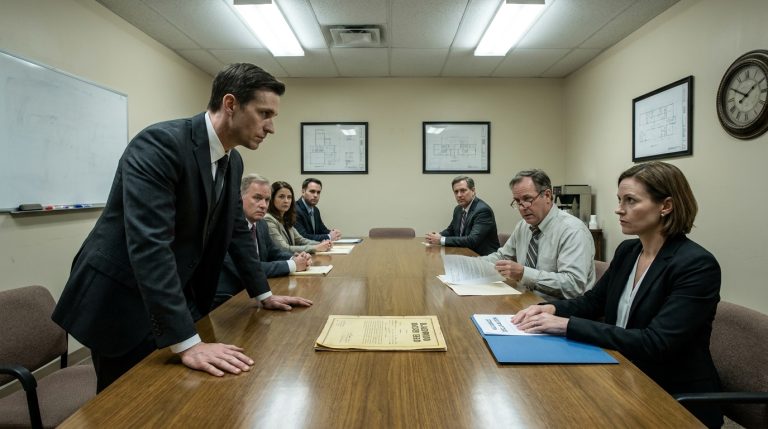
Thirty minutes later, the high-pitched hum of the fluorescent fixtures inside the Caldwell County community hall hit him like a physical blow. The room smelled of wet overcoats, stale floor wax, and the faint, chemical tang of commercial coffee urns. Nearly eighty residents from Stonebridge Meadows filled the rows of metal folding chairs, their low murmurs dropping to a sudden, rigid quiet as Clint walked down the center aisle. He didn’t look left or right. He carried the master binder under his arm, its thick cardboard spine cold against his ribs.
At the front table sat Darla Fitch. Her tailored navy blazer was dry, her hair immaculate, but her fingers tapped a frantic, irregular code against the edge of a leather-bound folio. To her left, Gene sat with his chin tucked into the collar of his canvas field jacket, his gaze fixed firmly on the beige linoleum floor.
Constance Waverly was already standing near the podium, her iron-gray hair drawn back, a series of certified courthouse maps spread across the table before her like pieces of armor. When she looked up, her expression didn’t soften, but her eyes held a steady, calculation-driven weight.
Darla cleared her throat, the sound tearing through the microphone with a sharp, electronic pop. “We will call the annual meeting to order. Before we proceed to the infrastructure allocations, we must address the ongoing boundary dispute regarding Parcel Zero-Four-B. The board has obtained the 2016 general platting files, which clearly show the community’s right to access the shoreline corridor.”
Constance didn’t wait for Darla to lay out the flyers. She stepped directly to the microphone, her heels making a sharp, transactional snap on the riser. “Let the record reflect that the 2016 master stabilization plat filed by this board contains an explicit material alteration.”
A ripple of motion passed through the front row of the audience. Neighbors leaned forward, the fabric of their raincoats rustling in the dense air.
“The documentation the association has relied upon to issue fine notices,” Constance continued, her voice level and devoid of theatrical flourish, “is a structural decoy. If you look at the physical courthouse index from the Lenoir archives—not the digital ledger scans provided by the development company—the eastern shoreline access rights were never transferred. The original signature line on page forty-two shows a distinct glue-line anomaly where an unrecorded tax exemption was pasted over the historical Puit property boundary.”
Darla’s hand froze against her folio. A faint line of sweat glistened along her temple under the harsh glare of the tube lights. “The 2016 survey was certified by the county planning board, Ms. Waverly. Any suggestion of procedural variance is an interpretation, not a legal fact. The neighborhood paid for the shoreline amenities under the impression that the developer cleared those rights before the foundation pour.”
“The developer cleared a utility easement,” Constance countered, her fingers pinning the edge of a certified county plat map to the table. “They did not clear an amenity title. The board used that survey copy to mask a structural deficit in the development’s operational ledger.”
Clint didn’t speak. He stood at the edge of the riser, his hand resting on the back of an empty metal chair, his knuckles white. He could see the physical tells of the room shifting—the way two board members shifted their seats away from Darla, the tight, defensive crossing of arms among the residents in the front row. The Layer 1 decoy was unravelling on the table, but as Clint looked at the blueprints, he knew the absolute truth remained buried deeper, tied to the purple ink of the unrecorded index card sitting in his pocket. The false bottom had dropped out, but the final, structural reality was still locked behind the name Gene had dropped in the mud.
CHAPTER 7: THE RECOVERY OF INSTRUMENT 402
The high-pitched ring of the microphone died out against the acoustic tiles, leaving a cold, heavy stillness that seemed to draw the damp air from the open doorway. Darla Fitch didn’t drop her fountain pen. She clamped her fingers tighter around its black casing until the plastic groaned against her nails, her shoulders locked hard against the back of her leather chair. Clint didn’t move from the side of the riser. He reached into his salt-damp coat pocket, his grease-blackened skin contrasting sharply with the yellowed paper of the oilcloth sleeve as he drew out the original pink carbon copy of the 1983 tax filing.
“The 2016 survey wasn’t an interpretation, Darla,” Clint said, his voice flat, cutting through the low hum of the ceiling fans without the aid of the podium speaker. “It was a deletion.”
He walked the four steps across the linoleum, his mud-caked soles leaving dry, red crusts on the floorboards. He laid the pink paper flat on the center table, directly over the clean, white margins of the subdivision’s master map.
“My grandfather didn’t clear an agricultural lien,” Clint said, his thumb pressing down on the ragged edge of the document. “He recorded a restriction. This is the nineteen-eighty-three Tax Instrument Four-O-Two. The county assessor’s office never put it into the digital portal because the corridor lines were grandfathered under the old Caldwell County index. It explicitly prohibits any sub-surface infrastructure development within fifty yards of the shoreline intake.”
Gene shifted his weight in his chair, his jacket rustling as he leaned forward, his eyes locked onto the faint purple typewriter ink. “The Vanguard line,” he muttered, his jaw tightening as he looked at Darla. “The pipeline bypass goes through that exact corridor. If Instrument Four-O-Two is active, the association’s agreement with Vanguard Utility is a federal title violation.”
Darla stood up, her leather folio slipping off the slick veneer of the table and hitting the floor with a heavy, flat thud. “This meeting is out of order. The board operates under certified filings, not unverified notes pulled out of a farmhouse cellar. We have a fiduciary obligation to maintain the community’s asset registry.”
“The asset belongs to the farm,” Constance Waverly said, her hand dropping an official, red-sealed certification ledger onto the table beside Clint’s paper. “I spent the last three hours with the registrar in Lenoir. The true Puit-Caldwell Deed Ledger lists this restriction as an unbroken covenant. The association didn’t sell kayak tags or dock rights to protect the lake, Mrs. Fitch. You signed an unauthorized access lease with Vanguard Utility in twenty-sixteen, using the lake as a buffer zone to conceal an off-book easement payment totaling three hundred and ninety thousand dollars.”
A collective intake of breath rattled through the back rows of the room. A man in an orange hunting vest stood up from his folding chair, his face dark in the sharp light. “We paid those environmental compliance assessments every June, Darla. Where’s the money if the county never saw the permits?”
Darla didn’t look at the crowd. Her eyes darted toward the side exit, her fingers twirling the silver zipper of her blazer. Her face had gone the color of skimmed milk, the rigid confidence that had driven her across Clint’s shoreline completely draining out of her expressions. She took a step back, her shoe catching on the strap of her fallen folio, but there was no counter-move left on the layout. The two board members to her right stood up simultaneously, stepping away from the long table and leaving her isolated under the bare tube lights.
Clint looked at her, his pocketknife cold against his thigh, the heavy iron pin from his grandfather’s smokehouse still a solid, grounding weight in his pocket. He didn’t raise his voice. He didn’t need to. The long-hidden ledger sheets were out on the oak table now, and the lines of his family’s land were resetting themselves in the silence that followed.
CHAPTER 8: THE SECURED SHORELINE
The red-sealed courthouse ledger remained flat on the table, its pages open to the immutable lines Elden Puit had registered forty-three years ago. Darla Fitch didn’t pick up her fallen folio. She left it lying in the dirt-streaked linoleum aisle, its brass bindings catching the flickering glare of the overhead tube lights as she walked toward the heavy fire doors without looking back. The latch snapped shut behind her with a short, metallic crack that broke the room’s paralysis. Within sixty days, the county prosecutor’s office dismantled the fraudulent instrument, forcing an extraction of the off-book ledger entries. The Vanguard Utility Easement was legally quarantined, rerouted five hundred yards east through municipal rock where it belonged, completely bypassing the family water intake.
By November, the cold mountain rain had given way to a crisp, dry frost that turned the red clay pastures brittle underfoot. Clint stood inside the hand-built cinder block smokehouse, the air dense with the sweet, heavy ribbons of applewood and hickory smoke rising from the open stone pit. The heat off the embers kept the damp chill from his bones, the slow currents of smoke drifting through the rafters to cure the hung hams exactly as they had every autumn since 1981.
Outside, the crunch of gravel signaled the arrival of local trucks turning off the main county line. They didn’t bring compliance notices or clipboards. Clyde, from three tracts over, stepped through the unlatched pine door first, his heavy canvas coat smelling of dry hay and woodsmoke. Behind him were four families from Stonebridge Meadows, their boots bearing the fine gray dust of the farm’s private approach. They stood by the unpainted walls, their voices low and conversational, asking about the seasoning cycles and the old timber beams instead of allocation rules.
“The air’s right today, Clint,” Clyde said, his calloused palm resting against the cold mortar of the wall. He reached down and picked up a rusted iron latch pin from the tool bench, turning it over to inspect the wear along the shank. “Your dad always said if you keep the fire low enough, the hickory does the work for you.”
“The wood stays dry if you build the roof right,” Clint replied. He took a heavy iron file from the wooden shelf and began to smooth the rough edges of a replacement hinge for the primary meat rack. The metal filings fell onto the dirt floor in a quiet, silver spray, the rhythmic rasping sound anchoring the room in the slow pacing of winter preparation.
A portion of the restitution funds recovered from the association’s frozen ledger had already been routed through Constance Waverly’s office to establish a land management scholarship at the local agricultural institute. It wasn’t about chasing every drop of blood from the stone; it was about ensuring the next generation understood how to read a county plait map before a development company tried to reinvent the markers.
When the last truck pulled away into the dusk, Clint walked down the rising slope toward the lake shoreline. The water was a perfect, unmoving pane of dark steel, reflecting the sharp orange rim of the setting sun across its surface. The fresh wooden stakes Bev and Trish had driven into the mud were gone, replaced by a single, unpainted oak post his grandfather had set near the old walnut tree decades ago.
Clint reached into his pocket and pulled out his father’s pocketknife, using the small brass awl to clean the carbon grease from beneath his thumbnail. He didn’t feel the sharp cold of the iron pin against his thigh anymore. The silence over the water was no longer a sign of surrender or an unread document waiting to be exploited. It was just the quiet of land that had returned to its own coordinates, solid, stubborn, and completely clear of the asphalt.