The Price of a Torn Veil: When the New Internal Affairs Boss Ran Her Own Arrest Like a Master Case File
CHAPTER 1: THE SHATTERED ARCH
The lace didn’t tear until the second tug, but the sound it made split the October morning completely in half.
Alicia Owens kept her fingers hooked into the silver casing of her grandfather’s pocket watch, her thumb resting on the cold, worn groove of the latch. The gold light of Bellamy Ridge Vineyard filtered through the cream roses of the wedding arch, heating the satin across her shoulders. She didn’t look down at the grass where the strip of antique lace now lay like a dead bird. She looked straight at the scratched plastic of Officer Kyle Brennan’s badge.
“Officer,” Alicia said, her voice dropping into a flat, level register that cut under the rising murmur of a hundred and fifty guests. “State your name and assignment for the record.”
“I do the talking, sweetheart,” Brennan said. His duty belt creaked as he shifted his weight, his hand hovering two inches above his holster with the easy arrogance of a man who owned the county line. “Step away from the gentleman. Hands where I can see them.”
Elliot lunged forward, his face turning the dark purple of crushed grapes, his open collar shaking. “This is our wedding—are you out of your mind? She bought the dress!” He reached into his tuxedo jacket, his fingers scrambling against empty pockets. The smartphone that held the digital transaction record was gone, left sitting on the charger in the bridal suite sixty feet away behind the stone house. The primary defense was completely out of reach.
“Sit down, sir,” Brennan said, not even turning his skull to face him. “Or you’ll honeymoon in a county box. Novak, secure the evidence.”
Officer Tyler Novak, twenty-six years old and eight months out of the academy, stepped onto the grass with his jaw locked so tight the muscle twitched under his ear. His white gloves trembled as he reached down to scoop up the torn veil. He held the antique lace like it was made of hot iron.
“Kyle,” Novak muttered, his eyes darting toward the front row where three older uncles were already standing up, their linen suits wrinkling under their tightening fists. “Maybe we should pull back. Check the book.”
“Watch the crowd, rookie,” Brennan snapped. He grabbed Alicia’s left wrist. The metal of the cuff was cold, the ratchets clicking twice past the standard safety stop, biting deep into the skin right above her thumb.
Alicia didn’t pull back. She didn’t scream. Four counts in, four counts out. She silenced the biological surge of adrenaline before it reached her eyes. She felt the heavy steel teeth of the cuffs pin her bones together, but her focus remained locked on the small black square of the camera on Brennan’s chest. The green power light was dead.
“You’re escalating a lawful assembly,” Alicia said softly. “Spell the name right on the report, Officer Brennan. O-W-E-N-S.”
Brennan let out a short, dry bark of a laugh, his boot heels grinding into the manicured lawn as he swung her toward the gravel path where the cruiser sat idling with its lights off. “You don’t get requests today, sweetheart. You match the description, and the dress stays with the state.”
The cellist in the back row stood up, his face pale under his gray hair, and deliberately turned his wooden chair around to face the vineyard wall. The silence that followed was heavy, wet, and absolute.
CHAPTER 2: THE DARK RIDE
The cruiser accelerated, the loose stones of the shoulder clattering violently against the undercarriage. Pinned behind her back, Alicia’s left thumb throbbed where the steel ratchet had clicked past the safety stop. She didn’t shift away from the metal partition. Every bump in the road transmitted the vehicle’s momentum straight into her collarbone, a harsh reminder of the physical stakes, but her mind remained clear, filing away the metrics of the transport.
In the front seat, the silhouette of Brennan’s heavy shoulders shifted as he reached for the mounted terminal. The glow of the screen illuminated the side of his jaw, his tongue poking slightly out of the corner of his mouth as he tapped out his log entry.
“Subject became agitated,” Brennan muttered aloud, his fingers rhythmic on the keys. “Subject refused lawful commands at the scene. Novak, you copy that?”
Novak didn’t look up from the passenger seat. He was staring at the evidence bag in his lap, his gloved fingers tightly gripping the antique lace of the veil. “Kyle, the camera light on your rig is off. If tech pulls the log—”
—”Tech doesn’t pull logs on a felony compliance stop, rookie,” Brennan interrupted, his voice dripping with the effortless entitlement of twelve years without a reprimand. “The battery’s been acting up. I’ll note it in the supplemental. We write what holds up on paper, not what the crowd thinks they saw.”
Alicia watched the reflection of Novak’s profile in the side glass. The kid’s jaw was clamped so tight a small bead of sweat was forming near his temple, threatening to ruin his neatly pressed uniform appearance. He wasn’t participating in the lie, but his silence was funding it.
Alicia tilted her wrist slightly inside the steel loops. The sharp edge of the cuff cut deeper, confirming the lack of a double-lock mechanism. A clear, actionable violation of general order four. She squeezed the silver pocket watch still tucked inside her palm, the cold metal casing acting as an anchor against the biological urge to snap back at the absurdity of the front seat conversation.
“Officer Brennan,” Alicia said, her voice dropping into the quiet, hollow space of the cage. “Check the dashboard log before you submit. You omitted the lack of a Miranda warning.”
Brennan didn’t stop typing. He let out a low, dry chuckle that vibrated through the wire mesh. “You still think you’re scheduling a meeting, sweetheart. Down here, the report is whatever I put my signature on.”
The cruiser swung hard to the left, the tires howling as they pulled into the rear intake lot of the Caro County precinct. The concrete walls of the sally port blocked out the remaining October sun, plunging the interior of the car into a cold, fluorescent shadow.
CHAPTER 3: THE TAPED WINDOWS
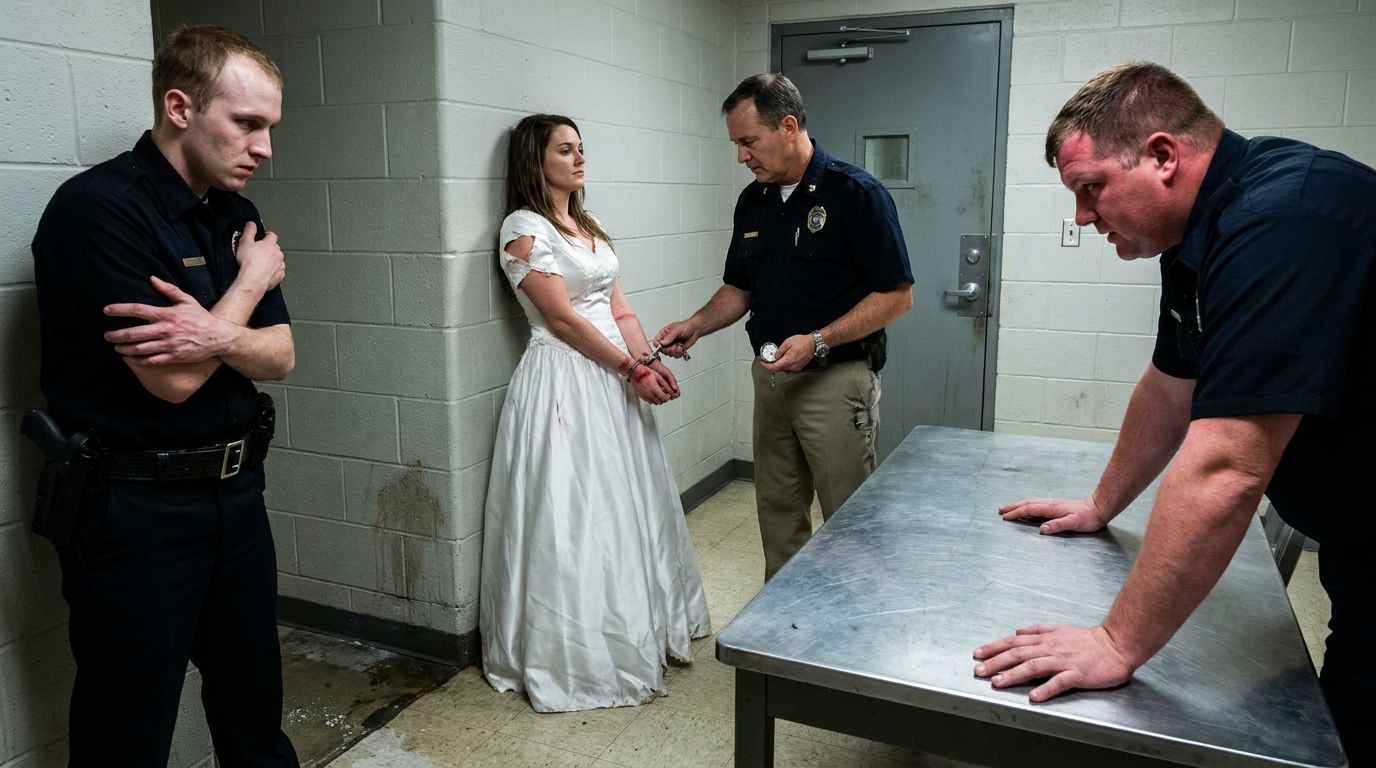
The deadbolt engaged with a heavy, industrial click that signaled the absolute end of the street rules Brennan had been playing by. The room smelled of wet ash and stagnant moisture trapped inside the cinder blocks. Pinned behind her back, Alicia’s thumbs were beginning to swell, the steel loops of the cuffs keeping her forearms locked in an unnatural, rigid angle against the lower small of her back.
Brennan stepped up to the edge of the metal table, his large hands flat against the scratched zinc surface as he leaned his weight forward. “We can sit here until midnight, sweetheart. The boutique reported a beaded gown missing, you’re wearing a beaded gown, and your partner back at the vineyard doesn’t have a single scrap of paper to prove otherwise.”
“You skipped the verification protocol,” Alicia said, her voice dropping into a quiet rhythm that refused to match his aggressive pitch. She leaned back against the concrete wall, letting the cold stone steady the raw throb in her forearms. “You drove twelve miles outside your sector because you were hunting a high-value arrest to clear your nine pending conduct reports.”
Brennan’s eyelids flickered, a tiny bead of sweat breaking through the heavy foundation cake near his sideburns. “My reviews are clear. Every single one signed off by the precinct supervisor. You’re out of your depth.”
The door behind him clicked open, cutting off his next word.
Captain Laura Stanton of the Virginia State Police stood in the frame, her dark winter coat open, exposing the gold shield pinned to her leather belt. She didn’t look at Brennan. She looked at the white satin dress, the torn seam at Alicia’s shoulder, and the dark purple swelling forming around the tight metal cuffs.
“Step outside, Officer Brennan,” Stanton said, her voice flat, carrying the unhurried authority of someone who had spent two decades pulling apart crooked houses one timber at a time. “Your vehicle’s GPS logs and your partner’s digital notebook are already being loaded into the state archive. The Cairo County jurisdiction over this room expired four minutes ago.”
Brennan stiffened, his jaw working as his hand dropped down toward his duty belt. “This is a local felony processing. State doesn’t have standing—”
“—Your dashboard camera log was terminated manually at 11:32,” Stanton interrupted, stepping into the room and forcing him backward by the sheer momentum of her stride. “The Commonwealth attorney calls that tampering with evidence in an active felony inquiry. Move.”
Brennan’s face shifted from dark red to a mottled gray, his boots scraping heavily against the linoleum as he backed out into the brightly lit corridor. Novak followed him, his eyes glued to the concrete floor, his arms clamped tightly over his chest.
Stanton waited until the heavy steel door clicked shut a second time before she reached into her pocket, producing a small brass key. She stepped behind the chair, her fingers dry and deliberate as she unlocked the ratchets.
The pressure released with a sharp, mechanical snap. Alicia brought her hands forward, the skin across her wrists deeply grooved and raw, but her fingers instantly sought out the silver pocket watch still tucked inside the torn lining of her dress. She clicked the casing open, checking the small glass face in the harsh fluorescent glare.
“Stanton,” Alicia said, her breath escaping in four slow counts. “Check the internal dispatch log for 11:06. The anonymous tip used the phrase ‘Possible 10-31 in progress.'”
Stanton paused, the key still held between her index finger and thumb. “Civilians don’t use ten-codes when they’re reporting a shoplifter.”
“Exactly,” Alicia said, standing up and smoothing the crumpled satin of her skirt. “Someone didn’t want a thief caught. Someone wanted the head of Internal Affairs off the schedule before Monday morning.”
CHAPTER 4: THE DECOY SECRET
The heavy paper resisted, curling tightly at the edges until Captain Laura Stanton pinned the corners down with a pair of heavy brass scale weights. The ink on the printed log sheets was cold, black, and perfectly readable under the harsh precinct tubes. Alicia leaned against the edge of the table, her bare shoulder chilling slightly in the damp basement drafts as she traced the column of signatures.
“Every single stop Brennan made over the last twenty-four months follows a precise geometric line,” Stanton said, her index finger tapping a highlighted date near the middle of the sheet. “The complaints came from three blocks in the north sector, all closed within ninety-six hours as unfounded. Every form bears the same mechanical review stamp at the bottom.”
Alicia did not answer immediately. Her fingers were wrapped around the smooth, silver edge of her grandfather’s watch, clicking the casing open with a muted, metallic snap that marked the rhythm of her thoughts. She wasn’t looking at Brennan’s name anymore; she was staring at the purple ink impression of the official precinct supervisor stamp on the final archive document.
The text was clean, devoid of the usual faint smudges or dust lines that covered every other file box in the room. The date inside the ink ring read October 4th, 2025—a Sunday afternoon, a full twelve hours before the Internal Affairs audit memo had even cleared the executive printer.
“This isn’t just a personal protective ring for a rough patrol officer,” Alicia said, her voice dropping into a low, quiet register as she straightened the torn fabric at her collar. “Look at the stamp alignment on the early complaints. The pressure marks match the administrative terminal in the records section, not the sergeant’s desk.”
Stanton turned a sheet over, her brow furrowing as she caught the implication. “Sergeant Wade Cutler signed these off. He’s been running the records and review desk for nineteen years.”
“He didn’t sign them to protect Brennan’s career,” Alicia said, her thumb running along the cold zinc edge of the table. “He signed them because those specific stops happened within forty-eight hours of major commercial zoning applications in the north district. The documentation didn’t evaporate because of bad habits—it was filed to create a paper trail of non-compliance for the property owners.”
The door handle rattled, the heavy lock mechanism groaning as someone attempted to slide a master pass through the slot from the outside. Alicia kept her eyes fixed on the Sunday archive sheet, her posture completely still as the scraping stopped and a low, hurried set of footsteps retreated down the linoleum corridor toward the administrative wing.
The false bottom had broken completely, exposing a deliberate grid of paperwork designed to use the street units like a weapon against the local board’s targets.
CHAPTER 5: THE GRAND AUDITORIUM CHECKMATE
The heavy hum of three separate broadcast cooling fans vibrated through the floorboards, cutting through the murmurs of the assembled press corps. Alicia walked down the center aisle, the torn satin shoulder of her bridal gown pinned crudely with a silver security clip from the precinct basement, but her stride remained measured and rigid. She kept her fingers hooked inside the small velvet lining of her skirt pocket, her palm resting squarely against the cold, closed casing of her grandfather’s pocket watch.
On the stage, behind the long mahogany panel, Sergeant Wade Cutler sat with his elbows wide, his fingers interlaced over a thick stack of manila folders. His face was flushed beneath the bright auditorium lamps, a dark vein pulsing visibly near his temple as he caught sight of the state police detail flanking the rows.
“This is an un-calendared administrative review,” Cutler said, his voice instantly projecting into the microphone, creating a sharp, whistling clip that rattled the front row speakers. “The local disciplinary board operates under county protocol, not under a state mandate. The officer in question responded to a verified dispatch tracking number.”
“The tracking number was generated from a cash-bought burner three blocks from your own administrative desk, Sergeant,” Captain Laura Stanton said, her voice cutting clean across the floor as she laid a stack of synchronized car wash surveillance frames onto the projector plate.
The main screen flared to life behind the panel, revealing the clear, unsmudged license plate of a gray pickup truck backed into the far corner of a Route 9 service lot at exactly 11:04 a.m.
Cutler didn’t break. He didn’t flinch. He leaned forward until his chest pressed hard against the wood of the panel, his knuckles turning a dry, bloodless white as he gripped the microphone stand. “An unverified video from a private commercial wash is not an identification. I sign off on nine hundred patrol summaries a month. If an officer under my review executes an aggressive field arrest based on a standard dispatch description, that is street discretion, not a conspiracy.”
“The physical stamp on the north sector zoning exclusions was applied twelve hours before the internal affairs memo left my terminal,” Alicia said, her voice dropping the room’s temperature instantly as she stepped up to the lower tier of the stage. “You didn’t use Brennan because you thought he was an effective cop. You used him because you knew his twelve-year history of unchecked entitlement meant he would never stop to verify a receipt if the target matched his personal bias.”
“This is a political ambush!” Cutler roared, his chair scraping violently backward against the stage floor as he slammed both palms onto his folders. “You come into this county from a Baltimore administrative desk and think you can dissect nineteen years of clean street records? You have zero physical link between my office terminal and that tip!”
Stanton stepped up to the center table, her hand lifting a single plastic evidence sleeve containing the pristine, unscratched official records stamp recovered from Cutler’s personal locker an hour prior. “The ink composition matches the Sunday entry exactly, Sergeant. The trap you aimed at the vineyard didn’t save your paperwork—it locked the door behind you.”
The press row erupted into a fast, rhythmic clatter of camera shutters, but Cutler remained standing behind the table, his chest heaving under his uniform shirt, his eyes wide, furious, and completely unrepentant as he stared down at the glass projector plate.
CHAPTER 6: THE THIN SEAM
The wood of the folding chair was warm under Alicia’s palm as she straightened the final row along the gravel aisle. Eight months had pulled the heat out of the case file, leaving only the dull administrative weight of the state board’s signatures and the quiet reality of an empty calendar. Her left wrist bore a thin, faint line above the thumb where the steel teeth had bitten down in October, but her fingers were steady now, loose and unhurried as she dropped them into her linen pocket.
The silver pocket watch sat inside the fabric, completely still. She didn’t click the latch open to calculate the seconds.
Elliot stood beneath the rebuilt arch of cream roses, his shoulders dropping two inches as he watched her approach. His tuxedo collar was open, the small silk bow holding together a routine that had taken three seasons to return to the dirt. Near the fence line, Officer Tyler Novak stood in a crisp dress uniform, his white gloves tucked neatly behind his duty belt as he nodded to the family rows.
“The cellist found the original score,” Elliot said, his hand reaching out to catch hers before she reached the lower step. “He said he owed the grass a full performance this time.”
“Let him play,” Alicia said, her voice small, level, and entirely stripped of the procedural edge that had filled the county auditorium.
Reverend Boone opened the dark leather binding of his worn Bible, his thumb catching the edge of the exact page he had marked before the sirens cut the air. He looked out over the hundred and fifty guests, his face crinkling under the soft afternoon sun as the quartet hit the opening chord.
“As I was saying before the state intervened,” Boone began, his voice carrying clearly across the rows of crushed clover.
A low, collective ripple of laughter moved through the chairs, breaking the last lingering stillness of the lawn. Alicia pulled the antique veil forward over her shoulders, her fingers tracing the vertical line of new, white thread where the menders had left the tear visible.
She didn’t use a device to record the horizon. She simply stood on her own two feet, breathing four counts in and four counts out, watching the light catch the vine rows as the day moved forward without a single flashing light to stop it.