The Price of Silence: Why a Arrogant Billionaire Threw a Twenty at His Waitress and Lost It All
CHAPTER 1: THE BROKEN LINE
The twenty-dollar bill didn’t flutter when it hit the floor; it landed flat against the dark oak plank with a heavy, wet click from a spilled drop of mid-shelf whiskey.
Gerald Covington didn’t look down at where his money fell.
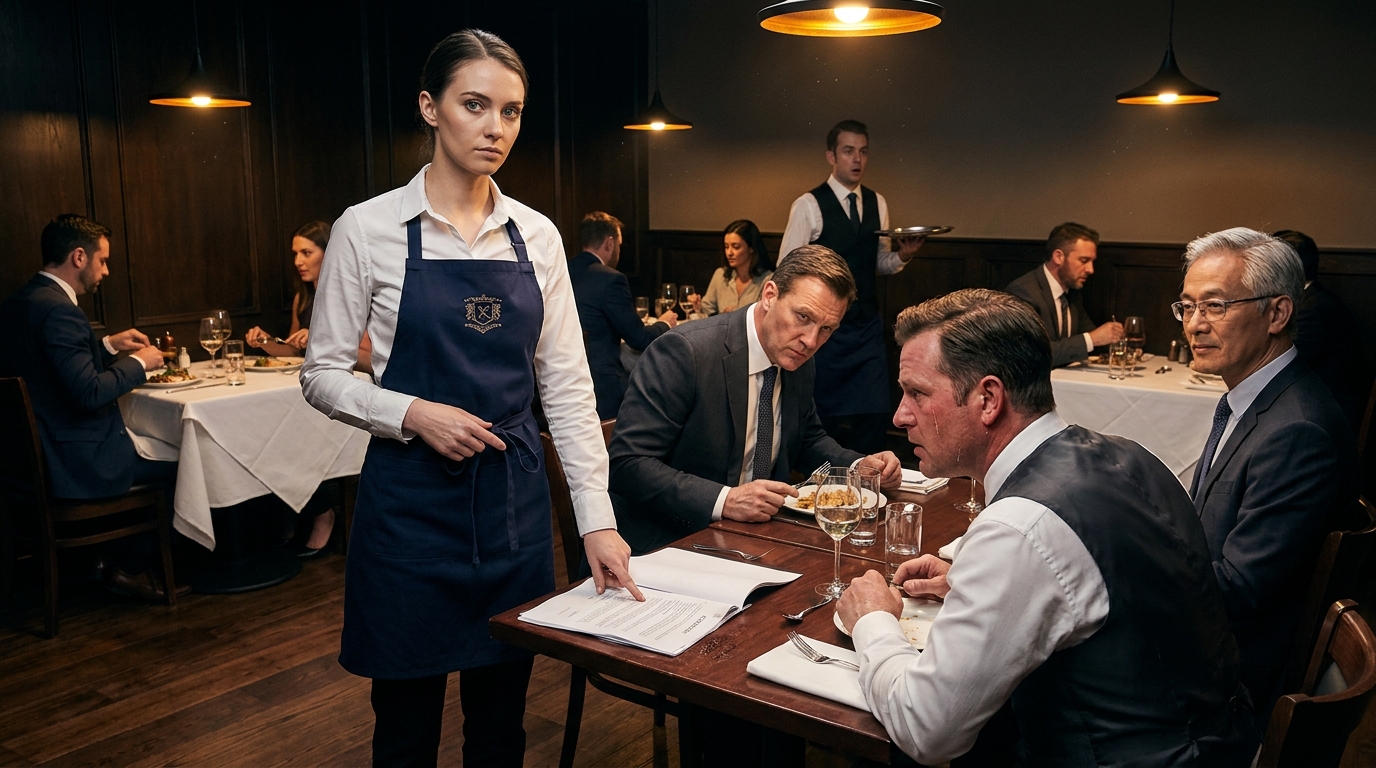
He kept his thumb Hooked into the pocket of his bespoke charcoal vest, his jaw rigid as he stared right through the center of Whitney’s linen apron.
“Pick that up and walk,” Gerald said, his voice carrying just enough gravel to cut through the soft jazz looping from the ceiling speakers. “I asked for someone who speaks Chinese, not a server who barely handles basic English.”
Whitney’s right thumb pressed hard against the serrated edge of the steel order pad clip hidden in her apron pocket.
The metal teeth bit deep into the soft skin of her palm, a sharp, grounding ache that kept her shoulders from dropping an inch.
Across the white tablecloth, three men in identical dark silk suits sat perfectly still, their hands resting flat against the pristine linen.
The oldest among them, a man whose silver hair was cropped close to his skull, kept his eyes fixed entirely on his own water glass.
His fountain pen remained securely tucked into his breast pocket, the platinum clip catching the light of the low hanging amber pendant.
“Sir, I am assigned to this station tonight,” Whitney said, her voice dropping into the flat, unhurried rhythm of a double-shift veteran. “The kitchen is currently preparing the premier course.”
Gerald laughed, a short, barking sound that caused the couple at table fourteen to pause their forks mid-air.
“Your mama scrubbed the floors on Stockton just so you could clear third grade, girl,” Gerald leaned forward, the scent of expensive peat and sour sweat rolling off his collar. “Don’t talk to me about schedules. Get me someone who can actually read the people I’m doing business with, or I’ll have Douglas clear your locker before the dessert menu hits the room.”
Whitney looked at the bill on the floor, then at the silver-haired man who hadn’t touched his drink since the appetizers arrived.
The serrated steel clip clicked once inside her pocket as she released the pressure.
She didn’t bend down.
CHAPTER 2: TONAL RETRIBUTION
The silence hanging over the white linen was different now.
It wasn’t the polite deference Gerald Covington usually bought with a three-hundred-dollar bottle of Scotch. It was the heavy, suspended stillness of a room waiting for a fuse to catch.
Whitney didn’t look back at the manager’s station or check for Douglas Harmon’s permission.
She turned her gaze fully onto the silver-haired man, ignoring the purple flush creeping above Gerald’s starch-white collar.
“Mr. Shu,” Whitney said, her voice dropping into the liquid, precise tones of classical Beijing Mandarin, the cadence smooth and utterly devoid of tourist hesitation. “I apologize for the minor friction at your table tonight. If you permit, I would be privileged to guide you through the vintage selection on page three, which our kitchen has paired specifically to balance the richness of the duck.”
Gerald’s glass clicked violently against the table as his hand stiffened.
The silver-haired man—Mr. Shu—didn’t look at Gerald.
His eyebrows lifted slightly, his gaze shifting from his capped fountain pen directly up to Whitney’s face, a sharp glint of absolute clarity flashing behind his thin-framed glasses.
He responded in the same language, his voice low and testing.
“Your accent carries the weight of the northern plains, young lady. A university degree does not typically grant that particular rhythm.”
“I did not learn from professors, Mr. Shu,” Whitney replied in Mandarin, her posture remaining perfectly straight, her hand resting naturally near her apron string. “I learned it at the fish counter on Stockton Street, from the women who survived the winters in the old districts.”
Mr. Shu let out a short, genuine laugh that broke the table’s rigid posture completely, his two associates immediately leaning forward with unlocked interest.
He leaned toward his wife, whispering two quick sentences in Mandarin that made her nod with an immediate, subtle smile.
“This man speaks loudly of partnership,” Mr. Shu murmured in his native tongue, his eyes darting toward Gerald for a single, chilly fraction of a second, “yet he cannot even see the value standing right at his shoulder.”
Gerald slammed his open palm flat against the linen, the silver forks rattling against the porcelain.
“Alright, enough with the parlor tricks,” Gerald barked in English, his chest heaving against his vest as he stared down his silent partner, Raymond Cross. “Speaking a few phrases to order noodles doesn’t mean you understand a word of a ninety-million-dollar development proposal. Get the main courses out here and clear out.”
Whitney didn’t move an inch from her position between the chairs.
“Would you like me to translate the three specific structural concerns Mr. Shu raised regarding your waterfront zoning limits over the last ten minutes, Mr. Covington?” Whitney asked, her English flat, calm, and perfectly audible to the surrounding tables. “Because from where I am standing, your legal team failed to catch any of them.”
Gerald’s jaw locked so hard the muscle beneath his ear twitched, his face turning an ash-pale shade of white under the amber lights.
CHAPTER 3: THE COLD IRON CONTRACT
“Read it,” Gerald said, his voice dropping into a rasping whisper that didn’t hide the tremor in his grip. “Since you claim my people are blind, let’s see how your Stockton Street education handles formal corporate structures.”
Whitney looked down at the paper, the heavy scent of raw fish counters and jasmine tea long gone, replaced by the stinging aroma of burnt starch and Gerald’s souring whiskey.
She picked up the printout, the pages damp from the glass condensation, and felt the familiar weight of everyday common sense steadying her hands.
Her thumb touched the serrated teeth of the steel clip inside her apron pocket, clicking it twice in the heavy quiet.
Her eyes scanned the dense blocks of black Mandarin characters, matching them against the English headers her grandmother had helped her memorize from city housing forms years ago.
“Clause one establishes the equity distribution,” Whitney rendered smoothly in English, her voice flat, carrying no dramatic performance, only the cold fact of the page. “The dilution event triggers automatically if the primary capitalization fails to clear the first tier by thirty percent.”
Raymond Cross leaned over the table, his fork hovering inches from his plate as his face shifted into a rigid stare.
“Go on,” Raymond muttered, ignoring Gerald’s sharp sideways glare.
“Clause two covers the mutual indemnity, standard hold-harmless language,” Whitney continued, her finger tracing down to the bottom of the third leaf where the ink looked slightly lighter, an out-of-place smudge blurring the edge of the final sub-clause.
She stopped, her breath catching just enough to make Mr. Shu’s wife tilt her head forward.
The anomaly was small—a single mismatched character in the Shanghai regional convention text that completely flipped the liability framework.
“This section regarding subsidiary protections,” Whitney said, pointing her fingernail directly at the smudged character. “Your English draft treats this as an isolation barrier for parent liabilities, Mr. Covington.”
She looked straight into Gerald’s bloodshot eyes.
“But in this dialect, this specific character extends the direct financial default to the individual signing officers—meaning if the waterfront construction halts for a zoning dispute, your personal assets are completely exposed to the debt.”
Gerald’s breath hitched, a bead of sweat breaking through his heavy makeup and tracking a greasy line down his cheek.
CHAPTER 4: THE STRATEGIC BRIDGE
The silver-haired investor did not glance at Gerald, whose fingers remained frozen over the ruined sheet of paper.
Instead, Mr. Shu extended a hand toward Whitney, inviting her into the physical boundary of the high-stakes negotiation with a quiet, unmatched gravity.
“Sit, Ms. Sawyer,” Mr. Shu said, switching to clear, precise English that cut cleanly through the background hum of the dining room. “A person who can read the foundational iron of a contract should not be standing in the margins.”
Whitney adjusted the heavy metal clip inside her apron pocket, its serrated teeth providing a cold anchor against her palm as she moved forward.
She did not slide into the leather seat like a guest expecting a luxury meal; she sat down with the blunt, practical efficiency of a working woman stepping up to a cluttered workbench.
Across the linen, Gerald’s face had deepened from ash-pale to a dark, dangerous crimson, his breathing rattling heavy in his throat.
“This is completely outside our protocol, Raymond,” Gerald muttered, his hand twitching toward his half-empty whiskey glass while he glared at his partner. “We don’t bring floor staff into executive alignments.”
Raymond Cross didn’t look back; his eyes were fixed entirely on the lighter ink of the Chinese characters where Whitney had exposed the personal liability trap.
“The protocol changed the second your legal team missed a personal default clause, Gerald,” Raymond said, his voice flat and practical. “Shut up and let her speak.”
Mr. Shu opened his palms over the clean table, his expensive fountain pen still securely capped and tucked away inside his breast pocket.
“Ms. Sawyer,” Mr. Shu directed, ignoring the tension entirely. “Please clarify the local Shanghai precedent regarding the municipal drainage allowances listed on page five.”
Whitney leaned forward, her eyes catching the specific layout of the paragraphs, completely tracking the missing margins that Gerald’s firm had tried to smooth over with standard boilerplate text.
The strategy was shifting right under Gerald’s fingers, the high-status wall he had built over thirty years dissolving into the simple, brutal reality of common sense and precise language.
CHAPTER 5: THE DESPERATE ASYMMETRIC MOVE
“You think you’re clever, don’t you?” Gerald spat, his voice low, his chest heaving under his sweat-stained collar. He didn’t use the loud, booming tone from the dining room; here, under the harsh fluorescent glare of the staff hallway, his weaponized audacity took the form of a tight, predatory cornering.
Whitney stopped, the condensation on the glass pitcher freezing against her fingers.
She felt the metal clip in her apron pocket press against her hip, a familiar weight of blue-collar reality keeping her spine perfectly rigid.
“I have tables to clear, Mr. Covington,” Whitney said, her voice completely stripped of emotion.
Gerald let out a sharp, ragged breath, his gold rings clicking against the metal tray shelf as he leaned closer, trying to use his massive frame to shrink the narrow space.
“I can buy your life ten times over,” he whispered, a thick smell of stale liquor rolling past his bared teeth. “You think Raymond or that old man care about a waitress? They’re using you to shave numbers off my margin. I’m going to offer you twenty thousand dollars right now to walk out the back door, clock out, and disappear from this city.”
Whitney looked at the heavy leather checkbook protruding from his vest pocket.
Then she looked past his shoulder, noticing a subtle movement near the kitchen door—the reflection of a tailored suit jacket against the glass panel.
It wasn’t a savior arriving; it was Raymond Cross, standing in the shadows with a small pocket notebook open, silently calculating the legal cost of his partner’s erratic behavior.
“The municipal drainage parameters on page five require a verified city engineer’s signature, Mr. Covington,” Whitney said, her voice raised just enough to cut through the hum of the dishwashers. “Your document uses a private surveyor’s stamp from last year. That’s a structural failure, not a translation error.”
Gerald’s face twisted into an unhinged sneer, his hand shooting out to grab the edge of her tray, his knuckles turning a dangerous, bloodless white.
“You don’t leave this hallway until I say so,” he hissed.
He was doubling down, completely unaware that his desperate attempt to buy her silence had just been tracked by the very partner holding his capital together.
CHAPTER 6: THE GRITTY COLLAPSE
“This is a conspiracy—a coordinated shakedown by floor staff and disgruntled minority partners!” Gerald bellowed, his voice cracking as his heavy frame hit the edge of the table, sending a wine glass spinning across the white linen. He grabbed the thick checkbook from his vest pocket, ripping a page out with trembling fingers and shoving it directly toward Mr. Shu’s chest. “Name the number. You want a translation fee? You want a zoning guarantee? I’ll write it right now, but we sign the exclusivity clause before anyone leaves this room!”
Whitney stepped out of the hallway, her linen apron straight, her thumb resting lightly on the serrated edge of the steel clip in her pocket.
She did not look at the paper Gerald was waving; her eyes stayed fixed on Mr. Shu’s right hand, which was now uncapping the platinum pen to sign a completely different document—a formal termination notice pulled smoothly from his associate’s leather briefcase.
“The exclusivity contract ended ten minutes ago, Mr. Covington,” Whitney said, her English calm, steady, and entirely flat. “When page five failed the municipal baseline, the material breach provision triggered automatically.”
Gerald screamed, a raw, unhinged sound that filled the silent restaurant as he lunged forward, slamming both hands onto the table to reach for the termination notice.
But Raymond Cross shifted his shoulder, his stocky frame physically blocking Gerald’s path with the quiet, heavy resistance of a man who had already recalculated the corporate ledger to zero.
“It’s over, Gerald,” Raymond said, his voice practical and utterly cold. “The delegation isn’t leaving because of a language barrier. They came here tonight looking for a legally binding reason to exit your sinking firm without paying the ten-million-dollar walk-away penalty—and your public tantrum just gave it to them on a silver platter.”
Mr. Shu did not offer a grand speech or a villainous smile; he simply slid the signed termination notice across the table to Raymond, capped his pen with a single, sharp click, and gave Whitney a slow, respectful nod in the traditional northern style.
The three associates stood up in perfect unison, leaving Gerald alone in the center of sixty silent onlookers, his jaw working back and forth over a ruined empire he could no longer scream back into existence.
The dining room returned to its quiet rhythm, the heavy oak floors clear of the twenty-dollar bill that had started the night.
Whitney stood at the service counter, her fingers smoothly folding a fresh stack of white dinner napkins, the gold vine pin on her lapel catching the low amber light with every steady movement.