The Untold Lessons of a Silent Legend Built on Blood, Sweat, and Unbreakable Resolve
CHAPTER 1: THE CHALKBOARD PROTOCOL
The fluorescent lights of the Coronado briefing room hummed, casting a sterile glare across thirty pairs of arms crossed over heavy, muscle-bound chests. The air smelled of wet sand, stale coffee, and the bitter reek of fresh sweat from the morning’s three-mile swim.
I picked up the heavy metal marker on the podium, turning it over in my right palm. Click. Click. The steady sound beat against the low, arrogant whispers rising from the back row.
“Theory,” a voice muttered from the third row. Trainee Davenport. Six-foot-four, two hundred and thirty pounds of bone and dense muscle, leaning back in his chair with his combat boots stretched into the aisle. “We’re here to learn how to breach doors and kill hostiles, not listen to a civilian read textbook chapters.”
I didn’t raise my voice. I didn’t reach for a badge, and I certainly didn’t call for the duty officer standing outside the doorway. Instead, I let the silence stretch until the chuckles died down under the sheer weight of my stare.
“Trainee Davenport,” I said, my tone as flat as a salt flat. “Demonstrate your team’s standard room-clearing procedure for a blind T-junction. Right now.”
Davenport smirked, pushing himself up with deliberate, lazy power. He stepped into the open space in front of the whiteboard, mapping out the entry with crisp, aggressive movements of his hands. “Lead man takes the hard corner, second man covers the funnel, third stacks high. High speed, low drag. Clean execution.”
“Clean execution,” I repeated softly. I stepped down from the riser, my khakis brushing against the edge of the desk. I picked up a piece of white chalk with my right hand. As I reached for the board, my cuff slid up two inches, exposing the thick, white cord of scar tissue wrapping around my wrist like a barbed-wire bracelet. My thumb twitched—an involuntary spike of nerve damage firing down into my palm.
I caught Davenport’s eyes dropping to my wrist for a fraction of a second before I slammed the chalk against the slate, drawing three swift, jagged lines.
“Your lead man enters at a forty-five-degree angle with his weapon index matched to his eye,” I said, pointing the metal marker at his drawn diagram. Click. “The local militia in the Al-Isgari district didn’t read your manual, Davenport. They cut holes through the floorboards of the upper stories. While your second man covers the funnel, two shooters fire down through six inches of dry plaster.”
Davenport’s smirk faltered, his jaw tightening as he stared at the redrawn lines on the board.
“You spend seven seconds in that fatal funnel,” I continued, stepping into his personal space until he had to tilt his chin down to meet my eyes. “Seven seconds. You’d be dead before your third man even cleared the threshold, and your strength wouldn’t stop a single nine-millimeter round from taking out your collarbone.”
He clenched his fists, his chest rising and falling heavily. “That’s just hypothetical scenario building, ma’am. In the real world, velocity overrides position.”
“Velocity gets you buried faster when you’re running blind,” I said quietly, clicking the marker once more against my palm. “Class is in session, Trainee. Sit down.”
CHAPTER 2: THE FRICTION POINT
Davenport’s boots scraped against the concrete deck as he retreated to his seat. The arrogance hadn’t left his eyes—it had merely curdled into something ugly and defensive.
“Sensory manipulation module,” I announced, turning to the heavy steel door at the side of the classroom. “Five minutes inside the simulator. Teams of two.”
A low murmur stirred through the ranks. Callaway, a quiet recruit with watchful eyes, shifted in his chair, his gaze lingering on the subtle tremor in my right hand before I tucked the metal clicker back into my pocket.
“It’s a box with light bulbs and speakers, ma’am,” Davenport said, his voice carrying that familiar, dismissive edge. “We’re trained to push through fatigue. Loud noises aren’t going to stop a breach team.”
“Physical strength won’t save you when your inner ear tells you up is down,” I replied, pulling the heavy steel lever on the simulator door. The seal hissed open, revealing a pitch-black chamber lined with high-frequency strobe arrays and directional acoustics. “Davenport, Callaway. You’re up.”
Davenport stood, rolling his broad shoulders. “Five minutes. Piece of cake.”
They stepped inside. The heavy door swung shut, locking with a thick, mechanical clack. I engaged the sequence on the outer control panel. Strobe lights burst to life at forty hertz inside the chamber, accompanied by overlapping, out-of-phase acoustic noise designed to scramble the brain’s spatial processing.
Through the reinforced observation glass, I watched Davenport’s immediate reaction. He took two confident strides before his knees buckled. His arms shot out, wildly searching for a wall that his brain swore had shifted ninety degrees. Beside him, Callaway sank to one knee, breath coming in ragged, shallow gasps as his eyes struggled to track the chaotic light spikes.
I stood by the monitor, my thumb resting over my wrist scar to dull the steady, throb of damaged nerves. I didn’t need rank or a security escort to prove the point. The physical reality of human biology was doing the heavy lifting for me.
After three minutes, Davenport was crawling on his hands and knees, disoriented, vomiting air, his massive frame completely useless against a threat he couldn’t punch or shoot.
I killed the power and pulled the door open.
The harsh daylight hit them like a physical blow. Davenport spilled out onto the cold concrete floor, dripping with sweat, his chest heaving as he tried to find his horizon. The rest of the class stared in dead, suffocating silence.
“That wasn’t training,” Davenport gasped out, his face pale, his fingers digging uselessly into the rough deck floor. “That’s… that’s just a parlor trick.”
“Ramati, 2012,” I said, stepping right up to where he lay on his hands and knees. My voice was dangerously quiet. “Three operators killed in a stairwell because insurgents used cheap commercial strobes and low-frequency sonic generators. They froze. They stumbled. They died.”
Davenport forced himself up, shaking, his knuckles white as he leaned against the doorframe. The entitlement was cracking, but in its place grew a dark, desperate humiliation.
“You speak like you were there,” he growled, staring up at me with raw, burning resentment.
“I know because I felt it,” I said, clicking the silver marker against my thigh. “And if you don’t learn to adapt to what you can’t overpower, the next time you feel it will be your last.”
CHAPTER 3: THE BROKEN LINE
Davenport rounded the corner, his broad shoulders blocking out the dim hallway light. The hallway was completely dead, the rest of the unit already down at the mess hall.
“I think it’s time we stop playing games, professor,” he said, his voice dropping into a low, grating rasp. He stepped past the door threshold, his six-foot-four frame looming over the small wooden podium. “You’re standing up there giving lectures to men who actually go out and catch bullets, while you sit behind a desk pushing paper. You’re a liability to this entire class.”
I didn’t reach for the desk phone. I didn’t yell for the compound guards. I simply slid the silver marker into my coat pocket and turned to face him squarely.
“Your ego is going to get people killed, Trainee,” I said, keeping my voice down to a steady, rhythmic rasp. “You think muscle covers up bad geometry. It doesn’t.”
“You don’t get it,” he growled, closing the remaining three feet between us until I could smell the stale coffee on his breath. “These men trust me. They don’t know you. You’re undermining everything we’re building here.”
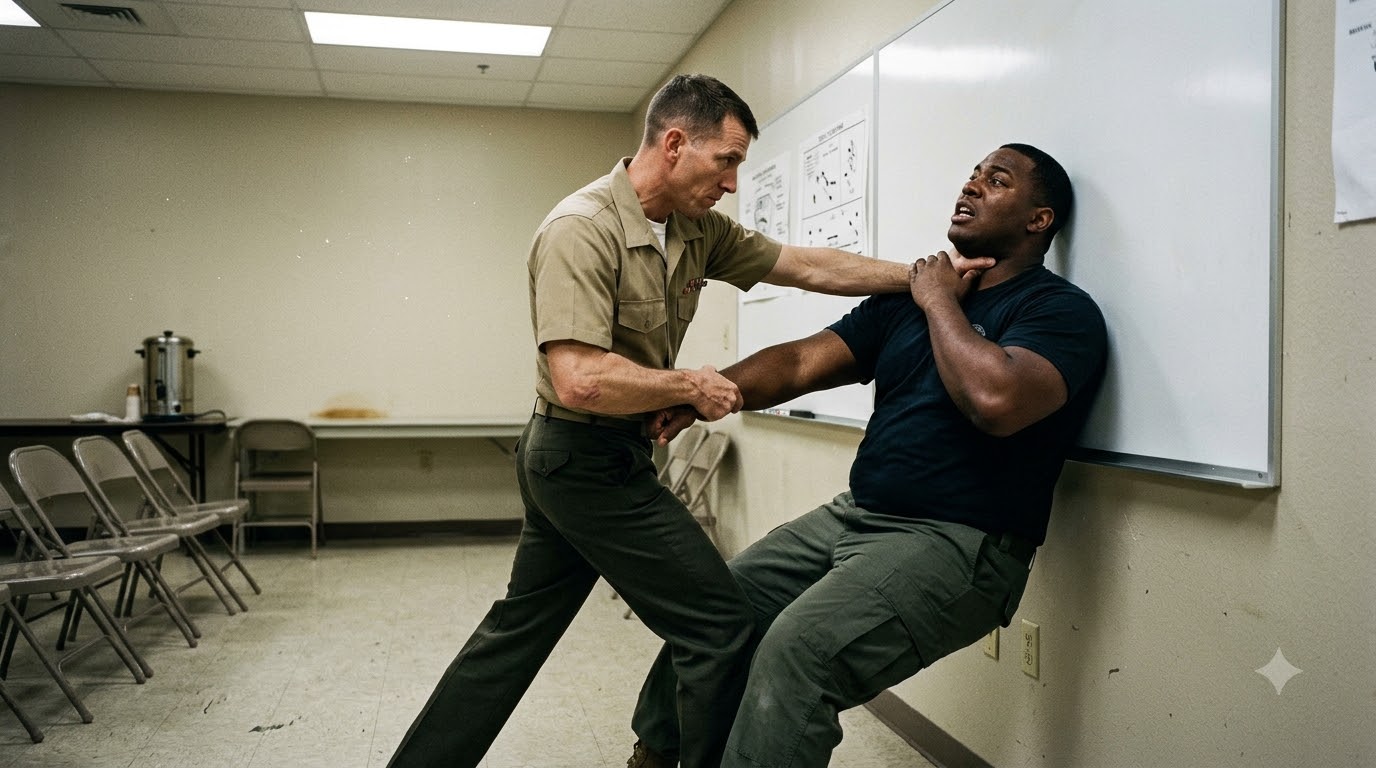
He reached out—a sudden, aggressive surge of motion meant to intimidate, his massive right hand clamping firmly around my throat to pin me against the whiteboard.
The impact rattled the slate against the wall. Air cut off instantly in my windpipe, the sheer biological pressure making my vision narrow at the edges.
I didn’t panic. Panic burns oxygen you don’t have.
Instead of pulling uselessly at his wrist, my left hand shot up, driving two fingers directly into the nerve cluster behind his elbow. His grip flickered for a fraction of a second. That was all the space I needed.
I tucked my chin, rotated my hips deep into his center of gravity, and drove my forehead hard into the bridge of his nose.
He grunted, his head snapping back as his fingers slipped from my neck. Before he could recover his balance, I grabbed his extended right wrist with both hands, stepping past his lead foot, and drove his arm downward across my hip with every ounce of momentum my body could leverage.
A sharp, hollow pop echoed through the empty room as his humerus popped out of its socket.
Davenport hit the linoleum floor with a heavy, shuddering thud, his chest heaving, a ragged scream locked behind his teeth as he clutched his dislocated shoulder.
I stood over him, my chest burning, my right wrist throbbing with a dull, white-hot fire where the old scar tissue had twisted under the sudden strain. I didn’t reach for a badge. I just adjusted my jacket and looked down into his wide, shock-filled eyes.
“That’s physics, Trainee Davenport,” I whispered, my voice cold and entirely steady. “Not theory.”
CHAPTER 4: THE UNMASKING
Davenport’s knees twitched as he tried to find a foot-hold to push himself upright. The sheer shock in his eyes had cut straight through his rage, leaving a hollow, bewildered pale staring back at me.
“You broke my shoulder,” he choked out, sweat running down his temple and dripping onto the floor. “You’re a civilian contractor—you’re going to be in handcuffs before the sun goes down.”
I didn’t answer him right away. I stepped slowly over his prone frame, retrieved my coat from the back of the chair, and reached into the inner breast pocket. No badge. No security detail call button. Just a worn, brass-bound service book, its edges frayed from years spent in salt air and desert heat.
I tossed it onto the floor three inches from his nose.
“Read the line under the seal, Trainee,” I said, my voice dropping an octave, carrying the weight of fifteen years spent in spaces that don’t exist on public maps.
Davenport squinted through the pain, his good hand dragging the book closer. His eyes locked on the stamped lettering. His breath hitched violently.
“Major Elaine Thorne,” he read, his voice cracking on the title. “Call sign… Wraith.”
The air in the room went dead still. Every recruit on Coronado base had heard the legend of Obsidian Shield—the black-budget deployment where an entire elite squad vanished into the dust, leaving behind a single operator who brought back the target against impossible odds.
“You’re… you’re Wraith,” he whispered, his jaw trembling as the full weight of his mistake crushed what was left of his pride. “They said Wraith was dead.”
“Ghosts don’t die easily, Davenport,” I said, kneeling until my face was level with his. “I don’t need to report you to command to destroy your career. I don’t need a tribunal to pull your Trident before you even wear it. You did that yourself the moment you assumed physical size was a substitute for judgment.”
He closed his eyes, a deep, shuddering sigh escaping his chest as he pressed his forehead against the cold floorboards. “Then sign the discharge. Send me packing.”
“That’s the easy way out,” I snapped, standing up and brushing the dust from my knees. “You’d go home thinking you were a victim of a system that didn’t appreciate your toughness. I’m giving you twenty-four hours in the medical bay to reset that joint. At 0800 hours tomorrow, you walk back into my classroom and you learn how to survive. Or you hand in your gear yourself.”
CHAPTER 5: THE WEIGHT OF GARRETT
Davenport stepped over the threshold, his dark blue uniform shirt pinned neatly over a black medical sling immobilizing his right arm. He didn’t look up at the rest of the class filing in behind him.
The recruits sat in complete, rigid silence. Callaway kept his eyes fixed on the front desk, his jaw set as if waiting for an explosion that hadn’t detonated yet.
“Take your seat, Trainee Davenport,” I said flatly, setting the metal marker onto the podium with a single, sharp clack.
He moved to the front row, pulling out his chair with his left hand and sitting down without a word. The defiance that had defined his posture for three weeks was entirely gone, replaced by a hollow, watchful quiet.
“You asked me yesterday why I preach adaptation over pure physical output,” I said, stepping out from behind the desk and walking down the center aisle. “You told me muscle keeps operators alive.”
I stopped directly beside Davenport’s chair. He stared straight ahead at the chalkboard, his chest rising in slow, controlled breaths.
“The strongest operator I ever served with believed the exact same thing,” I said, my voice cutting through the silent room like a blade. “Six-foot-three. Two hundred and twenty pounds. He could out-swim, out-climb, and out-fight anyone in the division.”
Davenport’s left hand slowly tightened into a fist against his knee.
“In the Al-Isgari district, our unit took heavy mortar fire,” I continued, looking down at his profile. “He took shrapnel to his right leg. It destroyed the knee joint. Instead of falling back to cover and using the structural geometry of the courtyard to hold off the advance, he tried to carry two men on his back using raw force.”
The room was so quiet you could hear the hum of the overhead lights.
“His leg gave out under the weight,” I said quietly. “He couldn’t move. He couldn’t adapt to the fact that his body was compromised. He died on that concrete floor because he relied on muscle when he needed strategy.”
Davenport turned his head slowly, his eyes bloodshot, his throat working as he swallowed hard. “Who was he?”
“Chief Garrett Davenport,” I replied softly. “Your father.”
Davenport went completely still. The color drained from his cheeks, his breath catching in a dry, painful gasp as he stared up at me.
“He saved my life twice before he fell,” I said, holding his gaze without flinching. “I carry his dog tags in my pocket every single day. I didn’t come to Coronado to insult your strength, Davenport. I came here to make sure his son doesn’t make the same mistake.”
CHAPTER 6: THE SILENT TRIDENT
The graduation formation stretched across the pavement in precise, perfectly aligned rows. Families stood along the bleached wooden grandstands, clapping and shouting as names were called over the PA system.
I stayed back near the shadowed edge of the hangar bay, my hands folded loosely behind my back. My khaki cuffs hid the scarred right wrist completely today. I didn’t need rank, badges, or a seat on the official reviewing stand. The work had already been done.
“Trainee Davenport,” the announcer’s voice boomed across the deck.
Davenport stepped forward from the front rank. His shoulder had healed clean, but the way he carried himself was completely different now—chin level, eyes calculating, every step controlled and deliberate without a single grain of wasted arrogance.
He stepped up to the board, turning to face the crowd as the gold Trident pin was pressed firmly into the dark fabric of his uniform dress whites. He didn’t smile or pump his fist. He took a single, measured breath, snapped his chin down, and looked past the cheering crowd.
His eyes swept the perimeter until they locked onto the shadow of the hangar bay where I stood.
Without breaking formation, without saying a word, Davenport brought his left arm straight up and rendered a sharp, textbook salute directly toward the shadows. Beside him, Callaway and the rest of his squad turned their heads in unison, holding the quiet, unwavering tribute.
I didn’t step into the light. I didn’t raise my voice or offer a grand speech. I simply lifted my right hand, held my thumb firmly over the edge of my palm to stop the faint nerve tremor, and returned the crisp salute.
He held it for three full seconds before snapping his arm down and marching back into the ranks with his men.
The ceremony ended, the crowds surged forward onto the asphalt, and the noise of laughter and family reunions filled the bright summer air. I turned my back to the sunlight, pulled the heavy metal marker from my pocket, and slipped it into my coat.
The lessons were anchored. The ghosts were finally at rest. I walked down the concrete access road toward my car, leaving the quiet ocean air behind me.