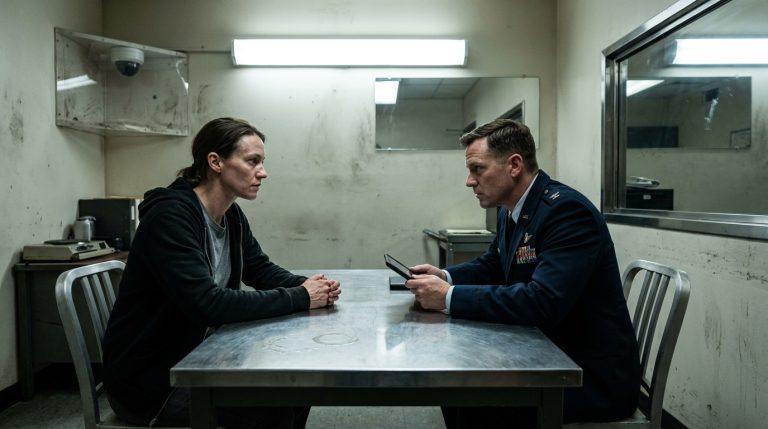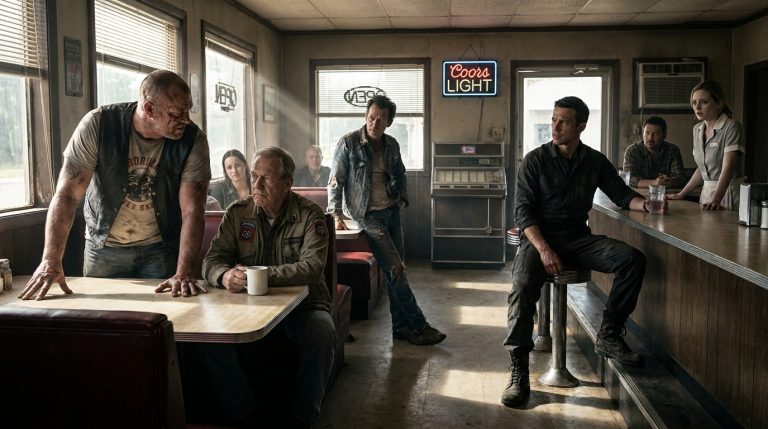
The Weight of the Crest: An Old Soldier Navigates the Remnants of a Broken Valley
CHAPTER 1: The Calculation of Rain
The Harmony Creek Town Hall was a tomb of good intentions, kept at a shivering temperature by an air conditioner that rattled with the effort of fighting a late-summer humidity. Up at the dais, Brent Collier was sweating through his suit, his face flushed with the kind of performative authority that evaporated the moment a real crisis hit.
Silas sat in the last row. He wasn’t slouching. His spine maintained a rigidity that had been drilled into him in a life that seemed a thousand years—and another identity—away. His work boots were stained with the ochre mud of the bottomlands, and his faded denim jacket felt like armor.
Collier tapped the microphone. The sharp, static pop sent a tremor through the room. “As you can see, our primary evacuation route is reinforced,” Collier said, gesturing to a bright, multicolored map that ignored the physical reality of the Whisper Ridge tributary. “The culverts have been stress-tested.”
Silas watched him, but he wasn’t looking at the slides. His eyes were fixed on the town hall’s main comms console, partially visible behind the podium. A small green light flickered on the unit—a frequency indicator. It wasn’t standard. It was a rhythmic, pulsing light, the kind used by wide-area emergency broadcasts. The town shouldn’t have been on that frequency. It was a secure channel, one that required an access key that hadn’t been in circulation since the base closures in the late nineties.
A flicker of suspicion tightened his chest. Someone had been messing with the old grid.
“The high school gym is the center of our response,” Collier continued, his voice taking on the brittle edge of a man who didn’t want his math challenged. “It is the safest point in the valley.”
Silas didn’t stand, but he spoke, his voice a low baritone that cut through the drone of the air conditioner. “The high school’s access road washes out at six feet, Mr. Collier. And the tributary behind it? That’s not a creek during a crest. It’s a funnel.”
The room went deathly silent. Collier’s smile withered into a thin, white line. “Mr. Blackwood,” he said, injecting a deliberate, condescending edge into the name. “We have consulted with engineers. We have protocols.”
“Protocols don’t dictate the river’s path,” Silas replied, his eyes dropping back to that flickering green light on the console. It was pulsing faster now. A distress signal, or an automated activation?
He looked out the window. The sky wasn’t dark yet, but it had that bruised, heavy purple hue that promised violence. He could feel the pressure dropping, the air thickening with the weight of impending deluge. He had come here to give a warning, but looking at the console, he realized the trouble wasn’t just coming from the clouds.
The door to the hall creaked open, and a volunteer rushed in, whispering something to the mayor’s assistant. Her expression sharpened into panic. The air in the room suddenly felt electric, charged with a shifting reality. Silas shifted in his seat, his hand brushing the radio crank hidden in his pocket. If the frequency was active, then the valley wasn’t just facing a flood—it was facing a total, systemic collapse of the very infrastructure Collier was so desperately defending.
He watched Collier turn back to his slides, his hands trembling just enough to betray him. Silas reached for his radio, his heart pacing not with fear, but with the cold, measured rhythm of a man who had seen the end of the world before.
The first crack of thunder didn’t come from the sky; it came from the ceiling as the building groaned under a sudden, massive gust of wind. The lights flickered and died. In the sudden darkness, the only thing Silas could see was that green, pulsing light, warning him of a storm that was already inside the walls.
CHAPTER 2: The Signal in the Dark
The blackness of the town hall was absolute, save for the faint, pulsing green light on the console—a dying firefly in the center of a grave. When the lights had cut, the sound of the storm outside had instantly surged, no longer muffled by the hum of the air conditioning. It was a roar now, a hungry, low-frequency vibration that rattled the window frames in their casings.
Silas didn’t move. He sat in the silence, his boots firmly planted on the scuffed linoleum. He could hear the sharp intake of breath from the mayor’s assistant in the front row, a sound of genuine, untrained fear. He could hear Collier shifting on the dais, the scrape of leather against wood, the sound of a man who had suddenly realized the floor beneath him was made of glass.
The darkness triggered something in Silas that his conscious mind tried to keep buried. It wasn’t just the loss of power. It was the sudden, sensory immersion in the void. For a heartbeat, the town hall evaporated. He was back in a desert night, the air tasting of grit and cordite, his hand hovering over a piece of equipment exactly like the console before him. The memory was an intrusive phantom, cold and sharp, forcing his muscles to coil with a readiness that was twenty years out of date.
He forced his hand to relax. The radio crank in his jacket pocket felt heavy, a counterweight to the ghost rising inside him.
“Brent,” Silas said, his voice cutting through the panic of the room like a blade through silk. He didn’t raise his volume, but the authority in his tone was absolute. “Stay where you are. Don’t touch the breakers.”
“Silas?” Collier’s voice cracked, sounding thinner than it had an hour ago. “What happened? Did the grid blow?”
“The grid didn’t blow,” Silas murmured, his eyes tracking that pulsing green light. It was flashing in a pattern. Three short, three long, three short. S.O.S. It was the universal language, but on this specific, restricted frequency, it was a death knell. It meant the regional system was triggering an automated, forced-down fail-safe. The valley was about to go dark in every way that mattered.
He stood, his knees popping—a reminder of the years that had passed since he’d been required to move with tactical silence. He didn’t use a flashlight. He didn’t need one. He knew the layout of the hall by the way the air currents moved through the room. He navigated toward the console, his movements economical, avoiding the clutter of plastic chairs.
He reached the console and pressed his thumb against the edge of the unit, feeling for the heat of the wiring. The system was overloaded, surging with a phantom demand. Whoever had been messing with the local infrastructure had inadvertently linked Harmony Creek into the dead-drop emergency circuit.
“Stay still,” Silas repeated, his voice lower now. “I need to confirm something.”
He pulled the small, battered radio from his jacket and held it to his ear. He clicked the frequency dial, searching for the static. It wasn’t the white noise of a radio station between signals. It was the rhythmic, metallic grinding of data packets being forced through a compromised channel.
Ghost Actual. The thought was a whisper of a name he hadn’t claimed in an eternity. He wasn’t Ghost Actual anymore. He was Silas. He was the man who kept a garden and mended fences and watched the river. But the river was rising, and the network was signaling.
He didn’t acknowledge the call. To do so would be to reopen a door he had welded shut. But as he touched the console, he saw a flickering red icon on the display—a flood-sensor warning from a sector that shouldn’t have been active. The data wasn’t from the state. It was from the deep-tier seismic sensors that were only supposed to be triggered by mass-scale structural failure.
The road at Devil’s Elbow was already buckling.
“Brent,” Silas said, stepping back from the console as the emergency lights finally kicked in, casting the room in a sickly, jaundiced yellow. The change in light was jarring. “The state engineers you spoke to? They didn’t tell you the truth. They didn’t tell you because they were looking at data that doesn’t exist anymore.”
Collier looked down from the dais, his face pale, his suit looking like a costume he had no business wearing. “What are you talking about? It’s just a storm.”
“It’s not just a storm,” Silas said, glancing toward the doors where the rain was beginning to seep through the seals. “It’s a systemic failure. The river is moving faster than the culverts can handle, and the drainage system in the north valley has been sabotaged by sheer incompetence.”
He looked at the console one last time. The green light had stopped pulsing. It was solid now. A permanent connection. The link was open.
“We have to move,” Silas said, his gaze shifting to the volunteers, who were frozen in the half-light. “We have to clear the valley floor before the tributary crests. If we wait for the state, we’re waiting for a ghost.”
Collier scrambled down from the dais, his movements frantic, lacking any center. “We can’t just abandon the plan! If we deviate from the protocol, the liability—”
Silas walked straight up to him, stopping inches away. He didn’t lean in, but the height of his stance and the absolute clarity in his pale blue eyes forced Collier to shrink back. “The liability is dead people, Brent. If you want to keep your job, start acting like a man who knows what he’s protecting. If not, get out of the way.”
Silas turned his back on the town manager and walked toward the side exit, his boots thudding rhythmically on the floor. He opened the door, and the roar of the storm rushed in to meet him—a wall of sound, wet and wild. He stood there for a moment, letting the spray hit his face, testing the density of the air. It was heavy with the scent of pulverized earth and uprooted trees.
He took one step out into the rain, the transition from the stifling heat of the hall to the brutal cold of the night an act of will. He wasn’t just a farmer anymore; he was a man walking into a storm he had helped prepare for, even if he didn’t know it yet. The real nightmare wasn’t the flood—it was the fact that the radio in his pocket was starting to broadcast again.
CHAPTER 3: The Geometry of the Flood
Silas stepped off the curb of the town hall parking lot and into the swirling dark. The rain wasn’t falling so much as it was being driven sideways by a wind that seemed to have developed a physical weight. He reached into his jacket, his hand finding the grip of his radio, shielding it from the deluge with his body. He didn’t head for his truck immediately; he knew the drainage in this part of town would be the first to fail, and driving would be a death sentence if the road surface had already begun to hydroplane.
He moved toward the alleyway behind the hall, keeping his head down, his senses tuned to the subtle changes in the environment. He didn’t need to see the town to know what it looked like in the dark. He felt it through his feet—the soft, spongy give of the saturated ground, the vibration of the river groaning against the stone pilings of the Miller’s Crossing bridge a mile away.
A sudden, sharp pop echoed over the roar of the wind, followed by a shower of orange sparks as a utility line snapped, dangling and thrashing against the side of an old hardware store. The circuit to the streetlights surged and then blinked out entirely, plunging the sector into a profound, suffocating blackness.
Silas paused, his eyes narrowing. The downed line was blocking the main egress toward the south logging road—the path Collier had been so insistent was safe. He shifted his weight, his mind already calculating the variables. If the south road was blocked, and the culverts had already turned the highway into a fire hose, the town was effectively bottlenecked.
He changed course, veering left into an overgrown orchard that lined the outskirts of the creek bed. The ground here was treacherous, a tangle of sodden grass and buried limbs, but it was the only route that maintained any elevation relative to the rising tide of the river.
As he pushed through a row of stunted apple trees, his radio crackled. It wasn’t the static of a malfunctioning unit; it was a rhythmic, digital handshake. Someone was pinging the emergency frequency. Silas didn’t pick it up, but he stopped, leaning his back against a dripping trunk to listen. The signal was clean, a ghost-line of data coming from the logging trail on Whisper Ridge.
They’re active. He felt a cold knot of dread form in his gut. The emergency network was supposed to be a dead-drop system, a fail-safe for the valley, but the fact that it was being pinged meant that someone—or some automated system—had realized the breach in the sector integrity.
He forced himself to move, the branches of the orchard whipping against his face like lashes. He had to reach the staging point on the ridge before the first wave of evacuees arrived. If they followed Collier’s original map, they would be driving straight into a mudslide zone.
He climbed a small embankment, his boots slipping on the slick shale, and found himself looking down at a drainage ditch that was already brimming with brown, frothing water. It was rising at a rate that defied standard hydrological models. He stood there for a moment, observing the current. The water wasn’t just flowing; it was roiling, carrying bits of debris—a rusted tractor part, a splintered fence post—things that spoke of the valley’s trauma being slowly dismantled.
He looked back at the lights of the town hall, which were now flickering erratically as the backup generators struggled to compensate for the downed lines. He was a hundred yards from his truck now, but he realized with a sinking heart that the bridge at the orchard’s edge was gone. The water had taken it, leaving only a yawning gap where the timber should have been.
He wasn’t going to get his truck out.
He adjusted his pace, the frustration of the situation replaced by a familiar, grim pragmatism. He would walk it. Every mile of it. He checked the radio again, feeling the weight of the device in his pocket. It was a burden, a reminder of a life he had tried to leave behind in a different century, but he realized now that he hadn’t been hiding; he had been waiting. The valley had been waiting for the storm that would finally test its memory.
He turned toward the logging trail, his breathing steady, his movements deliberate. He had no illusions about the coming night. He knew exactly what it meant to lead a town through a disaster, and he knew that for every life he managed to guide to the ridge, there would be a dozen pieces of the valley lost to the current.
He didn’t look back at the town again. He focused on the ground in front of him, tracking the incline of the hill as it rose into the darkness. His world had narrowed to the next five feet of earth, the steady, rhythmic pulse of the radio in his pocket, and the heavy, metallic promise of the dawn. The ghost in him was fully awake now, and it had a mission that had nothing to do with hiding.
CHAPTER 4: The Ghost in the Relay
Silas didn’t stop climbing. The slope of the hill grew steeper, a jagged spine of rock and exposed roots that had turned into a slick, treacherous slide under the deluge. Every muscle in his legs burned with the effort of stabilizing his weight, his breathing controlled, a measured cadence he had mastered in environments far more unforgiving than a storm-tossed valley.
He wasn’t running—running was for the desperate, and the desperate made mistakes. He moved with a predatory efficiency, his boots finding purchase on the embedded shale, his hand occasionally touching the bark of a pine to steady his momentum. The radio in his pocket continued its low, rhythmic pulsing. It was a digital heartbeat, and it was getting louder.
He stopped near a stand of ancient, twisted hemlocks, their needles heavy with water. He pulled the radio out, shielding the face of the device with his cupped palm. The frequency indicator was glowing a steady, piercing amber. He wasn’t just receiving; the device was registering a proximity alert. Something else on this ridge was transmitting on the same classified channel.
He scanned the immediate area, his eyes moving with the precision of a hawk. Ten yards ahead, partially buried in a mound of storm-tossed brush, something glinted. He approached it cautiously, his hand dropping to the heavy, utilitarian grip of his belt-knife—a reflex, old and deeply seated.
He knelt, pulling back the pine needles and mud. It was a communications relay, a compact, military-grade unit, sleek and black, its casing reinforced against moisture. It had been stashed with care, tucked into the roots to provide a line-of-sight signal toward the valley floor. It wasn’t something a civilian would own, and it certainly wasn’t local municipal hardware.
Silas ran his thumb over the serial plate. The markings were scuffed, deliberately filed down, but he recognized the architecture of the port. It was part of a larger, decentralized grid—a “shadow network” that was supposed to have been decommissioned decades ago. He hadn’t seen one of these since he had left the service.
Someone had been monitoring the ridge, watching the valley, recording the ebb and flow of the weather patterns and the town’s response long before the first clouds gathered. He felt a cold, sharp realization: the emergency plan Collier had been pushing hadn’t been just a product of incompetence. It had been guided, perhaps even manipulated, by someone who wanted to see how the town would react to a total infrastructure failure.
He didn’t touch the relay’s transmitter settings; he knew the triggers. Instead, he pulled his own radio and synced it with the relay’s output, just for a millisecond. A cascade of encrypted data flooded his screen, a shorthand of status reports: Sector 4 compromised. Node 9 operational. Evacuation path Alpha, secondary route unmonitored.
It was a contingency plan for a disaster that hadn’t happened yet.
He tucked the relay back into the brush, leaving it exactly as he had found it. Moving it would trigger a tamper-alarm, and he didn’t need whoever was watching to know he was on the ridge. He stood up, wiping the mud from his hands against his denim jacket. The ghost in him was no longer just an old man protecting his land; he was a sentry who had stumbled into a war that was still being fought in the dark.
He continued his climb, his pace quickening now. If they were watching the Ridge, they were likely already tracking the movement of the few volunteer rescue groups Silas had sent out. He had to reach the meadow. He had to ensure that when the National Guard aircraft arrived, it was using the coordinates he had provided, and not the ones hard-coded into the relay.
The wind picked up, howling through the trees, a sound like a choir of trapped spirits. He didn’t flinch. He reached the crest of the ridge, the meadow stretching out before him like a dark, flat pond of wet grass. It was the perfect LZ, a bowl protected by the natural curvature of the hill.
He could see the lights of the town below, flickering like dying embers in the vast, churning dark of the valley. He stood in the center of the meadow, the rain plastering his gray hair to his forehead. He took his radio out again, his thumb hovering over the transmit key. He didn’t just need the aircraft. He needed to verify the air-ground link before they touched down.
“This is Ghost Actual,” he murmured into the wind, his voice a gravelly, controlled command. He didn’t care if the relay picked it up; at this point, his presence on the frequency was the only way to establish dominance over the channel. “Target LZ secure. Sector is hot. Acknowledge and proceed.”
The response was instantaneous—a crisp, professional click, followed by the steady, calm voice of a pilot who knew exactly who he was talking to. “Copy, Ghost Actual. Guardian 6-9er inbound. We have a visual on your green beacon. ETA two minutes. We’re bringing the bird in, hold your position.”
Silas clicked the radio off and looked up at the sky. Through the breaks in the storm clouds, he saw the rhythmic, strobe-like flash of an aircraft’s navigation lights. They were coming, and for the first time in twenty years, he wasn’t standing on the edge of the world alone. He was standing on the edge of a battlefield, and he knew exactly what he had to do to survive the night.
CHAPTER 5: The Weight of the Rotor
The Blackhawk descended like a predatory bird of iron and light, its rotor wash tearing at the long grass of the meadow with a violence that made the air feel solid. Silas didn’t retreat; he stood his ground in the center of the LZ, his body angled slightly into the wind. The downwash was a horizontal gale, carrying the stench of wet earth and exhaust, a chaotic whirlwind that distorted the world into a blur of grey, strobe-lit panic.
Behind him, the volunteer teams he had directed were huddling near the tree line, their faces turned away from the blast of the rotors. They looked small, fragile, and utterly out of their element. Silas felt a flash of grim concern—they had followed his orders, but they were still civilians, and this level of intervention was going to shake them. He locked his gaze on the aircraft’s cockpit, watching the way the pilot held the machine in a hovering dance, compensating for the unpredictable gusts that were funneling up the ridge.
The side door hissed open, and the cabin was a dark, cavernous mouth, illuminated by the rhythmic, red glow of internal instrument lights. Sergeant Leo Vance leaned out, tethered to the floor by a thick safety cable. He was shouting something, but the wind stripped the words away, leaving only the shape of his mouth. Silas didn’t need to hear him. He knew the protocol.
He moved toward the hover point, his boots heavy, his steps deliberate against the trembling mud. The vibration of the machine was traveling up through his soles, a mechanical tremor that hummed in his teeth. For a split second, the sensory overload caught him—the world seemed to tilt, the horizon losing its definition as the lights of the aircraft played tricks on his depth perception. The ground beneath him felt fluid, as if the meadow itself was beginning to liquefy under the pressure of the storm and the force of the machine.
He shook the sensation away, focusing on the yellow-clad figure of the Sergeant. Vance was lowering the hoist, the hook swinging in a wide, rhythmic arc. Silas grabbed the cable, the cold steel biting into his palm, and gestured for the teams to start moving the first of the priority evacuees.
The first woman came forward, a blanket draped over her head, her face pale with shock. Silas took her by the arm, guiding her toward the open door of the Blackhawk. He didn’t speak; he didn’t need to. He moved with a clinical, unhesitating precision, each action a practiced mechanical motion. He saw the way the pilot kept the nose of the bird steady, and he saw the way the crew chief kept his eyes on the ground, scanning for hazards.
They were doing it right. It was a clean operation, but as the hoist retracted with the first load, Silas saw a flicker of something in the corner of his eye—a movement in the tree line where he had discovered the relay.
He paused, the second load of evacuees waiting behind him. He glanced toward the forest. There, caught in the beam of the helicopter’s searchlight for a fleeting second, was a silhouette. It wasn’t a volunteer. It was someone in a heavy, tactical-grade raincoat, their face obscured by a brimmed hood. They were holding a handheld terminal, watching the rescue with the detached, analytical focus of a controller.
The silhouette didn’t move. They were standing in the very spot where the relay was hidden.
Silas’s pulse didn’t quicken—it stalled. He realized then that the decoy was gone. The storm wasn’t just a natural disaster; it was a cover for a data-acquisition mission, and he had just handed the “shadow network” exactly the variables they needed to complete their model.
He didn’t signal the aircraft, and he didn’t call out. He turned back to the evacuees, his face a mask of iron-willed calm. He had to finish this. He had to clear the meadow. Whatever was happening in the trees, he couldn’t reach it now without abandoning the people who were counting on him to get them off the ridge.
He gestured for the next group to step up, his hand steady even as his mind raced. He was a piece on their board, he realized, but they had made a mistake: they assumed he was a relic. They didn’t realize that a ghost was only dangerous because you couldn’t see the edges of his reach.
As the second group was hoisted up into the belly of the machine, Silas looked one more time at the tree line. The silhouette was gone, swallowed back into the dark, but he knew they were still there. He could feel their focus—a silent, concentrated weight of intention that sat at the base of his neck.
He stepped back as the helicopter started to tilt forward, preparing for the departure. The roar became a physical hammer, driving the breath out of him as the craft surged into the wind. He watched it bank, the navigation lights disappearing into the rain-streaked black.
He was alone on the ridge again, save for the wind and the knowledge that the rescue was just the beginning of the collapse. He reached into his pocket and touched the radio, feeling the faint, rhythmic heat of the encrypted signal. It was still active, and now, it was transmitting something new.
He didn’t turn it on. He didn’t need to. He knew what the message was.
CHAPTER 6: The Broken Reckoning
The sudden absence of the helicopter’s roar left Silas standing in a silence so profound it felt like a physical pressure against his eardrums. The meadow was empty now, the grass trampled into a slick, mud-caked mess by the rotors, but the air still tasted of jet fuel and ozone. He didn’t stay in the center of the LZ. He moved toward the perimeter, his boots sliding slightly on the treacherous incline, his hand instinctively checking the radio for any shift in the signal’s intensity.
It was still pulsing. The relay in the trees hadn’t just been watching; it was broadcasting, using the storm’s energy to push a high-frequency packet out of the valley. Someone was downloading the data they had just harvested from the rescue operation.
He looked back at the town hall. He could just see the faint glow of the emergency lights through the gap in the trees. Brent Collier was down there, likely still trying to make sense of a situation that had spiraled far beyond the scope of his spreadsheets. The realization was bitter: Collier was a casualty of the very system he had championed, a man whose entire world was being dismantled by the same forces that had orchestrated this disaster.
Silas didn’t head back toward the town. He turned, tracking the slope of the ridge. He knew where the silhouette had gone. There was an old, defunct logging road that wound down the back side of the ridge, a trail that had been overgrown for thirty years. If someone was using a relay hidden in the brush, they would need a line-of-sight signal to the ridge’s far side, where the valley opened into the deep, unmapped forest.
He began the descent. It was a brutal, jarring traverse. The rain had turned the logging road into a wash of loose stones and slick, black silt that threatened to take his footing every few yards. He didn’t use a light. He relied on the ambient glow of the lightning that flickered periodically behind the clouds, illuminating the canopy in jagged, monochromatic flashes.
He had walked this path as a boy, long before the war, long before the ghost had taken up residence in his bones. He knew every turn, every dip in the terrain, and he knew that just past the old limestone quarry, the path narrowed into a choke point.
His radio clicked—not the encrypted ping this time, but a voice. It was raw, unfiltered, and coming from the local fire frequency. “This is Miller’s Crossing. The bridge is down. We have civilians trapped in the low-lying sectors. We need support on the north side, immediately.”
Silas slowed his descent, his hand hovering over the transmit key. He could answer. He could coordinate, he could save them. But if he did, he would expose his position to the observer in the woods. He would be trading the safety of the town for the chance to confront the shadow that was controlling the valley’s collapse.
He looked toward the quarry. He could see a faint, white beam of light moving through the trees below. Someone was carrying a directional high-output torch.
He didn’t make a sound. He stopped, flattening himself against the trunk of a massive, rotted-out cedar. He waited, his breathing slow and shallow. He was an expert at this—a lifetime of watching and waiting, of being the thing in the shadows that was never supposed to be seen. He watched the light weave through the branches. It moved with an arrogant, unhurried pace, the pace of someone who believed they were the only ones who knew the terrain.
The shadow moved into the small clearing at the base of the limestone cliff. It was a man, dressed in a tactical softshell jacket that shed the water like a duck’s back. He stopped, setting down a heavy, reinforced equipment case. He wasn’t a soldier; he was a technician. A corporate contractor, or something worse. He reached into his jacket and pulled out a terminal, the screen casting a pale, sickly glow on his face.
Silas watched him work. The man was inputting commands, his fingers dancing across the screen with a practiced, callous rhythm. He was purging the local nodes. He was erasing the evidence of the monitoring mission, wiping the servers clean before he slipped away into the woods.
Silas felt the cold, hard weight of the decision pressing against his chest. He could walk away. He could go back to the valley, answer the radio, and help the people who were currently fighting for their lives in the rising water. It was the choice the old man, the farmer, the neighbor would make.
But the ghost—the operator, the scout, the man who had seen the world break in the dark—he knew the truth. If he left the technician, the shadow would continue to manipulate the town, would continue to treat the valley like a laboratory for their systemic collapse.
He stepped out from behind the cedar. He didn’t speak. He didn’t shout a warning. He moved with a silent, terrifying grace, his boots making no sound on the wet leaves. He was ten feet away when the technician paused, his head tilting as if he’d sensed a change in the air.
“Who’s there?” the technician asked, his voice steady, his hand reaching for something at his waist.
Silas didn’t answer. He stepped into the light, his face a mask of weathered, granite-hard resolve. He didn’t look like a farmer anymore. He looked like the end of a long, dark story. The technician blinked, his eyes widening as he recognized the stillness—the dangerous, predatory stillness of a man who had never really left the war behind.
“You’re not on the manifest,” the technician whispered, his voice hitching.
“I’m not on your map,” Silas said, his voice a low, grinding rumble that silenced the storm.
The technician reached for his weapon, but Silas was already in motion. He didn’t use a gun, and he didn’t use a knife. He moved with the weight of the valley itself, a physical force that hit the technician with the suddenness of a landslide.
CHAPTER 7: The Last Coordinate
The technician didn’t struggle long. He went down with the sudden, boneless collapse of a man who had spent his life behind a keyboard and a tactical vest, not on the losing side of a hand-to-hand engagement. Silas stood over him, his chest rising and falling with a controlled, rhythmic intensity. The adrenaline didn’t flood his system; it streamlined it, clearing away the peripheral noise until there was only the technician, the terminal, and the encroaching roar of the flood.
Silas reached down, his fingers—thick, calloused, and steady—gripping the back of the man’s rain-slicked jacket. He hauled him up and pressed him back against the limestone cliff, the jagged stone biting into the technician’s shoulder. The man coughed, a wet, rattling sound, his eyes wide and unfocused as they darted toward the terminal.
“Who are you working for?” Silas’s voice was low, a rasping grind that seemed to draw the moisture out of the air. He didn’t look like a farmer now. The shadows in the quarry turned him into a specter, a silhouette of hard angles and suppressed violence.
“You… you’re the farmer,” the technician wheezed, his fingers trembling as he tried to claw at his holster. Silas moved with a flicker of speed, pinning the man’s arm against the stone with a force that made the technician cry out.
“The farmer is gone,” Silas said, his gaze dropping to the terminal in the mud. The screen was flickering, a blue light reflecting in the rainwater that pooled around their boots. It was transmitting a constant stream of coordinates—not to the town, not to the county, but to a satellite relay that sat in a high, geostationary orbit. It was a harvest command. They were recording the structural integrity and the evacuation metrics of the entire valley, using the disaster to calibrate a model for something much larger.
“If you don’t answer,” Silas continued, his voice dropping to a whisper that carried more threat than a shout, “the river will do the work for me.”
The technician stopped struggling. He looked at Silas, really looked at him, and the arrogance that had defined his earlier movements vanished, replaced by a cold, hollow terror. He saw the scars on Silas’s hands—the marks of a life spent in the dirt and the dark—and he realized that the legend was true. He wasn’t dealing with a civilian; he was dealing with the reason his own organization had prioritized this valley for “observation” in the first place.
“It’s not about the flood,” the man gasped, his eyes fixed on the radio in Silas’s pocket. “The flood is the variable. We needed to see how the local nodes would handle a total failure of the command chain. We wanted to see if the… the Ghost would actually trigger.”
The confession hung in the freezing air, heavier than the rain. Silas didn’t blink. He felt the cold truth settle into his marrow: he hadn’t been living a quiet life of retirement; he had been living in a cage, a watched specimen in a grand, calculated experiment. Everything he had done tonight, every coordinated rescue, every move he had made to save his neighbors, had been the data point they needed.
He shoved the technician aside, the man slumping into the mud like a discarded tool. Silas grabbed the terminal. His fingers hovered over the interface. He didn’t just need to shut it down; he needed to turn the signal back on them. He recalled the legacy protocols, the “fail-safe” handshake that was built into the deep-tier architecture of these units. It was a ghost-key, a command that forced the relay to feed back a corrupted, lethal loop of data.
He punched in the sequence. It was a rhythm he hadn’t used in two decades, a muscle-memory of violence and precision. The terminal hissed, the screen turning a violent, strobing red.
“You’re killing the link,” the technician whispered from the mud, his voice barely audible over the roar of the water.
“I’m sending it back home,” Silas said, his eyes hard as flint.
He didn’t wait to see if the handshake took. He tossed the terminal into the flooded drainage trench. It sputtered, sending up a final, angry spark, and then vanished beneath the brown, swirling water.
He stood alone in the quarry, the storm howling around him, the weight of the last twenty years finally shifting. He had made his choice. He had stepped back into the shadow, and he had pulled the whole damn valley into the light with him. He reached into his pocket, his hand trembling just slightly, and gripped the handle of his own radio. He had one last call to make, and he knew now that it wouldn’t just be to the Guard.
He looked back toward the ridge, toward the valley that he had tried so hard to protect. It was broken, bleeding, and drowning, but for the first time in twenty years, he wasn’t afraid of what would happen when the water finally receded. He was the Ghost, and he had finally decided to speak.
CHAPTER 8: The Ghost at Rest
Silas left the quarry without a backward glance. The technician remained crumpled in the mud, a temporary casualty of a conflict that had spanned decades, his utility terminal now a charred, useless husk beneath the rising brown water of the trench. Silas didn’t need to check if the man was breathing; his own pulse was the only thing that mattered now, steady and cold, a metronome for the work that remained.
He climbed back toward the ridge, his muscles burning with a profound, final exhaustion. The storm was breaking. The violent, horizontal rain had tapered off into a steady, rhythmic drizzle that sounded like applause against the pine needles. As he reached the crest, the clouds thinned, revealing a pale, bruised sliver of moonlight that turned the valley into a basin of silver and shadow.
He walked to the edge of the ridge, looking down at Harmony Creek. The town was a scattered collection of lights, some flickering, some dark, reflecting in the vast, reflective expanse of the flooded basin. He pulled the hand-crank radio from his pocket. It felt lighter now—a hollow shell, the secret inside it finally spent. He had uploaded the corrupted loop, the “ghost-key” that would blind the remote monitors, scramble their harvesting algorithms, and render their data-nodes inert across the entire sector.
He had won the engagement, but as he stood in the damp, quiet night, the cost settled into his shoulders like iron. He wasn’t just a farmer. He was an archive of things that should have remained buried.
He walked toward his truck, parked half-submerged near the edge of the logging road. It wouldn’t start—the engine was flooded, the ignition fried by the deluge—but he didn’t care. He sat on the tailgate, the cold, rusted metal biting into his thighs, and waited.
An hour later, the crunch of gravel signaled an arrival. A dark, unmarked sedan crawled up the road, its headlights cut. It stopped twenty feet away. A figure stepped out—Sergeant Leo Vance. He wasn’t in uniform, and he was alone. He walked slowly, his hands visible, his expression stripped of the professional veneer he had worn during the rescue. He stopped a respectful distance away and looked at Silas.
“The uplink is dead,” Vance said, his voice flat. “Everything they were harvesting from the sector—it’s gone. You didn’t just shut it down, Silas. You inverted the feed. You burned their entire regional infrastructure.”
Silas didn’t look up. He stared at his hands, watching the steady, involuntary tremor that finally touched his fingers. “They were using the town as a probe. I just reminded them that some probes have teeth.”
Vance walked closer and sat on the other end of the tailgate. They sat in silence for a long time, the only sound the distant, rhythmic gurgle of the receding water. “They’re going to keep looking,” Vance said, his eyes scanning the dark woods. “They’ll send a cleanup crew. They’ll look for the man who did this.”
“Let them look,” Silas said. He reached into his jacket and pulled out the small radio. He held it out to Vance. “Take it. The circuit is purged. There’s nothing left on it but a memory.”
Vance took the device, his grip firm. “What now? They know you’re alive. The Ghost isn’t just a story anymore.”
Silas stood, his back aching, his movements heavy with the weight of the night. He looked out over the valley—not the map of roads and culverts that Collier had obsessed over, but the land itself. It was broken, scarred by the water, littered with the debris of the storm, but it was still here. It was enduring.
“Now,” Silas said, his voice soft but resonant, “I go home and mend my fences.”
He turned and began to walk down the road, his gait slow and deliberate. He didn’t look back at the car, or at Vance, or at the dark, silent forest. He was done with the war. He was done with the shadows. For the first time in his life, he didn’t care about the observers, the monitors, or the architects of the collapse. He had done his duty to the valley, and he had done his duty to the ghost in his mind.
The road was long, and the mud was deep, but he walked with a strange, quiet peace. He would be the farmer again tomorrow. He would fix the fence, clear the debris from his fields, and listen to the river. And if the world came knocking again, he would be ready. But for tonight, the storm was over. The silence wasn’t a threat anymore; it was just a breath, long and deep, drawn by a valley that had finally stopped fighting and started to heal.
He reached the end of the road and stepped onto his own property. The house stood in the dark, weathered and small, a quiet fortress of wood and memory. He went to the porch, found the loose board where he kept his tools, and picked up a rusted wire cutter. He walked out to the edge of his field, where the fence had been torn down by the wind.
He bent down, his hands finding the broken wire in the dark. The metal was cold, the edges sharp, the work honest and hard. He began to twist the wire back into place, the rhythm of his hands steady, his mind finally, mercifully, clear. The ghost was at rest. The valley was silent. And beneath the pale moonlight, Silas Blackwood was finally, simply, home.