The Echo of the Hands: A Legacy of Grace, Memory, and the Quiet Weight of Truth
CHAPTER 1: THE SILENCE OF THE SHED
The coffee was already cold. Doyle sat at the kitchen table, his hands resting on the surface—palms down, fingers splayed. They were steady, a stark contrast to the thrum of anxiety that had been pulsing through the training room yesterday. The house was quiet, but it was a different kind of silence today. It lacked the anchor of his routine.
He looked at the bifocals lying on the wood grain. They had spent years connected to him, a necessary extension of his vision. Now, they felt like an artifact. He had corrected the hemorrhage charts and the airway diagrams, but he had left something more important behind: the need to fight for the record. For the first time in two decades, the roster didn’t matter.
He stood, his knees offering a small, rhythmic protest of protest—a reminder of the years spent in the field. He walked to the window. Outside, the Kingsport landscape was bathed in the pale, soft gray of a Sunday morning. The gravel drive was undisturbed. The world felt fragile, as if it were held together by the same thin, worn-out paper he carried in his wallet.
His gaze drifted to the back door. The peg was empty. The shoes that had haunted him for six years were gone from their place of prominence, tucked away on a closet shelf in the dark. It felt like a betrayal and a relief all at once. By removing them, he hadn’t erased his son, but he had finally allowed the space to change.
The phone on the counter chirped again—the third ring. He ignored it. He wasn’t ready to tell his daughter about the class, about the way he had stepped onto the floor, about the way he had seen his son’s ghost in the hands of a young medic who didn’t know what he was doing.
He walked to the mudroom. He pulled on his canvas jacket, the fabric soft from years of use, and opened the back door. The air outside smelled of damp earth and coming rain. He needed to move. He needed to verify that the gear in his own truck was still where it belonged, organized to the exact specification he had written down in 1974.
As he stepped out onto the porch, he saw something that made him stop. A truck was idling at the edge of the gravel road, near the property line. It was too polished for this stretch of road—too clean. It sat there, engine humming, a dark shape against the morning mist.
Doyle felt a strange, cold pressure in his chest. It wasn’t the instructor. It couldn’t be. But as the driver’s side door opened, and a familiar figure stepped out—the man with the clicker, the man who had been lecturing the architect about the foundation—Doyle realized his morning of reflection was over. He hadn’t been followed to be challenged. He had been followed because the student had realized he didn’t know how to ask the right question.
CHAPTER 2: THE UNINVITED RESONANCE
Doyle stood motionless on the porch, his hand still resting on the rough-hewn cedar of the doorframe. The wind, cool and smelling of pine, stirred the edges of his canvas jacket. Garrett Wynn stood at the foot of the gravel path, hands hovering tentatively near his sides, as if he were unsure whether to approach or retreat. He looked smaller here, removed from the authority of the training room and the sterile blue glow of his projector.
“Mr. Halverson,” Wynn said. His voice was steady, but it lacked the practiced, instructional lilt from the morning. It was raw, stripped of the cadence that had filled the air at the base. “I didn’t come to argue. I just… I couldn’t sit in that room anymore. Not after what I saw.”
Doyle didn’t invite him closer. He watched the way the younger man’s weight shifted, the tell-tale sign of someone who spent more time in urbanized environments than on uneven ground. Wynn’s boots were expensive, clean, and entirely unsuited for the deep, loose gravel of the driveway. He was, quite literally, out of his element.
“You followed me,” Doyle said. It wasn’t a question. It was a statement of tactical reality.
“I drove,” Wynn corrected, though the distinction seemed trivial to him. “I looked up your name after you left. The Pararescue records. The manual revisions. I realized—I’ve been teaching from your work for six years, and I’ve been doing it wrong. Or rather, I’ve been teaching the ‘efficient’ version, not the ‘necessary’ version.”
Doyle looked toward the barn, where the shadows were lengthening. The phantom ache in his chest, usually a dull, familiar weight, sharpened. Seeing Wynn, hearing that voice—the name Garrett attached to it felt like a jarring, disjointed melody. For a second, he heard his son’s laughter on a trail in Knoxville, a memory so vivid it pressed against his eyes. He squeezed his jaw shut, forcing the ghost back into the dark corners of the shed where he had put the running shoes.
“There is no efficient version,” Doyle said, his voice a low, gravelly anchor. “There is only the version that works when you’re cold, when you’re tired, and when the light is failing. Efficiency is a luxury for people who haven’t seen the clock run out.”
“I want to understand,” Wynn pressed, taking a half-step forward. The gravel crunched—a sharp, invasive sound. “I want to know why you come back. Why you sit in that room and endure it. You don’t have to be there. You don’t owe anyone anything.”
Doyle’s fingers tightened on the doorframe. The question was a scalpel, peeling back layers he had spent years callousing over. He didn’t want to explain the weight of the card in his wallet, the reason the roster had to keep the name Garrett Halverson on it. It was a vigil, a quiet, stubborn defiance of the fact that the world had moved on while his world had simply stopped.
“You think this is about the curriculum,” Doyle said, stepping off the porch. He didn’t walk toward Wynn, but he didn’t retreat inside, either. He stood in the middle of the yard, the space between them widening, creating a buffer zone of dusk. “You think because you teach, you understand the necessity of it. But you’re teaching a process, Wynn. You’re not teaching the cost.”
“Then teach me the cost,” Wynn replied. He wasn’t posturing now. There was a genuine, terrifying hunger in his eyes—the look of a man who had finally realized his own ignorance and was terrified by it.
Doyle turned his back on him and began walking toward the small, detached workshop at the rear of the property. He didn’t check to see if Wynn followed. He knew he would. The man had the look of someone who had spent his life searching for a compass and had finally found one, even if he didn’t yet know how to hold it.
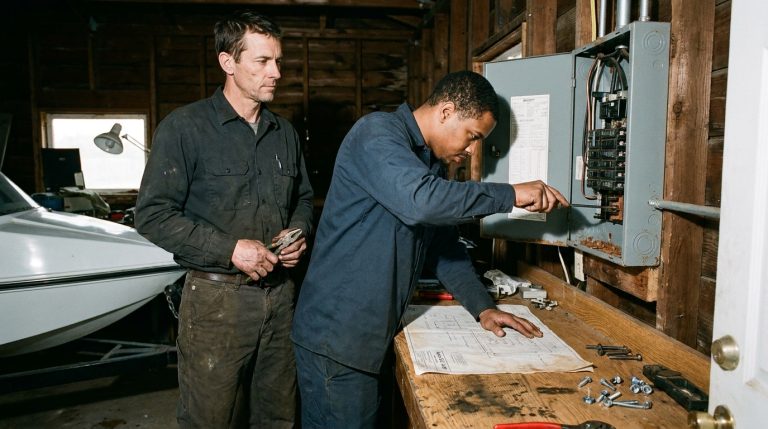
The air grew colder. The workshop was a repository of faded textures: the oil-stained workbench, the stack of spare airway bags, the worn manuals—all preserved in a state of constant, ready-state maintenance. Doyle unlocked the door and stepped inside. He didn’t turn on the light. He stood in the center of the room, letting the gloom settle, feeling the familiar, heavy peace of a place that held the truth of his trade.
Wynn lingered in the doorway, his silhouette framed by the deepening blue of the twilight. He was looking at the setup—the organized, sterile order of the room, the absence of “gear-head” branding. He was looking at the way Doyle had laid out his own field kit, stripped to the bare essentials.
“You want to know the cost?” Doyle asked, his voice echoing slightly in the small space. He pointed to a small, laminated sheet pinned to the wall, right beside a set of outdated but pristine trauma shears. It wasn’t an award. It was a casualty log, typed on a portable machine, the names of men who hadn’t come home from the hills of Laos. “The cost is that you start every single day by remembering that, sooner or later, the protocol is going to fail. And when it does, the only thing that stands between a life and the earth is the steadiness of your own hands.”
Wynn stared at the log. The silence in the workshop was absolute, thick with the weight of decades. It wasn’t the silence of an empty room; it was the silence of a memorial. Doyle watched the younger man, waiting to see if he would turn and run, or if he would finally understand why the shoes had to be put away—and why the class still had to be attended.
CHAPTER 3: THE WEIGHT OF THE RECORD
Garrett Wynn did not turn to leave. He remained in the threshold, his gaze fixed on the typed, yellowing paper pinned to the wall. It was a document of failure, a list of names for whom the protocol had been a final, desperate prayer. The contrast between that raw, ink-smudged history and the pristine, color-coded pouches in Wynn’s own bag was not just visible; it was visceral.
Doyle moved to the workbench, his hands finding the familiar weight of a metal trauma-shears casing. He didn’t look at his visitor. He began to organize a set of dressing packets, not because they needed organizing—they were already perfect—but because the motion kept his own hands from shaking. The memory of his son’s voice, “Try to keep up, old man,” hummed in the back of his mind like a persistent, low-frequency vibration. He had to keep the focus on the physical. If he allowed the emotional to bleed through, he would lose the ground he stood on.
“I didn’t mean to imply your methods weren’t effective,” Wynn finally said, his voice softer, stripped of the reflexive defensiveness that had characterized his presence at the base. “But in the field, we’re taught to prioritize speed. The faster you clear the site, the better your survival odds for the group.”
Doyle set the shears down with a sharp clack against the wood. He turned to face the younger man, his face carved into hard, tired lines.
“Speed is a variable,” Doyle said, his voice raspy. “Accuracy is a constant. You teach them to move fast, you teach them to be reckless. If you don’t teach them the geometry of the body, the anatomy of the break, you aren’t saving lives. You’re just delaying the inevitable.”
Wynn walked fully into the room, his eyes scanning the shelves. He stopped before a small, nondescript olive-drab notebook—not the one Doyle carried in his pocket, but a thicker, more weathered volume resting on the shelf. He didn’t reach for it, but his posture showed a profound, almost reverent curiosity.
“Is this it?” Wynn asked. “The revision?”
“That’s just notes,” Doyle said. “Observations on how the gear wears down in actual humidity. How a tourniquet strap loses its bite after three years of being carried against a hot engine block or in a wet pack. Things the manufacturers don’t put in their glossy brochures.”
Doyle walked over and retrieved the book. He didn’t open it; he simply held it, the leather cover soft from years of friction. He felt a sudden, sharp pang of protectiveness. This wasn’t just a record of mechanics; it was a record of the years he had spent as a ghost in his own life, iterating on ways to keep people alive so he could eventually come home and sit in a chair that would never be filled again.
“You have a family, Wynn?” Doyle asked, the question coming out more abrupt than he intended.
Wynn blinked, surprised by the pivot. “A wife. Two girls. Back in Knoxville.”
“Knoxville.” The word felt like a stone in Doyle’s throat. His daughter’s voice on the phone—Sunday at 8:00—echoed in the space between them. “Do you leave your gear at the door when you go home?”
“I… I keep it in the garage. My wife prefers it that way. Why?”
“Because eventually,” Doyle said, setting the book back on the shelf with finality, “you have to stop being the one who carries it. If you don’t, you’ll find yourself one day holding the gear for someone who isn’t coming back to claim it. And then you’ll spend the rest of your life trying to find a reason to keep the equipment in working order.”
Wynn shifted, his brow furrowing as he processed the statement. He looked around the workshop again, seeing it now not as a collection of tools, but as a shrine to a specific, haunting discipline. The faded textures of the room—the peeling paint on the workbench, the worn handle of the gear bag—seemed to press in on him.
“I came here,” Wynn started, his voice hesitant, “because I realized I’ve been teaching for an audience, not for the patient. I thought the ‘perfect’ presentation was the point. But seeing that list on your wall… it’s a different kind of authority.”
Doyle walked toward the door, signaling the end of the conversation. He couldn’t sustain this. The ghost of his son, the echo of the name Garrett, the weight of the Sunday morning call—it was too much to process with a stranger standing in his sanctuary.
“Go home, Wynn,” Doyle said, holding the door open. The evening air had turned crisp, a hint of frost creeping into the valley. “Go home and put your gear away. Not because it’s messy, but because you need to be there for those girls. If you’re going to teach, teach them to survive the work. Don’t teach them to love it more than they love the people they’re trying to save.”
Wynn stepped back out into the yard, the gravel crunching beneath his feet once more. He looked back at the workshop, then at the main house, where the kitchen light glowed, casting a long, rectangular beam across the porch. He seemed to want to say more, but he saw the look in Doyle’s eyes—a look that said the boundary was now drawn, absolute and non-negotiable.
Doyle watched him walk back to his truck. He didn’t wait to see the engine start. He turned back into the darkness of his workshop, closed the door, and locked it. He stood in the silence, his hand resting on the heavy, olive-drab notebook. The phantom presence of his son felt closer now, not as an intrusion, but as a quiet, heavy shadow in the corner of the room. He realized, with a deep, aching clarity, that he couldn’t keep this vigil forever. But as long as he did, he would make sure the work was done right.
CHAPTER 4: THE SUNDAY RECKONING
The sound was insistent, a thin, electronic blade slicing through the muffled stillness of the workshop. Doyle stood in the dark for a long heartbeat, his hand still cold from the iron lock he had just engaged. Every instinct he possessed, honed over decades of high-stakes environments, told him to ignore it. To let the machine take the message and retreat into the sanctuary of his own discipline. But he was a man of patterns, and the pattern was absolute.
He moved through the yard, the frost already settling on the hem of his jacket. The kitchen was warm, smelling of the remnants of the morning’s coffee. He reached the counter just as the phone prepared to roll over to voicemail. He picked up the receiver.
“Dad?”
His daughter’s voice, clear and underscored by the ambient noise of a busy Knoxville apartment, hit him like a physical blow. It was the voice of a life that was continuing, moving forward, while he remained moored to a past that was becoming increasingly difficult to anchor.
“I’m here,” Doyle said. His voice sounded thin to his own ears.
“You didn’t pick up this morning,” she said. She didn’t sound accusatory, just concerned—the habitual check-in of a woman who had learned to read her father’s silences as well as he read the terrain. “I was worried. Everything okay out there in the quiet?”
“Everything is fine,” he said, moving to the kitchen table and sitting down. He laid his hands flat on the wood, his knuckles pale in the dim light. “I had a… a commitment. Traveled a bit.”
There was a pause on the other end, the kind of stillness that meant she was holding back. “The recertification?”
“Yes.”
“And? Did you find what you were looking for?”
Doyle looked at the olive-drab notebook he had placed on the table earlier. He thought of Garrett Wynn, of the polished gear, of the casualty log pinned to his workshop wall, and of the look of absolute, shattering realization in the younger man’s eyes when he understood the cost.
“I found that the world is changing, Sarah,” he said, his voice slow and deliberate. “They have new manuals. New gear. New ways of telling the story of how to stay alive.”
“But?” she asked. She knew the ‘but’. She had lived with it since the day the runner shoes had been left on the peg.
“But the work is the same,” he said. “The hands don’t change. The panic doesn’t change. The need for a steady line—it’s as true now as it was fifty years ago. I think… I think I’ve been teaching a ghost instead of the future.”
“Dad, you can’t keep going back there,” she said, her voice softening, losing its edge of caution and becoming something more fragile. “It’s been six years. You’re holding onto a roster, a tradition, a memory. It’s not fair to you. And it wasn’t what he would have wanted.”
“I know,” Doyle said, though the words tasted like ash. He stared at his Hamilton watch. The crystal was scratched, the movement constant. “I just didn’t want the name to disappear from the record. If it’s not there, then in some way, the work he did—the work we did—it’s just… gone.”
“It’s not gone,” she said firmly. “It’s in the things you taught me. It’s in the way you still carry yourself. You don’t need a training room to prove he existed, or that he mattered.”
The conversation felt like a confrontation with a version of himself he had spent six years trying to repress. He was the sovereign protector of his son’s legacy, but in his devotion, he had become the prisoner of it. The “decoy” of his own mission—the belief that his presence in the training room was a vital, active necessity—began to unravel. He hadn’t been protecting the legacy; he had been hiding from the grief.
“I have to go,” he said abruptly, feeling the familiar, suffocating pressure of an emotional threshold he wasn’t prepared to cross.
“Dad, wait—”
He hung up. The silence that rushed back into the room was deafening. He sat in the dark, the weight of the phone receiver still cool under his palm. He had spent his life preparing for the moment of impact, for the physical crisis where everything narrowed down to a single decision. He had never been trained for this—the slow, creeping realization that the crisis had already passed, and he was still standing in the wreckage, trying to patch wounds that had long since healed over into scars.
He stood up and walked to the closet. He reached for the shelf where he had moved the trail running shoes. He didn’t take them out. He simply touched the worn heel of one shoe, the fabric faded and frayed, a relic of a life that had been cut short in the middle of a stride. He realized then that he couldn’t leave them there, tucked away in the dark, and he couldn’t take them to the training room as a talisman. He had to decide what to do with them.
He realized the “clue” he had been missing all these years wasn’t about the training protocols or the hemorrhage points. It was about the fact that he was the only one left who knew how to let go without losing the truth. He walked back to the kitchen, his posture no longer braced for an incoming blow, but heavy with the weariness of a man finally setting down a burden he had carried for far too long.
CHAPTER 5: THE UNEXPECTED RETURN
Doyle didn’t move from the kitchen chair. The sound of the truck—not his own, but the distinct, modern growl of the vehicle Wynn had driven—was unmistakable. It pulled up to the house, the engine cutting out with a harsh, abrupt finality. The silence that followed was heavy, expectant, and entirely unwelcome.
Doyle rose slowly, his knees stiff. The earlier conversation with his daughter still hummed in his ears, a frequency of doubt that made his resolve feel brittle. He walked through the dark hall to the front door, his hand resting instinctively on the latch. He did not turn on the porch light. He preferred to be the one who could see into the dark, rather than the one exposed by it.
Through the screen, he saw Wynn standing by the passenger door. He wasn’t wearing his tactical jacket now. He was in a simple sweater, his hands shoved deep into his pockets. He looked less like the instructor from the base and more like a man who had lost his way.
Doyle pushed the door open. He didn’t step out. He stayed in the shadow of the doorway, his silhouette imposing against the faint light of the kitchen behind him.
“I told you to go home, Wynn,” Doyle said. His voice was steady, but it held a jagged edge of warning.
Wynn looked up, his expression guarded. “I started to. I got three miles down the road, to that last stoplight, and I realized… I realized I didn’t know the answer to the most important question.”
“There are no more questions tonight,” Doyle said, his hand tightening on the doorframe. “I’m done with the classroom.”
“It’s not about the classroom,” Wynn said, stepping forward into the beam of moonlight that hit the porch. “I went back to the base. I looked at the original logs—the ones you were talking about. I found the 1974 revision. I looked at the dates.”
He paused, his eyes searching Doyle’s face. “The names on that log… those weren’t just personnel. They were friends. You didn’t just write that protocol to be efficient. You wrote it because you were trying to find a way to make sure that list didn’t grow. Every version since… it’s been about trying to preserve the mechanics while forgetting the intention.”
Doyle felt a sudden, sharp coldness. He hadn’t expected Wynn to dig that deep. Most men in his position would have been satisfied with the “correct” technique and moved on to the next slide.
“You think you’ve uncovered a secret,” Doyle said, his voice dropping into a low, dangerous rumble. “You haven’t. You’ve just discovered that some things are held together by grief, not by physics.”
“I think the secret is that you’ve been waiting for someone to notice,” Wynn countered. He wasn’t backing down. The “equal intellect” shift in their dynamic was palpable. “You don’t sit in that back row for two decades just to correct the record. You sit there because you’re looking for someone who sees the log on the wall and asks the right question. Not about the gear. About the names.”
Doyle stepped out onto the porch, the wood groaning under his weight. He felt a flash of anger—a raw, searing heat—that this stranger, this man who shared his son’s name but none of his history, was trying to pry open the closed room of his heart. But beneath the anger, there was a terrifying, fragile sense of relief.
“You want to know why I’m here?” Doyle asked, his voice shaking with the effort of containment. “I’m here because he was the only one who could look at that log and not see a list of casualties. He saw a map of what we needed to fix. And when he died, the map stopped making sense to everyone but me.”
“Then let me help you carry the map,” Wynn said, his voice barely a whisper in the night air.
Doyle stared at him. The “predator-prey” dynamic of their first encounter had completely inverted. Now, there was only the shared, heavy burden of a truth that neither of them could ignore.
The wind picked up, swirling dead leaves across the porch, a dry, whispering sound that seemed to mock the pretension of their words. Doyle looked at the truck, then back at the workshop. He realized that the “decoy” of his mission—the idea that he was protecting a professional standard—was completely shattered. He was just a father who had refused to let his son’s work be forgotten, even when it meant living in the past.
“If you want to help,” Doyle said, the words heavy with the price of honesty, “you don’t start by looking at the protocol. You start by acknowledging the failure.”
He turned and walked back into the house, leaving the door wide open. He didn’t look to see if Wynn followed. He went straight to the kitchen table, pulled out the chair where he had sat for years, and waited. The confrontation he had spent six years avoiding—the moment where the professional standard had to be reconciled with the personal loss—was finally, irrevocably upon him.
He didn’t have to fight it anymore. The exhausting, calculated motion of the last two decades began to slow, the rhythm of his life shifting from a rigid, guarded beat to something softer, more tired, and finally, human.
CHAPTER 6: THE CLOSING OF THE BOOK
Garrett Wynn sat opposite him, his posture stiff, his hands resting on the table—not the confident, baton-wielding hands of a master instructor, but the hands of someone who finally understood he was holding an empty cup. The kitchen was saturated with the scent of pine and old paper. The only sound was the steady, rhythmic ticking of the Hamilton watch on Doyle’s wrist—a heartbeat that had outlasted the crisis.
Doyle reached into his shirt pocket and pulled out the folded, threadbare square of paper: the certification card. He placed it in the center of the table. Beside it, he laid the olive-drab notebook.
“You wanted to know the cost,” Doyle said, his voice stripped of the gravelly defense he’d maintained for years. “This is it.”
He pushed the card toward Wynn. The younger man hesitated, then reached out, his fingertips brushing the faded blue ink of his namesake’s signature. Try to keep up, old man.
“My son,” Doyle began, his eyes fixed on the grain of the wood. “He didn’t die because of a bad protocol. He died because he was human, and the trail was unforgiving, and the clock finally ran out. I spent six years convinced that if I just kept showing up, if I just kept the name on the roster, I could somehow make the work he left behind permanent. I thought if I could fix the mistakes of the present, I could somehow balance the books for the past.”
Wynn looked up, his expression softened by a profound, heavy understanding. “You were trying to save him.”
“I was trying to save the version of him that still needed me to teach him,” Doyle corrected. “I was trying to freeze the moment before he ran out of time. But that’s not teaching. And it’s not living.”
He looked at the workshop door, visible through the kitchen window, still locked and dark. For six years, that room had been a memorial, a place where he curated the tools of a tragedy. He felt the phantom weight of the running shoes on the peg—not as a ghost, but as a memory of a boy who had moved through the world with joy, not just with gear.
“You asked me if I wanted to help you,” Doyle continued. “You wanted to know the secret of the protocol. The secret is that the gear is just gear. The protocol is just a guide. What matters is that you don’t let the weight of the work turn you into a machine. You have to be able to close the book.”
Doyle picked up the Hamilton watch and unclasped it. He set it on the table. It was a 1971 issue, still ticking, the crystal hazy. He pushed it toward Wynn.
“I’m done with the recertification, Garrett,” he said, using the name not for his son, but for the man sitting across from him. “I’m done standing in the back of the room. You have the foundation now. Use it. But don’t let it become your only language.”
Wynn stared at the watch, then at the older man. The realization of what was being offered—not just a piece of history, but the passing of a burden—seemed to drain the last of the arrogance from his face. He didn’t reach for the watch immediately. He understood the sanctity of the gesture.
“I won’t let it become a performance,” Wynn promised.
Doyle stood up. He felt a strange, light exhaustion, a sense of tectonic plates finally settling into place. He walked to the back door, grabbed his coat, and did something he hadn’t done in years. He went to the closet, retrieved the trail running shoes, and instead of hiding them away, he placed them on the porch, out in the open air, where the light could reach them. They weren’t a relic anymore. They were simply shoes that had once belonged to a runner.
He returned to the kitchen. The house was quiet. The Sunday call would come tomorrow at 8:00, and for the first time, he would answer it not because he was waiting for the clock to run out, but because he was ready to hear what his daughter had to say about her own life.
He walked to the stove and started a fresh pot of coffee, the old way, not measuring, just trusting the hands. He looked out the window at the ridge where the sun had long since dipped, leaving the sky a deep, bruised violet. The work was done. The protocol was handed off. The ledger was balanced.
He pulled a chair to the window, sat down, and watched the night settle over the property. He didn’t check the watch. He didn’t check the handbook. He simply sat, the stillness of the house no longer a wall, but a window. The weight in his chest had dissipated, replaced by a quiet, rhythmic peace that matched the settling of the land. He was no longer a custodian of a past that had stopped; he was a man living in the present, waiting for the morning.