The Silent Archive: How a Judge’s Unseen Labor Finally Echoed Through the Halls of Justice
CHAPTER 1: The Weight of the Robe
The courtroom was a study in stillness, save for the hum of the fluorescent lights that felt like a low-frequency warning. Dana, the court reporter, adjusted the margin on her stenowriter, her eyes fixed on the empty bench. I stood in the central aisle, the charcoal fabric of my suit jacket absorbing the morning light rather than reflecting it. I was holding a binder of exhibits—the mundane, heavy reality of the Bickford case—and for a second, I felt the sheer weight of the twenty-four years that had led to this exact square of carpet.
Then, the double doors at the rear of the chamber groaned.
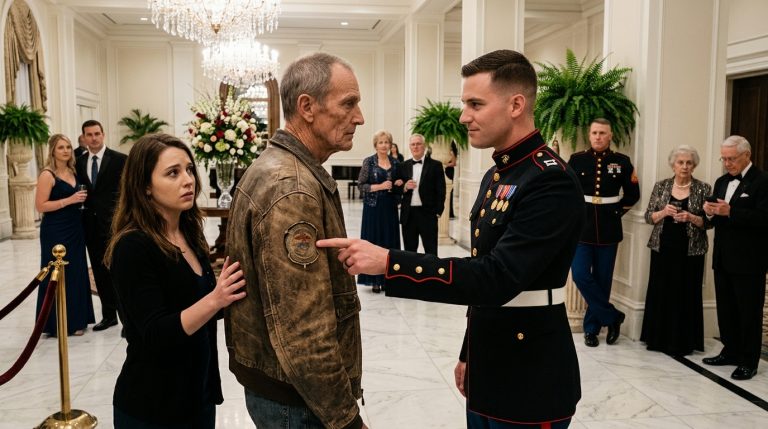
Major Troy Bickford didn’t walk; he arrived. He moved with the practiced, predatory grace of a man who had never been told “no” by anyone who mattered. Alan Pruitt, his civilian counsel, trailed him by half a step, an accessory to the arrogance radiating off the Major like heat from a desert road.
They stopped directly in front of me. Bickford, tall and draped in dress blues that looked like armor, didn’t bother to check for a nameplate. He looked at the binder in my hands, then over my shoulder at Dana, his expression curling into something patronizingly warm.
“Stenographer,” he said. The word was a weight, discarded on the floor between us. “Make sure you get every word right today, sweetheart. This one’s going to be over fast.”
He snapped his fingers, twice, a sharp sound that echoed against the oak paneling. He tilted his head toward the side table where the coffee machine sat, cold and unused. “And get my counsel a coffee before we start. He takes it black.”
Pruitt smirked, a quick, jagged movement.
I stood there, the binder pressed against my chest. I had spent half a lifetime becoming the person who could stand in the path of that snap, who could absorb the insult without internalizing the lie. I looked at Bickford, not with anger, but with the detached, clinical observation of a judge assessing evidence. He was a man built on the belief that the world was divided into those who signed the orders and those who typed them.
“The coffee’s on the side table, Counsel,” I said. My voice was level, unburdened by the sting he intended. I turned to Dana, handed her the binder, and walked toward the side door.
Bickford didn’t watch me go. He was already turning to Pruitt, leaning in to share a private joke about the morning’s proceedings. I was, in his eyes, successfully filed under furniture.
Inside chambers, the air was different—cooler, quieter. My uniform was draped over the back of the chair, the silver eagles on the shoulders catching the dim light. I dressed slowly, the fabric familiar against my skin, the routine an anchor. The robe went on last, a heavy, velvet-lined shroud of absolute impartiality.
I stood at the desk, hand flat against the wood, waiting for the feeling of the robe to settle. I wasn’t collecting courage; I was collecting the law. I breathed out, the tension in my shoulders dissolving into the purpose that had carried me this far. I wasn’t the stenographer anymore. I wasn’t the sergeant’s daughter who held her tongue to keep the peace at the kitchen table.
I was the bench.
I reached for the door handle. In less than a minute, Major Bickford would see me, and for the first time in his career, he would realize that the paperwork he had ignored was about to hold him to account.
CHAPTER 2: The Stillness of the Bench
The handle turned with a soft, mechanical click, a sound that felt entirely too loud in the stillness of the corridor. I pushed the door open, the transition from the enclosed, dim privacy of chambers to the bright, cavernous expanse of the courtroom feeling like walking out onto an open sea. The air here was different—recycled, cool, and laden with the faint, metallic scent of floor wax and old paper.
As I stepped onto the platform, the transition happened in that narrow margin between the door and the bench. I felt the robe settle against my shoulders, the weight of it suddenly not a burden but a grounding force. I wasn’t Lauren Caswell, the daughter of a patrol sergeant, the woman who had spent decades waiting for the right moment to speak. I was the process itself, distilled into a black robe and a gavel.
“All rise,” Staff Sergeant Ruiz’s voice cracked through the chamber, a practiced, authoritative rhythm that filled the high ceiling.
The courtroom moved with the synchronized grace of a military formation. Everyone rose—the spectators, the attorneys, the court reporter. And then, there was the Major.
Troy Bickford stood, his posture perfect, his uniform immaculate. But as my eyes swept the room and settled on him, I saw the exact moment the air left his chest. His head was turned, his gaze scanning the benches for the bailiff, or perhaps the clerk, before it landed on the elevated wood of the bench.
He didn’t just look up; he locked onto me.
The smile that had been plastered to his face—the warm, downhill smile of a man who owned every room he entered—didn’t just fade. It evaporated. It left behind a blank, hollow confusion that shifted almost instantly into a rigid, defensive stillness. His jaw tightened, the muscles flexing in a way that spoke of a man suddenly realizing that the terrain beneath his feet had shifted from solid ground to something far less certain.
I took the two steps up to the bench, my movements deliberate. Every sound—the rustle of my robe, the soft tap of my heels on the floor—seemed to amplify in the heavy silence he had created. I didn’t look at him directly. I didn’t need to. I could feel the heat of his confusion radiating from the defense table.
For a heartbeat, the image of my father’s kitchen table in 1989 flickered in my mind—the way he had set down his fork, the way he had told me that nobody liked a girl who thought she was smarter than the room. I felt that old, familiar sting, the phantom weight of being written off before I’d even begun to speak. But as I took my seat and felt the cold, polished oak of the bench against my palms, the ghost of that kitchen table dissolved.
This wasn’t Hartwell Creek. This was a courtroom, and the record was the only thing that mattered.
“Be seated,” I said. My voice was calm, projected with the even, measured cadence of the bench.
The room sat. The sound of chairs scraping against the floor was the only noise in the transition. I placed my hands on the desk, the folders already organized by my clerk. I could sense the tension thickening in the room, a palpable, vibrating energy that centered entirely on the defense table. Bickford remained stiff, his arms held awkwardly at his sides, his focus shifting from me to his counsel, Pruitt.
Pruitt was leaning in, whispering something behind his hand, his expression a mask of practiced indifference. He was a creature of the system, a man who believed every obstacle could be negotiated away with the right rhetoric. He didn’t know yet that he wasn’t dealing with a stenographer, and he wasn’t dealing with a victim. He was dealing with the law.
I opened the folder, my gaze sweeping across the parties present. I identified the government, then the defense, my tone as neutral and precise as a compass needle.
“Major Bickford,” I said, my gaze finally resting on him. He was staring at the nameplate on my bench, his eyes wide, his breathing shallow. He looked as if, if he stared long enough, the letters might rearrange themselves into something he recognized. “Before we proceed, the court notes for the record that at approximately 0755 this morning in the central aisle of this courtroom, the accused addressed the military judge, whom he did not recognize as the stenographer, directed her to transcribe accurately, and requested coffee for his counsel.”
The silence in the courtroom wasn’t just quiet; it was heavy. It had a texture to it, like thick, velvet curtains drawn shut. Dana’s stenowriter didn’t click. Not once.
“The court attaches no animus to the exchange,” I continued, my voice steady, unhurried. “And believes it can preside impartially. However, the defense may view the matter differently. Counsel, do you wish to voir dire the military judge or to move for recusal? Take whatever time you need.”
I leaned back slightly, my hands folded atop the file. The ball was in their court now. Pruitt leaned heavily into the Major, his head tilted, his brow furrowed. I watched the Major experience the conversation, saw the way the gray color crawled up his neck above his starched white collar.
This was the first movement of the dance, the moment where the power dynamic was stripped bare and tested. I saw the Major’s hand tremble—just a fraction of an inch—as he gripped the edge of the table. He was a man who had built his entire career on the assumption that he was the most important person in any room he occupied. Now, he was discovering that he was merely a participant in a process that was entirely indifferent to his status.
I watched him. I didn’t rush him. I gave him the silence, letting the gravity of his mistake settle over him, molecule by molecule. He was a man drowning in his own hubris, and I was the one holding the air.
CHAPTER 3: The Architecture of the Record
The seconds stretched, thinner and tighter, like a wire pulled to its breaking point. Major Troy Bickford didn’t look at his counsel, nor did he look at me. He stared at the nameplate bolted to the front of the bench—Colonel Lauren Caswell—as if the brass letters were a mirror reflecting a version of himself he hadn’t yet learned how to inhabit.
His counsel, Pruitt, finally broke the stalemate. He cleared his throat, a small, dry sound that seemed to scatter the tension in the room. He leaned back in his chair, his movements deliberate, calculated to project the effortless poise of a man who dealt with judges like this every week.
“Your Honor,” Pruitt began, his voice smooth, professional, and entirely devoid of the smugness he had worn like a cloak ten minutes earlier. “The defense has had a moment to confer. While we acknowledge the… candid nature of the court’s disclosure regarding this morning’s interaction, Major Bickford wishes to express his sincere regret for the misunderstanding. He is, as the court knows, a man of high standards and significant responsibilities. He was, perhaps, misaligned in his expectations of the courtroom environment.”
Pruitt stopped there, leaving the sentence hanging in the air. He was a master of the pivot, the kind of lawyer who knew exactly how to wrap an insult in the language of professional deference. He wasn’t apologizing for the disrespect; he was apologizing for the Major’s failure to recognize the role I was playing.
I waited. The silence I offered him was the same one I had given the Major, but it was colder. It didn’t invite him to continue; it forced him to dwell in the discomfort of his own words.
“The defense,” Pruitt said, his smile tightening, “has no challenge for cause. We are satisfied that the court is capable of an impartial hearing. We would like to proceed with the arraignment, Your Honor.”
I glanced at the government table. Captain Delgado remained perfectly still, her files laid out with the surgical precision of a field medic. She looked at me once—a brief, professional assessment—before turning her focus back to her notes. She didn’t need to speak; she knew the record was already doing the work for us.
“Understood,” I said. I tapped the gavel once, a crisp, clean sound that echoed with finality. “The record will reflect the defense’s position. We will proceed to the arraignment.”
The transition from the moment of tension to the routine of the procedure was a shift in temperature. As I began the recitation of the charges, I felt the familiar, rhythmic flow of the law. I read the charges—false official statements, dereliction of duty, conduct unbecoming an officer—not as a condemnation, but as a map of the destruction that had occurred on that range road.
As I spoke, I watched the Major. He was no longer trying to look like a man who owned the room. He was sitting at attention, his eyes fixed on the flag behind my bench. He was playing the part now, the soldier in the dock, but I could see the cracks in the paint. His fingernails were pressed white against his thighs. He was terrified, and for the first time, I realized he wasn’t terrified of the law. He was terrified of the possibility that the law might actually require him to look at the consequences of his own fiction.
“Major Bickford,” I said, once the reading was complete, “you have been advised of your rights. How do you plead?”
He didn’t speak immediately. He looked at Pruitt, and then back at me. His voice, when it finally emerged, was flat and hollowed out, stripped of the bravado that had defined him an hour ago.
“Not guilty, Your Honor.”
“Entered,” I replied.
I set the trial date, established the timeline for discovery, and brought the motion phase to a close. There was a specific, quiet rhythm to this, the way the law systematically dismantled the mess of human emotion and reconstructed it as a matter of fact. Every word we spoke was being recorded by Dana’s stenowriter, etched into the permanent record of the bottom copy.
As the courtroom began to stir—the rustle of papers, the low murmur of voices as the gallery prepared to file out—I noticed Harold Caswell in the back row. He hadn’t moved. He sat with his hands flat on his knees, his cap tucked under his arm, watching the proceedings with an intensity I hadn’t seen him direct at anything in years. When our eyes met for a fleeting second, he didn’t look away, and he didn’t offer the gruff, dismissive nod that had been his signature for three decades. He simply watched, his expression unreadable, a silent witness to the woman behind the bench.
I didn’t linger on him. I couldn’t afford to. I turned my attention to the courtroom as the Major rose to be escorted out. He walked past the gallery, his face a mask of iron, his head held at the exact, regulation-mandated angle. He was trying to project the image of a soldier enduring a trial, but I saw the way he stumbled—a minor, almost imperceptible catch in his step as he moved toward the doors.
He was walking into a storm he had manufactured himself, and the only question remaining was whether he had the intellectual capacity to understand that he had created the very weather that was about to destroy him.
I waited until the double doors swung shut, sealing the courtroom in a sudden, expectant quiet. Only then did I allow myself to lean back, the cold oak of the bench pressing against my spine. My work wasn’t to punish him. My work was to ensure that for the next two weeks, the truth would have nowhere to hide.
CHAPTER 4: The Grammar of the Motor Pool
The solitude of chambers was a reprieve, but it was brief. I didn’t go to the window to look at the airfield, nor did I reach for the tea I knew would be waiting for me in the staff lounge. Instead, I sat. I left the lights off, allowing the soft, grey light of the late afternoon to filter through the blinds, casting long, thin bars of shadow across my desk.
The Bickford file lay open before me, a dense, nine-hundred-page monolith of human error and bureaucratic neglect. I picked up my pencil. I had developed a habit over the years—a way of reading that ignored the headers and the official summaries, focusing instead on the margins, the timestamps, and the tiny, idiosyncratic details that people left behind when they thought no one would ever look.
I turned to the maintenance logs for the five-ton truck. They were clean, too clean. Every entry was initialed TB in a confident, sweeping hand that suggested a man who signed his name without ever pausing to consider the words beneath it.
I traced the line of a brake service entry dated October 2nd. It was signed, time-stamped, and closed out. But tucked away in the cross-referenced dispatch log for the same vehicle, there was a minor, almost invisible discrepancy—a request for a specific, non-standard hydraulic seal that hadn’t been processed by the supply chain until three days after the work order was marked as “complete.”
I sat back, the pencil resting against my lower lip. It was small. A ghost of a detail. But in the grammar of the motor pool, it was a scream.
There was a light tap at the door. I didn’t reach for the light. “Enter.”
It was Captain Delgado. She carried a stack of fresh exhibit binders, her posture weary but alert. She stepped into the room, her eyes adjusting to the dimness. She didn’t offer a polite opening or a comment on the long hours. She knew better. She set the binders on the edge of my desk, the leather covers making a soft, tactile thud in the quiet.
“The defense is trying to maneuver around the maintenance logs, Your Honor,” she said, her voice dropping to a register that acknowledged the weight of the work. “Pruitt’s looking for a path to claim procedural irregularity. He’s questioning the automated sync between the motor pool’s tablet records and the battalion’s main server.”
“Let him,” I said, my voice barely above a whisper. “If he wants to argue the technology, he’s welcome to try. But remind him that the law doesn’t care about the interface. It cares about the data that was entered.”
Delgado nodded, a small, knowing glint in her eyes. “I’ll prepare the foundation for the forensic examiner. He’s ready to walk them through the metadata. It’s going to be… tedious for them, I think.”
“Tedium is the point,” I replied. “When someone has built a castle out of sand, you don’t need a wrecking ball. You just need to show the court the tide coming in.”
She lingered for a moment, the silence between us heavy with the shared understanding of what the next few days would require. She looked at the file, then at me. “He’s scared, Ma’am. I saw it when he left today. He knows we aren’t following his script.”
“He never understood the script to begin with,” I said, finally setting the pencil down. “He thought he was writing the story, but he was just filling in the blanks. We’re the ones who read the bottom copy.”
After she left, the room returned to that hollow, humming quiet. I looked back at the logbook, at the entry initialed TB. It was a texture of a life—the arrogance of a man who thought he could overwrite reality with a single, looping signature. But reality, as I had learned long ago, had a way of correcting the record.
I thought of Private First Class Omar Green, twenty years old, relearning the simple, gravity-defying act of standing. I thought of the way the courtroom had risen, the entire room moving in a single, unbidden wave of respect that had nothing to do with me and everything to do with the fact that, for once, the record was finally being treated with the weight it deserved.
I didn’t need to be respected. I needed to be clear. I reached for the next binder, the pages crisp and cool beneath my fingertips. The truth was not a monster. It was not a weapon to be wielded. It was a foundation. And as the sun began to dip below the horizon, painting the room in shades of charcoal and ash, I began to draft the pre-trial rulings that would ensure the coming week would be defined by nothing but the slow, inevitable pressure of the facts.
I wasn’t just a judge; I was the librarian of their failures, and I would ensure that every single one of them was cataloged, indexed, and made impossible to ignore.
CHAPTER 5: The Friction of Evidence
The morning of the government’s opening statement arrived not with a roar, but with a sharp, sterile clarity. The courtroom was packed, the air thick with the hushed, nervous energy of people waiting for a story to be told. I sat on the bench, the weight of the robe feeling less like a garment and more like an extension of the courtroom itself.
Captain Delgado stood at the prosecution table. She didn’t look at the Major, nor did she look at the gallery. She looked at the jury box—empty, per the Major’s election—and then at me. Her opening statement was a masterclass in the accumulation of detail. She didn’t offer a theory; she offered a ledger. She began with the maintenance dispatch logs, then moved to the battalion’s readiness reports, and finally, to the forensic audit of the servers.
“The evidence,” she said, her voice clipped and devoid of flourish, “will show that the Major’s signature was not an act of administration. It was an act of omission.”
Across the aisle, Pruitt was writing, his pen moving in rhythmic, aggressive strokes. He was looking for the seam, the place where Delgado’s ledger might be argued as subjective. He wouldn’t find it.
The first witness was the safety investigator, a grizzled warrant officer who looked as though he had spent his entire career crawling under five-ton trucks. He described the accident scene with the flat, emotionless tone of a man who had seen too many ruined machines. Then, Delgado produced the maintenance record for the truck involved.
“Is this the vehicle’s official record?” she asked.
“It is,” the warrant officer said, his voice gravelly.
“And is it accurate?”
“No, Ma’am.”
“Why?”
“Because it says the braking system was fully operational,” he said, gesturing to a projection of the document on the screen. “And looking at the calipers pulled from that wreck, those parts hadn’t been touched in eighteen months.”
The room grew very still. I watched the Major. He was staring at the projection of the record, his face a mask of iron, but his hands—flat on the table—were trembling. Pruitt leaned in, his voice a low, urgent murmur, but the Major didn’t respond. He looked like a man watching his own life being dismantled, piece by piece, on a public screen.
Then, the unexpected occurred. A low, distorted buzz erupted from the back of the courtroom. The projection flickered, the images on the screen distorting into a wash of gray, digital static. The courtroom’s audio system, an aging relic of the installation’s infrastructure, hummed with a high-pitched, piercing whine that sent the spectators shifting uncomfortably in their seats.
“Court is in recess,” I said, my voice cutting through the noise. I didn’t wait for the bailiff. I stood and walked directly off the bench, toward the rear of the chamber.
The server room, a cramped, humid space tucked behind the gallery, was engulfed in a smell of sharp, biting ozone. A technician was already there, his face buried in the racks of wiring.
“What is this?” I asked, my voice demanding.
The technician looked up, startled. “It’s a hardware failure, Your Honor. The main server for the courtroom’s exhibit archives… it’s completely unresponsive.”
“Fix it,” I said. It wasn’t a suggestion. “Everything is recorded. The record is the trial. You have until the top of the hour.”
I turned and walked back into the main courtroom. The scene was a quiet chaos. The Major was sitting at the defense table, his head down, his posture slumped. For a split second, I saw his expression—he wasn’t looking at the static-filled screen; he was looking at the table surface with a raw, ugly desperation. He looked smaller than he had even an hour ago, the arrogance finally losing its battle with the sheer weight of what was happening.
I sat back on the bench. I didn’t return to the rear. I watched the room. I watched the spectators whispering, the way they looked at the Major—not with fear anymore, but with a cold, detached curiosity. The aura of command he had cultivated, the myth of the man who could make the world bend to his will, had evaporated.
He was just a man in a room, and he was failing.
When the screen finally stabilized—a long, agonizing twenty minutes later—it showed the same maintenance log. It hadn’t changed. The record was exactly as it had been before the static. The Major looked up at it, his eyes tracking the text, and I saw his shoulders drop. He knew. He knew that the record didn’t care about his stress, his rank, or his defense. It simply was.
“The witness may continue,” I said, my voice steady.
The trial resumed. The friction of the evidence was relentless. Every question Delgado asked was a turn of the screw, tightening the narrative until the truth was all that remained. I watched it all, my hands folded, the robe a weight of duty that felt, for the first time, like armor. The Major was being erased by his own paperwork, and the irony—that he was being undone by the very thing he had treated as beneath him—was not lost on me.
It was a slow, deliberate demolition. And as the day waned, turning the courtroom into a place of long shadows and flickering light, I felt the unmistakable sensation that the real trial hadn’t even begun yet. The record was complete, yes. But the Major? He was only just beginning to pay the price.
CHAPTER 6: The Anatomy of a Lie
The courtroom was colder the next morning. The air conditioning had been cranked up overnight, and the metallic, sterile scent of the facility was sharper, more pronounced. When I emerged from chambers, the room felt different. The collective gaze of the gallery wasn’t curious anymore; it was expectant. They were waiting for the moment the Major’s shield would finally shatter.
He was already seated when I took the bench. He didn’t stand as I entered—he didn’t have the room for it, not anymore. His dress blues, which had been pristine at the arraignment, now looked slightly frayed at the cuffs. He was staring at the floor, his shoulders hunched in a way that defied the military bearing he had clung to for so long.
Pruitt was arguing a motion to limit the testimony of a junior mechanic, his voice strained. He was fighting a war of attrition now, contesting every scrap of paper, every witness, every minor technicality. I overruled him with a brevity that didn’t leave room for follow-up.
“Counsel,” I said, my voice steady, “this court is interested in the facts as recorded, not as interpreted by the defense. Move along.”
Delgado stood, her movements as controlled as a metronome. She called the next witness: the young specialist, the one who had been told to “clean up” the logbooks. As he took the stand, I watched the Major. He finally looked up. His eyes, rimmed with fatigue, locked onto the young man with a look of pure, unadulterated warning. It was a commander’s look—an attempt to exert control over a subordinate who had already ceased to be his.
The specialist didn’t blink. He sat, hooked his thumbs into his belt, and began to speak.
As the testimony unfolded, the courtroom seemed to vanish. I found myself back in that kitchen in Hartwell Creek, the smell of my mother’s tea, the sound of Phil’s laughter, the sharp, authoritative voice of my father explaining to me—a twelve-year-old girl—that “nobody liked a girl who thought she was smarter than the room.” The phantom sensation of that kitchen table, that specific, claustrophobic pressure to be quiet, to be small, to be useful but never noticed, surged through me.
I gripped the edge of the bench. The wood was rough, worn thin by decades of judges holding onto the exact same feeling. I wasn’t that girl anymore. I was the one who had learned that the record wasn’t just paper—it was the only thing standing between the truth and the abyss.
“Major Bickford ordered you to replace the logs?” Delgado asked.
“Yes, Ma’am,” the specialist replied, his voice firm. “He said nobody reads the bottom copy. He said if I wanted a future in the battalion, I’d make the readiness report look like a success.”
The Major started to rise, a sharp, guttural sound escaping his throat. Pruitt’s hand slammed down onto his forearm, pinning him to the chair. The Major’s face was a map of raw, panicked rage—the face of a man whose world was built on the assumption that his subordinates would always, inevitably, be his mirrors.
“Major,” I said, my voice dropping to a low, warning register that echoed off the high rafters. “If you interrupt this witness again, you will be removed from this courtroom. Do not test the record.”
He froze. He looked at me, and for a fleeting, terrifying second, I saw his realization. He realized that the woman in the black robe wasn’t his peer, his enemy, or his servant. She was the one who decided whether or not he existed at all. The terror that washed over him was the kind that leaves no room for anything else.
He didn’t move. He didn’t speak. He simply slumped back, his eyes fixed on the empty space in front of him.
Delgado continued her questions, and I let her. I let the specialist detail the dates, the times, the specific lies the Major had dictated. Each fact was a brick in the wall he was building around himself. I watched the Major’s defense team unravel. Pruitt was sweating now, his notes chaotic, his focus fragmented. He was trying to defend a man who had already confessed in every action he had taken, in every line of paper he had falsified.
The courtroom felt tighter, the air pressurized. I realized then that I wasn’t just observing a trial; I was observing an exorcism. The Major was being purged of the arrogance that had defined him, and the court—this vast, silent, and indifferent machine—was doing it without a single drop of malice.
When I called for the afternoon recess, I didn’t rush out. I watched the Major remain in his chair even after the bailiff called for the room to rise. He looked like a man who had lost his home, a man who had suddenly realized that the foundation he had spent decades constructing was made of nothing more substantial than his own word.
As I walked toward the back, the weight of the robe felt different—lighter, almost like it had been stripped of the heavy history of everything I had carried into this room. I stopped by the door and glanced back. The Major was still there, sitting alone under the silent, watching flag. He was no longer the Major. He was just a man. And for the first time in the entire trial, I felt a deep, quiet sense of peace. The record was finally becoming complete.
CHAPTER 7: The Gravity of the Record
The morning of the findings was defined by a silence so absolute it felt like the walls themselves were holding their breath. I walked through the corridors toward the courtroom, the rhythmic click-clack of my heels against the polished floor tiles sounding like a metronome marking the remaining seconds of Major Bickford’s military existence. The air felt thin, over-oxygenated, as if the entire installation were leaning in to witness the inevitable conclusion of a failure that had been brewing for months, if not years.
I entered the courtroom. The room was packed—not with the casual curiosity of the opening days, but with a grim, solemn stillness. I scanned the gallery as I ascended the steps to the bench. Hobbs sat in the second row, his jacket pressed to perfection, his eyes fixed on me with a quiet, devastating intensity. Green, hooked into his aisle seat, sat with his cane laid across his lap like a soldier’s rifle. And in the very back, my father remained in that same Sunday jacket, his hands resting on his knees. He looked older than he had in the opening week, or perhaps the light was just less forgiving. He watched me with a stillness that, for the first time, held no judgment—only recognition.
I didn’t let the moment stretch. I was the process. I didn’t owe the room a performance; I owed it a ruling.
“All rise,” Staff Sergeant Ruiz’s voice was taut, vibrating with the solemnity of the occasion.
Major Bickford rose. He was a shell. The man who had entered the room with the easy, downhill smile of the entitled was gone. He stood at the position of attention, his eyes fixed on a point on the wall just above my head. He was vibrating, a fine, tremor-like motion that ran from his heels up to his jaw. He knew. The arrogance had been burned away, leaving only the raw, exposed nerves of a man who realized, finally, that his status had never been a shield—only a target.
“Be seated,” I said. My voice was neutral, the sound of an instrument functioning exactly as it was designed to.
The procedures for the findings were straightforward, a cold, mechanical progression that I had rehearsed in the quiet of my chambers until the words felt like part of my own heartbeat. I confirmed the presence of the parties. I looked at Bickford. He didn’t look back; he was focused entirely on the act of standing, of maintaining the facade of a soldier even as his entire professional identity evaporated.
“Major Troy Bickford,” I began, my voice echoing in the cavernous space. “This court finds you of all charges and specifications alleging false official statements, guilty.”
I watched him. His hands, gripping the edge of the defense table, turned white. There was no protest, no outburst, no dramatic plea. There was only the sound of his breathing—ragged, shallow, and increasingly desperate.
“Of the charge and specifications alleging dereliction of duty resulting in grievous bodily harm, guilty.”
The exhale in the courtroom was audible—a single, collective release of tension that sounded like a wind moving through a valley. I didn’t look at the gallery. I focused on the folder, on the black and white reality of the record.
“Of the charge of conduct unbecoming an officer, guilty.”
I brought the gavel down. The sound was flat, final, and absolute. It didn’t mark the end of a conflict; it marked the beginning of a consequence. The Major’s support, the rigid posture he had maintained throughout the trial, finally fractured. He didn’t collapse, but he slumped, his chest falling as if the very air had been vacuumed from the room. Pruitt reached for him, but his hand hung in the air, hesitant, as if afraid that touching his client might be a mistake.
The sentencing phase that followed was a blur of voices—the raw, broken testimony of Hobbs’ mother, the brief, quiet statement from Green about simply wanting to be heard. I listened to every word, noting the emotional cost of the “paperwork” that had been ignored in the interest of readiness. The Major said nothing. He didn’t speak in his own defense. He didn’t offer an apology. He simply sat, his gaze fixed on the table, a man watching his life being systematically dismantled by the very records he had once dismissed as meaningless.
When I sentenced him to dismissal and confinement, I felt nothing but the weight of the balance. The scales were level. The debt was being paid, not to me, not to the system, but to the truth of what had happened on that range road.
As I adjourned the court for the final time, I allowed myself one brief, sweeping look at the room. My father was still in the back row, his hands no longer on his knees, but pressed together in a quiet, contemplative gesture. He didn’t look at the Major, and he didn’t look at the gallery. He looked at me. And in the deep, tired lines of his face, I saw a reflection of the record I had just closed—complete, accurate, and finally, undeniably, mine.
I left the bench, the robe falling away as I stepped into chambers. I hung it on the hook, the black fabric catching the light. It was just a piece of equipment, a tool for holding the line. And for the first time in my life, I didn’t need the uniform to know exactly who I was.
CHAPTER 8: The Corrected Record
I stepped out from the cool, climate-controlled silence of the courthouse into the late afternoon heat of Georgia. The air was thick and heavy, smelling of baked red clay and the coming dusk. For twenty-four years, I had held the courtroom at a distance, a separate country where I was neither myself nor the woman I had spent decades trying to become. But as I stood on the granite steps, the robe left behind on its hook in chambers, I felt the space between the judge and the woman dissolve.
My father was there, waiting near the base of the stairs, his hands tucked deep into the pockets of his brown Sunday jacket. He stood with a slight slouch, squinting against the low-hanging sun, looking more like an old soldier waiting for a transport than a man who had just watched his daughter dismantle a life.
When I reached him, the silence between us wasn’t empty. It was pressurized, filled with the debris of three decades of unspoken things.
“Forty years,” he said, his voice gravelly, directed not quite at me, but at the sprawling, paved lot beyond. “Forty years I told the neighbors, told your mother, told myself… that you were just doing the paperwork. I filed you under ‘clerical,’ Lauren. I filed you under ‘quiet’.”
He shifted his weight, his bad hip causing a momentary wince. He didn’t look at me yet. He was staring at the distant, shimmering heat rising from the asphalt. “I watched a major—a man with gold on his shoulders and a command—get taken down by that paperwork. I watched a room full of soldiers stand up for you because they knew exactly what you were holding.”
He finally looked at me. His eyes were pale, watery, and searching. “I’m going to need to go back and correct the record. All of it.”
“That’s all I ever wanted entered into evidence, Dad,” I said. My voice didn’t shake. I realized then that I didn’t need him to understand the law, or the mechanics of the trial, or even the pain of those years. I only needed him to see the weight of what I had done.
He laughed—a short, jagged cough of a sound that seemed to surprise him as much as it did me. It was the first time I had ever triggered that sound, and the suddenness of it felt like a structural shift in our history. He stepped forward, and then, with a sudden, clumsy motion, he wrapped his arms around me.
The hug was tight, brief, and carried the tremor of age. It was a clumsy, desperate thing—a man trying to bridge a canyon with a handshake. I held him back, feeling the rough fabric of his jacket against my cheek, the smell of old tobacco and motor oil, the scent of the man I had spent my entire youth trying to decipher.
“Dad,” I whispered, the word feeling small and complete.
He stepped back and cleared his throat with immense, practiced authority. He looked around the installation grounds, his gaze landing on a small, nondescript coffee shack near the visitor’s center. “Tell me,” he said, shifting back into the man who insisted on logic, “is there anywhere on this base a man can get a cup of coffee that doesn’t taste like it was brewed during the Nixon administration?”
We walked toward the shack, the sound of our footsteps on the pavement syncopated and slow. We talked, but not about the trial. He asked about the mechanics of the law, about the specific files, and about the boys—Hobbs and Green. He listened, not with the impatient, dismissive air he had carried for years, but with a deliberate, painstaking attention. He was taking notes, building a new version of me in the architecture of his mind.
When I got home, the house felt different—not empty, but resonant. I went to the desk, pulled out the drawer where I had kept the clipping of my promotion photo, and finally, deliberately, tossed it into the wastebasket. It was just a clipping. The reality was in the record, and the record was secure.
I spent the evening in the quiet, my thoughts drifting to the courtroom. The gavel, the transcript, the stillness—they were just tools, and I was the one who had finally learned how to use them to carve out a space where the truth could breathe. I didn’t look back at the past, the kitchen table, or the long, lopsided years. I looked at the desk, at the blank, white sheets of paper waiting for the next docket, the next case, the next life that would need someone to hold the line.
I was forty-nine, I was a judge, and for the first time, I was entirely, fundamentally, myself. The record was complete. And as I sat in the gathering dark, I felt the finality of it—a quiet, unshakable peace that reached all the way to the bottom copy, where the truth had been waiting to be read, out loud, all along.