A Legacy of Wind and Light: Passing the Torch of Precision Across Seventy October Mornings
CHAPTER 1: THE BOUNDARY AT RANGE SEVEN
The air at Hawthorne Ridge tasted of dry sage and distant, high-desert iron. Eleanor stood at the edge of the firing line, her canvas bag a familiar weight against her hip. Beside her, the Marines were prone, their faces pressed against the stocks of Barrett M82s. They were young, their movements defined by a nervous, twitching energy that Eleanor had seen in every generation of students since 1950.
Captain Pierce was ten feet away, his back to her, hunched over a laptop that glowed with the cold, blue light of a failing model. He was typing with a sharp, rhythmic precision, but the screen only flickered with error codes. The shots were landing wide, erratic, and silent against the steel plate.
“That’s subjective interpretation, ma’am,” Pierce had said earlier, his voice smooth, professional, and entirely unaware of the scale of his error. He looked at her as if she were an anomaly in his perfect, digital architecture.
Eleanor didn’t look at him. She couldn’t afford to. Her focus was pulled tight, like a wire, down the center of the valley. She watched the south-facing slope, the way the light caught the golden aspens before diving into the ravine. It was a specific October shade, a color that signaled a thermal boundary no sensor could catch without a human eye to guide it.
“There is a boundary at twelve hundred yards,” she said, her voice quiet, layered with the dust of seventy years. “Four minutes of angle right will solve it. You aren’t averaging the wind; you’re averaging the noise.”
Pierce stopped typing. He didn’t turn around yet, but the stillness of his shoulders told her everything. He was a man who lived by the math on his screen, a man who believed the world could be perfected through data. He didn’t know that the earth, the grass, and the very air in this valley had their own, older language—one that required a different kind of calculation.
Staff Sergeant Torres, standing behind the bench, placed his hand on the wood. He didn’t put it back. He had been watching her since she walked up the gravel, and for the first time in his career, he saw a civilian who didn’t look at the rifles, but at the light itself.
Eleanor shifted her gaze. She looked at the seventh spiral notebook in her bag. It was the only thing that made sense of the morning. Behind the ink-stained pages, she could still hear Danny’s voice, the cadence of his questions, the way he had once read the grass on a ridge halfway across the world.
She looked back at the slope. The boundary was shifting, a subtle, shimmering ripple that signaled a change in pressure. It was happening exactly as it had in 1953, in 1968, in 1984. The valley wasn’t just a training ground; it was a map of everything she had ever lost.
“Your array’s averaging window is too wide, Captain,” she said, finally turning to him. Her eyes were steady, but inside, she felt the phantom sting of a cold wind. “You are missing the truth because you are too busy measuring the average.”
Pierce turned then. He was young, his skin unlined by the work she had done, his eyes full of a confidence that she knew would shatter the moment he looked through the scope and saw what she saw.
“Ma’am,” he began, his voice softening, “the system is designed to remove human error.”
“Is that what you call it?” Eleanor asked. She looked past him, toward the ravine. “Error?”
The next shot echoed across the valley. It missed the plate by three inches. The silence that followed was heavy, a suffocating vacuum that seemed to draw the life out of the firing line.
“Reeves,” Torres said, his voice clipped, “stand down.”
The young corporal sat up, his face pale, his hands trembling slightly as he pulled back from the scope. He looked at Eleanor. There was a question in his eyes—a desperate, aching need to understand why his perfectly calculated data had failed him.
Eleanor didn’t move. She felt the Zeigarnik bridge forming—the uncomfortable, pulsing gap between what these men knew and what they were about to be forced to learn. She reached into her bag, not for a rifle, but for the pen that had recorded seventy years of silence.
“You’re looking for an answer,” she said to the room, though she wasn’t sure if she was speaking to the Marines or to the ghost of the boy she had left behind in the Pacific. “But you need to start by looking for the question.”
She stepped forward, the gravel crunching under her feet like breaking bone, and noticed something she hadn’t seen before: a piece of metal, a discarded casing, glinting in the dirt. It wasn’t standard issue. It was old. And it was sitting exactly where Danny had described the slope in his final letter.
CHAPTER 2: THE GEOMETRY OF THE DUST
Eleanor remained motionless, her shadow stretching long and thin across the gravel. The discarded casing—a relic of some forgotten practice session—was dull, its brass oxidized by the harsh high-desert sun. To the Marines, it was trash. To Eleanor, it was a coordinate.
She didn’t reach for it. She didn’t have to. She knew exactly what it was and why it sat there: the drainage slope of the culvert she had recommended in 1956 hadn’t just changed the water flow; it had shifted the local thermal density of the ground itself.
Captain Pierce was staring at her, his lips parted. The silence on the range was total, broken only by the low, distant hum of a wind turbine on the ridge. He looked from the discarded casing to the sensor node mounted on the nearby fence post. He was a man who understood variables, but he was currently struggling with a variable that hadn’t been programmed into his master’s thesis: a woman who could read the history of the earth through the simple positioning of industrial debris.
“It’s not trash,” Eleanor said, her voice dry and rasping, like paper rubbing against stone. “It’s a marker. The heat retention of that culvert creates a micro-current that pulls to the north. Your sensor is reading the air temperature, but it isn’t reading the ground’s memory of the sun.”
Pierce stepped toward her, his boots crunching in the loose rock. He didn’t look at his laptop anymore. He looked at the culvert, then back to the sensor node, his brow furrowed with a dawning, uncomfortable realization. “The culvert,” he muttered, more to himself than to her. “If the concrete retains heat differently than the surrounding soil, the convective uplift would create exactly the displacement you mentioned.”
“Six feet per second,” Eleanor confirmed. She closed her eyes for a heartbeat.
The phantom sensation of a humid jungle night in 1953 flooded her senses—the damp, oppressive heat, the smell of cordite, and the way Danny Weiss had stood beside her, his finger tracing the wind currents on a topographical map that existed only in their shared imagination. ’It’s about the bounce, Eleanor,’ Danny’s voice echoed in her mind, a soft, insistent whisper of a ghost. ’The wind doesn’t just blow; it remembers where it’s been.’
She shook the thought away, the movement slow and deliberate. She was here, in Oregon, in the present, where the air was thin and biting.
“Corporal Reeves,” she said, her voice snapping back to the present with surgical precision. “Step back to the line.”
Reeves, who had been hovering near the spotting scope, hurried to obey. He didn’t look at Torres or Pierce. He looked at Eleanor as if she were the only person on the range who existed.
“You want me to shoot again, ma’am?”
“I want you to see the geometry,” Eleanor replied. She pointed a gnarled, steady finger toward the ravine. “The wind isn’t a force; it’s a consequence. Look at the grass at the ravine’s edge. Ignore the sensor. Ignore the tablet. Tell me what the ground is telling you.”
Pierce stood close enough to smell the faint scent of old dust and wool coming from her coat. He watched as Reeves lowered his head to the scope, his body tension visible in the hunch of his shoulders. The boy stayed there, silent, his breathing shallow. A minute passed. Then two.
“The ripple,” Reeves whispered, his voice trembling with a sudden, sharp clarity. “It’s… it’s folding back on itself. Like a wave hitting a wall.”
“That’s the counter-current,” Eleanor said. She felt a flicker of something—not joy, but a deep, resonant alignment. It was the same feeling she had felt seventy years ago when the shot had finally rung true. “Now, apply the offset. Don’t think about the math. Think about the path.”
As Reeves adjusted the scope, Pierce turned to her. His eyes were wide, the arrogance he’d worn like armor for eighteen months stripped away, replaced by the naked, frantic curiosity of a true student.
“I built that model to eliminate variables,” Pierce said, his voice barely audible. “I thought… I thought if I could quantify the world, I could remove the chance of failure. But you’re telling me the failure is the point.”
“The failure is the data,” Eleanor corrected him. She looked toward the observation building on the ridge, her gaze lingering on the distant, glass-fronted structure. She knew what was waiting for her up there—the archived truth, the folded letters, the weight of the past that she had carried in a canvas bag for a lifetime. “You think you’re here to upgrade the program, Captain. But you’re actually here to find out why the program needed you in the first place.”
She felt the cold wind pick up, the late October chill biting at her skin. The boundary was shifting again, moving with a subtle, predatory grace across the south-facing slope. It was a language she had been reading for seven decades, a silent, swirling conversation between the earth and the sky.
“Sergeant Torres,” Eleanor said, not turning around. “The session isn’t over. Keep them on the line. I have a conversation to finish on the ridge.”
Torres nodded, his expression unreadable, though his hand remained firm on the bench. He didn’t try to stop her. He watched her walk away, her gait steady and deliberate, the canvas bag swinging against her hip with a rhythmic, measured cadence.
She walked toward the path, leaving the Marines, the sensors, and the bewildered Captain Pierce behind her. She didn’t look back. She didn’t need to. She could feel the valley breathing, a vast, complex organism that was finally, after all these years, being understood not just by a machine, but by the people who had the patience to listen.
The gravel trail to the observation building was steep, a long, winding ascent through the gold-turning aspens. Every step was a negotiation with her own joints, a quiet, internal battle she had fought for years. She reached the first turn, paused, and placed a hand on a weathered cedar post to steady herself.
Below, the valley floor was a mosaic of light and shadow, the sensor nodes winking with tiny, intermittent status lights. They looked like fireflies caught in a glass jar. She took a breath, tasting the moisture in the air—the promise of a frost that would settle on the fences by dawn.
Her hand brushed the canvas bag. Inside, the Seventh Notebook lay pressed against the Navy Cross, a hard, cold, and heavy reality she was finally going to face. She remembered Danny’s face—the way he looked in the soft light of the camp, his eyes bright with the naive, desperate hope of a nineteen-year-old who thought the world could be made right with a single, perfect shot.
She kept walking, her shadow growing longer as the sun dipped toward the jagged spine of the mountains. She was closer now. The truth wasn’t a secret anymore; it was just waiting, buried under seventy years of paper and silence, ready to be unearthed by someone who knew how to look.
CHAPTER 3: THE TRANSMISSION OF SIGHT
The gravel trail toward the ridge was a test of endurance, but Eleanor didn’t hurry. Her breath came in short, measured puffs, white plumes that vanished into the crisp October air. Behind her, the firing line had gone quiet. Reeves and Hardesty were no longer firing; they were standing together, their eyes fixed on the distant ravine, trying to see the boundary as she had seen it.
Eleanor reached the crest of the first small rise and paused, not because her legs demanded it, but because the wind had suddenly veered. It wasn’t the boundary she had identified; it was a deeper, more erratic gust spilling over the ridge, carrying the scent of frost from the high desert. She took out her Seventh Notebook and made a quick, jagged mark in the margins.
15:20. Variable shift. Slope intake.
“You’re watching the grass, Corporal,” she said, her voice carrying clearly down the slope to where Reeves stood. She didn’t turn around, but she knew he was listening. “But you’re looking for movement. Stop looking for movement and start looking for the absence of it.”
Down on the range, she saw Reeves stiffen. He shifted his stance, his movements deliberate. The transition from active shooter to observant student was the hardest part of the craft—a shedding of the urge to force an outcome.
Captain Pierce had followed her a hundred yards, his gait hesitant. He held his closed laptop like a shield. When he reached her, he didn’t try to reclaim his authority. He stood beside her, his breathing heavy, his eyes scanning the hillside with a newfound, frantic intensity.
“The sensor array is still flagging the north-facing slope as the primary thermal source,” Pierce said, his voice stripped of its earlier professional veneer. “But the wind… it’s moving exactly contrary to the model’s projection.”
“Because the model assumes the ground is a static surface,” Eleanor replied, pointing toward a stand of aspens. Their leaves were pale gold, shivering in the sudden gust. “The ground here is a series of pockets. Pockets of heat, pockets of stagnant air, pockets of memory. You’re trying to build a map of a river while it’s in the middle of a flood.”
“How do you distinguish between the noise and the signal?” Pierce asked. He looked at the notebook in her hand, his gaze hungry. “How do you know what to write down?”
Eleanor looked at him, really looked at him, for the first time that day. He wasn’t the arrogant officer she had dismissed an hour ago. He was just a man who had realized the limits of his own tools.
“You don’t decide what matters,” she said softly. “The valley tells you. You just have to be in the right place, for a long enough time, to hear it.”
She turned and continued the ascent. The observation building loomed above them, a slab of raw, unyielding concrete that seemed to grow out of the ridge itself. It was the place where the official history lived—the files, the rejected awards, the records of men who had done the work only to have their names filed away in dark, forgotten drawers.
As they reached the base of the building, a sudden gust of wind whipped the canvas bag against her side. She felt the hard, sharp corner of the Navy Cross through the fabric. It was a physical weight, a dense, metallic anchor that grounded her to the reality of 1953.
“I spent four years in graduate school,” Pierce said, his footsteps slowing as they neared the concrete stairs. “I thought I was solving a problem of physics. I didn’t realize I was solving a problem of history.”
“The two are the same, Captain,” Eleanor said, reaching the concrete pad. She placed a hand on the cold, rough texture of the wall. “History is just physics that hasn’t been acknowledged yet.”
Inside the observation building, the air was still and smelled of ozone and old dust. It was a sterile, echoing space that felt entirely removed from the life outside. A window stretched across the entire front, offering a panoramic view of the target valley.
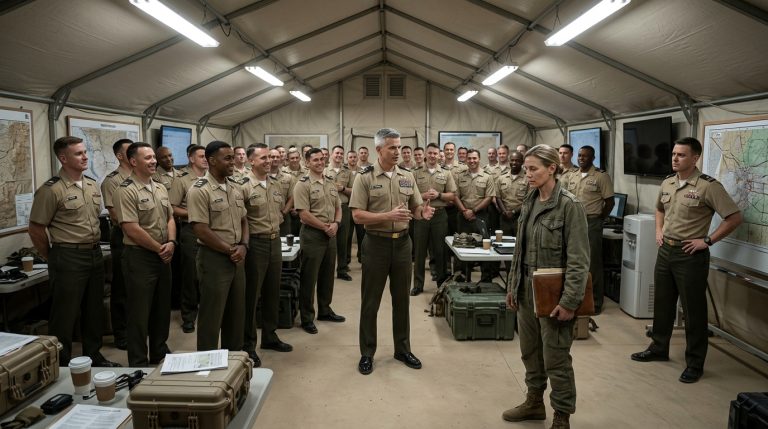
Colonel Hernandez was standing by the desk, her back to them. She was looking at a set of blueprints spread out on the table, their edges curled and yellowed with age. When she turned, her eyes went straight to Eleanor.
“The archives are being processed,” Hernandez said, her voice low. She didn’t offer a greeting. She went straight to the heart of the matter. “I found more than just the letter. There were duty logs from the 1956 period. The culvert wasn’t an accident. You fought the engineering board for months to get it installed.”
Eleanor felt a sudden, sharp pang of memory. The meetings, the smoke-filled rooms, the men in grey suits who couldn’t understand why a woman was arguing about drainage in the high desert. She hadn’t been fighting for the road. She had been fighting for the ground itself, for the stability of the shots she knew her students would have to take.
“They thought it was a waste of base budget,” Eleanor said, stepping toward the table. She didn’t look at the blueprints. She looked at the desk, where a small, leather-bound folder lay open.
“They thought it was irrelevant,” Hernandez corrected, her voice firm. “But they kept the memos. Every single one of them. It seems someone in the logistics office realized that your ‘anomalies’ were actually the most consistent data points on the range.”
Eleanor didn’t say anything. She walked to the window, the panoramic view of the valley below laid out before her like a living, breathing chart. She could see the firing line—tiny, insignificant dots of movement against the vast, golden expanse of the sagebrush.
“I’m going to document this,” Pierce said, standing by the door. He was looking at the folder, then at the notebooks in Eleanor’s bag. “I’m going to re-calibrate the entire array based on your ground observation. But I need you to show me the transitions. Not the averages. The transitions.”
“Then you have a long winter ahead of you, Captain,” Eleanor said. She didn’t turn around. She watched the grass at the ravine’s edge. Even from this height, she could see the boundary—a subtle, shimmering tension in the air.
The weight of the past was here, in this room, sitting on the table in the form of fading ink and brittle paper. But as she watched the valley, she realized the boundary hadn’t changed. It was still there, waiting, as it had been for seventy October mornings. And for the first time in her life, she wasn’t just observing it alone. She was passing the sight to someone who might finally understand why it mattered.
CHAPTER 4: THE ARCHIVES WEIGHT
The silence in the observation room was absolute, a heavy, airless vacuum that seemed to hold the breath of the mountain itself. Eleanor stood by the window, her gaze anchored on the valley below, where the training cycle continued in a cycle of imperfect shots. Colonel Hernandez stood beside her, her hands resting on the edge of the yellowed blueprints.
“The duty logs,” Hernandez said, her voice dropping into a register of professional gravity. “They aren’t just records of construction, Miss Dawson. They are admissions. The engineering board acknowledged, in their internal memos, that your input was the primary factor in the range’s accuracy. They suppressed it because it didn’t fit the emerging doctrine of centralized, sensor-based control.”
Eleanor turned slowly. The movement was a negotiation with her own weary frame. She looked at the folder, the leather cracked and worn, housing the evidence of a war that had been fought in hallways, not trenches. She hadn’t expected them to keep it. She had spent decades assuming her voice had been erased, filed into a drawer and forgotten, just another piece of administrative friction to be smoothed away by time.
“They didn’t want the truth,” Eleanor said, her voice a thin, brittle reed in the vast, echoing room. “They wanted a system that could be bought, sold, and replicated without the inconvenience of human intuition.”
“And yet,” Pierce interrupted, stepping closer to the table, “the system failed. Not because it was poorly designed, but because it was incomplete.” He looked at her, his eyes reflecting the pale, fading light of the late afternoon. “I’ve spent the last hour running the simulation again, incorporating the thermal shift you identified at the culvert. The model… it corrected itself. It’s perfect, Eleanor. It’s exactly what it should have been.”
Eleanor felt a sudden, sharp tremor in her hands. She reached out, her fingers brushing the edge of the leather folder. It wasn’t the perfection of the model that mattered; it was the fact that the secret—the subtle, tactile secret of the land—had been recognized.
She looked at Hernandez. “Why now? Why bring this to me now, after seventy years?”
“Because the Marine Corps is evolving,” Hernandez replied. “We are returning to a doctrine of adaptability. We need to understand that the machines are only as good as the eyes that read the environment. I didn’t find these files to apologize, Miss Dawson. I found them to use them.”
A sudden, sharp blast of air rattled the glass front of the observation building. The pressure was dropping, just as the notebook had predicted. Outside, the valley was turning a bruised, deep purple, the shadows stretching across the ravine in long, jagged fingers.
Eleanor took a step toward the desk and pulled the Third Notebook from her canvas bag. It was the one she didn’t handle without reason—the pages filled with Danny’s name, the dates, the raw calculations of a boy who had possessed a talent that transcended the brutality of his time. She opened it to the margin notes.
D.K.W. December 11th, 1953.
The ink was faded, but the handwriting was as sharp and clear as the day she had inscribed it. She felt the weight of the Navy Cross in the bottom of her bag, the cold bronze pressing against her palm through the canvas.
“I didn’t do this for the record,” she said, her voice growing firmer, the rasp replaced by a resonant, steel-like clarity. “I did it because the variables were real. The wind didn’t care about my authorization to be on that ridge. It didn’t care that I was a civilian. It cared only that the calculation was accurate.”
She looked at Pierce. “If you want to use these files, Captain, you have to understand the cost. This isn’t just data. It’s the result of being in the right place, at the right time, when the only thing that stood between a company of Marines and a failure was the ability to read three blades of grass.”
Pierce nodded, his face solemn. He picked up a pen, a modern, tactical instrument, and looked at the ancient blueprints. “Show me. Show me exactly where the micro-climate begins.”
As she leaned over the table, Eleanor felt the boundaries blurring. The room around her seemed to fade, replaced by the memory of the ridge in Korea—the biting cold, the smell of damp earth, the absolute, paralyzing fear that they had missed the wind. She saw Danny’s face in the candlelight, his youthful, earnest eyes asking her if the call was right.
She began to trace the lines on the blueprint, her finger moving with the practiced, effortless grace of a master. She didn’t need to look at the notes. The geometry of the valley was imprinted on her soul, a permanent map of the places she had saved.
But as she spoke, describing the pressure gradients and the way the air curled over the culvert, she realized something that made her falter. The wind wasn’t just physical. It was the medium through which she had kept them alive, a language of survival that had become her entire world.
Outside, a sudden, violent gust hit the building. The glass groaned. She stopped speaking, her heart stuttering in her chest. For a split second, she felt the phantom sting of a bullet—the cold, metallic reality of the war she had been fighting for seventy years.
She gripped the edge of the table, her knuckles white.
“Eleanor?” Pierce asked, his voice sharp with concern. “Are you alright?”
She didn’t answer. She looked at the valley floor, watching the light disappear, the landscape plunging into the suffocating, familiar dark of the Pacific night. The barrier between then and now had finally shattered, and she was left standing in the center of the wreckage, holding a pen over a map of a valley that was both her home and her grave.
The truth was here, etched into the blueprints and the old files, but the cost of that truth was a memory she could no longer suppress. She reached into her bag and pulled out the Navy Cross. She laid it on the blueprints, the bronze reflecting the sterile, flickering light of the observation room.
“The shot worked,” she whispered, the words barely escaping her lips. “But it didn’t bring them home.”
The silence returned, deeper and colder than before. Hernandez, Pierce, and the ghosts of her past all seemed to wait, hanging on the fragile, dying light of the afternoon.
CHAPTER 5: THE FINAL LESSON
Eleanor’s hand remained steady, though her pulse was a frantic rhythm against her wrist. She looked down at the blueprint, then toward the window, her gaze sweeping across the dark, undulating spine of the high desert. Pierce was still hunched over the desk, his pen tracing the lines of her correction. But the atmosphere in the room had soured; the sterile, efficient air was now charged with the static of an unresolved discrepancy.
“There,” Eleanor said, pointing to a nondescript mark near the north culvert—a small, red circle that didn’t align with the facility’s official installation map. “That node. It wasn’t in the original layout.”
Pierce paused, his pen hovering in the air. He leaned in, peering at the faded ink of the blueprint. “That’s not a standard sensor position. It’s too low, almost in the drainage ditch itself.”
“It’s not a sensor,” Eleanor murmured. She felt a cold prickle of apprehension crawl up her spine. “It’s a repeater.”
Colonel Hernandez pushed away from the desk, her expression tightening into a mask of professional scrutiny. “A repeater? Why would there be a repeater in the drainage ditch? That entire sector was supposed to be decommissioned in the late seventies.”
“Because someone wanted to monitor the thermal boundary without it being part of the central network,” Eleanor said, her voice dropping to a whisper. She turned away from the desk, walking toward the window to peer into the oppressive dark of the firing line. “Someone didn’t just want to measure the air. They wanted to measure the deviation.”
The realization hit her with the force of a physical blow. The reason her records had been suppressed, the reason the engineering board had fought so hard to bury the culvert memo—it wasn’t just about control. It was about surveillance. They had used her data, her meticulous decades of observation, to turn the valley into an experimental testbed for tracking variables they couldn’t control.
“Show me,” Pierce commanded, already grabbing his jacket. “If there’s an unauthorized node down there, it’s feeding data somewhere. If I can find the signal, I can find the receiver.”
The descent from the ridge was a blur of shadows and sharp, jagged adrenaline. They didn’t take the gravel road; they cut through the sagebrush, the dry stalks scratching at Eleanor’s coat like grasping fingers. She moved with a desperate, frantic speed that ignored the protest of her joints, her eyes fixed on the distant, dark patch where the culvert met the north-facing slope.
When they reached the drainage ditch, the air was heavy, damp with the coming frost. Pierce clicked on a high-intensity tactical light, its beam cutting through the gloom. The culvert mouth loomed before them, a gaping, rusted throat choked with dead brush.
He didn’t hesitate. He waded into the ditch, his boots sinking into the wet, clinging silt. Eleanor stood on the bank, watching the light dance over the corroded metal.
“I have a signal,” Pierce called out, his voice muffled by the culvert’s echo. “It’s tied into the power grid, but it’s routed through an isolated frequency. Someone has been running an independent data harvest from this spot for decades.”
He emerged a moment later, holding a small, blackened box—a piece of hardware that looked as though it had been installed during the early days of the facility’s operation. It was crusted with mud, its wiring brittle and frayed, yet the faint, rhythmic blink of a red LED light pulsed from within, a heartbeat in the dark.
“It’s a legacy system,” Pierce said, his face pale in the harsh glare of the flashlight. “It’s been here since the mid-seventies. Every bit of atmospheric data, every wind shift, every boundary calculation… it’s all been logged and transmitted to an off-site archive. They weren’t just ignoring your work, Eleanor. They were stealing it.”
The coldness in the ditch was absolute, but Eleanor barely felt it. She reached out, her fingers trembling as she touched the cold, wet surface of the box. She had spent seventy years believing she was a ghost in their system, a woman whose contributions were dismissed as subjective noise. The truth was far more calculated: they had treated her life’s work as a literal, physical resource to be mined.
“Danny,” she whispered, the name lost in the rustling of the brush. “They didn’t just forget us. They used us.”
“We can pull the logs,” Hernandez said, stepping down into the ditch. “We can trace the signal back to the origin point. If this hardware is still live, we can see exactly what they were tracking.”
“No,” Eleanor said, her voice rising, suddenly and violently clear. She looked at the box, at the rhythmic, mocking pulse of the red light. “The lesson isn’t in what they stole. The lesson is in what they could never see.”
She reached down, her hands firm, and ripped the wiring from the box. The LED light flickered, turned a sickly, pulsating amber, and then went dark. The silence that followed was total, a profound and absolute cessation of the machine’s heartbeat.
“They had the data,” Eleanor said, looking at the broken hardware, “but they never had the understanding. They had seventy years of my life in a box, but they still couldn’t read the grass. They still needed me.”
She looked at Pierce, then at Hernandez. She stood tall, the weight of the Navy Cross in her bag a reminder that the work—the real work, the work of the soul, the work of the teacher—belonged to her. They had taken the data, but they had failed to take the truth.
“The lesson is finished, Captain,” she said, her voice steady and echoing against the walls of the ravine. “You have the technology. You have the record. Now, you have to go back to the line and learn how to look at the world without needing a machine to tell you what you’re seeing.”
She turned and began to climb the bank, leaving the broken box in the mud. She felt lighter, the burden of the past peeling away with every step, leaving only the cold, clear reality of the morning ahead.
CHAPTER 6: THE QUIET RETURN
The walk back from the ditch was not a retreat; it was a homecoming. Eleanor moved with a strange, fluid grace, the heavy fatigue that had plagued her for years replaced by a cold, sharpened clarity. Pierce and Hernandez followed her, the beam of the tactical light slicing through the darkness, illuminating the path she had walked—in one way or another—for seventy years.
When they crested the final rise, the firing range lay spread out before them like a quiet, sleeping machine. The sensor nodes, now stripped of their illicit repeater, stood as mere sentinels of metal and wire. The valley itself felt different, the air no longer vibrating with the hidden, electronic pulse of surveillance. It was just air again—cold, dry, and indifferent to the machinery of men.
“The data logs,” Pierce said, his voice quiet as they reached the edge of the firing line. “They’re gone. The repeater was the only physical link to the archive. Without it, the signal has nowhere to go.”
“Good,” Eleanor said. She stopped at the spot where she had first stood that morning, the exact coordinate where she had read the grass. She looked down at the ground. The earth was dark, damp with frost, and completely silent.
“You did more than just break a machine, Eleanor,” Hernandez added, standing a respectful distance away. “You dismantled an architecture of silence. The history that was suppressed… it’s not buried anymore. By exposing the repeater, you’ve forced the entire logistical chain into the light. There will be an inquiry.”
Eleanor didn’t care about inquiries. She looked at her canvas bag. The Navy Cross felt heavier now, its weight no longer an abstract burden of memory, but a tactile piece of history she had finally reclaimed.
“The inquiry is for you,” Eleanor said, turning to face them. The moonlight caught the silver braid down her back, and for a moment, she looked exactly as she had in 1953: a woman who knew the terrain better than anyone, and who was no longer asking for permission to stand on it. “I’m going home. The frost is already on the sagebrush. My chores don’t wait for inquiries.”
Pierce took a step forward, his hesitation gone. He held out his hand, not for a handshake, but with the open palm of a student. “I’ll document the boundary. I’ll cite the work, the observation methods, everything. Not as a footnote, but as the foundation. You saved them, Eleanor. You saved them then, and you saved the work today.”
Eleanor took his hand. It was a strong, steady grip—the grip of a man who had finally stopped looking at the screen and started looking at the world. “Don’t just document it, Captain. Teach it. If you want to honor the work, make sure the next person to stand on this line knows how to read the grass before they look at the sensor.”
As she walked toward her truck, the sound of her boots on the gravel was the only noise in the valley. She reached the door, the engine still cold, and opened it. The cab smelled of old leather and the faint, lingering scent of the high desert. She tossed the canvas bag onto the passenger seat. The Seventh Notebook sat on top, its pages filled with the records of the day—the thermal shifts, the sensor adjustments, and the final, quiet entry: The boundary is still there. The work is finished.
She started the truck. The engine turned over with a low, guttural growl that shuddered through the chassis. She didn’t look back at the range. She knew the valley would be there in the morning, and the morning after that, and every October for as long as the earth kept its secrets.
The drive home was a long, meditative slide through the dark. She crossed the Nevada line, the road stretching out before her like a ribbon of ink. She felt no lingering anger, no bitterness, no desire for revenge. The men who had tried to bury her had been defeated by their own arrogance—the arrogance of believing that they could own the wind if they only built a fast enough computer.
She pulled into the farm at 3:00 AM. The house was a dark, silent outline against the sky, the cottonwood tree rattling its bare branches in the wind. She walked into the kitchen, the warmth of the wood stove still clinging to the walls. She went to the table, set the Navy Cross down, and finally, after seventy years, it looked like it belonged. It was just bronze. It was just a token. The real work was in the notebooks on the shelf, the decades of mornings she had read like a letter, the lives she had held in the quiet, steady rhythm of her own observation.
She went to the kitchen counter and picked up her pen. She opened the Seventh Notebook and wrote one final line in the margin, the ink smooth and dark against the paper.
The valley keeps its own time. I have kept mine.
She closed the notebook and placed it on the shelf, perfectly aligned with the six that preceded it. She was done. She went to the kitchen door, looked out at the vast, cold expanse of the sagebrush, and stood in the threshold for a long moment, listening to the silence.
The wind was shifting, a subtle, cold movement from the north. She read it without meaning to, the information flickering through her mind like a heartbeat. A light frost was coming. She would have to cover the south fence in the morning.
She turned, walked into the living room, and sat in the chair by the window. She felt the heavy, comfortable weight of the house around her—a place she had earned, a life she had carved out of the high desert, one morning at a time. She closed her eyes, the rhythm of the valley still echoing in the silence of the room. She was a teacher, a keeper of boundaries, and for the first time in her life, she was finally, completely, at peace.