Echoes of Valor: The Quiet Restoration of Honor Within the Iron Gates of Fort Holloway
CHAPTER 1: THE GATE OF GLASS AND STEEL
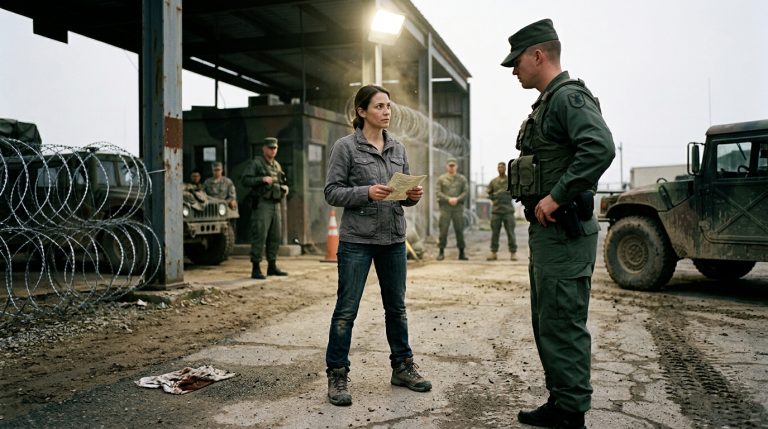
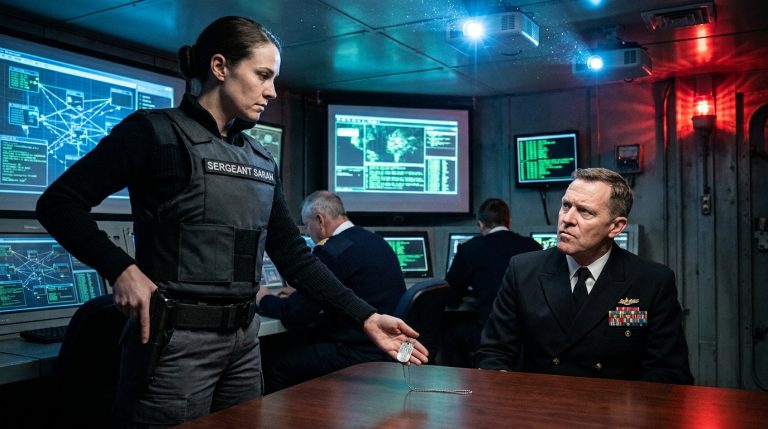
The November chill at Fort Holloway wasn’t just a weather pattern; it was a physical weight, pressing against the glass of the visitor’s booth like an unwanted guest. Airman Jessica Chen watched the old Ford F-150 rattle to a stop, its engine emitting a sound that sat somewhere between a dying gasp and a mechanical prayer. Beside her, Sergeant Kyle Rask stood at the window, his posture so rigid it seemed to defy the very laws of spinal flexibility.
“Check the plate, Chen,” Rask commanded, his eyes narrowing as he tracked the vehicle’s slow, uneven approach to the barrier. He didn’t look at her; he looked at the world as if it were a series of potential infractions waiting to happen. “And watch the driver. People who drive machinery that sounds like it’s being held together by rust and stubbornness are usually hiding something. A license, an expired tag, or just an inability to follow basic instructions.”
Chen tapped the keys, the familiar digital chirp filling the small space. “Copy, Sergeant.”
But as the driver’s door groaned open, the sound of the engine—that clattering, rhythmic pulse—faded into a background hum, replaced by the silence of the man stepping onto the pavement. Arthur Finch moved like a man walking through deep water. He wore a tweed coat with leather patches at the elbows, the fabric worn thin by decades of use, and he didn’t look up at the towering automated barriers or the cameras swiveling above like mechanical hawks. He looked through them, his eyes fixed on the long, oak-lined road that stretched toward the heart of the base.
“Sir!” Rask’s voice sliced through the crisp morning air, sharp and hungry for compliance. He stepped out of the booth, his polished boots clicking against the asphalt with aggressive precision. “You are entering a restricted installation. Return to your vehicle immediately and produce identification.”
Arthur didn’t flinch. He didn’t even accelerate his pace. His boots, heavy and caked with the dust of a life lived far from the polished marble of the Pentagon, kept their steady, measured rhythm. He was crossing the threshold of the base, his gaze distant, his mind seemingly miles and years away from the sterile, beige reality of Fort Holloway.
Rask’s face tightened. He broke into a jog, closing the distance between them. “I said halt! Are you deaf, old man? I am giving you a lawful order!”
As Rask reached out, his hand gripping the wool of Arthur’s coat, the air in the booth shifted. Jessica Chen, her heart suddenly hammering against her ribs, grabbed her radio. “Gate one to command post,” she whispered, her voice tight with an intuition she couldn’t explain. “We have a non-responsive walk-on. Requesting assistance.”
Arthur stopped. He turned slowly, his pale, tired eyes meeting Rask’s furious, red-faced glare. He didn’t look like a trespasser; he looked like a ghost who had finally found his way back to a place he once called home. He reached down, his hands trembling with a fine, rhythmic tremor, and touched the sergeant’s hand where it gripped his sleeve.
“Son,” Arthur said, his voice a low, raspy scrape that seemed to carry the weight of a century. “Take your hand off me.”
For a heartbeat, the gate was perfectly, terrifyingly still. The flag above snapped in the wind, a sharp, metallic sound that seemed to mock the tension between them. Arthur’s focus wasn’t on the sergeant’s rank or the looming cameras. It was on something far beyond the fence—a memory of a tree, a boy named Danny, and a promise that had kept him breathing for sixty years.
But then, Rask yanked his arm back, his frustration boiling over. “You’re a trespasser,” Rask snapped, his voice rising, his eyes darting to the passing cars. “And you’re going to regret this, old man.”
As Rask tightened his grip again, the leather satchel at Arthur’s side slid down, the old metal clasp groaning under the sudden movement. It gave way with a sharp, sickening snap, and the contents began to spill onto the unforgiving, hard-packed ground of the gate.
CHAPTER 2: THE WEIGHT OF THE SATCHEL
The sound was small—a sharp, brittle click that carried the finality of a closing door. For Arthur, that snap was the sound of a world rupturing. He stood frozen on the hot asphalt, his breath hitching in his chest, watching the contents of his satchel spread out like a fan of secrets. The thermos, its silver flank now bearing a fresh, jagged dent, rolled until it hit the tire of a stationary vehicle. An apple, crisp and bright, spun away and disappeared into the shadows beneath the guard shack.
But it was the small wooden box, skittering across the grit, that held the gravity of the universe. It had popped open upon impact. Nestled inside, on a bed of velvet so faded it had turned the color of dried dust, lay the dog tag.
“Don’t,” Arthur whispered. The word wasn’t a command; it was a plea to a past that refused to stay buried.
Sergeant Rask didn’t hear the plea. He saw an opportunity. He stepped forward, his polished boots heavy and deliberate, and loomed over the scattered items. His face, previously a mask of pure irritation, sharpened into a predatory focus. To Rask, this wasn’t a tragedy of lost memories; it was evidence.
“Well, well,” Rask murmured, his voice tight. He bent down, his movements calculated, and reached for the dog tag.
The heat rising from the asphalt was stifling, smelling of sun-baked oil and grit. In that sudden, humid rise of air, Arthur’s mind was jerked backward. He wasn’t at the gates of Fort Holloway; he was in the valley, the air thick with the smell of scorched earth and the metallic tang of blood. He felt the phantom weight of a man on his back—the boy from Iowa, Miller—his grip failing, his breathing jagged. The sergeant’s hand, reaching for the dog tag, seemed to superimpose itself over the memory of the shrapnel that had torn through his coat.
The intrusion of the memory was so visceral that Arthur’s hand twitched, the tremor in his fingers momentarily vanishing as a cold, crystalline clarity took hold. He didn’t want the boy—this Rask—touching Danny’s tag.
“I said, don’t,” Arthur repeated, his voice stronger, carrying a resonance that made Rask pause.
Rask looked up, his brow furrowed in a mix of condescension and growing agitation. “Is this it, then? Is this why you’re here, old man? Some petty theft? Some trinket you swiped from a collection box?” He snatched the dog tag from the ground. He held it up to the light, turning it over between his thumb and forefinger. He squinted at the name stamped into the metal. “D. Henderson. Who is this? Some poor soul you conned? Or is this part of the dementia? You forget where you live, so you start carrying around dead men’s tags?”
The accusation hung in the air, sharp and poisonous. It was a tactical strike, intended to strip Arthur of his dignity and transform his pilgrimage into a pathetic display of mental decline. Rask was looking for a narrative that fit his world—a simple, broken old man who could be easily dismissed, processed, and removed.
Arthur watched him, his pale eyes unblinking. He didn’t fight back with words. He didn’t explain. He only felt the profound, quiet ache in his hip, a physical anchor to the present that kept him from drifting entirely into the valley. He watched the sergeant’s fingers—too young, too smooth—clasp the tag that had once been warm against Danny’s chest.
“You have no idea what you’re holding,” Arthur said, his voice barely a whisper, yet it possessed a texture that cut through the noise of the base traffic.
“I’m holding evidence,” Rask retorted, his confidence rebounding now that he had found a narrative of “delusion” to cling to. “Evidence of trespassing, and likely, a mental health incident. Airman Chen!”
“Yes, Sergeant?” Chen’s voice came from the booth, trembling. She was watching the scene, her eyes fixed not on Rask, but on the way Arthur Finch stood—completely still, his shoulders back, the tremors having vanished entirely. She saw something in the old man that Rask was too blinded by his own ambition to perceive: a terrifying, absolute patience.
“Call the duty officer,” Rask ordered, not taking his eyes off Arthur. “Tell them we have a non-compliant civilian, clearly confused, in possession of military property. And tell them to bring a transport. This isn’t just a gate issue anymore.”
As Rask began to dictate the report into his radio, his back turned to Arthur, the old man slowly bent down. His joints protested, a symphony of creaks and dull aches, but he ignored them. He reached for the dented thermos, his fingers brushing the cool, scratched metal. It felt solid. Real.
He didn’t look at Rask. He looked at the oak-lined road beyond the booth. The sycamore tree was there, even if he couldn’t see it yet. It was a living thing, reaching toward the sky, holding the promise he had whispered to Danny sixty years ago. The sergeant’s voice, droning on about protocols and mental assessments, became nothing more than the sound of static—a distant, meaningless interference.
Arthur stood up, clutching the thermos to his chest. He knew the cost of what was happening. He knew that by letting Rask hold the tag, he had invited the very scrutiny he had spent six decades avoiding. But he also knew something the sergeant could never understand: the path to the tree was never going to be easy. It had to be earned. Every bit of friction, every indignity, was just another layer of the tax the past demanded of him.
Rask turned back, holding the dog tag out like a trophy. “You’re done, sir. Whatever game you thought you were playing, it ends here.”
Arthur just looked at him, his gaze soft, almost pitying. “You think you’re holding a tag,” Arthur said, his voice steady. “But you’re only holding the beginning of a conversation you aren’t ready to have.”
The sergeant scoffed, but for the first time, his hand—the hand holding the tag—shook just a fraction. He pulled his eyes away from Arthur, feeling a sudden, unexplained urge to look over his shoulder, as if someone—or something—had just stepped onto the asphalt behind him. The air grew still, the morning wind dying down, leaving the gate in a pocket of profound, unnatural silence.
CHAPTER 3: THE GENERALS AWAKENING
The static hissed, a harsh, jagged sound that filled the small space of the gate, vibrating against Arthur’s collarbone as if the radio itself were a live wire. Rask held the device to his mouth, his jaw clamped shut so tight the muscles pulsed beneath his skin. He was waiting for confirmation, his eyes darting toward the distant horizon where the main road curved out of sight behind a cluster of evergreen trees.
“Roger that, Command,” Rask muttered, his voice losing its earlier bravado. He glanced at Arthur, not with the predatory heat he had displayed moments ago, but with a sudden, twitchy nervousness. He stepped back toward the shelter of the guard booth, keeping the distance, keeping the perimeter.
Arthur stood on the asphalt, the small wooden box feeling impossibly heavy in his hand. He watched the air shimmer above the blacktop—a distortion caused by the growing heat of the day. In that haze, he saw shadows move. Not the shadows of the guards, but the silhouettes of men he hadn’t seen in sixty years, their forms flickering like sunlight through dense canopy. He blinked, and the figures dissolved into the sharp, aggressive angles of the Fort Holloway infrastructure.
It was happening. The call had been made. The chain of command was reacting, pulled forward by the phantom weight of a name on a dog tag.
“Stay right there,” Rask snapped, though the authority in his voice sounded thin, like stretched plastic. “The duty officer is on his way. You’re not going anywhere, old man.”
Arthur didn’t answer. He simply reached into the pocket of his tweed coat and pulled out the photograph he had carried for decades. The edges were soft, frayed to the point of disintegration. He didn’t look at the photo—he knew every crease, every sun-faded feature of the two young men standing in the dust—but he let his thumb trace the silhouette of the face that wasn’t his.
“They’re coming,” Arthur said, the words barely audible.
Rask frowned, his eyes narrowing. “Who? The MPs? You better believe they are. They don’t take kindly to people messing with the front gate.”
“No,” Arthur said, his gaze drifting back to the long road. “Not them.”
A sudden, high-frequency whine began to build in the distance—the sound of an engine pushed beyond its standard operational parameters. It wasn’t the steady, low rumble of a delivery truck or the controlled hum of a sedan. It was a aggressive, straining sound, growing in intensity with every passing second.
Airman Chen, who had been hovering near the doorway of the booth, stepped out. She looked down the road, her face pale. “Sergeant? Is that… is that the staff car?”
Rask’s neck snapped toward the road. His mouth opened, but no words came out. The sound grew—a mechanical scream that heralded the arrival of something that refused to wait for traffic to clear. A black car, polished to a mirror finish that seemed to swallow the light, crested the hill. It moved not like a vehicle, but like a predator clearing a path, the two stars on the bumper glinting with a cold, unforgiving light.
The air on the base seemed to lose its oxygen. Arthur watched the car approach, the spectral memory of the past colliding with the high-tech reality of the present. He saw the way the wind caught the flag at the base’s entrance—a sharp, violent snap that mirrored the cadence of his heart.
The staff car didn’t slow. It hit the gravel of the visitor’s lot with a spray of dust, the tires screeching as it executed a maneuver that belonged on a training course, not a main gate. The doors flew open before the car had even finished rocking to a halt.
Out stepped Major General Marcus Thorne. He was a man built of sharp lines and heavy responsibility. He didn’t look at the booth. He didn’t look at the traffic beginning to pile up on the public road. His eyes—intense, searching, and vibrating with an emotion that transcended military regulation—locked instantly onto the figure in the threadbare tweed coat.
Rask, caught in the sudden vacuum of the General’s presence, stumbled. He frantically tried to fix his posture, his hands fumbling with his belt, his face draining of all color. He was an officer of the gate, a monarch of his own small, petty kingdom, and in the presence of the two-star general, he suddenly looked like nothing more than a child caught in the rain.
“Sir!” Rask barked, the salute so stiff it looked painful.
The General ignored him. Thorne took a step forward, his boot meeting the asphalt with a sound that seemed to silence the very world around them. He stopped, his breathing audible—sharp, rhythmic, and heavy. He looked at Arthur, his gaze tracing the lines of the old man’s face, the worn tweed, the slight tremor in the hands that clutched the thermos and the box.
Thorne’s face, usually a mask of impenetrable command, began to soften. The power radiating from him—the aura of the Pentagon and the burden of the base—seemed to recede, leaving only the man beneath the uniform.
“It can’t be,” Thorne said, his voice barely a tremor in the wind. “After all these years… it’s really you.”
Arthur stood his ground, the weight of the moment pressing into his shoulders. He felt the cold iron of the dog tag in his hand, the physical bridge to the man who would never walk these grounds again. He looked at the General, and for a fleeting second, he saw the boy who had once listened to stories with wide, hungry eyes—a boy who had grown up to wear the stars of his father’s past.
“I promised, Marcus,” Arthur said, his voice a soft rasp that carried no rank, no title, and no fear. “I promised I’d come back to check on the tree.”
The General’s composure shattered. He didn’t move toward the gate’s guards; he didn’t address the trespass report. Instead, he took one slow, agonizing step toward Arthur, his posture shifting from the rigid stance of a commander to the humble, bowed carriage of a soldier recognizing a legend that had long since passed into the realm of ghost stories.
Behind them, Sergeant Rask stood frozen, his world tilting on its axis, the rules he had spent the morning enforcing revealed as nothing more than dust in the face of a history he couldn’t comprehend.
CHAPTER 4: THE SALUTATION AT THE PERIMETER
The silence was brittle, a thin film of glass stretched over a pit of raw, unspoken history. General Thorne held his position, his hand still poised in the air near his brow, a salute given not to the rank on a uniform, but to the weight of the man beneath the threadbare tweed. He didn’t look at Rask, nor at the MPs who had formed a perimeter of tense, uneasy steel around the lot. He looked only at Arthur.
“Chief Warrant Officer,” Thorne said, his voice dropping into a tone that was no longer that of a commanding officer, but that of a man honoring a debt that had been compounding interest for sixty years. “I have waited a long time to witness this, sir.”
Arthur slowly raised his hand. It was a laborious movement—the joints stiff, the skin papery and translucent under the harsh midday sun—but as he brought his hand to his brow, the tremor vanished. For a second, the years of decline, the ache of the hip, and the fog of memory fell away, revealing the posture of a soldier who had once held the line against hell itself. The salute was returned.
Rask, standing a few feet back, felt as though the floor beneath his boots had turned to liquid. His breath came in shallow, ragged hitches. He had called this man a trespasser. He had physically laid hands on a legend. The realization wasn’t a sudden epiphany; it was a slow, crushing realization of his own utter insignificance in the face of what was unfolding.
Before Thorne could speak again, the high, rhythmic chirping of his own tactical radio pierced the tension. He frowned, his eyes flicking toward the base’s horizon, then back to the device on his belt. He adjusted the frequency, his features hardening.
“General Thorne, Command Post, do you copy?” The voice on the other end was frantic, buzzing with the agitation of an administration realizing a high-value narrative was slipping from their control. “Sir, we have the Inspector General’s office on the line regarding the gate incident. They are asking for an immediate report on the detention of a civilian… and, sir, the Pentagon is requesting an identification check via the historical records database. We need to clear the perimeter.”
Thorne’s jaw tightened. He held up a finger, a silent command for the radio to be still, but the interference remained—a persistent, intrusive reminder that he was, despite his rank, still a cog in a machine that valued protocol over ghosts. He looked at Arthur, a flash of genuine, human apology crossing his face.
“They are waking up, Chief,” Thorne said, his voice low. “The machine doesn’t like things it can’t file away in a neat, orderly box.”
Arthur watched the General, seeing the conflict etched into the lines around his eyes. Thorne was a man of the base, a guardian of its current, sterile traditions, but he was also the son of a man who had been saved from the darkness by the man standing before him.
“Let them come,” Arthur said, his voice quiet but carrying a weight that seemed to dampen the static from the General’s radio. “The tree is still there, isn’t it?”
Thorne nodded, a sharp, decisive movement. “It is. The ground has been preserved. It has been safe since the day you left.”
Rask, seeing an opportunity to regain some small measure of control—a fool’s errand, but one born of pure survival instinct—stepped forward, his voice cracking. “Sir, if he’s to be cleared, I have the logs, I have the—”
Thorne turned. The look he gave the sergeant wasn’t one of fury; it was worse. It was the look a surgeon might give a gangrenous limb—clinical, detached, and utterly resolute. “Sergeant Rask, you have nothing left here today. You will stand by your post and you will keep this gate secure from all further interference until I return. Do you understand?”
“Sir, yes, sir,” Rask whispered, the sound dying in his throat.
Thorne turned back to Arthur, his demeanor shifting back to that of a grateful heir. He didn’t call for his driver. He stepped toward the passenger door of his staff car, opened it, and bowed his head—a gesture of profound respect that made the watching MPs shift uncomfortably.
“Chief,” Thorne said. “I am going to take you to the rise. The walk is… it is a long one, and I will not have you doing it alone.”
Arthur looked at the car. It was sleek, modern, and alien, a far cry from the dust and sweat of the valley, but it was the only way forward. He looked back at the gate, at the small wooden box he had retrieved, the dog tag tucked safely inside. He had survived the gate, but the struggle was only just beginning. The machine was moving to label him, to file him, to turn him into an anecdote—and he knew that the hardest part of his journey wouldn’t be the path to the sycamore, but the battle to remain a man instead of a monument.
As he slid into the plush, cool interior of the staff car, the smell of leather and ozone hit him—a scent that reminded him of nothing and everything. The General slid into the driver’s seat, his face set, his hand resting on the wheel as he waited for Arthur to signal the next move.
“Are you ready, sir?” Thorne asked.
Arthur looked through the glass, his eyes focusing on the road that led to the sycamore. “I’ve been ready for sixty years.”
As the engine hummed to life, the car rolled away, leaving Rask standing alone in the center of the gravel lot, the radio in his hand still buzzing with the insistent, meaningless demands of the world that had been left behind.
CHAPTER 5: THE WALK TO THE RISE
The ride up the oak-lined road had been a descent into a world that no longer existed. General Thorne drove with a focused intensity, his eyes scanning the landscape as if he were trying to map it against an invisible blueprint in his mind. He didn’t speak. He didn’t need to. The silence in the car wasn’t empty; it was a conversation held in the language of shared, unspoken gravity.
When the car finally slowed and rolled to a stop at the base of the rise, the air outside felt different—thinner, colder, and heavy with the scent of pine needles and damp, shadowed soil. Thorne cut the engine. The sudden absence of the hum of the internal combustion engine made the silence feel like a physical pressure against the eardrums.
Arthur opened the door. His feet hit the ground, and he felt the familiar, grounding crunch of dry leaves—the same sound that had heralded the start of so many marches in a land far away.
“I’ll wait here, Chief,” Thorne said. He didn’t reach for the door handle. He sat with his hands resting on the steering wheel, his gaze fixed straight ahead, granting Arthur the one thing he had been denied for decades: absolute, unmonitored privacy.
Arthur nodded, the movement slow and deliberate. He began his ascent. The path was overgrown, the grass reclaiming the edges, but the memory of the route remained etched into his muscle memory. He felt the familiar strain in his hip, a dull, rhythmic ache that pulsed in time with his heartbeat, but it was nothing compared to the mounting pressure in his chest.
As he neared the summit, he saw it. The sycamore.
It was magnificent. It rose from the earth like a titan, its trunk broad and scarred with the rough, mottled texture of a tree that had endured everything the seasons could throw at it. Its limbs, vast and heavy with the weight of years, spread out to frame the sky in a canopy of fading gold and copper.
Arthur approached the tree, his heart hammering against his ribs. He felt like an intruder in a cathedral. As he reached the base, he stopped. His eyes drifted to the soil at the base of the trunk.
He froze.
There was a disruption in the earth. A patch of ground near the root structure had been turned over, the soil darker and looser than the surrounding terrain. Someone had been digging—not deep, but enough to disturb the sanctity of the rise. A piece of blue surveyor’s tape fluttered from a low-hanging branch, a bright, artificial plastic streak against the ancient wood.
The ache in his hip intensified, sharp and sudden. He dropped to his knees, his hands reaching out to touch the soil. It was cool, damp, and smelled of disturbed time. This was supposed to be a place of quiet, a place left to the wind and the sun. Instead, it bore the marks of progress, of development, of a world that didn’t know how to stop long enough to respect the dead.
“They’re coming for it, aren’t they?” he whispered to the trunk.
He leaned his forehead against the rough bark. He could feel the pulse of the tree—the slow, deep rhythm of a life that measured time in decades, not in the frantic, buzzing ticks of a clock. He felt the tremor in his hands finally subside, replaced by a cold, hardened resolve. He hadn’t just come to remember. He had come to defend.
The decoy secret—the idea that he was just a confused old man—suddenly felt like a joke. He was the only one who remembered the promise. He was the only one who knew that the ground beneath this tree wasn’t just dirt; it was the foundation of the debt he owed to Danny, the only debt that had ever mattered.
He stood up, his knees popping, his body feeling the heavy toll of the day. He looked back down the rise. General Thorne was still sitting in the car, a solitary, immobile figure. He looked like a monument to the very system that was currently reaching out to dismantle the rise, to turn this sacred ground into something profitable, something useful, something that could be filed away.
Arthur reached into his coat and pulled out the small wooden box. He didn’t open it. He held it against the bark of the sycamore, a silent, final communion.
“I’m still here, Danny,” he said into the silence. “And I’m not done yet.”
The wind shifted, carrying the sound of a distant, encroaching mechanical hum—the base’s construction crews, the surveyors, the engineers. They were closer than he thought. The realization hit him with the force of a physical blow. The pilgrimage wasn’t just a visit. It was a frontline.
He turned away from the tree, his eyes hardening as he surveyed the rise. He had spent his life running from the ghosts, and now, at the end of it all, he realized he had been running toward this. A confrontation. A last stand. Not with guns, not with fire, but with the only weapon he had left: the truth of what this place had cost.
He began his descent, his stride firmer, the limp in his step seemingly forgotten. He had come home for both of them, and he was not going to let them pave over the memory.
CHAPTER 6: THE ECHO OF THE PROMISE
The walk back down the rise was longer than the ascent. With every step, the tension in Arthur’s shoulders began to bleed away, replaced by a profound, hollow weariness that settled deep into his marrow. As he emerged from the tree line, he saw General Thorne standing beside the staff car. The General was no longer looking at the horizon; he was looking at the ground, his face illuminated by a flickering, painful clarity.
“I saw the tape, Chief,” Thorne said, his voice quiet, devoid of the command-level projection he had used all morning. “I didn’t know they had started the survey for the new wing this early. I… I gave the order for that expansion six months ago.”
Arthur stopped a few feet away. He didn’t look at the General; he looked at the tree behind him, its gnarled branches silhouetted against the waning afternoon sun. “You didn’t know,” Arthur said. It wasn’t a question. “But you know now.”
Thorne looked up, his eyes glassy. “I do. And I will stop it.”
The General reached out, his hand hovering uncertainly before he realized the gesture was unnecessary. He stepped toward the car, opened the door, and for the first time, he didn’t wait for Arthur to slide in before he started talking.
“I was a boy when my father told me about the valley,” Thorne said, his voice picking up a rhythm, an unfolding of truth that he had kept locked in the silent chambers of his memory. “He told me that you didn’t just carry him—you carried the memory of everyone else who didn’t make it back. He told me that you were a ghost, a man who refused to believe in his own survival because he had left so much of himself in that mud. When I took command of this base, I felt like I was walking on hallowed ground. I thought I was protecting the legacy of the men who stood where you stood.”
Thorne paused, his gaze drifting back to the rise. “But I was protecting the institution, not the people. I turned the history into architecture, into budget reports and new wings. I didn’t see that the ghost had come back to check on the only thing that was real.”
Arthur slid into the seat, the leather cool beneath his touch. He felt a sudden, sharp pang of sorrow—not for himself, but for the General. Thorne was a good man, but he had been drowning in the sterile efficiency of a machine that had no place for ghosts.
“You have a choice, Marcus,” Arthur said, his voice thin but steady. “You can keep the machine running, or you can decide what actually matters. The tree doesn’t need a plaque. It needs space to grow.”
The ride back to the gate was a funeral procession for the man Arthur had been, and a birth for the man Thorne would become. When they arrived at the front gate, the scene had changed. The bustle of the morning had died down, replaced by a strange, anticipatory hush. Sergeant Rask was still at his post, but his posture had collapsed; he stood like a man who had been hollowed out, staring at the gate as if he were seeing the world for the first time.
When the car stopped, the General didn’t signal the MPs. He stepped out and walked to the guard shack. He looked at Rask, then at the scattered items on the ground—the thermos, the box, the dog tag that now lay in the dirt.
Thorne bent down and retrieved the dog tag. He held it for a moment, then handed it to Arthur.
“I have already placed a call to the Inspector General,” Thorne said, his voice loud enough for the guards to hear. “The expansion project is suspended, pending a full historical review of this sector. And Sergeant Rask… you will report to the archives at 0800 tomorrow. You will finish cataloging the unit history of the 1st Special Operations Detachment. You will learn the names of the men who died so you could stand at this gate.”
Rask nodded, his throat working. He didn’t offer an excuse. He didn’t offer a defense. He simply saluted—a gesture that, for the first time all day, looked earned.
Arthur stood by the car. He looked at the dog tag in his palm, the cool metal a final tether to Danny. He looked at the General, then at the base that had been his cage for a few short, agonizing hours. The ghost had been seen, the promise had been kept, and the machine had been forced to stutter.
He didn’t say goodbye. He didn’t need to. He simply stepped back into his old truck, the engine turning over with a clatter that sounded, in the sudden silence of the gate, like a triumph.
As he drove away, the rear-view mirror captured the sight of the General standing at attention, a lone, rigid figure against the backdrop of the base. Arthur didn’t look back. He drove until the gate was a small, fading speck in the distance, his hands steady, his hip finally silent. He was an old man in a rusted truck, driving toward a sunset that felt, for the first time in sixty years, like a beginning.