The Iron Wolf Protocol: A Soldier’s Calculated Descent into the Rust of a Compromised Command
CHAPTER 1: THE TREAD OF A GHOST
The smell of ozone still hung in the corridor, a sharp, acidic bite that had nothing to do with the storm outside. Sarah knelt, her fingers tracing the metal grate of the ventilation panel. It was hanging slightly askew, a jagged sliver of darkness where the screws had been forced by a precise, heavy hand.
Most people saw a breach. Sarah saw a map.
She pulled a penlight from her vest, the beam cutting through the gloom like a scalpel. She didn’t look at the mess of wires the intruder had left behind; she looked at the frame of the vent. There, embedded in the dull gray paint, was a faint impression. A deep, circular indentation left by a specific type of climbing crampon—the kind not used in standard maneuvers, but common in high-altitude, low-oxygen extraction units.
Iron Wolf.
The name wasn’t a badge of honor; it was a weight she had carried for seven years. It meant she was the only one in this facility who knew that the intruder hadn’t been trying to bypass the alarm. They had been trying to trigger it.
“He was testing the threshold,” Sarah whispered, her voice barely audible against the rhythmic drumming of rain on the reinforced roof.
Corporal Nina Torres crouched beside her, her breathing shallow. She stared at the device Sarah had ripped from the wall—a sleek, proprietary piece of hardware that shouldn’t have been within five miles of a training facility.
“They left it, Sarah,” Nina said, her brow furrowed. “Why leave the evidence?”
Sarah stood, her boots clicking softly on the linoleum. She felt the chill in the air, the kind that preceded a complete system failure. She didn’t answer. Instead, she knelt again, her eyes catching a minute, shimmering trail of residue near the hinges. It wasn’t grease. It was graphite lubricant, the kind used for long-term storage in arid, high-pressure environments.
She reached into her pocket, her thumb brushing the worn black iron bolt she kept there, a jagged piece of metal that felt like a secret.
“They didn’t leave it,” Sarah replied, standing up straight, her gaze fixed on the dark tunnel of the vent. “They discarded it because it was already obsolete. They weren’t breaking in, Nina. They were checking to see if we were still capable of noticing.”
A flicker of motion caught her eye at the far end of the hall. A shadow, long and distorted by the emergency lights, detached itself from the wall and vanished around the corner. It wasn’t running. It was pacing.
Sarah didn’t hesitate. She signaled for Nina to hold position and moved toward the corner, her hand resting on her sidearm. She reached the junction, her heart rate steady, her senses locked on the vibration of boots on cold marble. She turned the corner, weapon raised, ready to confront the phantom.
There was no one there.
But lying in the center of the floor, right where the shadow had been, was a single, silver dog tag. It was old, the edges worn smooth by years of friction. Sarah picked it up, her fingers trembling just enough to be noticeable.
It wasn’t a standard issue tag. It was hers. The one she had left behind at Dawson Ridge. And on the back, etched in fresh, gleaming steel, were coordinates to the base’s own command vault.
CHAPTER 2: THE ANATOMY OF A GHOST
The tag felt heavier than its weight in steel, a cold, biting anchor in the center of her palm. Sarah didn’t look at it; she didn’t need to. The sensation of the stamped lettering—her own call sign, her own blood type, the specific, jagged notch she’d filed into the edge during a brutal winter in the Ridge—told the story more clearly than any screen.
She closed her fingers, the metal biting into her skin, and looked up. The corridor was empty. The emergency lights continued their rhythmic, flickering pulse, casting long, erratic shadows that seemed to dance across the bulkhead. Nina stood three paces back, her weapon lowered but still tight against her shoulder, her eyes darting between the ventilation grate and the silent, silver object in Sarah’s hand.
“That’s not just a tag, Sarah,” Nina whispered. The silence of the base felt suffocating, a heavy shroud pressing against their eardrums. “That was buried. With the unit.”
“Nothing stays buried in a place built on shifting sand,” Sarah replied. Her voice was thin, stripped of all unnecessary inflection. She moved toward the nearest camera terminal, her boots making no sound on the abrasive flooring.
She didn’t try to access the encrypted feed; she knew it would be a dead end. Instead, she knelt and pulled a small, multi-tool from her kit, prying the side panel of the camera housing away. She didn’t look at the optics. She looked at the wiring harness.
There, tucked behind the primary data lead, was a microscopic bridge—a shunt that hadn’t been there when she walked this perimeter hours ago. It was hand-soldered, the work so precise it felt like a signature. This wasn’t an act of chaos; it was a modification. Someone had turned the base’s own eyes into a closed loop, allowing them to watch without being seen.
Sarah’s mind worked through the physics of it. To install this, the intruder had to know the exact frequency of the camera’s output and the precise moment of the power flicker. This wasn’t the work of a disgruntled cadet. It was the work of someone with an engineer’s clearance and a ghost’s intent.
“Nina,” Sarah said, not turning around. “The maintenance logs. Who was on shift for the North and West wings at 0300?”
“The sector is automated,” Nina replied, stepping closer, her face pale in the strobe-like wash of the emergency lights. “No maintenance logs for the internal grid.”
“Automated is just another word for unattended.”
Sarah pulled a small notebook from her jacket—the same one she had used to track the flicker—and flipped to the final entry. She didn’t write. She stared at the pattern of the coordinates she had mapped over the last two weeks. The locations of the ‘flickers’ formed a geometric progression, a sequence that pointed not toward the perimeter, but toward the central command vault.
The realization hit her with the weight of a physical blow. The breach at the fence line was a distraction. It was a loud, chaotic noise designed to draw every eye to the exterior, while the real work—the systemic audit—was happening in the heart of the building.
“They aren’t testing the perimeter,” Sarah muttered, her gaze locking onto the camera’s shunt. “They’re recalibrating the security baseline to see how quickly we adapt. Every time we catch a ‘glitch,’ they move to a deeper layer of the architecture.”
She looked at the dog tag again. It was a message. A prompt. They were acknowledging her, inviting her to play the game they were forcing onto the base.
“We need to see Roordon,” Sarah said, rising to her feet.
“He’s in the strategy room,” Nina said, her voice rising in pitch. “The whole command staff is there. You can’t just walk in and—”
“I don’t need permission to report a system compromise.”
Sarah didn’t wait. She turned and began walking, her pace measured, her hand still closed tight around the cold steel of the dog tag. Every step down the hall felt like traversing a minefield. The facility, usually so sterile and predictable, now felt like a living machine, its gears grinding against her presence. She could feel the gaze of the cameras—now unreliable, potentially compromised—following her progress.
As they reached the heavy double doors of the strategy room, Sarah paused. The muffled sound of voices drifted from within—heated, urgent, the sound of men who were losing control and refusing to admit it. She caught the edge of a phrase: …unauthorized access, Colonel.
She didn’t hesitate. She pushed the doors open.
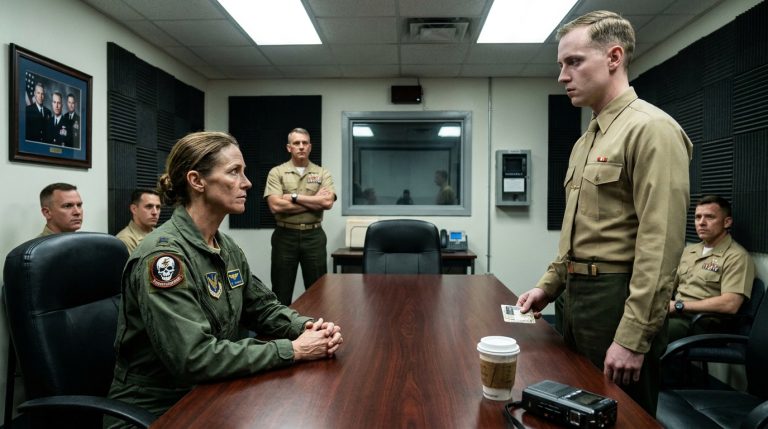
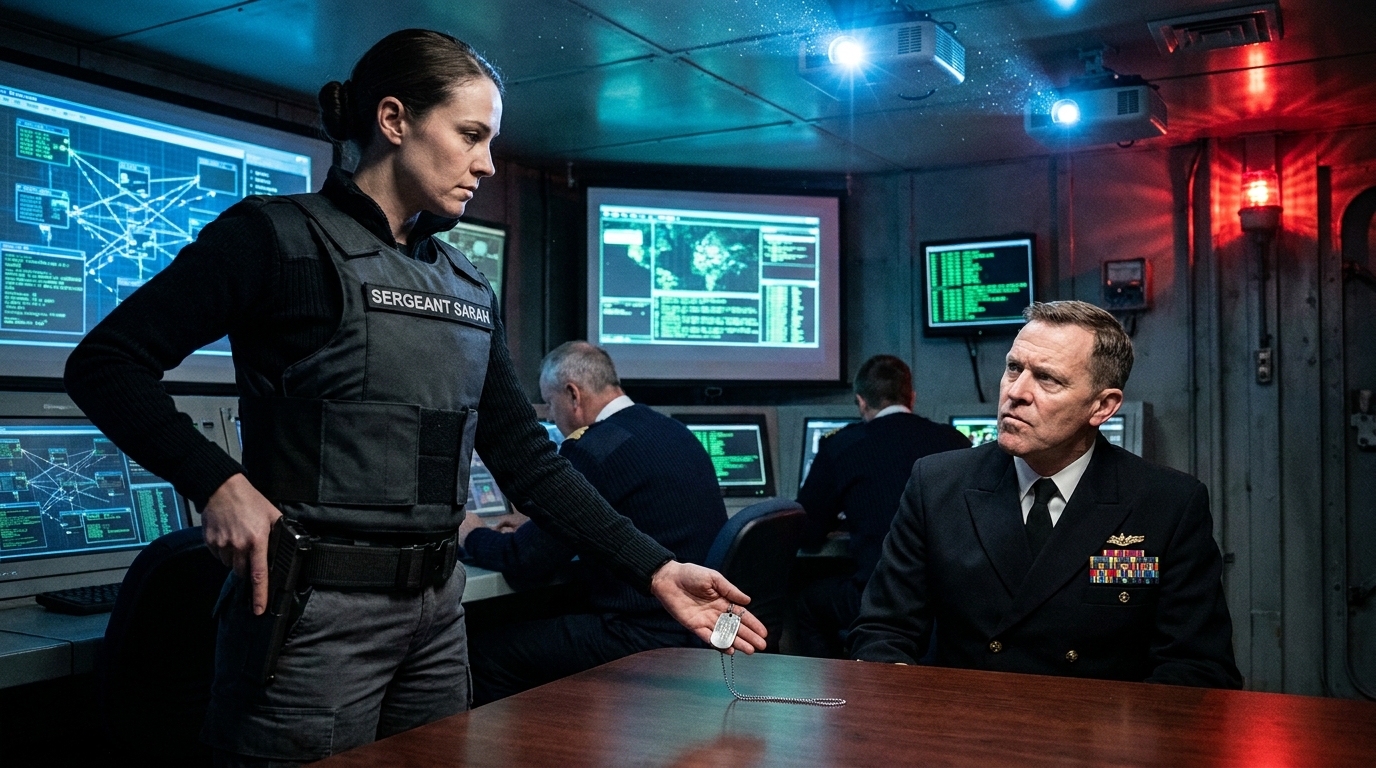
The room was bathed in the harsh, blue glare of the central projector. Colonel Roordon stood at the head of the table, his posture rigid, his face a mask of controlled fury. Beside him, several senior officers were hunched over consoles, their fingers flying across keys. They all turned as one.
Roordon’s eyes cut through the room, landing on Sarah. For a heartbeat, the tension in the room spiked, a palpable surge of static electricity. He looked at her, then down at the dog tag she held out—her hand steady, her expression as unyielding as the iron she’d been named for.
“I found this,” Sarah said, the silence in the room expanding, swallowing the sound of the fans and the hum of the servers. “And I found how they’re watching us.”
Roordon walked toward her, his movements predatory, his eyes searching her face. He didn’t look at the officers; he looked only at her, as if testing the integrity of the steel she was made of.
“The perimeter is secure, Sergeant,” he said, his voice low, a warning wrapped in a question.
“The perimeter is a ghost, Colonel,” Sarah replied, the air between them thick with the scent of ozone and the metallic tang of hidden agendas. “We’re already being audited from the inside.”
She placed the dog tag on the table. It made a sharp, final sound that silenced the remaining whispers in the room. Roordon looked down at it, and for the first time, Sarah saw a flicker of something in his eyes—not fear, but a weary, grinding recognition.
“Then we stop playing defense,” Roordon whispered, his jaw locking. “Start the trace, Sergeant. Let’s see who’s holding the other end of the line.”
Sarah leaned over the console, her fingers poised over the keyboard. She wasn’t just searching for an intruder anymore. She was tracing the rot back to its source, and she knew, with the cold, hard certainty of a veteran, that the truth was going to cost them more than just their pride.
CHAPTER 3: THE FRICTION OF THE ARCHIVE
Sarah’s fingers hovered over the console, her pulse rhythmic against the cool, unresponsive metal. The room around her had shrunk to the space between her eyes and the screen. Around the table, the officers held their breath, a collective stillness that made the air feel thin, almost pressurized. Roordon didn’t move, his presence a heavy, looming weight at her shoulder, his gaze fixed on the data stream as it began to unravel.
“It’s not an external hack,” Sarah said, her voice a low rasp that barely disturbed the quiet. “It’s a firmware-level override. Someone with root access didn’t just break in; they built a back door into the base’s core logic months ago.”
She keyed in a command, bypassing the standard security layers to look at the raw kernel logs. She expected to see a trail of unauthorized packets, a signature of an intruder’s footprint. Instead, she found silence. The logs were pristine, almost aggressively so, as if someone had scrubbed the history of the base’s own operating system.
But there was a trace. She shifted the display, looking at the thermal data from the server racks in the lower level. A single rack, marked for decommissioning three months prior, was drawing power. It was a phantom load, a ghost in the machine, and it was tied directly to the central command hub.
“There,” Sarah pointed, the light from the monitor casting stark, clinical shadows across her features. “The maintenance grid isn’t automated. It’s being fed by a dummy node in the old archives. They’re using the base’s own infrastructure to host the audit.”
She heard a sharp intake of breath behind her. It was Morgan. He was leaning forward, his earlier arrogance replaced by a frantic, jagged focus. He looked at the screen, then at Sarah, his jaw muscles working. “That rack… it was supposed to be wiped clean. I signed the transfer orders myself.”
Sarah didn’t look at him. She couldn’t afford to. Her focus was entirely on the data, on the way the lines of code seemed to shimmer as she probed them. As she accessed the directory of that dummy node, she noticed a faint, oily smear on the edge of the keyboard—the residue of a chemical coolant. It smelled of ozone, the exact same sharp, acidic bite she had detected in the corridor.
She wasn’t just tracking a ghost; she was tracking a presence that had been in this room.
“Someone didn’t just sign those orders,” Sarah said, her voice sharpening. “They utilized your clearance to create a blind spot.”
She watched as the screen refreshed. A folder materialized in the root directory, labeled with a code name she hadn’t seen in seven years: IRONWOLF_AUDIT_FINAL.
Her breath hitched. She hadn’t expected to see her own past weaponized against the present. She reached out, her finger hovering over the icon, but then the entire console flickered, the lights in the strategy room surging and then dimming until they were nothing but a dull, red glow.
“It’s a trap,” Roordon muttered, his hand dropping to his side, his posture shifting into a defensive, tactical crouch. “Sarah, pull back.”
“I can’t,” she replied, her eyes locked on the monitor. “If I close the connection now, the whole system locks. We lose the trail.”
She realized, with a sinking feeling, that the intruder wanted them to see this. They weren’t hiding; they were inviting her to witness the dismantling of the base. She clicked the folder.
It opened into a list of encrypted files—personnel records, duty rosters, and a series of mission logs from Dawson Ridge. As she scrolled, her vision blurred. She saw names she had buried, faces she had tried to forget, all cataloged with a terrifying, clinical precision. The folders weren’t just data; they were a roadmap of the betrayal.
Then, she noticed a secondary file path, hidden deep within the system’s registry. It was a live audio feed, broadcasting from a location she recognized instantly. It was the bunker where the original rescue had failed. The irony was a jagged blade; someone was using the base’s current network to stream the silence of her greatest failure.
“They aren’t just auditing us,” Sarah whispered, the cold creeping into her bones. “They’re rebuilding the scene.”
Suddenly, the screen went black. A single, blinking cursor appeared, rhythmic and steady, pulsing like a heart.
INPUT AUTHORIZATION.
The room was silent, save for the hum of the cooling fans and the heavy, ragged breathing of the men around the table. Sarah stared at the cursor, her reflection ghosting on the dark screen. She looked tired, a woman carved from long years of friction and the hard, dry earth of a life spent in the shadows.
“Sarah,” Roordon said, his voice a low command. “What is it?”
“It’s a prompt,” she replied, her voice steadying. “They’re asking me to acknowledge the account.”
She didn’t know who was on the other end, but as she looked at the blinking light, she realized that the breach wasn’t about the base. It was about her. The entire tactical, structural integrity of Fort Redstone was being leveraged to force her into a corner, to make her verify the truth of the disaster she had survived.
She reached for the keyboard. Her hand was steady, a weapon of precision. She wasn’t going to retreat. If they wanted a confrontation, she would give them one, but she would do it on her own terms, by peeling back the layers until she hit the bedrock of the truth.
She began to type, each key click sounding like a gunshot in the stagnant, iron-scented air. As the characters appeared on the screen, the entire base seemed to tremble, a deep, structural vibration that started in the foundations and moved upward. The audit wasn’t just a test; it was a detonation.
The cursor stopped blinking. The screen flashed a bright, blinding white, and then, slowly, the names of the officers in the room began to scroll across the screen, each one marked with a red tag.
Betrayal, Sarah realized, was just another form of friction. And she was the one who had finally struck the match.
CHAPTER 4: THE PERIMETER OF TRUST
The light in the strategy room seemed to have curdled, shifting from the sharp, sterile white of a command hub to a bruised, flickering crimson. Sarah didn’t look away from the monitor. Her reflection was gone, replaced by the names of the men she served under—marked. Each red tag was a digital condemnation, a line of code indicating an override that bypassed standard authorization.
Colonel Roordon stepped forward, his boots heavy, anchoring him to the floor. “Explain, Sergeant,” he ordered, his voice devoid of his usual command cadence. It sounded hollow, like metal scraping against stone.
Sarah stood up, her movements stiff. She felt a sudden, sharp ringing in her ears—a phantom echo of gunfire, the deafening roar of a suppression field from a life she thought she had long since silenced. Her hand shot toward her sidearm, a purely subconscious, lizard-brain reflex, before she caught herself and jammed her fist into her pocket, gripping the cold iron bolt. The phantom sound dissipated, leaving only the steady, rhythmic hum of the servers.
“They didn’t just breach the network,” she said, keeping her gaze pinned to the console to avoid looking at the men behind her. “They synchronized it. These red tags… they don’t mean these officers are the infiltrators. They mean these officers have been designated as ‘authorized observers’ by a secondary protocol. One that was initiated at the time of the Dawson Ridge extraction.”
The room went deathly still. Lieutenant Morgan, standing near the door, took a half-step back, his face a canvas of confusion and sudden, dawning terror. “That’s impossible,” he muttered. “Dawson Ridge is a classified history. The records are sealed.”
“Sealed for you, Lieutenant,” Sarah retorted, her voice hard, metallic. “But not for the ghost that’s currently running this base.”
She reached out and began to navigate the directory tree, her hands steady despite the tremor in her gut. She needed to know who held the keys. The audit wasn’t just checking the base; it was isolating it. If she could find the primary uplink, she could sever the connection, but doing so would likely trigger a total lock-down of the facility’s life support and security systems.
It was a classic “Sovereign Protector” gamble: burn the house down to keep the intruder from reaching the foundation.
She moved to the console, tapping into the auxiliary ports. As she worked, she felt a shift in the room’s atmosphere. It was subtle—a change in the way the air circulated, the slight increase in the hum of the ventilation. Someone was watching the terminal from another point in the network. She could feel the friction of the data being pulled from her side of the line, a digital pressure that pushed back against her efforts.
“They know I’m in the kernel,” Sarah murmured.
“Then disconnect,” Roordon commanded. “We’ll move to hard-line protocols.”
“If I disconnect now, they finalize the overwrite,” she countered. “I have to find the gatekeeper.”
She tracked the signal, following the invisible breadcrumbs through the base’s internal wiring. She moved through the nodes, bypassing the firewalls until she reached a subroutine titled SENTRY_STATION_9. It was a location that didn’t appear on any of the current base schematics. It was an old, subterranean monitoring post, decommissioned nearly a decade ago.
She initiated a remote camera feed to the location. The image crawled onto the screen, grainy and distorted by decades of neglect. She saw a darkened room, filled with the shadows of rusted filing cabinets and the tangled mess of obsolete cabling. In the center of the room sat a single, modern terminal—an intrusion, a foreign body in a tomb of dead tech.
The camera panned, and for a fleeting second, she saw a shadow pass in front of the lens. It was a silhouette, tall and motionless, holding a device that looked suspiciously like the one she had retrieved from the vent.
“I have a location,” Sarah announced. She didn’t turn around. She grabbed her tactical vest, her mind already shifting into a pre-engagement posture. “It’s in the subterranean archives, old Station 9.”
“That station has been sealed for years,” one of the senior officers stammered. “There’s no power, no access.”
“There is now,” Sarah said, stepping away from the console.
She walked toward the door, her pace deliberate, her senses tuned to the environment. She could feel the base shifting around her, the quiet, predatory hum of a machine that knew it was being hunted. She passed Morgan, and for a split second, their eyes met. He looked terrified, the arrogance completely stripped away, leaving only the fragile, human mess underneath. She didn’t offer him comfort; she didn’t have any to give.
“Nina,” she called out, not looking back. “With me.”
As she pushed out of the strategy room, the corridor seemed to narrow. The walls were lined with heavy, industrial steel, and the dim lights hummed with a low-frequency drone that set her teeth on edge. She knew that by moving toward Station 9, she was playing directly into the intruder’s hands, but it was the only move left on the board.
She reached the stairwell, the iron grating under her boots echoing with each step. The air grew colder, thick with the smell of wet rust and ancient, stagnant dust. This was the basement of the base—a place that time had forgotten, where the secrets were buried in layers of oxidation and neglect.
She paused at the bottom, her flashlight cutting a clean, sharp arc through the darkness. Ahead, the heavy, vault-like door to Station 9 stood slightly ajar. A sliver of blue light spilled from the room, cutting a sharp, clinical line across the floor.
She drew her weapon, the weight of it familiar and grounding in her hand. She checked the chamber—a silent, mechanical confirmation of readiness—and took a breath. The silence here was heavy, absolute, the kind that only existed in places that had been stripped of their life.
She didn’t know if she was walking into a trap or a revelation, but as she moved toward that thin line of blue light, Sarah Whitaker realized that the iron in her blood was all the defense she needed.
CHAPTER 5: THE WEIGHT OF THE ARCHIVE
Sarah didn’t move. She held the silence as if it were a tactical position. Behind her, Nina’s breathing was a soft, ragged sound, a stark contrast to the oppressive weight of the subterranean air. The sliver of blue light emanated from a terminal screen, an impossible glow in a room that should have been dark for a decade.
She nudged the heavy, rusted door further with the muzzle of her weapon. It groaned, a high-pitched protest of metal on metal that seemed to echo down the entire length of the archives. She stepped inside, the light from her flashlight cutting through the dust-choked air to reveal aisles of rusted filing cabinets, like rows of skeletal teeth.
The terminal was there, glowing atop a heap of salvaged hardware. As Sarah approached, the air pressure in the room shifted. A massive, floor-to-ceiling shelving unit, long since compromised by rust and neglect, gave a violent shudder. A heavy metal shelf groaned, metal shearing from its supports, and crashed into the path ahead, spewing a cloud of ancient paper and grit.
“Stay back,” Sarah commanded, moving around the debris with a fluid, practiced caution.
The terminal was active, but the screen wasn’t showing logs or registry entries. It was projecting a static image: a top-down view of the current strategy room she had just vacated. She saw herself—a grainier, delayed version of her current self—standing at the console. The camera angle was from the ceiling, from a sensor she hadn’t identified as active.
“They’re still watching,” Nina whispered, her voice tightening with the weight of the realization. “Even here.”
Sarah reached the terminal. The screen was touch-sensitive, vibrating with a high-frequency hum. She saw the directory she had accessed earlier—the IRONWOLF_AUDIT_FINAL folder—was already open. But it had changed. The sub-directories were now expanding, scrolling at a speed that suggested an automated process.
She noticed something else: a small, physical override key protruding from the side of the machine. It was a standard-issue military component, but the plastic casing was scorched, as if it had been forced into place by someone who didn’t care about the integrity of the port.
She reached for the key, her fingers inches away, when the monitor flashed. The image of the strategy room vanished, replaced by a live feed of the armory. She saw the door latch cycling, the heavy electronic bolt sliding back with a sharp, pneumatic thud. Then, the camera view shifted again. It was cycling through the base, revealing doors being opened, lockers being searched, and the internal perimeter being dismantled by a phantom force.
“They aren’t just auditing,” Sarah said, her voice a hard, cold edge of resolve. “They’re staging.”
She reached for the override key again, but the monitor shifted once more. This time, it displayed a document. It was a digital copy of a death certificate, dated seven years ago. The name was hers.
The shock of it was a physical impact, a sudden, sharp ache in her chest. She had lived that day in the Ridge; she had felt the dirt, tasted the copper, and crawled through the mud until her skin was raw. How could someone have processed her death?
“Sarah?” Nina asked, sensing the sudden rigidity in her posture.
Sarah ignored her, her focus narrowing to the terminal. She didn’t have time for the existential weight of the document. She grabbed the override key and twisted it, hearing the satisfying clack of a hardware lockout.
The monitor died instantly, the blue light vanishing and leaving the room in a heavy, suffocating gloom. But the silence didn’t last. A chime sounded, clear and sharp, from the floor beneath them. A low, rhythmic thumping, like the heart of the base starting to beat, vibrated through the soles of their boots.
“The server room,” Sarah said, her voice cold. “They’re forcing a system wipe. If they purge the core, we lose the evidence of the original mission entirely.”
She turned, her movements sharp, efficient, and devoid of fear. She could feel the friction of the base working against them now—the automated security systems, once silent, were beginning to cycle, the lights in the archives flickering as the power grid struggled to maintain the surge.
She didn’t run. Running was for those who were being chased. She moved with the predatory, calculated pace of someone who was turning the hunt around.
“We need to get to the main hub,” Sarah said, her eyes fixed on the darkness of the corridor. “If we hit the primary breaker before they finish the purge, we can force a manual override.”
“That’ll put the whole base in the dark,” Nina replied, her voice trembling slightly. “No lights, no sensors, no communications.”
“Exactly,” Sarah said, a small, grim smile touching her lips. “They’ve been using our own tech to play god for seven years. It’s time we brought them down to our level.”
She started back toward the archives’ exit, her boots rhythmic and steady on the cold floor. The air felt heavier now, charged with the static of an impending system failure. Every shadow felt like a threat, every groan of the facility a warning, but Sarah pushed through it. She was the one who had finally struck the match, and now, she was going to make sure the fire burned clean.
The path back to the stairwell was obstructed by the fallen shelving unit, the mass of twisted metal and ancient debris forcing them to scramble. Sarah took the lead, her hands finding purchase on the cold iron, her muscles working with a familiar, burning efficiency. She wasn’t just a soldier anymore; she was an architect of the collapse.
As she reached the top of the stairwell, she heard the sound—the faint, rhythmic click-clack of boots on marble coming from the corridor ahead. They weren’t hiding anymore. The hunt was out in the open.
She leveled her weapon, her heart rate steady, her gaze locked on the dark corner where the shadow waited.
CHAPTER 6: THE GHOST IN THE CIRCUIT
Sarah’s boots hit the marble with a synchronized click that was swallowed instantly by the basement’s heavy, dead air. She moved with her weapon raised, eyes tracking the silhouette. The flickering light—a casualty of the power surges radiating from the lower levels—turned the hallway into a sequence of disjointed snapshots. In one flash, the figure was a solid, singular mass; in the next, the strobe-effect made it appear as if the shadow had fractured, blooming into a dozen impossible shapes before settling back into a man’s frame.
“Identification!” Sarah barked. Her voice hit the metal walls and flattened, robbed of its authority by the sheer volume of rust and decay surrounding them.
The figure didn’t move. He stood with his back to her, arms held slightly away from his body, as if he were holding something delicate. Sarah closed the distance, her heart rate locked in a calm, lethal rhythm. She wasn’t just clearing a room; she was purging a memory.
As she reached the effective range of her flashlight, she saw the texture of the intruder’s uniform. It wasn’t the black fatigues of a tactical unit; it was a gray technician’s coverall, weathered and stained with the same graphite lubricant she had found in the vent. The man turned, his movements agonizingly slow, and the light caught his face.
It was Elias, an engineer she had served with at the Ridge. Or, at least, it wore his face. But Elias was dead—or so the mission report had stated seven years ago.
“Sarah,” the man said. The voice was thin, eroded by time, like a recording played back too many times on degraded tape. “You were never supposed to come back to the vault.”
Sarah stopped, the barrel of her weapon never wavering, though a cold, sharp tremor crawled up her spine. This was the fracture point. The decoy secret she had been chasing—the ‘audit’—was just the surface of a much deeper, more personal ruin.
“Elias died in the extraction,” Sarah said, her voice a flat, dead blade. “His body was never recovered.”
“Bodies are just assets in the ledger,” the man replied, his gaze drifting to the terminal behind him. “You, of all people, should know that. You were the one who signed the abandonment protocol. You were the one who left us in the dust when the air cover pulled out.”
The words hit her with the force of a physical strike. Sarah’s grip on her weapon tightened, the cold metal digging into her palm. The phantom sound of gunfire roared in her ears again, louder this time, a cacophony of screaming radio static and the wet thud of impacts. She fought the urge to close her eyes, to retreat into the numbness that had kept her alive for seven years.
“The order was given,” Sarah said, her throat tight. “I didn’t have a choice.”
“There is always a choice, Sergeant,” he said, stepping into the light. He wasn’t armed. He held a small, handheld data bridge, its ports glowing with a steady, pulsating blue light. “You chose to live. We chose to survive.”
Nina, hovering behind Sarah, raised her weapon. “Sarah, he’s stalling. He’s syncing the uplink.”
Sarah knew it. The vibration in the floor had changed, a low, tectonic hum that signaled the activation of the primary archive servers. They weren’t wiping the system; they were uploading it—transferring the entire, classified history of the Dawson Ridge mission, along with the proof of the current base’s corruption, to an external, untraceable node. If this went through, the truth would be scattered into the dark web, uncontainable and unredacted.
“Drop the device, Elias,” Sarah commanded.
“I can’t do that,” he said, and for the first time, Sarah saw a flicker of genuine humanity in his eyes—a wet, desperate look of a man who had been hollowed out from the inside. “If I don’t finish this, they’ll erase us both. The archives are the only thing that proves we exist. If they go, we disappear entirely.”
The complexity of the betrayal was finally unmasking itself. It wasn’t just about the base; it was about the erasure of a legacy. The command staff wasn’t just corrupt—they were part of a systemic, decade-long project to sanitize history.
Sarah saw her chance. She didn’t aim for the device; she aimed for the terminal’s power supply, a small, exposed junction box three feet to the left of the man’s hand. She fired.
The report of the weapon was deafening in the confined, metal space. The junction box shattered in a shower of sparks, but the man didn’t flinch. Instead, he lunged, not toward her, but toward the terminal, throwing his body weight against the console. The entire unit groaned, the rusted bolts holding it to the floor screaming under the pressure of the collision.
The room began to shake—not from an explosion, but from the massive, sudden power draw of the system forcing a hard reboot.
“Sarah, look out!” Nina screamed.
The floor beneath them buckled. The archive was built over a subterranean cooling sump, and the vibration was enough to shatter the weakened, salt-crusted supports. With a sound like a tearing metal lung, the floor gave way, swallowing the terminal and the man in a sudden, violent descent into the darkness below.
Sarah lunged forward, reaching into the yawning void, but she caught nothing but the sharp, acrid scent of ozone and the taste of settling dust. She fell back, gasping, as the floor settled into a jagged, uneven slant, the metal groaning as it shifted toward the pit.
She stared into the hole, the beam of her flashlight lost in the depths. There was no sound of impact. Just the echoing silence of the archive, now cold, still, and utterly broken.
She stood up, her breath hitching in her chest, the weight of the moment pressing down on her like an iron plate. She had come here for a test, and she had found the ghost of her own failure. And now, the base was dying.
She turned back to Nina, her expression cold, her eyes fixed on the distant, flickering lights of the corridor. “It’s not over,” Sarah whispered, the words a promise to the dark. “If they want to bury the truth, we’ll drag it out into the light.”
CHAPTER 7: THE ARCHITECTURE OF BETRAYAL
The dust in the archives was thick enough to taste, a dry, bitter grit that coated Sarah’s throat as she peered into the ragged hole. The structural integrity of the basement was failing. Above, the base groaned, a low, tectonic shifting of steel that signaled the entire facility was responding to the damage. Nina stood at the edge of the collapse, her flashlight beam dancing erratically over the twisted rebar and broken concrete that had claimed the terminal—and the man who had worn Elias’s face.
“He’s gone,” Nina said, her voice strained, a jagged line of anxiety running through it. “But the upload… Sarah, the servers are still drawing power. They didn’t stop.”
Sarah shifted, her boots finding purchase on the slick, dust-covered floor. She ignored the vertigo induced by the flickering strobe of the lights. Her eyes were fixed not on the pit, but on a sliver of darkness behind the primary rack that had been revealed by the floor’s collapse. There was another door—a small, reinforced hatch, barely visible against the dark, oxidized concrete of the foundation.
“He wasn’t just an intruder,” Sarah murmured. “He was a bridge.”
She stepped over the edge of the pit, her movements light and lethal, her hand finding a secure grip on a pipe running along the wall to lower herself into the debris field. She didn’t look at the mess of wires or the shattered terminal; she went straight to the hatch. It wasn’t rusted like the rest of the basement; it was clean, marked with a faint, embossed logo that hadn’t appeared on any official military schematic.
It was the mark of the same group that had sanctioned the Dawson Ridge extraction.
She pushed against the hatch. It was locked, but the mechanism was a simple, manual lever—a relic of an older era. She pulled. The metal shrieked, a sound of profound mechanical protest, before the hatch gave way.
Inside, it wasn’t a room, but a narrow, vertical service shaft. A ladder, narrow and steep, led upward—not into the archives, but toward the base’s central command vault.
“Sarah, what is that?” Nina called down, her voice echoing in the hollow space.
“The internal artery,” Sarah replied. She didn’t wait for a response. She grabbed the ladder and began to climb. Her muscles burned, a familiar, throbbing ache that reminded her of the Ridge. Each rung was cold, the iron biting into her palms, but she kept moving, her focus locked on the rhythmic thumping that had grown louder—a steady, mechanical pulse coming from the very heart of the facility.
She emerged into a cramped, dark space—the crawlspace beneath the strategy room floor. She could hear the voices above, muted and distorted by the floorboards.
—unacceptable loss of data—
—if the Sergeant isn’t neutralized, the audit will reach the Pentagon—
—she’s not supposed to be alive, much less in command of the situation—
Sarah froze. The voices were familiar. They were the voices of the men who had been standing in the strategy room minutes ago, the men she had trusted to hold the line. The betrayal wasn’t external; it was the foundation of the base itself. They hadn’t been auditing her; they had been waiting for her to stumble back into the trap, to finish the cleanup operation that had been left incomplete seven years ago.
She pulled her tablet from her vest. The screen was dark, but she activated the secondary, hard-wired sensor she had installed during her first week. She wasn’t just transmitting; she was recording.
She crawled along the floorboards, the wood groaning under her weight, until she was directly beneath the main command console. She found the primary data lead—a thick, shielded cable that connected the base to the external world. She didn’t cut it. Instead, she clipped a bypass lead onto the wire, creating a direct shunt to her own encrypted cloud server.
She was uploading everything. Not just the records of the audit, but the audio of the conversation happening feet above her head.
The thumping grew louder, a mechanical grinding that suggested the entire base was preparing for a kinetic purge. She could feel the vibration of heavy equipment moving in the floor above—the sound of soldiers being deployed, the rhythmic, heavy clack of combat-ready boots.
She didn’t have much time. As she finished the shunt, her finger hovered over the ‘execute’ command. She had enough leverage to destroy the base’s reputation, to force a full-scale federal investigation that would dismantle the hierarchy from the top down. But if she did, she would never get out of the base alive. They would lock the facility, purge the air, and seal the grave before the transmission even completed.
She glanced at the photo on the tablet’s lock screen—a faded, grainy image of her squad from the Ridge. The weight of it felt absolute. She wasn’t just a soldier anymore; she was a witness. And a witness’s only duty was to ensure the truth survived.
She pressed the icon.
The tablet hummed, a tiny, vibrating pulse against her palm. UPLOAD IN PROGRESS: 10%… 20%…
Above her, the voices stopped. A sudden, chilling silence washed over the room. Then, the floorboard directly above her shifted, a piece of metal being pried away, and the bright, searing beam of a weapon-mounted light cut through the gloom, searching for the source of the hum.
Sarah rolled to the side, her heart rate spiking, her hand moving to her weapon. The game of shadows was over. She was exposed, and she was, for the first time, truly alone in the dark.
CHAPTER 8: THE WEIGHT OF THE IRON WOLF
The searchlight didn’t just illuminate the crawlspace; it sterilized it, burning away the shadows that had protected her for the last ten minutes. Sarah didn’t blink. She pressed herself into the corner, her fingers curling around the cold, rusted support beam of the sub-flooring.
“Step out, Sergeant,” Roordon’s voice echoed, not from the opening above, but from the speaker system that suddenly hissed to life throughout the entire floor. It was a cold, calculated command, devoid of the respect he had feigned in the strategy room. “The upload is meaningless. We own the network. We own the truth. And now, you’re just a loose variable in a system that’s already reset.”
Sarah didn’t retreat. She looked at the tablet—the progress bar hit 98%—and then at the support beam. She realized the mechanical thumping she’d heard wasn’t a purge; it was the activation of the building’s atmospheric containment protocols. They were venting the lower levels. The smell of ozone deepened into the sharp, bitter stench of nitrogen, the air itself being replaced with an inert, suffocating substitute.
“You’re killing your own people,” Sarah said, her voice amplified by the same system they were using to hunt her. She spoke into the tablet’s microphone, her words projecting into the strategy room. “Everything on this server is already mirrored. You’re not scrubbing history; you’re just carving your confession into the wall.”
Above, the floorboard was ripped away completely. Roordon stood there, his silhouette stark against the office’s bright LED overheads. He didn’t look like a Colonel anymore. He looked like a man standing over a grave he’d been digging for seven years.
“Confession is for those who expect a judgment,” Roordon replied, his tone chillingly pragmatic. “We are the architects of the narrative. The Dawson Ridge mission wasn’t a failure, Sergeant. It was a test. A necessary sacrifice to prove that the Iron Wolf protocol could be effectively weaponized and then buried. We needed you to survive, so you could be the scapegoat when the time came for us to transition to a total oversight model.”
He raised his sidearm, a slow, deliberate movement. “You were never the hero of this story, Sarah. You were the final line of the report.”
Sarah didn’t look for a way out. There wasn’t one. Instead, she looked at the tablet. 99%.
“You’re right about one thing, Colonel,” she whispered, her thumb hovering over the final transmit key. “I was a test. And you’ve been failing it since the day you set me up.”
She shoved the tablet into the circuitry of the primary data lead, shorting the connection to create a high-voltage feedback loop. The resulting spark was like a lightning strike in the confined space, a blinding, white-hot flash that tore through the crawlspace, overloading the base’s primary node.
The command vault lights exploded in a shower of glass and sparks. Roordon staggered back, his weapon firing wild—a thunderous, uncontrolled retort that punched holes into the ceiling.
The air in the room didn’t just rush out; it detonated. The pressure equalization triggered a massive surge in the facility’s power grid, the sound of the base literally tearing itself apart as the automated systems fought the sudden, violent surge.
Sarah didn’t wait for the dust to settle. She surged upward through the gap in the floor, tackling Roordon with the raw, desperate force of a woman who had nothing left to lose. They hit the floor of the strategy room, a tangle of limbs and tactical gear. Roordon was strong, his training ingrained and precise, but he was fighting a ghost—a soldier who had already accepted her own erasure.
She disarmed him with a savage, twisting strike to his wrist, the weapon skittering across the polished floor. She pinned him, her forearm against his throat, her eyes burning with the cold, hard clarity of a truth finally brought to light.
“Look at the screen,” Sarah breathed, her voice a low, jagged tremor.
The main wall monitor, miraculously still functional, was flashing a single message: TRANSFERS COMPLETE. DATA MIRRORED TO EXTERNAL COMMAND.
Roordon’s eyes widened, the color draining from his face as the reality of the upload—the full, unredacted, multi-layered truth of the institutional betrayal—ripped through the base’s internal network. It wasn’t just the Pentagon seeing it now. It was every node, every terminal, every officer on the base.
The door to the strategy room burst open. Nina stood there, her weapon raised, flanked by a dozen cadets who had seen the data stream and the red tags on their own screens. The hierarchy had collapsed in the span of a single heartbeat.
Roordon slumped, his body going limp under her grip. The fight had left him, not because he was defeated, but because he was irrelevant.
“It’s over,” Nina said, stepping toward them, her gaze steady, her weapon pointed directly at the Colonel.
Sarah released him. She stood up, her uniform torn, her hands covered in dust and grease. She felt a profound, heavy silence settle over the room. She walked to the center of the hall, the space where she had stood under the Colonel’s scrutiny just hours ago. She picked up the dog tag she had left on the table—the one she had retrieved from the archive—and slid it back into her pocket.
The base was quiet now. The alarms had ceased, replaced by the faint, rhythmic ticking of cooling electronics. The atmosphere of suspicion, of forced order and hidden rot, had been stripped away, leaving only the raw, exposed reality of the people remaining.
She walked to the window. Outside, the rain had stopped. The dawn was breaking over the ridge, a pale, gray light that washed the world in a quiet, fragile peace. It wasn’t the heroic ending she had once imagined, but it was real.
She felt a weight settle in her chest—not the heavy, stifling weight of the secret, but the clean, sharp burden of history finally placed on the right shoulders. She turned back to the room. The cadets were waiting, their expressions a mix of shock and resolve.
Sarah didn’t offer a speech. She didn’t have to. She simply walked toward the exit, her steps deliberate, her posture unshakable. She had come to Fort Redstone to survive, but she left as something else entirely: the witness who had survived the fire and emerged, finally, as herself.
The Iron Wolf was gone. But for the first time in seven years, Sarah Whitaker was alive.