The Iron Logic of a Father’s Silence and the Broken Road Home
CHAPTER 1: THE WEIGHT OF STEEL
The keys hit Daniel’s chest with a sharp, metallic thud before he even registered the heiress’s hand moving across the marble floor. He caught them against his palm, the cold brass ring biting into his calloused skin while the laughter of three dozen people in tailored suits rippled over the dessert tables. Vanessa Callaway didn’t blink, her thin lips holding a perfect, frozen curve as she turned back toward her champagne glass. Daniel didn’t give them the satisfaction of a flush in his cheeks; he simply closed his fingers around the dulled metal, gave a single nod to the empty space between them, and walked out the open garage doors into the cool night air.
The heavy flatbed truck groaned against the incline of the driveway the next morning, the winch cable straining with a high-pitched whine as it dragged the dead weight of the prototype onto the steel deck. Daniel guided the frame with one hand on the rusted rear fender, his boots slipping slightly on the gravel as the cracked, flat tires resisted every inch of the pull. His neighbor, Pete, spat a stream of tobacco juice onto the dirt, leaning against the truck cabin with a heavy frown. “You’re spending a whole Saturday’s fuel on three tons of junk, Dan,” Pete said, wiping his brow with the back of a stained sleeve. Daniel didn’t look up from the winch line, his jaw set as he adjusted the tension lever. “The lines are right, Pete,” Daniel murmured, his voice flat, exhausted, but steady. “Cars don’t get hidden under canvas in a place like that unless someone wanted them forgotten.”
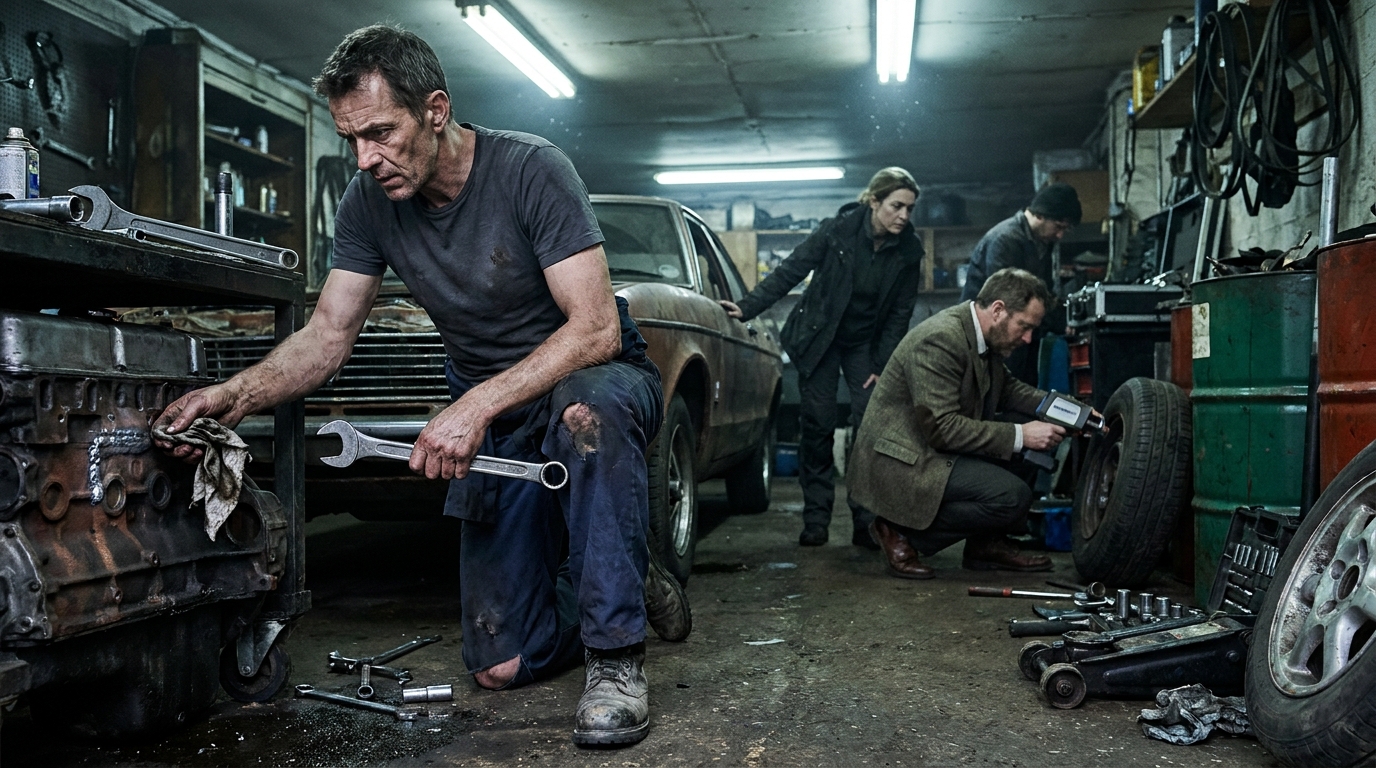
By noon, the car sat under the flickering fluorescent tubes of his small leased workshop, the smell of old motor oil and damp concrete settling around it like a heavy blanket. Daniel stood at his workbench, ignoring the ache in his lower back as he slowly dragged a oily rag down the length of a twelve-inch steel standard wrench. He didn’t have his old corporate diagnostic computers or the high-end hydraulic lifts from his engineering days; he had a rolling jack that leaked fluid and a set of mismatched sockets inherited from his uncle. He walked a slow circle around the vehicle, his fingers tracing the deep grime along the cowl, feeling the strange, deliberate thickness of the metal panels that no factory press from the eighties would have produced. The silence in the shop was thick, broken only by the distant sound of an afternoon train, anchoring him to the concrete floor while he stared at the machine that had just cost him his remaining dignity in the eyes of the town.
CHAPTER 2: THE GHOST IN THE FRAME
Standing beneath the flickering tube light, Daniel’s fingers rested on a mismatched metric bolt head near the firewall of the seized engine. The cold alloy bit into his thumb, a jagged anomaly that shouldn’t exist on a vehicle supposedly built in Detroit. A standard domestic line from that era used imperial fasteners exclusively, yet this structural anchor was a specialized European metric thread, cross-threaded by hand into the chassis.
The heavy wood-and-iron door of the workshop rattled, the rusted hinges scraping against the frame as a tall figure stepped out of the rain. Professor Diane Marsh didn’t offer a polite greeting; she simply shook her dripping umbrella, her sharp eyes instantly locking onto the exposed radiator core. Two younger men followed her, lugging heavy, scuffed equipment cases that smelled of ozone and damp canvas.
“The serial number on the public listing was a decoy,” Diane said, her voice dropping into the quiet space of the shop as she pulled a heavy magnifying loupe from her coat. She didn’t look at Daniel; she walked straight to the fender, her fingers hovering just millimeters above the dented steel panel without touching it. “Callaway Enterprises filed a scrap affidavit for this vehicle identification number in the winter of 1986.”
Daniel set his standard wrench down on the wooden workbench, the tool making a dull clatter against the grease-stained grain. “They didn’t scrap it,” he said, his internal common sense rejecting the official corporate paper trail. “They re-engineered it by hand, using whatever parts were left in the back room after the investors walked out.”
The older specialist, a grey-haired man named Marcus, knelt by the front wheel hub, adjusting a portable handheld spectrometer that hummed with a low, vibrating whine. The blue light from the sensor washed over the lower control arm, reflecting off the thick grime and revealing a distinct, heavy weld-bead hidden beneath the oil crust.
Marcus let out a short, sharp breath, his shoulder muscles tightening under his tweed jacket as he leaned closer to the metal. “This isn’t factory slag, Diane,” he muttered, pointing a gloved finger at the jagged seam underneath the intake manifold. “Look at the torch pattern—it’s a two-stage oxy-acetylene manual bead, done with a high-nickel rod to bind mismatched structural alloys.”
Daniel stepped forward, the floorboards creaking under his boots as he looked down into the dark recess of the engine block. The weld was ugly, functional, and completely buried, a hidden scar that proved someone had bypassed every standard assembly line to keep this specific frame from cracking under pressure.
Diane pulled up a grainy, desaturated blueprint on her laptop screen, the bright glare illuminating the deep lines of frustration on her face. “The official 1986 archive has a hole right where this chassis logic belongs,” she said, tapping the glass with a blunt fingernail. “Someone spent a fortune buying up every piece of documentation from the suppliers—they wanted this project scrubbed from the earth.”
Daniel touched the crude weld, the rough texture of the iron binding the abstract corporate history directly to the physical reality in his hands. This wasn’t a rich man’s trophy bought at a pristine gallery; it was a desperate mechanic’s secret, kept alive by sheer refusal to let the machine die.
CHAPTER 3: THE HEADLINE HITS THE MARBLE
Standing by the high-rise window, a smartphone screen reflecting off the polished glass surface, Vanessa Callaway watched the morning fog drift over the city rooftops. The text on the glass didn’t blur, no matter how hard she blinked. A trade journal headline stared back at her, detailing the sensational recovery of an unlisted automotive holy grail, complete with a clear, sharp photograph of the dented left fender she had spent thirty years ignoring in the corner of her family estate.
Her knuckles turned white against the sleek casing of the device. The memory of the charity auction room rushed back—the smell of expensive catering, the polite chuckles of men in tailored linen, and the casual flick of her wrist as she tossed the keys to a man wearing a grease-filmed canvas jacket. The digital print on the screen estimated the value at nine million dollars, a figure that didn’t hurt her bank account but acted as a slow, agonizing twist to her pride.
The heavy mahogany door to her office clicked open without a page announcing the arrival. Walter Briggs stepped onto the thick carpet, his leather briefcase held tightly against his knee, his usual professional composure replaced by a tight, strained line around his mouth.
“The paperwork is absolute, Vanessa,” Walter said, his voice dropping the formal cadence he had used since her father’s funeral. He didn’t sit down; he remained standing by the edge of the desk, his eyes fixed on the phone in her hand. “You signed the unconditional transfer slip as an uncataloged estate clearance. Legally, the vehicle belongs entirely to the mechanic.”
Vanessa turned away from the glass, her heels clicking sharply against the floorboards as she crossed the room to face the old attorney. “My father kept that specific frame out of every audit for three decades, Walter—you managed his private filings, you knew exactly what he was keeping from the board.”
Walter didn’t flinch, but his fingers tightened down on the brass latch of his briefcase, a rare tell from a man who usually moved like iron clockwork. “Your father didn’t tell me everything, Vanessa—he paid the storage fees out of a private holding account that closed the day his heart stopped, and the only note left in the registry was a single order to never let the board inspect the chassis numbers.”
The absurdity of the situation hit her like a physical weight in the quiet office. She had spent her entire life believing she understood every corner of the Callaway empire, treating the working-class town below her tower as nothing more than background noise to be managed with charity checks and standard press releases. Now, the key to her father’s deepest secret was sitting in a low-rent garage on the edge of the industrial district, held by a man she had publicly used as cheap entertainment for a room full of millionaires.
She picked up her leather coat from the back of the chair, her movement swift, cutting off Walter’s next sentence before he could form the words. “Get the corporate vehicle brought around to the front,” she directed, her tone dropping into the cold, sharp authority she used when a contract began to turn bad. “We are going down there to buy it back before the historical society gets their hands on the registration.”
CHAPTER 4: THE PRICE OF THE BUYBACK
Stepping through the low, oil-stained doorway of the garage, the smell of old iron hitting her face, Vanessa Callaway pulled her designer coat tightly against her waist. She stopped on the uneven concrete, her leather heels catching in a narrow seam near the drainage channel. Daniel Hayes didn’t stand up to greet her; he remained balanced on a wooden crate by the vehicle’s exposed engine bay, slowly threading a wire brush over a rusted hex head.
The low hum of a rusted box fan in the window chopped the damp air, offering the only rhythm to the sudden standoff. Walter Briggs lingered a half-step behind her, his expensive Italian leather shoes gathering a thin glaze of grey shop dust from the floorboards.
Vanessa cleared her throat, her chin tilting upward to reclaim the sharp stance of the high-rise boardroom. “I am authorized to offer five hundred thousand dollars cash, Mr. Hayes—right now, with a standard release waiver to clear the estate records.”
Daniel didn’t pull the brush away from the block, the stiff bristles making a dry, rhythmic scrape against the iron casting. “The title cleared two days ago, Ms. Callaway,” he said, his voice flat, steady, completely unbothered by the number she had dropped into the small space. “The town clerk didn’t find any liens on the registration.”
Vanessa took two steps forward, the thin fabric of her trousers brushing against the grimy edge of a nearby rolling tool chest. “Let’s be practical—you restore old lawnmowers and trade-in sedans for a living, and that sum changes your daughter’s entire trajectory before the school year starts.”
Daniel stopped the wire brush, the sudden silence in the bay pressing hard against the concrete walls as he slowly turned his head to look her in the eye. He didn’t rise from the crate, but his fingers slid down the length of the steel wrench resting in his palm, his grip tight enough to blanch the skin over his knuckles.
“My daughter has dinner at five-thirty every night, and her school bills are paid through November,” Daniel murmured, his internal sense of common decency rejecting the transactional weight she was trying to force into his workspace. “Your father didn’t hide this machine from his own board because he wanted a five-hundred-thousand-dollar payout.”
Vanessa felt the cold draft from the open bay door cut through her coat, the absolute lack of leverage making her chest tighten with an unfamiliar, frustrating heat. She looked past his shoulder at the exposed engine block, her gaze snagging on a crude, uneven weld-bead hidden deep under the manifold—an amateurish mark that looked completely out of place on a machine valued at millions.
“There is a discrepancy in the original development filing from 1986,” Vanessa said, her voice dropping its smooth public edge as she pointed a manicured finger toward the dark metal casing. “The corporate record says the project died because the main frame cracked under pressure—why is this iron still whole?”
Daniel stood up slowly, his tall frame blocking the glare of the flickering fluorescent tube as he leaned over the fender. “The corporate record only tells you what the accountants needed to hear to write off the loss—if you want the real story behind this metal, you’re going to have to get your hands dirty to find it.”
CHAPTER 5: THE UNWELDED TRUTH
Leaning over the raw metal under the hood, a single drop of dirty oil smudging her thumb, Vanessa didn’t pull away from the grime. She stared at the rough, uneven seam binding the intake manifold to the block, her breath shallow as the harsh fluorescent tube above flickered against the raw steel.
The low hum of the box fan cut through the heavy silence of the bay. Walter Briggs took a half-step toward the door, his polished shoe heels clicking weakly on the concrete, his face pale as he checked his watch.
Vanessa touched the jagged weld, the rough texture of the iron biting into her skin. “This wasn’t done by a machine, Walter—this is manual work.”
Daniel Hayes didn’t offer a corporate explanation; he simply picked up a clean shop rag, slowly wiping the grease from his palms before pointing a steel punch at the hidden underside of the block. “Your father didn’t lose his fortune in eighty-six because the market turned, Ms. Callaway—he spent every dime he had buying back the parts for this frame to keep the bank from melting it down.”
Vanessa’s voice faltered, the cold weight of the realization pressing hard against her chest. “He told the board the prototype was destroyed in the testing facility.”
Daniel leaned against the rusted fender, his face cast in shadow as he let out a slow, heavy sigh. “He needed them to look at the spreadsheets instead of the garage—if they saw he was building the anchor with his own hands, they would have taken the name off the building forty years sooner.”
Vanessa stared at the crude weld, the abstract history of her family’s empire crumbling down into the physical friction of an old man’s desperate grip on his identity. There were no hidden diaries or convenient letters left behind in the cushions to explain his choice—just the raw, exhausting proof of an everyman’s labor, buried deep within a chassis he had given away to a stranger as a worthless piece of junk.
“He wanted me to see it,” Vanessa whispered, her hand dropping from the metal as she looked at the mechanic’s grease-stained jacket.
Daniel gave a single, quiet nod, his common sense laying out the final boundary. “He wanted you to know what the name actually cost before you spent the rest of your life selling the scrap.”
CHAPTER 6: THE RECORD GAVEL
Standing at the edge of the glittering auction platform, the glare of the gallery spotlights blinding her eyes, Vanessa Callaway felt the heavy roar of the crowd drop into a sudden, expectant silence. The industrialist in the front row raised his white card one final time, his voice cutting through the stuffy warmth of the hall with a blunt, unhurried cadence. Nine million dollars.
The auctioneer’s wooden gavel came down on the sound block with a sharp, echoing crack that vibrated through the floorboards. Flashbulbs erupted along the back wall, throwing jagged shards of light across the polished mahogany trim and the rows of tailored suits. Vanessa didn’t join the applause; she looked toward the shadows by the exit doors where Daniel Hayes stood, his worn canvas jacket looking entirely out of place against the velvet drapes, his arms crossed over his chest with the steady composure of a man who had built his peace by hand.
A corporate board member pushed past her, his smartphone already pressed to his ear as he threw an angry glare toward the platform. —”We could have locked that asset in the holding registry weeks ago if the legal team hadn’t cleared the uncataloged scrap list,”— he hissed into the receiver, his thumb twitching against the polished screen.
Vanessa turned her back on the board member, her heels clicking softly as she walked out of the glare and into the cooler air of the corridor. The high-society crowd was already drifting toward the champagne tables, talking about tax write-offs and historic provenance, completely blind to the rough, amateur weld under the intake manifold that had actually held the machine together when the money failed.
The low hum of the city traffic outside the academy workshop was peaceful the next afternoon, the scent of damp earth and fresh motor oil rising from the newly cleared bays. Daniel didn’t look up from the workbench as Vanessa stepped through the open door, her designer coat left behind for a simple cotton sleeve. He was slowly running an oil-dipped stone down the edge of a flat scraper, his routine steady, calm, and completely devoid of the tension that had crowded her life for thirty years.
“The registration fees for the first youth cohort cleared this morning, Daniel,” Vanessa said, her voice quiet, matching the steady rhythm of the shop. She didn’t offer a contract or an exchange; she simply leaned against the heavy timber frame of the doorway, watching the tool move back and forth.
Daniel stopped the stone, wiping the edge clean with a grey rag before setting it neatly beside his imperial sockets. “The iron holds up fine when you don’t force it to carry more pride than it was built for,” he said, his internal common sense providing the final anchor as he gave her a small, knowing nod.
Vanessa looked at her hands, the grease stain from the previous week fully scrubbed away but the reality of the work still firmly lodged in her stride. The empire her father built was still standing in marble, but the true legacy was right here on the concrete—a broken frame restored, an old debt settled, and a daughter who finally knew how to measure the value of a name by the grit it took to preserve it.