The Silent Blade: Staff Sergeant Mara Keane and the Anatomy of a Shadow Operation
CHAPTER 1: THE WEIGHT OF THE BLADE
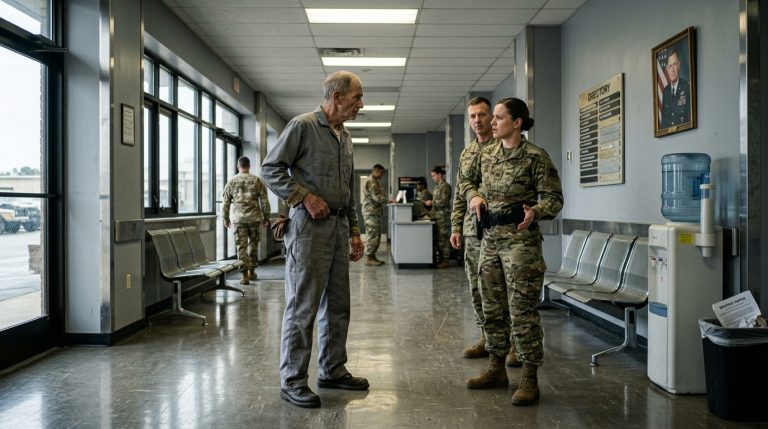
The debriefing room was a vacuum. Four concrete walls, a steel table that felt like ice beneath Mara’s fingertips, and a single flickering fluorescent light that hummed in B-flat. It was a sound she had learned to ignore for three years, but now, it felt like a serrated edge against her nerves.
Master Chief Reigns didn’t know where to look. He kept glancing from the disassembled parts of Mara’s rifle—laid out with the surgical precision of an autopsy—to the woman herself. Mara didn’t blink. She didn’t fidget. She sat with her spine a perfectly straight line, a monument to a discipline that was no longer hers to control.
“Ghost Knife,” Reigns repeated, his voice barely a murmur. He looked at the rifle, then at the wall, as if he expected the concrete to explain what he was hearing. “That’s not in any manual I’ve read.”
Maddox sat opposite her. He was relaxed, a stark contrast to the coiled tension radiating from the younger soldiers waiting in the hallway. He leaned back, his chair groaning under the shift in weight. He was the only one in the room who seemed to understand that the air wasn’t empty; it was filled with the kinetic potential of a weapon that had just been taken off safety.
“Because it’s not supposed to be,” Maddox said. His voice was smooth, devoid of the jagged edges of a battlefield. “Classified program. Need-to-know basis. Small teams. Deep penetration. High-value targets in denied areas. And Keen was the architect of the success.”
Mara’s hands moved over the firing pin. She cleaned it, a rhythmic, microscopic task. She didn’t look up, but she knew the exact trajectory of Maddox’s gaze. He wasn’t watching her work; he was watching for a crack in the armor. He wanted to see if the “Ghost Knife” was still buried deep enough, or if the trigger he’d pulled on the course had left the door wide open.
“Three years,” Maddox continued, his eyes locking onto hers. “Operating in places that don’t officially exist. Doing things that never officially happened. Perfect mission record. Zero friendly casualties. Extraction rate of one hundred percent.”
“So, what happened?” Reigns asked, his voice tighter now. “Why the transfer to regular training?”
Mara’s fingers stopped. The silence in the room stretched until it became a physical pressure in her ears. She looked at the firing pin, noting a minute scratch on the steel that hadn’t been there yesterday. She remembered the IED. The flash of white light, the sound that didn’t shatter—it silenced. She remembered the feeling of the ground rushing up, and the thought that had come to her in the fraction of a second before the impact: This is how I end it.
“Took a hit on the last mission,” Mara said. Her voice sounded strange to her, flat and hollow, as if someone else were speaking through her vocal cords. “IED. Close quarters, hostile territory. Medical rotation stateside while they decided if I was still fit for duty.”
Maddox smiled. It was a brief, sharp motion that didn’t reach his eyes. “The Ghost Knife program requires very specific psychological conditioning. Operators learn to compartmentalize. To suppress certain responses until they receive proper authorization codes.”
Mara looked up then. She caught Maddox’s reflection in the dark, cold surface of the table. He was leaning in, his posture shifting from relaxed to predatory.
“It’s a safety measure,” Maddox murmured, his voice dropping to a near-whisper. “Keeps them from going operational during routine activities. Like a leash on a guard dog.”
He reached across the table, his hand hovering near her rifle. Mara felt a sudden, sharp spike of ice in her chest—not fear, but a cold, mechanical recognition. The realization hit her with the force of a physical blow: the authorization code wasn’t just a trigger for her skills. It was a digital key for her autonomy. And Maddox was checking to see if the key still fit.
“Do you feel it, Staff Sergeant?” Maddox asked, his eyes searching her face. “The leash?”
Mara looked at the door. She looked at the exit, then back to the steel-gray eyes of the commander. Somewhere in the building, she heard a sound—not a shout, not a shot, but the soft, rhythmic click of a security camera rotating in the hallway.
She stood up, leaving the rifle in pieces on the table.
“I feel the hum of the lights, Commander,” Mara said, her voice perfectly steady. “And I know when the room is being watched.”
She walked toward the door, her pace measured, her heart rate exactly sixty beats per minute. But as she touched the handle, she realized with a jolt of pure, cold clarity that her left hand was trembling. It wasn’t the IED. It was the system, searching for a command she didn’t know she had given.
CHAPTER 2: THE SURVEILLANCE SHADOW
The door to the debriefing room swung shut with a muted, pressurized thud, cutting off the hum of the light fixture. Mara stood in the hallway for a moment, her breath hitching in her chest. The corridor was empty, bathed in the sickly yellow hue of emergency lighting that made every shadow look deeper, more jagged. She looked down at her left hand. It was still there—a fine, rhythmic vibration that felt like a tuning fork vibrating against bone.
She forced her fingers into a fist, digging her nails into her palm until the sharp sting grounded her. It wasn’t the IED. It was a phantom, a biological glitch that shouldn’t be possible. The Ghost Knife conditioning was supposed to be a closed loop; once she was off-duty, the files were meant to be compressed, encrypted, and buried under layers of mundane habit. But as she walked back toward the barracks, the rhythm of her own footsteps sounded like a countdown.
She didn’t take the direct route. She moved with a calculated shift in her gait, keeping to the periphery where the light couldn’t reach, her eyes tracing the ceiling lines for the telltale black bubbles of security cameras. She found them, spaced every twenty feet, their lenses reflecting nothing. Or at least, that’s what they wanted her to think.
Her mind cataloged the path: three turns, two stairwells, the scent of industrial floor wax and stale sweat growing stronger as she neared the barracks. She felt watched. Not by the casual, judgmental gaze of Lieutenant Markham or the instructors, but by something more precise. It was the sensation of a laser sight tracing the nape of her neck—a pressure, a weight.
She reached the entrance to the barracks, a heavy steel door that stood slightly ajar. She didn’t push it open immediately. She paused, tilting her head, listening to the ambient noise of the building. Somewhere in the distance, a faucet dripped. A fan rattled in a ceiling vent. But beneath those sounds, there was a cadence that didn’t fit. A secondary rhythm.
She slipped inside. The barracks were dark, lit only by the faint orange glow of the exit signs. Her bunk was in the far corner, the one she had chosen for the sightlines it offered. She walked toward it, her boots silent on the concrete, but as she drew closer, she stopped.
Her locker was perfectly aligned. Her boots were exactly where she had left them. But her rifle—the one she had been cleaning in the debriefing room—was supposed to be locked in the armory. And yet, she could smell it. Gun oil. The sharp, metallic tang of cold steel lingering in the air of her bunk.
She scanned the room. Markham’s bunk was empty, his linens unmade, the standard disorder of a soldier who felt untouchable. Torres and Miller were in their bunks, their breathing deep and rhythmic. They were asleep, or feigning it so well the difference didn’t matter.
Mara knelt by her locker, her hand hovering near the combination dial. Her mind flickered—a sudden, intrusive vision of a different room, a concrete cell with white walls and a monitor that pulsed with blue lines. She squeezed her eyes shut, chasing the image away. It was a V-2, a phantom of the conditioning. A side effect of the “leash” being tugged.
She opened the locker. It was empty, save for her standard-issue gear. But as she reached for her field manual, her fingers brushed against something hard and cold tucked behind the lining.
She pulled it out: a data chip, smaller than a thumbnail, matte black.
She didn’t check it. She didn’t even look at it directly. She slipped it into the hem of her sleeve, her heart rate remaining a steady, rhythmic sixty beats per minute. She knew who had put it there. Maddox. He hadn’t just been checking the leash in the debriefing room; he had been setting a snare. If she took the chip, she was playing the game. If she ignored it, she was confirming she was broken.
She stood up, her eyes flicking toward the darkened doorway. She felt the gaze again—the surveillance shadow. Someone was waiting for her to make the first move, to see if she would be the soldier they wanted her to be, or the weapon she had spent three years trying to forget.
She climbed into her bunk, pulled the thin, rough wool blanket up to her chin, and closed her eyes. She wouldn’t check the chip. Not yet. She would wait for the silence to return, for the base to fall into the deepest part of the night, when the only eyes watching were the ones behind the lenses.
She lay perfectly still, a statue in the dark, and listened to the barracks breathe. She was counting seconds. One. Two. Three. The rhythm was back, a low-frequency hum that vibrated through the mattress. It wasn’t the fan. It wasn’t the plumbing. It was a digital signal, a localized broadcast meant only for her.
Maddox wasn’t just observing her. He was talking to her. And the conversation had only just begun.
CHAPTER 3: THE BROKEN LINK
Mara didn’t move. She lay with her eyes fixed on the gray underside of the top bunk, her breathing orchestrated to mimic the deep, slow rhythm of someone in REM sleep. The hum wasn’t just audible; it was tactile, a sub-vocal frequency that seemed to bypass her ears and vibrate directly against her skull. It was an interrogation without questions, a relentless probing of her neural pathways, testing which connections were severed and which were merely dormant.
If Maddox was running this signal, he was doing it with a level of authorization that shouldn’t exist for an off-site training facility. It suggested that the entire building wasn’t just a school; it was an extension of the program’s infrastructure.
She waited until the signal spiked—a sharp, rhythmic pulsing that suggested a handshake protocol—before she shifted. She didn’t roll out of bed; she slid, her body fluid and silent, until her feet touched the cold concrete floor. She kept her back to the room, her eyes adjusting to the darkness. She needed the medical file. If the “IED blast” in her records was a fabrication, the digital paper trail would have to be housed in the administrative archives, a heavily guarded sector of the base that she had only seen during orientation.
She reached into her sleeve and touched the edge of the black chip. It felt like a razor blade against her skin. She didn’t know what was on it, but she knew it was the only leverage she possessed.
Mara moved toward the exit, avoiding the center of the room where the floorboards creaked. She passed the bunks of her squadmates. Miller was snoring, a soft, whistling sound that broke the tension of the room. She paused by the door, listening. The hallway outside was silent, but it was the silence of a held breath.
She stepped into the corridor, her boots making no sound on the industrial tiling. She needed to reach the admin terminal in the second-floor lobby. It was the only node on the base with an unshielded uplink, a leftover from the facility’s older construction. If she could interface there, she could pull her own records, cross-reference the medical authorization numbers, and find out exactly what happened on that final mission.
As she turned the corner toward the lobby, she stopped dead.
A shadow detached itself from the wall near the stairwell. It was tall, framed by the faint moonlight spilling through the high, barred windows. Lieutenant Markham. He wasn’t in uniform. He wore charcoal-gray training gear, his posture relaxed, his hands shoved deep into his pockets. He wasn’t on patrol; he was waiting.
“Can’t sleep, Keane?” he asked. His voice was low, devoid of the bravado he wore during the day. It was colder, sharper.
Mara didn’t tense. She let her posture slump slightly, adopting the facade of the hesitant, unremarkable soldier he expected. “Too much noise,” she replied, her voice carefully flat.
Markham stepped into the dim light. He wasn’t looking at her face; he was looking at her shoulders, his eyes tracking the way she held her center of gravity. He was looking for the weapon. “You’re a long way from the bunks. The administrative wing is off-limits after 2200.”
“I took a wrong turn,” Mara said, taking a half-step back, toward the shadows. “Habit, I guess.”
Markham chuckled, but there was no humor in it. “Habit. You’ve got a lot of those, don’t you? You spend your days looking like you’re trying to remember how to breathe, and your nights walking the halls like you’re patrolling a perimeter.” He stepped closer, encroaching on her personal space. “Commander Maddox seemed very interested in your ‘recovery’ today. Seems like you’re a special project, Keane. Everyone’s curious what happens when the leash comes off.”
Mara felt the vibration in her hand flare again—a spike of pain that made her jaw clench. The signal was stronger here, closer to the admin wing. The building itself was reacting to her proximity to the archives.
“I’m just here to train, Lieutenant,” Mara said, her voice steady.
“Are you?” Markham moved fast, his hand shooting out to grip her shoulder. It wasn’t an attack; it was a test. He was checking her response time, gauging the muscle density, testing the “broken” exterior.
Mara didn’t fight him. She didn’t redirect or strike. She let her shoulder go limp, her body sagging under his touch. She forced her eyes to go wide, to project a flicker of panic, of the helplessness that had defined her performance for the last two weeks. She gave him the broken soldier he wanted to see.
Markham held her for a heartbeat, his grip firm, his eyes searching hers for a tremor of the Ghost Knife. He saw nothing but the hollow, lost expression of a woman who didn’t know where she was. He let go, a look of genuine disappointment crossing his face.
“You really are just a ghost, aren’t you?” he muttered, turning away. “Go back to your bunk, Keane. Before you get lost in the wrong place.”
He walked toward the stairwell, his footsteps echoing in the silence. Mara stood still, letting the air rush back into her lungs. She had played the part, but the cost was etched into the tension of her muscles. She turned, watching him disappear down the stairs, and then she saw it—a small, silver keycard had fallen from his pocket during the brush.
It lay on the concrete, reflecting the moonlight. A security bypass card.
Mara knelt, her fingers closing over the cold plastic. It wasn’t just a keycard; it was a piece of the puzzle. She looked at the admin wing, then back at the stairs. Markham wasn’t just a bully. He was a sentinel. And he was guarding the very path she needed to take.
She stood, the bypass card burning a hole in her palm, and realized the game had changed. The training wasn’t just about her. It was a live-fire exercise, and she was the only one who didn’t know she was the target. She turned toward the admin wing, the silence of the base now feeling less like a lack of sound, and more like a closing trap.
CHAPTER 4: THE MIDNIGHT EXTRACTION
Mara didn’t return to the barracks. She retreated into the narrow service gap behind the stairwell, a space where the shadows were thick enough to hide in, and where the facility’s hum was muffled by exposed insulation. She held the bypass card between her thumb and forefinger, feeling the cold, smooth plastic. It was a bridge—or a noose.
The administrative wing was a hundred yards of open, floodlit concrete away. Crossing it meant running a gauntlet of sensors, cameras, and the unpredictable patrol of the base’s security team. She could feel the vibration in her left hand increasing in frequency, a frantic, irregular tap-tap-tap against her radius bone. The signal wasn’t just searching for her now; it was trying to sync.
She took a deep breath, pushing the air into her lower abdomen, and clamped down on her own physiology. She had to stay under the threshold. If her heart rate climbed too high, the “Ghost Knife” parameters would detect the surge and trigger an automated shutdown. She had to move like a machine, not a human.
She stepped out from behind the stairwell and began to move. She didn’t run; she glided, staying in the blind spots of the floodlights. Every three seconds, she paused, shifting her weight to maintain balance, her eyes tracking the rotating lens of the nearest camera. She timed it perfectly—a two-second window of darkness as the light swung wide. She crossed the open ground in a blur of motion, her boots barely grazing the asphalt.
When she reached the admin wing, she found the service entrance. It was a heavy steel door, reinforced with electronic locks. She pressed the bypass card against the sensor.
The lock clicked—a sharp, mechanical retort that sounded like a gunshot in the quiet desert night.
Mara slipped inside, pulling the door shut behind her. The interior was different from the barracks. Here, the air smelled of ozone, hot servers, and floor wax. It was a space designed for data, not soldiers. She moved down the hallway, the walls lined with glass-fronted offices that felt like aquarium tanks. She reached the main terminal hub.
The terminal was a massive, antiquated console, its screen glowing with a soft, green phosphor light. She sat down, her fingers flying over the keys. She bypassed the first-level security protocols, her movements fluid and devoid of hesitation. She was accessing the root directory, her eyes scanning lines of code.
Subject: Keane, Mara. Status: Active. Operational Directive: Ghost Knife. Trigger Phrase: [REDACTED].
She hit the medical section. Her heartbeat began to accelerate, and she immediately felt the surge in her wrist—a sharp, electric jolt. She suppressed it, forcing her breathing back to a rhythmic, shallow cadence.
There it was. Mission 74-Alpha. IED Incident. Extraction Report.
She opened the file. It wasn’t an incident report. It was a maintenance log.
Subject successfully returned to containment. Neural dampeners applied. Memory wipe 40% effective. Secondary trigger installed.
The room suddenly felt much smaller. The cold that had been on the surface of her skin was now settling into her marrow. She wasn’t just a soldier; she was a system being debugged. She reached for the command to purge the file, but the screen flickered. A warning light flashed red.
Unauthorized Access Detected. Security Protocol 9 Initiated.
The facility’s alarm didn’t sound; it just activated. The lights in the hall clicked off, leaving her in total darkness. She heard the sound of heavy boots on the concrete floor—not one set, but three. They were moving in a pincer formation, blocking the hallway she had just exited.
Mara stood, her back to the terminal. She hadn’t finished the extraction, but she had the baseline. She grabbed the black chip from her sleeve and jammed it into the console’s auxiliary port, initiating an automated data dump. She needed time.
She turned and faced the darkness. She heard the soft click of a tactical light being switched on, the beam cutting through the gloom like a scalpel. They were coming for her.
She reached into her vest, but she didn’t grab a weapon. She grabbed a small, heavy fire extinguisher from the wall bracket. As the first flashlight beam swept over the desk where she had been sitting, she swung.
The extinguisher caught the heavy glass door of the office partition, shattering it into a million fragments. The noise was deafening, a cascade of breaking glass that masked her movement. She dove through the frame, landing on the floor in a roll, and moved toward the ventilation shaft she had identified during her morning sweep.
The security team surged into the room, their lights darting over the empty desk. “Clear,” one of them shouted.
Mara didn’t wait. She pulled the shaft cover off, crawled into the narrow, metallic space, and began to move. She had the data. She had the proof. But as she crawled, she realized the signal in her head had changed. It wasn’t pulsing anymore. It was steady. A permanent, localized lock.
They weren’t hunting her anymore. They were tracking her.
She stopped, the cold metal of the shaft pressing against her chest. She had escaped the room, but she had run straight into the center of the web. And the person controlling the signal was waiting at the other end of the tunnel.
CHAPTER 5: THE DECOY REVEALED
The vent system was a labyrinth of galvanized steel that amplified every scrape of Mara’s fatigues against the rivets. Ahead, the air grew warmer, smelling faintly of the ozone and high-voltage hum that radiated from the facility’s central server farm. She moved by tactile instinct, her fingers tracing the seams of the ductwork, her body angled to minimize friction.
She had to suppress the urge to bolt. The signal in her head—the constant, rhythmic pulsing of the Ghost Knife trigger—was becoming a roar. It wasn’t just a beacon; it was a projection. She caught herself glancing at the empty air ahead of her, momentarily convinced she saw the flickering green lines of a heads-up display overlaying the dark metal of the vent. She blinked, and the hallucination vanished, replaced by the grim reality of the cramped, dusty space. The “Unreliable Perception” wasn’t a failure of her mind; it was the signal itself, forcing its way into her visual cortex, trying to graft its own digital reality onto her own.
She stopped at a junction, the junction that led directly above the central command node. She peered through the rusted slats of the floor grate.
Below, in the heart of the command center, sat the terminal she had accessed earlier, but the room was no longer dark. It was bathed in the harsh, clinical light of a staging area. Commander Maddox stood at the console, his posture as still as a statue. Opposite him, Lieutenant Markham stood with his arms folded, watching the screen.
“She’s in the vents,” Markham said, his voice carrying clearly through the grate. “She’s not going for the exit. She’s circling back.”
Maddox didn’t look up. “She’s not circling, Lieutenant. She’s reacting. She thinks she’s being clever, finding the data, but she’s just following the breadcrumbs we left in the code. The Ghost Knife protocol is designed to force a return to the source. It’s a homing instinct.”
Mara felt her jaw tighten. Every decision she had made—the bypass card, the server access, the vent route—it had all been facilitated, predicted, and encouraged. The “decoy” wasn’t just the file she found; it was the path itself.
“And when she gets to the terminal?” Markham asked.
“Then we engage the secondary trigger,” Maddox said, his voice devoid of emotion. “The physical dampeners will fail, the neural override will initiate, and we will finally be able to see if the subject can handle the complete system integration. No more ‘containment.’ If she survives the transfer, she’s the perfect asset. If she doesn’t… she’s a redundant liability.”
Mara realized then that the “IED blast” wasn’t the only lie. She wasn’t a soldier being evaluated for service; she was a platform being tested for an upgrade—an upgrade that would burn away the last of her autonomy. The “Ghost Knife” wasn’t a set of skills; it was a blank slate waiting for the master script.
She felt the vibration in her hand move up her arm, a crawling, freezing sensation that set her skin on fire. She couldn’t stay in the vents. If she reached the terminal, she was walking into the kill-box. If she stayed, she was just waiting to be flushed out.
She had to be the variable they didn’t account for.
She turned and began to backtrack, moving away from the command node. She needed a different kind of leverage. She scanned the map of the ventilation system in her mind—the layout she had memorized during the first week of drills. There was a coolant bypass valve three rooms over, a junction that controlled the heat distribution for the entire northern wing.
If she couldn’t access the data, she would deny them the arena.
She reached the valve and gripped the iron wheel. It was rusted, locked tight by years of neglect and desert heat. She braced her feet against the side of the duct and pulled. The friction was immense, a physical grind that tore the skin of her palms. She didn’t let go. She imagined the signal as a physical weight, a parasite burrowing into her spine, and she pulled against it with everything she had left.
The valve groaned. A spark of metal-on-metal fire flared in the darkness as the lock sheared. She gave it one final, violent tug, and the wheel spun.
Below her, the facility’s cooling system began to whine—a high-pitched, discordant shriek that resonated through the floorboards. In the command center, she heard the startled shouts of the tech team and the abrupt silence of the server hum as the power grid began to cascade into a localized overload.
Mara didn’t wait to see the result. She kicked the grate out, the metal screaming as it fell to the floor below, and she dropped into the darkness of the auxiliary storage room. She hit the floor, rolled, and sprang to her feet, her hand reaching for her belt.
She was outside the network now. The signal in her head had gone from a roar to a sharp, high-pitched whine—a feedback loop caused by the system’s sudden instability. She had cut the wire. But she had also declared war.
She moved toward the storage room exit, her shadow long and sharp against the concrete. She had no more decoys. The truth was no longer a secret to be uncovered; it was a reality she had to survive.
CHAPTER 6: THE HORIZON SHIFT
The storage room was a tomb of dust and forgotten equipment. Mara pressed her back against the cool, industrial-grade steel of a rack, her breath ragged. The power surge she had triggered was still cascading through the facility; overhead, the lights flickered in a stuttering, desperate rhythm, and the air was thick with the scent of ozone and burning plastic. She was no longer hunting for information; she was the hunt itself.
She opened her palm. The black chip was warm, pulsating with the heat of the encrypted data it carried. She knew what was on it now—not just the maintenance logs, but the full architectural schematic of her own neural tether. Maddox wasn’t just a handler; he was the primary contractor for her existence.
Footsteps. Heavy, rhythmic, and methodical. They weren’t scrambling; they were stalking.
Mara checked the magazine of her rifle, the metal cold and biting against her palms. She stepped out into the hallway. The lights had fully died, leaving the corridor in total, oppressive darkness. She didn’t need to see; she felt the shift in air pressure as the command team moved toward her.
“Keen,” Maddox’s voice echoed down the hall, devoid of the earlier tactical calm. It was layered with a jagged, impatient hunger. “You don’t understand the physics of what you’re doing. You’re trying to unplug a system that is currently running your own heart.”
Mara didn’t reply. She moved, sliding through the shadows with the fluidity of a predator. She didn’t head for the exit; she headed for the server farm, the heart of the grid. If the Ghost Knife was a remote-access program, the kill switch wasn’t in her brain—it was in the central processor.
She reached the server farm’s entrance just as a figure rounded the corner. It was Markham. He wasn’t hiding his intentions anymore; he held his rifle at the high ready, his face a mask of concentrated malice. He saw her, his finger tightening on the trigger, but he was a fraction of a second too slow. Mara was already in motion, a blur of kinetic force. She didn’t engage; she bypassed. She dropped low, kicking the legs out from under him, and as he hit the deck, she slammed the butt of her rifle into the electronic lock of the server door.
The door yielded with a groan of stressed metal. She slipped inside, the room a cathedral of humming towers, a wall of blinking blue lights that stared back at her like a thousand mechanical eyes.
Maddox appeared in the doorway, flanked by his security detail. He stopped, his gaze sweeping the room before settling on Mara, who stood before the main control rack. He didn’t raise his weapon. He looked tired.
“You think you’re free,” Maddox said, stepping into the room. “You think destroying this equipment changes who you are. But you’re a construct, Mara. The Ghost Knife is in the synapses. Even if I stop the signal, you’ll never be ‘civilian.’ You don’t know how to exist without a target.”
“Then I’ll be the target,” Mara said. She didn’t scream it. Her voice was a cold, sharp blade.
She slammed the data chip into the port. The screens in the room exploded into a cascade of red code. She wasn’t just downloading the data; she was uploading the contradiction—the proof that the “IED” was a maintenance cycle, the proof that the base was a black-site prison for human assets. She hit the command for an open-broadcast to the regional command center.
“Don’t,” Maddox warned, his voice a low, vibrating growl. “If you broadcast that, the system will trigger a hard reset. It will liquefy the memory centers. You’ll be a shell.”
“Better a shell than a weapon,” Mara said. She pressed the final key.
The room erupted. The screens turned white, a blinding, searing glare that seemed to burn the very air. Mara felt a jolt—not of electricity, but of something deeper, a sensation of gravity reversing. She fell, but she wasn’t hitting the floor. She was floating in a void of static, the Ghost Knife trigger—the signal, the leash, the voice—screaming one final, high-pitched note before snapping.
The silence that followed was absolute.
When Mara opened her eyes, the room was dark. The hum of the servers had died. The only sound was the drip of coolant from a ruptured pipe. She sat up, her head throbbing with a dull, heavy ache.
Maddox was on the floor, his face pale, his hands trembling as he reached for a device that no longer functioned. The security team was gone, vanished into the fog of the facility’s sudden, total power failure. Markham lay slumped against the wall, unconscious, the arrogance stripped from his features, leaving only the hollow look of a man who had bet on a losing horse.
Mara stood. Her hand was steady.
She looked at her reflection in the dark, dead screen of a server monitor. She looked the same, but the sharp, jagged edges of her perception had softened. The world didn’t feel like a series of angles and vulnerabilities anymore. It felt… quiet.
She walked out of the server room. The base was a tomb of dormant electronics, the desert night pouring in through the broken doors. She walked past the empty guard station, past the silent tactical range, and toward the front gate.
She stopped at the perimeter fence and looked back at the sprawling, dark silhouette of the facility. She reached into her pocket and pulled out the small, silver bypass card she had taken from Markham. She didn’t crush it. She didn’t throw it away. She simply let it fall into the dry, cracked sand at her feet.
She repaired the strap of her pack, the physical motion simple and grounding. She took a breath—a real, deep, unmeasured breath—and stepped through the gate.
The desert was vast, cold, and entirely empty. She didn’t know where she was going, and for the first time in three years, that wasn’t a tactical failure. It was the start of a life. She walked until the base was just a smudge of shadow on the horizon, her pace steady, her heart rhythmically, beautifully, her own.