The Silent Observer: An Old Sniper’s Final Lesson on Seeing the World Beneath the Noise
CHAPTER 1: The Weight of Quiet
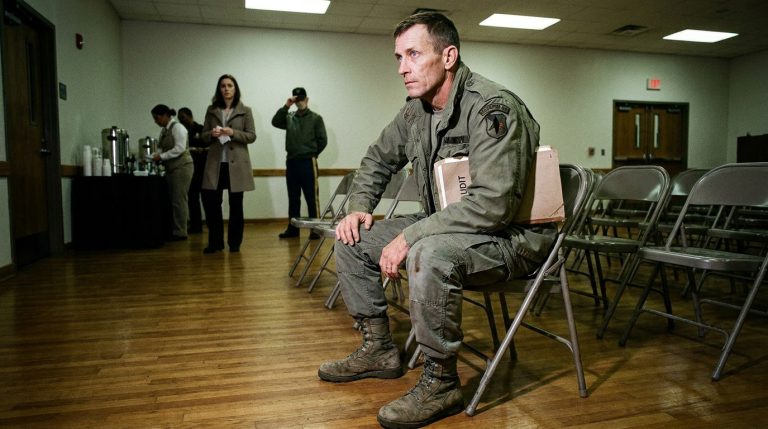
The engine died with a shudder, leaving the silence of the valley to rush back into the cab of the truck. Roy sat still, his hands resting on the steering wheel. His left hand—the one that usually betrayed him with a faint, insistent tremor—was perfectly, unnervingly still. He stared through the windshield at the sedan parked by his gate. It was a charcoal gray sedan, the kind of paint that swallowed the twilight, completely devoid of markings or vanity. It looked like a smudge of ink on the canvas of his quiet life.
He didn’t reach for the door handle. Instead, he reached for the thermos in the passenger seat, unscrewing the cap with a practiced, fluid motion. The scent of bitter, lukewarm coffee filled the cramped space. He took a sip, letting the warmth settle in his chest, feeling the familiar ache of the shrapnel in his knee. It was the only part of him that felt old today. Everything else felt like 1971.
The sedan hadn’t moved. The driver’s window was cracked, just enough to let a sliver of the outside world breathe. Roy watched the way the wind caught the willow branches, sweeping them across the sedan’s roof like a broom. He didn’t recognize the vehicle. He didn’t recognize the way it sat on the gravel, perfectly centered, a calculated position that maximized field of vision while remaining obscured by the tree line.
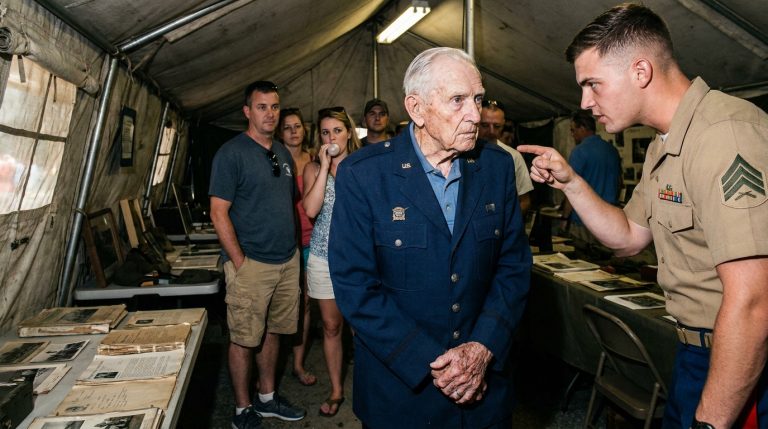
He looked at his own hands. The tremor began to return, a small, rhythmic pulse in the base of his thumb. He sighed, the sound lost in the rustle of dry leaves against the truck’s fender. He had gone to Camp Ashby to see his grandson, to play the role of the decoration, to shake the hands of boys who smelled of soap and eagerness. He hadn’t gone looking for an encore.
He watched a crow land on the hood of the gray sedan. It tilted its head, stared at the windshield for a beat, and then launched itself into the sky with a sharp, ragged cry.
Roy didn’t move. He waited for the person inside to show themselves. He knew the protocol for being approached; he had written half the books on it. But this wasn’t a tactical engagement. This was his home. And the person in that car was waiting for something that Roy had spent fifty years trying to forget: the truth about the valley in 1971, and why he had walked away from the most important mission of his career.
He reached into the glove box, his fingers brushing against a worn, leather-bound notebook he hadn’t opened since the Reagan administration. As his fingers closed around the spine, the driver’s door of the sedan opened, and a figure emerged—not with a weapon, but with a cane. The man moved with a pronounced limp that mirrored Roy’s own, his face obscured by the low-slung brim of a hat he had seen only once before, in a photograph that had been burned a long time ago.
CHAPTER 2: The Ghost of the Highlands
Roy watched the man limp toward the driver’s side of the truck. His heart hammered a rhythm against his ribs that felt like a telegraph machine in a war zone—staccato, urgent, and heavy with coded meaning. The figure was taller than he remembered, or perhaps it was just the way the man held his shoulders, square and unyielding against the dying light.
He didn’t reach for the door handle. His hand remained on the worn leather of the notebook in the glove box. He didn’t want to open it. He didn’t want to confirm the name he had already begun to whisper to himself in the quiet dark of his own mind.
“Roy,” the man said. The voice was like dry paper rubbing together. It was a voice he hadn’t heard in fifty-four years, yet it hit him with the force of a physical blow.
Roy finally pushed the door open. The truck groaned as he stepped out, his right knee catching with a sharp, familiar protest. He stood on the gravel, the cold autumn air biting at the back of his neck. He didn’t look at the man’s face at first; he looked at the cane. It was an old-fashioned thing, dark hickory with a worn brass head. It was the kind of cane a man used when he refused to trust anything modern.
“You’re a long way from the Central Highlands, Elias,” Roy said. His own voice sounded thin, eroded by time.
The man—Elias—stopped three paces away. He pulled his hat off, revealing a face etched with the same deep-set lines that Roy saw in his own reflection every morning. The resemblance to the General was undeniable, but where the General had the polished confidence of a man who served in a modern army, Elias looked like a man who had been carved out of the landscape itself.
“I’m a long way from everything, Roy,” Elias replied. He didn’t offer a hand. He didn’t offer a greeting. He just stood there, letting the silence settle between them.
Roy’s left hand began to tremble, the tremor rhythmic and persistent. He shoved it into his pocket, gripping his keys until the metal bit into his palm. “How did you find me? My records… they were sealed at the request of the Department.”
“The Department doesn’t keep secrets as well as they think they do,” Elias said. A faint, humorless smile touched his lips. “They think they hid the files. They don’t realize they just buried them deep enough for people like us to find the trail.”
Roy glanced toward the gray sedan. It was empty. The surrounding woods were darkening, the pines becoming jagged silhouettes against a bruised, purple sky. He felt a prickle of unease. He was an old man, and his knees were bad, but his instincts—the ones that had kept him breathing when the jungle was trying to swallow him whole—were as sharp as tempered steel.
“You didn’t come here to talk about records,” Roy said, his gaze narrowing.
“I came because the General is asking questions he isn’t prepared to answer,” Elias replied. He took a step forward, his cane clicking against a stone. “He thinks his father died a hero in ’70. He thinks the recon team ASP was a clean slate. He’s digging into the classified engagements, Roy. He’s going to find the incident at the valley.”
The name of the valley hung in the air like a ghost. Roy’s lungs felt tight. He had spent his entire life building a wall around that moment, brick by brick, silence by silence. He had convinced himself that the past was a dead country he had finally left behind.
“The records are classified for a reason,” Roy said, his voice hardening. “Leave them be, Elias. If he finds out what really happened in those trees… it won’t be a hero he finds. It’ll be a man who made a choice he couldn’t live with.”
“He’s my nephew,” Elias said, his eyes locking onto Roy’s. “And your grandson is his direct subordinate. You think you can keep the truth under the floorboards forever? The past has a way of rising up when the weather turns cold.”
Roy looked at his truck, then back to the darkening treeline. The world felt smaller, tighter, as if the woods were closing in on the small circle of light cast by his porch lamp. He had been a scout sniper, a man trained to see what others missed, but he realized now that he had been blind for fifty years. He hadn’t been hiding from the world; he had been waiting for the world to come and demand payment.
“You shouldn’t have come,” Roy said softly.
“I didn’t come to argue, Roy,” Elias said, reaching into his coat pocket. He pulled out a small, faded envelope and held it out. “I came because I’m the only one left who knows you didn’t miss that shot on purpose. And I’m the only one who knows why you didn’t pull the trigger.”
Roy felt the blood drain from his face. He stared at the envelope, the paper worn and stained by age. The tremor in his hand became a violent shaking that he could no longer hide, even in his pocket. He didn’t move to take the envelope. He just watched the way the wind fluttered the edges, a small, fragile thing that carried the weight of a lifetime of secrets.
“Go inside, Roy,” Elias whispered. “Read it. And then tell me if you’re ready to finish what we started all those years ago.”
Elias turned and began to limp back toward the sedan. Roy stood paralyzed on the gravel, the sound of the wind in the pines sounding like the distant, rolling thunder of an artillery barrage he had thought he had finally left behind in the mud of a different world. He looked at the envelope, then at his own trembling hands, realizing that for the first time in half a century, the silence of the valley was no longer enough to protect him.
CHAPTER 3: The Geometry of Regret
The envelope felt impossibly heavy, as if the paper itself were weighted with the density of the years it had been hidden. Roy didn’t look at the sedan as it pulled away; he watched only the rhythmic dance of its taillights fading into the gloom, a pair of fading embers in the dark. He was alone again, but the silence now felt jagged, cut through by the anticipation of what lay inside the sealed flap.
He walked slowly back toward the porch, the beam of his flashlight cutting a stark, white path through the gathering mist. His knee gave a sharp, grinding pop with every step, a reminder of the terrain he had once traversed with the effortless grace of a younger man. He didn’t turn on the porch light. He preferred the twilight; it allowed him to transition into the past without the harsh, artificial intrusion of the present.
He sat in the wooden rocker, the wood groaning under his weight, and smoothed the envelope against his thigh. His hands were shaking again, a fine, frantic vibration that blurred the edges of the ink. He took a slow, steadying breath, the scent of damp earth and pine needles filling his lungs, and tore the edge.
Inside was a single sheet of onionskin paper, yellowed and brittle, folded twice. He unfolded it with agonizing care. There were no names, no signatures, only a set of grid coordinates and a brief, hand-drawn sketch of a riverbank—a topographical map of the very valley he had tried to erase from his memory. Beneath the map, a single line of text was written in a script so familiar it made his throat tighten: The truth isn’t in what you did, Roy. It’s in why you let them believe you missed.
Roy stared at the coordinates. He didn’t need a map to know where they pointed. He knew that bend in the river better than he knew the layout of his own living room. It was the place where the jungle opened up into a momentary, lethal clarity—the place where he had held his target in his sights, breathed out, and then gone cold.
He had told the after-action report that the wind had shifted, that he’d slipped on a wet root, that the angle had been impossible. He had taken the reprimand for a “missed opportunity” because it was better than admitting he had seen the man’s face and recognized the terror—the specific, human realization of someone who knew they were already dead.
His hand drifted to his pocket, touching the worn leather of his notebook. He stood up, the rocker swaying behind him, and looked out into the darkness toward the mountains. He had spent decades believing his life was a series of tactical decisions, but the paper in his hand suggested something far more complicated: that his entire existence had been built on a foundation of mercy.
He walked into the house, the floorboards creaking under his weight. He didn’t turn on the lamp in the hallway. Instead, he went straight to his study, a room filled with the artifacts of a life lived in the shadows. He opened the bottom drawer of his desk, pushing aside old manuals and range cards, and pulled out a heavy, locked box.
The key was on a chain around his neck, hidden beneath his flannel shirt. He unlocked the box and pulled out a small, tarnished compass. It was the same one he had carried in 1971. He set it on the desk and watched the needle dance, then settle toward the north. He laid the envelope next to it.
The decoy secret—the idea that his team had simply been protecting a perimeter—suddenly felt flimsy, a thin piece of fabric pulled over a jagged truth. Elias wasn’t just bringing him memories; he was bringing him the realization that the “classified” nature of their work hadn’t been about enemies across the border, but about the secrets they had kept from one another.
Roy looked at the photograph tucked into the back of his notebook—a young man with his arm around a friend who would never make it home. He saw the flicker of his own youth in those eyes, a light that had been extinguished long before he walked out of the jungle.
He reached for the telephone. His fingers hovered over the keypad. He knew who he had to call, and he knew that the moment he placed the call, there would be no going back. He wasn’t just a retired master sergeant anymore; he was a man holding the thread to a tapestry that was beginning to unravel.
He dialed the number—a secure, private line he hadn’t used since the early nineties. The line clicked, a hollow, electronic sound that filled the room.
“Callaway,” a voice answered. It wasn’t the General, but someone from the office, someone who recognized the cadence of his voice immediately. “We were told you might be in touch. Where are you?”
“I’m at home,” Roy said, his voice steadying. “And I have something you need to see. It’s about the valley. It’s about why the files were sealed.”
There was a long silence on the other end, the kind of silence that usually preceded a significant change in the weather. “Understood, Master Sergeant. We’ll be there by morning. Keep your doors locked. The world has grown louder since you last checked.”
Roy hung up the phone. He sat in the dark, the faint hum of the electricity in the walls a stark contrast to the silence of the valley. He had started a fire, and he had no intention of putting it out.
CHAPTER 4: The Archive of Shadows
The archive facility sat in an industrial park on the edge of the city, a brutalist concrete block that looked more like a bunker than a repository for history. Roy leaned against his truck, the engine ticking as it cooled. He wore a canvas jacket, heavy and durable, and his movements were deliberate, each step calculated to minimize the protest of his knee. He watched the main entrance. A security guard stood behind the glass, his posture stiff, hands hovering near his radio.
The call had been short. The voice on the other end had been clear: Get inside, secure the box labeled 7-Alpha, do not—under any circumstances—look at the manifest.
Roy knew the manifest was the bait. It was the “decoy” they wanted him to find, the paper trail that linked the unit to a standard tactical error rather than the deeper, more rot-filled truth of what really happened in the valley. He had no intention of looking at the manifest. He was looking for the photographs, the personal ones, the ones that weren’t supposed to exist.
As he began to walk toward the entrance, a klaxon cut through the cool air. It was a low, guttural sound, vibrating in his chest. The heavy steel shutters at the main entrance began to rattle downward. The facility was going into lockdown. Someone had tipped the hand.
Roy didn’t hesitate. He changed his trajectory, pivoting toward the loading dock on the east side. The security cameras rotated with the slow, mechanical whir of a predator tracking movement. He moved into the shadow of a large, idling freight container, his breath hitched, his heart rate spiking into the familiar, focused zone of a man who had worked the edges of intelligence for a lifetime.
He didn’t run. Running invited eyes. He moved in a crouch, staying low, using the geometry of the architecture to mask his approach. He reached the side access panel—an old, rusted service grate he’d spotted during his reconnaissance twenty minutes prior. It was held by four flathead screws, weathered and stubborn. He reached into his pocket and pulled out a small, multi-tool. The steel was cold against his palm, the movement of his fingers smooth, practiced. He unscrewed the panel, the metal groaning as he pried it loose.
The interior was tight, a crawlspace thick with the smell of dust and stagnant air. He slid inside, the grate clicking back into place behind him just as a flashlight beam swept over the spot where he had been standing. He didn’t look back. He dragged himself forward, his elbows scraping against the rough concrete, his mind mapping the layout of the ventilation ducts he had studied in the blueprints Elias had provided.
He reached the primary junction, the intersection of the main cooling shafts. Below him, he could hear the muffled, frantic voices of the night staff. They were talking about a breach, about a “security anomaly.” Roy felt a grim satisfaction. They were looking for a ghost, and he was currently inside the architecture of their own creation.
He followed the duct until he reached the grate overlooking the internal storage wing. He peered down. Below, the rows of climate-controlled shelving stretched into the darkness like the spines of giant, dead books. There, in the center of the room, sat the temporary processing station. A single desk, a computer terminal, and the box—7-Alpha.
He dropped down, his landing soft and muffled by the industrial carpet. He didn’t waste a second. He moved to the desk, his fingers flying across the shelf until he found the box. It was locked, secured with a heavy-duty plastic seal. He didn’t bother with the seal. He used the blade of his tool to cut through the bottom seam of the cardboard, his eyes scanning the contents.
Photographs. Dozens of them. Most were standard, bureaucratic records—grainy shots of topographical surveys and equipment manifests. But then he saw it. A stack held together with a weathered rubber band. He pulled them free. The top photo was of a man standing at the edge of a riverbank.
It was the General’s father. And he wasn’t standing alone. He was standing with another man, a man whose face was partially obscured by the shadow of a heavy canopy—a man wearing the exact same unit patch Roy had worn.
Roy’s hand began to shake, the tremor returning with a vengeance. He held the photo under the dim emergency light. There, in the corner of the frame, he saw the date. October 1971. He saw the background—the very bend in the river that haunted his dreams. He realized then that the decoy was gone. The “truth” he was supposed to find was the manifest—the list of “failed engagements.” But the reality, the terrifying, absolute reality, was that he and the General’s father had been in the same frame, at the same moment, and he had been ordered to eliminate him.
He hadn’t missed. He hadn’t been defeated by the wind. He had chosen to live with the secret of his insubordination because the alternative—the truth of the order—would have destroyed everything the General believed about his own bloodline.
A sudden, sharp metallic click echoed from the doorway. Roy spun around, his hand instinctively moving to his jacket pocket, his gaze locking onto the silhouette of a figure standing in the doorway—the Brigadier General, his uniform crisp, his eyes cold and devoid of the respect he had shown earlier that day.
“I told you, Roy,” the General said, his voice devoid of warmth. “I told you that some stories are better left buried. You should have stayed on the tower.”
Roy didn’t move. He kept the photo in his hand, his thumb pressing firmly against the edge. The tremor in his hand vanished entirely. He was back in the valley. He was back in the moment where a life hung in the balance, and this time, he was the one being hunted.
“You knew,” Roy said, his voice low and steady. “You knew the whole time.”
“I knew what I needed to know to keep the order,” the General replied, stepping further into the room. “And now, I know exactly what needs to be done to ensure it stays that way.”
CHAPTER 5: The Riverbank Echo
The air in the storage wing felt thin, sterilized to a point where every breath tasted like ozone. Roy’s fingers were white-knuckled around the photograph. The General took another step into the aisle, the rubber sole of his boot squeaking against the polished concrete. He didn’t have his sidearm drawn, but his hand hovered near his jacket with an ease that told Roy he was ready for a fight.
“You’re a man of tradition, Roy,” the General said, his tone clinical. “You always were. You think that because you spared him, you’ve earned the right to decide how the world views the past. But you’re wrong. You were just a scout. You were the instrument. The order was the reality.”
Roy looked past the General, his vision swimming. The sterile gray shelving began to dissolve in his mind’s eye, replaced by the lush, suffocating green of the valley in 1971. He could smell the rot of the riverbank, the metallic tang of rain-soaked jungle. He could see the man in his crosshairs—the General’s father—crouched and shivering, unsuspecting, as a spider web caught the morning dew. He had been so young then, his heart beating with the same frantic energy it did now. He had waited for the shift in the wind, but the wind had never moved. He had just stopped.
“You speak about the order like it was a law of physics,” Roy whispered, his voice gaining a sudden, dangerous clarity. “But it was a choice. Just like the one I made. And just like the one you’re making tonight.”
“My choice is to preserve the integrity of this service,” the General replied, his gaze unyielding. “The history of my father is a cornerstone for the men who follow. I won’t have it dismantled by an old man holding onto a ghost.”
The General moved faster than his age should have allowed. He surged forward, reaching for Roy’s wrist to pry the photograph loose. Roy pivoted, his bad knee throbbing, and used the weight of his own body to drive his shoulder into the General’s chest. The impact was dull and heavy. They crashed into the metal shelving, the metal frame shrieking as it shuddered. Boxes of records spilled onto the floor, a cascade of white paper raining down around them like snow in a graveyard.
Roy scrambled back, his breath ragged. He wasn’t fighting for the paper anymore; he was fighting for the memory. He saw the General reach out again, and this time, Roy didn’t block him. He stepped to the side, letting the General’s momentum carry him into the racks, and then he reached into his jacket pocket and pulled out the compass. He slammed it down on the workstation, the impact echoing through the silent wing.
“Look at it!” Roy shouted. “Look at the direction! You think your father was a hero? You think he was leading a mission? He was lost, General. He was bleeding out in that mud, waiting for someone to finish the job because he knew he’d failed his own team. I didn’t spare him out of mercy. I spared him because he was already dead, and I wanted to see if the institution he served would even notice.”
The General froze, his hand still gripping the edge of the metal rack. The mask of command finally cracked, revealing the raw, unfiltered fear underneath. The silence that followed was absolute.
“That’s a lie,” the General whispered, but his voice lacked conviction. He looked at the compass, then at Roy’s face, searching for the crack in the logic.
“Read the back of that photo,” Roy urged, his voice dropping to a low, steady rumble. “The one you didn’t have the guts to look at. The one I’ve been carrying in my mind for fifty years.”
The General reached down and scooped up the photograph that had fallen during their struggle. He turned it over. The handwriting was faint, almost eroded by time, but the message was clear. It was a note, written by his father in the final hours of that mission—a confession of the very thing the General had spent his life trying to rewrite.
“He knew,” Roy said. “He knew exactly what happened. He didn’t want a legacy. He wanted to be forgotten. You’re the one who built the altar, General. You’re the one who turned a failure into a god.”
The General looked at the photo, his hands beginning to shake. The uniform, the rank, the cold, military precision—it all seemed to drain away, leaving only a man struggling to reconcile the myth he had worshipped with the human truth of the man who had abandoned it. The archive was silent, save for the hum of the cooling system. Roy stood tall, his tremor gone, his eyes fixed on the man who had come to silence him, but who now found himself silenced by the weight of a long-dead truth.
The General took a step back, the photograph clutched in his hand. He looked toward the exit, his composure shattered, the archive now a tomb for his own constructed reality. He didn’t look at Roy again. He simply turned and walked toward the door, his steps heavy, the rhythm of his own heartbeat the only sound in the room. Roy watched him leave, the photograph discarded on the floor, the truth now laid bare in the sterile, unfeeling light.
CHAPTER 6: The Quiet After the Storm
The archive was deafeningly silent. Roy stood amidst the debris of paper, the scattered records of a life—and a war—that had finally been stripped of its mythology. His heart rate, which had been a frantic drumbeat only moments ago, began to slow. The adrenaline, that cold, familiar poison that had powered him through the crawlspaces and the confrontations, ebbed away, leaving behind a profound, bone-deep exhaustion.
He knelt down, his knee complaining as he shifted his weight, and picked up the photograph that the General had dropped. It was creased now, a permanent scar running across the faces of the two men in the frame. He looked at it not as a relic of a secret, but as a map of the man he had been. He hadn’t been a monster, and he hadn’t been a hero. He had been a soldier who realized, in a heartbeat that lasted fifty years, that the mission was hollow.
Roy didn’t leave the archive through the ventilation ducts. He walked to the main access door and pressed the manual release. The heavy steel groaned and rolled upward, admitting a shaft of cold, pre-dawn light that cut through the stagnant air of the facility. He stepped out into the industrial park, the world outside unchanged, vast and indifferent. The city lights were flickering out, replaced by the soft, gray luminescence of a new day.
He walked to his truck. He didn’t look back at the bunker of secrets. He climbed in, the scent of stale coffee and old upholstery greeting him like an old friend. He took the photograph and placed it inside the leather-bound notebook he kept in the glove box. He laid it flat against the page where he had documented his final range card in 1971. He snapped the glove box shut. The sound was final.
The drive home was slow, a quiet pilgrimage through the winding roads of the valley. When he finally turned onto his private gravel drive, the morning sun was just beginning to crest over the mountains, painting the pines in shades of burnt orange and gold. The willow tree by his gate swayed gently in the breeze.
He parked the truck, sat for a long moment, and listened. No engines. No rushing. Just the sound of the wind, the rustle of leaves, and the rhythmic, steady beating of his own heart. The tremor in his hand was gone. He looked down at his palm, spread it flat against his thigh, and found it steady. The weight he had carried for half a century hadn’t been the secret; it had been the refusal to forgive himself for the choice he’d made.
He walked into the house, the quiet greeting him like a soft blanket. He went into his study and sat at his desk. He took the compass he had used so many years ago—the one that had guided him through the jungle—and placed it on the shelf, not as a tool for navigation, but as an object of remembrance.
He picked up a small, hand-carved wooden bird from his desk, a project he had started months ago but never managed to finish because his hands wouldn’t stay still. He picked up the sandpaper and began to smooth the rough edges, his movements fluid, precise, and entirely free of the shake that had plagued him for so long.
The front door opened and closed. A heavy knock sounded on the study door. It was his grandson.
“Grandpa?” the boy asked, his voice hesitant. “I heard you were home.”
Roy looked up, the wooden bird resting in his palm. He felt a deep, resonant peace. The history was buried where it belonged, and the future was standing in the doorway, waiting for a life that wasn’t haunted by the ghosts of the valley.
“I’m here, son,” Roy said, his voice soft. “Come in. Pull up a chair. I think it’s time I told you about a bird I once saw.”
He leaned back, the chair offering its familiar, comforting support. He didn’t look at the files, or the compass, or the photograph in the glove box. He looked at the boy, and in that gaze, he saw the man he had once been—but one who would never have to learn the weight of the secrets Roy had finally, irrevocably laid to rest. The valley was quiet. And for the first time in his life, Roy Calloway was finally home.