The Weight of the Serpent: A Legacy Forged in Blood, Shadow, and the Quiet Cost of Honor
CHAPTER 1: THE SERPENTS BITE
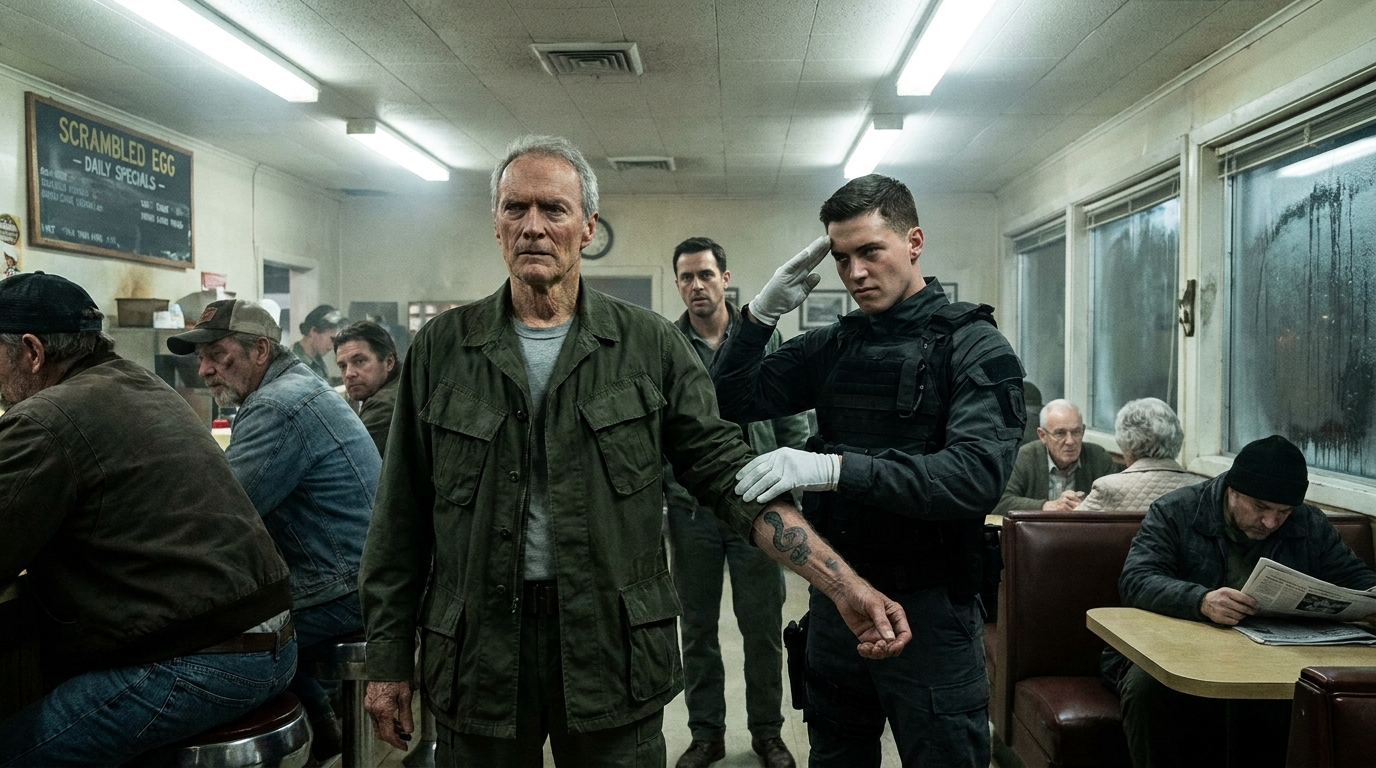
The diner wasn’t built for men like Cutler. It was a space designed for the slow consumption of burnt coffee and the quiet maintenance of a life lived in the margins. When Cutler’s finger tapped against the tattoo on Glenn’s forearm, the sound was insignificant—a dull, rhythmic rap against dry skin—but to Glenn, it was the sound of a trigger being pulled.
The smell of the Scrambled Egg—the stale, comforting scent of grease-slicked grills and percolated grounds—evaporated. In its place, the air grew thick and wet, saturated with the metallic, heavy iron tang of blood and the suffocating humidity of a jungle that existed on no map.
Glenn’s vision fractured. He wasn’t staring at the cracked vinyl of the booth anymore; he was seeing the mud-slicked face of a man who hadn’t made it out. He felt the phantom pressure of a bamboo shard, cold and sharp, biting into his skin while the wump-wump-wump of a distant Huey rotor thrummed in his chest, a rhythm that had never truly left him, not even after fifty years.
Cutler, oblivious to the history he was currently trampling, leaned in closer, his jaw set in a display of practiced, aggressive arrogance. He was waiting for a stumble, a tremor, a crack in the old man’s veneer of silence. “Stolen valor,” Cutler hissed, the words dripping with the entitlement of a generation that had never known a war fought in the dark. “I know the units, old man. Every single one. And that ink? That’s nothing but a back-alley mark.”
Glenn felt the cold, hard reality of the diner floor beneath his feet, but his mind was still back in the thick, suffocating canopy of Laos. He saw the star—the constellation they had pinned to the sky with their own blood. The serpent wasn’t just a design; it was a cage. It was the promise of a war that never ended, a circle that trapped them in the same moment, over and over, regardless of the years that had passed.
He pulled his arm back, not in fear, but with the deliberate, slow-motion grace of a predator reclaiming territory. He didn’t look at Cutler. He looked past him, through the plate glass of the diner window, toward the shimmering heat haze of the parking lot. His heart rate remained steady, a veteran’s pulse, yet the environment began to feel fragile, like a thin layer of ice over a deep, dark reservoir of secrets.
Cutler laughed, a sharp, barking sound that felt abrasive against the quiet hum of the room. He turned toward his partner, Reyes, his mouth opening to deliver the final, crushing jab that would solidify his perceived victory. But as he turned, he didn’t see the expected look of amusement. He saw Reyes staring at the door, his expression hardening into something resembling sudden, sharp recognition.
The diner bell gave a single, frantic jingle, and the front door swung wide, admitting not a customer, but a change in the atmospheric pressure. The space in front of the door was suddenly occupied by men who moved with a terrifying, synchronized fluidity. They were shadows in dress uniforms, men whose presence made the diner feel suddenly, claustrophobically small.
Cutler’s hand was still hovering near the table, his arrogance momentarily suspended, caught in the transition between his planned insult and the sudden, irrational rise of a primal, instinctual dread. He looked toward the door, and the smugness vanished from his face, replaced by a sudden, hollow realization that he had just touched something he was never meant to see.
CHAPTER 2: THE OFFICE OF GHOSTS
Sarah, the waitress, didn’t need to be told twice. She saw the way the General’s security detail moved—not like men patrolling a beat, but like predators clearing a sector. She slipped away from the coffee machine, her movements fluid and practiced, retreating into the cramped, grease-stained office behind the kitchen. The door clicked shut with a finality that seemed to seal off the diner’s current reality from the one Stacy Miller was about to confront on the other end of the line.
Her fingers were shaking, but she forced them to be steady as she tapped the numbers into her old flip phone. She didn’t look back through the small, rectangular window at the scene unfolding in the dining area. She didn’t need to. The sound of the General’s voice—a low, controlled rumble that didn’t just command attention but demanded submission—was enough.
“Stacy,” Sarah whispered, her voice tight, pressed against the cool, painted metal of the office door. “They’re here. The General is here. You need to know what’s happening.”
On the other end of the line, the silence was total. It was the kind of silence that existed in a vacuum, where every breath was magnified. Sarah stood in the dark, surrounded by the smell of stagnant fryer oil and the hum of a commercial refrigerator, waiting for the connection to the world of power, of files, and of hidden histories.
“Sarah?” Stacy’s voice arrived, thin and tight, devoid of the crisp professionalism that usually characterized her role at JSOC. “Tell me everything. The old man, Patterson—has he spoken? Did the operators—?”
“They’re being dismantled, Stacy,” Sarah interrupted, her eyes focused on the scuff marks on the linoleum floor. She could hear the muffled, sharp commands outside, the way the General’s detail had positioned themselves as a living wall between the rest of the world and the booth where Glenn Patterson sat. “The General… he recognized him. He saluted him. It wasn’t a gesture, it was a burial. He looked like he was saluting a tombstone.”
Sarah heard Stacy inhale sharply. In the sterile, high-tech environment of the command building, hundreds of miles away, the senior airman was likely standing amidst the hum of servers and the frantic activity of a four-star’s staff. “The tattoo,” Stacy said, her voice dropping to a near-whisper. “Sarah, you told me about the star. You described the circle.”
“I did,” Sarah said, gripping the phone so hard her knuckles turned white. “It’s on the General’s arm, too. I saw him roll up his sleeve. They’re the same, Stacy. They’re part of the same thing.”
Outside the office, the diner felt like it was shrinking. The temperature seemed to drop, the warmth of the morning sun through the window unable to penetrate the sudden, chilling professionalism of the General’s detail. The regulars—truckers, local retirees, the usual Thursday morning crowd—remained frozen in their booths. They were witnesses to a history they couldn’t decipher, observing the physical manifestation of a myth that had never been intended for public eyes.
Stacy’s voice returned, firmer now, the panic replaced by a cold, efficient urgency. “Do not let them leave. Do not let the General’s men clear the room until they have secured the perimeter. There’s something in the archives, something that isn’t even in the digital logs. Project Omega. It’s a ghost story, Sarah. It’s what the sergeants major talk about when they think no one is listening. You’ve just walked into the center of a black hole.”
“What do I do?” Sarah asked. She felt a phantom chill, a sense that the floor beneath the diner was shifting, revealing something that had been buried under decades of tactical shifts and geopolitical maneuvering.
“You stay where you are,” Stacy instructed, her voice regaining the clipped, administrative tone of the command. “I am going to get General Thorne’s chief of staff. If this is what I think it is, the entire unit—the entire command—is about to be forced to look at the very foundation they’ve been standing on. Do not hang up. Do not move.”
Sarah leaned her head back against the wall, closing her eyes. The office was small, claustrophobic, but it was a sanctuary compared to the diner. She could hear the General’s voice again, a low, surgical rebuke directed at Cutler. It was the sound of a man who was cutting out rot, a sound of absolute, ruthless precision. She felt a strange, detached pity for the two operators. They had walked in looking for a war story, looking to assert their dominance, and in doing so, they had stumbled into a graveyard of secrets.
She kept the phone to her ear, the line open, a thin, electronic thread connecting her to the truth. She listened to the hum of the diner—the clinking of a mug, the heavy, rhythmic pacing of the General’s detail, and the profound, suffocating silence of a room full of people who realized, all at once, that their understanding of the world had just become obsolete. The atmosphere was turning, the rusted edges of their small-town reality scraping against the sharp, cold steel of a shadow history that was finally, after fifty years, stepping out into the light.
CHAPTER 3: THE PERIMETER OF SHADOWS
The diner’s atmosphere had undergone a violent transition. Where there had once been the smell of burnt toast and the casual indifference of a Thursday morning, there was now a pervasive, chilling sterility. The two operators, Cutler and Reyes, stood motionless, their faces drained of color, caught in the wake of an authority they had only ever read about in sanitized manuals.
General Thorne didn’t look at them. He didn’t have to. His presence in the booth, standing as a sentinel beside Glenn Patterson, communicated more than any court-martial could. He was a pillar of dark fabric and silver stars, his eyes focused entirely on the man who sat before him. Glenn, for his part, hadn’t shifted. He remained seated, his hands wrapped around the ceramic mug as if it were the only anchor he possessed in a room suddenly filled with ghosts.
“General,” the lead NCO of the security detail said, stepping forward with a sharp, synchronized click of his heels. His hand was resting near the holster at his hip—a gesture of protection, not aggression. “The perimeter is secure. No unauthorized communication in or out. The local line has been neutralized.”
Thorne nodded once, a gesture so sharp it was almost imperceptible. “Keep it that way, Sergeant Major. No one comes into the Scrambled Egg until I give the order.”
The NCO retreated to the door, forming a living blockade with the other men in their crisp, dark uniforms. The diner was quiet—a deep, heavy silence that made the ticking of the clock on the wall sound like a hammer hitting an anvil. The patrons at the counter remained hunched over their plates, not daring to lift their heads, while the cook in the back was a silhouette behind the frosted glass, motionless.
Glenn took a slow, measured sip of his coffee. The heat of the ceramic radiated into his palms, a sensory tether that fought against the creeping intrusion of the past. He could feel the phantom pressure of the jungle humidity pressing against his skin, the smell of wet earth and rotted vegetation rising from the floorboards, defying the reality of the linoleum and industrial cleaning supplies. He looked at Thorne, not as a four-star commander, but as the young lieutenant he had carried through the swamps of Laos on his back. The memory was a sudden, intrusive phantom—the wet, ragged sound of Thorne’s breathing, the weight of his body against his own, the desperate, silent count of their heartbeats as the battalion hunted them.
“You look tired, Marcus,” Glenn said, his voice a low, raspy rumble that cut through the silence of the diner like a dull blade.
Thorne allowed a flicker of something—regret? exhaustion?—to cross his face before he shuttered it back behind the mask of command. “Tired is a luxury I haven’t been afforded for a long time, Glenn. Not since we left that canopy. You know that.”
“We left the canopy, but we never left the mission,” Glenn replied, his eyes pale and steady, observing the way Thorne stood. It was the stance of a man holding up the ceiling of the world, a posture forged in decades of keeping secrets that would have broken lesser men. “They don’t teach them what it means, do they? The legacy. They just wear the gear.”
He gestured toward Cutler, who was standing as if turned to stone, his hands limp at his sides. The young operator’s arrogance had been completely cauterized, replaced by the shivering realization that the entity he had been mocking was the architect of his own existence.
“They think they’re the pinnacle,” Thorne said, his voice cold, devoid of sympathy. “They have the satellites, the encrypted links, the funding. They have everything we didn’t. And yet, they have nothing.” He turned his gaze toward Cutler, the intensity of his stare causing the young man to visibly flinch. “You thought he was a relic. You thought his ink was a scribble from a back-alley shop. You didn’t realize that every step you’ve taken in your career was made on the path he cleared with a bamboo needle.”
Cutler tried to speak, his throat working convulsively. “Sir, I… I had no idea. There’s nothing in the database—”
“There is no database for the truth,” Thorne snapped, the brevity of his response like a whip crack. “There are only men who lived it and men who are forgotten by it. You have been playing at war, Cutler. You have been reciting a script while the real work has been happening in the shadows that you are too arrogant to even notice.”
Glenn didn’t join in the reprimand. He looked away, back toward the window, where the morning light seemed to dance on the dusty glass. He saw the reflection of the diner—the old booths, the peeling paint, the worn surfaces that had survived decades of routine. It was a place of pragmatism, of steady, rusted truth. He realized, with a quiet sense of finality, that the bubble of his retirement had been breached. He hadn’t been here to hide; he had been here to endure. But the past was a persistent, hungry thing. It didn’t care for the comfort of silence. It demanded to be recognized, and now, it was forcing itself into the light through the most unlikely of conduits: the humiliation of two men who thought they were the best the world had ever seen.
The atmosphere in the diner was thick with the weight of the revelation. It wasn’t just a confrontation; it was an intersection. The present was colliding with the foundation, the steel clashing with the rust. And as the General turned his gaze back to Glenn, a silent understanding passed between them—a recognition that the quiet life was over, and the long-delayed accounting of the debt was finally, inevitably, beginning.
CHAPTER 4: THE RECOGNITION
Cutler felt the blood rushing in his ears, a frantic, thrumming sound that drowned out the hum of the diner’s refrigerator. He had spent his career conditioned to see authority in terms of rank, brass, and the cold, unyielding hierarchy of the military industrial complex. But this—this was different. The General hadn’t just used his rank to silence them; he had stripped them of their own identity by revealing the hollow nature of their arrogance.
General Thorne didn’t spare them a second glance. He pulled out the chair opposite Glenn Patterson with the same measured, tactical precision he used to deploy a battalion. The wood of the chair scraped against the linoleum, a harsh, grating sound that seemed to pull the eyes of everyone in the room toward the booth. Thorne sat, his back ramrod straight, his hands—calloused, battle-scarred—resting flat on the table, mirrored exactly by the hands of the older man sitting across from him.
“You haven’t touched your coffee,” Thorne said, his voice dropping from the thunderous command he’d used seconds ago to a low, intimate rumble.
Glenn looked down at his mug. The surface of the dark liquid was still, reflecting the low-hanging light of the diner fixture. “It’s gone cold, Marcus. Doesn’t matter much.”
Cutler watched, unable to pull his gaze away. The scene was surreal. The most powerful man in the special operations community, a man whose word could shift geopolitical landscapes, was sitting in a roadside diner in the middle of nowhere, talking about cold coffee. Cutler’s partner, Reyes, took a slow, involuntary step backward, his eyes darting from the General to the faded, ink-blurred serpent on Glenn’s arm.
Cutler looked at his own knuckles. They were scarred, yes—the result of a thousand hours of hand-to-hand combat training, the byproduct of an elite fitness regime. But they were empty. They weren’t marked. He had spent his entire adult life trying to reach the pinnacle of professional lethality, believing he was part of an unbroken line of warriors. Now, he felt like a child staring at a map he couldn’t read.
“We were never supposed to be remembered,” Glenn said, his gaze shifting to the window. “That was the deal, wasn’t it? The shadow for the light. We took the mission, we signed the pact, and we vanished so that people like them,” he jerked his chin toward Cutler, “could have a clean, shiny world to fight in.”
Thorne leaned forward, his eyes fixed on Glenn. The dynamic between them was ancient. It wasn’t based on the rank on their collars; it was based on the blood they had spilled together in a jungle that no longer officially existed. “The world is never clean, Glenn. It’s just better at hiding the mess. These two,” he didn’t even look at the operators, “they’re just the symptom. They’ve forgotten the weight of the work. They think it’s about the reputation, the gear, the prestige. They’ve never had to survive by the edge of a blade when the command center is a thousand miles away and no one is coming to help.”
Cutler felt a cold knot tighten in his stomach. He remembered the briefings—the stories of the early, experimental units that had been disbanded, written off as failures of protocol or accidents of history. He had always assumed those stories were cautionary tales about how not to operate. Now, he was seeing the men who had written those stories. The realization was physically sickening. He had spent years mocking what he thought was a lack of standards, when in reality, he was looking at the very people who had set the bar for the entire profession.
General Thorne stood up, his movement sudden and fluid, catching everyone in the room off guard. He walked toward the counter, where Sarah was standing, her hand still clutching the phone she had used to summon the world down upon their heads. He reached into his pocket, pulled out a heavy, leather-bound wallet, and placed a hundred-dollar bill on the counter. It was an absurdly large tip for a single cup of coffee.
“Keep the change, Sarah,” Thorne said, his voice softer now, but still carrying the authority of a man who commanded legions. He turned back to the booth, his gaze finding the two operators one last time. “You stay here. You don’t leave this property until my staff officers arrive to process your credentials. If you attempt to leave, I will have your security clearance revoked before you reach the parking lot. You are going to be processed, you are going to be debriefed, and then you are going to be reassigned. You will spend the rest of your careers learning how to be the infrastructure that supports the men you so arrogantly thought you were.”
He didn’t wait for a reply. He gestured for Glenn, and the older man stood, his joints stiff, moving with a cautious, practiced gait. Together, they walked toward the door. The security detail outside the diner parted like the tide, their eyes never leaving the crowd, their faces masks of stone. As they pushed through the door, the bell jingled once—a light, innocent sound that contrasted sharply with the heavy, life-altering weight that had just descended upon Cutler and Reyes.
Cutler stood in the center of the diner, the smell of grease and cold metal clinging to his uniform. He looked at the empty booth, at the half-finished, cold cup of coffee, and at the mark on the table where Glenn’s arm had rested. He realized then that he was no longer an operator. He was just a witness, a man who had seen the truth of his own insignificance. The chain of command he had relied on for his entire identity had just been severed, and he was left standing in the wreckage of his own arrogance, forced to confront the fact that everything he had believed was a lie. He looked at Reyes, but his partner couldn’t look back; he was already staring at the door, where the two legends had vanished, leaving behind nothing but the silence of a truth that couldn’t be ignored.
CHAPTER 5: THE DISMANTLING
The diner was silent, save for the hum of the refrigerator and the distant, rhythmic ticking of the wall clock. Cutler didn’t move. He couldn’t. His legs felt as though they had been grafted to the worn linoleum tiles. Beside him, Reyes was staring at the doorway where the General and Glenn had just vanished, his jaw clamped shut so tightly that the muscles in his face stood out like ridges of corded steel.
“We need to leave,” Reyes said, though his voice lacked any conviction. It was a hollow, breathy sound.
“How?” Cutler asked, his gaze fixed on the empty booth. “The detail is still outside. You heard him. If we cross that threshold, we aren’t just breaking protocol—we’re committing professional suicide.”
Cutler looked down at his own hands. They were the hands of a man who had been told, since the very first day of selection, that he was the apex of his field. He had been taught that there was a clear, logical progression to power and merit: you trained, you suffered, you excelled, and you became the best. But that logic had just been incinerated. The existence of Glenn Patterson—a man who had been erased from the official record, a man who had built the very systems Cutler now operated within—meant that the history he had been taught was a lie.
A sound at the door—the distinctive, heavy thud of a vehicle door closing outside—made them both jump.
“They’re still here,” Reyes muttered, his hands hovering nervously near his belt.
Cutler felt a sudden, sharp surge of panic. He had to know. If the history was a lie, what else was? He walked toward the counter, his steps heavy and uncoordinated. He wanted to look at the table. He needed to see if the mark of the old man’s arm was still there, if the table somehow held the ghost of the conversation that had just dismantled his worldview.
He reached the booth and stopped. The table was empty, save for the two cold mugs and a stray napkin. He ran a finger along the edge of the vinyl, the friction of the worn fabric rough against his skin. There was nothing here. No residue of legend, no physical evidence of the secret that had just been weaponized against them.
“We’ve been played,” Cutler said, his voice rising in volume, fueled by a mixture of anger and confusion. “The whole command structure—it’s built on a foundation we aren’t even allowed to see. We aren’t operators. We’re just placeholders. We’re just the maintenance crew for a legacy we don’t even understand.”
“Cutler, stop,” Reyes warned, his eyes darting toward the window. “The detail is watching. They know what we’re saying.”
Cutler didn’t care. The frustration was a physical weight, crushing his chest. He turned to face the diner—the patrons who were still sitting in their booths, watching them with a mixture of fear and curiosity. He realized then that he had never been the protagonist of this story. He was just a footnote, an obstacle that had been effortlessly cleared by the people who actually mattered.
He saw Sarah standing by the office door. She wasn’t afraid. She looked at him with a strange, pitying expression, as if she were watching a man who had just realized his house was on fire while he was still sitting inside it.
“Why are you looking at me like that?” Cutler demanded, stepping toward her. “You knew. You knew who he was, didn’t you?”
Sarah didn’t retreat. She stood her ground, her face calm, her shoulders relaxed. “I knew he was a man who deserved to be treated with dignity,” she said. Her voice was steady, unimpressed by his uniform or his anger. “I didn’t need to know his history to recognize his character. You, on the other hand, spent your entire time here trying to figure out if he was ‘valuable’ enough to notice. That was your first mistake.”
Cutler felt the heat rise in his face. It was a sting of humiliation that cut deeper than any tactical reprimand. He looked at his reflection in the darkened glass of the kitchen window—a man in a crisp uniform, a man who stood for the best of his generation, but who, in the face of the truth, looked remarkably small.
The front door opened. Two men in dark suits, their lapels devoid of any insignia, stepped into the diner. They were not from the General’s security detail. They were civilian-clothed, and they moved with an administrative, bureaucratic focus that was even more terrifying than the soldiers outside.
“Cutler? Reyes?” the lead man asked, his voice clipped and neutral. He didn’t wait for a response; he simply walked to the counter and placed a thick, sealed envelope on the top. “Your credentials have been suspended. Effective immediately. You are to follow us to the processing facility on post. Your temporary reassignment orders are inside.”
Cutler looked at the envelope. It felt like a death warrant for everything he had spent his life building. He looked at Reyes, whose face had gone completely blank, a mask of resignation. He realized then that the system wasn’t going to punish them in a way that the world would see; it was going to absorb them, erase them, and utilize them as the very tools they had so arrogantly dismissed.
He turned back to the booth one last time. The space was still empty. The weight of the moment felt terminal, a final closing of a door he hadn’t realized was locked until it was already shut. He picked up the envelope, the paper heavy and cool against his palms, and followed the men toward the door. The rust of the diner, the smell of the old grease, and the silence of the room remained, a permanent reminder of the moment their world had ceased to exist.
CHAPTER 6: THE SILENT CONVOY
The ride to the processing facility on post was a masterclass in suffocating efficiency. Cutler sat in the back of the black, windowless transport, Reyes beside him. Neither man spoke. The men in suits—the ones who had delivered the envelope—occupied the front and the middle row, their presence as immovable as the chassis of the vehicle itself. There was no radio music, no idle chatter, no clatter of equipment. Just the rhythmic thrum of the tires against the asphalt and the occasional, sharp turn that jerked Cutler against his seat belt.
He looked down at the envelope. It was thick, made of heavy, cream-colored cardstock that felt expensive, almost tactile against the callouses of his fingers. He hadn’t opened it. He didn’t need to. He knew what was inside: a clean slate that was actually a prison sentence. A reassignment to the very program that had been created to ensure that men like him never again made the mistake of underestimating the ghosts of the past.
The road wound through the outskirts of the base, past the training ranges where Cutler had spent the better part of his career testing the limits of his own lethality. Seeing those familiar berms and towers—now viewed through the lens of a man who had been cast out of the inner circle—felt like looking at the ruins of a life he had only just inhabited. Everything he had been proud of—the precision, the tactical mastery, the sheer, unadulterated strength—now felt brittle. It was a shell, a polished exterior that hid an utter void of historical context.
“They aren’t going to fire us,” Reyes whispered, his voice barely audible over the hum of the engine. It was the first time he had spoken since leaving the diner.
Cutler looked at him. Reyes looked smaller, his shoulders hunched as if he were trying to occupy less space in the world. “Fire us? No. That would be an admission that we were ever capable of functioning independently. They’re just going to recycle us, Reyes. We’re going to be the ones who carry the boxes, set up the chairs, and make sure the speakers have fresh water.”
“It’s humiliating,” Reyes said, his eyes unfocused as he stared at the back of the driver’s head.
“It’s penance,” Cutler corrected, though the word tasted like ash in his mouth. “The General didn’t want us gone. He wanted us to serve. He wanted us to watch the people who actually built the foundation we’ve been walking all over. He’s turning us into the background characters of the history we thought we were leading.”
The transport slowed, the engine dropping to a low, guttural growl as they approached the perimeter of the JSOC headquarters. The security checkpoint was a fortified bunker, the gate swinging open with the mechanical, screeching groan of heavy iron. Cutler watched as a squad of MPs, eyes scanning the vehicle with robotic intensity, stepped back and saluted as they passed. He had received that salute a hundred times before. It used to make him feel like a titan. Now, it made him feel like a prisoner of his own reputation.
The vehicle came to a stop in a concrete lot shielded from the main thoroughfare. The lead man in the suit stepped out, his movements fluid and quick. He opened the side door, his expression as blank as a stone wall.
“Out,” he ordered.
Cutler stepped onto the pavement. The air here smelled different—deeper, more sterile, a mixture of ozone and high-grade cleaning solution that seemed to bleach the color out of the world. He felt the weight of the facility around him, the vast, hidden machine of the special operations command. He was back at the heart of the power, but he wasn’t an operator anymore. He was a piece of logistics.
They were led through a side entrance, a heavy steel door that required a palm scan and a retinas check. As the door swung open, revealing a long, fluorescent-lit corridor, Cutler hesitated for a fraction of a second. He was staring at a wall of plaques—a memorial to the units and the operations that had passed through this hallway over the last forty years. He scanned the brass plates, looking for a sign, a trace, a hint of the serpent or the star.
There was nothing.
The history was sanitized, scrubbed clean of the blood and the shadow that General Thorne had talked about in the diner. It was a wall of polished, honorable success. It was the story the command wanted the world to see, and Cutler realized with a cold, sinking feeling that he was about to be part of the mechanism that kept it that way.
“Move,” the man in the suit said, a hand briefly touching the small of Cutler’s back—not a shove, but a guiding, absolute pressure.
Cutler began to walk, his footsteps echoing on the hard, industrial flooring. Every step felt like a further departure from the man he had been an hour ago. He looked at the long, sterile hall stretching out before him, and for the first time in his life, he didn’t feel like he was moving toward an objective. He felt like he was being subsumed. The corridor seemed to narrow, the walls closing in with the weight of all the secrets they contained, and as they reached the end, toward a door marked ‘Legacy Program Administration,’ Cutler gripped the envelope in his hand so tightly the edges bit into his skin, a final, sharp reminder of the reality he could no longer escape.
CHAPTER 7: THE ARCHIVE OF ASHES
The door pushed open with a soft, pneumatic hiss, revealing an office that was less a workplace and more a tomb of forgotten paper. Rows of metal filing cabinets stretched toward the back of the room, their gray, industrial finish dull under the unforgiving glare of the overhead LEDs. The air inside was dry, tasting of ancient dust and the sharp, chemical tang of ozone—a scent Cutler had never associated with administrative work.
At a desk cluttered with stacks of yellowing folders, an older man sat hunched over a magnifying glass. He didn’t look up as Cutler and the two security men entered. He was dressed in a worn, olive-drab sweater, his hair white and thin, his movements as precise and deliberate as a watchmaker’s.
“You’re late,” the man said, his voice a dry rustle.
“We were delayed,” the lead suit replied, his tone shedding its previous neutrality for something approaching genuine respect. “They’ve been processed. These are the new staff members for the Legacy Program.”
The man at the desk finally looked up. His eyes were milky with cataracts, yet they seemed to possess a piercing, disconcerting clarity. He looked at Cutler, then at Reyes, his gaze lingering on the insignias they still wore—the patches they had not yet been ordered to remove.
“Staff members,” the old man repeated, a faint, humorless smile touching his lips. “Is that what they told you? That you’re here to help?”
Cutler stepped forward, the envelope feeling like a lead weight in his hand. “We were told we’d be performing administrative duties for the Legacy Program.”
The old man laughed, a sound like dry leaves skittering across pavement. He stood up—slowly, painfully, as if his joints were made of rusted iron. He walked toward a cabinet, his hand tracing the edge of the metal as if he were reading braille. “Administration. That’s a polite word for it. In this room, we don’t administer. We archive. We hold the things that were too dangerous to exist, and too valuable to destroy.”
He pulled a drawer open. It didn’t slide with the smooth precision of a modern cabinet; it groaned, a metallic protest of friction and neglect. Inside, there weren’t folders or documents. There were artifacts. A dented canteen, a fragment of a radio headset, a rusted buckle, and a small, faded photograph protected by a plastic sleeve.
Cutler felt a sharp, intrusive phantom of his own—the image of the diner, the smell of the grease, the way the General had stood beside the old man in the booth. The psychological weight of that moment surged back into his mind, the shame of his arrogance clashing violently with the sterile, dust-choked reality of this room.
“Look at these,” the old man said, holding up a small, hand-carved piece of wood. It was a five-pointed star. “You think you know what service is because you’ve read the manuals. You think you know honor because you’ve worn the medals. But you’ve never touched the reality of it. You’ve never held the things that were left behind when the mission was scrubbed from the books.”
Cutler looked at the star. It was rough, uneven, the work of a man in the middle of a conflict that made craftsmanship a luxury. It was the same symbol he had mocked at the diner. The sight of it felt like a physical blow to his solar plexus. He felt the structure of his own life—his career, his pride, his entire understanding of the hierarchy—crumbling into the gray dust that coated these shelves.
“Why are we here?” Reyes asked, his voice cracking. “What is this?”
“This is the cost,” the old man said, turning to face them, his expression severe. “You mocked the tattoo because you didn’t understand the sacrifice. You saw a scribble and thought it was a joke. Here, you will learn the name of every man who was erased. You will learn the history of every operation that never happened. You will organize the legacies of men who were never allowed to have their own. And when you understand the weight of what you mocked, then, and only then, will you understand what it means to actually be an operator.”
The lead man in the suit turned and left, closing the door behind him with a final, heavy click that signaled the end of their previous existence. Cutler was left in the room with the archivist and the smell of dead paper. He looked down at the envelope in his hand. He realized he was no longer holding orders; he was holding a sentence. He was going to spend his days cataloging the ghosts of a war he hadn’t known existed, an apprentice to an archive of shadows. The reality of his situation didn’t just feel heavy; it felt absolute, a descent into a quiet, dusty truth that offered no escape, only the long, slow process of learning how much he had never known.
CHAPTER 8: THE PROMISE OF THE SERPENT
Cutler stood in the center of the archive, the silence of the room no longer feeling like an absence of sound, but like the presence of a thousand voices that had finally been granted the space to breathe. The old man, the archivist whose name Cutler still didn’t know, watched him with those milky, cataracts-covered eyes, yet Cutler felt as though he were being dismantled. Every piece of his former identity—the tactical arrogance, the belief in the clean, modern precision of his unit, the certainty that he was the apex of his profession—was being stripped away, cataloged, and placed onto a shelf of forgotten things.
“You’re waiting for an explanation,” the old man said, his voice quiet, lacking the bite of earlier hostility. “You’re waiting for me to tell you that you’ve been betrayed by your command, that you were just a tool in a machine that didn’t care for you. But that would be a simplification. And you’ve had enough of those.”
Cutler looked at the wooden star in his hand. He turned it over, feeling the rough edges, the slight splintering of the wood where the grain had resisted the carver’s knife. “The General,” he began, his voice raspy, “he talked about a pact. A circle. The serpent eating its tail. He said it was a promise.”
“It was,” the old man confirmed. He walked slowly to a wall of cabinets, his hands trembling slightly as he pulled a heavy, iron-bound ledger from a top shelf. He laid it on the desk and opened it. The pages were brittle, yellowed, and covered in a dense, spidery script that looked like it had been written in diluted ink. “Project Omega wasn’t a unit, Cutler. It was a condition. We were sent into places that didn’t officially exist to do things that the world couldn’t afford to know about. We were the fire that burned the rot out of the foundation so that the house could stand. And the price? The price was that we were never allowed to leave the fire.”
He pushed the ledger toward Cutler. “Look.”
Cutler stepped forward. The ledger contained names, dates, and locations—places that had been scorched from every map he had ever been taught to read. But it was the names that stopped his heart. He saw the name of the General, Marcus Thorne, written in the same hand as Glenn Patterson. And beside them, in the margins, were other names—names he recognized from historical footnotes, from the ‘lost’ units of the sixties, from the whispers that circulated in the barracks but were never given credence.
“They aren’t just names,” Cutler whispered.
“They are the anchor,” the old man said. “When you tattoo that serpent onto your skin, you aren’t declaring yourself a warrior. You are declaring yourself a ghost. You are agreeing to be forgotten, to be the silent weight that holds the structure in place. The reason you and your partner were brought here, the reason the General allowed you to live, is because someone needs to start writing the names down again. Someone needs to maintain the archive of the things that were paid for in blood.”
Cutler felt a strange, chilling clarity settle over him. The anger, the humiliation, the desperation to regain his position—it all evaporated, leaving behind a cold, pragmatic resolve. He looked at the archive, at the thousands of lives that had been reduced to fragments of equipment and lines of fading ink, and he understood. He wasn’t being punished. He was being recruited into the only force that actually mattered: the one that remembered.
He set the wooden star back on the desk. He felt a sudden, sharp, and entirely unexpected sense of peace. The world outside this room—the politics, the medals, the polished uniforms—seemed like a distant, irrelevant play. This was where the work was. This was where the truth resided.
He reached into his pocket and pulled out his own knife, a high-grade, titanium-alloy blade he had carried on every deployment. He placed it on the desk, right next to the ledger. It was a surrender of his old self. He looked at Reyes, who was standing a few feet away, watching the exchange with a bewildered, shell-shocked expression. Cutler saw the same realization dawning in his partner’s eyes—the quiet, terrifying recognition of their new purpose.
“What do we do?” Cutler asked, his voice steady, stripped of all ego.
“We start at the beginning,” the old man said, pulling a stack of blank index cards from a drawer and setting them in front of Cutler. “We read the files. We document the sacrifices. And we wait for the next time the world needs someone to go into the dark and be forgotten.”
Cutler sat at the desk. He took a pen, the grip familiar, the weight comforting. He looked at the ledger, at the names that had been erased, and he began to write. The silence in the room wasn’t oppressive anymore; it was the hum of a machine working exactly as it was meant to. Outside, the base would continue to turn, the soldiers would continue to march, and the modern units would continue to play at war. But in here, under the harsh, clinical light of the archive, the true history was being preserved. He was the caretaker of the ghosts, the guardian of the rusted truth, and for the first time in his life, he didn’t care about the glory. He only cared about the record. The serpent was eating its tail, the circle was closing, and Cutler finally understood the weight of the promise. He kept writing, his hand steady, his focus absolute, the rust of the past becoming the bedrock of his new, quiet life in the dark.