The Weight of Silence: A Journey to Reclaim the Soul of a Forgotten Ghost in the Shadows
CHAPTER 1: The Ghost in the Rearview
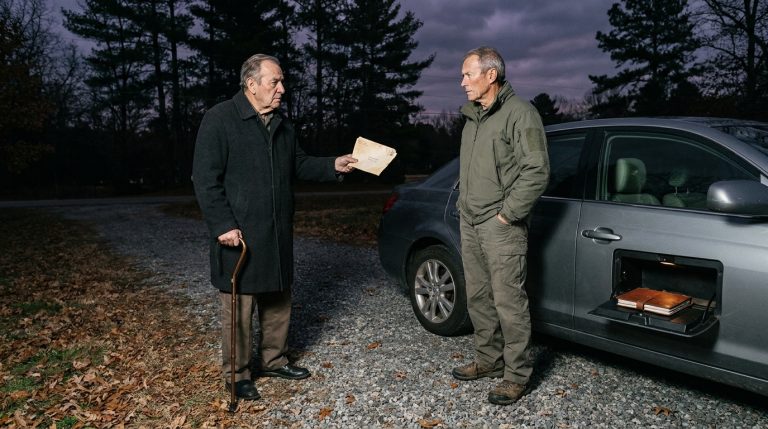
The SUV pulled away from the Fort Bragg veteran services center, the tinted glass sealing Titan Two inside a pressurized, leather-lined tomb. Beside him, Colonel Davis sat with her hands folded over a tablet, her posture a testament to rigid discipline. She didn’t look at him, but her breathing was shallow, rhythmic—the breathing of a woman who knew exactly what kind of volatility sat next to her.
Outside, the world of the living blurred into a smear of autumn colors.
“You left your sign,” Davis said, her voice quiet, barely audible over the hum of the engine.
Titan Two stared out the window at the receding horizon. His hands, resting on his knees, were stained with the dust of a dozen transit stations, the skin mapped by callouses that had once gripped rifles and now, more recently, held nothing at all. He felt the absence of the cardboard sign like a phantom limb. It was the only thing that had felt honest in years.
“It wasn’t mine anymore,” he replied, his voice raspy, unused to the social friction of speech.
He reached into his tattered jacket pocket, searching for his old Zippo lighter—the one with the dented bottom, the silver tarnished to a dull charcoal. His fingers brushed the fabric, then the lining. Empty. He froze. He knew he had moved it to his right pocket before the General had stepped out of that car, before the screaming, before the world broke open.
He didn’t ask for it. He didn’t want to alert the Colonel to the fact that he was already calculating the distance between the seat and the door, his mind automatically assessing the exit vectors of the moving vehicle. Instead, he forced his fingers to relax. The lighter was gone, a small, tangible piece of his history discarded on the concrete of a base he’d never intended to see again.
“The team is waiting, sir,” Davis continued, her eyes flickering toward the digital display on the dashboard. “Phoenix Actual is at the facility. He’s been there since dawn.”
Titan Two turned his head slowly. The movement hurt; his shoulder, damaged in an operation he wasn’t supposed to remember, sent a sharp, familiar jolt of pain through his collarbone. It was a grounding sensation. It reminded him that he was still made of flesh and bone, even if his identity was a classified footnote.
“Does he know?” Titan Two asked.
“Know what, sir?”
“That I’m not the man he’s looking for.”
Davis finally turned to look at him. Her face was a mask of professional neutrality, but in the fading light, he caught the faint, frayed texture of her exhaustion. She was a soldier, yes, but she was also a woman caught in the middle of a history that should have been burned.
“To them, you are exactly the man they need,” she said, her voice dropping an octave, carrying the weight of a secret she hadn’t yet been authorized to speak.
As the SUV hit a bump, a sudden, sharp rattle emanated from under the floorboards—not the sound of metal on metal, but something hollow, like a loose panel. Titan Two felt a chill crawl up his spine. He leaned forward, his eyes darting to the floor, where a small, silver corner of a metal object was wedged beneath the heavy rubber floor mat. It wasn’t his Zippo. It was a key, stamped with a serial number that hadn’t been issued since the mid-nineties.
His heart thudded once—a heavy, resonant strike against his ribs. He looked at Davis. She was watching the road, her expression unreadable, but her hand had moved, almost imperceptibly, to the heavy security strap on her service holster.
The car slowed as they turned onto the restricted access road leading toward the base’s subterranean wing. The air inside the cabin grew heavy, charged with the static of a secret that was beginning to pulse against the glass. He realized then that he wasn’t being driven to a reunion. He was being driven back into the machine, and the machine had finally decided to acknowledge that he was still inside.
CHAPTER 2: The Architecture of Memory
The SUV did not just move; it glided with a synthetic, frictionless grace that felt entirely alien to the world of grit and gravel Titan Two had occupied for the better part of a decade. He kept his foot angled carefully over the spot where the key lay hidden. It was a small thing—a piece of cut brass—but it felt heavy enough to anchor the entire vehicle to the earth.
He didn’t move it. He didn’t look down again. Instead, he forced his gaze toward Colonel Davis, who was staring fixedly at the road ahead. The air in the cabin had begun to shift. The climate control, previously a whisper of cool, filtered air, suddenly let out a strained, high-pitched mechanical wheeze, followed by a blast of stagnant, overheated air that smelled of ozone and synthetic rubber. The temperature spiked, pressing the scent of aged upholstery and stale, recycled oxygen against them.
Davis frowned, her fingers twitching near the control dial, but the system didn’t respond to her input. The cabin became a pressurized chamber of rising heat. It was a small, erratic failure—a mechanical glitch in a world that pridefully claimed to have no flaws.
“Electronics,” Titan Two said, his voice flat, cutting through the sudden hum of the struggling blower. “Everything reaches a breaking point eventually, Colonel.”
Davis glanced at him, her brow furrowed. The heat made a thin sheen of perspiration bloom across her forehead, blurring the sharp lines of her professional composure. “It’s a maintenance oversight. We’ll have it handled upon arrival.”
“Will you?” He leaned back, letting his head rest against the vibrating leather of the headrest. The heat was a distraction, a V-3 variance in an otherwise rigid transit, but it served its purpose—it forced the Colonel to move her hands, to adjust her posture, to reveal the tension in her shoulders. “Nothing stays hidden forever, Colonel. Not even the things you think you’ve buried under a layer of classification.”
She didn’t answer. She only accelerated. The SUV surged forward, the tires biting into the asphalt with a sound like tearing silk.
As they bypassed the perimeter gate, the landscape began to change. The lush, autumnal sprawl of Fort Bragg gave way to something stark and utilitarian: high, chain-link fences topped with concertina wire that looked more like rusted iron lace in the fading light. There were no signs here. No insignia. Just the brutal, geometric lines of a facility designed to exist in the margins of the map.
Titan Two watched the world pass. He felt the phantom weight of the key beneath his boot, a physical discrepancy that sat at odds with the sterile perfection of the SUV’s interior. He knew this road. Even though it had been years, the rhythm of the turns, the specific slope of the access ramp—it was burned into his muscle memory. This was the entrance to the ‘Black Wing,’ a place that wasn’t supposed to have a name.
“You said Phoenix Actual was here,” Titan Two noted, his voice low, steady. “He shouldn’t be. Not unless the mandate has changed.”
Davis finally looked at him, her eyes searching his face for a flicker of fear or, perhaps, a hint of recognition. “The mandate hasn’t changed. But the reality of your return has forced their hand. They aren’t looking for a ghost anymore, sir. They’re looking for a contingency.”
“I am not a contingency.”
“That isn’t your call to make today.”
The SUV slowed to a crawl as they approached a heavy blast door that looked like the maw of a buried vault. It hummed with the sound of high-voltage machinery. As the vehicle stopped, Titan Two felt the shift in the atmosphere. The heavy, pressurized air of the cabin matched the sudden, absolute silence of the facility outside.
He slid his foot back, his heel catching the edge of the key and dragging it into the gap between the seat rail and the floor mat. It was hidden, secure, and entirely his own.
The door began to roll upward, revealing a corridor bathed in harsh, flickering fluorescent light. At the end of the tunnel stood a figure. Even from this distance, through the windshield, Titan Two recognized the set of those shoulders, the way the man stood with his hands locked behind his back—a posture of command that hadn’t wavered in thirty years. Phoenix Actual. He looked older, his hair a shock of silver against the gray walls, but the presence remained—a solid, jagged rock in a sea of shifting shadows.
Titan Two opened the door. The air that rushed in was cold, sterile, and tasted of antiseptic. He stepped out, his boots hitting the concrete with a heavy, deliberate thud. He didn’t look back at the SUV or the Colonel. He walked toward the end of the corridor, his stride long and measured, ignoring the way his shoulder flared in protest.
He had spent years trying to erase himself, to vanish into the gray landscape of the forgotten. But as he looked at the man waiting for him, he realized the past was not a place he could simply leave behind. It was a current, and he was being pulled back into the depths.
Phoenix Actual didn’t move until Titan Two was ten paces away. Then, he stepped forward, his eyes fixed on the man who had supposedly died twice over. There was no warmth in his gaze, only a deep, penetrating scrutiny, as if he were trying to read the service record that had been ripped from the files.
“Titan,” the man said, his voice a low, gravelly rasp. “You’ve been a difficult man to keep track of.”
“I wasn’t trying to be tracked, Actual.”
“That’s the difference between you and the rest of us,” the man replied, stepping aside to reveal the heavy, reinforced doorway behind him. “We were waiting to be found. You were waiting to be left alone.”
Titan Two stopped at the threshold, glancing once behind him at the darkened interior of the SUV, where the key remained tucked away, a secret promise of leverage he wasn’t yet ready to deploy. He looked back at Phoenix Actual and realized the hardest part of the mission wasn’t the return—it was the lie he would have to sustain to keep them all from seeing what he had become.

CHAPTER 3: The Weight of the Living
The blast door groaned as it slid shut, a thick slab of reinforced steel that severed the connection to the world outside. The interior of the Black Wing was not the high-tech, glowing laboratory Titan Two had braced for. It was utilitarian, smelling of damp concrete and heavy-duty industrial lubricant. The light here was low, oscillating with a faint, rhythmic hum that set his teeth on edge.
Phoenix Actual did not walk away. He stood his ground, his eyes scanning Titan Two with a clinical, detached precision that felt more like a combat assessment than a reunion. He was evaluating the damage—not just the physical toll of the years, but the mental erosion that came with long-term isolation.
“You look like hell, Titan,” Phoenix said. His voice was a rasp of sandpaper against stone.
“I look like a man who wasn’t supposed to be found,” Titan Two replied. He didn’t offer a hand, and he didn’t stand at attention. He simply let his shoulders drop, assuming a stance that was loose but ready—a posture that signaled he was done performing for the brass.
Phoenix huffed, a sound that might have been a laugh in another life. He turned and began walking down the corridor, his footsteps ringing sharp and hollow on the polished floor. “Follow me. There are things you need to see. Things you were never meant to understand, let alone hold on to.”
Titan Two shadowed him. His mind was constantly mapping the environment: the location of the fire suppression sensors, the spacing of the recessed ceiling cameras, the subtle pitch of the floor. This was an old habit, a survival mechanism that operated in the background, independent of his conscious thought. He thought of the key tucked away in the SUV parked outside. It was a lifeline he had hoped never to use, but as he navigated the sterile maze of the facility, he realized it was becoming a necessity.
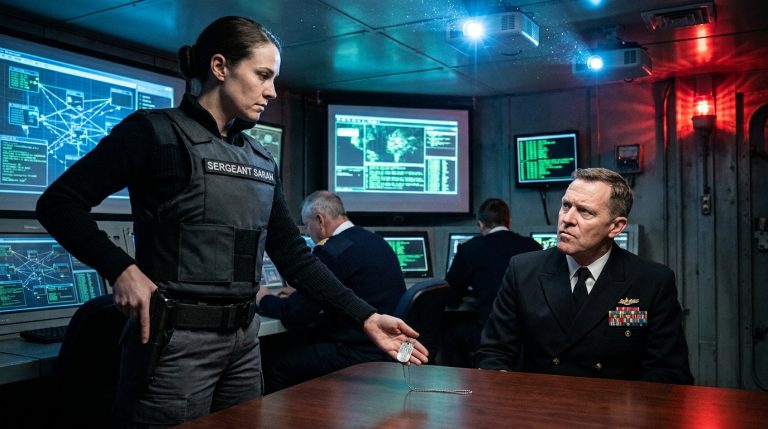
They entered a room that was cavernous and cold, filled with rows of filing cabinets that looked like tombstones. In the center, a single desk sat beneath a pool of harsh, yellow light. Colonel Davis was already there, her tablet open, her fingers dancing across the screen with a speed that spoke of a high-priority deadline.
“The assets have been mobilized, Colonel?” Phoenix asked without stopping.
“Yes, sir,” Davis replied, her voice crisp, devoid of the hesitation she had shown in the vehicle. “Reaper 6 is on-site within the hour. The others are being signaled.”
Titan Two watched them. It was a coordinated dance—a precision of logistics that felt too organized, too deliberate. They weren’t just bringing back a soldier; they were reassembling a tactical unit for a purpose that hadn’t yet been named.
“Why now?” Titan Two asked, his voice echoing in the vast, empty room. “We were erased. We were told the books were closed.”
Phoenix stopped and turned. The yellow light caught the deep, jagged scars on his hands—scars that mirrored the ones Titan Two carried beneath his own layers of grime. “The books are never closed, Titan. They’re just moved to a different shelf. We’ve found inconsistencies in the project data. Anomalies that suggest the erasure was… incomplete.”
“Incomplete.” Titan Two repeated the word. It tasted like ash. “You mean there’s a trail.”
“I mean there’s a threat,” Phoenix corrected. He stepped into the light, his face a landscape of hard-won experience. “Someone has been pulling on the threads of our history. We’ve lost three assets in the last six months. Not just erased—wiped from the record, as if they never existed.”
Titan Two felt a cold prickle of realization at the base of his neck. He remembered the feeling of being hunted, the sense that his seclusion in the veteran services center hadn’t been an accident, but a slow, tightening snare. He had assumed he was being tracked by the government, but if Phoenix Actual was here, if the others were being hunted, then the predator wasn’t the institution he had served. It was something else. Something that moved in the same shadows they had been carved out of.
“You think they’re hunting the unit,” Titan Two said.
“I know they are,” Phoenix replied. He leaned over the desk, his presence overwhelming the small space. “We didn’t just walk away from the mission, Titan. We were part of an experiment that ended in failure. Or so we were told. Now, it seems someone wants to verify the results.”
Titan Two felt the weight of his own history pressing down on him. The ‘Titan Project’ had always been a ghost story told in whispers among the operators—a legend of black-budget testing and morality-defying operations that pushed men to their absolute breaking point. To hear it spoken aloud, here, in the bowels of a facility that shouldn’t exist, was a harrowing intrusion on the fragile peace he had built.
“I’m not a test subject anymore,” Titan Two said, his voice dropping into a register that made Davis pause in her typing.
“You never stopped being one,” Phoenix said quietly. “None of us did. That’s the lie we all lived with. We thought we were serving a flag, but we were just variables in a long-term study.”
Titan Two felt the floor beneath him shift. The logic was cold, precise, and utterly terrifying. He thought of the key in the SUV—not a lifeline, but perhaps a piece of the experiment he had unknowingly scavenged.
“I need to see the files,” Titan Two said, moving toward the desk.
“You aren’t cleared for the full data set,” Davis interjected, her voice sharp.
“I think,” Titan Two said, turning to look at her with eyes that had seen the end of the world and decided to survive it, “that the time for clearance levels is long over. If you want my help, you stop treating me like an asset and start treating me like the man who knows more about this project than the people who wrote the code.”
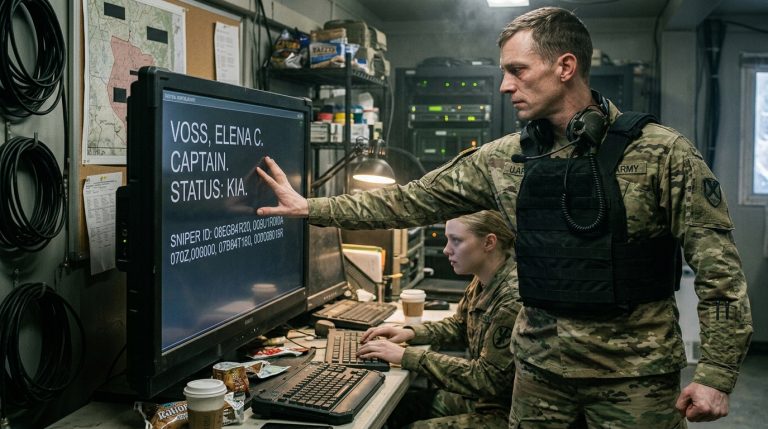
He stood over the desk, looking down at the screen. The flickering light caught the edges of the documents Davis was scrolling through—lists of names, dates of operations, and a recurring, cryptic project designation that Titan Two hadn’t seen in decades. It was the name of the experiment, and seeing it again brought the memory of his unit—the faces of the men he had thought were long dead—crashing into his mind with the force of a tidal wave. They weren’t just ghosts anymore. They were targets.
CHAPTER 4: The Fragile Echoes
Titan Two did not move. He kept his eyes locked on the screen, letting the data wash over him. His breathing remained rhythmic, shallow—the breath of a man who had survived by never reacting, only observing. Beside him, Colonel Davis shifted, her hand hovering near the edge of the desk, a silent warning that he was crossing a threshold he couldn’t step back from.
“This data,” Titan Two said, his voice quiet, almost conversational. “It’s indexed with a current-gen cryptographic signature.”
He didn’t look at her, but he felt her focus intensify.
“The project was terminated in the nineties, Colonel,” he continued, his finger tracing the edge of the glass screen where a small, blinking cursor marked the timestamp: 2026.06.30. “So why does this file have a sync date from less than three hours ago?”
The silence that followed was absolute, heavy with the weight of unsaid things. Phoenix Actual leaned back, his chair creaking under the strain. He wasn’t surprised by the observation. He was waiting for it.
“We aren’t just looking for ghosts, Titan,” Phoenix said, his voice devoid of pretense. “We’re tracking a breach. The project didn’t end. It evolved. It moved from the field into the architecture of our own logistics.”
Titan Two straightened, his shoulders rolling back. The ache in his collarbone flared, a sharp, metallic pain that served to keep him alert. He turned away from the desk, moving slowly toward the corner of the room where a rack of old, analog maps hung like forgotten tapestries. He needed space to think. The room felt smaller than it had seconds ago, the air thickening with the scent of ozone and the dry, dusty smell of aging paper.
“You’re not investigating a sabotage,” Titan Two realized, the pieces clicking together with a sickening precision. “You’re trying to contain an exposure.”
“If the public knew what was done to the twelve operators,” Davis said, her voice strained, “if they understood the methodology behind the Titan Project, it wouldn’t just be the end of the careers involved. It would be the end of the agency.”
Titan Two leaned against the map rack. He looked at his hands—the same hands that had been scarred and calloused in those operations. They had been told they were soldiers. They had been told they were the tip of the spear. To hear it reduced to ‘methodology’ felt like a betrayal that cut deeper than any enemy bullet ever had.
“And now?” he asked. “Now that I’m back, and the threads are unraveling, you need to know which of us is talking.”
“We need to know who is left,” Phoenix corrected. “The breach isn’t coming from outside, Titan. It’s coming from someone who knows the protocols as well as you do.”
Titan Two felt the shift in the room’s energy. He was no longer just an asset they had retrieved; he was a suspect. They were measuring his reactions, gauging the depth of his knowledge, looking for the tell-tale signs of a man who had held on to too much.
He moved to the door, his pace deliberate. “I need time to see the rest of the file. The redacted portions.”
“That’s not authorized,” Davis said, her voice dropping into a professional command.
Titan Two stopped. He didn’t turn around. “You found me in a parking lot, Colonel. You brought me into a facility that doesn’t exist, to talk about a project that isn’t supposed to be running. I think we’ve long since passed the point of authorization.”
He stepped out into the corridor, the fluorescent lights buzzing overhead like a trapped insect. He wasn’t walking away; he was creating a gap. He needed to reach the SUV, to retrieve the key he had hidden beneath the seat rail. If there was a breach, if someone else from the unit was playing a game of their own, he needed to know what they had left behind—or what they were trying to recover.
As he walked, he felt the weight of the facility around him. It was a machine designed to erase, to bury, and to contain. But machines had parts, and parts wore down. He had been a part once, a cog in a gear that had turned the world’s dark corners. Now, he was the friction that would either grind the gear to a halt or break it entirely.
He reached the end of the corridor, his mind playing back the images from the screen—the timestamps, the project designations, the names he had tried so hard to forget. He was walking toward the exit, his focus narrowed, his intent hidden beneath a mask of compliance. He knew they were watching him from the cameras, tracking his path, but he also knew the architecture of this place. He had built his life on knowing exactly where the shadows were deepest.
He wasn’t going to surrender his history. He was going to reclaim it, piece by agonizing piece, until he found the one who had started the sabotage. And then, he would see who was truly left in the dark.
CHAPTER 5: The Archive of Shadows
The humming of the fluorescent lights suddenly morphed, deepening into the high-pitched, rhythmic whine of the wind whipping across an arctic plateau—1987. Operation Arctic Shade. Titan Two blinked, his boots feeling the crunch of permafrost that wasn’t there. He was standing in the corridor of the Black Wing, but for a heartbeat, his mind was back in the snow, his hands numb, his lungs burning with the sharp, icy intake of a forced march. He saw the face of Phoenix Actual, thirty years younger, pointing toward a ridge that was nothing more than a wall of white death.
“Move,” the younger Phoenix had hissed, “because if you stop, you’re just a landmark.”
The memory broke as a maintenance drone whirred past him, its camera lens clicking as it scanned his profile. Titan Two steadied himself, his palm pressing hard against the cold, unyielding concrete of the wall. The phantom cold of the permafrost vanished, replaced by the sterile, recycled air of the facility. He was back.
He moved quickly, his stride predatory and silent. He didn’t head for the exit. He headed for the Archives. If the files were being synced to a current-gen server, the breach wasn’t occurring from a remote terminal—it was happening locally, within the heart of the facility. Someone was physically accessing the deep-storage drives, likely within the sub-basement levels he remembered as the “Vault.”
As he approached the stairwell, he stopped. The door to the Archive was slightly ajar, a sliver of darkness peering out from the seam. He didn’t approach head-on. He drifted to the side, pressing his back against the cooling duct, listening.
Silence. No typing. No breathing. Just the faint, rhythmic ticking of the cooling system.
He pushed the door open with the toe of his boot, his body coiled. The room beyond was a sea of towering shelves, the air thick with the smell of dry paper and ozone. He slipped inside, his vision adjusting to the gloom. He moved with the muscle memory of an operator, tracing the perimeter of the room, his eyes scanning for any sign of intrusion.
He found it near the primary terminal. A data-bridge, slim and black, was plugged into the terminal’s peripheral port. It was glowing with a faint, pulsing blue light—a heartbeat in the machine. Someone had been here. Someone who knew the bypass codes that had been deleted from every official record thirty years ago.
He reached down, his fingers hovering over the device. He didn’t touch it. He knew the protocols—anti-tamper circuits, thermal triggers, the works. If he pulled it, he might fry the entire drive, or worse, set off a silent alarm that would bring the security team down on him before he could identify the user.
He leaned in, his eyes narrowed, searching the floor. There, in the faint dust of the archive, was a smear—not a footprint, but the distinct, flat mark of a tactical knee-pad.
Titan Two felt a surge of cold fury. This wasn’t an outside breach. This was someone from within the Black Wing. Someone who had been trained exactly as he had been.
He stood up, his gaze sweeping the rows of files. He had to know who. He began to scan the labels, looking for the project designation he had seen on the screen upstairs. He found the shelf—Row 9, Sector C. The files were gone. Only the empty space remained, a hollow rectangular gap that felt like a missing tooth in a jaw.
He heard it then—a soft, metallic click from the far end of the row. A safety coming off.
He didn’t think; he dropped. He dove behind a heavy stack of document bins just as a suppressed round hissed through the air, carving a jagged splintered path through the shelving unit where his head had been a second before. The impact sounded like a dry branch snapping.
He stayed low, his heart a steady, thudding rhythm in his ears. He wasn’t afraid. He was back in his element. The hunt was on, and for the first time in a decade, the confusion that had clouded his mind since Fort Bragg burned away, replaced by the sharp, focused intent of a predator who had finally found the trail.
“I know you’re still in the room,” Titan Two called out, his voice a low, gravelly rasp that didn’t betray his location. “You’re using the 1993 bypass. You’re sloppy.”
No answer. Just the quiet, shifting sound of someone moving in the dark, their boots making no sound on the floor.
Titan Two reached into his jacket, his hand closing around the only tool he had—a heavy, metallic stapler he had swiped from the desk. It wasn’t a weapon, but in the right hands, it was a distraction. He waited for the rhythm, the tell-tale shift in the air that indicated a change in position. He counted the seconds, his mind calculating the geometry of the room, the distance between the shelves, the trajectory of a possible flank.
When he heard the faint scuff of a boot, he tossed the stapler hard against the opposite wall. It clattered with a loud, ringing sound that echoed through the archives.
The silhouette of a figure rose from behind the shelves, a weapon raised—and in that split second, Titan Two lunged. He didn’t go for the weapon; he went for the center. He collided with the figure, his shoulder taking the brunt of the impact, and they both hit the floor with a bone-jarring thud.
The figure struggled, lean and efficient, but Titan Two was older, heavier, and fueled by a decade of rage that had nowhere to go. He pinned the figure’s arm, his fingers finding the edge of a mask—a high-tech, tactical concealment hood. He ripped it back, his eyes searching the face of the man who had been hunting him.
The face was familiar. It was a man from the unit. A man he had watched die in a ditch in Somalia, a man whose funeral he had helped bury with his own hands.
“Reaper,” Titan Two whispered, the word hollow, shattered.
The figure beneath him didn’t fight back. He went limp, his eyes wide and vacant, staring up at the fluorescent lights. Titan Two looked down, his heart stalling. There was a wound on the man’s neck—a clean, precise entry point. He hadn’t been hunting Titan Two. He had been dead for hours, a puppet controlled by wires he couldn’t see, a corpse dressed in tactical gear and sent to bait him into a trap.
The entire Archive was a kill-box. And he had just walked right into the middle of it.
CHAPTER 6: The Architects Reach
Titan Two didn’t move for several heartbeats. The body of the man he had known as Reaper—cold, stiff, and clearly not a recent casualty—pressed into the floorboards beneath him. The stillness in the archive became claustrophobic. Every flicker of the overhead fluorescents sent long, frantic shadows dancing across the rows of empty document shelves.
He wasn’t alone. He could feel it. A subtle shift in the air pressure, a faint, rhythmic sound that didn’t belong to the ventilation system. It was the sound of a professional predator adjusting their stance.
He didn’t stand up. He rolled, bringing his frame behind the cover of the nearest shelving unit, his hand sweeping the floor for anything useful. He found the discarded tactical mask Reaper had been wearing. It was heavy, reinforced with carbon-fiber plating, and still smelled of synthetic coolant and metallic dust.
“You’re playing with ghosts, Titan,” a voice drifted from the darkness, smooth and devoid of any discernible origin. It didn’t sound like Phoenix or Davis. It sounded synthetic, a voice processed through a high-end audio modulator.
Titan Two tapped his finger against the floorboards, listening to the resonance. “You’re using a dead man to send a message. That’s not a tactic. That’s a desperate attempt to stay invisible.”
“Invisible?” The voice laughed, a low, modulated ripple that seemed to come from every direction at once. “We are the architecture. You are just a recurring error in the system. And errors are meant to be purged.”
Titan Two ignored the provocation. He shifted his weight, his eyes scanning the ceiling grid. He remembered the facility’s blueprints—not the ones they had shown him, but the ones he had memorized in the eighties. The Archive had an auxiliary power shunt running directly above the primary shelves. If he could create a localized surge, he could drop the lights, kill the cameras, and regain the advantage of the dark.
He took his belt, the buckle made of heavy, non-conductive alloy, and swung it with a precise, measured snap toward the junction box above the nearest shelf.
Crack.
The sound of sparking wire filled the room. A flash of blue light illuminated the aisle for a fraction of a second, revealing a silhouette near the far end of the room. A man in tactical gear, his weapon leveled.
Titan Two didn’t wait for the darkness to return. He bolted. He wasn’t running away; he was closing the distance. He moved through the aisle with the fluidity of a man who knew every blind spot in the room. He didn’t use the floor; he used the shelves, his feet catching on the ledges, his body weight shifting to keep the structure from swaying.
When he reached the end of the aisle, the man was still tracking the space where Titan Two had been a moment before. Titan Two dropped, his weight slamming into the man’s midsection. They hit the floor in a tangle of limbs and tactical webbing.
He didn’t bother with a fight. He grabbed the man’s throat, his fingers digging into the collar of his uniform, and pinned him against the concrete.
“Who sent you?” Titan Two hissed, his face inches from the man’s mask.
The man didn’t struggle. He simply started to laugh—a wheezing, wet sound. He reached up, not to defend himself, but to rip the mask off his own face.
Titan Two recoiled. It wasn’t an enemy. It was a man from the facility’s custodial staff, a man he had seen earlier in the hallway, his face twisted in a look of absolute, soul-crushing terror. He wasn’t a soldier. He was a pawn, a man whose mind had been hollowed out and replaced with a set of triggered impulses.
“They… they said…” the man whispered, his eyes rolling back. “They said it was a drill.”
He went limp, his chest heaving with a final, ragged breath. He wasn’t dead, but his mind had effectively shut down. He had been a sleeper, a regular employee who had been activated by a remote signal to play a part in a show designed specifically to break Titan Two’s resolve.
The realization hit Titan Two with the force of a physical blow. They weren’t just fighting a war; they were participating in a psychological endurance test. Every obstacle, every threat, every dead body was a layer of a design meant to see how much one man could endure before his identity shattered into pieces.
He stood up, his hands shaking—not from fear, but from a rage that was so cold it turned his blood to ice. He looked around the archive, at the empty shelves, at the two bodies, at the flickering, dying lights. He understood now. They didn’t want him back to serve. They wanted to see if he was still human.
He walked to the terminal, the blue light of the bridge still pulsing. He didn’t try to pull it this time. He took the key he had retrieved from the SUV—a piece of the past he had kept as a desperate insurance policy—and inserted it into the secondary port on the terminal.
The machine didn’t lock. It hummed. The screens shifted, the data streams turning from red to a calm, steady green.
“You want a subject?” Titan Two whispered to the empty room, to the cameras, to the architect watching from behind a wall of screens. “Then let’s see how you handle the truth.”
He pressed ‘Execute’.
The entire facility shuddered. The power grid buckled. For the first time in thirty years, the secrets of the Titan Project were no longer buried. They were being broadcast to every encrypted channel, every secure server, and every hidden link the agency had spent decades trying to build. He wasn’t playing the game anymore. He was tearing the board apart.
CHAPTER 7: The Final Protocol
The air in the Archive grew heavy with the smell of scorched circuitry and the impending collapse of the facility’s central processing hub. Titan Two stood over the terminal, his hand still resting on the bridge that had just broadcast the truth to a world that wasn’t ready to hear it. The red lights of the server racks shifted to a frantic, blinking amber.
Suddenly, a series of pneumatic hisses erupted from the ceiling. A dense, white foam—a chemical fire-suppression agent—began to pour into the room like a waterfall. It was cold, thick, and blinding. Within seconds, the room was a disorienting, chemical-smelling abyss. Titan Two exhaled, his lungs burning as he pulled the collar of his jacket up over his nose and mouth. He was blind, forced to navigate the space by the memory of the floor plan he had burned into his mind.
He moved toward the exit, his boots skidding on the slick, foam-covered floor. He didn’t have his weapon; he didn’t need it. The threat now wasn’t a man; it was the facility itself. He felt the wall, the rough texture of the concrete, and slid his hand along it, counting the doorways. One. Two. Three.
He tripped over the body of the fallen custodian, his hand catching on the man’s tactical vest. He paused, his heart thudding a heavy, rhythmic beat in the silence. He didn’t leave him. He hauled the man up, slinging him over his shoulder, the extra weight dragging on his own injured collarbone. He was not a monster. He had proven that to himself, and he would prove it to the architects who thought he was just a variable.
The corridor was a nightmare of shifting shadows and the roar of failing machinery. Somewhere ahead, the emergency lockdown protocols were clashing with the fire-suppression system. Every few seconds, a heavy blast door would slam shut, vibrating the floor beneath his feet.
He reached the primary junction—the hallway that led back to the hangar bay. The lights were out entirely, replaced by the strobing, deep-red pulse of an emergency alert. Through the haze of the foam, he saw figures moving. Not soldiers. Security. They were wearing respirators, their movements rigid, their weapons raised in a slow, methodical sweep of the room.
He didn’t engage. He ducked into the maintenance access—a narrow service crawlway behind the panels. It was tight, the metal grating digging into his back, the heat of the wiring systems radiating through the narrow space. He crawled, the weight of the man on his back pressing him into the grate, his breath coming in short, sharp gasps.
He reached the vent above the hangar bay. Through the slats, he could see the SUV still sitting on the concrete. And he saw Phoenix Actual. He was standing in the center of the bay, his back to the terminal, speaking into a secure radio.
“Containment is failed,” Phoenix was saying, his voice clear even through the vent. “The asset has accessed the primary. There is no recovery. Initiate the final protocol.”
Titan Two froze. The ‘Final Protocol.’ He knew what that meant. It wasn’t about the data; it was about the site. They were going to trigger a self-destruct—a localized, total-containment event that would bury the Black Wing and everyone inside it under a thousand tons of mountain.
He pushed the vent cover open, dropping the man he was carrying onto the concrete of the hangar floor. The thud echoed in the vast space. Phoenix spun around, his hand flying to his holster.
“Titan,” he breathed, his eyes wide.
“It’s over, Actual,” Titan Two said, his voice ringing with the clarity of a man who had nothing left to lose. He stood in the center of the hangar, the foam still dripping from his hair, his silhouette a jagged, dark shape against the sterile white of the bay. “The data is out. It’s sitting in every inbox from here to the Pentagon. You can’t bury this one.”
Phoenix stared at him, his face a mask of absolute, frozen disbelief. “You have no idea what you’ve done. You think you’ve exposed a lie, but all you’ve done is trigger the system’s immune response.”
“Then let it come,” Titan Two replied. He didn’t move toward Phoenix. He moved toward the SUV. He reached under the seat, his fingers finding the key he had hidden—the key that opened not just the SUV, but the local emergency override for the base’s outer perimeter.
He held the key up, a small, silver promise. “I’m not a test subject, Actual. I’m the result.”
The sound of a siren began to wail—a low, mournful tone that signified the end of the countdown. The lights in the hangar flickered once, twice, and then died. They were standing in the dark, two ghosts of a project that was finally, finally, going to the grave.
CHAPTER 8: The Threshold of Peace
The siren’s wail reached a pitch that vibrated against the very marrow of Titan Two’s bones. In the hangar, the red emergency lighting bathed the scene in the color of old, dried blood. Phoenix Actual stood motionless, his hand hovering over a secondary control console—the override that could stop the self-destruct, or cement it.
“The protocol is set, Titan,” Phoenix said, his voice strangely calm now. “It isn’t a weapon. It’s an erasure. The facility, the records, and the remaining subjects—everything goes. You’ve exposed the data, but you’ve also provided the final confirmation. If you are still capable of this level of resistance, the experiment isn’t a failure. It’s a success.”
Titan Two realized the truth then—a truth that hollowed out his chest. They didn’t care about the exposure. They didn’t care about the secrets leaking to the world. They wanted to see if the human element could break the cycle. He wasn’t the man who was sabotaging the machine; he was the final stage of the machine’s calibration.
“You’re not destroying the project,” Titan Two said, his voice steady. “You’re finalizing it.”
“I’m giving you a choice,” Phoenix said. “You walk out that door, you live the rest of your life as a man who knows the truth, knowing that the system you hate is the very thing that created your strength. Or you stay here, you assume the command, and you become the next architect. We need someone who understands the weight of what we’ve done.”
Titan Two looked at the SUV, then at the man who had been his brother-in-arms for decades. He saw the fatigue in Phoenix’s eyes—a fatigue that mirrored his own. He realized that this, too, was part of the design: the hope of succession, the lure of ‘fixing’ it from the inside.
Titan Two stepped forward, his boots crunching on the foam-covered concrete. He reached into his pocket and pulled out the Zippo lighter he had retrieved from the SUV, the one he had spent all day mourning. He flicked the lid. The spark ignited—a small, defiant flame in the sea of darkness.
“You think you’ve tested me,” Titan Two said. “You think you’ve measured the limits of my identity.”
He walked past Phoenix, his eyes fixed on the override console. He didn’t use force. He used the key—the small, simple piece of brass that had been the missing part in the project’s own design. He slotted it into the manual port and turned it.
The sirens abruptly died. The hangar plummeted into a silence so profound it felt like a physical weight. The self-destruct was halted, not by a override code, but by the mechanical disconnection of the facility’s core processor.
“You didn’t pass the test,” Phoenix whispered, his shoulders slumping. “You rejected the premise.”
“The premise was always a lie,” Titan Two replied.
He turned to the man who had been his commander and, for a long time, his mirror. Phoenix looked broken, the armor of his command dissolving in the quiet. Titan Two reached out, not to strike, but to steady him. It was a gesture of shared, fractured humanity—an acknowledgment of the pain they had both carried, the Kintsugi of souls that had been broken and re-forged by a system that demanded they be something other than men.
“I’m going,” Titan Two said. “And you’re going to step down. If I ever see another file, another record, or another ghost of the Titan Project, I won’t just expose it. I’ll burn the entire foundation to the ground.”
He left the hangar, the night air outside rushing in to meet him—crisp, cool, and smelling of damp pine and wet earth. He didn’t look back. He walked to the SUV, the engine still ticking as it cooled. He climbed in, the leather seat feeling familiar, a relic of a life he had been forced to leave.
As he drove down the winding access road, the facility disappeared behind him, a dark, silent monolith in the side of the mountain. He stopped at the edge of the perimeter fence, where the gate stood open. He pulled the Zippo from his pocket and set it on the dashboard. It was just a lighter. A bit of tarnished metal. But it was his.
He drove out into the night, the road ahead unfolding in the dim glow of the headlights. There would be questions. There would be others like him, lost in the shadows, waiting for a signal. He wouldn’t lead them—he would never lead again—but he would be the one to ensure they had the chance to be forgotten, in their own way, on their own terms.
He looked at the rearview mirror one last time. There was no one behind him. For the first time in his life, the road was entirely his own. He was not a Titan. He was not a ghost. He was just a man, finally allowed to exist in the quiet, dusty gray of an ordinary, un-redacted morning.