The Honor Road: A Journey Across the Heart of America to Honor a Final Promise
CHAPTER 1: THE LUCKY STRIKE
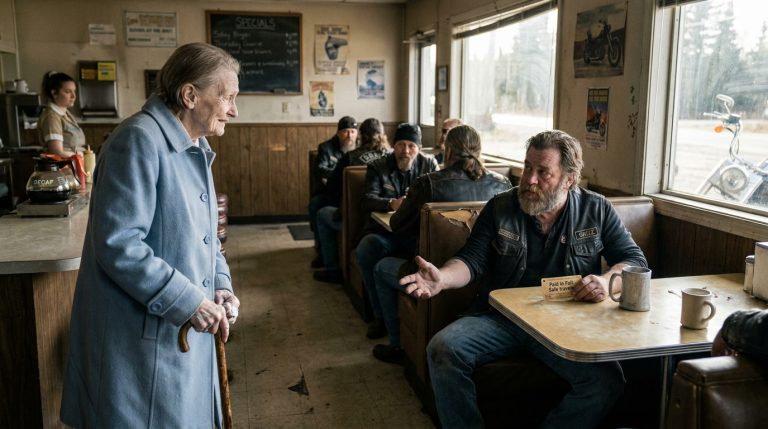
The neon sign of the Lucky Strike Saloon hummed with a low-frequency buzz that felt like a migraine behind Thomas’s eyes. Inside, the air tasted of stale tobacco and a kind of tired, lingering grief that felt entirely too familiar. Thomas stood by the counter, his knuckles white against the formica. He had walked three hours through the Nevada scrub, his boots pulverized by the grit, but the physical ache was a dull hum compared to the sharp, jagged terror vibrating in his chest.
His wife was dying. That was the fact, raw and unvarnished. Four thousand miles away, the clock was ticking, and he was stuck in a wasteland of red dirt and broken transmissions.
The bartender, a woman with silver-streaked hair and eyes that had clearly seen enough of the world to stop asking questions, watched him with a steady, quiet empathy. She didn’t offer a platitude; she simply pushed the phone across the counter.
Thomas dialed the hospital. His daughter’s voice on the other end was a thin, frayed wire. “She’s holding on, Dad. But the nurses… they aren’t promising anything past tonight.”
He hung up. The silence that followed was heavy, a suffocating blanket. He didn’t turn around, but he felt the sudden shift in the room’s atmosphere. The jukebox had gone silent. The idle chatter of the few patrons in the back had dissolved into a watchful stillness.
“You look like you’re trying to carry the world, brother.”
The voice was gravel and smoke, coming from a man sitting at the edge of a pool table. He was wrapped in a leather vest that looked like it had been through a war of its own. He wasn’t aggressive; he was observant, his eyes tracking the way Thomas’s hand wouldn’t stop shaking.
Thomas felt a sudden, irrational spike of anger. He didn’t want charity. He wanted a miracle. He started to turn away, to walk back out into the desert night, when the man stood up. The movement was deliberate, calm. He stepped into the light of the jukebox, revealing a faded patch on his chest that bore no symbols of hate, only a mark of shared experience.
“Show me,” the man said softly. It wasn’t a demand; it was a recognition.
Thomas hesitated. His breath caught in a throat that felt like it had been packed with dust. Slowly, he reached up and rolled back his left sleeve. The skin was paper-thin, aged by the sun and the decades, but the ink—the Eagle, Globe, and Anchor—was still there, a dark, permanent brand of a life lived in the trenches. Beneath it, the letters KHESAN 1968 were blurred by the passage of time.
The man at the pool table stopped. His face went unreadable, stripped of the casual ease of a barroom patron. He pulled out a phone, but he didn’t check the time. He dialed a single number.
“We have a brother here,” the man said, his voice dropping into a register of absolute, terrifying intent. “He needs to get home. He’s got forty-eight hours, and he’s not going to make it alone.”
Outside, the desert wind began to rise, but for the first time in six hours, the crushing weight in Thomas’s chest shifted. As the man hung up, the roar of a distant engine began to bleed into the silence of the bar—not one, but dozens, vibrating the very foundations of the building.
CHAPTER 2: THE FORMATION
The silence that reclaimed the Lucky Strike Saloon was different now. It was no longer the hollow, suffocating vacuum of a man who had reached the end of his resources; it was a pressurized, expectant stillness. Thomas stood frozen, the phantom vibration of his daughter’s voice still echoing against the frantic beating of his heart. The man called Wrench hadn’t moved from his spot near the pool table, but his demeanor had undergone a rigid, tectonic shift. He was no longer a patron; he was a sentinel.
Outside, the first sharp crack of a motorcycle ignition tore through the desert air like a dry branch snapping underfoot. Then another. Then a rhythmic, guttural sequence that began to drown out the low-fi country music still playing from the jukebox.
“You need to breathe, brother,” Wrench said, his voice cutting through the rising cacophony outside. He walked toward the door, his movements fluid and purposeful. “The desert is going to be cold tonight. You’re going to need more than that flannel.”
Thomas followed him, his boots scraping against the uneven floorboards. Each step felt mechanical, a sequence of limbs he had to consciously command. He stepped out onto the porch of the Lucky Strike, and the sensory input nearly buckled his knees.
The parking lot, previously a dark, forgotten scar on the edge of the Nevada highway, was bathed in the harsh, flickering glare of headlamps. They were everywhere—machines of polished chrome, deep-dyed leather, and raw, idling power. The scent of high-octane fuel and scorched rubber hung thick in the air, a scent that abruptly triggered a memory so sharp it tasted like copper: 1968. The heat of the Khe Sanh valley floor, the smell of burning vegetation and cordite, the desperate, unblinking focus of men who knew their only way out was to keep moving.
Thomas’s chest tightened. He wasn’t in the valley. He was in Nevada. And these weren’t soldiers in green fatigues; they were a wall of leather-clad silhouettes, their faces obscured by shadows and helmets, yet their posture—the way they stood in tight, synchronized formation—was the same. It was the stance of men who had claimed their own corner of the world and would fight to defend it.
A man emerged from the center of the formation. He was tall, his silhouette framed by the wide, dipping handlebars of a custom-built machine. He took off his helmet, revealing a face etched with the kind of maps that only years of regret and hard-won resilience can draw. This was Reaper.
He didn’t speak immediately. He walked toward Thomas, the heavy tread of his boots striking the asphalt with a rhythmic finality. When he finally stopped, the roar of the fifty-two idling engines seemed to drop in pitch, a collective holding of breath.
“I heard you served,” Reaper said. His voice wasn’t an interrogation; it was an acknowledgment.
Thomas couldn’t find the words. The sheer magnitude of what was happening—the logistics, the sheer absurdity of it—felt like a dream. But the chill wind whipping his face was real, and the look in Reaper’s eyes was grounded in an uncompromising, dangerous kind of kindness.
“I… I never asked for this,” Thomas managed, his voice cracking. He felt small. He felt ancient.
“You didn’t have to,” Wrench interjected from behind him. “We don’t wait for invitations when the objective is clear.”
Reaper signaled to one of the riders, a woman with iron-gray hair and eyes that were both hard and weary. She dismounted and walked toward them, carrying a heavy, worn leather jacket. She didn’t offer a smile; she offered a necessity.
“It’s going to be a long ride,” she said, handing him the gear. The leather was heavy, smelling of rain and asphalt, a tactile weight that anchored Thomas to the present. “We’re going to be in the wind for a long time. You need to keep your core warm if you’re going to make it.”
Thomas slid his arms into the sleeves. The jacket was stiff, unyielding, but as he zipped it up, the wind that had been biting his skin lost its edge. He looked at the fifty-two riders, each of them waiting for a signal, a word, a nod. He looked back at the desolate stretch of Highway 50, now a path illuminated by a hundred piercing beams of light.
“We aren’t taking the fastest route,” Reaper said, his tone shifting into the logistical cadence of a commander. “We’re taking the relay route. Every chapter, every transition, every mile. We’ve already cleared the path through the Nevada basin. If you’re ready, we move now.”
Thomas looked at the horizon. He thought of Margaret—of the way she would look at him when he returned from his shifts at the VA, her eyes steadying the tremors in his hands. She was waiting for him, not in the ground, but in the memory of the promise they’d made forty-seven years ago. He realized then that he couldn’t just arrive at the hospital; he had to earn the arrival.
“I’m ready,” Thomas said.
Reaper nodded once. He stepped back, mounted his bike, and the fifty-two engines roared into a singular, thunderous crescendo. Thomas climbed onto the back of the bike waiting for him, his hands gripping the cool, vibration-heavy chrome. As they pulled out of the lot and the tires hit the dark expanse of the highway, the desert night seemed to collapse around them, turning into a tunnel of light. He was no longer a lost old man on the side of the road. He was part of something that moved with the precision of a clockwork machine. He was moving forward.
CHAPTER 3: THE MIDNIGHT MILE
The world beyond the back of the motorcycle ceased to be a landscape and became a blurred, strobe-lit corridor of ink and silver. Thomas held onto the leather-clad waist of the rider—Gunnar—with a grip that had turned his knuckles into ivory knobs. The air was a physical entity, a freezing, abrasive torrent that clawed at the seams of the borrowed jacket, seeking every point of entry.
For the first hour, the internal monologue that had defined Thomas’s life for the last six months—the frantic tallying of time, the rehearsal of apologies, the crushing weight of the ‘what-ifs’—was scoured clean by the sheer, unadulterated velocity of the machines. There was no room for introspection when the bike leaned into a curve, the road inches away, the horizon a jagged smear of starlight and shadow.
Gunnar maintained a steady, disciplined speed. The convoy was not a chaotic mob; it was an extension of a military drill. The bikes moved in a staggered formation, a protective, shifting grid of steel and light that seemed to isolate Thomas from the vast, indifferent desert night. Every few miles, the lead riders would signal, and the entire formation would adjust, a dance of machines that spoke a language of absolute trust.
Thomas felt a strange sensation begin to uncoil in his gut. It was the absence of decision-making. For the first time since the doctor’s office in North Carolina, he wasn’t the one calculating the next move. He wasn’t the one scanning the horizon for the solution to an impossible problem. He was being carried. The surrender of that autonomy, which should have been terrifying, was instead a profound, hollow relief.
The vibration of the engine traveled up through the frame, pulsing against his chest in a rhythmic thrum that matched his own accelerated heart rate. It was a mechanical lullaby, deep and consistent, a stark contrast to the erratic, spiking fear that had dominated his days.
They passed through a small, nameless town, the neon sign of a single gas station flickering like a dying pulse in the distance. The convoy didn’t stop. They didn’t slow. They were a singular, passing phenomenon, a thunderbolt moving through the dark. People in passing cars stared—heads turning, faces illuminated for a micro-second in the sweep of the headlights—but Thomas didn’t look at them. He kept his gaze locked on the back of Gunnar’s helmet, a black, featureless globe reflecting the road ahead.
The cold began to seep deeper, numbing his fingers despite the heavy gloves, but he didn’t shift his posture. The physical discomfort was a grounding wire. It reminded him that he was still made of flesh and bone, that he was still traveling toward the only thing that mattered.
He thought about the Relay. The mention of it had been brief, a logistical necessity explained by Reaper at the bar. But now, seeing the way these riders functioned—the way they communicated with a mere gesture, the way they watched his back as if he were a long-lost brother—the term began to take on a different weight. It wasn’t just a relay of vehicles. It felt like a relay of burdens. They weren’t just passing him across the map; they were absorbing the silence of his desperation and replacing it with the sound of movement.
Gunnar leaned forward slightly, and the bike responded with a subtle uptick in speed. The wind shifted, the smell of sagebrush and cold, dry earth giving way to the faint, sharp tang of metallic exhaust. Thomas tilted his head, watching the way the stars seemed to race alongside them, caught in the slipstream.
He was sixty-eight years old. He had survived the red dirt of Khe Sanh, the long, quiet aftermath of a life spent wondering if he had truly left the war behind, and now, he was racing toward the final curtain. He realized that for the last twenty years, he had been waiting for something to happen. He had been waiting for the past to finally claim him, or for the future to drift out of reach. Now, he was in the center of the conflict, and he was realizing that the only way to endure it was to match the pace.
The road ahead was a ribbon of black, disappearing into the void. He didn’t know what the Arizona chapter would look like. He didn’t know if the hospital would still be there, if the nurses would have the same faces, if Margaret would still be breathing when he arrived. But for these sixty miles, for this midnight hour, the only thing he knew was the grip of his hands on the bike and the unwavering commitment of the fifty-one shadows riding around him.
The formation tightened as they entered a steep, winding canyon pass. The walls rose up on either side, closing in, and the sound of the engines amplified, echoing off the rock faces until it was a deafening, unified roar. It was a wall of sound that felt like a sanctuary. Thomas closed his eyes for a second, feeling the bike lean into a sharp, precarious turn, and let the roar consume the last of his hesitation. He wasn’t just going to North Carolina. He was crossing the bridge.
CHAPTER 4: THE ARIZONA HANDOFF
The vibration that had become Thomas’s heartbeat for the last several hours ceased with a sudden, jolting silence. The convoy swept into the sprawling, dust-choked expanse of a Kingman truck stop. It was a sun-bleached landscape of corrugated steel and scorched pavement, where the air shimmered with the early, aggressive heat of an Arizona morning.
Gunnar cut the engine. The silence that followed was heavy, amplified by the ringing in Thomas’s ears. His legs, stiff and cramped from the unrelenting posture, felt like dead weight as he slid off the passenger seat. His boots hit the dirt, and for a moment, the world tilted. He reached out to steady himself against the bike’s frame, his fingers tracing the cooling metal.
Around them, the Nevada riders were already dismounting. They didn’t look exhausted; they looked efficient, their movements practiced. Thomas stood in the center of the formation, a spectator to his own salvation. He felt a profound sense of disorientation, not from the movement, but from the sudden reality of the landscape—the vast, indifferent scale of the high desert.
“We’re at the line, brother,” Gunnar said, pushing his helmet back. His face was streaked with a fine, uniform layer of dust, his eyes squinting against the harsh, rising sun. “The Phoenix chapter is coming up the ramp now.”
Thomas looked past the row of bikes. In the distance, a second, equally imposing column of machines was cresting the highway rise. He felt a flicker of something he hadn’t expected: a pang of loss. The Nevada riders, the men and women who had stood with him in the dark, were about to fade back into their own lives.
As the new contingent pulled into the lot, Reaper dismounted his own bike and walked over to Thomas. He pulled a small, worn patch from his vest pocket—a piece of fabric with a design that didn’t match the traditional club insignia he’d seen earlier. It was simple, geometric, and ancient-looking. He pressed it into Thomas’s palm, his hand calloused and firm.
“You’re going to need this for the next stretch,” Reaper said. His voice was low, devoid of the bravado that usually accompanied these types of encounters. “Don’t ask what it is. Just make sure it’s visible on the jacket when you hit the New Mexico border.”
Thomas looked down at the patch. It was a subtle, out-of-place detail in a world of standardized leather and steel. He looked up, intending to ask for clarification, but Reaper was already turning away, his attention shifting to the Phoenix lead. Thomas slid the patch into his jacket pocket, the fabric rough against his fingertips. It felt significant, a fragment of a secret that existed beneath the surface of the relay—a sign that this was not merely a favor, but a coordinated effort of a scale he had yet to comprehend.
The exchange was rapid. There were no long goodbyes. The Nevada riders offered brief, firm handshakes—not the kind that signify the end of a relationship, but the kind that signify a job performed with honor. There was a sense of profound professional respect that Thomas found staggering. He had spent his life thinking of the military and the life he built with Margaret as the only two worlds that mattered. Now, he was standing in the middle of a third, a hidden architecture of men and women who were operating on a frequency of pure service.
Thomas moved to the bike that would carry him through Arizona. The rider was a man with a graying beard and eyes that had seen too much—a mirror image of the man he himself had been just a few hours ago.
“Name’s Elias,” the rider said. He didn’t offer a hand; he offered a steady, grounded nod.
As Thomas climbed back on, the heat began to rise in earnest, a dry, abrasive pressure against his skin. The desert didn’t care about his mission. It didn’t care about Margaret. It was a vast, geological theater that had seen empires rise and fall, and it looked on with absolute indifference as Thomas pushed forward.
He gripped the handlebars, the metal burning slightly under the sun. The Phoenix riders moved into position, and as the engine beneath him roared to life, Thomas looked back at the Nevada chapter. They were already beginning to mount their bikes, their silhouettes sharp and dark against the glare of the horizon.
He didn’t know where the next hand-off would be, or what the patch in his pocket truly meant, but as they accelerated back onto the highway, he felt the rhythm of the journey solidify. He wasn’t just a passenger anymore; he was a component of a living, moving machine. The fatigue that had threatened to pull him down was replaced by a cold, sharpened focus. He was moving toward the final resolution, the distance shrinking with every turn of the wheel, and for the first time, he realized that if he wanted to reach the end, he would have to surrender entirely to the road.
CHAPTER 5: THE MIDPOINT REFLECTION
The transition from Arizona into New Mexico was marked not by a sign, but by a sudden, punishing intensification of the sun. The high plains opened up—a vast, bowl-shaped world of scrub and ochre dirt that felt as though it had been scrubbed clean of all human history. Thomas sat behind Elias, his head beginning to swim with the rhythmic drone of the engine. The fatigue, which had been a dull background noise, now began to manifest as a low-grade delirium.
Every time they stopped to refuel, the physical world seemed to warp. The gas stations were islands of grease-stained concrete in a sea of nothingness. Thomas would climb off, his knees buckling, his joints feeling as though they were filled with sand. He would reach for the water bottle offered to him, his hands trembling with a fine, persistent vibration that lingered even when the bike was still.
It was during one of these stops, in a desolate patch of New Mexico, that the reality of the relay shifted. Thomas noticed something while watching the riders—the way they weren’t just refueling the bikes, but conducting a methodical exchange. One of the riders from the Phoenix chapter handed a heavy, locked courier bag to a man waiting by a blacked-out SUV that had appeared, as if from nowhere, at the edge of the lot.
It wasn’t a club matter. It was something else.
Thomas squinted against the glare, the heat shimmering off the pavement like a veil. He saw the patch he had been given by Reaper earlier, tucked into his pocket. He felt the weight of it, a sudden suspicion cooling his blood. This wasn’t just an honor escort. The precision, the coordination, the way the convoy acted as a mobile shield for movements that had nothing to do with him—it suggested a layer of infrastructure he was only beginning to perceive.
He leaned against a brick wall, catching his breath, and watched as the exchange concluded with a silent, sharp nod. The SUV pulled away, disappearing into the heat haze, and the convoy riders returned to their machines as if nothing had happened. They didn’t look at him; they didn’t acknowledge the detour.
The weight of the realization was heavy. He was the center of a movement he didn’t control, a catalyst for actions he couldn’t name. The decoy—the idea that this was just a group of bikers doing a good deed—began to fray at the edges.
“You doing alright, brother?” Elias asked, walking over with a cup of lukewarm, bitter coffee.
Thomas looked at the man. His face was a map of lines and shadows. “What is this?” Thomas asked, his voice barely a rasp. He gestured toward the highway where the SUV had vanished. “You’re not just moving me.”
Elias took a slow sip of his coffee, his expression unyielding. “We’re moving everything that needs to get to where it’s going, Thomas. You’re the reason the road is open. That’s enough to worry about for now.”
The ambiguity was a tactical wall. Thomas didn’t press it. He realized that if he pushed, if he demanded answers, the wall would only become higher. He drank the coffee, the bitterness coating his tongue, and stared out at the shimmering horizon. The decoy had served its purpose—it had kept him moving, kept him focused on the goal—but now, the truth was beginning to bleed through the seams. He wasn’t just a Marine on his way to say goodbye; he was the primary mechanism of a much larger, silent machinery.
As they mounted up again, the vibration returned, more intense than before. The road ahead looked less like a path and more like a line drawn by a blind man—unpredictable and endless. The heat hit him like a physical blow as they accelerated back up to speed.
He closed his eyes for a moment, letting his head rest against Elias’s back. The memory of 1968 flickered to life: the roar of the C-130 transports, the heavy, metallic smell of the cargo bay, the silent terror of men who knew they were heading into a meat grinder. He pushed the memory away, clawing his way back to the present. He wasn’t a boy in the valley anymore. He was a man in the desert, and he had a promise to keep.
The sun began to dip, casting long, bruised purple shadows across the plains. The convoy pushed on, a jagged needle stitching its way across the map. Thomas looked down at his own hands, calloused and mapped with veins, and realized he had changed. The exhaustion was still there, but beneath it, there was a hard, cold resolve. He would get to Asheville. He would see Margaret. And whatever this network was, whatever its real purpose, he would be at the end of the line before they asked him for anything else.
The road stretched out—a relentless, dusty, gray ribbon of truth that offered no comfort, only the steady, grinding promise of the next mile.
CHAPTER 6: THE SOUTHERN PUSH
The transition into the Mississippi Delta was not marked by a change in terrain, but by a sudden, atmospheric collapse. The sky, which had been a clear, sun-baked expanse for days, bruised into a deep, sickly indigo. The air grew heavy, saturated with a moisture that clung to the skin like a warm, wet wool blanket. Thomas, tucked behind the rider known as Gunnar, felt the bike shudder as the first heavy, deliberate drops of rain hammered against his helmet.
Within seconds, the world was obscured by a wall of water. The convoy didn’t stop, but the pace plummeted. The motorcycles, usually a fluid, coordinated swarm, became isolated islands of light in the deluge. The roar of the engines took on a new timbre—wet, guttural, and struggling. Thomas gripped the handlebars, the leather slick and cold against his palms. The road beneath them was no longer a path; it was a slick, unpredictable hazard.
“We need to find cover!” Gunnar shouted over the storm, his voice barely audible above the drumming of the rain.
The convoy swung off the main artery, navigating a series of flooded backroads toward a sprawling, rusted industrial complex that appeared like a shipwreck in the flat landscape. As they pulled into the shelter of a corrugated steel loading bay, the reality of the storm hit with renewed intensity. The sound of the rain against the metal roof was a thunderous, percussive assault, making conversation impossible.
Thomas slid off the bike, his boots splashing into a shallow pool of oily water. He was shivering. The cold, which had been a manageable companion on the high plains, now bit into his marrow. He stumbled toward a dry patch of concrete near the back wall, his movements sluggish and uncoordinated.
The riders were everywhere—peeling off their soaked jackets, checking their gear, their movements efficient but muted by the exhaustion that the storm had accelerated. Thomas watched them, feeling a sudden, sharp spike of resentment. Why were they doing this? Why were they risking their lives for a man who had nothing left to offer them?
He sat down on the cold concrete, leaning his back against a stack of wooden crates. He closed his eyes, and the darkness was immediately filled with the sensory overload of 1968: the rain in the valley, the mud that would pull the boots off your feet, the sound of the transport choppers struggling in the turbulence. He saw Margaret’s face, not as she was now, but as she had been the day he returned—vibrant, steady, and terrifyingly hopeful.
The ghost of that hope was too much. It was a physical ache in his chest, more painful than the cold. He realized that the convoy’s efficiency, their mechanical precision, was the only thing keeping him from drifting away. If they stopped—if the storm lasted too long—he would lose the momentum that was his only anchor.
“Thomas.”
The voice was soft, cutting through the drumming of the rain. It was the woman from the Nevada chapter, the one who had given him the gear. She crouched down beside him, offering a dry thermal blanket. Her face was pale, her eyes tired, but she didn’t look at him with pity. She looked at him with a mirror-reflection of his own internal wreckage.
“The road is going to clear,” she said, her tone as steady as the idling engines. “It always clears.”
“Why?” Thomas whispered, his voice cracking. He didn’t want to know about the relay or the logistics. He wanted to know about the people. “Why are you here, really?”
She paused, looking out toward the wall of rain. “Everyone who rides this far has something they’re running toward, or something they’re trying to leave behind. We’re not just moving you, Thomas. We’re moving the weight of all of us. You’re just the one who happens to be at the front of the line right now.”
It was a piece of the truth—not the Layer 2 reality he was still blind to, but a fragment of the emotional architecture that bound them. The realization did not solve the mystery of their coordinated, massive effort, but it provided a bridge. He wasn’t a stranger. He was a vessel.
Thomas pulled the blanket tight around his shoulders. The shivers began to subside, replaced by a dull, aching clarity. He looked at the industrial bay—the rusted girders, the grease-stained floor, the silent, waiting riders. He realized then that the decoy—the idea of this being just a motorcycle club—was completely shattered. They weren’t a club. They were a collective, a silent, mobile society that existed in the cracks of the map. And he was currently the most significant object in their inventory.
The rain continued to hammer against the roof, but the frequency of the storm was changing. The thunder was moving further east, leaving a low, rumbling echo in its wake. Thomas stood up, his body protesting the movement, and walked back toward his bike. He saw Gunnar watching him, his hands already on the throttle.
The delay had cost them time. The hospital in Asheville felt further away than ever. But as he mounted the bike and felt the engine come to life—a deep, confident thrum that defied the dampness of the air—he knew he couldn’t afford to break. He had to be the object they were delivering. He had to finish this, not just for Margaret, but to see what waited for him at the other end of the line.
The convoy began to roll out, back into the wet, dark night. The road was still treacherous, shimmering with reflections of their headlights, but Thomas no longer looked at the surface. He looked ahead, toward the horizon, where the storm was finally beginning to break.
CHAPTER 7: THE ARRIVAL CORRIDOR
The final thirty miles to Asheville were a blur of sound and light. The convoy had swelled, a massive, jagged serpent of chrome and leather that seemed to own the interstate. Thomas, hunched over the back of the lead bike, felt his perception flickering. The lights of the police cruisers—off-duty officers who had joined the fray with the silent, solemn intensity of brothers—were like strobe lights, illuminating the highway in violent, repetitive bursts.
Each flash brought a fragmented memory of 1968, the light of tracer fire, the sudden, sharp illumination of a flare over the valley. He squeezed his eyes shut, trying to hold onto the present, to the vibration of the engine and the damp, cool night air, but the boundary was thinning. He was vibrating at a frequency that felt as though he might simply shatter.
“Almost there, brother!” Gunnar shouted, but the words were thin, whipped away by the speed.
Thomas looked up. The city lights of Asheville began to bloom on the horizon, a soft, hazy amber glow that felt like a sanctuary. He felt a surge of panic. What if he arrived and the room was empty? What if the relay, with all its precision and hidden purpose, had merely been a way to keep him occupied while the inevitable happened? He gripped Gunnar’s jacket, his fingers digging into the heavy, wet leather.
The descent into the city was a descent into a tunnel of urgency. They bypassed the standard exits, moving with a tactical disregard for traffic signals that was breathtaking to behold. At every intersection, the police escort held the line, a wall of blue and red that allowed the convoy to flow through the city’s heart without a single pause.
When they finally hit the Mission Memorial Hospital, the sight was a shock to his senses. The building was a monolith of glass and concrete, clinical and impossibly bright. The convoy didn’t pull into the main lot; they funneled into a side entrance, their arrival announced by the roar of sixty engines that reached a final, deafening crescendo before dying away into an absolute, ringing silence.
Thomas dismounted. His legs were made of lead, his joints screaming in protest. He stood in the middle of the parking lot, surrounded by the riders. They were dismounting in unison, their movements synchronized, a quiet, disciplined army of shadows. Reaper, who had appeared at the front of the formation somewhere near the state border, walked toward him.
“We’ve got the perimeter,” Reaper said. His voice was a calm anchor. “Take your time. Nobody is going to interrupt you.”
Thomas looked around. The Hell’s Angels were forming two lines, a gauntlet of respect that stretched from the concrete to the glass doors of the entrance. It was a corridor of honor, a silence so profound it felt like a holy place.
He walked between them, his head bowed, his breath coming in ragged, shallow hitches. He was acutely aware of every step, of the sound of his boots on the pavement, of the collective, watchful presence of the men and women who had carried him through the desert. He didn’t deserve this, not really. He was just a man who had broken down on a highway in Nevada. But as he passed the first rider—a young man with a face full of fresh, raw grief—and saw him place a hand over his heart in a silent salute, Thomas understood. This wasn’t about him. It was about the endurance of the promise.
He reached the sliding doors. They parted with a smooth, automatic hiss that sounded like a breath of air. Inside, the world was sterile, smelling of antiseptic and floor wax—a sharp, stinging contrast to the road. A nurse stood at the desk, her expression startled, then quickly shifting into a look of recognition. She didn’t ask questions; she simply nodded toward the hallway.
“Room 304,” she said quietly. “She’s been waiting for you.”
Thomas walked down the corridor. The hospital lights were too bright, exposing every tremor in his hands, every smudge of road dust on his jacket. He felt like a ghost haunting his own life. He reached the door of room 304 and stopped. His hand hovered over the frame. The silence inside was different—it was a heavy, expectant silence, the kind that preceded the very end of all things.
He opened the door. The room was bathed in the soft, blue-tinged light of the monitors. Margaret was there. She looked impossibly small, a delicate, fragile configuration of bones and breathing, her life anchored to the room by a tangle of tubes and the rhythmic pulse of the machines.
But when she turned her head, when her eyes found his, the blue light seemed to recede, leaving only the warmth of forty-seven years. She smiled. It was a faint, weary thing, but it was unmistakably hers.
“You came,” she whispered.
Thomas crossed the room in three jagged steps, his voice failing him. He reached out and took her hand. It was cold, so cold it felt like glass, but the pressure of her grip, however slight, was the strongest thing he had ever felt. He fell to his knees beside the bed, burying his face in the starched, white linen of the sheets. The dam finally broke. The desert, the relay, the roar of the engines, the weight of the war, the ghost of 1968—it all dissolved into the simple, agonizing reality of her presence.
He was home.
CHAPTER 8: THE FINAL THRESHOLD
The hours that followed were a slow, rhythmic dissolution of time. There was no more rushing. The frenetic, adrenaline-fueled pacing of the last three thousand miles had reached its natural terminus in the quiet geometry of room 304. Outside, the world was still spinning—the hospital staff shifting in the halls, the city of Asheville continuing its nocturnal pulse, the Hell’s Angels maintaining their silent, unwavering vigil in the parking lot—but within the walls of this room, everything had come to a standstill.
Thomas sat by the bed, his hand enveloped in Margaret’s. He spoke to her, not in the urgent, jagged bursts of the road, but in a low, continuous stream of memory. He talked about the small things: the way the light hit the kitchen table in the mornings, the exact shade of the garden in April, the way she had hummed that specific, wordless melody when she was worried. He wasn’t recounting a life lived apart from her; he was reclaiming the life they had shared, stitching the frayed edges of their history back together with the thread of his own presence.
Margaret’s breathing grew shallower, a soft, fading tide. Each exhale was a little more effortless than the last. There was no pain in the room, only the profound, heavy weight of a life fulfilled. Thomas watched her face—the familiar terrain of a woman he had known for forty-seven years—and felt the final, terrifying barrier between ‘soldier’ and ‘man’ collapse.
He understood now why the relay had happened. It wasn’t just to get him here in time. It was to strip away the armor he had been wearing since the valley floor in 1968. Through every mile of the journey, through every rider who had shielded him, through every mile of wind and rain, he had been forced to leave behind the bitterness, the hyper-vigilance, and the unspoken guilt of surviving. The convoy had been a process of shedding the veteran’s skin, layer by layer, until he was left with only the man Margaret had loved.
She passed at dawn. The transition was so quiet, so subtle, that he didn’t realize she was gone until the pressure in her hand relaxed, losing its strength but retaining its warmth. The heart monitor’s steady, rhythmic pulsing smoothed into a single, continuous, and peaceful tone.
Thomas didn’t pull away. He leaned forward and rested his forehead against her shoulder, the scent of her—faint, familiar, and enduring—filling his lungs. He felt a sudden, sharp clarity. The mission was complete. He had kept his promise.
He walked to the window and pulled back the curtain. The sun was cresting over the Asheville ridges, casting a long, golden light across the hospital parking lot. Below, the rows of motorcycles remained, fifty-two silhouettes waiting in the morning light. They were waiting for a signal that wasn’t a call to arms, but a silent acknowledgment of closure.
Thomas realized that the ‘Layer 2’ of his journey was not the destination, but the reconciliation. He had spent fifty years looking for a way to prove that he deserved the life Margaret had given him. He had finally found the proof, not in the medals or the service, but in the simple act of showing up when the world told him it was impossible.
He walked to the door and stepped out into the hallway. Reaper and Wrench were standing there, their vests dusty, their expressions etched with a weary, profound respect. They didn’t speak. They didn’t offer to take the burden. They simply stepped aside, forming an honor guard as he walked toward the exit.
The walk to the parking lot was the longest he had ever taken. He reached the center of the riders, the morning air crisp and tasting of damp earth and pine. Reaper stepped forward, his eyes unclouded.
“She’s gone?”
“She’s gone,” Thomas confirmed. His voice was steady, the tremors in his hands replaced by a deep, resonant calm.
Reaper nodded, and at a subtle gesture, the entire formation moved. Fifty-two riders climbed onto their machines. There was no chaos, no loud bravado. When they ignited their engines, the sound was a collective, thunderous salute that rattled the glass of the hospital and rolled over the mountains like a storm.
Thomas stood in the middle of them, the leather vest heavy on his shoulders—a tangible, permanent weight. He touched the patch Reaper had given him in New Mexico, feeling the geometry of it under his fingers. It was a mark of the collective, a symbol of a promise that had expanded far beyond the two of them.
He knew he would have to build a new life in the house that had once belonged to both of them. He would have to learn to tend the garden alone and read in the chair where she used to sit. But he would not be doing it in the shadows of the past. He would be doing it as a man who knew exactly who he was, and who was surrounded by a brotherhood that would never let him lose his way again.
He walked to the sidecar of Reaper’s lead bike and climbed in, a passenger once more, but this time, he wasn’t running. He was returning. As the convoy rolled out of the hospital lot, turning back toward the quiet, green hills of the city, Thomas looked at his own reflection in the side mirror. The face he saw was older, tired, and deeply marked by the road, but for the first time in fifty years, the eyes were clear. He was a veteran of the road, a husband, and a brother. He was home.