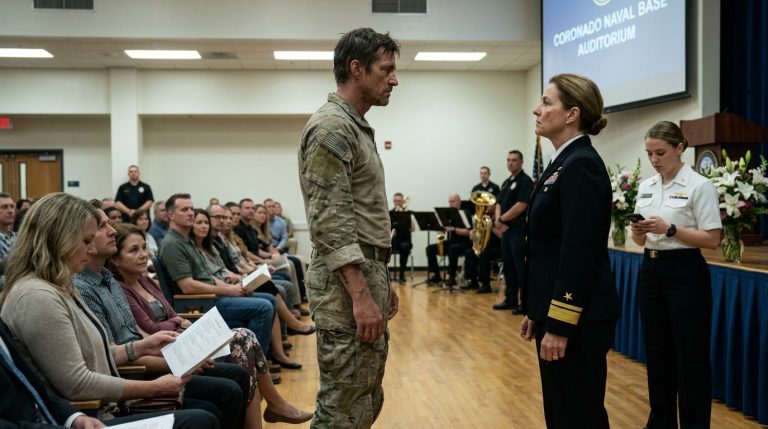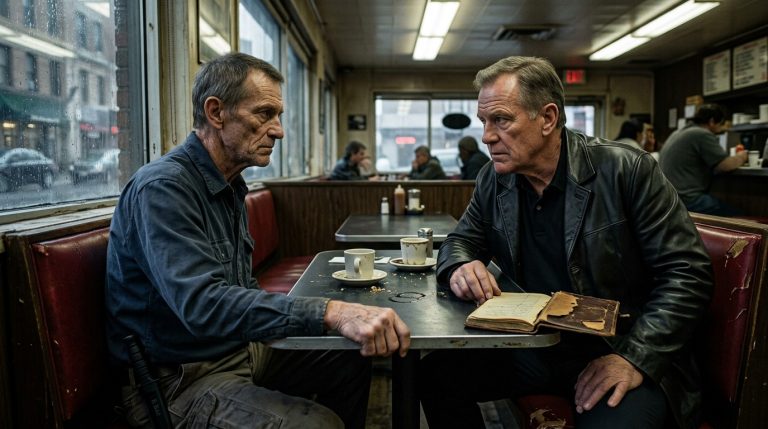
The Mother’s Gambit: A Precise Descent into the Heart of a Closed Military Fortress
CHAPTER 1: THE PERIMETER
The sun hammered down on the tarmac, bleaching the world into a series of harsh, white-hot lines. Brenda didn’t squint. She kept her eyes fixed on the point where Captain Haze’s jaw met his collar, studying the way the fabric pulled tight across his chest. He was a creature of geometry and procedure, a man built to identify anomalies, and she was currently the only anomaly in his field of vision.
He held the visitor’s pass up, his thumb pressing firmly against the synthetic fiber of the paper. A micro-mystery blossomed in the air between them: Haze’s hand was steady, but there was a subtle, rhythmic twitch in his index finger—a nervous tell that had nothing to do with her and everything to do with the radio clipped to his belt, which had crackled three times in the last minute.
He wasn’t just checking her pass. He was stalling.
“Brenda Lo,” he repeated, the name tasting like metal in his mouth. He shifted his gaze from the document to her eyes. The contact was transactional, cold as a scalpel. He wasn’t looking for a mother; he was looking for a ghost.
“That’s me, Captain,” she said, her voice a calm, steady ribbon of sound. She made sure her hands remained relaxed at her sides, not tucked into her purse, not trembling. She felt the weight of the air—the heavy, humid silence of the base, punctuated only by the distant, thunderous rhythm of recruits marching in unison on the parade deck. It was a sound of absolute order.
Haze leaned in, his shadow stretching over her feet. “You’re early, Mrs. Lo. The ceremony doesn’t conclude for another twenty minutes.”
“I know,” Brenda replied, offering a thin, practiced smile that didn’t reach her eyes. “I’m just eager to see him. It’s been a very long time.”
She didn’t tell him how long. She didn’t tell him that she hadn’t seen the man they called Adam Lo in six years, and that the boy who would walk off that field was a stranger she had memorized from a file.
Haze’s gaze flickered to the purse hanging from her shoulder. He didn’t move to grab it, but the tension in his shoulders spiked. The radio on his belt let out another sharp, static-filled burst, a distorted voice calling for a status update on ‘Sector Four.’
Haze didn’t answer the radio. Instead, he took another step, closing the distance until the sharp, metallic scent of his cologne filled her lungs.
“Sector Four is currently on lockdown, ma’am,” Haze said, his voice dropping to a low, dangerous register. “Your son isn’t in the viewing area. He’s in holding.”
The breath in Brenda’s chest turned to ice. She had calculated for many contingencies—security checks, background deep-dives, even a sudden change in schedule—but she hadn’t calculated for them to know about Adam before she even arrived.
CHAPTER 2: THE ANOMALY IN SECTOR FOUR
The word “lockdown” hit the air like a physical blow. Around them, the rhythmic thunder of the marching recruits didn’t falter, but the atmosphere of the tarmac seemed to curdle. Brenda’s heart performed a single, violent kick against her ribs before she forced it back into a steady, predatory rhythm.
Haze stood perfectly still, his eyes locked on the microscopic shift in her pupils. She felt the ghost of a memory—a simulation in a windowless room, years ago, where a handler had pressed a gun to her temple and whispered, The moment they name the threat, you own it.
“Holding,” she repeated, her voice perfectly calibrated for confusion rather than fear. “I was told he was cleared for the parade. Is there a disciplinary issue?”
She took a half-step back, creating a sliver of space to breathe. The movement was calculated—not a retreat, but a repositioning to bring the peripheral activity of the base into her line of sight. She needed to know who else was watching.
Haze didn’t blink. He lowered his hand from the visitor’s pass, but he didn’t hand it back. He folded the paper slowly, his movements deliberate, like a man testing the structural integrity of his own control. “Disciplinary, administrative—the specifics aren’t for the public, Mrs. Lo. We have a security protocol active. It requires all non-essential personnel to vacate the perimeter.”
“I am his mother,” Brenda said, her voice tightening just enough to sound human. “I’ve traveled across three states to see him stand in that parade. Surely, there’s some flexibility.”
“Flexibility is the enemy of security,” Haze countered. His voice was devoid of malice, which made it far worse. He wasn’t enjoying this; he was merely executing a function.
He leaned closer, and the scent of him hit her again—gun oil, synthetic fabric, and the faint, bitter tang of cheap coffee. It was the smell of a man who lived within the lines. He is a mirror, she thought. He thinks he’s protecting the machine. If I push too hard, I reveal that I know how the machine is built.
She let her shoulders drop, mimicking the posture of a deflated, anxious parent. It was a lie, but it was a well-crafted one. She focused on the reflection in his sunglasses, trying to catch a glimpse of the guard shack behind her. There was movement there—a second captain, checking a tablet. The lockdown wasn’t a bluff.
“I understand,” she said, her voice softening, losing its sharp edge. She reached out, her fingers hovering near the folded paper in his hand. “If he’s in trouble, I don’t want to make it worse for him. I’ll head back to the grandstands.”
Haze’s eyes flickered downward, tracing the movement of her hand. For a heartbeat, the silence stretched, heavy as lead. If he didn’t return the pass, she would be stranded on the tarmac without credentials, a target for every security detail on the base.
“The pass stays with me for verification,” Haze said, tucking the paper into his breast pocket. “You’ll wait in the designated civilian hold-area. If the lockdown clears, you’ll be notified.”
“And if it doesn’t?” Brenda asked, keeping her tone light, almost dismissive.
Haze turned his head, his gaze sweeping the horizon where the parade deck sat in the sweltering heat. “Then you won’t be seeing your son today, Mrs. Lo.”
He gestured toward a paved path leading away from the tarmac, toward the sprawling, grey-concrete barracks that housed the holding sectors. It was an order, not a suggestion. As he stepped aside to allow her to pass, he pressed his hand to his radio again.
“Control, this is Haze. Subject is moving toward the secondary checkpoint. Requesting backup for a sweep.”
Brenda turned and began to walk. The concrete was unforgiving beneath her soles, sending vibrations up her shins. She didn’t look back, even though she could feel the weight of his eyes tracing the line of her spine. She wasn’t going to the grandstands. She was going to see exactly what kind of ‘holding’ they had prepared for Adam, and how many of them stood between her and the hard drive.
The phantom of the training drill whispered in the back of her mind: The objective is not the son. The objective is the data. The son is the carrier. If the carrier is compromised, the objective is lost.
She rounded the corner of the first barracks, breaking the line of sight from the parade deck. The noise of the ceremony faded, replaced by the suffocating, industrial silence of the restricted zone. She glanced at her watch. She had less than ten minutes before the secondary checkpoint picked her up on their cameras.
She needed a distraction, and she needed it before she hit the next corner. Her eyes scanned the environment, landing on a maintenance locker half-hidden by overgrown ivy. It wasn’t much, but it was a starting point. She stepped into the shadows of the building, her pulse steadying, her world narrowing down to the iron-wrought edges of the locked gate ahead.
She was no longer a mother. She was a ghost walking through a machine that had already marked her for deletion.
CHAPTER 3: THE SHADOW OF THE BARRACKS
Brenda pressed her forehead against the cool, abrasive brick of the maintenance locker. The ivy was damp, smelling of rot and trapped humidity, but it offered the only cover between her and the patrol. A set of heavy, rhythmic footsteps crunched along the gravel path just ten feet away. She didn’t move. She didn’t even adjust her breathing, keeping it shallow, trapped deep in her diaphragm.
Maintain. Endure. Do not react.
The patrol was moving toward the sector entrance, their flashlights cutting erratic, violent arcs through the shadows of the barracks. They were speaking in low, clipped tones, the words indistinguishable but the intent clear: a sweep. They were looking for something, and Brenda knew with chilling certainty that they were looking for her.
She waited until the sound of their boots faded into the rhythmic, distant hum of the base’s ventilation systems. Only then did she shift her weight. Her legs were cramped, the muscles singing with the strain of forced stillness. She eased herself away from the locker, her movements fluid and silent, and peered around the edge of the ivy-covered brick.
The path ahead was clear, but it was exposed. The open space between her current position and the rear entrance of the barracks—where Adam was supposedly held—was bathed in the harsh, sodium-yellow glare of a high-mounted floodlight. It was a kill zone for anyone caught in the open.
Brenda scanned the perimeter, her eyes locking onto the infrastructure. The base was a geometric nightmare of sharp angles and restricted sightlines. To move forward was to risk detection; to stay was to lose the window of opportunity before the next patrol cycle.
She focused on the physics of the environment. A series of supply crates sat stacked near the loading bay of the adjacent building. If she could reach them, she could bypass the primary floodlight by moving through the narrow gap between the crates and the wall. It was tight, requiring her to exhale fully and pull her shoulders back, but it was the only route that didn’t involve a direct sprint across the asphalt.
She began to move, staying low, her feet finding the soft patches of dirt to minimize the sound of her passage. The air felt heavy, charged with the static of the security systems. Every shadow seemed to stretch toward her, eager to snag her clothing or reveal her position.
As she neared the crates, a sudden, sharp metallic click echoed from somewhere above. She froze, her back pressed against the corrugated metal siding of the building. Her hand went instinctively to her purse, her fingers brushing the hard, cool edge of the specialized keycard she had acquired for this specific sector. It was the only thing she had that could bypass the electronic locks, but it was useless if she couldn’t reach the door.
She tilted her head, listening. Above the distant, automated hum of the base, she heard a voice—sharp, authoritative, and terrifyingly close. It was Captain Haze. He wasn’t at the perimeter anymore.
“Check the loading bays again,” he said, his voice carrying clearly on the cool breeze. “She didn’t just vanish. Someone with her profile doesn’t just evaporate. Find the trace.”
Brenda’s lungs burned, a desperate, irrational need for air fighting against the necessity of silence. She realized then that Haze wasn’t just patrolling; he was hunting. He had profiled her path, anticipated her movement. He wasn’t just a guard; he was a tactical mind that mirrored her own.
She couldn’t go back. She couldn’t go forward through the loading bay. She looked up, her eyes tracing the line of a rusted fire escape ladder that climbed the side of the building. It was old, the metal pitted and worn, but it led to the second-story service catwalk—a way inside that bypassed the ground-level sensors entirely.
It was a risk. If the ladder groaned under her weight, or if a sensor was tripped on the catwalk, she would be trapped in a confined space with no exit. But the alternative was Haze.
She reached up, her fingers wrapping around the lowest rung. The metal was cold, vibrating with the pulse of the building’s power grid. She took a breath, steeling herself, and pulled. Her muscles engaged, the strain radiating across her shoulders as she began the slow, agonizing ascent. Every movement was a calculation—the distribution of weight, the placement of her boots to avoid the noisy, rusted joints of the ladder.
She was halfway up when the floodlight suddenly swung, its beam scanning the side of the building. She pressed herself flat against the wall, a gargoyle in the shadows, her breath held in a hard, frozen knot. The light passed over the ladder, lingered for a agonizing second on the iron rungs, and then moved on.
Brenda waited, her heart hammering against the metal, before pulling herself onto the catwalk. She crouched low, the corrugated steel grating biting into her palms. She was inside the envelope of the barracks now. The air here was stale, heavy with the smell of floor wax and ozone.
Ahead of her, a glass door led into the upper hallway. It was locked, but through the glass, she saw a cluster of doors—individual holding cells. She didn’t see Adam yet, but she saw the door marked Detention Area: Level 4.
She checked her watch. She was three minutes behind schedule. She had to move, and she had to be fast. She reached for the service panel beneath the catwalk, looking for the bypass she knew must be there. As her fingers traced the wires, she felt a sudden, sharp chill.
She wasn’t just being hunted; she was being channeled. Every path she chose, every obstacle she navigated, felt… allowed.
She pushed the thought away. It was the stress, the fatigue. She had a job to do. She popped the panel, the small click sounding like a gunshot in the silence of the hallway. She reached for the ignition wires, ready to override the lock.
The security monitor inside the barracks flickered to life, showing the entire corridor. And there, sitting at a desk at the end of the hall, was not a guard, but an empty chair—and a single, blinking red light that seemed to be waiting for her to step into its view.
CHAPTER 4: THE DECOY SHIFT
The red light on the security monitor pulsed with a rhythmic, sickly intensity that seemed to sync with the throbbing in Brenda’s own temples. She remained crouched on the corrugated steel of the catwalk, her eyes fixed on the empty chair at the end of the hall. The lack of movement was more unsettling than a guard’s presence would have been. It felt intentional. It felt like a stage set specifically for her arrival.
She forced herself to breathe, ignoring the metallic taste of adrenaline in the back of her throat. She needed to know if the room was truly empty, or if the feed itself was being manipulated. She pulled a small, silver-cased device from her pocket—a signal interceptor she’d rigged for this exact purpose. She didn’t plug it in; she simply pressed it against the cold metal of the conduit running along the wall.
The device chirped once, a soft, high-pitched tone, and a digital readout flickered to life. The feed wasn’t a loop. It was live. But as she watched the monitor, a shadow moved across the edge of the screen—a flicker of dark fabric passing through a doorway that should have been locked.
Brenda’s skin prickled. The hallway was not empty. Someone was there, but they were staying just outside the camera’s limited arc, playing with the geometry of the room to remain unseen.
They know I’m watching.
The realization sent a jolt of cold clarity through her. She wasn’t just breaking into a holding area; she was engaged in a tactical dialogue with an unseen opponent. She retracted the interceptor and slid it back into her purse. She had to move, but she couldn’t take the direct route anymore. If she stepped into that hallway, she would be walking into a fatal funnel.
She looked up at the ceiling panels. They were standard, lightweight aluminum, probably concealing the building’s ventilation and cable runs. It was a tight fit, but it offered a path that ignored the floor-level sensors and the calculated sightlines of whoever was lurking in that hallway.
She reached up, her fingers finding the recessed latch of a service panel. It gave with a dry, protesting scrape of metal on metal. She pulled herself up, her boots finding purchase on the thick, insulated cables that ran like veins through the ceiling. The space was cramped, stiflingly hot, and smelled of dust and old heating oil. She crawled forward, the metal vibrating beneath her as she moved toward the Detention Area: Level 4 sign she had glimpsed earlier.
The hallway below her felt like a different world. She could hear muffled voices now, though the sounds were distorted by the ductwork. She stopped, pressing her ear to a vent slat.
“—the protocol is clear, Captain. If the subject manifests, we contain,” a voice said—hollow, sterile, and resonant. It wasn’t Haze. It was deeper, more calculated.
“I have the perimeter locked,” Haze’s voice replied, clearer, closer. “But she’s gone dark. No visual, no thermal. It’s like she’s a ghost.”
“She isn’t a ghost,” the first voice retorted. “She’s a professional. Check the overheads. She’s too disciplined to stay on the ground level.”
Brenda went motionless. The ceiling wasn’t a escape route; it was a tracking hazard. She slowly shifted her weight, trying to find a position that kept her off the main support struts where their thermal sensors would be most effective.
She crawled past the first door—an empty storage room. The second door was the one she needed. She peered through the slats, her heart hammering against her ribs like a trapped bird. Below her, the cell was illuminated by a dim, clinical blue light.
Adam sat on the cot, his head down, his hands folded in his lap. He looked tired—not beaten, just exhausted by the weight of the situation. His duffel bag sat on the floor, untouched, its zipper pulled tight.
The hard drive.
It was within reach, but the door to the room was guarded by a heavy, magnetic deadbolt that required a physical override from the hall—the hall where Haze and his superior were currently dissecting her movements.
She had to force a shift in their attention. If she couldn’t get to him, she had to make them leave the room.
She reached into her bag, pulling out a small, glass-encased flare—a high-intensity chemical light. It wasn’t a weapon, but in a room designed for total containment and observation, it would be an extreme anomaly. She cracked the casing, the blue light turning into a blinding, white-hot flare.
She dropped it through the vent.
It landed on the floor of the hallway, right in the center of the corridor. The reaction was immediate. A harsh, electronic alarm began to blare, a pulsing, rhythmic shriek that echoed through the entire barracks.
“Intrusion on the second level! Secondary containment, move!”
The voices below erupted into chaotic, urgent shouts. She heard boots pounding on the concrete, moving away from the detention area and toward the flare.
Brenda didn’t wait. She kicked out the vent cover, the heavy metal piece clattering to the floor, and dropped into the hallway. The air was thick with the scent of the flare’s ozone, and the hallway was a strobe of red emergency lights.
She sprinted for Adam’s door. She didn’t have time for the keycard. She jammed a manual bypass tool into the lock, her hands moving with frantic, rehearsed precision. The lock clicked, but the sound was almost drowned out by the shouts of the guards returning—they’d realized the flare was a distraction.
The door swung open. Adam looked up, his eyes widening as he saw her. He didn’t look like a son; he looked like a soldier realizing his extraction had finally arrived.
“Move,” she whispered, her voice a serrated blade.
She grabbed his arm, pulling him toward the light-drenched doorway, but as she moved, a shadow detached itself from the far wall of the hall. It was Haze. He wasn’t running; he was standing, his weapon raised, his face a mask of cold, professional resolve.
“Mrs. Lo,” he said, his voice cutting through the alarm. “Or whoever you are. The game is over.”
Brenda stood between Adam and the gun, her body tensed for a move that would decide everything. She hadn’t expected the decoy to fail this fast. She hadn’t expected Haze to be this close.
“It hasn’t even started, Captain,” she replied, and for the first time, she let the mask of the mother fall, revealing the sharp, unyielding edge of the woman he was actually hunting.
CHAPTER 5: THE TACTICAL BREACH
Haze did not fire. The silence in the detention corridor was absolute, a vacuum created by the sudden cessation of the emergency alarms. His stance was textbook—feet planted, weapon leveled at her chest, his eyes scanning for the tell-tale flinch that would signal her next move. Brenda remained motionless, her hand gripping Adam’s arm, her fingernails digging into the fabric of his uniform. She felt the young man’s pulse, rapid and shallow against her palm. He was scared, but he was holding his ground.
“You’re making a mistake, Captain,” Brenda said, her voice low and devoid of the motherly inflection she had maintained until seconds ago. It was a professional tone, the register of an equal. “If you pull that trigger, the containment protocol you’re so fond of fails. The information doesn’t just disappear. It propagates.”
Haze’s expression did not soften, but his focus narrowed. He was calculating the validity of her threat, weighing the risk of a high-profile termination against the potential for an intelligence breach. “You’re an infiltrator,” he said, his voice flat. “You have no leverage here. You’re in a locked sector, surrounded by three squads of armed personnel currently converging on this location. There is no propagation. There is only capture.”
Brenda smiled, a thin, dangerous movement of her lips. “If you were really waiting for them, you wouldn’t be standing here alone, Haze. You’d be in the control center, coordinating the intercept. You’re here because you’re not sure what this is. You’re curious.”
She shifted her weight, moving just enough to shield Adam from Haze’s direct line of sight. “The bag,” she whispered, the words barely audible to anyone but Adam. She felt him stiffen, his hand moving toward the duffel strap.
“Don’t,” Haze commanded, his aim shifting slightly toward the bag.
Brenda didn’t hesitate. She threw her weight backward, using the momentum of the pull to swing herself and Adam behind the heavy steel frame of the open cell door. The crack of a gunshot shattered the air, a lead slug punching through the wall where her chest had been a second before.
She shoved Adam toward the rear utility hatch she had mapped out during her ceiling ascent. “Go. Now.”
“Brenda—”
“Go!”
He scrambled into the small, dark opening, the bag swinging from his shoulder. Brenda pulled a secondary interceptor from her pocket—not a signal jammer, but a high-frequency acoustic emitter. She jammed it into the wall-mounted speaker system just as the heavy doors at the end of the hall burst open.
The corridor erupted in a deafening, piercing whine that sent the incoming guards clutching at their ears. It was a blunt-force sensory assault. Haze staggered, his discipline faltering as the frequency vibrated through his own gear, destabilizing his balance. Brenda took the opening. She didn’t retreat toward the hatch; she lunged toward Haze.
She didn’t try to disarm him—that was a fool’s errand against a man of his size. Instead, she swept his lead leg, her boot connecting with the back of his knee, and drove her shoulder into his chest as he fell. The impact was jarring, the taste of copper flooding her mouth as she struck the concrete, but it served its purpose. Haze’s weapon clattered across the floor, skidding into the shadows beneath a service desk.
She rolled to her feet, ignoring the searing pain in her shoulder, and grabbed Haze’s radio from his belt. She didn’t destroy it; she keyed the frequency and shouted, “Containment Breach in Sector 4! Suspects moving to the maintenance conduit!”
It was a classic misdirection. By reporting a break in a sector that was already under lockdown, she was forcing the command center to shift their assets away from the laundry bays—her actual extraction point.
She spun and sprinted for the utility hatch. Adam was already waiting on the other side, his face pale, his eyes wide.
“What now?” he hissed.
“Now we survive,” Brenda replied.
They moved into the maintenance conduit, a cramped, twisting artery of pipes and wiring that ran the length of the barracks. The air here was hot, smelling of stagnant water and heated rubber. She took the lead, her movements driven by a frantic, calculated urgency. She knew Haze would recover within seconds, and when he did, he would be faster, more precise, and infinitely more dangerous.
They navigated the tunnel by touch, the dim red light of the emergency systems barely illuminating their path. The environment was a maze of steel, but Brenda recognized the markers—the junction boxes, the specific, rhythmic drip of a leaking pipe. She had studied the blueprints for weeks, but the reality of the structure was more claustrophobic than the paper suggested.
Behind them, she heard the muffled, echoing shouts of guards entering the hallway they had just vacated. The sound of their boots was distinct—heavy, purposeful, and getting louder.
“They’re coming,” Adam whispered.
Brenda didn’t stop. She checked her watch. The extraction team was due at the outer perimeter wall in exactly four minutes. If they didn’t make the transition through the exterior bulkhead by then, they would be trapped in the conduit.
She turned a sharp corner, her hands brushing against the wall, and felt the edge of a heavy, iron-bound access door. She pulled at the handle. It was locked, but it was an mechanical lock—old, pitted with rust, and susceptible to the right amount of force.
She braced her back against the pipework, placed both boots against the door, and pushed with every ounce of strength she possessed. The metal groaned, a high, protesting shriek that seemed to vibrate through her entire skeleton.
“Help me,” she gasped.
Adam slammed his weight against hers. The door screamed—a sound of tearing metal—and then, with a final, violent crack, the frame buckled. They spilled out into the cool, sharp night air of the base’s exterior.
They were in the loading bay. Across the tarmac, three hundred yards away, the perimeter fence stood as a dark silhouette against the moon. The searchlights were sweeping the barracks, but they hadn’t turned toward the bay yet.
“Run,” she said.
As they sprinted across the open ground, Brenda looked back one final time. In the doorway they had just exited, a lone figure stood, watching them—a silhouette against the red glow of the emergency lights. Haze wasn’t following. He was standing perfectly still, his hands at his sides, as if he were waiting for the inevitable.
She didn’t have time to wonder why. She had to reach the fence. She had to finish the mission.
CHAPTER 6: THE CALCULATION OF LOSS
The tarmac was a vast, unforgiving expanse of cracked asphalt that shimmered under the harsh floodlights. Brenda’s boots hit the surface with a rhythmic, desperate slap, her lungs burning as she dragged Adam toward the fence line. The silence of the base had been replaced by the distant, rising wail of sirens—not local this time, but the high-pitched, automated screech of a facility-wide lockdown.
“Keep your head down,” she gasped, her voice raw.
Adam stumbled, the duffel bag swinging wildly against his hip. He looked back over his shoulder toward the barracks. The searchlights were no longer sweeping the grounds; they were converging. Three pillars of blinding white light cut through the dark, pinning their position with the precision of a scalpel. They were exposed.
Brenda slowed just enough to shove him behind a row of parked supply trucks—the only cover available on the desolate strip of ground leading to the perimeter. The trucks were cold, their metal siding pitted by years of neglect. As they huddled in the narrow sliver of shadow, Brenda scanned the approach.
The perimeter fence was fifty yards away. Between them and the chain-link barrier, a series of trip-sensors flickered a dull, rhythmic red—a web of invisible alarms that would notify the guard towers the second they breached the perimeter.
She realized then why Haze had stopped following. He didn’t need to chase them. He had already set the parameters of their failure. The perimeter wasn’t a wall; it was a containment field, and they had just run into the center of the trap.
He’s not hunting me. He’s herding me.
A sudden, sharp realization hit her with the force of a physical blow. The duffel bag. The data on that drive was the only reason they were being pursued this intensely. If they could get the drive across the line, the mission was a success. But if the drive was the lure, then Adam wasn’t the extraction target—he was the signal.
She turned to him, her eyes searching his face. “Give it to me,” she said, reaching for the bag.
Adam hesitated, his fingers tightening on the strap. His expression, previously one of blind panic, shifted into something colder, more detached. “You were told it was an extraction, Brenda. You weren’t told it was a delivery.”
Brenda went still. The air in the narrow gap between the trucks seemed to drop ten degrees. “What did you say?”
“You’re not here to take me home,” Adam said, his voice quiet, almost monotone. “You’re here to bring the key to the hand-off. The hard drive doesn’t contain evidence of a cover-up. It contains the activation codes for the entire sector’s server grid. My father didn’t send you. They did.”
The world tilted. The tactical clarity she had relied on—the mission, the objective, the identity she had crafted—fractured. The psychological phantom she had suppressed for weeks surfaced in a rush: the mission wasn’t to save a son; it was to facilitate a breach.
A sharp, metallic clack echoed from the darkness of the tarmac. Brenda moved by instinct, shoving Adam down just as a bullet sparked against the side of the truck where his head had been. Haze was there, moving through the shadows, his silhouette merging with the darkness of the trucks. He wasn’t alone. Behind him, two tactical teams moved in a perfect pincer formation, their weapon lights cutting through the night.
“Drop the bag, Lo!” Haze’s voice boomed across the tarmac, echoing off the concrete. “We know the play. We know what you’re carrying.”
Brenda pulled her weapon—a sleek, suppressed pistol she had hidden in the lining of her jacket. She had two magazines, six rounds each. She was outgunned, outmaneuvered, and the person she was supposedly extracting was the one holding the blade to her back.
“Stay low,” she ordered Adam, though the command lacked its previous conviction. She pivoted, firing two suppressive shots toward the approaching shadows. She didn’t aim to kill; she aimed to force them back, to buy the split-second of chaos she needed to think.
The pincer broke. The guards dove for cover, the sound of their tactical comms crackling in the air.
Brenda looked at the fence, then at Adam. The reality of the mission was a poison, but the physics of survival remained. If she walked away, the data stayed in the wrong hands. If she stayed, she was as good as dead.
She looked at her hands. They were steady. The training, the years of compartmentalization, the absolute, cold resolve—it was all she had left.
“They’re moving to flank us,” Adam whispered, his eyes fixed on the shadows. “Brenda, if we give them the bag, they’ll let us go.”
“Nobody is going anywhere,” Brenda said, her voice a low, hard vibration.
She reached into her vest and pulled out a small, weighted EMP charge—a last-ditch tool she had saved for the final extraction phase. If she couldn’t get the data out, she would ensure it never left the base.
“Hold onto me,” she commanded, grabbing Adam’s vest. “And don’t let go, no matter what happens.”
She didn’t run for the fence. She turned and ran toward the trucks, toward the very center of the pincer formation. It was a move born of pure, distilled tactical madness—the only move they wouldn’t expect. As she rounded the last truck, she jammed the charge against the ground-level sensor bank and triggered the timer.
Three seconds.
The world turned into a white-hot bloom of static and sound. The floodlights around them shattered, showering the tarmac in jagged glass. The sensors surged, then went dark, the entire sector plunged into sudden, suffocating shadow.
In the chaos, Brenda dove into the gap, her shoulder slamming into the earth. She wasn’t fighting Haze anymore. She was fighting the machine. And for the first time in years, she didn’t care who won—as long as the truth stayed buried in the dark.
CHAPTER 7: THE FINAL APPROACH
The darkness that followed the EMP strike was absolute, a heavy, suffocating blanket that turned the tarmac into a labyrinth of indistinct shapes. Brenda flattened herself against the cooling chassis of the supply truck, her breath coming in ragged, painful hitches. The ringing in her ears, a byproduct of the acoustic emitter, slowly receded into a high-pitched, insistent hum.
She didn’t move. She waited, her eyes straining to adjust to the absence of the floodlights. Across the expanse, the base was silent—an unnatural, suspended quiet that suggested the security grid wasn’t just down, it was being rebooted. She knew how long that took. Sixty seconds. Maybe eighty. It was the only window she had.
“Brenda,” Adam whispered, his voice trembling—or perhaps feigning it. He was huddled against the tires of the truck, the duffel bag clutched against his chest like a shield.
“Quiet,” she snapped, though her own voice lacked its usual icy precision. The adrenaline was beginning to ebb, leaving behind a cold, hollow fatigue that made her limbs feel like lead.
She scanned the perimeter fence. Through the gloom, she could just barely make out the outline of the gate. It was silent, unmanned. The guards had been blinded by the surge, their own internal communication lines severed by the localized collapse of the facility’s power. She looked back toward the barracks. Somewhere in that blacked-out mass of steel, Haze was getting back on his feet. He wouldn’t be slowed down by the dark; he would be moving through it with the confidence of a man who knew every inch of his territory.
She tapped the side of her headset, but the comms were dead—fried by the EMP. She was on her own.
“We move now,” she said, pulling him to his feet.
They sprinted. The ground beneath their feet felt treacherous, uneven, and far longer than she had estimated. Her spatial awareness, warped by the lingering shock of the charge, made the fence line appear to shift, the distance expanding and contracting with every stride. She kept her eyes fixed on the gate’s support pillar, treating it as the only anchor in a world that had lost all texture and scale.
Halfway across the tarmac, a spotlight flickered to life—a lone, high-powered beam from the guard tower that had managed to isolate its power supply. It swept the ground, missing them by inches. Brenda pulled Adam down into the shadow of a fuel tanker.
“They’re rebooting the grid,” she hissed. “The gate is going to lock down in ten seconds.”
“I have the code,” Adam said, his voice strangely steady now. “I can cycle the gate for us.”
Brenda turned to look at him. In the reflected glare of the distant searchlight, his face looked older, more composed than it had only minutes ago. The panicked recruit was gone. In his place was someone she didn’t recognize—someone who knew exactly how the gates worked because he had been taught by the same handlers who had trained her.
“Why you?” she asked, the words forced out by the sheer weight of the deception.
Adam didn’t answer. He turned his attention to a small, hidden interface panel on the tanker’s chassis—a local override point for the perimeter sensors. He worked with a fluid, practiced efficiency that confirmed her worst fear: this wasn’t an extraction. This was an infiltration.
“Don’t worry about the ‘why’,” Adam replied, his eyes never leaving the keypad. “Just worry about the fact that if we don’t open that gate, Haze is going to catch us in the open. And he isn’t going to negotiate.”
The fence line groaned as the hydraulic locks began to cycle, a low, mechanical growl that echoed across the tarmac. The gate swung inward, just enough to provide a sliver of an opening.
Brenda looked back. A single flashlight beam pierced the darkness near the barracks—sharp, white, and steady. Haze. He was closing the distance, his pace methodical, his weapon raised. He wasn’t running; he was waiting for them to make a move.
“Move,” Adam urged, slipping through the gap.
Brenda hesitated. The drive in the bag. The codes. If she followed him, she was facilitating a breach that could bring down the entire regional grid. If she stayed, she could stop him—but she would be left to face Haze alone in the dark.
She looked at the gate, then at the advancing light. She had been trained to prioritize the mission above all else. But the mission had changed, and the truth of what she was holding was still locked behind the physical reality of the bag.
She stepped through the gate.
As the metal slammed shut behind them, the perimeter sirens roared back to life, a deafening, unified sound that signaled the total failure of her cover. She was outside the wire, but she was in the middle of a desert, miles from any extraction point, with a partner she couldn’t trust and an antagonist who was now within reaching distance of the gate.
She grabbed the duffel bag from Adam’s shoulder. He didn’t fight her. He just smiled—a thin, mirthless expression that chilled her more than the night air.
“The gate is open, Brenda,” he said. “But you’re still on the wrong side of the truth.”
She didn’t reply. She pulled the drive from the bag, looked at it, and then at the dark, expansive horizon before them. The end of the road was here, and for the first time, the mission was no longer a game of tactics. It was a race to see who could live with the secret first.
CHAPTER 8: THE SHADOW OF THE TRUTH
Brenda’s hand curled around the hard drive. It was cool, inert, and felt heavier than lead. The desert air was biting, a stark contrast to the stifling humidity of the facility, and the silence here was not peaceful—it was predatory. Adam stood a few feet away, his silhouette barely visible against the starlit scrub brush. He wasn’t reaching for the drive. He was watching the gate, his posture relaxed in a way that signaled he had expected this outcome all along.
Behind them, the metal of the gate vibrated. Haze was there, pounding on the other side, his voice a muffled, rhythmic roar that sounded more like a structural groan than human speech.
“You think you’ve won, Brenda,” Adam said. His voice was smooth, stripped of the trembling cadence he’d used back in the holding cell. “But you’re holding a dead terminal. That drive doesn’t hold the codes. It holds the ledger.”
Brenda turned slowly, her grip on the drive tightening. “The ledger of what? Who we were? Or who you’re working for?”
“We’re the same, you and I,” Adam said, stepping closer. The starlight caught the cold, predatory intelligence in his eyes. “We’re the ghosts in the machine. You were sent to extract an asset, but the asset was always the handler. My father didn’t send you. The Agency didn’t send you. You were programmed to be the fall guy for a cleanup operation that had to look like a failure.”
The truth hit her not as a shock, but as a final, bitter piece of a puzzle she had been building for years. The identity she held—the name, the memories, the mission—it wasn’t a cover story. It was a digital construct. She was never a mother. She was a deep-cover repository, and Adam was the interface that would either upload or erase her.
Haze suddenly stopped pounding on the gate. The silence that followed was absolute. Then, a soft, electronic hum began—the sound of the gate’s override engaging.
“He’s coming through,” Brenda said, her voice devoid of emotion.
“Let him,” Adam replied. “He’s part of the cleanup. Just like you.”
Brenda didn’t hesitate. She didn’t try to run, and she didn’t try to negotiate. She stepped toward the gate, the hard drive clutched in her hand. As the heavy steel barrier began to slide open, she didn’t aim her weapon at the dark figure of the Captain emerging into the moonlight. She aimed at the ground—at the precise junction box Adam had used to cycle the gate.
She fired once.
The spark was blinding. The drive sparked, the sensitive internal platters fracturing under the surge of the shorted-out gate mechanism. The hard drive in her hand didn’t just fail; it liquefied, the casing heating up until she was forced to drop it into the sand.
Haze stepped through, his sidearm drawn, his face a mask of exhausted fury. He looked at Adam, then at Brenda, and finally at the smoking wreckage of the drive in the dirt.
“You destroyed it,” Haze breathed, his voice hollow. “You have no idea what you just did.”
“I did exactly what I was designed to do,” Brenda said, her voice steady.
She turned to Adam. He looked stunned, the composure finally cracking as he realized the leverage he’d been holding had been turned to slag. He reached for his weapon, but Brenda was faster. She didn’t strike him—she simply stepped forward, closing the distance, and pressed the muzzle of her weapon against his chest.
“The ledger is gone,” she said. “And the ghosts are out of a job.”
Haze watched them, his weapon lowered. He was the one who had been ordered to watch the experiment, and he had just watched it conclude. He didn’t move to intervene. He watched as Brenda stepped back, leaving Adam alone in the sand, the drive useless, the mission failed, and the lie of their identities fully exposed.
Brenda turned and began to walk away into the dark, toward the horizon where the desert met the sky. She wasn’t a mother. She wasn’t an infiltrator. She was a woman finally walking without a tether.
She didn’t look back. She didn’t hear Haze call out to her, and she didn’t care if Adam followed. The machine had been broken, and for the first time in her life, the silence that followed wasn’t a threat—it was peace. She kept walking until the silhouettes of the gate, the Captain, and the boy faded into the gray, indistinct edges of the morning.
The repair was not in the object, but in the decision to let it break. She was finally, truly, no one at all.