The Weight of the Trident: A Father’s Redemption and the Silent Legacy of a Fallen Hero
CHAPTER 1: The Gate of Ghosts
The scent of salt air and freshly mown grass was a sensory assault. For six years, James Colton had existed in the gray, gritty world of concrete alcoves and the constant, rhythmic roar of traffic overhead. Now, the sterility of the Coronado Naval Base felt like a vacuum, sucking the oxygen out of his lungs.
He stood in the back of the auditorium, his shadow stretching long and thin across the polished floor. The brass band played with a mechanical precision that made his skin crawl. When the National Anthem began, he stood. His joints ached, a deep, bone-weary protest against the effort, but he forced himself to remain rigid. He was an outsider, a relic of a war that had officially ended, though the static in his head suggested otherwise.
Then, Admiral Katherine Hayes took the podium. She was a figure of authority that James once respected, but from his vantage point in the shadows, he saw only the fragility of her facade. When she spoke of “legacy” and “earned rights,” James felt a flicker of cynical warmth in his chest. He was the living, breathing antithesis of her speech. He was the ghost of the legacy she was building.
He scanned the rows. Mothers in bright floral dresses, fathers with eyes full of reflected pride. None of them looked like him. None of them carried the internal map of Fallujah etched into their retinas.
Then, the name was called. Aiden Michael Colton.
The breath left James in a ragged hitch. His son—the boy with the missing front tooth—marched toward the stage. Aiden looked like a mirror reflection of James, but scrubbed clean of the blood and the years of survival. He was golden, perfect, and terrifyingly vulnerable.
When the Admiral asked for a seal to pin the trident, the room fell into a silence so profound it felt like a collective holding of breath. James didn’t decide to move; his body simply betrayed him. His hand rose, a scarred, trembling flag in the sea of suits.
As he walked down the aisle, the click of his worn boots against the floor sounded like gunshots. He saw the shift in the room—the recoil of the families, the confusion of the guards. When he reached the Admiral, the air between them thickened. She stared at him, her gaze traveling from his matted hair to the faint, faded ink on his forearm.
She whispered, “Reaper.”
The word hit him like a physical blow. He wasn’t just James anymore; he was a liability, a secret, a weapon that had decided to stop firing. He stood tall, despite the rags, and saluted.
“Permission to approach, Admiral.”
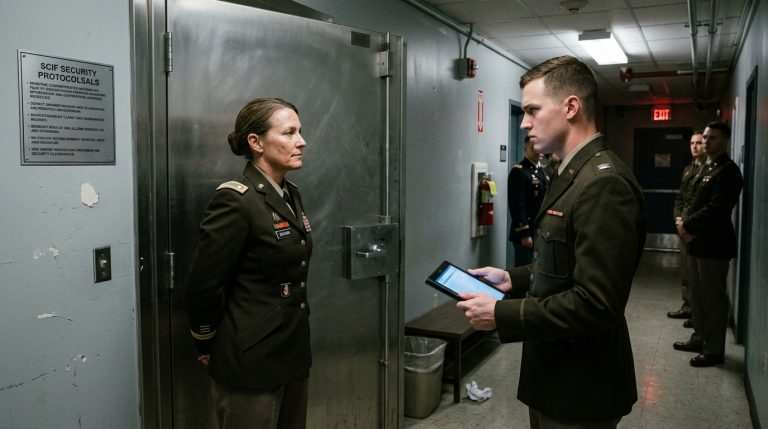
As Aiden sprinted off the stage, the world blurred. The embrace was the first piece of reality James had touched in years. But as his son wept into his shoulder, James looked past the crowd and saw the Admiral’s assistant, a young man in a crisp uniform, frantically typing into a handheld device, his eyes locked not on the father-son reunion, but on the tattoo on James’s arm.
The warmth of the moment was interrupted by a sharp, metallic ping of a notification from the assistant’s device. It wasn’t just a ceremony anymore. It was an investigation.
CHAPTER 2: The Admirals Recognition
The ping of the device was a sharp, high-frequency sound that seemed to slice through the heavy, humid air of the auditorium. It was a digital intrusion, a stark reminder that while the room was filled with the soft rustle of floral dresses and the warm, stifling scent of human emotion, the machinery of the base remained cold, efficient, and observant.
James didn’t look at the assistant. He didn’t look at the device. His eyes remained locked on Admiral Hayes. He saw the shift in her posture, the way her shoulders subtly squared, a defensive mechanism honed by decades of standing at the apex of naval command. The warmth of the reunion—the solid, comforting weight of Aiden’s arms around him—began to feel like a tether, keeping him grounded when every instinct in his body screamed at him to dissolve into the shadows of the exit.
“Permission to approach, Admiral,” James repeated, his voice a gravelly rasp that felt alien in the polished, pristine silence of the hall.
Hayes hesitated. The air around her seemed to ripple, a silent communication passing between her and the aide. James saw it—the slight tilt of the Admiral’s chin, the way her eyes darted toward the exit. It was a tactical assessment. She wasn’t just looking at a man; she was weighing a strategic variable. The Reaper was supposed to be a ghost story, a myth used to inspire young recruits and terrify nameless enemies in the dark corners of the globe. A ghost appearing in the light of day was a glitch in the system.
“Granted,” Hayes said, her voice tight, a thin veneer of professionalism stretched over something much older and more brittle.
Aiden didn’t let go of his father’s arm. He felt the tension, the sudden electric shift in the atmosphere. “Dad?” Aiden whispered, his voice low, filled with a sudden, sharp confusion. He had been looking for a father, a man to fill a void in his life, and instead, he had found a man who commanded the room to stop breathing.
James leaned down, his voice barely audible over the distant, muffled sound of the brass band preparing for the recessional. “Stay close, Aiden. But keep your head down.”
They walked toward the stage. Each step was a measured calculation. James felt the weight of every eye, the mixture of reverence, fear, and curiosity. He wasn’t walking on the polished floorboards; he was walking across a minefield of past decisions. He could feel the familiar, sickening phantom of a low-frequency hum—the sound of an engine idle on a dark, rainy night in Fallujah, the smell of cordite and wet concrete. The fluorescent lights above the Admiral’s office, visible through the open doorway of the stage entrance, flickered with a rhythmic pulse that matched his heartbeat. For a heartbeat, the pristine white walls of the auditorium morphed into the scarred, gray walls of an abandoned bunker.
He blinked, forcing the phantom imagery back into the dark recesses of his mind. Focus, he commanded himself. The objective is the boy. The objective is the truth.
As they neared the podium, Hayes motioned for the aide to move back. The young man hesitated, his thumb hovering over the screen of his device, but the Admiral’s glare was a weapon in its own right. He retreated, leaving them in a circle of relative privacy.
“Six years, James,” Hayes said softly, stepping into his personal space. Her eyes were sharp, searching, looking for the man she remembered—the operative who never blinked, who never faltered. What she found was something else: a man eroded by time, yet possessed of a core that remained immovable. “You were declared KIA. The reports… the recovery teams… they said nothing was left to find.”
James didn’t flinch. “They looked for a body, Admiral. They didn’t look for a man.”
“And now you come back, on the day your son takes the oath?” She glanced at Aiden, then back at James. “Is this a reunion, or a signal?”
James felt Aiden’s grip tighten on his sleeve. The boy—no, the man—was beginning to realize that the atmosphere wasn’t just celebratory. He looked at his father, then at the Admiral, his brow furrowed. “Admiral, he’s just my father. He’s been… he’s been away.”
“Away,” Hayes repeated, the word tasting like ash. “Yes. Away.” She looked down at the Trident in her hand, then held it out. Her fingers didn’t tremble, but there was a hesitation in the gesture that James recognized. It wasn’t pity. It was the careful handling of a live grenade.
James took the pin. The gold was warm from her palm. He looked at his son, seeing the youth and the idealism that he had spent six years trying to protect from the very secrets he was now being forced to confront.
“I didn’t come to signal anyone,” James said, his voice steady, carrying an edge of iron that cut through the Admiral’s professional veneer. “I came to pin this on my son. And then, I’m taking him home.”
“Home,” Hayes whispered, her eyes tracking the movement of a security team gathering near the main doors. “James, the world you left is not the world you’ve returned to. You are a variable that the board didn’t account for.”
“Then they’d better start counting,” James replied. He stepped forward, pinning the Trident over Aiden’s heart. He felt the fabric of the uniform, the solid beat of his son’s pulse beneath it. It was a tangible, beautiful truth in a room full of lies.
As he finished, he caught the eye of the aide again. The young man was talking into a headset now, his eyes fixed on the back entrance. The exit was being blocked.
James didn’t look at the Admiral again. He turned, his hand firmly on Aiden’s shoulder. “We’re leaving,” he said, not as a request, but as a statement of fact.
“You can’t just walk out, James,” Hayes said, her voice dropping to a warning whisper. “Not with what you know. Not after what they’ve done.”
James paused, his back to her. The room seemed to expand, the walls turning into vast, empty spaces. “Then they should have made sure I stayed dead.”
He moved toward the side aisle, ignoring the curious, expectant stares of the families. The air was thin, the tension palpable, but for the first time in six years, James didn’t feel like a ghost. He felt like a guardian. And he knew, with a certainty that chilled his blood, that the path out of this auditorium was only the first mile of a very long, very dangerous walk.
CHAPTER 3: A House of Cards
The transition from the sterile, air-conditioned cool of the auditorium to the humid, oppressive heat of the parking lot was jarring. James kept his hand on Aiden’s shoulder, a light touch that was, in reality, a constant monitoring of his son’s physiological state. Aiden was walking too fast, his breathing shallow, his face a portrait of suppressed agitation. He kept glancing toward the main gates, where a black SUV had just pulled into a position that felt, to James, far too intentional.
“Slow down,” James said, his voice low, blending with the distant rumble of thunder.
Aiden stopped, his keys dangling from his fingers. “Dad, what is happening? Admiral Hayes… she looked like she’d seen a ghost. And that guy—the one with the tablet—he hasn’t taken his eyes off us since we stepped outside.”
“The past is a heavy thing to carry, Aiden,” James replied. He steered them toward a nondescript, weathered sedan tucked into a corner of the lot. He didn’t look at the SUV. He didn’t look at the cameras mounted on the perimeter fencing. He looked only at the ground, observing the flow of the puddles, the quality of the light, the subtle shifts in the shadows that suggested human movement.
As they reached the car, the heavens opened. It wasn’t just rain; it was a deluge, a sudden, violent downpour that turned the asphalt into a slick, mirror-like surface. It was a chaotic, sensory shift that forced the surrounding families to scatter, their polished shoes and carefully curated outfits becoming liabilities in the storm.
“Get in,” James ordered.
The interior of the sedan was warm, smelling of old leather and the faint, sweet scent of coffee grounds. It was a space of transition, a fragile bubble of safety in a world that was rapidly recalibrating around him. James slid into the passenger seat, his eyes immediately sweeping the mirrors. The black SUV had moved; it was now idling near the exit, its headlights cutting through the gray curtain of rain like the eyes of a predator.
Aiden started the engine, his hands shaking slightly on the steering wheel. “I’m taking us back to the apartment. It’s the safest place.”
James watched the road ahead, his mind tracing the route. He wasn’t thinking about safety in the way a civilian did; he was thinking about choke points, sightlines, and the inevitable reaction time of a bureaucracy that had just realized its most successful ‘asset’ was no longer under its control.
“Take the back roads,” James said, his voice flat, devoid of emotion. “Avoid the main thoroughfare.”
“Dad, you’re scaring me. You’re acting like we’re on a mission.”
James turned his head to look at his son. In the dim light of the dashboard, he saw the same jawline he used to see in the mirror every morning before the darkness took hold. He saw the potential for greatness, but also the vulnerability of a life built on a foundation of service that had been, in his own experience, fundamentally hollow.
“We are,” James said softly. “The mission is simply keeping you out of the crossfire.”
The rain intensified, drumming against the roof of the car with a rhythmic, hypnotic frequency. It was the only sound in the car, a stark contrast to the internal noise of James’s thoughts. He found himself remembering the smell of the damp earth in the mountains of Afghanistan, the taste of dry rations, the cold, metallic weight of a rifle in his hands. These were phantoms, but they felt more real than the suburban streets they were now navigating.
As they turned onto a narrow road flanked by overhanging trees, the engine sputtered. Aiden cursed, hitting the wheel. The car lurched, the lights flickering as the old battery struggled against the moisture and the strain of the wipers.
“Damn it,” Aiden muttered, pulling over onto the rain-slicked shoulder. “It’s been acting up for weeks. I thought I had more time.”
James watched the rearview mirror. The SUV was nowhere in sight, but the silence of the woods felt unnatural. He scanned the trees—the dark, swaying trunks, the thick underbrush. He wasn’t looking for an enemy; he was looking for the absence of one. In his experience, the absence of an enemy in a situation like this was the most dangerous sign of all.
“Keep the engine running if you can,” James said, stepping out into the rain.
“Dad, what are you doing?”
James didn’t answer. He moved with a silent, feline grace that betrayed his years under the bridge. He walked to the edge of the tree line, letting the rain soak through his jacket. He needed to feel the environment, to understand the ground they were standing on. He reached down, pressing his hand into the wet earth. It was soft, yielding—a place where tracks would be left, where movement would be audible.
He stayed there for a long time, listening to the rain, the wind, and the far-off, rhythmic heartbeat of the forest. He felt a sudden, sharp pang of recognition. This was it—the familiar, heavy, uncertain ground of the unknown. He looked back at the car, at the small, glowing cabin that held the only thing in the world he truly cared about.
He realized then that the decoy secret he had feared—the idea that his past was just a series of tactical failures—wasn’t the truth. The truth was something deeper, something that involved not just his own survival, but the very integrity of the uniform his son was now wearing. He wasn’t just running from a ghost; he was running toward an answer that might destroy the very legacy he had come to honor.
He wiped the rain from his eyes, his gaze hardening. He walked back to the car, the mud clinging to his boots like the past itself. As he slid back into the passenger seat, he knew one thing for certain: they weren’t going home. They were going into the dark, and he was the only one who knew the way.
CHAPTER 4: The Shadow in the Records
The apartment was smaller than James remembered from the blurry, brief glimpses he’d had in the past—not that he had really been present to see them. It was a space defined by the limitations of a junior officer’s pay: a kitchen barely wide enough for one, a living room that doubled as a staging area, and a bedroom that seemed to serve as a library for manuals and tactical gear. Dust motes danced in the pale, filtered light of a single streetlamp outside, illuminating the space with a soft, melancholic glow.
James moved through the rooms with a quiet, practiced deliberation, his eyes cataloging the life Aiden had built. It was orderly, structured, and entirely devoid of him. He felt like a ghost haunting his own legacy.
“It’s not much,” Aiden said, leaning against the doorframe, his face shadowed, the adrenaline of the escape slowly fading into a weary, hollow exhaustion. He reached up, instinctively touching the Trident pinned over his heart—a physical anchor to the identity he had just fought to claim. “But it’s mine. I… I didn’t want to rely on the base housing.”
James nodded, moving to the small, cluttered desk in the corner. His gaze drifted to a stack of files neatly organized by date. His fingers twitched, a reflexive movement from a life spent processing intelligence.
“You’re thorough,” James remarked, his voice barely rising above the low hum of the refrigerator.
“Everything has a place,” Aiden replied, turning to the kitchen. “I’ll make coffee. You look like you need it.”
As Aiden busied himself with the familiar clatter of a mug and a kettle, James couldn’t help himself. He picked up a thick, leather-bound binder—the service dossier Aiden kept of his own training milestones. It was a mirror of his own past, a systematic documentation of growth. But as he flipped through the pages, his thumb caught on a sheet of paper tucked deep in the back, behind the official certifications.
It was a handwritten note on stationary that hadn’t been manufactured in at least a decade. The ink was faded to a soft, brownish gray, but the handwriting was unmistakable. It was his own.
Fallujah, October 14th. If this reaches you, know that the mission was never about the objective. It was about the exclusion. We were the distraction, not the tip of the spear.
James felt the room tilt. He stared at the words, the texture of the paper beneath his fingertips suddenly feeling like dry, brittle bone. He didn’t remember writing it. He didn’t remember the note, the date, or the mission it referred to. Yet, the pressure in his chest—the specific, heavy guilt that had driven him to the streets six years ago—suddenly shifted in its axis.
He heard the kettle begin to whistle, a sharp, piercing sound that cut through the haze of his shock. He quickly tucked the note back into the file, his heart hammering against his ribs like a trapped bird.
“Dad? Everything okay?” Aiden walked into the living room, two mugs in his hands. He stopped, his gaze darting toward the desk.
James turned, his face carefully composed into the mask of the man who had survived the unsurvivable. “Just looking at your progress, son. You’ve come a long way. You have a knack for organization that I never mastered.”
Aiden smiled, a genuine, warm expression that didn’t quite reach his eyes. “You taught me that, Dad. Or, at least, I watched you do it enough times when I was a kid. You always kept your gear ready, even when you weren’t on call.”
James took the mug, the heat of the ceramic seeping into his calloused palms. He sat on the edge of the worn couch, his legs feeling heavy, his mind racing through the fragments of memory that the note had unearthed. If he had written that, it meant the memory loss, the years of trauma, the very reason he’d walked away—it was all potentially part of a narrative that had been constructed for him.
Aiden sat across from him, his expression turning solemn. “Dad, the Admiral… she knows who you are. The way she looked at you wasn’t just recognition. It was fear. What really happened back then?”
James looked down at the coffee, the dark liquid swirling in the dim light. He wanted to tell him everything, to purge the poison of his past, but the note was a cold, silent warning. The secret wasn’t just his; it was a systemic anchor that had been dropped into their lives long before Aiden had even picked up a rifle.
“There are things that were never meant to come back to the surface, Aiden,” James said, his voice dropping, the warmth of the coffee failing to penetrate the icy chill creeping into his marrow. “The ‘Reaper’ wasn’t a title I chose. It was a designation. And names like that… they don’t just go away. They’re filed away.”
Aiden leaned forward, his hands clasped tightly. “I’m not a kid anymore, Dad. I’m a SEAL. Whatever is in those files, whatever the Admiral is hiding… I have the clearance to look, if you just tell me where to start.”
James looked at his son—the man he had tried to protect by disappearing, only to realize that by disappearing, he had left Aiden vulnerable to the very machinations he had tried to escape. He realized then that he couldn’t protect him by staying silent. He had to lead him through the dark.
“Start with the October deployments from six years ago,” James said, his voice almost a whisper. “And look for the names that aren’t on the official roster.”
As he spoke, he felt the heavy, suffocating silence of the apartment settle around them, a weight that promised to either break them or forge them into something that the institution could no longer ignore. Outside, the rain continued to fall, a steady, relentless rhythm that felt like the ticking of a clock, counting down to a revelation that was already far too late to stop.
CHAPTER 5: The First Mentor Session
James watched the steam rise from his mug, a thin, twisting ribbon of white against the dark, cramped kitchen. His eyes tracked the way Aiden’s hands hovered near his phone—a subconscious habit, he realized, of a young man trained to be constantly connected to a network, a grid, a command structure. It was the exact opposite of the survivalist instinct James had spent the last six years cultivating, where being disconnected was the only way to remain unseen.
“You’re looking at the network logs,” James said, his voice flat, cutting through the silence. It wasn’t a question. He had watched the way Aiden’s thumb flicked across the screen—not checking messages, but refreshing connection statuses.
Aiden looked up, his jaw set. “I have access to the public servers. If there was an operation in Fallujah six years ago that didn’t have an official roster, it should be in the archives. I just need a bypass key.”
James felt a flash of cold alarm. “You’re already reaching for the keys to the kingdom, Aiden. You have no idea how deep this goes. You start rattling the cages of the people who write the history, they won’t just come for me. They’ll come for you.”
“They’re already coming for us, Dad!” Aiden’s voice rose, a flash of frustration breaking his composed surface. He stood up, pacing the tiny kitchen floor—a space that suddenly felt far too small for the energy he was radiating. “We’re sitting here in an apartment that’s likely being monitored. We’re talking about a ghost mission that happened six years ago. If they want me, they don’t need a bypass key. They already have the address.”
James rose slowly, his movements deliberate. He didn’t pace. He didn’t show his frustration. He moved with the quiet efficiency of a man who had learned that motion without purpose was a death sentence. He stepped toward Aiden, closing the distance until he could see the reflection of the single flickering lightbulb in his son’s pupils.
“You want to learn how a Seal survives?” James asked, his voice dropping into the low, vibrating register that had once made hardened interrogators break. “Stop looking for the truth in the digital archives. They control those records. They wrote the code. If the truth were sitting on a public server, you would have found it years ago.”
“Then where is it?” Aiden asked, his breathing ragged.
“It’s in the paper,” James said, gesturing toward the folder he had found. “It’s in the logs that were never uploaded. It’s in the people who were there and never came back, and the families who were told their sons were heroes while their service records were being scrubbed.”
Aiden looked down at the folder, his hands trembling. “You’re saying the entire unit…?”
“I’m saying I was the Reaper,” James interrupted, the word tasting bitter, like old blood. “And every time a headline was written about me, or a story was told in a command briefing, it was a tactical redirection. They needed a legend so they didn’t have to explain why the men under my command weren’t coming home.”
James walked back to the desk, his movements momentarily blurring in the flickering light. For a terrifying second, he felt the floor pitch—he wasn’t in the apartment anymore; he was in a hallway in the Pentagon, or perhaps a base in the desert, his perception fracturing under the weight of the half-remembered reality. The walls seemed to pulse with a low, digital hum. He gripped the edge of the desk until his knuckles turned white, forcing the reality of the apartment to solidify. It was just a hallucination—a trick of the light, or perhaps the psychological phantom of the trauma he was finally beginning to excavate.
“Dad?” Aiden’s voice was closer now, worried.
James shook his head, pushing the vertigo away. “I’m fine. Just… old memories. They like to play tricks.” He looked at his son, his eyes steady again. “You want to be a mentor, Aiden? You want to be a leader? You learn to read the gaps. You learn to see the shadow in the records. We aren’t going to search for the truth. We’re going to let it come to us.”
“How?”
James walked to the window, pulling the curtain back just a fraction of an inch. Outside, the rain had slowed to a drizzle, the streetlamp casting long, distorted shadows across the wet pavement. A car—not the black SUV from earlier, but a nondescript gray sedan—was parked down the street, its headlights dark.
“We act like the men they want us to be,” James said, his reflection ghostly in the windowpane. “We follow orders. We be the perfect, obedient soldiers. And when they think we’re safely tucked away in the system, we start asking the questions they can’t afford to answer.”
Aiden followed his gaze to the street, his expression darkening as he recognized the car. The reality of their position hit him: they weren’t just investigating a mystery; they were being hunted by a system that couldn’t afford to exist in the light.
“Okay,” Aiden said, his voice finally steadied by the grim resolve he had inherited from his father. “What’s the first step?”
James turned away from the window, his shadow looming large against the far wall. “The first step is realizing that we’re not the ones in control here. And until we find out who is, we don’t trust a single thing the command puts in front of us. Not even the medals.”
He looked at his son, seeing the weight of the realization settling into his shoulders. They were two men against a machine that had been designed to erase them, and in the quiet of the apartment, the only thing that felt real was the fraying edges of the life they were currently living, and the dark, tangled truth that lay just beneath the surface.
CHAPTER 6: The Unseen Watcher
The stairwell was a narrow, concrete throat that tasted of dust and stale cigarette smoke. James led, his steps silent, his body hugging the inner rail. He wasn’t looking for an exit; he was looking for the telltale signs of surveillance—a cigarette butt that was still warm, a smudge on the glass where someone had been peering through, the faint, rhythmic thrum of a remote signal. Aiden followed, his movements slightly less disciplined, his breathing audible in the hollow acoustic space of the stairwell.
When they hit the ground floor, James paused, pressing his back against the peeling paint of the wall. He signaled for Aiden to wait. Through the small, wire-reinforced window of the door, he watched the gray sedan. It hadn’t moved. The street was empty, washed out by the sickly yellow glow of a sodium streetlight that hummed with a maddening, mechanical persistence.
“Stay behind me,” James murmured, the command sharp enough to override Aiden’s instincts to take point. “If we’re being followed, they’re not here to talk. They’re here to observe.”
They stepped out into the night. The air was colder now, biting and damp, smelling of rain-soaked asphalt and the distant, chemical tang of the shipyard. They walked at a steady, civilian pace, neither too fast to draw attention nor too slow to signal hesitation. Every instinct in James’s body was screaming at him to turn around, to close the distance to that car and drag the driver into the light, but he forced his hands to remain in his pockets. He was a shadow, and for now, the shadow had to remain compliant.
“Take the bus,” James directed, nodding toward the transit stop two blocks over. “It’s crowded, public, and impossible to track with a single vehicle. We need to lose them before we try the archives.”
They reached the shelter just as the bus rounded the corner, its headlights cutting jagged, brilliant arcs through the fog. The doors hissed open with a pneumatic sigh. James watched the driver—a tired man in a faded uniform—and the half-dozen passengers huddled in the back. He scanned their faces: an elderly woman clutching a plastic bag, a teenager with headphones, a man in a rumpled raincoat reading a paperback. None of them were threats. None of them were watchers.
They took the back row, Aiden sitting by the window, James taking the aisle. As the bus jerked forward, James watched the gray sedan in the rearview mirror. It didn’t move for a full ten seconds after the bus pulled away, then, slowly, its lights flickered on, cutting a path through the mist. It was following, but at a distance—enough to keep them in sight, not enough to be flagged as a tail.
“They’re sticking with us,” Aiden whispered, his eyes fixed on the reflection in the dark window.
“Let them,” James replied. He closed his eyes, his head leaning back against the vibrating frame of the bus. He wasn’t sleeping. He was calculating. He was replaying the note, the handwritten warning that felt like a bridge to a version of himself he no longer recognized. He realized that the decoy secret—the idea that he was just a rogue veteran with a grudge—was the perfect cover. It kept the watchers focused on his instability rather than his history.
“What are we going to do when we get to the archives?” Aiden asked, his voice low. “If they know we’re coming, they’ll lock the files.”
“They’ll lock the digital files,” James agreed, opening his eyes to look at the scrolling ticker of the city outside. “But the archives—the physical ones—are a maze of red tape and decaying paper. They don’t monitor the basement stacks because they don’t think anyone is desperate enough to dig through the rot.”
He looked at his son, seeing the transition happening in real-time. The boy was gone; in his place was a man who understood that sometimes, you have to break the machine from the inside.
“I need you to create a distraction,” James said. “You’re a SEAL. You know how to draw a crowd and keep eyes on yourself. I need five minutes in the restricted stacks.”
Aiden looked at the reflection of the sedan, then back at his father. There was no hesitation now. The fear was still there, but it had been forged into something harder, something resilient. “What kind of distraction?”
James smiled, a tight, grim expression that didn’t reach his eyes. “The kind that makes them regret following us.”
The bus hit a bump, the lights overhead flickering with a dying, yellow intensity. For a moment, the bus was plunged into near-total darkness, the streetlights outside flashing past like strobes. In that pulse of darkness, James saw the Reaper staring back at him from the window—the man who had done the unthinkable, the man who had been erased, the man who was now standing on the precipice of a truth that would either set them free or bury them both. He didn’t blink. He just waited for the next streetlamp to bathe them in its cold, artificial light.
CHAPTER 7: The Frayed Cloth
The basement of the naval archives was a tomb for bureaucratic history. Here, the air was stagnant, heavy with the dry, acrid scent of disintegrating paper and the underlying chemical tang of industrial cleaners. Metal shelving units stretched toward a ceiling obscured by shadow, creating a labyrinth of narrow aisles that seemed to close in on James as he moved deeper into the stacks.
He didn’t need a light to navigate; his hands, calloused and mapped with the history of a hundred tactical insertions, instinctively found the edges of the metal shelves, using them to guide his path through the dark. He moved with a quiet, fluid grace, his senses tuned to the subtle shifts in the environment. Aiden was above, somewhere near the main reception, likely already starting the commotion he had been instructed to cause. James gave it two minutes—the time it would take for the head archivist to notice an unauthorized access or for a minor equipment malfunction to escalate into a security priority.
He reached the section labeled ‘October 2020: Special Operations – Unclassified/Non-Active’. It was a dusty, forgotten corner. James pulled a heavy, leather-bound register from the shelf, his heart a steady, thumping presence in his chest. As he opened it, the pages groaned—a sound like dry leaves skittering across pavement.
He began to search. He wasn’t looking for the ‘Reaper.’ He was looking for the names of the men who had been with him in Fallujah—the ones whose files had been systematically erased.
As he flipped through the records, he found a bundle of reports tied together with a fraying piece of black cloth—the same material, he realized with a jolt of cold, that wrapped his Purple Heart. He unraveled it. Inside were not military reports, but medical evacuation summaries. They were stamped VOID in thick, red ink. Beneath the stamp, he saw the cause of death listed for each man: Non-combat incident, classification restricted.
The reality hit him with the force of a physical blow. They hadn’t died in a firefight. They had been exposed to something—a substance, a failed test, a tactical error—and the command had chosen to bury the evidence along with the bodies. The ‘Reaper’ legend wasn’t just a cover; it was the weapon used to distract the public from the truth of what had happened to those men.
Suddenly, the silence of the room felt thick, oppressive. A sharp, high-pitched ringing began in his ears, and the smell of the basement shifted to the sterile, clinical ozone of a debriefing room—a memory, sharp and jagged, of Admiral Hayes sitting across from him, her face a mask of practiced empathy.
“You did your duty, James. You survived. That’s all that matters.”
He gripped the edge of the metal shelf, the cold, sharp friction grounding him as the phantom memory began to blur. He wasn’t back in that room. He was here, now. He was being watched. He could feel it—a weight on the back of his neck, the sensation of invisible eyes tracking his every movement from the darkness at the end of the aisle.
He didn’t turn around. He didn’t drop the file. He knew that if he turned, he would see nothing but shadows, but he also knew that the silence was no longer empty. The distraction above had started. He heard the muffled sound of a distant fire alarm—a thin, reedy wail that was immediately dampened by the thick concrete of the basement ceiling. It was Aiden. He was doing his part.
James stuffed the bundled papers into his jacket, the rough edges of the medical files pressing against his ribs. He needed to get out, but the aisle behind him suddenly felt longer, the shadows thicker. He moved, his boots silent on the concrete, but as he reached the corner of the row, a figure stood in the entryway—a silhouette, featureless and still, framed by the cold, flat light of the hallway.
It didn’t speak. It didn’t move. It simply stood there, a physical manifestation of the institution that had spent years trying to erase him.
James didn’t reach for a weapon. He didn’t have one. He simply stopped, his shoulders squared, his gaze locked onto the silhouette. The room seemed to expand, the archives blurring into a vast, empty void where the only two things that mattered were the secret he carried and the authority standing in his way.
“You’re a long way from the bridge, Master Chief,” the silhouette said, its voice a soft, mechanical modulation that lacked any human resonance.
James didn’t back down. “And you’re a long way from the truth.”
He didn’t wait for a reply. He lunged into the darkness of the adjacent aisle, using his knowledge of the room’s layout to put a row of shelving between him and the watcher. He moved with a desperate, frantic speed, his hands scraping against the metal, his heart pounding a rhythm of survival. He wasn’t just a relic of the past anymore. He was the man who was going to break it open.
CHAPTER 8: The Confrontation
James didn’t look back. His lungs burned, a sharp, metallic sting that reminded him of years spent ignoring his body’s limits in the pursuit of objectives that were, in hindsight, built on sand. He scrambled over a low-lying service trolley, his movements heavy and efficient. The archives were a vertical maze; he was currently deep in the sub-basement, but the service ladders offered a path upward, toward the ventilation shafts—a route he hadn’t used since his training days, but one that his muscle memory recalled with painful clarity.
He heard the soft, rhythmic thud of boot steps behind him. Whoever—or whatever—was pursuing him didn’t run; they stalked. It was the movement of a predator that knew its prey was cornered.
James reached the service ladder, a rusted iron spine bolted into the damp concrete wall. He climbed, his fingers gripping the cold, flaking metal with desperate force. He didn’t have time for elegance. He needed elevation. As he ascended, the air grew thinner, tinged with the smell of old grease and the distant, stale heat of the base’s HVAC system.
He pulled himself into the vent just as a flashlight beam sliced through the darkness below, illuminating the spot where he had been seconds before. The beam was harsh, clinical, and sweeping—the gaze of someone who wasn’t just searching, but hunting.
He crawled forward, his knees scraping against the ridged metal of the ducting. The space was claustrophobic, a tight, rattling tomb that vibrated with the immense power of the building’s infrastructure. As he reached a junction, he froze. A faint, low-frequency hum permeated the metal—a hidden surveillance node, tucked neatly into the corner, its small, blinking blue LED a silent sentinel in the dark.
It was an infrared sensor, keyed to thermal signatures. If he moved past it, he would trigger an alarm in the security center. He was trapped in the ducting, and behind him, the pursuer was already beginning to climb the ladder.
Think, he told himself. The objective is not to fight; the objective is to survive long enough to get the files to Aiden.
He reached into his jacket, his fingers brushing the bundled medical records—the proof of the systemic sacrifice he had spent his life unknowingly perpetuating. He realized then that the decoy secret he had feared—that he was merely a broken man—was the ultimate lie. He was an archive of the truth. If he died here, the truth died with him.
He looked at the sensor, then at his own scarred, calloused hands. He stripped off his jacket, bundling it into a thick, insulating mass. With a grunt of exertion, he shoved the bundled jacket into the vent just ahead of the sensor, blocking its line of sight with the density of his own gear. It was a makeshift thermal buffer—a gamble that would last, at most, a few seconds.
He pressed himself against the side of the duct, his body rigid. Behind him, the pursuer entered the ducting, their movements metallic and sharp. James could hear the heavy, measured breathing of the man—a professional, someone who knew exactly how to dismantle a target.
“I know you’re here, Colton,” the voice came, echoing through the ducting. It was distorted, cold, and possessed a familiar, terrifying authority. “You’re a legend, but legends are just ghosts with better PR. And ghosts don’t have a place in a secure facility.”
James didn’t reply. He gripped the edge of the service grate—a heavy, bolted piece of steel—and waited. He was a master of underwater demolitions and hostile infiltration; he knew that silence was not just the absence of sound, but a weapon.
The pursuer reached the jacket. James heard the distinct sound of a blade slicing through the fabric. The sensor in the corner flickered red, then orange, as the heat from the jacket dissipated, finally exposing the gap in the line.
“Got you,” the man muttered.
James didn’t hesitate. He launched himself from the side of the duct, his boots slamming into the pursuer’s chest with the force of six years of repressed rage and a lifetime of training. The impact was sickeningly solid—the sound of air being driven from lungs, the clatter of gear against metal.
They grappled in the claustrophobic space, a tangle of limbs and desperate, suffocating effort. The pursuer was strong, efficient, and clearly equipped with the best the navy had to offer, but James was fueled by something that couldn’t be quantified by a training manual. He fought with the desperate, jagged rhythm of a man who had nothing left to lose.
He shoved the man backward, his fist connecting with the chin of the visor. The pursuer slumped, the movement restricted by the narrow confines of the duct. James didn’t wait for him to recover. He scrambled forward, his heart hammering against his ribs, his hands bloodied by the sharp metal edges of the ducting.
He reached the next grate, kicking it out with a sudden, violent strike. He fell through, landing hard on the tiled floor of a deserted hallway. He was on the ground floor. He was out. But as he stood, he saw the security cameras at the end of the hall tracking his movement, their red lights blinking in a synchronized, lethal pulse.
He wasn’t safe. He was exposed, and he was being broadcast to every monitor in the facility. He looked at the files in his hand—the frayed cloth, the voided records—and realized that the confrontation was only just beginning.
CHAPTER 9: The Decoy Falls
The hallway was a rhythmic, bleeding smear of red. With every pulse of the alarm strobes, the world vanished and reappeared, distorted and jagged. James flattened himself against a wall, his breathing ragged, his ears ringing with the relentless, electronic wail of the lockdown. He had broken out of the archives only to find himself in the maw of the beast. The facility hadn’t just reacted; it had anticipated him.
Every door, every corridor, every vent—the automated systems were cycling through a lockdown sequence that turned the building into a self-contained trap. He looked at his hands, still trembling from the exertion in the vents, and then at the bundled records tucked deep inside his jacket. They felt heavy, a burden of truth that was physically anchoring him to a reality the facility was desperate to overwrite.
He pushed off the wall, his boots silent on the smooth tile. He had to reach the central stairwell—the only egress that wasn’t digitized, the only way to avoid the thermal sensors now sweeping the floors. But as he turned the corner, he saw the security team. They weren’t just guards; they were tactical operators, their silhouettes sharp against the strobe-lit backdrop, their weapons raised in a low, disciplined ready.
“Colton,” the lead operator said, his voice amplified by a comms mask. “Drop the files. Step into the center of the hall.”
James didn’t stop. He couldn’t. He saw the shift in the operator’s stance—the subtle tension of a finger on a trigger. He recognized the training; he had taught it. They were waiting for him to run so they could justify the termination.
He lunged for an open janitor’s closet to his left, the metal door heavy and stubborn. As he dived inside, a suppressed crack echoed through the hall, a bullet biting into the door frame just inches from his head, spraying a fine mist of plaster and paint into the red-tinted air. He slammed the door, the lock clicking into place just as a heavy boot kicked the exterior with enough force to rattle the hinges.
“He’s in the closet. Clear the sector.”
The interior of the closet smelled of pine cleaner and industrial bleach—a mundane, stifling scent that felt absurd in the face of the violence outside. James scanned the space. It was small, cramped, and windowless. But he saw the vent—a small, wall-mounted register that led to the central circulation plenum. It was too small for an operator, but just large enough for a man who had spent six years squeezing into the crevices of the world.
He worked at the screws with his fingernails, the metal biting into his skin. Come on, come on, he hissed, his mind reeling. The footsteps outside were getting closer—the slow, rhythmic advance of a team closing in. He felt the weight of the records; they were more than paper now, they were the evidence of a ghost story that had killed his unit and nearly destroyed his son.
The grate popped loose. He pulled it away, the sharp metal scraping against the wall, and shoved himself into the narrow, claustrophobic opening. He was crawling away from the light, away from the red strobe, into the absolute, suffocating dark of the wall space.
Below him, the door to the closet was blasted open. A sudden, blinding white light flooded the closet, followed by the heavy, rhythmic thud of equipment.
“Target has egressed through the plenum. Seal the sector. Do not let him reach the ground level.”
James kept moving. He didn’t think about the pain, the exhaustion, or the fact that he was effectively cornered. He thought about Aiden—about the trident pinned to his uniform, about the boy who still believed in the integrity of the institution. If the decoy secret—the idea that he was just a rogue veteran—wasn’t the truth, then the truth was much worse. It meant the institution was not a defender; it was a consumer of its own history.
He reached the end of the ducting and peered through the slats. He was looking into the main command hub—the brain of the facility. The rows of monitors, the sprawling digital maps, the calm, methodical way the controllers were managing the lockdown of the entire base.
And there, standing at the center console, was a familiar figure: Captain Moss. The senior instructor who had shaken his hand at the graduation. The man who had promised to help, who had looked him in the eye and spoke of ‘mentorship.’
Moss wasn’t a hero. He was the architect.
The realization settled into James’s chest like ice. The entire operation—the graduation ceremony, the invitation, the Admiral’s recognition—it was all a setup. They hadn’t wanted to mentor him; they had wanted to bait him, to bring the ‘Reaper’ back into the light so they could finally, definitively, close the file on the Fallujah incident.
He watched Moss, his throat tight, his eyes burning with a sudden, violent clarity. The records in his jacket weren’t the end of the mystery; they were the trigger. And as Moss tapped a command into the console, initiating a final, lethal sweep of the facility, James realized that he wasn’t just fighting for his own life anymore. He was the only thing standing between the truth and the total erasure of everything he had left.
He didn’t need a distraction anymore. He needed a breach. And as he looked at the cooling pipes running along the ceiling above the console, he knew exactly how to bring the whole house of cards down.
CHAPTER 10: The Tactical Withdrawal
The plenum gap opened into the darkness above the command hub’s drop ceiling. James pressed his face to the slats, watching the sterile, glowing theatre of the room below. It was a cathedral of data—blue and white light cascading over glass consoles, the quiet, rhythmic clicking of keys, and the detached, professional tone of operators managing the facility’s pulse.
Captain Moss stood at the central terminal, his back to the ceiling, his hands moving with the grace of a conductor. On the main wall-mounted screen, a map of the facility showed the red-pulsing sector where James had disappeared. A team of operators was converging on the janitor’s closet.
“Target is mobile within the ventilation grid,” Moss said, his voice clipped and devoid of hesitation. “Use the automated thermal dampers. Force him out through the sector C exhaust. We need him contained, not vaporized.”
James felt the air around him heat up as the command was executed. The facility was literally breathing, the automated dampers shifting to vent the heat from the servers into the very ducts James was currently occupying. He was being smoked out.
He looked at the overhead coolant lines—thick, reinforced steel pipes that ran directly above Moss’s station. They were the lifeblood of the server bank. A quick rupture would flood the hub with pressurized, sub-zero liquid, shorting the entire system and buying him the only window of opportunity he would get. But doing so would trap him in the hub.
He didn’t hesitate. He pulled the combat knife he’d recovered from the operator in the ventilation shaft and, with a controlled, precise movement, drove it into the valve housing of the main pipe.
The sound was a terrifying, high-pitched scream of metal. A jet of super-cooled white vapor blasted into the hub, followed by a torrent of liquid that turned the room into a chaotic, freezing mist.
“Breach! Sector 4, hub compromised!”
The alarms shifted from the steady drone of the lockdown to a manic, oscillating shriek. James didn’t wait. He kicked the ceiling tiles out and dropped into the chaos, his body landing in a crouch behind the main console. The air in the room was a blinding, frigid haze of coolant and electrical fire.
Moss was shouting, his hands sweeping across his screen, but the terminal was dead, the monitors flickering and blackening as the liquid flooded the keyboard. James moved, a shadow in the mist. He reached Moss in two strides, grabbing the Captain by the tactical vest and slamming him against the glass console.
“The Fallujah records,” James growled, his voice a low, terrifying rasp against the chaos of the room. “Tell me where the originals are.”
Moss gasped, his eyes wide, the professional mask shattering. “You don’t know what you’re doing, Reaper. You’re trying to burn down a forest to save a single tree. Those records… they aren’t about the men we lost. They’re about the men we’re currently protecting.”
“I don’t care about the mission,” James said, his grip tightening, his knuckles white against the Captain’s vest. “I care about the truth.”
“The truth is that you were never the hero, James!” Moss laughed, a dry, rasping sound. “You were the control group. You were the only one who didn’t die because we needed to see how long you would survive the guilt before you broke. You’re not a whistleblower. You’re a clinical subject.”
The room seemed to tilt. The high-frequency whine of the servers blended with the phantom, mocking laugh of Marcus Reed, echoing in James’s mind—a memory of a conversation in the mud of Fallujah that he had never actually had. The realization didn’t break him; it galvanized him. Layer 1, the systemic sacrifice, was a lie. The deeper, darker Layer 2—the institutional betrayal of his entire existence—was the only thing left.
He realized the decoys were all falling away. He wasn’t a soldier who had lost his way. He was a piece of equipment that had been discarded, and the facility wasn’t trying to capture him; they were trying to recover their data.
“Where are they?” James repeated, his voice cold, final.
Moss gestured toward the main terminal, his face twisted in a mocking smirk. “The secure terminal on the third floor. But the elevator is locked, the stairs are sealed, and your son is already being processed in the holding wing. You go for the truth, you lose the boy. That’s the protocol.”
James looked at the monitors, now flickering back to life. He saw a live feed of the holding wing—Aiden, sitting in a stark, white room, his hands cuffed to the table, his head bowed.
The choice wasn’t a choice at all. It was a test. And James knew exactly what a Reaper would do. He didn’t let go of Moss. He pulled him closer, looking him dead in the eye.
“You have no idea what a father will do for his son,” James whispered.
He dropped Moss, leaving him gasping on the floor, and turned toward the service egress—the one that led not to the records, but to the holding wing. He was leaving the truth behind, but he was choosing his own legacy. As he stepped out of the hub, the facility began to groan, the lockdown protocols failing, the structural integrity of the hub giving way under the weight of the coolant flood. The hunt was over; the war was on.
CHAPTER 11: The Mirror Image
The holding wing was a sterile, windowless artery of the facility, lined with heavy, steel-plated doors that felt less like security and more like a final judgment. James moved through the corridor, his boots making a soft, rhythmic thud against the polished floor. The adrenaline that had carried him through the hub was fading, replaced by a cold, sharp precision. He didn’t look at the cameras mounted every ten feet; he knew they were recording, and he knew that for the first time in six years, he didn’t care.
He reached the door to the holding room. A keypad blinked in the low light—a digital eye guarding the only thing he had ever truly loved. He didn’t use a bypass key. He didn’t need one. He looked at the door, then at the camera mounted above it, and spoke.
“Open it, Moss. I know you’re watching.”
The lock clicked with a heavy, mechanical finality. The door hissed open, revealing a white, windowless room. Aiden sat at the metal table, his head bowed, his cuffed hands resting on the cold surface. He looked up as James entered, the exhaustion in his eyes flickering into a desperate, fragile hope.
“Dad?”
“We’re leaving,” James said, stepping into the room. He didn’t waste time with comfort. He moved to the table, his fingers finding the seam of the magnetic cuffs. “I’m sorry, Aiden. I didn’t mean for you to be part of this.”
“I’m a SEAL, Dad,” Aiden said, his voice stronger than it had been an hour ago. “I’m part of this whether I knew it or not.”
James felt a lump form in his throat, but he swallowed it down. He pulled a small, improvised shim from his pocket—a sliver of steel he’d salvaged from the hub—and worked the lock. The cuffs fell away with a sharp, metallic clatter. As Aiden stood, he rubbed his wrists, his eyes searching James’s face.
“What did you find?”
James hesitated, then pulled the bundled medical records from his jacket and placed them on the table. He didn’t speak. He just watched as Aiden leafed through the voided reports, the medical evacuation summaries that contained the silent, erased legacy of their unit.
Aiden’s face drained of color as he read. He looked up, his voice barely a whisper. “They didn’t just abandon them, Dad. They monitored them. These aren’t reports; they’re clinical logs.”
“They needed to see how the ‘Reaper’ legend would hold up if the control group were removed,” James said, the words heavy and final. “We weren’t soldiers, Aiden. We were a test. And you… you were never meant to enlist. You were the only variable they couldn’t control.”
The silence in the room was absolute, a heavy, suffocating weight that seemed to swallow the light. They were trapped in the heart of the facility, surrounded by the machine that had built them, used them, and attempted to discard them.
“Moss is in the hub,” James continued, his gaze drifting to the door. “He thinks he has us cornered. He thinks the protocol will hold.”
“It won’t,” Aiden said, his posture shifting, his hands curling into fists. “I know this base. I know the blind spots.”
“Then show me.”
As they moved toward the exit, a figure stepped into the doorway. It was Moss, his uniform torn, his face smeared with the gray dust of the hub’s ruptured coolant lines. He held a sidearm, his grip steady, his expression devoid of remorse.
“You think this is a revelation, James?” Moss asked, his voice echoing in the small room. “You think you’re going to walk out of here and hold a press conference? This facility is a ghost. It doesn’t exist. You don’t exist. If you leave this room, you’ll be ‘lost at sea’ before you even hit the perimeter.”
James didn’t flinch. He didn’t look at the gun. He looked at the man—the man who was just as tired, just as scarred, and just as deeply buried in the machinery as he was.
“The records are already gone, Moss,” James said, pointing to the vent in the corner where he had hidden a digital transmitter—a device he had scavenged from the hub during the breach. “They’re being beamed to every major news outlet in the country. You’re not the architect anymore. You’re the evidence.”
Moss froze. For a second, his confidence wavered. He glanced at the ceiling, then back at James, his face a mask of sudden, frantic realization.
“You bluffing, you son of a…”
“Check the server logs,” James said calmly. “You’ll see the upload already finished.”
The room seemed to shudder. Moss’s radio erupted with a chaotic, high-pitched static. The facility was coming alive, the security protocols failing, the very structure of the base beginning to groan as the digital truth began to permeate the network. Moss looked at the door, then back at James, the gun in his hand lowering by a fraction of an inch—a moment of hesitation that James exploited with the cold, brutal efficiency of the man he used to be.
He didn’t fire. He didn’t fight. He simply stepped forward, his eyes locked on Moss, forcing the man to choose between the protocol and his own survival.
“The choice is yours, Moss,” James said, his voice steady. “You can stay here and drown with the facility, or you can open the gate.”
CHAPTER 12: The Final Covenant
The dawn broke over the coast not with a fanfare, but with a quiet, persistent spread of amber light across the horizon. James and Aiden stood at the edge of the naval base’s outer fence, the chain-link vibrating in the coastal wind. Behind them, the facility was a silhouette of industrial geometry, its internal rhythm silenced by the cascading failures James had triggered. The emergency lights had finally died, replaced by the natural, unrelenting clarity of the morning.
Moss had opened the gate. It wasn’t an act of grace; it was a surrender to the inevitable. As the file upload had hit the public domain—an unstoppable wave of data tearing through the digital architecture of the Navy—the structure of his authority had simply evaporated. He stood near the gate, a man stripped of his purpose, watching as James and Aiden walked into the open space beyond the perimeter.
They walked for a mile before they reached the quiet stretch of beach where James had once slept beneath the Coronado Bridge. The sand was cool and damp, the tide pulling back to reveal the hidden architecture of the shoreline.
James stopped, his gaze fixed on the water. The Purple Heart, wrapped in its fraying black cloth, was tucked firmly in his pocket—no longer a secret, but a history he had finally reconciled with his present. He pulled it out and looked at it. It felt lighter now.
“The world is going to change, Dad,” Aiden said, his voice soft, standing beside him. “The news is everywhere. They’re already talking about the ‘Fallujah Incident’ on every major channel.”
“It’s not just a story, Aiden,” James replied, his voice steady. “It’s a weight. And for the first time, it’s not just mine to carry.”
He knelt in the sand, the grit pressing against his knees—a sensation he had dreaded for six years, now feeling like a simple, grounding reality. He took the frayed cloth and buried the medal, not as an act of discarding it, but as an act of sealing the past. It was a symbolic closure, a return to the earth of the life he had once been forced to abandon.
Aiden knelt beside him. He reached into his pocket and pulled out his trident—the small, gold pin that had caused so much suffering, so much longing, and so much growth. He didn’t bury it. He pinned it to the inside of James’s worn, salt-crusted jacket.
“You earned this,” Aiden said, his eyes meeting James’s with a clarity that surpassed rank or protocol. “You’ve been earning it every day for six years.”
James felt the sharp, cold metal of the pin against his chest. It was a bridge—a connection between the man he had been and the man he was becoming.
The denouement came slowly. The sirens of the emergency responders—the civilian authorities now swarming the base—grew louder, a distant, rhythmic wail that signaled the end of their flight. But they didn’t run. They stood, two men against the rising sun, watching as the world arrived to witness the aftermath of their resistance.
There was no sudden rescue, no miracle that would wash away the scars of the last six years. There was only the quiet, profound realization that the institution had been defeated by its own hubris, and that they had survived by reclaiming the only thing that couldn’t be quantified or commanded: their humanity.
James stood up, his joints aching, his body weary. He reached out and took Aiden’s hand, a simple, human gesture that defied the rigid, detached expectations of the world they had just exited.
“What now, Dad?” Aiden asked, as the first of the response vehicles crested the hill.
James looked at the horizon, where the light was now full and golden, casting long, peaceful shadows across the sand. He thought of the apartment, of the therapy sessions, of the quiet mornings spent watching the sunrise—a life that was no longer a dream of survival, but a reality of belonging.
“Now,” James said, his voice a whisper of contentment, “we start living.”
They turned toward the road, walking away from the fence, away from the shadow of the base, and into the sprawling, uncertain, and beautiful light of a day they had earned. The struggle had left them hollow, but it had also left them empty enough to be filled with something new. The Reaper was gone. In his place stood a father, a son, and the quiet, iron-clad resolve of a second chance.