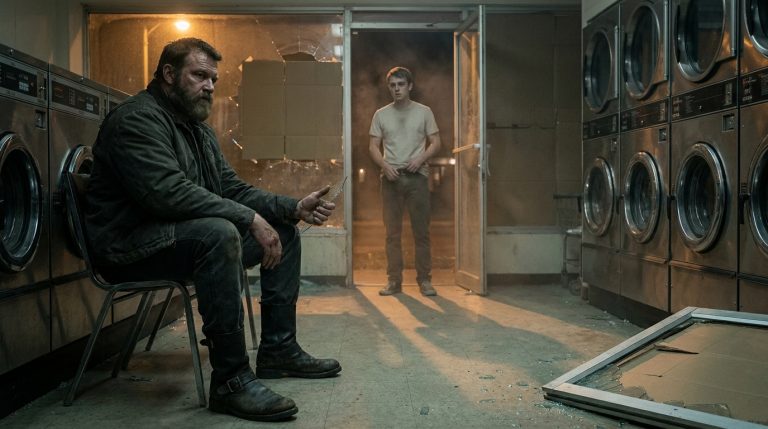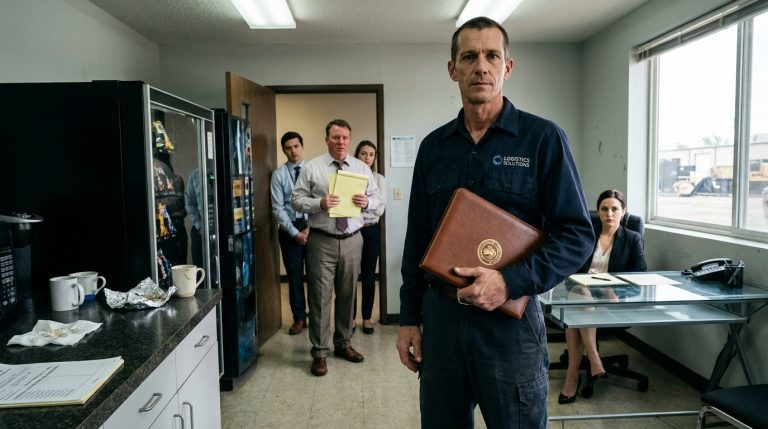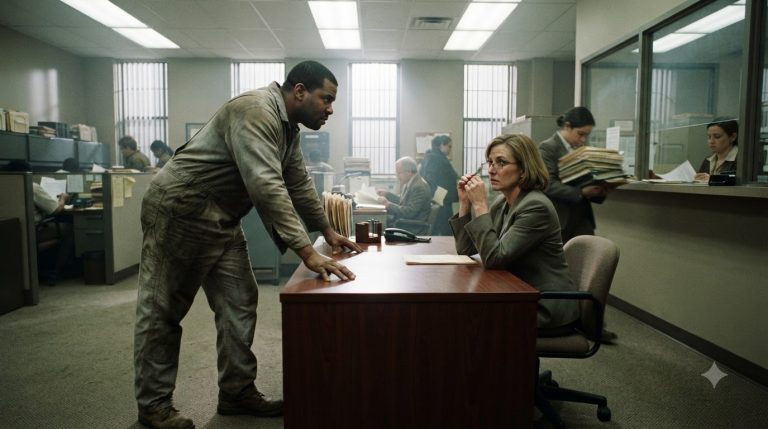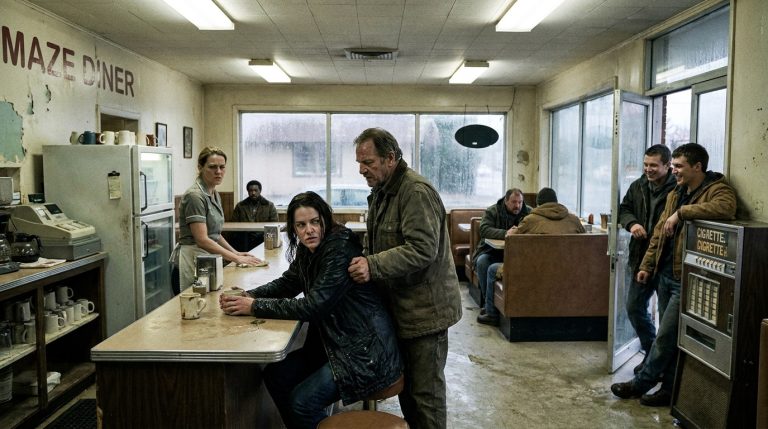
The Weight of Air: A Tale of Suburban Sovereignty, Fractured Rhythms, and the Heavy Cost of Rusted Laws
CHAPTER 1: THE FRICTION OF LAWS
“Step away from the resident,” the voice said. It didn’t sound like a man; it sounded like a megaphone scraping against a rusted gate.
Diego didn’t lift his head. His palms were already coated in the grit of the sun-baked asphalt, the rough texture of the outdoor basketball court biting into the skin of his knees through his jeans. Down. Up. Count to thirty. The boy’s chest under his fingers felt like unbaked dough—cold, resilient, and horribly quiet.
“Thirty,” Diego muttered, his breath coming in a dry hiss. “Clear the airway.”
“I said, step back. This is private property, and you are failing to comply with Pine Ridge security ordinances.”
The shadow of Rick Masterson fell across the boy’s blue-tinted face. Through the desaturated glare of the afternoon sun, Diego could see the reflection of his own strained features in the guard’s mirrored aviators. The tactical vest Masterson wore creaked with stiff, unwashed nylon. On his hip, the heavy iron casing of a radio sputtered with static.
“He’s in full arrest,” Diego said, his voice flat, stripped of everything except the mechanical precision of a decade on the rescue box. “Get the kit from the grass. The orange tabs. Move.”
“You are unauthorized,” Masterson replied, his hand moving down toward his belt where the heavy chrome of a pair of Peerless handcuffs caught the light. “You have no standing within this gate. The community assumes liability for non-resident intervention.”
“He’s sixteen,” Diego whispered. He leaned back in, his shoulders locking into place for the next cycle. The friction of the concrete against his sneakers was the only anchor he had left in the world. “One. Two. Three…”
The boy’s mother was screaming somewhere beyond the low chain-link fence, a raw, metal-on-metal sound that the perfectly manicured hedges of Pine Ridge couldn’t dampen.
Then came the metallic click.
It wasn’t the sound of the automated external defibrillator analyzing the rhythm. It was the sharp, mechanical bite of iron ratchets sliding into place. Masterson didn’t use a warning; he used his weight, grabbing Diego’s left wrist and pulling it backward with a short, downward jerk that broke the alignment of the compression.
“You’re trespassing,” Masterson grunted, his breath smelling of stale mints and synthetic leather. “Citizen’s detention under Section 4-B.”
Diego’s shoulder struck the hot ground. The skin over his collarbone tore slightly against the coarse aggregate of the pavement. The metal cuff snapped shut around his right wrist, binding them behind his back with a heavy, unyielding weight. The cold iron bit deep, finding the old scar tissue near the joint.
Beside them on the green grass, the medical bag lay open, but the small square velcro patch that held Diego’s state paramedic credentials was gone—only a frayed gray square remained where the thread had rotted away.
“Look at him!” a kid shouted from the baseline, a phone held aloft like a small glass shield. “Look at his chest!”
The defibrillator unit cycled in silence, its green light pulsing against the desaturated dust of the court. Shock advised, the machine’s small speaker crackled. But Diego’s hands were pinned beneath his spine, the chrome links clicking once, twice, tightening until the bone itself throbbed against the metal restriction. The boy lay entirely still, the blue on his lips deepening into gray.
CHAPTER 2: THE WEIGHT OF THE LATCH
The concrete didn’t cool. The heat from the sun-baked aggregate radiated straight through Diego’s shirt, baking the grit into his shoulder blades while the chrome links of the handcuffs dug an exact, sharp indentation into his lower lumbar. Above him, the sky remained a flat, desaturated white.
Two pairs of heavy duty, rubber-soled department boots crunched onto the gravel edge of the court, their cadence measured and distinct from the erratic, scraping steps of the gathering teenagers.
“Hands where I can see them,” the first officer said, though the instruction wasn’t meant for Diego. The officer’s shadow cut across Masterson’s polished boots.
Masterson didn’t run. He stood his ground with the rigid, heavy posture of a man who believed the plastic badge on his nylon vest carried the weight of a federal decree. “Officer, I have detained a non-resident individual for unauthorized medical practice under the community’s Section 4-B liability guidelines. He refused a lawful command to vacate private property.”
Diego didn’t try to roll over. The weight of his own body against his pinned wrists was a dull, localized ache that kept his focus sharp. He looked sideways, his cheek pressed against the rough asphalt. Six feet away, the responding paramedic crew from Engine 40—guys he recognized from the third-shift rotation at the county garage—slammed their rear doors open. The latch made a heavy, double-clicking sound that echoed off the stucco walls of the surrounding condos. They didn’t look at Diego. They went straight to the boy.
“Get him up,” the second officer muttered, his hands hooking under Diego’s armpits. The lift was unceremonious, the friction of the officer’s heavy wool uniform fabric rasping against Diego’s bruised ribs.
Diego’s feet found the ground, but his balance was off, his shoulders pinned back by the short chain of the Peerless cuffs. His gaze locked onto the hood of Masterson’s security SUV. Resting face-up on the black paint was a vinyl clipboard holding the private security log. Printed in micro-type along the bottom margin of the incident sheet was a corporate disclaimer: Managed under premium guidelines of OmniShield Risk Underwriters.
The first officer—a veteran with deep creases around his mouth and a faded nameplate that read G. Vance—looked from the blinking AED unit, to the open trauma kit in the grass, and then directly at the gray square of rotted thread on Diego’s sleeve where his state paramedic credential patch should have been.
“You’re Rivera?” Vance asked, his voice low, dry from the valley dust.
“Ten years out of Station 4,” Diego said. His throat felt like it was lined with sand. “The kid went into secondary ventricular fibrillation. Masterson broke the sequence during the second cycle of compressions.”
Masterson stepped forward, his nylon vest creaking. “He had no resident authorization—”
“Shut up, Rick,” Officer Vance said without turning his head. He reached behind Diego’s back, the key sliding into the rusted alignment mechanism of the cuffs with a tiny, clean snap. The iron fell away, leaving two deep, purple-red trenches around Diego’s wrists. “Get in the back of the cruiser. We need statements before the county supervisor arrives.”
There was no leap in time, no sudden transition to a quiet room. Every inch of the distance had to be earned. Diego walked stiffly toward the idling Ford Interceptor, his fingers twitching as the blood rushed back into his extremities. He opened the rear door himself—the heavy, unyielding plastic paneling stripped of internal handles or window cranks. The interior smelled of old bleach, vinyl breakdown, and sweat.
As the door slammed shut from the outside, isolating him in a muffled pocket of low-frequency engine vibration, Diego looked through the reinforced partition. Through the rear glass, he watched the Engine 40 crew stop their chest compressions. The lead medic pulled a long strip of white telemetry paper from the monitor, tore it off with a sharp rip, and looked at his watch.
The cruiser engaged its gears with a heavy mechanical clunk. The tires rolled over the pristine, white-painted speed bumps of Pine Ridge, each jolt sending a dull throb through Diego’s collarbone. The manicured hedges gave way to the industrial chain-link of the perimeter fence, and then the desaturated gray of the state highway. Nobody spoke. The radio on the dash hummed with intermittent bursts of tactical code, a constant reminder of the machine that was already closing its teeth around the afternoon’s failure.
The vehicle slowed down five miles later, pulling into the rear concrete lot of the Fourth Precinct. The sun was lower now, casting long, sharp shadows across the rusted impound fence. Vance opened the door, the hot valley wind rushing back into the cabin.
“Inside,” Vance said, pointing toward the heavy steel fire door at the base of the concrete wall. “Processing Room B. Your brother’s already on his way down from the city.”
CHAPTER 3: THE COLD LEVERAGE
The fire door shut behind Diego with a dry, concussive thud that cut the hot valley wind down to an instant vacuum. Inside, the corridor smelled of commercial floor wax and the sulfurous bite of an old cooling system struggling against July. Officer Vance didn’t look back; his standard-issue utility belt clicked rhythmically against the plastic housing of his baton as he led the way down the narrow, desaturated corridor toward Processing Room B.
Every step vibrated through Diego’s bruised ribs. He kept his thumbs hooked loosely in his front pockets, hiding the tremors in his fingers where the Peerless cuffs had left deep, purple depressions.
Vance turned a heavy brass handle, pushing open a door lined with worn sheet-metal protection along its base. “Wait here. The detective will be down after the supervisor finishes the report with Engine 40.”
The room was smaller than the transport cage. A single rectangular table sat in the center, its surface finished in an imitation wood laminate that had peeled away at the corners, revealing gray, compressed particles underneath. Diego sat down on the metal folding chair. The iron frame groaned beneath his weight, the cold metal transferring a chill straight through the denim of his jeans.
On the center of the table lay a stack of standard precinct statement sheets, held down by a cheap plastic pen with its cap chewed flat. Diego leaned forward, resting his forearms on the cool surface. His eyes traced the document header. It wasn’t the standard state-issued legal intake form used by the county sheriff. In the upper right-hand corner, printed in a light, faded dot-matrix ink, were the letters: Ref Form: Section 4-B / OSR-Internal.
A physical discrepancy. The precinct wasn’t just taking a report; they were using paperwork that matched the exact corporate identifier he had spotted on Rick Masterson’s clipboard.
The lock clicked. The door swung wide, the metal frame scraping against the concrete floor before a tall figure stepped into the small space. Emilio Rivera didn’t wear a trial suit today; he wore a rumpled linen shirt with the sleeves turned back twice, exposing thick, calloused forearms that carried the same sun-baked grit as Diego’s. He didn’t offer a dramatic greeting. He slammed a heavy leather briefcase onto the laminate table, the brass latches popping open with a sharp, dual metallic ring that filled the small space.
“They’re trying to hold the box,” Emilio said, his voice a low, gravelly vibration that skipped any conversational setup. He dropped into the opposing metal chair, the structural joints squeaking in protest. “The precinct chief is meeting with an attorney representing Pine Ridge’s management company right now in the front office.”
Diego watched his brother’s hands sort through a thick bundle of legal paper. “The kid didn’t make it, Emilio. Engine 40 called it on the court.”
Emilio’s jaw tightened, a small muscle twitching near the base of his ear. “I know. The video from the kid’s phone is already on the regional servers. But the HOA isn’t backing down. They’re trying to shield Masterson under a private enforcement clause. They’re calling it an unregulated intervention on a high-liability zone.”
“Look at the form,” Diego whispered, tapping his finger against the paper on the table. “They aren’t using the county tracking code. Look at the margin.”
Emilio leaned in, his eyes narrowing as he caught the faint dot-matrix print. He pulled a yellow legal pad from his briefcase, the rough paper rasping as his pen tore across the page. “Section 4-B. That’s the indemnity waiver Masterson cited when he put his hands on your shoulder. They’ve integrated their private risk models straight into the precinct’s initial processing loop.”
“They’re trying to make it a civil trespass issue to bury the intervention failure,” Diego said, his palm flat against the cool laminate. “Masterson had an entire binder on his seat. He wasn’t acting like a standard neighborhood watch. He had a military patrol guide with the same corporate stamps.”
“We’re going to file before the coroner finishes the intake,” Emilio said, his voice dropping into a transactional, hard rhythm. “But we don’t just sue Masterson. We go after the corporate structure that authorized the cuffs. They think they own the air inside that gate because of their premium underwriters.” He stood up, his leather bag clicking shut with an unyielding finality. “Don’t sign anything they put on this table. Vance is coming back with a standard release waiver. We refuse it.”
The door handle on the outside began to turn, the rusted internal mechanism rattling against the strike plate.
CHAPTER 4: THE LEAKED RHEOSTAT
The external handle ground to a halt against its internal stop, the latch tongue sliding free from the strike plate with a heavy, hollow pop. Officer Vance did not step through the gap alone. Behind his blue-uniformed shoulder stood a smaller, compact man wearing an ironed corporate polo shirt with the words Pine Ridge Estates Asset Management machine-stitched in gold across the left chest.
Emilio didn’t break his stroke. His pen left a long, black ink furrow across the yellow legal pad as he pulled the paper toward the edge of the peeling table, his body positioned as a physical barricade between the corporate representative and Diego’s scarred forearms.
“The release authorization is standard,” the manager said. He didn’t offer a name; his voice carried the thin, practiced cadence of a claims adjuster working a regional line. He laid a tri-folded sheet of gray paper onto the far side of the laminate table. The document bore a large, red watermarked warning diagonally across the text: Privileged under OmniShield Risk policy guidelines. “We simply require a verification of exit posture. Mr. Rivera is free to go once the signature is logged.”
“We are tracking the intake code,” Emilio said, not looking up from his legal pad. His fingers were locked around the plastic barrel of his pen, the skin over his knuckles white and rigid. “Your Section 4-B form doesn’t align with the county judicial clerk’s digital registry. This precinct is processing an administrative detainer under an active corporate contract.”
Diego leaned back, his heels digging into the floorboards. The metal backing of the chair bit hard into his shoulder blades, the localized pressure clear and cold. Through the half-open door, his eyes drifted toward a grey plastic recycling container shoved against the corridor wall. Resting on top of a heap of discarded daily shift logs was a thick, cardstock folder marked with a bright orange adhesive tab. Stamped directly into the upper corner of the heavy cover was a bold phrase: Meridian Ground Survey – Annex C.
The discrepancy was subtle but absolute—an environmental classification folder sat inside a standard criminal processing branch, carrying the exact cross-reference numbering as the private security manual Rick Masterson had brandished on the court.
“The precinct chief has signed the administrative release,” the corporate manager stated, his eyes remaining fixed on the table surface, avoiding Diego’s steady gaze. “We are correcting the operational misunderstanding. Mr. Masterson acted on an internal protocol regarding civil liability. The community board is treating the matter as a localized enforcement error.”
“An error doesn’t stop a chest from moving,” Diego said. His voice was raw, the scratchy texture of the intake room’s dry air settling deep into his lungs. He reached across the table, his fingers brushing the corner of the sheet-metal lining along the frame. “You had three units outside the perimeter fence before the ambulance crew even reached the main gate. That isn’t a watch captain making an independent choice.”
The manager gathered the gray sheet, the heavy paper crisping between his hands with a dry, rapid rattle. “The incident occurred on private asphalt. The public safety dispatch logs will reflect a concurrent response profile. We are done here.”
“Not quite,” Emilio muttered. He stood up slowly, the iron legs of his chair scraping a gray circular track into the floor wax. He reached down, sliding the dot-matrix statement sheet he had analyzed earlier straight into his open leather bag. “We are declining the waiver. If the precinct wants to charge my brother with civil trespass for trying to restart a sixteen-year-old’s heart, they can present the summons at the county courthouse tomorrow morning.”
The manager’s face remained a blank mask of desaturated tone, but his thumb twitched against the edge of the folder he held, a tiny rhythm of friction against plastic. He stepped back into the corridor, his corporate shoes clicking softly against the linoleum as Vance stood by the open door, his heavy hand resting on the brass latch mechanism, waiting for the room to clear.
Diego stood up, his joints popping in the quiet space. He could feel the dried blood from his collarbone cracking against the fabric of his shirt, a reminder of the court’s aggregate grit that he hadn’t yet washed away. They walked out of Room B, their boots sounding out a hard, synchronized beat against the concrete hall as they headed toward the glass entry doors where the valley sun was setting, turning the perimeter fences outside into long, black iron bars across the dust.
CHAPTER 5: THE TRANSACTIONAL MASK
The heavy plate glass doors swung shut with a rubbery hiss, sealing the sterile bleach-and-wax air inside Processing Room B behind them. Outside, the valley sun had died down to a sharp, copper sliver on the horizon, casting the long shadows of the precinct’s chain-link fence across the cracked asphalt lot like black iron grates. Diego took a slow breath, his lungs instantly protesting the heavy, particulate heat of the evening air. His wrists still burned where the iron had left red, pulsing grooves.
“Get in,” Emilio muttered, his hand already gripping the door handle of his sedan. The vehicle’s dark paint was coated in a fine layer of gray agricultural dust. “We don’t talk here. We don’t talk until we’re clear of the precinct’s wireless cell.”
Diego opened the passenger side door. The internal vinyl seat was scorching, heat-warped from hours in the unshaded lot, giving off a sharp chemical tang that scratched the back of his throat. He sat down stiffly, his bruised ribs checking his movement as he pulled the door closed with a solid mechanical latch. Emilio threw the transmission into reverse, the gears whining softly before the tires bit into the gravel exit lane, tracking the unbroken line of the road back toward the city center.
Neither of them spoke for the first three miles. The rhythm of the expansion joints on the state highway provided a steady, metallic thud beneath their boots. The desaturated landscape rolled past—dilapidated repair garages, dry irrigation ditches, and the distant, uniform rooftops of developments like Pine Ridge rising out of the dust like concrete fortresses.
Emilio finally broke the silence as he steered the car into the underground parking deck of his office building. The structure was a gray concrete cavern smelling of damp oil and cold stone. He killed the engine, the sudden absence of the hum leaving only the ticking of the cooling radiator.
“The management company filed a preliminary motion to seal the internal logs,” Emilio said, his forearms resting on the steering wheel, his gaze fixed on the concrete wall ahead. “They are advancing the narrative that Rick Masterson is an isolated fanatic. A rogue agent who exceeded corporate protocol. They’re dropping him to protect the asset framework.”
Diego turned his head, his neck muscles stiff. “He had the Section 4-B liability forms pre-printed in his binder, Emilio. The precinct had the exact same indexing codes on their administrative sheets. That isn’t a rogue guard acting alone. That’s a system that has already integrated its defense.”
“Exactly,” Emilio said, his jaw tightening as he reached into the backseat for his leather briefcase. “They want us to focus our fire on Masterson. They want a clean civil suit against an individual who has no assets, leaving the corporate umbrella intact. But that cardstock folder you spotted—the one stamped Meridian Ground Survey—tells a different story. The precinct wouldn’t hold environmental survey records for a private housing community unless those records were tied to the liability underwriting.”
“The kid didn’t just collapse from a random heart failure, did he?” Diego asked, the memory of Jalon’s blue-tinted face rushing back in the dim, desaturated light of the garage.
“We don’t know yet,” Emilio said, opening his door. The iron hinges gave off a dry, sharp squeak. “But we have a mandatory meeting tomorrow morning at ten in the corporate headquarters of the development’s management firm. They think they’re going to hand us a standard settlement proposal to cut Masterson loose. We let them think that until they log their statements.”
Diego stepped out onto the cold concrete, his boots echoing in the empty structure. He felt the weight of his old medical kit in his thoughts—the tools that had been rendered useless by a strip of chrome and a plastic manual. The line was drawn, but as they walked toward the reinforced elevator doors, he knew the corporate board was already calculating their next defensive move behind their glass walls.
CHAPTER 6: THE SILENT RECORD
The steel elevator doors glided shut with a heavy, oiled click, sealing the damp garage air beneath a layer of polished limestone and low-frequency electrical hum. Diego leaned back against the brushed steel handrail, his knuckles tightening as the carriage rose. The climb was smooth, but his ears popped with the change in pressure, a sharp reminder of the mechanical boundary lines built to separate the dusty valley floor from the clean floors of the asset management suite.
Emilio stood to his left, his hand anchored to the leather grip of his briefcase. He didn’t adjust his collar. He didn’t check the file inside. The silence between them was heavy, transactional, and sustained until the indicator light above the door illuminated the twelfth floor with a quiet electronic tone.
The doors parted onto an expansive lobby wrapped in floor-to-ceiling glass. The light here was flat, desaturated by tinting designed to block the harsh glare of the state highway below. Behind a polished granite reception counter, a corporate assistant sat beneath a minimalist brass logo that read Pine Ridge Asset Holdings.
“Mr. Rivera,” a voice said, cutting through the low murmur of the central climate control.
It wasn’t the manager from the precinct. A woman in a tailored dark suit stepped from the interior corridor, her heels striking the polished limestone with a clean, rhythmic cadence. She held a single black leather portfolio under her arm. “The executive committee is assembled in Conference Room Three. Please follow me.”
Diego walked down the hallway, his boots making a duller, more stubborn sound on the high-pile carpeting than the clean snap of the attorney’s shoes. As they passed a small copy alcove, his gaze drifted toward a wide-format digital print machine that was currently rolling out automated map layouts. A technician was slicing the edges off a master schematic. On the discarded margins falling into the bin below, Diego caught a familiar cross-reference label in bold black print: Meridian Ground Survey – Sample Matrix 09.
The decoy secret—the narrative that Rick Masterson was simply an unhinged, rogue entity playing out an isolated security fantasy—was about to be laid on the table. But the true architecture was leaking through the margins of their own print room.
The attorney pushed open the frosted glass panel of Conference Room Three. Inside, the space was dominated by a long slab of dark walnut wood. At the far end sat the HOA Board President, a man whose tailored shirt couldn’t hide the rigid, defensive set of his shoulders. Next to him was the corporate manager from the precinct and two senior risk adjusters.
“Let’s sit down,” the Board President said, his voice dropping into the quiet vacuum of the room like a heavy stone. He didn’t offer his hand. He simply gestured to the empty leather chairs opposite him. “We have reviewed the incident logs from the basketball court. The board recognizes that Mr. Masterson acted with an extreme interpretation of the community’s standard perimeter rules. He has been terminated from his position, effective immediately.”
Emilio slid his briefcase onto the walnut surface, the brass locks popping open with a sharp, dual resonance that seemed to startle the manager. He didn’t open the folder. He kept his hands flat on the leather exterior. “You’re offering a sacrifice to preserve the structure.”
“We are acknowledging an operational error by a private contractor,” the President countered, his fingers locking together on the table. “The community’s Section 4-B guidelines were never intended to impede municipal first responders. Mr. Masterson fabricated his own enforcement training manual. We have turned those documents over to the county sheriff.”
Diego leaned forward, the skin over his bruised ribs tightening as he rested his forearms on the wood. He could see the reflection of his own frayed sleeve in the polished walnut. “Masterson didn’t print those indemnity forms in his garage. They came out of your risk office. The code matches the sheets the precinct tried to slide under my hand.”
The senior risk adjuster, a man with heavy frames around his eyes, shifted a thin stack of papers forward. “The forms are standard templates provided by OmniShield Risk. They are used nationwide to manage general premises liability. They are not specific to this deployment.”
“But the environmental mapping is,” Emilio said, his voice dropping into a hard, low register that filled the glass room. He reached into his bag, pulling out the dot-matrix page he had taken from the precinct. He didn’t present it as evidence; he held it just within their line of sight. “We aren’t here to discuss a rogue security guard. We are here to discuss why a private asset company requires a liability waiver that explicitly classifies emergency medical services as an unauthorized exposure risk.”
The room went entirely still, the hum of the ventilation system suddenly loud in the absence of dialogue. The Board President’s left eyebrow twitched once, a tiny, involuntary break in his calculated composure. He looked toward the risk adjuster, a silent, brief exchange of glances that locked the absolute final reality behind an iron wall of institutional defense.
“The settlement offer includes a full confidentiality clause regarding the operational layout of the gate,” the corporate attorney said, her voice remaining perfectly level, transactionally hollow. “We suggest you review the terms before the formal filing is completed by the county clerk.”
“We’ll take the terms under review,” Emilio said, standing up without breaking eye contact with the President. He closed his briefcase with a deliberate click. “But we will see you at the deposition on Friday.”
Diego stood with him, his fingers curled into loose fists, feeling the friction of the old scars on his wrists. They turned and walked back toward the frosted glass exit, the corporate board remaining motionless behind them like statues in a desaturated gallery, waiting for the doors to close.
CHAPTER 7: THE WEAPONIZED SILENCE
The frosted glass panel of Conference Room Three clicked shut, vibrating slightly within its aluminum frame. The corporate board remained static behind the tint, their faces blurred into gray silhouettes against the high-rise windows. Emilio didn’t pause to let the silence settle. His leather briefcase swung in a short, deliberate arc by his side, its brass latches catching the desaturated light of the ceiling fixtures as he headed toward the heavy oak doors of the adjoining deposition suite.
Diego followed, his boots striking the industrial floor runner with a dense, unyielding rhythm. The burning in his wrists had dulled to a stiff ache, a physical reminder of the constraints he had spent the last forty-eight hours dismantling.
“They think the Masterson termination buys them insulation,” Emilio said, his voice dropping to a harsh whisper as his palm hit the brass plate of the suite door. “But they logged the operational protocol under the OmniShield index. That means the master file is already part of the public registry. They can’t delete the chain.”
The deposition room smelled of old toner, legal paper, and dry wood. A court reporter sat at a small mechanical terminal near the window, her fingers hovering above the keys like iron levers. At the center of the oak table sat the defense counsel, flanked by the same corporate manager who had attempted to enforce the Section 4-B waiver at the precinct.
Emilio sat down, the wood frame of his chair anchoring him to the floorboards. He didn’t parse through his bag for small talk. He reached inside, pulled out a thick, bound document with an orange adhesive tab, and slid it directly across the dark finish of the table. The cover bore the heavy black stencil: Meridian Ground Contamination Report – Core Phase.
The defense attorney didn’t reach for the folder. Her hand froze an inch above her legal pad, her fingers tightening around a slim silver pen. “This document is outside the scope of a civil detention inquiry. The community’s environmental history has no bearing on a localized security dispute.”
“It governs the entire liability structure,” Emilio stated, his posture perfectly rigid, his voice flat and transactionally cold. “Your clients didn’t build a private security force to keep non-residents off the asphalt. They built it because the Meridian Ground data proves the soil beneath the court has been venting industrial solvents for six years. Every emergency call brings public environmental monitoring inside the gate. The Section 4-B waiver wasn’t designed to protect the residents—it was designed to exclude public first responders from testing the air.”
The corporate manager didn’t look up, but his chin dropped slightly, his throat tightening as he stared at the stamped logo on the folder. The room fell into an absolute vacuum, the mechanical clicking of the court reporter’s terminal providing the only cadence in the desaturated space.
Diego watched the manager’s hand move toward the edge of the table, his fingers tracing the rusted underside of the iron reinforcement trim. The mask of suburban sovereignty was cracking, stripped down to the raw calculation of corporate survival.
“The medical examiner’s telemetry shows the boy’s respiratory arrest began after prolonged exposure on that specific court,” Emilio continued, his words cutting through the dry atmosphere with the weight of an iron mallet. “Masterson didn’t act on a personal whim. He was acting under direct orders from OmniShield Risk to prevent any unauthorized medical personnel from logging the systemic symptoms on corporate property. You didn’t terminate him for breaking the rules; you terminated him because he let the video leak.”
The defense attorney looked toward the window, her mouth a thin, bloodless line. She didn’t offer a counter-argument. She didn’t launch into an expository defense. The silence in the room became absolute, weaponized by the presence of the paper between them—the concrete proof that an institutional cover-up had directly cost a sixteen-year-old his life.
“We are amending the complaint to include negligent homicide and systemic concealment,” Emilio said, his hands coming down flat on the oak table. “The county prosecutor has already issued the subpoena for the internal server logs. The gate is open.”
CHAPTER 8: THE REMNANT VALUE
“The gate is open,” Emilio’s voice hung in the absolute stillness of the deposition room, the vibration of his final syllable absorbing into the heavy acoustic paneling. The defense attorney remained fixed, her silver pen resting parallel to the yellow pad, completely immobile. The corporate manager’s fingers slowly detached from the rusted iron trim beneath the walnut table, leaving a damp smudge on the oxidized metal. No one rose to offer a handshake. No one spoke a formal conclusion. The record was set, locked in by the mechanical tracking of the reporter’s terminal.
Diego pushed his chair back, the iron legs cutting a faint, final rasp into the low-pile carpet. He picked up his battered canvas medical pack from the floorboards, its worn strap leaving a residue of gray dust on his palm. Every motion was measured, a step-by-step retreat from the glass towers back down to the unvarnished reality of the streets below. They walked out of the suite, down the limestone corridor, and into the elevator, the iron doors sealing them into a silent, dropping capsule that returned them to the subterranean concrete lot.
The journey out of the city
CHAPTER 8: THE GROUNDED RETURN
The heavy oak door of the deposition suite clicked shut with a dead, final vibration. Behind the panel, the sharp rustle of defense papers and the low, tense murmurs of the corporate adjusters were instantly muffled. Emilio didn’t halt his pace down the desaturated corridor of the office tower, his leather bag gripped tight against his linen shirt, his shoes maintaining their hard, steady beat against the stone floor. Diego walked beside him, his chest breathing in the cooler air of the corridor, the red ridges on his wrists no longer pulsing, just setting into a dull, permanent stiffness.
They didn’t speak in the glass elevator. They watched the state highway shrink below them, the lines of uniform rooftops fading into the afternoon dust. The descent was deliberate, real-time, zero-skip. They walked out through the basement parking structure, the vehicle starting with its familiar, mechanical rasp, and drove out into the valley heat, steering away from the corporate high-rises and back toward the old parish lines of the city center.
The car stopped forty minutes later outside the desaturated limestone facade of St. Jude’s. The air here smelled different—dry dust, sun-baked brick, and the faint, sweet scent of wax from the basement chapel.
Diego carried his old trauma kit under his arm. The orange nylon exterior was stained with grease from the rescue box, and the gray velcro patch where his credentials belonged was still frayed and empty. He pushed open the heavy iron-reinforced door of the church basement, the rusted hinges giving off a slow, deep groan that filled the cool, shadowed staircase.
Inside the quiet chapel, Jalon’s parents sat on the end of a long, dark cedar pew. A single duffel bag rested between the father’s work boots, containing a folded basketball jersey—number sixteen, dark green with white lettering. The mother’s fingers were looped through the fabric, her thumbs tracing the hemline in a slow, rhythmic circle.
The Board President’s defense had collapsed completely three hours prior, when the county prosecutor signed the structural seizure for the OmniShield Risk internal databases. The settlement terms had already been logged with the state registry; the Section 4-B liability protocol was dead, and the Meridian Ground reports were slated for federal publication by sunset. But in the dim light of the church basement, the systemic victory felt distant, reduced to the simple physics of four people sitting in a concrete room.
Diego sat on the opposite bench, his knees clicking slightly as he leaned forward. He didn’t offer a legal summary. He didn’t drop a heavy explanation into the quiet space. He reached into his pocket, pulled out a small, chrome tool—a pair of heavy duty utility shears that had been bent slightly at the hinge during the struggle on the court—and placed them on the cedar wood between them.
“The corporate waiver is gone,” Diego said softly, his voice rough but clear in the basement silence. “The reports are with the state clerk now. They can’t close the gate again.”
Jalon’s father looked down at the bent metal tool, his palm coming down over his son’s jersey. The corner of his mouth twitched, a tiny, hard break in his weathered face before his shoulders slowly dropped, letting out a long, dry breath that had been held since Tuesday afternoon. “They had all the paperwork,” the father whispered, his fingers smoothing the green mesh. “They had every line written down.”
“The lines don’t hold anymore,” Emilio said from the shadow of the doorway, his briefcase resting flat against his knee.
Diego picked up the utility shears, his fingers finding the small rivet at the center. With a slow, calculated pressure, he forced the rusted alignment back into place, the metal giving off a clean, sharp click as the blades met perfectly once more. He slid the tool back into the side pocket of his kit, zipping the heavy nylon runner shut with a smooth, continuous pull.
The mother looked up, her eyes catching the desaturated light filtering through the high basement window. She didn’t cry. She reached out, her hand resting briefly against the scarred skin of Diego’s wrist, her fingers cool and steady. “Thank you for not leaving the court,” she said.
Diego nodded, his hand remaining anchored to the handle of his bag. The valley wind outside was picking up, rattling the dry leaves against the limestone foundation, but inside the basement, the air had gone still, settled into a quiet, permanent peace that no corporate ledger could reclassify.