The Measure of a Heart: How an Heir in Hiding Found His True Anchor
CHAPTER 1: SHADOWS ON THE PAVEMENT
The steering wheel of the company fleet sedan had a rough, artificial grain that bit into the meat of my thumbs. Outside, the afternoon sun beat down on the blacktop of Adeyemi Construction’s main yard, turning the air thick with exhaust and humidity.
“Driver, lift those boxes to the third floor!”
Vanessa didn’t even turn around as she spoke. She stood by the glass main entry, her high heels clicking like small hammers against the tile. She held a stack of quarterly briefs against her chest, her posture rigid as an iron spike.
“I’m on it,” I said, keeping my voice flat.
I smoothed my palm over the cracked leather of my driver’s logbook in my pocket. The worn cover felt grounding against my thigh—a physical reminder of why I was standing here in a cheap blue work shirt instead of sitting in the air-conditioned executive suite on the top floor.
“Make it quick,” she added, flicking a speck of dust off her tailored lapel. “Some of us actually contribute to this company’s bottom line.”
I grabbed the heavy paper crate from the trunk, the cardboard damp with condensation from the morning rain. The strain in my shoulders was real enough, but I kept my mouth shut. You learn more about human nature in five minutes of being ignored than in four years of business school in London.
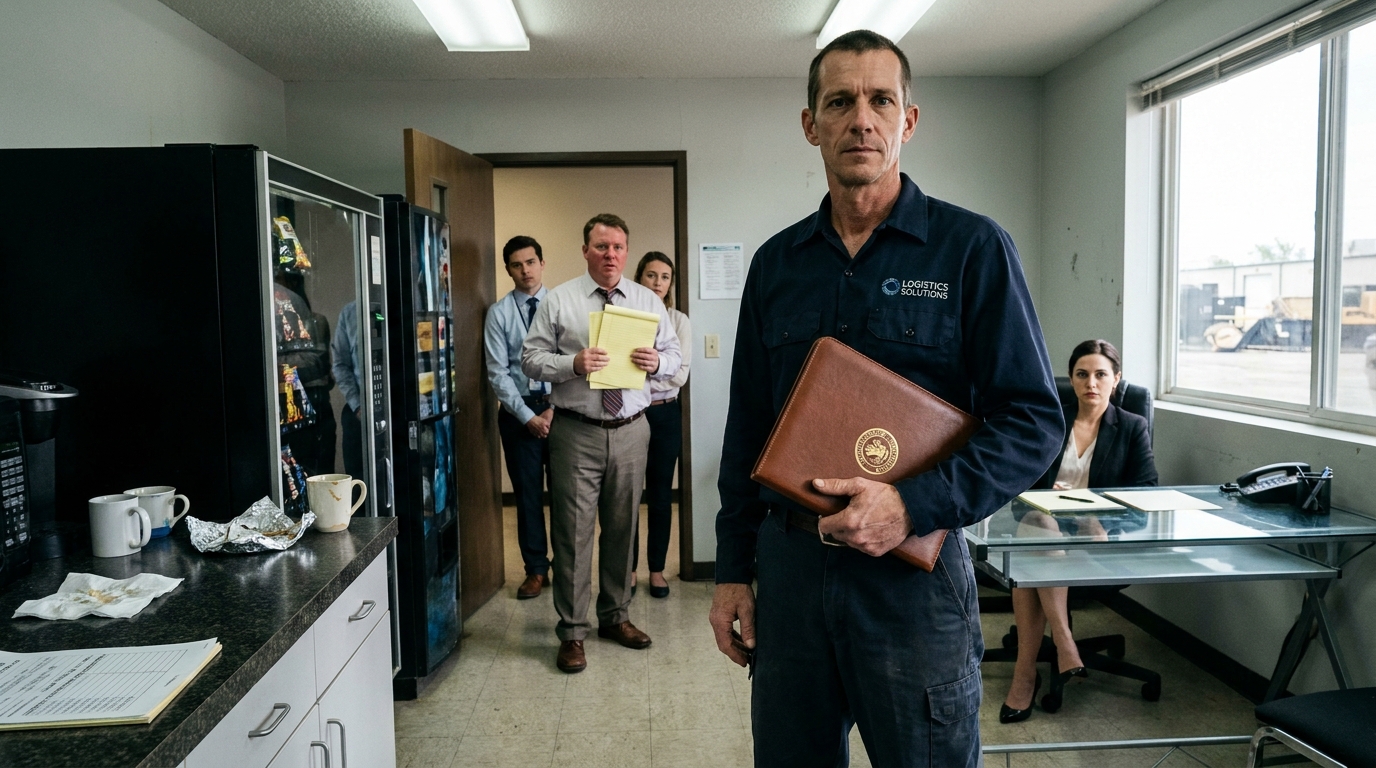
The breakroom smelled of stale instant coffee and bleach. Sitting at the small laminate table near the back was Amara, her fingers tracing the edge of a paper cup that had gone cold hours ago. Her eyes carried a faint dark shadow beneath them, but when she looked up and saw me hauling the weight, she stood up immediately.
“Here, let me hold the door for you,” she said, her voice soft against the low hum of the vending machine.
“I’ve got it,” I grunted, setting the box down on the counter with a heavy thud. “Just moving paper.”
“You look exhausted,” she said, reaching into her tote bag and pulling out a small, foil-wrapped biscuits package. She slid it across the formica table toward me. “Take this. You’ve been running back and forth to the parking lot all morning.”
I looked at the wrapper, then at her face. There wasn’t a trace of performative politeness in her expression—just simple, unearned consideration for a guy in a grease-stained uniform.
“I can’t take your lunch, Amara,” I said quietly.
“It’s not lunch, it’s a biscuit,” she replied, a tiny, genuine smile softening the fatigue around her eyes. “Everyone survives their first week here. I’m just making sure you don’t pass out before yours is over.”
I pressed my thumb against the spine of my logbook through my pocket, feeling the steady heat of the room settling between us.
CHAPTER 2: THE SCENT OF RAIN AND SMOKE
“Nobody moves out of this floor!”
It was Dennis, the senior accountant, his neck tie pulled crooked and his face flushed a mottled red. He stood in the doorway, his chest heaving as if he’d just run three miles up the stairwell. Behind him, two junior auditors hovered like nervous shadows, clutching yellow legal pads against their chests.
Amara froze, her hand still resting near the edge of the formica table. She didn’t flinch, but her eyes narrowed slightly as Dennis pointed a shaking finger toward the main corridor.
“Three million naira,” Dennis barked, his voice cracking on the last syllable. “Gone from the regional petty account. Just vanished between the ten o’clock reconciliation and now.”
The silence that followed was heavy and sudden, broken only by the distant hum of the building’s air conditioning unit. Across the room, a couple of clerical workers slowly set down their mugs. Nobody spoke. When that kind of money evaporates in a corporate office, the atmosphere doesn’t just turn tense—it turns toxic.
Vanessa stepped around Dennis, her designer pumps making no sound on the heavy rubber runner. Her eyes swept the room, entirely cold, until they locked onto me.
“He’s the newest hire on the floor,” she said smoothly, her tone conversational, almost pleasant, if you didn’t catch the venom underneath it. “And he’s spent the last four hours wandering between the executive garage and the accounting office with run sheets.”
I didn’t move. I kept my hand flat on the table, feeling the cold laminate beneath my palm. “I moved four crates of quarterly archives to the third-floor storage, ma’am. Per your direct order.”
“Which gave you unrestricted access to the unlocked archive annex right behind the safe room,” she countered, stepping closer. Her perfume hit the air—sharp, heavy lavender that smelled expensive and completely out of place in a breakroom that smelled like pine cleaner. “A driver making minimum wage suddenly spending thirty minutes unmonitored near the primary ledger holds.”
“He was delivering files Dennis asked for,” Amara interrupted. Her voice wasn’t loud, but it was steady as bedrock. She didn’t stand up, but she shifted her posture, putting herself directly between Vanessa’s line of sight and my chair. “I logged his entry at the desk. He was in the hallway for five minutes, Vanessa. Not thirty.”
Vanessa turned her head slowly, looking at Amara as if she were a stubborn stain on the upholstery. “I don’t recall asking for input from the front desk, Amara. Unless, of course, you’re helping him keep time.”
“I keep the visitor and courier logs,” Amara said, her chin lifting half an inch. “That’s my job. The logbook doesn’t lie.”
“Logbooks can be altered,” Vanessa replied, her gaze drifting toward the quiet counter near the coffee machine. Resting right beside the sugar dispenser was a pristine leather folder—one with a misaligned, off-center corporate seal stamped onto the corner, slightly crooked, like a rush job done in a dark room. “Or stolen altogether.”
I caught the detail in a fraction of a second. That binder didn’t belong to the fleet office. The seal on Adeyemi paperwork was always centered by machine at the central press; only the internal draft ledgers used the manual hand-stamp.
“If the money is missing, call the managing director,” I said, my voice deliberately flat, grounded in the plain logic of a guy who just wants to finish his shift. “Call the auditors. Search the bags.”
“We don’t need a three-day audit to figure out where the grease flows,” Dennis snapped, taking a step toward me. “A new driver comes in, and suddenly the physical float vanishes? It’s obvious.”
Amara stood up then. She didn’t raise her voice, and she didn’t throw a tantrum. She simply picked up her tote bag, slid her phone into her side pocket, and stood beside my shoulder.
“Search his locker if you want, Dennis,” she said, looking straight at Vanessa. “Search mine too. But don’t accuse people just because it’s easier than looking at who actually holds the keys to the safe.”
Vanessa’s lips narrowed into a tight, pale line. For a fraction of a second, the composure cracked, exposing something desperate and sharp beneath her polished exterior.
“We’ll see who holds the keys when the board reviews the shift reports tomorrow morning,” Vanessa said coldly, turning on her heel. “Nobody leaves this building without security checking their belongings.”
She walked out, Dennis trailing behind her like a faithful hound.
Amara looked down at me, her breathing quiet and measured. “You didn’t do it,” she said simply. It wasn’t a question.
“I didn’t,” I replied, my fingers tightening slightly against the worn spine of my driver’s logbook in my pocket. “And tomorrow, we find out why that leather binder on the counter has a fake stamp on it.”
CHAPTER 3: A LEDGER OF SILENCE
I walked over to the counter and picked up the pristine leather binder.
Amara stepped closer, her eyes following my thumb as I traced the edge of the misaligned corporate seal on the corner. The gold foil was still fresh enough to smudge under direct pressure.
“That isn’t a fleet log,” I said quietly, holding the cover open so she could see the top line. “This is a hand-stamped transfer ledger for off-site vendor payments. We haven’t used paper manifests for internal cash since the system update two years ago.”
“Vanessa brought that in this morning,” Amara murmured, glancing toward the empty hallway. “She had it under her arm when she came back from the bank drop before noon.”
“Without working security cameras on this floor, anyone could claim a cash bag vanished between the vault and the parking lot,” I said, setting the folder back down on the formica surface. “They don’t need footage if they have a signed paper transfer with an unverified signature.”
“She’s setting up a fall guy,” Amara’s voice hardened, her fingers tightening around the strap of her bag. “She knows Dennis won’t double-check the seal. He’s too panicked about his own department’s audit to look at the date.”
“She thinks I’m going to panic and run,” I said. “Or offer to pay it back quietly just to keep a low-level driving job.”
“What are you going to do?” she asked.
I pulled my driver’s logbook from my back pocket and flipped to the carbon receipts at the back—the physical, signed delivery slips for every box moved between the annex and the executive floor today.
“We don’t need a shouting match,” I said, handing her the duplicate carbon slip dated 11:15 AM with Vanessa’s initials inked firmly at the bottom. “We just need her to sign off on the daily shift reconciliation in front of the entire floor tomorrow morning.”
Amara looked at the paper, then up at my face, a slow realization settling in her eyes. “If she signs the physical manifest to prove you were in the archives, she validates the exact timeline that proves she had the transfer binder in her office two hours before the cash was ever flagged as missing.”
“She can’t claim I took it without admitting she faked the transfer,” I said.
Vanessa was sitting behind her glass desk when I walked into the main office ten minutes later, her phone pressed tight against her ear. She looked up, her posture instantly stiffening, her hand hovering over the receiver.
“You’re supposed to be in the fleet office,” she said, cutting off whoever was on the line and setting the phone down with a sharp click.
I placed the carbon delivery slip flat on her desk, right on top of her leather blotter.
“I need your signature on the end-of-shift archive delivery log, ma’am,” I said, my voice completely steady. “Standard protocol before the morning board review.”
Vanessa looked at the paper, then up at me, her eyes flaring with pure contempt. “You think a piece of scrap paper clears you of three million naira?”
“It logs the exact time you took possession of the archive boxes,” I said flatly. “Unless you’d prefer to explain to Dennis why the archive log has a gap.”
Her jaw tightened, a vein pulsing faintly at her temple as she grabbed a silver pen. She signed her name with a sharp, jagged stroke, slamming the pen back down onto the blotter.
“Get out of my sight,” she snapped. “Tomorrow morning, when the board sits, your paper won’t save you.”
I took the signed carbon slip, folded it neatly, and slipped it into my pocket.
CHAPTER 4: UNMASKED LIGHT
The room fell completely silent as my mother smoothed her hands over the mahogany lectern.
Vanessa sat near the front, her posture poised, a smug, satisfied smile resting on her face. She had her leather folder sitting squarely in front of her, ready to present her case against the new driver.
“Before we begin our annual anniversary proceedings,” Mrs. Adeyemi’s voice echoed clearly through the hall, “there is a critical matter of integrity we must address.”
Vanessa nodded eagerly. “Mrs. Adeyemi, if I may—we have identified the primary suspect in yesterday’s missing funds. The driver sitting in the back—”
“The driver sitting in the back,” my mother interrupted calmly, “is Tunde Adeyemi. My son, and the incoming Managing Director of this company.”
The air left the room in a single, collective gasp.
Vanessa’s smile froze, turning into a pale, rigid mask. Her eyes snapped toward me, wide with a sudden, paralyzing shock. Beside her, Dennis dropped his pen, his jaw slack as he stared at my driver’s uniform.
I stepped forward, taking out the folded paper manifest from my pocket along with the hand-stamped transfer ledger I had retrieved from the breakroom counter. I laid both documents flat on the center table.
“He didn’t come here to inspect your spreadsheets,” Mrs. Adeyemi continued, her gaze locking onto Vanessa. “He came here to see how you treat people when you think they have no power.”
“This is a mistake!” Vanessa blurted out, her voice rising an octave as she stood up so fast her chair screeched against the floorboards. “Mrs. Adeyemi, he’s lying or playing a trick—he’s just a driver! He was near the archive vault when the three million naira disappeared!”
“The three million naira didn’t disappear from the vault,” I said, setting my thumb against the misaligned seal on the binder. “It was moved two hours earlier through a manual draft account—signed off with a fake internal stamp that only exists on the desk in your private office.”
“You can’t prove that!” she snapped, her knuckles turning white as she pressed them against the table. “You have no camera footage! You have nothing!”
“I have your signed delivery receipt from 11:15 AM,” I replied smoothly, pointing to the carbon slip. “Which puts you in sole possession of the transfer book long before you claimed the money was missing. You staged the theft to cover your own fraudulent offshore balances.”
Vanessa looked around the room, desperately searching for support, but Dennis looked away, and the board members remained completely silent, their expressions cold. The weight of her own paper trail had completely pinned her.
“Auditors are waiting in your office, Vanessa,” my mother said softly, with zero drama, just absolute finality. “Security will escort you down.”
Vanessa didn’t say another word. She grabbed her bag, her heels clicking rapidly and unevenly as she rushed out the double doors, flanked by two corporate officers.
I turned away from the head table and walked down the center aisle toward the back row.
Amara was standing by her chair, her hands clasped tightly together. She looked at me—not at the title, not at the company name, but directly into my eyes.
“You’re the heir,” she whispered, a faint, breathless smile breaking through her hesitation.
“I’m the guy who owes you for a biscuit,” I said softly, pulling a bank draft from my inner coat pocket—one already made out in full to the hospital for her mother’s complete medical care. I slid it gently into her hands. “Your mother’s bills are settled. Fully.”
Tears welled in her eyes, but she held my gaze, her chin strong. “Tunde… I can’t accept this.”
“Kindness doesn’t come with conditions,” I said, repeating the words she had given me when I was just a man in a dusty blue shirt. “You stood by me when everyone else walked away. Let me stand by you.”
She looked down at the receipt, then back up at me, letting out a quiet, relieved breath that seemed to lift months of heavy exhaustion off her shoulders.
I took her hand in mine, feeling the calm, steady rhythm of the room settling around us.
Outside the high bay windows, the sun broke through the afternoon clouds, casting a warm, golden light across the clean mahogany table. I reached into my pocket, touched the worn edge of my old driver’s logbook one last time, and set it quietly inside the desk drawer, leaving it open to a blank, fresh page.