The Iron Foundation: How a Broken Workshop Exposed the Rusted Truth of Oakridge Community
CHAPTER 1: THE RUIN
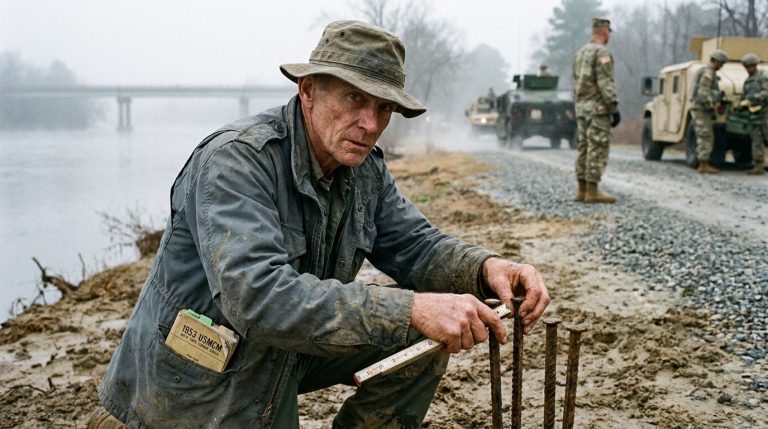
The diesel exhaust from the three yellow excavators still hung in the humid morning air, thick and greasy enough to coat the back of my throat. I dropped my canvas duffel bag. It hit the gravel with a dead, heavy thud. Five years of joint-grease, seasoned cedar, and the quiet safety of manual labor had been reduced to a flat, gray expanse of scarred concrete. The walls were gone. The roof was gone. Even the heavy iron vice I’d bolted to the main workbench had been ripped out, leaving only four jagged, rusted bolts sticking up from the stone like broken teeth.
“You’re thirty-six hours early,” Harriet Thompson said, the rhythmic, sharp click of her heels on the grit sounding like a firing pin dropping on an empty chamber.
I didn’t turn around immediately. I looked at the claw marks left by the excavator buckets in the dry clay bordering the slab. The soil was torn, revealing the pale, sickly roots of the old pines. The friction of the metal against the stone had left gray streaks of powdered masonry.
“Where is it, Harriet?” My voice was low, dry from the long flight, still carrying the faint metallic tang of military transport fuel.
“Oh, that old structural eyesore?” Her voice drifted over my shoulder, light and manicured, smelling of cheap lavender perfume and mints. I turned slowly, my boots grinding the loose gravel. She stood there, her bleach-blonde bob perfectly intact despite the wind, clutching a plastic clipboard to her pink-cardiganed chest like a breastplate. “We had it removed. It was in direct violation of the community aesthetic standards, Section Four. You didn’t respond to our certified letters.”
“I was in a combat outpost outside of Erbil,” I said. The words were flat, stripped of heat. I reached into my pocket, my fingers brushing against the cold brass of my grandfather’s old measuring caliper. I pulled it out, adjusting the slide with my thumb, feeling the familiar, mechanical click of the thumb-screw. “You demolished a permitted structure while I was deployed.”
“The board voted unanimously,” she replied, her smile tightening at the edges, though her eyes remained wide, glassy, and completely unbothered. “A deployment doesn’t exempt your property from the rule of law, dear. The neighborhood has to maintain its standards.”
She turned on her heel, her clipboard clutched tight as she walked back toward the paved street. I looked down at the concrete edge where my workbench used to sit.
Among the crumbled mortar and shattered brick, something caught my eye. It wasn’t the red clay or the gray dust of my walls. A thick, yellowish-green mineral crust had seeped up through the expansion joint of the concrete slab, drying into a brittle, synthetic-looking salt. When I leaned down and touched it, the tip of my finger came away with a faint, bitter scent that smelled nothing like cedar, oil, or soil. It smelled like industrial poison, and the concrete beneath it was warm to the touch.
CHAPTER 2: THE WATCHERS
The yellow-green crust on the tip of my index finger was cool, greasy, and stubbornly persistent. I rubbed my thumb against it, trying to grind the fine powder into the skin, but the synthetic, metallic stink lingered, biting through the familiar scent of old grease and dust. I wiped my hand against my work trousers, leaving a dull smudge on the faded canvas.
I stood in the center of the demolished slab, my shadow stretching long and thin across the concrete as the morning sun climbed higher over the pine line. The world around me was too quiet. The roar of the excavators had vanished down the county road, leaving only the soft hiss of wind through the dry needles of the trees and the crunch of my own boots as I shifted my weight. I bent down again, tracing the hairline fractures radiating from the expansion joint. The concrete shouldn’t have been warm. A slab that had been poured five years ago, shaded by overgrown oaks, should have carried the damp chill of the earth beneath it. Instead, a subtle, rhythmic vibration pulsed against my palm—so faint it might have been my own pulse, if not for the dry, scraping hum that accompanied it deep below the stone.
I stood up, my knees cracking in the silence. My fingers drifted back to the brass caliper in my pocket, adjusting the thumb-screw out to three inches, then back to zero. A habit of precision in a space that had been violently stripped of it.
“You’re looking in the wrong place,” a voice rasped from the edge of the property line.
I didn’t jump. My shoulders locked, my weight settling automatically onto the balls of my feet as I turned toward the treeline. Lewis stood there, half-shadowed by a sagging cedar fence. The retired neighbor looked smaller than he had ten months ago, his flannel shirt hanging loosely off his thin frame. He held a weathered garden spade in one gloved hand, the rusted metal edge caked with dry, pale clay.
“Lewis,” I said, my voice rough.
He stepped over the low wire, his boots shuffling through the dry pine needles. His eyes didn’t meet mine; instead, they darted past my shoulder, scanning the empty street behind me before settling on the flat expanse of the ruined slab. “They didn’t just pull down the walls, kid. They spent three hours digging at the southeast corner before Harriet even showed up with that clipboard. I watched from my kitchen window. They weren’t clearing debris. They were looking for something.”
I walked toward him, the dry gravel crunching under my boots. “They told me it was an aesthetic violation. Section Four.”
Lewis let out a dry, hacking laugh that turned into a cough. He spat into the dust. “Section Four is a stick they use to beat anyone who doesn’t bend. But they don’t bring three commercial-grade trackhoes just to settle a yard dispute. They wanted the ground open.” He lowered his voice, his gaze shifting back to the paved road. “Look down the street. The white utility truck. It’s been idling near the cul-de-sac since the operators left.”
I didn’t look immediately. I kept my back to the road, using Lewis’s thin frame to block my line of sight as I slowly turned my head.
About two hundred yards down, where the asphalt dissolved into dirt and scrub oak, a heavy-duty white pickup sat on the shoulder. Its engine was running, a thin wisp of pale exhaust curling from the tailpipe. The windows were deeply tinted, reflecting the gray glare of the morning sky, but the bold, blocky lettering on the side panel was clear even from this distance: Apex-Interstate Logistics.
My thumb tightened on the brass caliper in my pocket. Apex didn’t handle residential landscaping or municipal utility work. They were a heavy freight and industrial containment outfit, their massive terminal located ten miles south near the river. There was no logical reason for one of their scout vehicles to be idling in a quiet residential cul-de-sac on a Monday morning, watching a pile of broken concrete.
“They’ve been doing it to me, too,” Lewis muttered, his fingers tightening on the handle of his spade. “Wrote me up for the old oak out front. Said the root system was threatening the public water main. But when I asked to see the county survey, Harriet threatened to place a lien on my house. People are terrified of her, kid. She’s got the whole board signing off on whatever she puts in front of them.”
“They paid the contractor with emergency funds,” I said, the thought solidifying as I recalled the frantic letters Harriet had waved. “No community vote. No warning.”
“They wanted it gone before you got back,” Lewis said, his voice dropping to a harsh whisper as the white truck down the road shifted gears, its tires crunching slowly over the gravel shoulder as it crept ten feet closer. “They knew your return date. They had the schedule. You need to get inside, kid. They’re watching to see what you do next.”
I looked down at my hands, still carrying the faint yellow residue of the chemical salt. The heat in the concrete wasn’t coming from the sun. It was coming from something buried, and Harriet’s nephew wasn’t just clearing a violation—he was sealing a lid.
CHAPTER 3: THE PAPER TRAIL
The faint, persistent hum of the utility truck down the street seemed to make the very air vibrate against my collarbones. I kept my back toward it, standing alongside Lewis near the sagging cedar fence. My fingers were still raw, cold wind biting at my bare knuckles as I held the canvas strap of my duffel bag. The dry, bitter scent of the yellow residue on my hand didn’t just linger on my skin; it drifted up, triggering a sharp, unwelcome knot of muscle in my jaw. It was a sensory trigger I hadn’t expected to feel outside of Iraq—a memory of scorched earth, leaking industrial valves, and the heavy, flat taste of chemically treated water from a municipal distribution grid that had been sabotaged near our base.
I blinked the memory back down, focusing on the rough texture of the spade Lewis was holding. The metal was heavily oxidized, flaking orange scales of rust onto his dirt-stained gloves.
“Get inside,” Lewis said again, his voice barely a breath. “Before they find another excuse to step onto your property.”
“Let them try,” I said, though I didn’t stay standing on the open slab.
I picked up my duffel bag, the heavy canvas dragging through the dry pine needles as I walked toward the back porch of my house. The steps creaked under my weight, a familiar, hollow sound that offered a small sliver of ground-level reality. Behind me, the idling white truck from Apex-Interstate Logistics sat motionless at the curve, its dark windshield reflecting the dull, flat gray of the sky. I unlocked the rear door, stepping into the cold kitchen. The air inside smelled of dust and dead plaster, the stagnant odor of a home that had been closed up for ten months.
Without turning on the lights, I walked straight to the small wooden table in the corner where my laptop sat beneath a thin layer of grit. I pulled my phone from my pocket and dialed Amanda Greer’s office number.
The line ringed three times before her voice cut through the quiet. “John? You’re back. I saw the notice you sent from the airport. Is it as bad as you feared?”
“It’s worse,” I said, my voice sounding hollow in the empty room. I sat down on the edge of a wooden chair, my boots leaving two dusty prints on the linoleum. “They didn’t just clear a violation, Amanda. The whole structure is flat. They brought in heavy excavators and dug deep into the foundation. And there’s a residue on the concrete. Something synthetic. Yellow, bitter.”
There was a long pause on the other end, the sound of papers shifting over a desk. “They demolished a permitted building without a court order or a local municipal directive. Even if the HOA bylaws allow for lien enforcement, physical destruction of property without a judicial warrant is an incredibly high-risk legal maneuver. Especially for a civil board.” Her voice was methodical, steady, stripping the panic out of the situation and replacing it with the cold logistics of litigation. “I’ve already pulled the initial public filings for the Oakridge Community Association. We need to look at the money, John. An operation that size—three excavators, contractors, legal notices—requires a paper trail. Give me ten minutes. I’m going into the county tax portal and the state registry.”
“I’ll wait,” I said.
I set the phone on speaker and walked back to the kitchen window. I didn’t pull the curtain back; I simply stood at an angle, peering through the small gap between the fabric and the wooden frame. The white truck down the road hadn’t moved. The driver was a shadow behind the tinted glass, but I could see the pale glow of a mobile terminal or tablet illuminating the interior of the cab. They weren’t checking electric meters. They were monitoring the house.
“John, are you there?” Amanda’s voice broke the silence, sharper now, stripped of its professional detachment.
“I’m here.”
“I’m looking at the association’s ledger entries from the last quarter,” she said. “The demolition wasn’t processed through the standard maintenance account. It was flagged under an emergency authorization code—specifically for environmental hazard mitigation. But here is the anomaly: the payment went to an entity registered as Silver Pines Property Services. The total amount was a flat, unitemized disbursement of twelve thousand dollars.”
“Who owns Silver Pines?” I asked, my fingers tightening on the edge of the kitchen counter.
“The business registration was filed four months ago,” Amanda replied. “The registered agent is a resident of this county. Marcus Thompson. That’s Harriet’s nephew. He’s twenty-four, and his prior business experience is a single-member LLC for residential lawn care. There are no other employees, no heavy equipment listings, and no commercial liability insurance on file that would cover a structural demolition of that scale.”
The puzzle pieces were beginning to grind together, but the fit was still jagged. “She used community funds to pay her own family for a rushed job,” I said, looking out at the bare concrete slab. “She wanted it down before my deployment ended.”
“That’s classic self-dealing, and potentially criminal fraud,” Amanda said. “But it doesn’t explain the speed or the scale. An HOA board doesn’t risk a felony charge just to put twelve thousand dollars into a nephew’s pocket. There’s a discrepancy in the timing, John. The payment cleared before the demolition order was even drafted. We need the actual board meeting minutes to see who signed off on the emergency declaration.”
“I’m going to get them,” I said.
“Be careful,” she warned. “If Harriet realizes we’re digging into the accounts, she’ll try to retroactively amend the record. Don’t confront her yet.”
I hung up the phone, the cold kitchen quiet once again. Outside, the white truck slowly shifted into reverse, its tires rolling back into the deeper shadows of the pine trees, waiting.
CHAPTER 4: THE GROUND PENETRATION
The dark glass of the kitchen window remained cold against my forehead as I watched the white truck down the road. The shadow inside the cab didn’t move, its faint electronic screen casting a soft blue glow against the steering column. But then, the low, steady rumble of thunder rolled across the pine trees, vibrating through the glass pane. A heavy raindrop struck the dusty window, leaving a clean trail down the center, followed immediately by another, and then the sky simply let go.
The downpour hit the metal roof of the house with a sudden, deafening roar. In seconds, the dry dirt of the driveway turned into slick, dark mud, and the gravel began to hiss under the weight of the water.
I stepped away from the window, my decision made. The truck’s visibility would be severely cut by the sheets of water coming down. If there was anything to find out there on that slab, the rain was my cover. I pulled a heavy, oil-skin coat from the peg by the back door, slipping my arms into the stiff sleeves. The thick fabric smelled of old grease and storage. I reached down, grabbed a heavy iron crowbar from my small tool chest under the sink, and slipped the cold brass caliper back into my inner pocket to keep it dry.
I opened the back door, stepping directly into the storm.
The rain hit me like a physical force, cold and relentless, instantly soaking the collar of my shirt. I kept low, moving along the side of the house where the shadows of the eaves offered some protection. My boots sank into the newly formed mud, each step making a wet, sucking sound that was easily drowned out by the downpour. I reached the edge of the slab.
The concrete was slick now, water pooling in the shallow dips left by the excavator buckets. As the rain washed over the gray surface, it began to collect the yellow-green mineral crust I had noticed earlier, carrying it toward the edges in greasy, frothy channels. The smell of sulfur and wet rust rose from the ground, thick enough to make my chest tighten.
I knelt down on the cold concrete, ignoring the water soaking through the knees of my work trousers. The physical vibration I’d felt earlier wasn’t gone; if anything, the cold water hitting the warm stone seemed to make the concrete groan. I placed my bare palm against the wet surface. It was still warm—unnatural, heat rising from deep beneath the five-inch-thick pour.
I crawled toward the southeast corner of the slab, the area Lewis had said the workers were digging around before Harriet halted them. The rain was washing away the loose, disturbed clay at the edge. I leaned closer, my eyes searching the dark mud.
The constant stream of water was carving away a shallow trench in the clay, revealing a horizontal band of orange-flaked iron buried just beneath the edge of the concrete. It wasn’t a standard reinforcement rod. It was a thick, curved plate, bolted directly into the underside of the foundation.
I took the iron crowbar, using the flat, chiseled end to scrape away the heavy, wet clay. The metal of the bar scraped against the buried plate with a dull, ringing sound. The plate was heavily pitted with age, the rough texture of rusted iron biting into my fingertips as I cleared the mud. The rain kept filling the hole, but I worked fast, digging deeper into the trench until the bar struck something solid and hollow.
Clang.
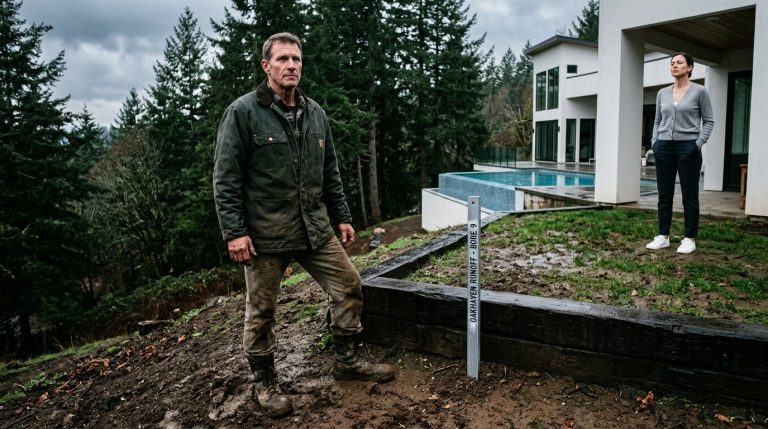
The sound was distinct—a resonant, metallic echo that came from directly beneath the center of my former workshop. I cleared a larger section of the clay, revealing a heavy, industrial-grade steel hatch cover bolted to the side of the foundation wall, sealed with grease that had turned black with age. Painted on the rusted surface of the hatch, half-eaten by decay but still legible under the wash of rainwater, was a stenciled code: A7-WH.
My breath caught in my throat. The yellow water was bubbling up from a small weep hole right next to the hatch, carrying that same bitter, synthetic stench. This wasn’t a standard residential plumbing connection, and it certainly wasn’t an aesthetic violation. My workshop had been built directly over a sealed access point.
I jammed the end of the crowbar into the seam of the hatch, throwing my weight against it to test the seal. The metal groaned, but the bolts didn’t budge. Down the street, the headlights of the white pickup truck suddenly cut through the heavy gray curtain of rain, two bright, yellowish beams of light swinging wide as the vehicle slowly began to roll forward, heading straight toward my driveway.
CHAPTER 5: THE DECOY CONFRONTATION
The twin shafts of yellow light pierced the driving rain, casting long, sweeping shadows across the flattened concrete slab. The white pickup truck crawled forward, its tires churning through the mud at the edge of my driveway with a heavy, rhythmic sloshing sound.
I let go of the iron crowbar. It dropped silently into the thick, dark clay beside the exposed steel plate of the Acre-7 Wellhead. Staying low to the ground, I rolled back into the shadow of the brick chimney—the only structural element of my workshop left standing. The brickwork was cold and rough against my shoulder blades as I pulled my wet oil-skin coat tightly around myself to minimize my silhouette. Rainwater streamed down my forehead, stinging my eyes, but my gaze remained locked on the vehicle.
The truck didn’t pull all the way into the yard. It stopped near the mailbox, its idling engine a low, wet growl beneath the drumming of the storm. The driver’s side door opened just an inch. The interior light remained off, but a pale hand reached out to adjust the side mirror before pulling back inside and clicking the door shut. They weren’t stepping out into the downpour. They were waiting to see if the sudden movement on the slab had been an optical illusion caused by the storm.
My hand slid inside my coat pocket, my cold fingers finding the brass caliper. I adjusted the slide, the small metallic clicking acting as a anchor to keep my breathing shallow and even. They knew I was looking. Or, at the very least, they knew the rain would wash away the fresh earth they had worked so hard to pack over the buried hatch.
After a long, agonizing minute, the truck shifted into reverse. The tires spun briefly in the mud, throwing up a spray of gray gravel, before gaining traction and backing down the street toward the main exit of the subdivision. The red glow of its taillights gradually faded into the gray curtain of rain.
I waited until the sound of the engine was completely swallowed by the storm before I stood up. My joints were stiff, the damp cold having settled deep into my bones. Instead of returning to the open hatch, I walked back toward the house. If they were patrolling, staying out in the open was a tactical error. I needed to move the search to the paper trail before I touched that hatch again.
Inside the kitchen, I stripped off the wet coat and grabbed a dry towel to wipe my face. The house was quiet, but the air felt charged. I went straight to the living room where I had left the binder Marcy had given me earlier in the week.
I spread the contents across the dining table. The paper was dry, a sharp contrast to the saturated world outside. I flipped past the complaints about grass height and mailbox paint, searching for any mention of the property line surveys or soil work.
Near the back of the folder, tucked behind a series of standard zoning notices, was a heavily creased sheet of paper. It was a copy of a backdated zoning amendment, stamped three months ago by the county planning office, but signed only by Harriet Thompson and Ron. It authorized an “emergency easement access” for the maintenance of subterranean utilities along the eastern edge of my lot.
The handwriting on the margin was sparse, but a specific name was jotted down next to the easement coordinates: Silver Pines.
The decoy was clear. Harriet had set up a paper shield. She had used her nephew’s newly registered company to claim a structural violation on my workshop, creating a legal excuse to clear the building so they could access the area beneath it. If anyone questioned the demolition, she could point to the backdated zoning notice and the “imminent hazard” of an unapproved structure sitting over an easement.
But the physical evidence on the slab didn’t match a simple utility easement. The yellow-green crust, the sealed iron hatch, and the presence of the Apex-Interstate Logistics truck pointed to something far more hazardous than a local water pipe or sewer line. They had established a legal cover story to keep me from looking at what lay directly beneath the concrete.
I picked up my phone and dialed Amanda’s number again. When she answered, the sound of her keyboard tapping was audible in the background.
“John? I’m still looking at these filings,” she said, her tone businesslike.
“I found the cover story,” I said, looking down at the backdated notice. “She filed an emergency easement for utility maintenance under my slab, using Silver Pines as the contractor. She’s claiming the building was structurally encroaching on community utility lines.”
“That’s a paper shield,” Amanda agreed, her typing stopping. “It gives them a color of authority if the county building inspector asks questions. But a civil easement doesn’t authorize summary demolition without a ten-day notice of default. Even with the backdating, it’s a massive liability.”
“They aren’t worried about civil liability,” I said, my eyes tracking the yellow smudge on my sleeve. “They’re trying to keep something buried.”
CHAPTER 6: THE WELLHEAD BREACH
The rain had not let up. It drummed against the windowpane with a flat, metallic persistence, washing down the glass in gray, distorted sheets. I stared at the creased easement notice on the table, my thumb tracing the edge of the paper. The stenciled mark A7-WH on the buried hatch matched nothing in the official municipal zoning documents, but in Marcy’s binder, tucked underneath a receipt for legal fees, there was a single page with a faded letterhead from years ago. It bore the name Apex-Interstate Logistics and referenced a retired monitoring site designated as the Acre-7 Wellhead.
The piece of paper felt cold under my touch. Harriet hadn’t just used her nephew’s company to tear down my workshop to satisfy a petty grudge or to pocket twelve thousand dollars of community money. She had done it to gain immediate, unmonitored physical access to this specific spot.
I folded the page, sliding it into my inner pocket next to the brass caliper. Outside, the wind howled through the pines, driving the rain sideways. If the white truck returned, I wouldn’t have another window of opportunity. I needed to know what was inside that wellhead.
Grabbing a heavy steel pry bar and a high-intensity flashlight from my workbench tool chest, I stepped back out into the deluge. The cold water immediately soaked through my clothes, plastering my hair to my forehead. I moved quickly through the dark mud, keeping low until I reached the southeast corner of the concrete slab.
The trench I had dug earlier was already half-filled with muddy water. I knelt in the grit, the wet clay squelching under my knees as I cleared the debris away from the steel hatch. The stenciled letters A7-WH were slick with grease and rain.
I wedged the flat edge of the pry bar into the seam of the heavy iron cover. I threw my entire weight against the handle, my boots slipping in the mud as I fought the resistance of the rusted bolts. The metal protested with a sharp, echoing screech that was swallowed by the sound of the thunder overhead. Slowly, the corrosion gave way. The seal broke, and a heavy, suffocating odor of sulfur and chemical solvent erupted from the gap, making my eyes water.
I pulled the heavy hatch open, pinning it back against the mud.
I clicked on the flashlight and shone the beam down into the dark opening. The light cut through a thick, yellow mist, revealing a concrete-lined shaft that descended ten feet below the foundation of my former workshop. At the bottom of the shaft sat a rusted iron pump assembly connected to a thick steel conduit. A slow, steady drip of neon-yellow liquid was leaking from a fractured pressure gauge, pooling in a shallow basin below.
Beside the pump, bolted to the concrete wall, was a weather-resistant plastic housing. I reached down into the shaft, the cold air rising from the depths smelling strongly of chemical waste. My fingers brushed against the latch of the plastic housing, and I pulled it open.
Inside lay a heavy leather-bound logbook, its cover stained with grease. I pulled it out, the wet cover cold against my hands. I opened it to the first page, keeping it shielded from the falling rain under my coat.
The pages were filled with hand-written entries detailing chemical concentration levels, dates, and names. The column headers were clearly marked: Chromium-9 Level. The last dozen entries, dated over the past six months, showed levels spiking far beyond municipal safety margins. Every single entry was initialed by Harriet Thompson, accompanied by a signature that authorized the bypass of the automatic alarm system.
It was the Chromium-9 Ledger.
The pieces aligned with a sickening clarity. The wellhead under my workshop was an active monitoring station for an industrial spill, and Harriet had been paid to falsify the safety logs, hiding the toxic runoff from the community water supply. My workshop had been demolished not because of community rules, but because the monitoring system had failed, and they needed to seal the leak before environmental inspectors detected the contamination.
The sound of tires crunching on gravel broke through the roar of the rain. I turned my head, the flashlight beam catching the high-intensity headlights of the white utility truck as it pulled back into my driveway, blocking my path to the house.
CHAPTER 7: THE SILENT SYNDICATE
The high-intensity headlights of the white utility truck cut through the sheets of rain, blinding me for a split second as I crouched near the open hatch of the Acre-7 Wellhead. The glare turned the falling water into a brilliant, silver screen, completely washing out my surroundings. The vehicle didn’t turn off its engine; its idling hum was a deep vibration that resonated through the mud under my knees.
I slipped the heavy, leather-bound Chromium-9 Ledger beneath my dry oil-skin coat, pressing it tight against my ribs. My thumb found the brass caliper in my pocket, the cold metal grounding my breathing.
The truck’s driver-side door swung open against the wind.
A figure stepped out into the downpour, clad in a dark, waterproof jacket with the word SUPERVISOR stenciled across the back in reflective lettering. The man didn’t rush toward me. He walked with a deliberate, slow pace, his heavy boots sinking into the wet clay at the edge of the concrete slab. He stopped ten feet away, keeping his hands visible but close to his sides, his face shadowed beneath a low-brimmed hat.
“You should have left the slab alone, John,” he said, his voice flat, barely carrying over the sound of the rain hitting the metal siding of the nearby house.
I slowly stood up, my knees aching from the damp cold. I kept the steel pry bar in my right hand, its point resting in the mud, maintaining my balance. “Marcus,” I said, recognizing the build and the voice from the public registry photo Amanda had retrieved. Harriet’s nephew. “You brought a lot of heavy machinery just to clear a minor property-line dispute.”
Marcus looked down at the open steel hatch, the yellow-green froth bubbling slightly near his boots. “This wellhead was decommissioned ten years ago. It’s a closed system.”
“It’s not closed,” I replied, my left hand holding my coat shut over the stolen ledger. “The pressure gauge is fractured, and the concentration levels are spiking. Your aunt has been signing off on bypass codes to hide the runoff from the community reservoir. How much did Apex-Interstate Logistics pay her to keep the Acre-7 Wellhead off the county inspect list?”
Marcus didn’t answer immediately. He reached into his jacket pocket, but instead of pulling a weapon, he pulled out a small, ruggedized tablet, its screen sealed against the rain. He tapped the display once, the blue light reflecting off his wet face. “The board voted on a maintenance contract. Everything on this site is covered under the emergency easement.”
“That backdated paper won’t protect you from a federal environmental investigation, Marcus. Not with this,” I said, shifting my weight to keep my boots from slipping in the mud. “This isn’t a zoning issue. It’s a chemical hazard.”
He looked at me, his eyes cold and empty under the brim of his hat. “The easement stands. If you interfere with utility maintenance, the county sheriff has to enforce the association’s physical access rights. We have the legal paperwork, John.”
“You have a fabricated ledger and a fake contract,” a new voice broke through the storm.
From the shadow of my back porch, a figure stepped out into the rain. It was Detective Carla Nuion, her dark utility jacket slick with water. She held a heavy flashlight in her left hand, its beam cutting past Marcus to illuminate the side of his truck, where the logo of Apex-Interstate Logistics was plastered. Behind her, two marked police cruisers pulled onto the curb with their blue and red lights flashing silently against the dark pine trees, their engines muted by the heavy downpour.
Marcus didn’t run. He stood completely still, his hands slowly rising to shoulder level as the officers stepped onto the grass, their boots squelching in the mud.
“Mr. Thompson,” Carla said, her voice clear and authoritative over the drumming rain. “We have a warrant for the seizure of all physical records and digital devices belonging to Silver Pines Property Services and the Oakridge Community Association. Step away from the wellhead.”
Marcus slowly lowered his hands, letting the tablet slide into the mud as the officers approached. He didn’t offer a defense. His face remained completely expressionless, the cold water washing the dirt from his forehead as they led him toward the waiting cruisers.
I looked down at the open hatch, the yellow-green water slowly draining away into the clay as the storm began to pass, leaving the rusted iron structure exposed to the cold, clean air.
CHAPTER 8: THE SATURDAY RECKONING
The silent strobe of blue and red light slowly receded down the street, casting long, rhythmic pulses across the wet pine trees before the dark bend of the road swallowed them entirely. The storm had passed. The heavy downpour had dwindled into a quiet, cold mist that clung to the hollows of the driveway, carrying away the stinging smell of ozone and sulfur. I stood on the muddy edge of the concrete slab, my boots sank into the saturated clay, and my hand still rested under my damp oil-skin coat, fingers holding the heavy leather corners of the Chromium-9 Ledger against my ribs.
I did not move for a long time. The street was empty, the neighborhood dark, save for the single yellow porch light of Lewis’s house down the road.
“It’s over, John,” Carla’s voice had said right before her cruiser doors had clicked shut. But the real weight of it was only now settling into the stone beneath me.
By Saturday afternoon, the dry heat of the southern sun had baked the clay back into a pale, hard crust. The community clubhouse was packed, its air-conditioned room smelling of dry carpet, folding chairs, and the sharp, nervous sweat of eighty people crammed into a space built for fifty.
Harriet Thompson sat at the head of the long oak table. She wasn’t wearing her pink cardigan today. She wore a dark, structured blazer, but her bleach-blonde bob seemed slightly frayed, a few stray hairs catching the harsh glare of the fluorescent lights. Her hands were folded flat on her plastic clipboard, but her knuckles were white, and her eyes darted toward the double doors every time the brass latch clicked. Behind her stood Ron and Marsha, their faces pale, shifting their feet like passengers on a sinking vessel.
I walked down the center aisle, my boots sounding loud and heavy against the vinyl flooring. I wasn’t carrying a weapon. I had no need for one. In my right hand, I held the heavy leather ledger, and tucked under my arm was a certified copy of the state environmental registry for the Acre-7 Wellhead.
“We have a scheduled agenda, John,” Harriet said, her voice attempting its familiar high-pitched authority, but it lacked the grease. It was dry, catching in her throat as her gaze locked onto the worn leather book in my hand. “We are not taking unscheduled comments from the floor.”
“The floor is done listening, Harriet,” I said.
I didn’t raise my voice. I stood three feet from the table, placing the ledger down with a solid, echoing thud that made the plastic clipboard rattle. I flipped the book open to the last page, pointing to the handwritten bypass codes and her own faded initials.
“This is the Chromium-9 Ledger,” I said, my voice carrying clearly to the back row where Lewis, Marcy, and dozens of others stood shoulder-to-shoulder. “For five years, Apex-Interstate Logistics has been leaking industrial runoff into the local water main directly beneath my backyard. This board didn’t tear down my workshop because of a zoning violation. They tore it down because the monitoring pipe at the Acre-7 Wellhead had fractured, and they needed to seal the chamber before the county inspectors detected the toxicity levels in the soil.”
A low, horrified murmur rippled through the crowd. Marcy stepped forward, holding her binder open to the financial pages we had pulled from the state portal. “The twelve thousand dollars paid to Silver Pines wasn’t for clearing debris,” she announced. “It was a kickback from Apex-Interstate, funneled through Harriet’s nephew to cover the cost of the fast-tracked excavation.”
Harriet’s face went from pale to a deep, mottled red. Her mouth opened, her fingers twitching against her clipboard. “This is private association business. You have no legal standing to bring these documents—”
“The EPA and the State Attorney General signed the warrants three hours ago,” I said, leaning over the table, my eyes locking onto hers. “Your nephew Marcus is already in custody. He gave them the bank routing numbers for the Silver Pines accounts. It’s over.”
The silence that followed was absolute, broken only by the hum of the air conditioner. Harriet slowly let go of her clipboard. It slid an inch across the polished oak, her fingers trembling as she looked at the rows of silent, unyielding faces of the neighbors she had ruled for half a decade.
Two state environmental enforcement officers stepped through the back doors, followed by Detective Nuion. The crowd parted for them in complete silence.
The denouement of the neighborhood came slowly, like the quiet rebuilding of a dry-stone wall.
Three weeks later, the warm sunset cast a long, amber glow over my property. The air smelled of clean, unseasoned pine and fresh-turned earth. The concrete slab had been professionally remediated, the toxic monitoring wellhead safely sealed and diverted by county engineers under a federal oversight program.
I stood in the center of my new workshop, the wooden frame smelling of cedar and resin. The walls were up, the rafters casting long, geometric shadows across the floor. On the main workbench, the old iron vice was bolted down once more, its threaded screw clean and newly greased.
I reached into my pocket and pulled out my grandfather’s brass caliper. The slide was slightly stiff from the grit of the past few weeks. I grabbed a small rag dipped in machine oil, slowly wiping the metal clean, removing the last traces of the yellow chemical dust from the brass grooves. I adjusted the slide, feeling the smooth, solid click of the thumb-screw settling into place.
Through the wide double doors of the shop, I could see the street. There were no white utility trucks idling in the shadows. Kids were riding bicycles down the cul-de-sac, their laughter faint and clear in the evening air. Lewis was sitting on his front porch, a mug of coffee in his hand, watching the sunset without looking over his shoulder.
I set the caliper down on the clean pine of the workbench, picked up my hand plane, and began to smooth the edge of a rough-cut cedar plank. The sweet, dry scent of wood shavings rose around me, filling the room, and for the first time in ten months, the air was entirely clear.