The Hill Demands a Reckoning of Broken Concrete to Bury the Ancient Treachery of a Manufactured Crown
CHAPTER 1: THE MEASURE OF GRAVITY
The paper was too thick for a small town. It had the heavy, textured weight of stationery bought by people who used the word protocol in casual conversation.
Luke stood at the edge of the property line, the certified envelope tucked under his arm, his boots sinking two inches into the damp, hemlock-needle mulch. The air smelled of impending rain and the sharp, medicinal tang of creosote—the old, black oil that had kept thirty-five feet of railroad ties from rotting into the Oregon clay since the winter of 2002.
He reached out and tapped the top timber with his knuckles. The sound was dull, dense, and dry. It was the sound of a wall doing exactly what it was built to do: fighting gravity and winning by a fraction of an inch every single day.
Below him, the hillside fell away toward Vanessa Caldwell’s lot. Her house was a stark, white cube of stucco and glass, looking entirely out of place against the dark, ragged wall of Douglas firs. From this height, her new infinity pool looked like a dropped scrap of blue sky, its clean concrete lip cutting into the natural sweep of the slope.
He looked down at the letter again. Visually inconsistent.
A slow, dry smile touched his face, but it didn’t reach his eyes. He had spent twenty-five years moving dirt in Lane County. He knew that clay didn’t care about aesthetic harmony. Clay only cared about water, and right now, the water was coming. He could feel it in the soles of his boots—the subtle, cold sponginess of earth that had reached its saturation limit.
Luke knelt down to inspect the deadman anchors—the heavy timbers that extended backward into his own yard to tie the wall into the stable soil. As he cleared away the wet leaves, his fingers struck something hard and cold.
It wasn’t a root.
He scraped the dark loam aside with the blade of his pocketknife. A square steel survey stake had been driven flush into the ground, directly behind the third railroad tie. The metal was bright, unrusted, and completely raw, as if it had been hammered into the earth within the last forty-eight hours.
Luke leaned closer, the scent of wet iron and disturbed clay filling his nose.
Stenciled along the flat face of the steel was a string of characters yellowed by protective lacquer: PROPERTY BOUNDARY ASSAY – OAKHAVEN RUNOFF – BORE 9.
Luke sat back on his heels, his fingers stained black with leaf mold. He had lived on this ridge for twenty-four years. He knew every property line, every corner pin, and every county easement. There was no Oakhaven Runoff on any deed he had ever signed, and no one had asked his permission to drive steel into his yard.
Behind him, the first heavy drop of the autumn rain hit the dry cedar siding of his shop with the sound of a falling pebble.
CHAPTER 2: THE WEEPING CLAY
The single drop on the cedar siding was followed by a silence so thin it felt brittle. Luke did not stand up immediately. He kept his fingers pressed against the cold, unyielding edge of the steel survey stake. The vibrations of the ridge were slow, almost imperceptible to anyone who hadn’t spent half a lifetime reading the tension of grade lines, but through the iron pin, he felt the faint, high-frequency hum of subterranean water searching for an exit.
He wiped his clay-smeared thumb against the coarse seam of his canvas work pants, leaving a dark, greasy streak. The grease on the stake wasn’t standard surveyor’s oil; it had a thicker, chemical viscosity that didn’t wash off with the rain. He stood slowly, his knees making a dry, paper-like pop in the cool air. The timber wall behind him rose eight feet, its massive creosoted faces blackening as the drizzle began to coat the wood, turning the rough-sawn grain slick as coal.
To get down to the pool deck, he couldn’t just jump the drop. He had to follow the narrow shoulder where the slope transitioned from his graded, stable soil to the raw cut of the hillside. His boots, heavy with five pounds of clinging Lane County clay, ground against the exposed basalt gravel he had laid down for drainage years ago. Every step was an exercise in friction. He leaned his weight back into the hill, using the heel of his left boot to bite into the sodden earth before committing his balance.
Halfway down the descent, a sharp, wet pop echoed from the brush to his right.
Luke stopped, one hand stabilizing himself against the trunk of a stunted cedar. A length of corrugated black drainpipe, buried six inches beneath the surface of the slope, had buckled under some sudden, localized pressure. The plastic had split down its seam, and a thick, yellowish tongue of water began to lick out, carrying with it a slurry of fine silt. It wasn’t the clean, gray runoff of rainwater. It was thick, carrying a greasy sheen that caught the dull afternoon light like oil on a wet road.
He watched the miniature torrent cut a clean groove through the ferns. The water was draining toward the east corner of Vanessa’s property, right toward the edge of her newly laid turf. He didn’t move to patch it. He simply watched the volume of the leak, measuring the rate of erosion against the steady, rhythmic beat of the rain on his hood. The hillside was already changing its plumbing.
He continued down, the grade flattening slightly as he reached the perimeter of the Caldwell lot.
Vanessa’s yard was a study in artificial geometry. Where his yard ended in raw timber and natural brush, hers began with razor-straight lines of black basalt pavers and sod so green it looked painted. But near the edge, where the sod met the natural clay slope, the grass was spongy. Luke stepped onto the manicured lawn, and his boot sank three inches with a wet, sucking sound.
He looked toward the pool. It sat perfectly still, a massive concrete vault sunk into the shelf of the hill. But at the corner nearest the slope, right where the infinity edge spilled into the catch basin, the concrete wasn’t dry. Water was weeping upward through the joints of the basalt pavers—not down from the sky, but up from the foundation, driven by the hydraulic pressure of the saturated hill behind it.
“You’re on my property, Luke.”
Vanessa stood under the deep overhang of her modern porch, her hands tucked into the pockets of a gray cashmere cardigan that looked far too delicate for the Oregon autumn. She didn’t have her sunglasses on now. Her eyes were sharp, dark, and entirely dry, tracking the mud his boots had dragged onto her clean stone walkway.
Luke didn’t step back. He stood on the edge of the turf, his hands hanging loose at his sides. “The survey pin up top,” he said, his voice level and devoid of heat. “The one stenciled with the Oakhaven Runoff mark. Your people put that in?”
Vanessa’s posture didn’t change, but her chin tilted up a fraction of an inch. “The association had the easement verified last week. If you’re referring to the structural boundary, it’s well within the legal limit of the slope correction.”
“It’s driven three feet into my deadman anchors,” Luke said. He pointed a finger back up the hill, toward the dark line of the railroad ties looming over them. “You’ve got water coming out of the lateral drains that isn’t yours, Vanessa. And that pool of yours is sitting right on the main artery.”
Vanessa took two steps forward, her white leather sneakers stopping just short of the wet grass. “I paid seventy thousand dollars for the engineering on that vault, Luke. It’s anchored to the bedrock. If your ancient wood wall can’t handle the natural runoff of the ridge, that’s a liability issue your insurance will have to resolve with the board.”
Luke looked down at her shoes, then back at the concrete lip of the pool. The water in the basin was clear, but along the raw concrete underside of the cantilevered deck, a tiny, persistent stream of brown clay was beginning to paint a dark, permanent stain.
“The hill doesn’t care about the board,” Luke said quietly. “And it doesn’t care about seventy thousand dollars.”
“We’ll see what the city’s building inspector says about the aesthetics of that creosote barrier next week,” she replied, her voice dropping into that cold, transactional register he had heard from county land lawyers. “You have twenty-eight days left on that notice.”
Luke didn’t answer. He turned and began the slow, heavy climb back up the slick clay path, his boots slipping once on the wet basalt before his heel found the solid, honest grip of his old railroad ties.
CHAPTER 3: THE DEEP CORE MEASURE
The climb back up the slope was silent save for the wet, rhythmic crunch of gravel under Luke’s soles. He didn’t look back at the white modern box of Vanessa’s house, but he could feel the cold weight of her gaze resting between his shoulder blades until he crested the ridge and stepped behind the dark timber line.
The rain had settled into a steady, gray hum, drilling into the cedar needles and turning the topsoil to a thick, cold paste. Inside the metal-sided equipment shop, the temperature had dropped. Luke pulled off his wet canvas coat, hanging it from a rusted iron nail on the collar beam where it began to drip onto the concrete with a slow, flat tap-tap-tap.
He didn’t sit down. He walked straight to the back wall where the county survey maps from 2002 were pinned to a sheet of fiberboard. The edges of the paper were yellowed and curled, smelling of damp cedar and hydraulic oil. He traced his finger along the boundary line of his lot, down to the southern margin that bordered the Caldwell property.
There was no Oakhaven Runoff listed on the municipal watershed overlay.
The phone on his workbench buzzed twice against a pile of galvanized pipe fittings. He picked it up.
“Luke,” David Morales’s voice was dry, carrying the flat, tinny resonance of a truck speaker. “I’m looking at the elevation charts you sent over. That ridge is moving faster than the county’s public works database is updating.”
“I found a steel stake driven into the deadman timber behind the third tie, David,” Luke said, his voice quiet in the hollow space of the shop. “It’s got a stencil on it. PROPERTY BOUNDARY ASSAY – OAKHAVEN RUNOFF – BORE 9. You ever run across that designation in the regional soil surveys?”
A long pause stretched over the line, filled only by the crackle of bad cell reception on the ridge. “I’ve done the foundation surveys for half the subdivisions between here and Coburg, Luke,” Morales said, his tone shifting, losing its professional distance. “Oakhaven isn’t a county project. That was the old name of the timber treatment facility that burned down in the late seventies. The state cleaned up the surface, but the deep hydrologic records are… difficult to access. Let’s just say they’re filed under restricted industrial classification.”
“The Halogen File,” Luke muttered, his eyes drifting back to the survey map.
“What’s that?”
“Nothing,” Luke said, though he had seen the name typed on a faded yellow county zoning map tucked into the back of his original land title folder—a file labeled with a red sticker that had since peeled to a dry, white scar. “How soon can you get your rig up here?”
“I’m ten minutes out. I’ve got the static penetrometer in the bed,” Morales replied. “But Luke, if they’ve got Bore 9 marked, they aren’t just measuring the grade. They’re looking for where the deep water is pooling under that clay shelf.”
The call clicked off. Luke set the phone down on the cold aluminum surface of his clipboard.
He walked back out into the drizzle to wait at the gravel driveway. Within minutes, the gray four-wheel-drive truck emerged from the mist, its mud-flaps caked in yellow clay. Morales climbed out, his yellow slicker shining under the dull sky. He didn’t offer a handshake; instead, he reached into the back of the truck and hauled out a three-foot steel rod fitted with a brass dial at the shoulder.
“Let’s check the lateral pressure behind the center ties first,” Morales said, his boots crunching as he followed Luke toward the retaining wall.
They stood at the top edge of the timber barrier. Below them, the slope seemed to hold its breath. The yellow water weeping from the split black drainpipe had already carved a six-inch channel through Vanessa’s sod, but the pool itself remained a motionless, brilliant blue square in the middle of the brown mud.
Morales knelt at the spot where the raw steel pin had been driven. He took a brass-handled probe, aligned it with the grain of the clay, and pushed down with the slow, deliberate weight of his chest. The dial on the gauge flickered, then jumped.
“Eighty pounds per square foot of static pressure at eighteen inches,” Morales whispered, his eyes narrowed against the rain. “That’s not rain runoff, Luke. That’s a deep hydrologic head. The mountain is pushing from three rooms down, and someone has been drilling holes to find out exactly where the floor is going to drop.”
Luke reached down and touched the bright steel of the Bore 9 pin. It was vibrating—faintly, like a copper wire in a drafty room. The earth was speaking, and it wasn’t a whisper anymore.
CHAPTER 4: THE ACCORD OF MALICE
The vibration of the pin on the hill lingered in the tips of Luke’s fingers long after he walked back inside the shop. Rain continued to drum its relentless, flat rhythm against the corrugated tin roofing, a sound that made the close, oil-scented air feel smaller, tighter. He stood before the green steel filing cabinet in the corner, his boot heels leaving damp clay crescents on the concrete floor.
He didn’t pull the top drawer. He went straight to the bottom, where the heavy, suspension folders from his 2002 purchase were filed under faded plastic tabs. The metal runners groaned, a dry scrape of ungreased steel on steel that echoed in the quiet room. He reached past the standard title insurances and county sewage permits, his hand seeking the coarse, stiff texture of the folder he had ignored for over two decades.
His fingers found the edge. The manila folder was soft at the corners, swollen slightly by twenty-four years of Pacific Northwest humidity. When he pulled it into the light of the single overhead bulb, he saw the red adhesive label he’d noted in his memory. It had dried, curled, and split down the center like an old autumn leaf, but the faint purple ink of a county clerk’s stamp was still legible beneath the dust: EXEMPTION CLAUSE – DEEP BOUNDARY ZONING.
Inside lay the land survey, but behind it, stapled with a heavy, rusted iron wire, was a single sheet of red-bordered bond paper.
The staple had bled a dark brown streak down the margin, nearly obscuring the first line of type. Luke leaned closer, the smell of old cellulose and iron rust sharp in his nose. The document was an indemnity agreement between the county and the developer who had subdivided the ridge before Luke bought his parcel. Near the center of the page, a term was underlined twice with a blue ballpoint pen: Subject to structural containment obligations under the Halogen File (Water Quality Control Ordinance 77-B).
The phone on the workbench did not ring. Instead, the gravel outside hissed.
The sound of tires on wet basalt gravel was different from Morales’s heavy truck. This was a lighter, smoother vehicle, its engine purring with a quiet, expensive frequency before cutting out. Luke slid the red-bordered document into his back pocket, letting the folder drop back into the dark of the drawer. He didn’t close the cabinet; the drawer remained open, a black gap in the green steel.
By the time he reached the open bay door of the shop, his attorney, Greg Foster, was already stepping out of a clean, silver sedan. Greg didn’t wear a slicker. He held a black umbrella close to his shoulder, his gray wool trousers immaculate despite the mud beginning to splash against his leather loafers. His face, weathered at the corners of his eyes, carried the expression of a man who spent his mornings reading the fine print on foreclosure notices just to keep his mind sharp.
“You’re standing in a puddle, Luke,” Greg said, his voice a low, dry baritone that barely carried over the rain.
“The hill is draining faster than it did yesterday,” Luke said, gesturing toward the ridge behind the shop. “David Morales was just here. He put a static probe behind the third tie. Eighty pounds of lateral pressure. And he found a steel pin labeled with a borehole marker I’ve never seen on any city plat.”
Greg stopped at the concrete threshold of the shop, lowering the umbrella with a crisp, downward snap. He tapped the wet metal tip against the floor, leaving a small, dark ring of water. “Let me guess. A regional assay?”
“Bore 9,” Luke said. He pulled the red-bordered sheet from his pocket and held it out. “And this was stapled to the original deed folder. It references a water quality ordinance from 1977. Something called the Halogen File.”
Greg took the paper, his eyes scanning the lines with a rapid, practiced sweep that didn’t stop for the punctuation. He didn’t look up, but his thumb traced the rust stain left by the old staple. “The county didn’t just approve your retaining wall in 2002 because they were being neighborly, Luke. They approved it because they wanted a private citizen to maintain a structural barrier they didn’t want to pay to engineer themselves.”
“And Vanessa?”
“Vanessa Caldwell is a designer, but her partners in Portland are commercial developers,” Greg said, folding the paper once and sliding it into his breast pocket. “They don’t want a residential view. They want the entire slope graded flat for a multi-unit access road once the residential zoning is broken. But to break the zoning, they need the current structures—including your wall—to be declared non-compliant with the modern design standards.”
“They’re using the HOA to force me to pull my own teeth,” Luke said, his jaw tightening until the muscle along his cheek showed hard under the skin.
“They’re using her vanity as a lever,” Greg corrected him, his eyes meeting Luke’s with a cold, steady clarity. “But they made a mistake. They sent the demand on professional stationery, signed by Vanessa as the corporate board president, and they threatened daily municipal fines without consulting the county hydraulic engineer first.”
He reached into his leather briefcase and pulled out a single sheet of paper—clean, white, and carrying the blue ink signature of his firm.
“This is the response,” Greg said, his voice dropping into a quiet, almost cheerful cadence. “We don’t fight the removal. We don’t appeal the design standards. We demand a formal, notarized confirmation of the board’s order to dismantle the timber barrier, explicitly stating that the association assumes all structural liability for the slope’s subsequent behavior. If they sign it, they own the mountain.”
Luke looked down at the paper. “And when the rain doesn’t stop?”
“Then,” Greg said, his dry smile appearing like a crack in old leather, “we let gravity do the depositions.”
CHAPTER 5: THE EXTRACTION MECHANISM
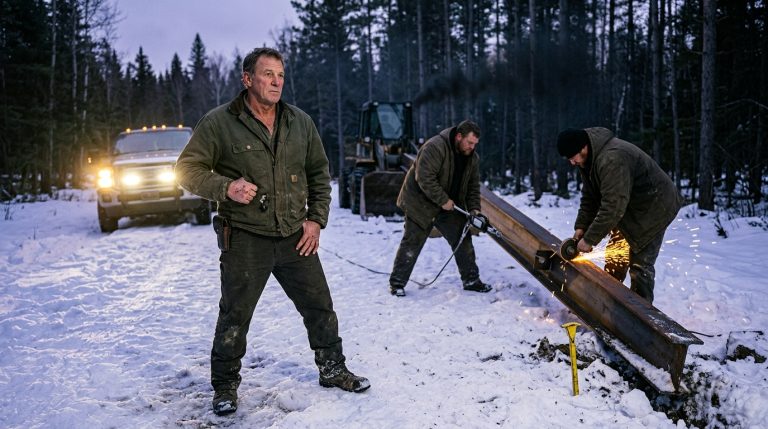
The paper settled into Greg’s coat pocket with a soft rustle, instantly swallowed by the roar of the flatbed truck backing down the gravel drive. Luke didn’t wait for the dust to clear. He stepped toward the yellow steel chassis of the rented thirty-ton excavator, his boots slicked with the yellow, iron-rich clay of the upper path. The rain had ceased its heavy drumming, leaving behind a cold, heavy fog that pooled in the hollows of the timberline and smelled of wet fern and old diesel fuel.
He climbed the three metal rungs to the cab, his wet hands gripping the cold, diamond-plate safety handles. The seat was stiff, freezing beneath his thighs as he settled into the vinyl cockpit. When he turned the key, the starter ground once, a heavy, metallic rasp, before the six-cylinder engine caught. The machine shivered, sending a high-frequency vibration straight up through the floorboards and into the soles of Luke’s work boots.
Below, in the white modern courtyard, Vanessa Caldwell stood by the gray stone edge of her pool deck. She had a dry wool throw draped over her narrow shoulders, her face pale and static under the overcast sky. She didn’t wave. She didn’t move. She simply watched the steel boom of the machine swing toward the ridge, her presence a silent, regulatory pressure at the bottom of the grade.
Luke rested his hands on the twin hydraulic joysticks. The steel linkages hummed beneath his palms. He nudged the left lever forward, and the massive, bucketed arm rose, its greasy black joints groaning as they sliced through the cold fog.
“Step back, Marty,” Luke called out of the open cab window to the neighbor leaning against the perimeter wire.
Marty nodded once, his eyes fixed on the center of the retaining wall. He took three deliberate steps backward onto the gravel shoulder, his hands shoved deep into his canvas pockets. “She signed it, then?” he shouted over the rumble of the idling engine.
“She signed it,” Luke said.
He lowered the bucket. The five massive carbon-steel teeth of the shovel touched the top of the center railroad tie. It was the heart of the structure—the pivot point where the deadman anchors met the vertical face of the twenty-year-old wall. He applied downward pressure, feeling the resistance of the hill travel straight up the hydraulic lines. The steel frame of the excavator groaned, the tracks shifting an inch into the soft gravel as the machine anchored its weight.
The tooth of the bucket bit into the creosoted wood. A smell like old tar, sharp vinegar, and deep-earth decay burst into the air, instantly cutting through the clean diesel exhaust.
Luke pulled the right lever back. The bucket curled.
With a deep, wood-fiber scream, the first tie began to move. It didn’t slide out easily; it fought, its old spruce grain bound tight to the eighty tons of wet clay behind it. The wood let out three rapid, gun-shot cracks—the sound of long-anchored steel spikes bending under thirty tons of hydraulic force.
As the timber broke free, a small, dark mouth opened in the face of the hill. A steady trickle of liquid mud, thick and yellowish-brown, immediately began to seep through the gap, pooling around the tracks of the excavator. It carried the faint, chemical scent of old coal tar—not just rain, but something heavy and industrial that had been trapped behind the wood for twenty years.
Luke didn’t stop. He pivoted the cab, dropping the massive, caked timber onto the growing pile at the edge of the drive with a heavy, hollow thud. His movements were methodical, a calculated rhythm of reach, bite, lift, and drop.
By the fifth timber, the structure was losing its structural shape. The hillside was no longer a vertical terrace; it was beginning to bulge, the topsoil behind the gap weeping in slow, sluggish waves like a wound exposed to the cold air.
From the corner of his eye, Luke saw Greg Foster standing near the shop, his briefcase held high against the light spray of the machine’s tracks. Greg was watching the mud, not the timbers. His face remained expressionless, but his eyes were fixed on the oily rainbow sheen that began to swirl on the surface of the yellow water draining toward the Caldwell lot.
Luke reached for the next tie. The mountain was lighter now, the pressure shifting away from his steel machine and moving downward, seeking the path of least resistance.
CHAPTER 6: THE SHEAR PLANE
The tracks did not hold. Beneath the thirty-ton chassis, the basalt gravel didn’t just slide—it liquefied, the waterlogged yellow clay acting like grease under the heavy steel pads.
As Luke reached for the seventh timber, a high-pitched, metallic ping echoed from the main boom cylinder. It wasn’t the sound of wood splitting. It was the sharp, violent snap of a pressurized seal giving way. Instantly, a hot, white spray of hydraulic oil erupted from the line, hitting the freezing exhaust manifold with a violent hiss that filled the cab with the bitter, choking smell of scorched synthetic fluid.
The controls in Luke’s hands went soft. The massive bucket, half-clamped around a creosoted tie, sagged six inches, its steel teeth dragging down the face of the timber wall with a dry, grinding screech.
“Luke! Get it back!” Marty’s voice was thin, swallowed by the roar of the engine and the hiss of the steam rising from the engine bay. He was gesturing wildly from the edge of the drive, his boots half-submerged in the yellow water now spilling over the top margin of the gravel.
Luke didn’t panic. He kept his feet flat on the floorboards, his left hand shifting the travel levers to reverse while his right hand worked the dying bucket controls to clear the timberline. The engine roared, its governor fighting the drop in pressure, but the tracks only spun, churning the mud into a frothy, yellow soup.
Below, Vanessa Caldwell had taken three steps back toward her sliding glass doors. The white wool throw had fallen from her shoulders, lying forgotten on the pristine black pavers where the first fingers of yellow silt were already beginning to lap. She looked up at the excavator, her face frozen, her fingers gripped tight around the railing of her pool deck as the mountain began to settle in real-time.
Through the floor of the cab, Luke felt the sheer plane let go.
It was a deep, subterranean sigh—not a crack, but a low-frequency displacement that vibrated through his pelvis. The remaining three railroad ties on the left flank didn’t fall forward; they simply slid outward as a single unit, pushed by eighty tons of wet organ soil that had finally been given permission to move.
He killed the engine. The silence that followed was heavy, broken only by the steady, cold hiss of the rain and the metallic tick of the cooling manifold.
He swung his legs out of the cab, his boots landing with a wet splash in four inches of moving clay. The mud was warm—unseasonably warm—carrying that same thick, chemical stench of coal tar and old sulfur he had smelled on the Bore 9 pin. He stood on the shifting track, his hand gripping the cold steel lift arm as he watched the hillside redefine itself.
The slide did not drop in a sudden, crashing wave. It moved like cold molasses, the top soil rolling over the lower terrace in three distinct, heavy folds. The black basalt pavers of Vanessa’s courtyard buckled first, the joints popping like small firecrackers as the clay forced its way beneath them. Then, the concrete lip of the infinity pool began to tilt.
The water in the pool didn’t splash; it crested the blue tile edge in a single, massive sheet, a seventy-thousand-gallon wave of clear blue that slammed into the white stucco facade of her lower level, shattering the glass doors in a clean, musical ring of impact.
“Greg!” Luke called out, his voice low and steady as he stepped down from the track into the thick of the slurry.
Greg Foster stood on the dry concrete of the shop threshold, his silver sedan untouched behind him. He had his phone in one hand, his thumb resting on the camera button, his face as still as the basalt ridge. “I have the timestamp, Luke,” he said, his voice carrying clearly over the soft, sucking sound of the moving earth. “The board’s certified directive was executed at exactly twelve-fourteen. The structural failure began at twelve-twenty.”
Down in the basin, Vanessa Caldwell was screaming something into the wind, but her voice was lost to the steady, rhythmic roar of water still draining through her broken basement windows.
Luke walked to the edge of his property line, his boots caked in the yellow muck. He looked down at the dark, raw scar where his wall had stood for twenty years. Deep within the exposed clay of the slip-face, three feet below where the timber anchors had been buried, a rusted, six-inch iron pipe had been sheared in half by the movement.
It wasn’t a modern municipal line. The metal was thick, flaked with layers of black scale, and the liquid pouring from its broken mouth was dark, iridescent, and smelled of the deepest coal pits.
CHAPTER 7: THE BURIED OUTLET
The black, sulfurous liquid did not splash so much as creep. It poured from the sheared iron conduit in a thick, continuous ribbon, cutting a dark path through the fresh yellow clay. Luke stood on the very lip of the sliding earth, his boots caked in the oily sediment. The air around him changed in a single breath, the clean smell of mountain rain utterly crushed by the thick, medicinal odor of coal tar and spent chemical neutralizers.
He bent down, lowering his hand toward the severed edge of the iron line. His fingers hovered an inch from the flow. The temperature of the discharge was warm—distinctly warmer than the surrounding groundwater—and when he brought his hand close, a thin, greasy mist coated his skin. It had a gritty, mineral texture that clung to his pores like graphite.
“Luke!”
Foster’s voice was crisp, cutting through the low roar of the water still flooding Vanessa’s lower level below. The attorney had descended the gravel shoulder, his leather soles sliding slightly on the wet basalt before he found purchase on a stable patch of bedrock. He held his phone high, its camera lens tracking the dark, shimmering line of the runoff. “Don’t touch it. That’s not municipal drainage, and it’s certainly not natural seepage.”
“It’s from the old timber yard,” Luke said, his voice flat, raspy from the sulfur fumes. He wiped his hand against a clean patch of dry grass, but the dark sheen remained, catching the dull gray light like a lead pencil. “The Oakhaven plant. This pipe wasn’t on the county plat. It was run straight through the bedrock shelf, right beneath my deadman anchors.”
“And the retaining wall was the only thing keeping the pressure from splitting the joint,” Foster said. He stepped closer, his analytical gaze mapping the physical trajectory of the leak. “The clay held it back for twenty years because your timbers kept the structural face compacted. The moment we pulled the wood, the lateral resistance dropped to zero, the shelf shifted, and the iron sheared.”
“She wanted it gone,” Luke muttered.
He looked down the hill. Vanessa Caldwell had retreated inside the dry perimeter of her upper terrace, but she wasn’t looking at her ruined infinity pool or the shattered glass of her living room. She was staring at her phone, her fingers moving across the screen with a frantic, jerky motion. The gray wool throw she had dropped was already half-buried in the creeping yellow silt, its delicate fibers turning the color of rust.
A low rumble from the broken pipe drew Luke’s attention back to the trench. The flow was expanding, the pressure behind the blockage clearing a path. A chunk of ancient, mineralized timber—caked in a white, crystalline salt—was coughed out of the iron mouth, tumbling down into the mud.
Luke reached down with his pocketknife, using the flat of the blade to scrape a sample of the white crust off the wood. It didn’t dissolve in the rain. It stayed solid, a hard, chalky deposit that smelled faintly of chlorine and carbolic acid.
“This is the core of the Halogen File, Greg,” Luke said, showing the knife blade to the attorney. “They didn’t clean up the Oakhaven site in the seventies. They capped the deep-core wells, ran a discharge line down the ridge, and let the hill act as a natural filter. My wall wasn’t just a boundary. It was the plug.”
Foster looked at the white crystal on the blade, then back down toward the Caldwell property. His eyes narrowed, the cold logic of a land litigator calculating the liability chain in real-time. “If the HOA board ordered the removal of the structural barrier that was keeping an unmapped, hazardous discharge from entering the valley’s water table… they didn’t just ruin a pool, Luke. They committed a federal environmental violation.”
“And they signed the paperwork,” Luke said.
The first siren wailed in the distance, a thin, tinny sound climbing the winding road from Eugene. The mountain was settling, the water from the broken pool carving deep, permanent gullies through the fresh mud, but the black pipe kept weeping, its oily stain spreading across the white stucco walls of the house below like ink on paper.
CHAPTER 8: THE BALANCE OF LIABILITY
The distance between the upper ledge of the ridge and Vanessa’s crumbling lower terrace was only forty feet of sliding clay, but the transition down was a slow, grinding descent. Luke stepped off the basalt outcrop, his boots sliding through three inches of warm, oily muck before finding the solid resistance of the sheared bedrock underneath.
Beside him, Greg Foster adjusted his grip on his briefcase, his leather-soled shoes finding footing on the exposed ribs of stone. The attorney did not look down at the mud; his eyes were fixed on Vanessa Caldwell, who had finally stepped out of her ruined frame of glass.
She stood on a dry patch of concrete near the far edge of her patio, her white leather sneakers stained gray-brown at the toes. The water from the ruptured infinity pool was still gushing down her basement stairs, a heavy, hollow roaring sound that vibrated through the stone deck. Her cell phone was pressed so hard against her ear that her knuckles showed white.
“The county has to turn it off,” she was saying, her voice a sharp, brittle edge that cut through the thunder of the water and the approaching sirens. “It’s not my line. It’s coming from above. There is a hazardous discharge coming from the Harper property.”
“It’s not municipal water, Vanessa,” Luke said. He stopped ten feet from her, his mud-caked trousers dripping onto the pristine, buckled basalt pavers. He didn’t raise his voice, but the weight of his physical presence seemed to force her to a halt. “And it’s not coming from my yard. It’s coming from under your feet.”
Vanessa lowered the phone slowly, her lips pressed into a bloodless line. “You did this. You brought that machine down here and tore up the hill. I have three neighbors down there with two feet of silt in their crawlspaces, and my foundation is cracking in real-time.”
“I have the board’s directive, Ms. Caldwell,” Greg Foster said, stepping forward. He reached into his coat pocket and pulled out the laminated copy of the signed HOA order, holding it out not for her to take, but for her to see. The white paper was dry, protected by the plastic sleeve, a stark contrast to the ruined lawn around them. “You ordered the removal of the structural timber barrier on September third. You were warned, in writing, by a licensed soil engineer, that doing so would result in immediate slope failure.”
“That report was a negotiation tactic,” Vanessa spat, though her eyes flicked to the sheared iron pipe behind Luke, where the dark, iridescent slurry was still pulsing into the mud. “Your old wall was a violation of the aesthetic guidelines. We had the authority to demand its replacement.”
“You had the authority to manage design standards,” Foster corrected her, his tone dropping into the cold, clinical register of a deposition. “You did not have the authority to bypass the state environmental zoning. That pipe behind Luke is an unmapped outlet for the Oakhaven timber plant’s industrial drywells. The county locked that file twenty-four years ago under a municipal containment exemption. Your pool excavation cut the lateral drainage, and your removal order broke the seal.”
Vanessa’s chin jerked, her gaze shifting from Foster’s face to the dark, shimmering film coating her white stucco wall. The smell of coal tar was thick now, a heavy, medicinal weight in the damp air that made the eyes water. “The association has immunity for maintenance enforcement,” she whispered, though her voice lacked its earlier brass.
“Not when the board president has a financial interest in grading the slope flat for a private Portland development team,” Foster said quietly. “We have the county easement filings from last week, Vanessa. We know about the survey pins. We know who paid for Bore 9.”
A heavy silence fell over the patio, punctuated only by the rhythmic, rushing sound of the pool water dying down to a trickle. From the road below, the blue lights of the first county emergency vehicle flickered through the wet fir trees, casting long, erratic shadows across the ruined yard.
Luke looked down at his caked boots, then back up at the ridge. The hill was quiet now, the major slide over, but the black iron pipe kept weeping, a steady, dark finger of history writing itself across her clean stone deck. He had spent his life keeping the dirt where it belonged, but some things were meant to come to the surface.
CHAPTER 9: THE UNEARTHED ARCHIVE
The blue and red strobes of the first responding patrol unit pulsed through the damp fir needles, painting the raw clay slope in rhythmic, unnatural bruises. Luke didn’t wait for the deputies to slide down the path. His shoulder muscles ached from the hours spent in the cab of the excavator, but his boots kept moving, grinding through the yellow slurry toward the deepest trench carved by the escaping pool water.
Below him, the torrent had done more than ruin Vanessa’s landscaping; it had functioned as a hydraulic mining operation, stripping away a decade’s worth of cosmetic topsoil to expose the black, jagged ribs of the basalt shelf underneath. Right there, where the flow had sheared a three-foot vertical gap in the clay, a horizontal sheet of rusted iron plate emerged from the bank.
Luke knelt, his knee joints stiffening as he sank into the cold mud. He reached out, his knuckles scraping against a heavy, round iron handle welded to the center of the plate. It was a subterranean utility hatch, bolted directly into the rock face and sealed with a heavy brass padlock that was caked in hard, green verdigris.
This was the lower monitoring station for Deep-Core Bore 9.
“Luke, we have about three minutes before the county fire chief cordons this entire property,” Foster said, his breath coming in shallow white plumes as he scrambled down the stone rib behind him. He didn’t look at the flashing lights; his eyes were locked on the iron hatch. “If there are records down there, they’re state property. We touch that seal, and the narrative changes from compliance to trespassing.”
“The easement maps don’t show this chamber, Greg,” Luke said. He pulled the heavy, steel-jawed framing hammer from the loop on his work pants. The cold steel handle felt solid, weighted, and honest in his hand. “Which means it doesn’t exist on the residential plat. As far as the county is concerned, this is just a buried hazard on my property line.”
He didn’t wait for the lawyer’s objections. He brought the flat face of the hammer down on the brass padlock with a single, sharp blow. The sound was a flat, metallic clack that echoed off the wet concrete of Vanessa’s patio. The brittle brass loop sheared cleanly, the lock tumbling into the dark slurry with a soft splash.
Luke grabbed the heavy iron handle, his fingers slipping on the greasy, sulfurous film that coated the metal. He leaned his weight back, his boots finding purchase on the basalt rib, and pulled.
The hatch groaned, the rusted hinges shrieking like dry iron brakes as they fought twenty-four years of compressed clay. A gust of cold, pressurized air hit Luke in the face, carrying a smell so dense and rotten it made his chest tighten—the suffocating stench of stagnant water, old coal tar, and wet paper.
Inside the three-foot-square concrete shaft, a set of rusted rebar rungs led down into the dark. On a shallow concrete shelf just below the rim, half-submerged in two inches of dark, oily water, sat a heavy plastic storage container. The lid was held down by four rusted steel wing nuts, but the plastic itself was yellowed and brittle, bearing the faded, stamped logo of the Oakhaven Timber Corporation.
“The registry,” Greg whispered, leaning over Luke’s shoulder, his clean leather coat dragging against the wet mud of the bank. “They didn’t destroy the monitoring logs when the plant burned. They sealed them in the wells to keep them out of the federal discovery process.”
Luke reached down into the cold vault. His fingertips brushed the wet plastic box. The air inside the chamber hummed—a deep, low-frequency vibration that wasn’t the sound of the rain or the sirens, but the physical movement of the poisoned water table shifting through the mountain’s veins. He gripped the edges of the box, the plastic cracking slightly under his thumbs as he hauled the waterlogged weight of the past up into the gray Oregon light.
CHAPTER 10: THE ASSAY RECORD
The plastic of the storage container was cold, slick with a fine film of sulfurous grease that threatened to slip from Luke’s grip. He carried the box three paces up the exposed basalt shelf, his wet boots leaving dark, oily impressions on the gray stone.
He did not wait to climb back to the shop. He dropped to his knees right there on the basalt rib, the cold, muddy water soaking through the fabric of his trousers. His fingers, stiff from the damp chill, worked the first rusted wing nut. The corroded iron resisted, grinding against the threads with a sharp, dry rasp before snapping off entirely under his thumb. The second and third nuts came away in pieces, dropping into the yellow clay at his knees.
Greg Foster knelt beside him, blocking the cold wind with his shoulder, his eyes fixed on the seal of the box. Down on the paved patio, the blue lights of the emergency vehicles had finally come to a stop, their engines idling with a low, rumbling thrum. Car doors slammed in sequence, but Luke did not look up.
He pried the yellowed lid off the container.
The interior was dry at the center, preserved by a thick rubber gasket that had partially liquefied into a black, tar-like glue. Resting inside was a single, three-ring binder bound in stiff, black vinyl. Stenciled across the cover in faded white lettering was the code: OH-A7-B9: SUB-SURFACE CHEMICAL REPORT.
Luke flipped the binder open. The pages inside weren’t standard paper; they were heavy, non-porous sheets of Mylar, designed to withstand the humidity of an underground well. He turned the first page, his thumb leaving a dark mud smudge on the margin.
The first sheet was a regional geologic map, but it didn’t show property lines or residential subdivisions. It showed the entire ridge mapped as a single, shaded contour labeled Oakhaven Runoff Containment Zone. A series of bold, red arrows pointed from the crest of the hill straight down to a circular structure marked Drywell 3 (Sub-Core Casing)—the exact location where Vanessa Caldwell’s infinity pool had been excavated.
“Look at the date,” Foster whispered, his finger pointing to the lower corner of the index block.
August 14, 1978. Three months after the timber treatment plant had officially ceased operations.
Luke turned the page to the assay sheets. Column after column of hand-written figures recorded chemical concentrations from Deep-Core Bore 9. The names of the compounds were written in neat, drafting-style print: Pentachlorophenol. Creosote-Coal Tar Distillates. Halogenated Phenols. The final column on every sheet was marked with a red stamped word: ABOVE MAXIMUM CONTAMINATION LIMIT.
“The state didn’t clean it up,” Luke said, his voice flat, barely carrying over the sound of the draining water below. “They couldn’t. The bedrock is fractured. If they tried to pump the drywells out, they would have pulled the water table down and collapsed the entire western slope.”
“So they left it,” Foster said, his analytical mind assembling the legal puzzle in real-time. “They ran the lateral discharge lines to bleed the pressure slowly, and they buried the zoning files under the municipal exemption. They needed a physical anchor to keep the clay from shifting and breaking the wells.”
“My wall,” Luke said.
He turned to the final sheet in the binder. Folded into a narrow pocket was a copy of the 2002 county permit for his retaining wall. Stapled to the back of the permit was a letter from the Lane County Environmental Health Division, addressed to the original developer of the subdivision.
The letter was clear. The developer was granted permission to build the residential lots on the lower slope on the condition that a permanent, deadman-anchored timber wall be maintained at the property boundary of Lot 4 to prevent the lateral displacement of the clay cap over Bore 9. The wall was the legal and physical plug for the containment field.
“The Halogen File,” Luke muttered, his eyes tracing the rusted staple marks. “The county knew. The developer knew. But they didn’t put it on the residential titles because it would have made the entire ridge worthless.”
“And Vanessa Caldwell’s Portland partners knew too,” Foster said, his voice tightening. “They didn’t want to replace the wall because it was ugly, Luke. They wanted the wall gone so the slope would fail, forcing the county to declare the entire ridge a hazardous zone. Once the land is condemned, they can buy up the foreclosed residential lots for pennies and secure state cleanup funds to grade the entire ridge flat for commercial access.”
Luke closed the binder with a heavy, vinyl slap. He stood up, the black book tucked firmly under his arm, his fingers locked around its plastic edge.
Down on the patio, three county fire officials in high-visibility slickers were climbing the buckled basalt steps toward the slide. Vanessa stood behind them, her face pale, her finger pointing up toward the excavator where the dark, oily water was still trickling from the broken iron pipe.
Luke didn’t run. He stood on the basalt rib, his boots caked in the ancient clay, watching them come. The mountain had finally spoken, and the truth was written in the black oil dripping from his hands.
CHAPTER 11: THE SYSTEM LEVER
The black vinyl binder stayed tucked beneath Luke’s arm, its hard plastic corners pressing into his ribs through his damp work shirt. He remained on the basalt outcrop, his boots anchored in the caked, sulfurous yellow clay. Below him, on the buckled courtyard tiles, the three county fire officials in heavy, high-visibility orange slickers climbed the slope with deliberate, cautious steps. Their heavy utility boots crunched against the loose rock and shattered glass of Vanessa’s pool deck.
Vanessa Caldwell followed immediately behind them, her face pale, almost translucent under the gray sky. Her wet leather sneakers dragged through the silt, leaving shallow, erratic tracks. Her arm was extended, her index finger pointing directly at the base of the excavator where the dark, iridescent slurry of the Oakhaven Runoff continued to pulse in a slow, greasy rhythm.
“That’s the source,” she cried, her voice thin and raspy, fighting the hum of the idling emergency engines. “The mudslide came straight from his property line. He brought heavy machinery down and deliberately compromised the stability of the slope.”
The lead official, a burly man with the name GARRISON stenciled in reflective silver across his chest, stopped three paces from Luke. His boots sank two inches into the saturated clay. He didn’t look at Vanessa; his eyes were fixed on the black, tar-like fluid weeping from the sheared iron conduit. He pulled a small, brass-nosed water testing vial from his pocket.
“Luke Harper?” Garrison asked, his voice a low, gravelly baritone that had spent thirty years in the wet timber country.
“Yeah,” Luke said. He didn’t move his hand from the binder. “I’m Luke.”
“We got a report of a structural failure leading to a hazardous material release,” Garrison said, kneeling to dip the testing vial directly into the dark, shimmering ribbon. When he lifted the container, the water inside was cloudy, carrying a thick, iridescent meniscus that didn’t separate. He shook his head once, his jaw tightening. “This isn’t municipal drainage. It smells like carbolic acid.”
“It’s from the Oakhaven Timber Plant drywells,” Greg Foster said, stepping down from the bedrock rib to stand beside Luke. His silver sedan key was tucked into his palm, his analytical posture perfectly calm. “Specifically, Deep-Core Bore 9. The lateral discharge lines were run through the bedrock shelf in 1978 under an environmental containment exemption.”
Garrison stood up, his slicker creaking in the damp air. He turned his gaze to Vanessa, then back to the black binder under Luke’s arm. “That’s a bold claim, counselor. Those files were supposedly sealed and cleared during the state remediation in the late eighties.”
“They weren’t cleared,” Luke said, tapping the vinyl cover of the binder. “They were locked inside the lower monitoring station three feet below my deadman anchors. The county and the original developers signed an agreement—the Halogen File. My retaining wall was the physical plug keeping the clay cap compacted over the drywell.”
Vanessa took a sharp step forward, her white sneakers splashing a fan of yellow mud across Garrison’s boot. “That’s a lie. He had an illegal, non-compliant railroad tie wall that violated the subdivision’s aesthetic standards. The association issued a standard compliance order to have it removed.”
“Which you signed, as president, on September third,” Foster said, pulling the laminated order from his pocket and presenting it to Garrison. “Despite receiving a formal structural engineering report from David Morales warning that removal would cause immediate slope failure and system compromise. Your Portland development partners wanted the wall gone, Ms. Caldwell. They wanted the hill to fail so they could condemn the residential parcels and build their commercial access road with state cleanup funds.”
Garrison took the laminated document, his gloved fingers leaving a wet smear across Vanessa’s neat, typed signature. He read it slowly, his eyes shifting to the sheared iron pipe, then to the waterlogged red-bordered zoning page tucked into the front pocket of Luke’s binder.
“Is this true, Caldwell?” Garrison asked, his voice dropping into a flat, professional tone that offered no room for negotiation.
Vanessa didn’t answer. Her mouth opened slightly, her gaze darting from the testing vial in Garrison’s hand to the black vinyl book under Luke’s arm. The silence that followed was heavy, broken only by the steady, cold drip of the rain on the plastic hood of her discarded wool throw.
“We’re cordoning the entire ridge,” Garrison said, turning back to his crew. “Get the hazardous materials unit up here from Eugene. Tell them we have a breached Sub-Core Casing on Bore 9.” He looked back at Luke, his expression hard but steady. “I’m going to need that binder, Mr. Harper.”
“You’ll get a certified copy from my office within the hour, Chief,” Foster said, his hand resting lightly on Luke’s shoulder. “Along with a formal notice of the association’s absolute structural and environmental liability.”
Luke didn’t say a word. He turned and began the slow, heavy climb back up the ridge toward his shop, his boots finding the solid, unyielding grip of the basalt bedrock that had remained unchanged beneath the clay for ten thousand years.
CHAPTER 12: THE IRON ANCHOR
The basalt didn’t give. Every step up the ridge was a cold, jarred shock through the heels of Luke’s boots, his wet canvas pants stiff with the yellow silt of the slide. Behind him, the low-frequency thrum of the county fire truck’s auxiliary generator vibrated through the damp Oregon fog, but he didn’t turn back to look at the lights. His shoulder blades were tight, holding the heavy weight of the black vinyl binder against his ribs like a shield of cold iron.
He reached the gravel driveway of his shop. The silver sedan belonging to Greg Foster was still idling, its tailpipe sending a thin, clean plume of white steam into the hemlocks. Greg stood by the open passenger door, his fingers lightly tapping the roof of the car.
“They’re calling the state coordinator,” Greg said, his voice flat, drained of its legal edge by the sheer exhaustion of the afternoon. “By tomorrow morning, this ridge will have more yellow caution tape than a highway spill. The HOA’s insurers are already freeze-framing the footage of that broken conduit.”
“They’ll try to say the wall was the problem,” Luke said, his voice a low gravel rasp. He set the binder down on the rusted steel bed of his work truck, his hands leaving gray, sulfurous prints on the oxidized paint.
“They can try,” Greg said, his eyes shifting to the dark, caked mud on Luke’s sleeves. “But the signed directive is already on the secure server. Vanessa Caldwell didn’t just order a wall down; she authorized the disruption of a federal containment field. The liability doesn’t stop with her pool, Luke. It goes all the way back to the developer’s original indemnity bond.”
“The Halogen File,” Luke muttered, his thumb tracing the worn iron latch of his truck’s tailgate. “The state knew the well was leaking twenty years ago.”
“And they’ll keep trying to hide it,” Greg replied, sliding into the driver’s seat. “But for now, the immediate threat is closed. The county is taking over the site. Go inside. Get dry.”
The car door shut with a solid, expensive click, and the silver vehicle slowly navigated the slick basalt turn, its red taillights disappearing into the thick pine fog.
Luke didn’t go inside. He turned back toward the edge of his yard where the first railroad ties had been pulled. The yellow excavator sat silent, its boom lowered like a broken arm, a small pool of dark hydraulic fluid still shimmering on the wet gravel beneath its chassis.
The immediate tactical fight was over; the board had accepted the terms of his reconstruction contract in a frantic, three-way conference call with their insurance adjusters before the EPA could issue a formal cease-and-desist. They were paying him twelve thousand eight hundred dollars to put the barrier back exactly where it had stood for twenty years. But as he looked down at the exposed rock shelf, he knew the deeper truth of the Oakhaven Runoff was still buried in the dark, waiting for the next heavy rain to push it through the fractured stone.
“Luke?”
His wife, Clara, stood in the doorway of the cedar house, the warm light of the kitchen framing her shoulders in a soft, orange glow. She was holding a dry wool blanket and a thermos of black coffee, her eyes taking in the mud on his face and the raw, red skin of his knuckles.
“The county said we don’t have to evac,” she said quietly, stepping out onto the porch. Her boots made no sound on the soft cedar needles. “They’re setting up a bypass pump on Bore 9. They said the water up here is safe.”
“For now,” Luke said, walking toward her. He took the blanket, the rough, dry texture of the wool instantly drawing the damp chill from his neck. He reached out and took her hand. Her skin was warm, small, and entirely free of the grit that had coated his world since the first letter arrived.
“Is it done?” she asked.
“The wall is,” Luke said, his fingers tightening around hers. “But the hill isn’t finished talking yet.”
He looked back down into the dark basin. The emergency strobes continued to paint the white stucco of Vanessa’s ruined house in rhythmic, bloody intervals. Below, the woman who had tried to organize the mountain stood alone in the headlights of a county truck, her hands shoved deep into her cashmere pockets as the yellow tape was stretched across her flat, ruined lawn.
Luke pulled the wool blanket tighter around his shoulders. He would start setting the new ties tomorrow at dawn, driving the steel spikes deep into the creosoted wood until the mountain was silent again. But he knew, with the cold certainty of a man who worked the earth, that some plugs were only temporary.